




MHT CET 2022 Aug 8 Shift 2 PCM Question Paper is available for download here. Maharashtra State CET Cell conducted MHT CET 2022 PCM Exam on Aug 8 in Shift 2 from 2 PM to 5 PM in CBT mode.
The MHT CET 2022 PCM question paper includes the following:
- The MHT CET 2022 PCM Question Paper consists of 150 multiple-choice questions (MCQs) totalling 200 marks divided into 3 sections: Physics, Chemistry, and Mathematics, with 50 questions in each subject.
- Physics and Chemistry questions carry 1 mark each while Mathematics questions carry 2 marks each.
- There is no negative marking for incorrect answers.
MHT CET 2022 Aug 8 Shift 2 PCM Question Paper with Solution PDF
| CD PDF | CD PDF with Solutions |
|---|---|
| Download Collegedunia PDF 1.01 MB | - |
Also Check:
MHT CET 2022 Aug 8 Shift 2 PCM Questions with Solutions
Physics (Q1 - Q50)
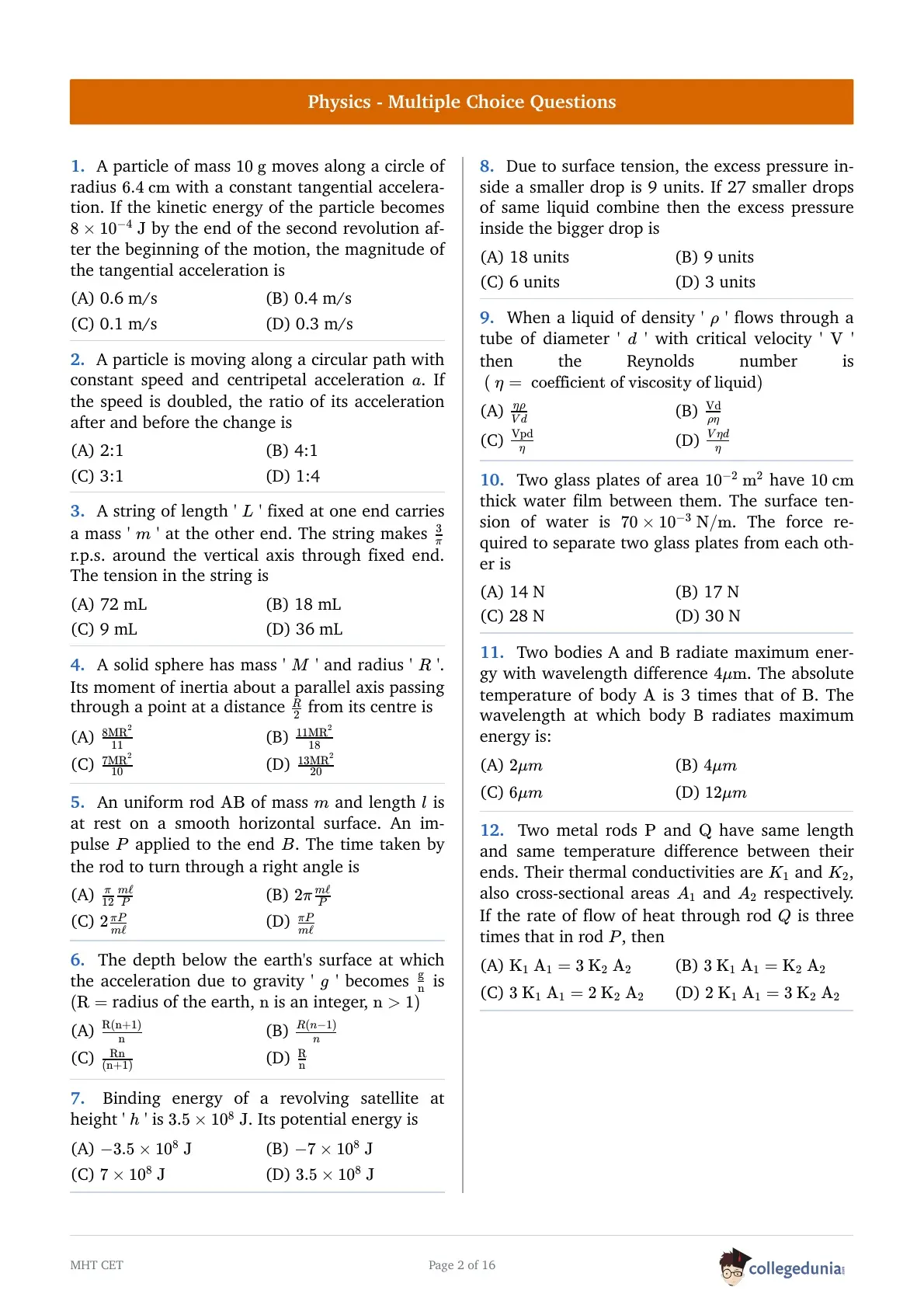
A particle of mass \(10\ \mathrm{g}\) moves along a circle of radius \(6.4\ \mathrm{cm}\) with a constant tangential acceleration. If the kinetic energy of the particle becomes \(8\times 10^{-4}\ \mathrm{J}\) by the end of the second revolution after the beginning of the motion, the magnitude of the tangential acceleration is
A particle is moving along a circular path with constant speed and centripetal acceleration \(a\). If the speed is doubled, the ratio of its acceleration after and before the change is
A string of length ' \(L\) ' fixed at one end carries a mass ' \(m\) ' at the other end. The string makes \(\frac{3}{\pi }\) r.p.s. around the vertical axis through fixed end. The tension in the string is
A solid sphere has mass ' \(M\) ' and radius ' \(R\) '. Its moment of inertia about a parallel axis passing through a point at a distance \(\frac{R}{2}\) from its centre is
An uniform rod \(\mathrm{AB}\) of mass \(m\) and length \(l\) is at rest on a smooth horizontal surface. An impulse \(P\) applied to the end \(B\). The time taken by the rod to turn through a right angle is
The depth below the earth's surface at which the acceleration due to gravity ' \(g\) ' becomes \(\frac{\mathrm{g}}{\mathrm{n}}\) is \((\mathrm{R}=\) radius of the earth, \(\mathrm{n}\) is an integer, \(\mathrm{n}>1)\)
Binding energy of a revolving satellite at height ' \(h\) ' is \(3.5\times 10^{8}\ \mathrm{J}\). Its potential energy is
Due to surface tension, the excess pressure inside a smaller drop is 9 units. If 27 smaller drops of same liquid combine then the excess pressure inside the bigger drop is
When a liquid of density ' \(\rho\) ' flows through a tube of diameter ' \(d\) ' with critical velocity ' \(\mathrm{V}\) ' then the Reynolds number is \(\text{ ( }\eta =\text{ coefficient of viscosity of liquid) }\)
Two bodies A and B radiate maximum energy with wavelength difference \(4\mu \mathrm{m}\). The absolute temperature of body \(\mathrm{A}\) is 3 times that of \(\mathrm{B}\). The wavelength at which body B radiates maximum energy is:
Two metal rods \(\mathrm{P}\) and \(\mathrm{Q}\) have same length and same temperature difference between their ends. Their thermal conductivities are \(K_{1}\) and \(K_{2}\), also cross-sectional areas \(A_{1}\) and \(A_{2}\) respectively. If the rate of flow of heat through rod \(Q\) is three times that in rod \(P\), then
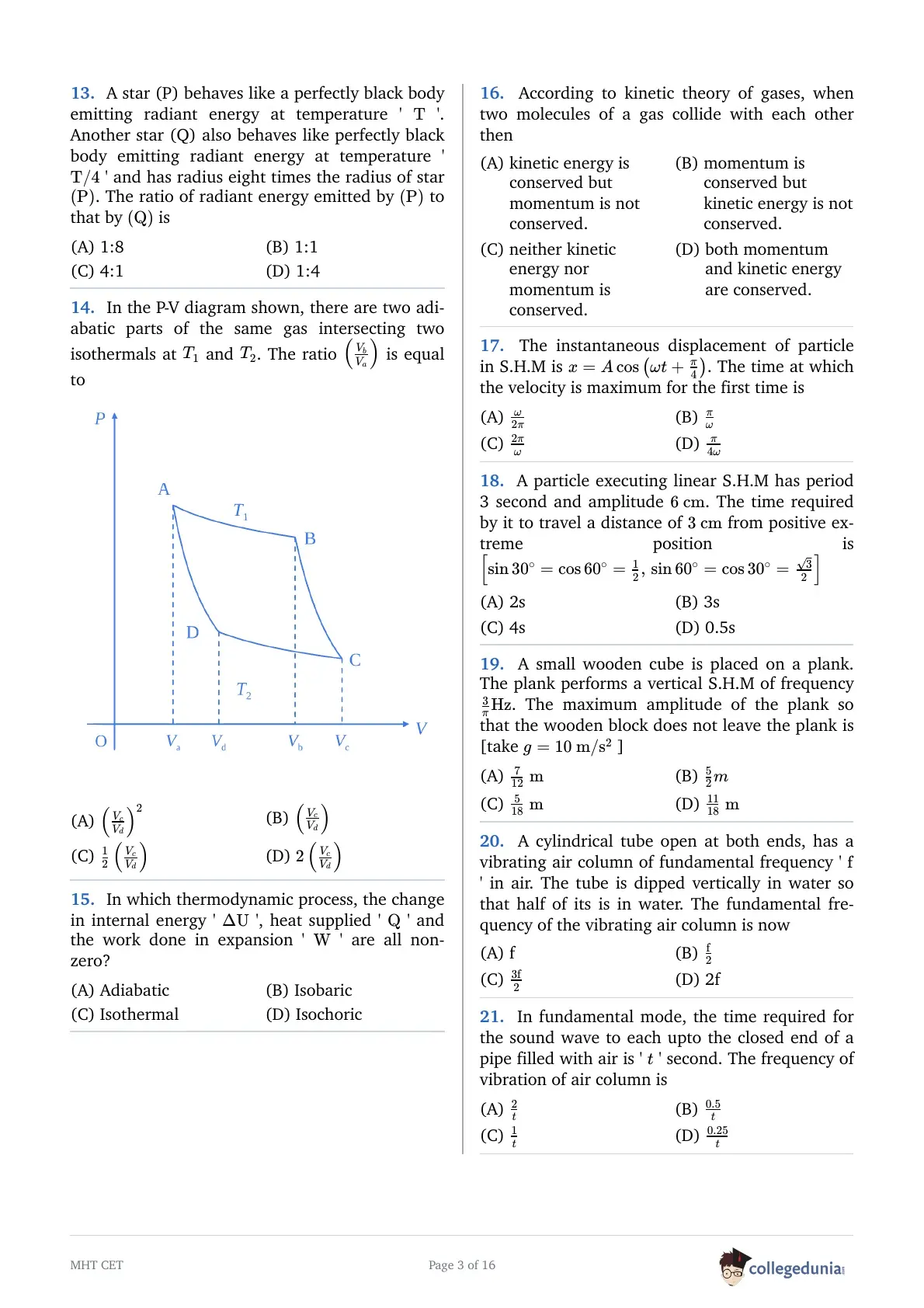
A star (P) behaves like a perfectly black body emitting radiant energy at temperature ' \(\mathrm{T}\) '. Another star (Q) also behaves like perfectly black body emitting radiant energy at temperature ' \(\mathrm{T}/4\) ' and has radius eight times the radius of star \((\mathrm{P})\). The ratio of radiant energy emitted by \((\mathrm{P})\) to that by \((\mathrm{Q})\) is
In the P-V diagram shown, there are two adiabatic parts of the same gas intersecting two isothermals at \(T_{1}\) and \(T_{2}\). The ratio \(\left(\frac{V_{b}}{V_{a}}\right)\) is equal to

In which thermodynamic process, the change in internal energy ' \(\Delta \mathrm{U}\) ', heat supplied ' \(\mathrm{Q}\) ' and the work done in expansion ' \(\mathrm{W}\) ' are all non-zero?
According to kinetic theory of gases, when two molecules of a gas collide with each other then
The instantaneous displacement of particle in S.H.M is \(x=A\cos \left(\omega t+\frac{\pi }{4}\right)\). The time at which the velocity is maximum for the first time is
A particle executing linear S.H.M has period 3 second and amplitude \(6\ \mathrm{cm}\). The time required by it to travel a distance of \(3\ \mathrm{cm}\) from positive extreme position is \(\left[\sin 30^{\circ }=\cos 60^{\circ }=\frac{1}{2},\,\sin 60^{\circ }=\cos 30^{\circ }=\frac{\sqrt{3}}{2}\right]\)
A small wooden cube is placed on a plank. The plank performs a vertical S.H.M of frequency \(\frac{3}{\pi }\mathrm{Hz}\). The maximum amplitude of the plank so that the wooden block does not leave the plank is [take \(g=10\ \mathrm{m}/\mathrm{s}^{2}\) ]
A cylindrical tube open at both ends, has a vibrating air column of fundamental frequency ' \(\mathrm{f}\) ' in air. The tube is dipped vertically in water so that half of its is in water. The fundamental frequency of the vibrating air column is now
In fundamental mode, the time required for the sound wave to each upto the closed end of a pipe filled with air is ' \(t\) ' second. The frequency of vibration of air column is
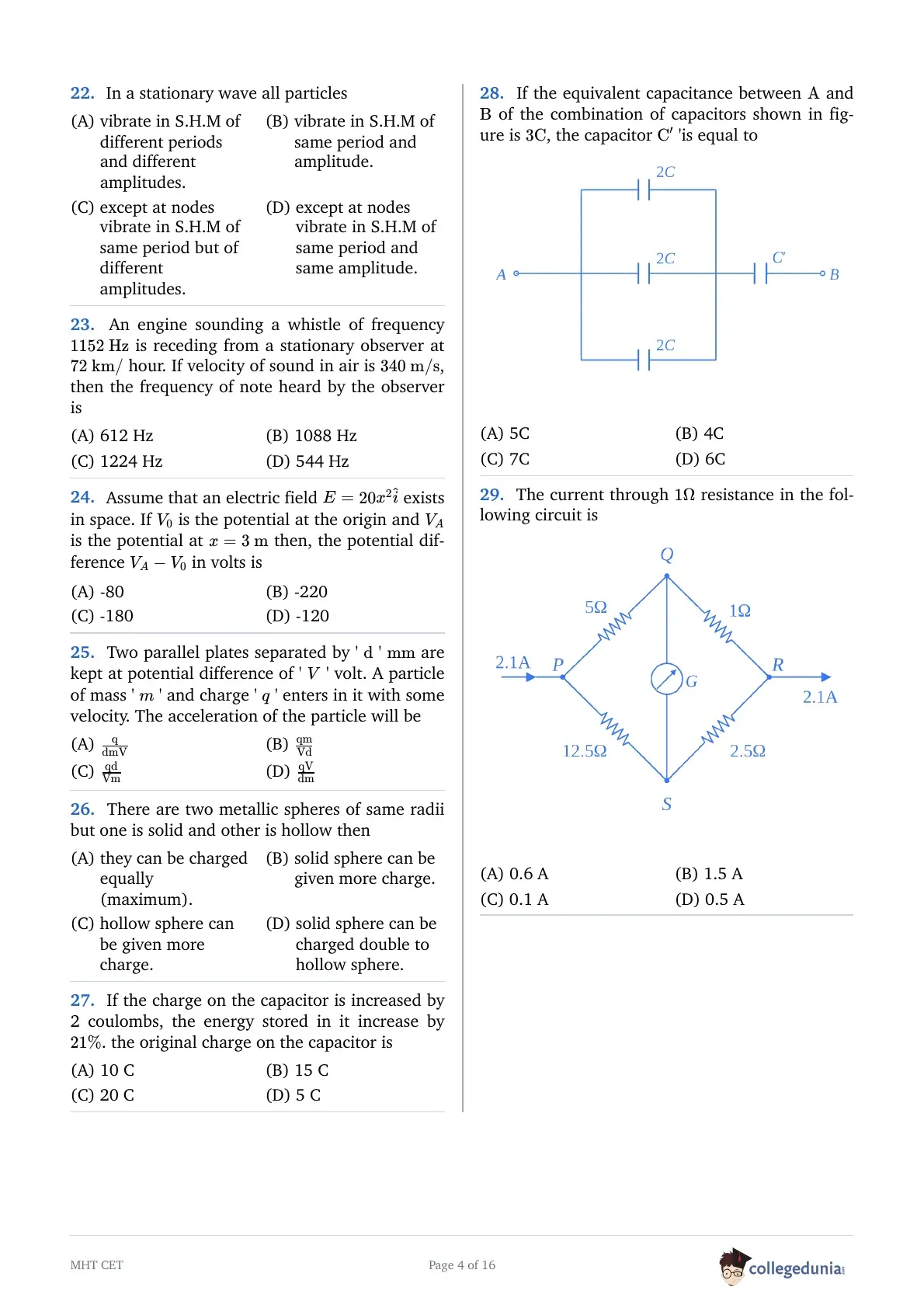
In a stationary wave all particles
An engine sounding a whistle of frequency \(1152\ \mathrm{Hz}\) is receding from a stationary observer at \(72\ \mathrm{km}/\) hour. If velocity of sound in air is \(340\ \mathrm{m}/\mathrm{s}\), then the frequency of note heard by the observer is
Assume that an electric field \(E=20x^{2}\hat{i}\) exists in space. If \(V_{0}\) is the potential at the origin and \(V_{A}\) is the potential at \(x=3\ \mathrm{m}\) then, the potential difference \(V_{A}-V_{0}\) in volts is
Two parallel plates separated by ' \(\mathrm{d}\) ' \(\mathrm{mm}\) are kept at potential difference of ' \(V\) ' volt. A particle of mass ' \(m\) ' and charge ' \(q\) ' enters in it with some velocity. The acceleration of the particle will be
There are two metallic spheres of same radii but one is solid and other is hollow then
If the charge on the capacitor is increased by 2 coulombs, the energy stored in it increase by \(21\%\). the original charge on the capacitor is
If the equivalent capacitance between \(\mathrm{A}\) and \(\mathrm{B}\) of the combination of capacitors shown in figure is \(3\mathrm{C}\), the capacitor \(\mathrm{C}'\) 'is equal to

The current through \(1\Omega\) resistance in the following circuit is

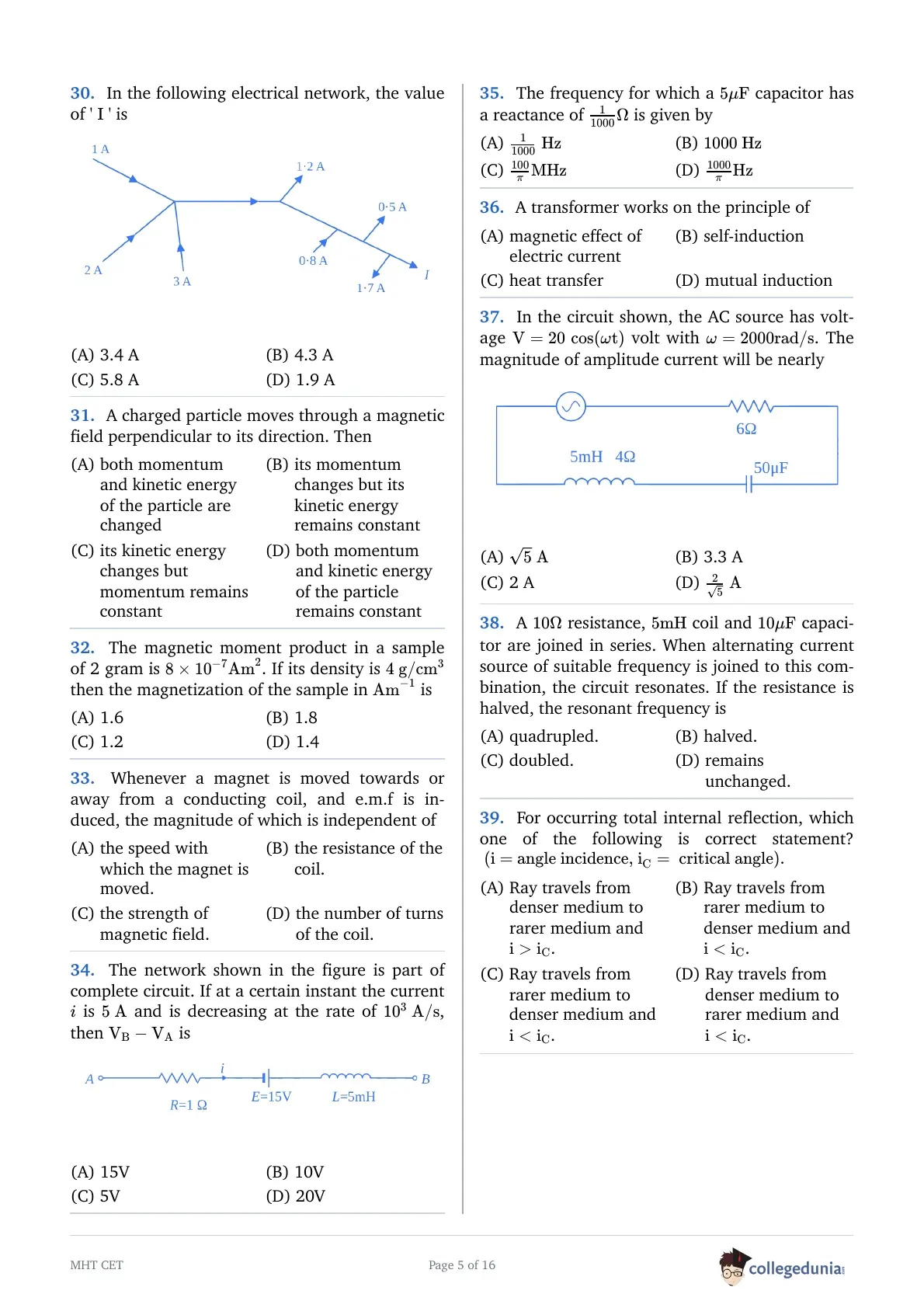
In the following electrical network, the value of ' \(\mathrm{I}\) ' is

A charged particle moves through a magnetic field perpendicular to its direction. Then
The magnetic moment product in a sample of 2 gram is \(8\times 10^{-7}\mathrm{Am}^{2}\). If its density is \(4\ \mathrm{g}/\mathrm{cm}^{3}\) then the magnetization of the sample in \(\mathrm{Am}^{-1}\) is
Whenever a magnet is moved towards or away from a conducting coil, and e.m.f is induced, the magnitude of which is independent of
The network shown in the figure is part of complete circuit. If at a certain instant the current \(i\) is \(5\ \mathrm{A}\) and is decreasing at the rate of \(10^{3}\ \mathrm{A}/\mathrm{s}\), then \(\mathrm{V}_{\mathrm{B}}-\mathrm{V}_{\mathrm{A}}\) is

The frequency for which a \(5\mu \mathrm{F}\) capacitor has a reactance of \(\frac{1}{1000}\Omega\) is given by
A transformer works on the principle of
In the circuit shown, the AC source has voltage \(\mathrm{V}=20\,\cos (\omega \mathrm{t})\) volt with \(\omega =2000\mathrm{rad}/\mathrm{s}\). The magnitude of amplitude current will be nearly

A \(10\Omega\) resistance, \(5\mathrm{mH}\) coil and \(10\mu \mathrm{F}\) capacitor are joined in series. When alternating current source of suitable frequency is joined to this combination, the circuit resonates. If the resistance is halved, the resonant frequency is
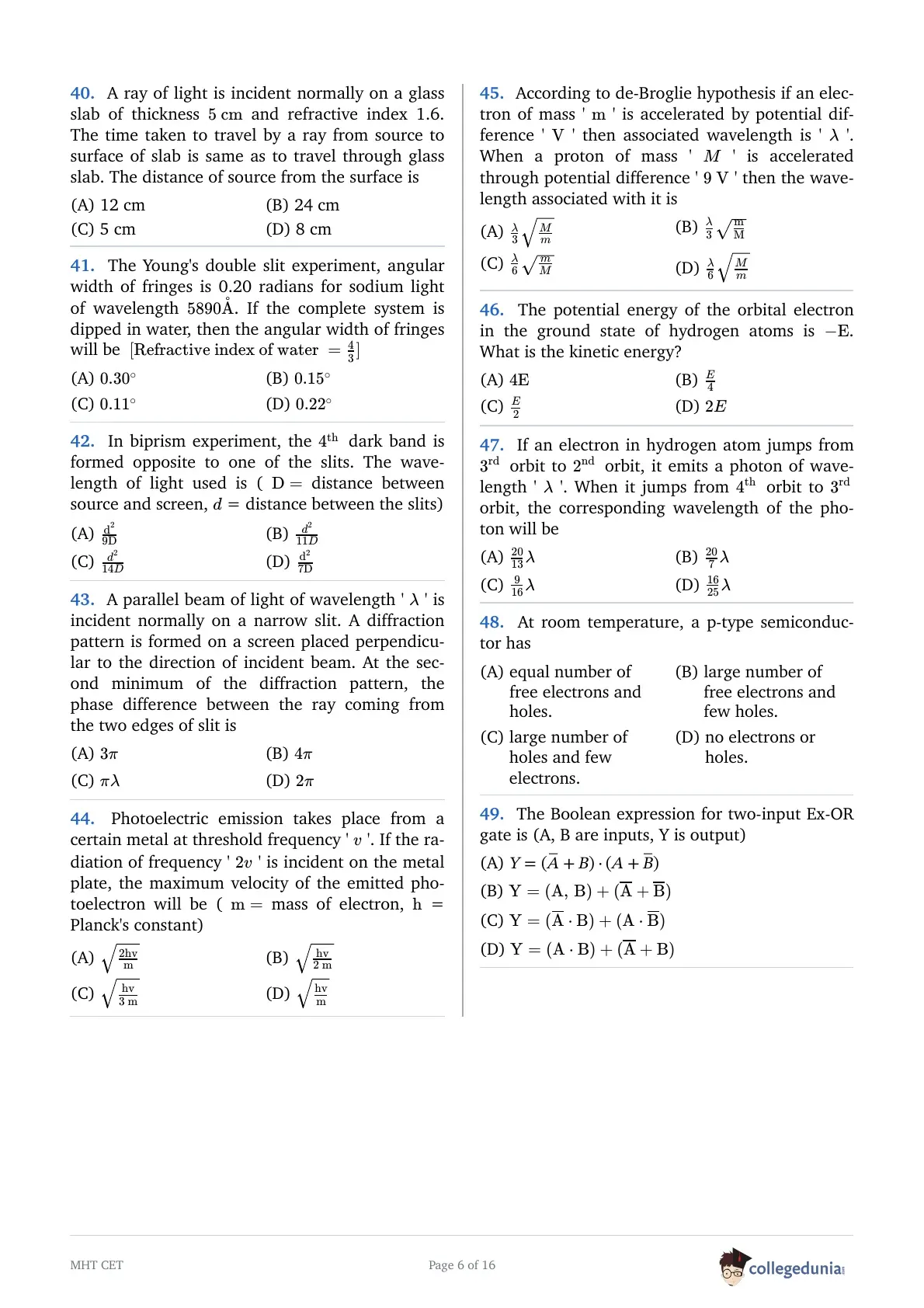
A ray of light is incident normally on a glass slab of thickness \(5\ \mathrm{cm}\) and refractive index 1.6. The time taken to travel by a ray from source to surface of slab is same as to travel through glass slab. The distance of source from the surface is
The Young's double slit experiment, angular width of fringes is 0.20 radians for sodium light of wavelength \(5890\text{Å}\). If the complete system is dipped in water, then the angular width of fringes will be \(\text{ [Refractive index of water }=\frac{4}{3}]\)
In biprism experiment, the \(4^{\text{th }}\) dark band is formed opposite to one of the slits. The wavelength of light used is ( \(\mathrm{D}=\) distance between source and screen, \(d\) = distance between the slits)
A parallel beam of light of wavelength ' \(\lambda\) ' is incident normally on a narrow slit. A diffraction pattern is formed on a screen placed perpendicular to the direction of incident beam. At the second minimum of the diffraction pattern, the phase difference between the ray coming from the two edges of slit is
Photoelectric emission takes place from a certain metal at threshold frequency ' \(v\) '. If the radiation of frequency ' \(2v\) ' is incident on the metal plate, the maximum velocity of the emitted photoelectron will be ( \(\mathrm{m}=\) mass of electron, \(\mathrm{h}\) = Planck's constant)
According to de-Broglie hypothesis if an electron of mass ' \(\mathrm{m}\) ' is accelerated by potential difference ' \(\mathrm{V}\) ' then associated wavelength is ' \(\lambda\) '. When a proton of mass ' \(M\) ' is accelerated through potential difference ' \(9\ \mathrm{V}\) ' then the wavelength associated with it is
The potential energy of the orbital electron in the ground state of hydrogen atoms is \(-\mathrm{E}\). What is the kinetic energy?
If an electron in hydrogen atom jumps from \(3^{\text{rd }}\) orbit to \(2^{\text{nd }}\) orbit, it emits a photon of wavelength ' \(\lambda\) '. When it jumps from \(4^{\text{th }}\) orbit to \(3^{\text{rd }}\) orbit, the corresponding wavelength of the photon will be
At room temperature, a p-type semiconductor has
The Boolean expression for two-input Ex-OR gate is (A, B are inputs, Y is output)
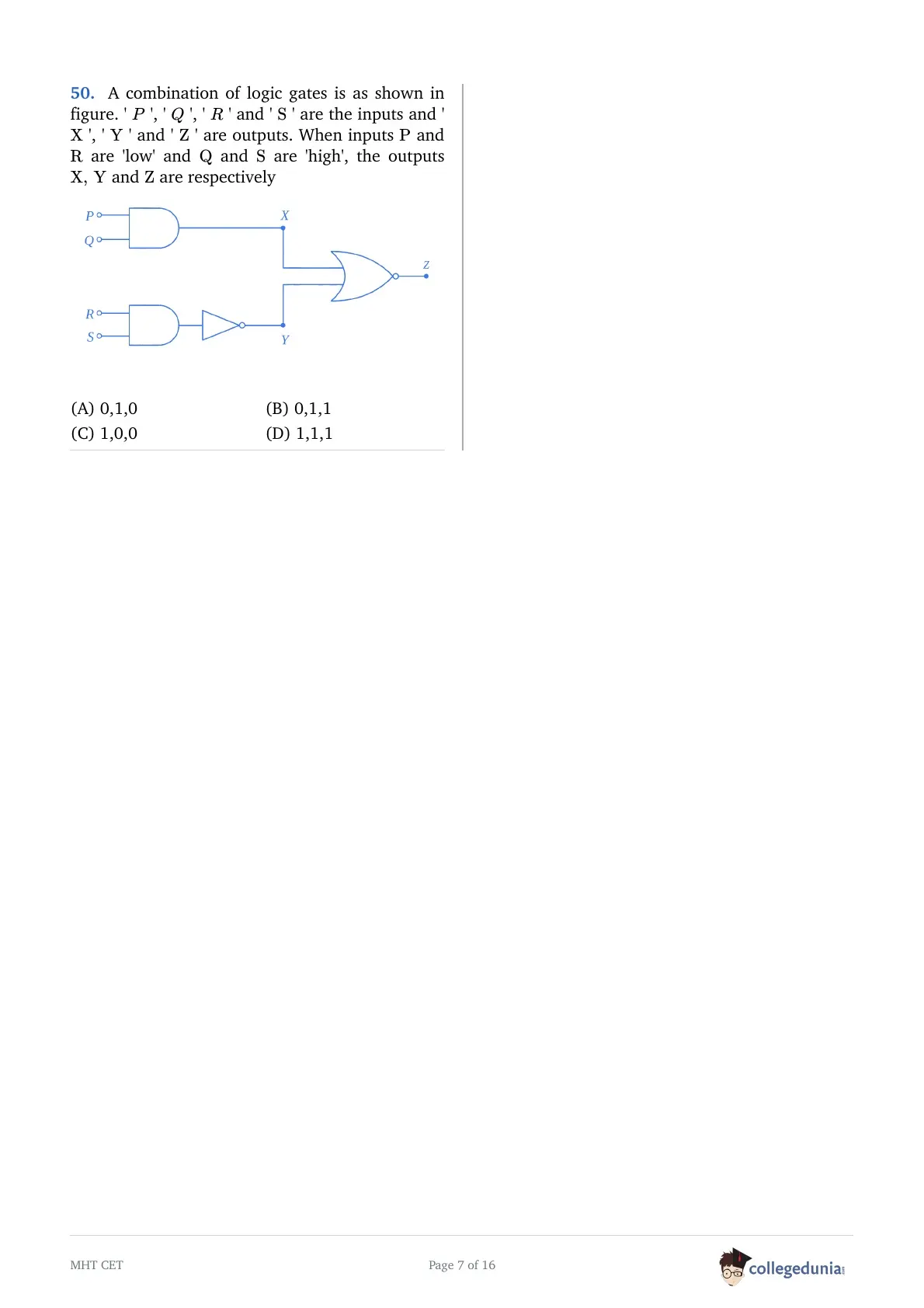
A combination of logic gates is as shown in figure. ' \(P\) ', ' \(Q\) ', ' \(R\) ' and ' \(\mathrm{S}\) ' are the inputs and ' \(\mathrm{X}\) ', ' \(\mathrm{Y}\) ' and ' \(\mathrm{Z}\) ' are outputs. When inputs \(\mathrm{P}\) and \(\mathrm{R}\) are 'low' and \(\mathrm{Q}\) and \(\mathrm{S}\) are 'high', the outputs \(\mathrm{X},\,\mathrm{Y}\) and \(\mathrm{Z}\) are respectively

Chemistry (Q51 - Q100)
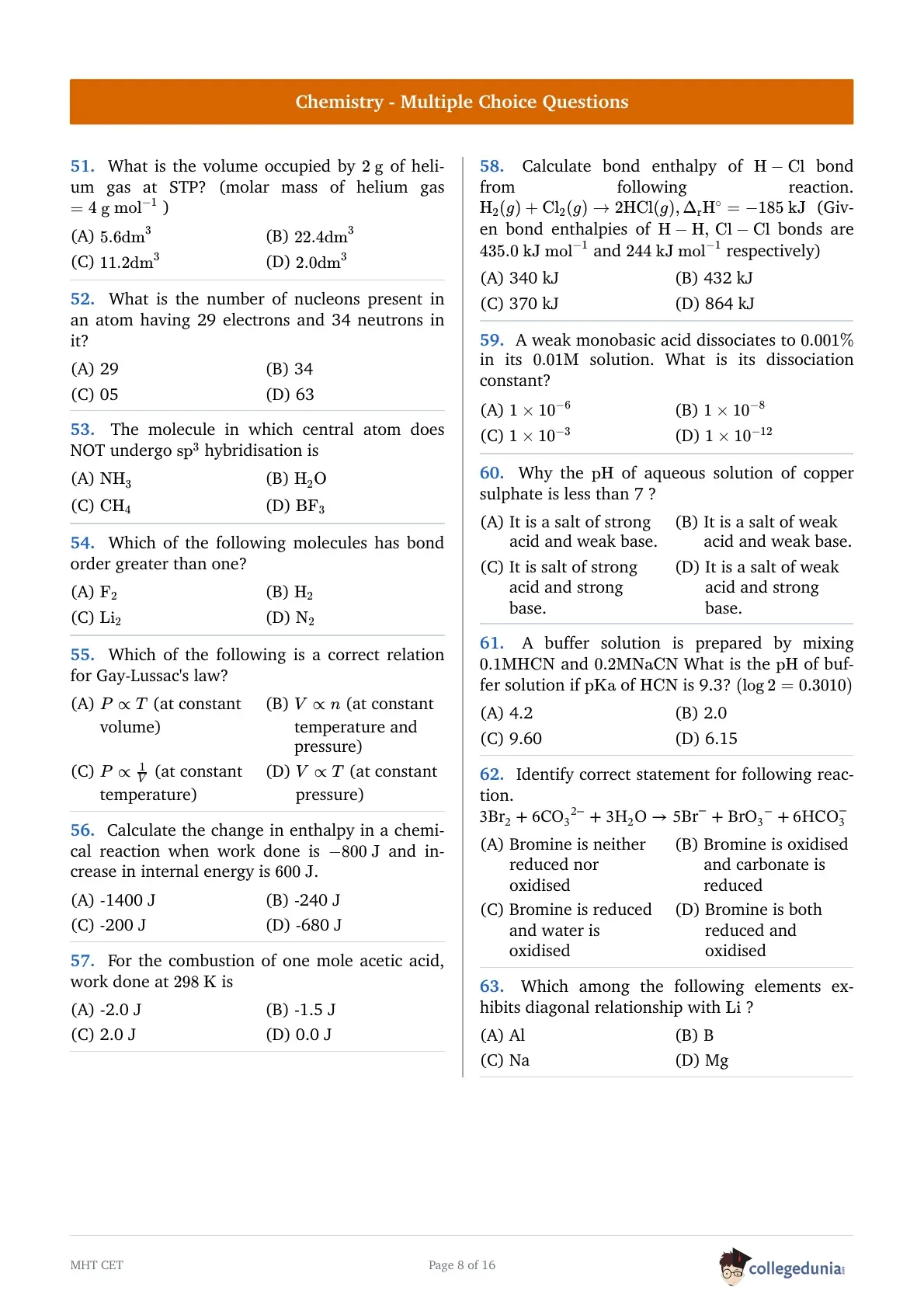
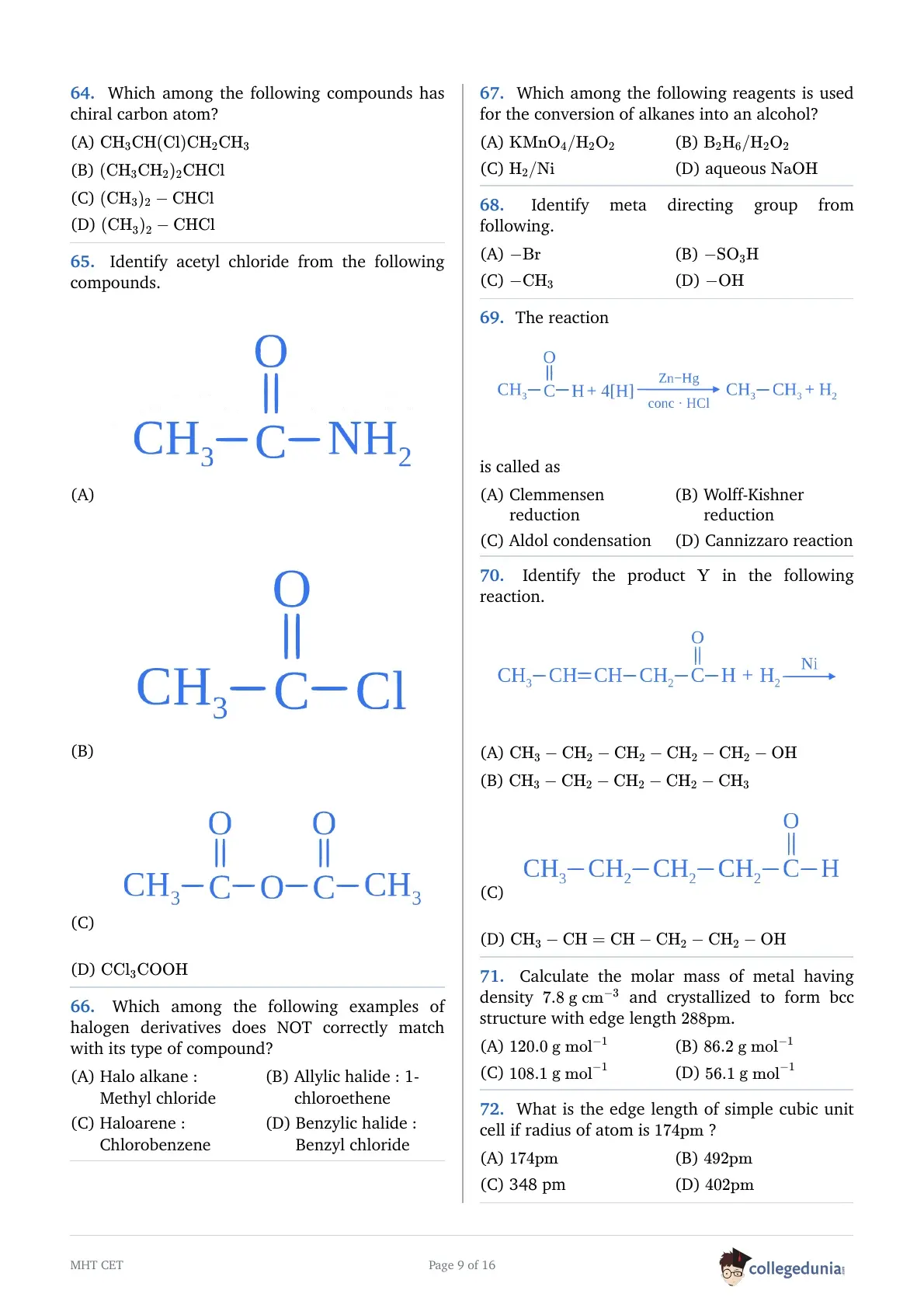
What is the volume occupied by \(2\ \mathrm{g}\) of helium gas at STP? (molar mass of helium gas \(=4\ \mathrm{g}\ \mathrm{mol}^{-1}\) )
What is the number of nucleons present in an atom having 29 electrons and 34 neutrons in it?
The molecule in which central atom does NOT undergo \(\mathrm{sp}^{3}\) hybridisation is
Which of the following molecules has bond order greater than one?
Which of the following is a correct relation for Gay-Lussac's law?
For the combustion of one mole acetic acid, work done at \(298\ \mathrm{K}\) is
Calculate bond enthalpy of \(\mathrm{H}-\mathrm{Cl}\) bond from following reaction. \(\mathrm{H}_{2}(g)+\mathrm{Cl}_{2}(g)\rightarrow 2\mathrm{HCl}(g),\Delta _{\mathrm{r}}\mathrm{H}^{\circ }=-185\ \mathrm{kJ}\) (Given bond enthalpies of \(\mathrm{H}-\mathrm{H},\,\mathrm{Cl}-\mathrm{Cl}\) bonds are \(435.0\ \mathrm{kJ}\ \mathrm{mol}^{-1}\) and \(244\ \mathrm{kJ}\ \mathrm{mol}^{-1}\) respectively)
A weak monobasic acid dissociates to \(0.001\%\) in its \(0.01\mathrm{M}\) solution. What is its dissociation constant?
Why the \(\mathrm{pH}\) of aqueous solution of copper sulphate is less than 7 ?
A buffer solution is prepared by mixing \(0.1\mathrm{MHCN}\) and \(0.2\mathrm{MNaCN}\) What is the \(\mathrm{pH}\) of buffer solution if \(\mathrm{pKa}\) of \(\mathrm{HCN}\) is 9.3? \((\log 2=0.3010)\)
Identify correct statement for following reaction. \(3\mathrm{Br}_{2}+6\mathrm{CO}_{3}{}^{2-}+3\mathrm{H}_{2}\mathrm{O}\rightarrow 5\mathrm{Br}^{-}+\mathrm{BrO}_{3}{}^{-}+6\mathrm{HCO}_{3}^{-}\)
Which among the following elements exhibits diagonal relationship with \(\mathrm{Li}\) ?
Identify acetyl chloride from the following compounds.
- (A)
![]()
- (B)
![]()
- (C)
![]()
- (D) \(\mathrm{CCl}{}_{3}\mathrm{COOH}\)


Which among the following examples of halogen derivatives does NOT correctly match with its type of compound?
Which among the following reagents is used for the conversion of alkanes into an alcohol?
Identify meta directing group from following.

Calculate the molar mass of metal having density \(7.8\ \mathrm{g}\ \mathrm{cm}^{-3}\) and crystallized to form bcc structure with edge length \(288\mathrm{pm}\).
What is the edge length of simple cubic unit cell if radius of atom is \(174\mathrm{pm}\) ?
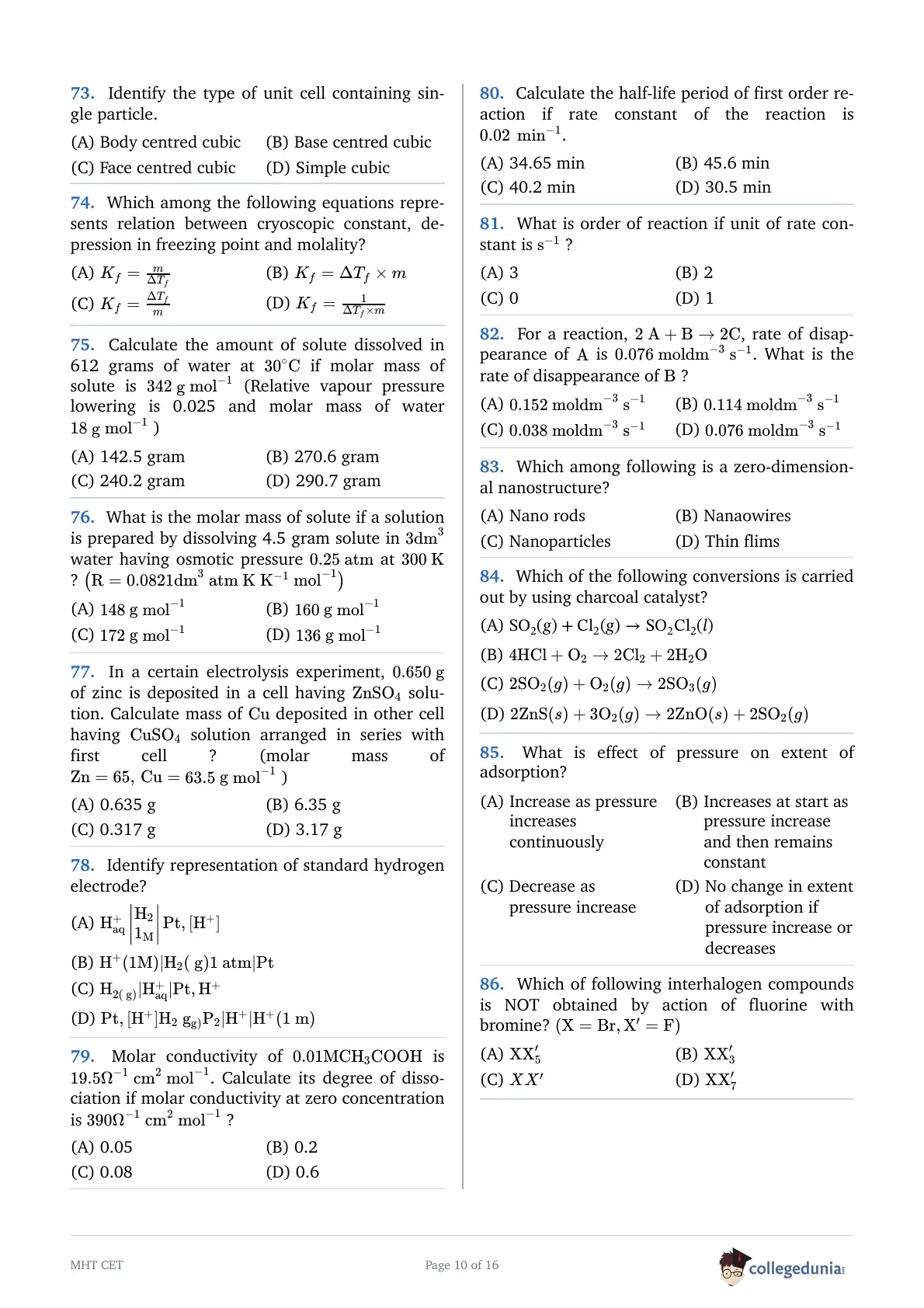
Identify the type of unit cell containing single particle.
Which among the following equations represents relation between cryoscopic constant, depression in freezing point and molality?
Calculate the amount of solute dissolved in 612 grams of water at \(30^{\circ }\mathrm{C}\) if molar mass of solute is \(342\ \mathrm{g}\ \mathrm{mol}^{-1}\) (Relative vapour pressure lowering is 0.025 and molar mass of water \(18\ \mathrm{g}\ \mathrm{mol}^{-1}\) )
What is the molar mass of solute if a solution is prepared by dissolving 4.5 gram solute in \(3\mathrm{dm}^{3}\) water having osmotic pressure \(0.25\ \mathrm{atm}\) at \(300\ \mathrm{K}\) ? \(\left(\mathrm{R}=0.0821\mathrm{dm}^{3}\ \mathrm{atm}\ \mathrm{K}\ \mathrm{K}^{-1}\ \mathrm{mol}^{-1}\right)\)
In a certain electrolysis experiment, \(0.650\ \mathrm{g}\) of zinc is deposited in a cell having \(\mathrm{ZnSO}_{4}\) solution. Calculate mass of \(\mathrm{Cu}\) deposited in other cell having \(\mathrm{CuSO}_{4}\) solution arranged in series with first cell ? (molar mass of \(\mathrm{Zn}=65,\,\mathrm{Cu}=63.5\ \mathrm{g}\ \mathrm{mol}^{-1}\) )
Identify representation of standard hydrogen electrode?
Molar conductivity of \(0.01\mathrm{M}\mathrm{CH}_{3}\mathrm{COOH}\) is \(19.5\Omega ^{-1}\ \mathrm{cm}^{2}\ \mathrm{mol}^{-1}\). Calculate its degree of dissociation if molar conductivity at zero concentration is \(390\Omega ^{-1}\ \mathrm{cm}^{2}\ \mathrm{mol}^{-1}\) ?
Calculate the half-life period of first order reaction if rate constant of the reaction is \(0.02\ \min ^{-1}\).
What is order of reaction if unit of rate constant is \(\mathrm{s}^{-1}\) ?
For a reaction, \(2\ \mathrm{A}+\mathrm{B}\rightarrow 2\mathrm{C}\), rate of disappearance of \(\mathrm{A}\) is \(0.076\ \mathrm{mol}\mathrm{dm}^{-3}\ \mathrm{s}^{-1}\). What is the rate of disappearance of \(\mathrm{B}\) ?
Which among following is a zero-dimensional nanostructure?
Which of the following conversions is carried out by using charcoal catalyst?
What is effect of pressure on extent of adsorption?
Which of following interhalogen compounds is NOT obtained by action of fluorine with bromine? \((\mathrm{X}=\mathrm{Br},\mathrm{X}'=\mathrm{F})\)
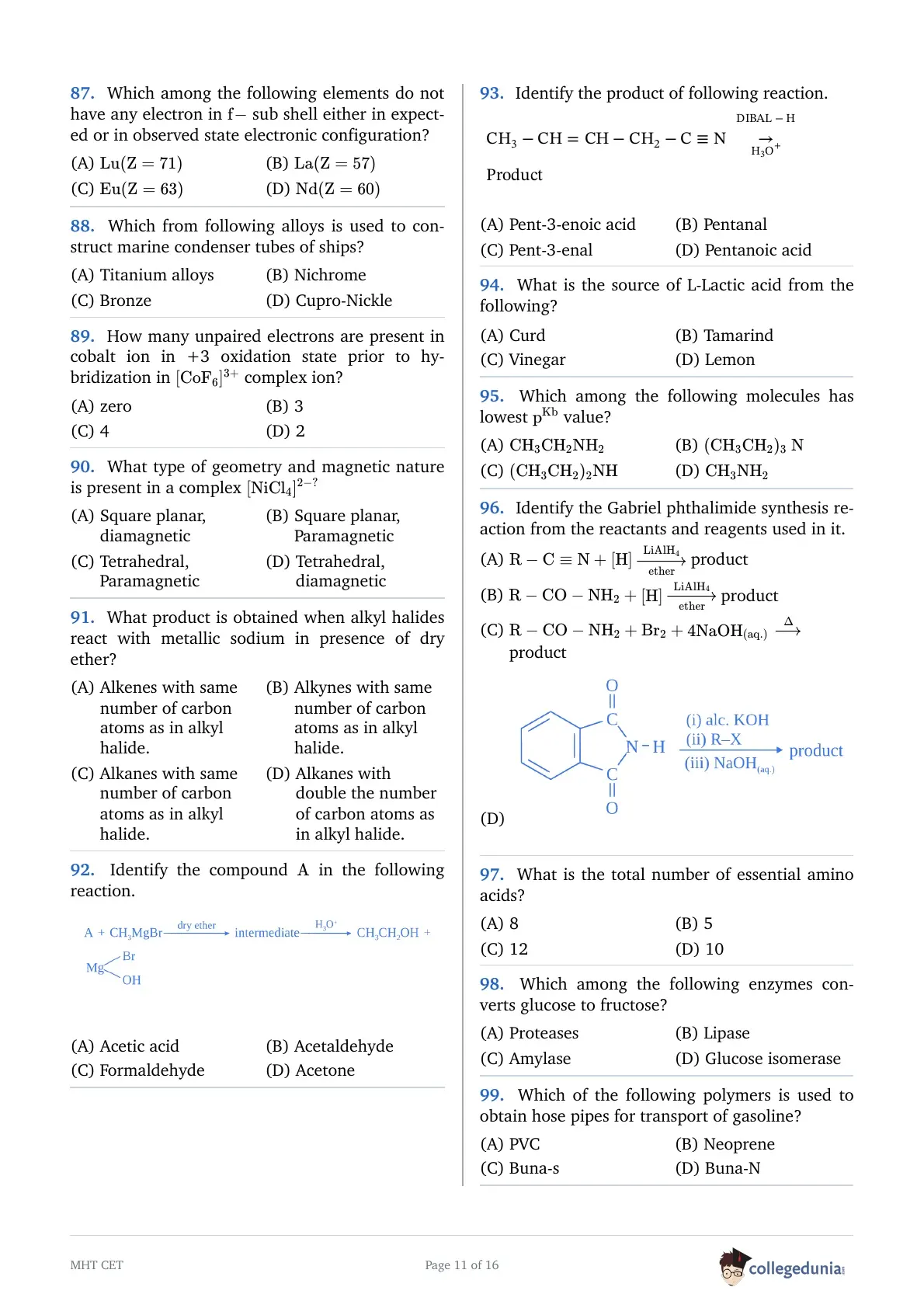
Which among the following elements do not have any electron in \(\mathrm{f}-\) sub shell either in expected or in observed state electronic configuration?
Which from following alloys is used to construct marine condenser tubes of ships?
How many unpaired electrons are present in cobalt ion in +3 oxidation state prior to hybridization in \([\mathrm{CoF}_{6}]^{3+}\) complex ion?
What type of geometry and magnetic nature is present in a complex \([\mathrm{NiCl}_{4}]^{2-?}\)
What product is obtained when alkyl halides react with metallic sodium in presence of dry ether?

Identify the product of following reaction.
\(\mathrm{CH}_{3}-\mathrm{CH}=\mathrm{CH}-\mathrm{CH}_{2}-\mathrm{C}\equiv \mathrm{N}\xrightarrow[\mathrm{H}_{3}\mathrm{O}^{+}]{\text{DIBAL}-\mathrm{H}}\text{Product}\)
What is the source of L-Lactic acid from the following?
Which among the following molecules has lowest \(\mathrm{p}^{\mathrm{Kb}}\) value?
Identify the Gabriel phthalimide synthesis reaction from the reactants and reagents used in it.
- (A) \(\mathrm{R}-\mathrm{C}\equiv \mathrm{N}+[\mathrm{H}]\xrightarrow[\text{ ether }]{\mathrm{LiAlH}_{4}}\) product
- (B) \(\mathrm{R}-\mathrm{CO}-\mathrm{NH}_{2}+[\mathrm{H}]\xrightarrow[\text{ ether }]{\mathrm{LiAlH}_{4}}\) product
- (C) \(\mathrm{R}-\mathrm{CO}-\mathrm{NH}_{2}+\mathrm{Br}_{2}+4\mathrm{NaOH}_{\text{(aq.) }}\xrightarrow{\Delta }\) product
- (D)
![]()

What is the total number of essential amino acids?
Which among the following enzymes converts glucose to fructose?
Mathematics (Q101 - Q150)
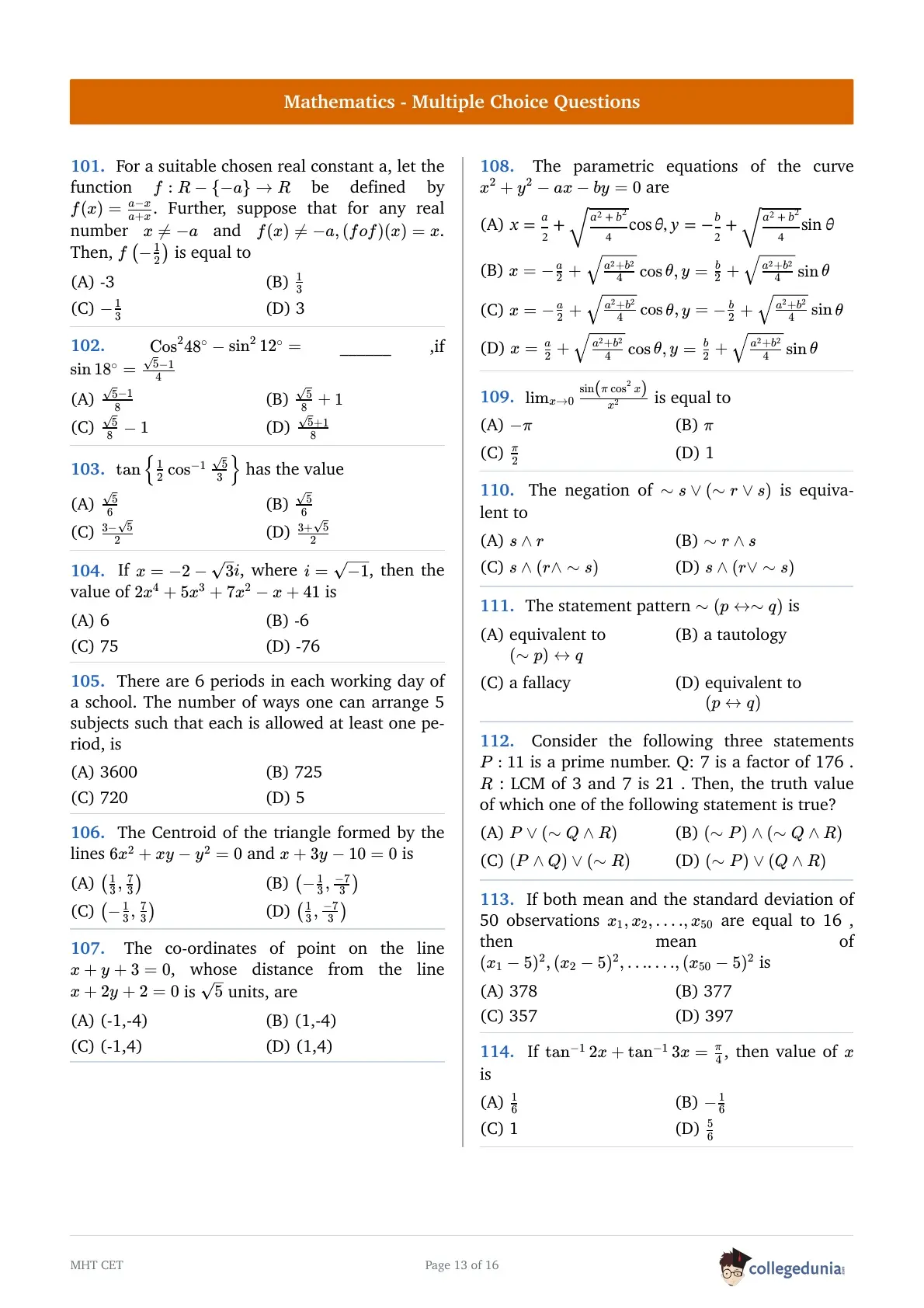
For a suitable chosen real constant a, let the function \(f:R-\{-a\}\rightarrow R\) be defined by \(f(x)=\frac{a-x}{a+x}\). Further, suppose that for any real number \(x\neq -a\) and \(f(x)\neq -a,(fof)(x)=x\). Then, \(f\left(-\frac{1}{2}\right)\) is equal to
\(\mathrm{Cos}^{2}48^{\circ }-\sin ^{2}12^{\circ }=\) ______ ,if \(\sin 18^{\circ }=\frac{\sqrt{5}-1}{4}\)
If \(x=-2-\sqrt{3}i\), where \(i=\sqrt{-1}\), then the value of \(2x^{4}+5x^{3}+7x^{2}-x+41\) is
The Centroid of the triangle formed by the lines \(6x^{2}+xy-y^{2}=0\) and \(x+3y-10=0\) is
The co-ordinates of point on the line \(x+y+3=0\), whose distance from the line \(x+2y+2=0\) is \(\sqrt{5}\) units, are
The parametric equations of the curve \(x^{2}+y^{2}-ax-by=0\) are
\(\lim _{x\rightarrow 0}\frac{\sin \left(\pi \cos ^{2}x\right)}{x^{2}}\) is equal to
The negation of \(\sim s\vee (\sim r\vee s)\) is equivalent to
The statement pattern \(\sim (p\leftrightarrow \sim q)\) is
Consider the following three statements \(P:11\) is a prime number. Q: 7 is a factor of 176 . \(R\) : LCM of 3 and 7 is 21 . Then, the truth value of which one of the following statement is true?
If both mean and the standard deviation of 50 observations \(x_{1},x_{2},\ldots .,x_{50}\) are equal to 16 , then mean of \((x_{1}-5)^{2},(x_{2}-5)^{2},\ldots \ldots .,(x_{50}-5)^{2}\) is
If \(\tan ^{-1}2x+\tan ^{-1}3x=\frac{\pi }{4}\), then value of \(x\) is
\(\tan ^{-1}2+\tan ^{-1}3=\)
If \(\tan ^{-1}\sqrt{x^{2}+x}+\sin ^{-1}\sqrt{x^{2}+x+1}=\frac{\pi }{2}\), then the value of \(x\) is
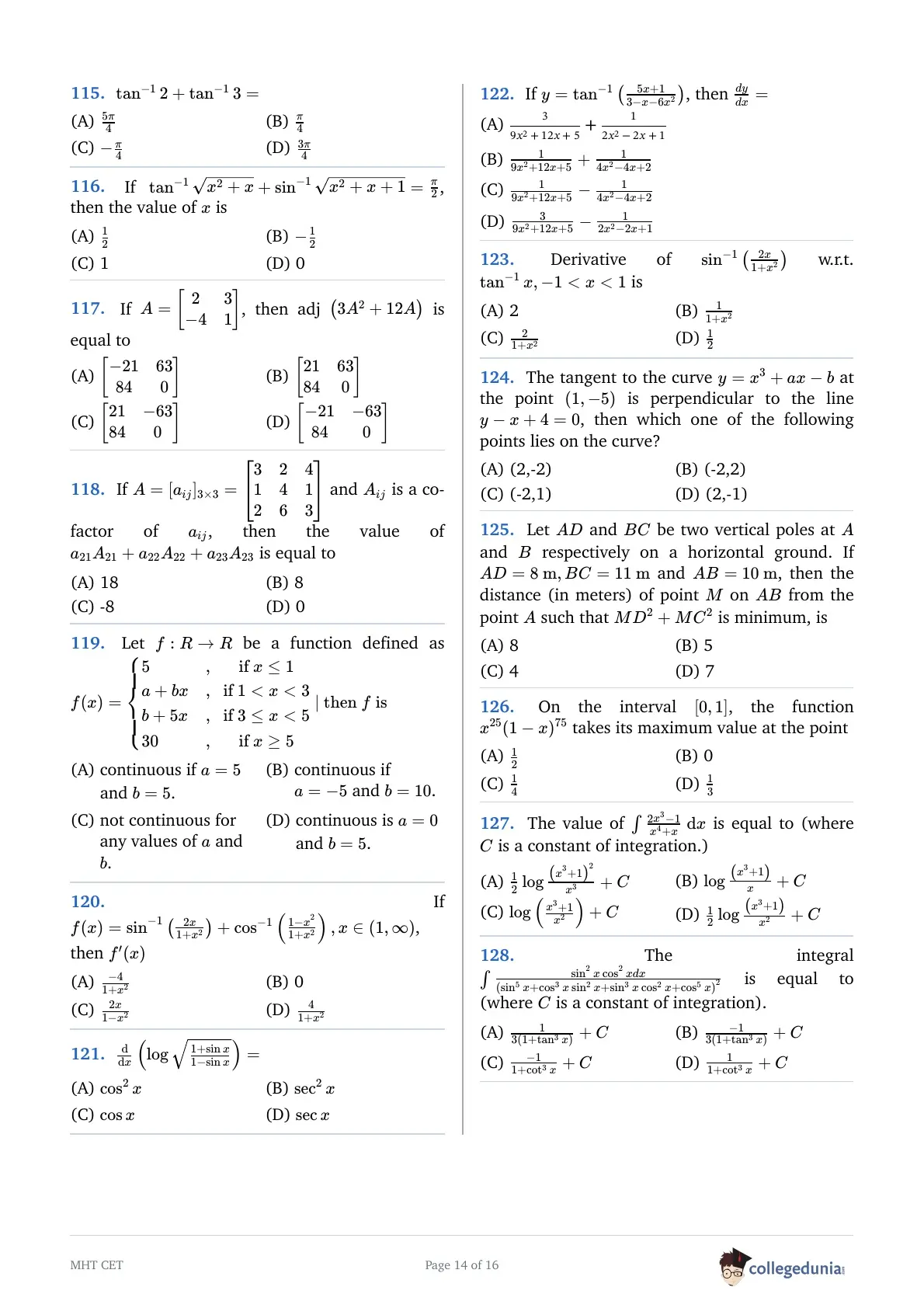
If \(A=\begin{bmatrix} 2 & 3 \\ -4 & 1 \end{bmatrix}\), then adj \(\left(3A^{2}+12A\right)\) is equal to
If \(A=[a_{ij}]_{3\times 3}=\begin{bmatrix} 3 & 2 & 4 \\ 1 & 4 & 1 \\ 2 & 6 & 3 \end{bmatrix}\) and \(A_{ij}\) is a cofactor of \(a_{ij}\), then the value of \(a_{21}A_{21}+a_{22}A_{22}+a_{23}A_{23}\) is equal to
Let \(f:R\rightarrow R\) be a function defined as \(f(x)=\begin{cases} 5 & , & \text{ if }x\leq 1 \\ a+bx & , & \text{ if }1\lt x\lt 3 \\ b+5x & , & \text{ if }3\leq x\lt 5 \\ 30 & , & \text{ if }x\geq 5 \end{cases}|\text{ then }f\text{ is }\)
If \(f(x)=\sin ^{-1}\left(\frac{2x}{1+x^{2}}\right)+\cos ^{-1}\left(\frac{1-x^{2}}{1+x^{2}}\right),x\in (1,\infty )\), then \(f'(x)\)
\(\frac{\mathrm{d}}{\mathrm{d}x}\left(\log \sqrt{\frac{1+\sin x}{1-\sin x}}\right)=\)
If \(y=\tan ^{-1}\left(\frac{5x+1}{3-x-6x^{2}}\right)\), then \(\frac{dy}{dx}=\)
Derivative of \(\sin ^{-1}\left(\frac{2x}{1+x^{2}}\right)\) w.r.t. \(\tan ^{-1}x,-1\lt x\lt 1\) is
The tangent to the curve \(y=x^{3}+ax-b\) at the point \((1,-5)\) is perpendicular to the line \(y-x+4=0\), then which one of the following points lies on the curve?
Let \(AD\) and \(BC\) be two vertical poles at \(A\) and \(B\) respectively on a horizontal ground. If \(AD=8\ \mathrm{m},BC=11\ \mathrm{m}\) and \(AB=10\ \mathrm{m}\), then the distance (in meters) of point \(M\) on \(AB\) from the point \(A\) such that \(MD^{2}+MC^{2}\) is minimum, is
On the interval \([0,1]\), the function \(x^{25}(1-x)^{75}\) takes its maximum value at the point
The value of \(\int \frac{2x^{3}-1}{x^{4}+x}\ \mathrm{d}x\) is equal to (where \(C\) is a constant of integration.)
The integral \(\int \frac{\sin ^{2}x\cos ^{2}xdx}{\left(\sin ^{5}x+\cos ^{3}x\sin ^{2}x+\sin ^{3}x\cos ^{2}x+\cos ^{5}x\right)^{2}}\) is equal to (where \(C\) is a constant of integration).
\(\int \sin \sqrt{x}\ \mathrm{d}x=\ldots +C\) (where \(C\) is a constant of integration.)
If \(\int \frac{\sqrt{1-x^{2}}}{x^{4}}\ \mathrm{d}x=A(x)\left(\sqrt{1-x^{2}}\right)^{m}+C\) for a suitable chosen integer \(m\) and a function \(A(x)\), where \(C\) is a constant of integration, then \((A(x))^{m}\) equals
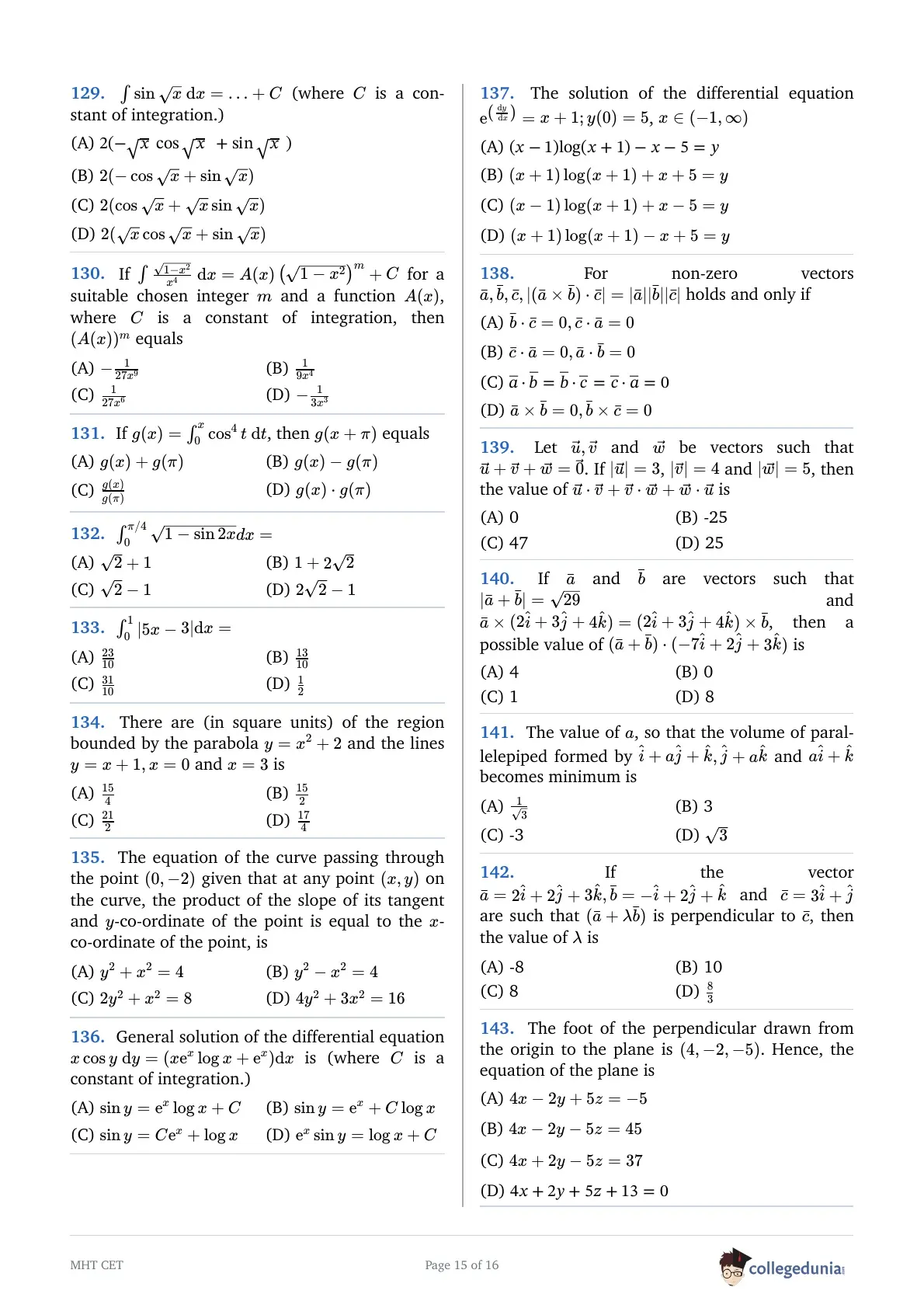
If \(g(x)=\int _{0}^{x}\cos ^{4}t\ \mathrm{d}t\), then \(g(x+\pi )\) equals
\(\int _{0}^{\pi /4}\sqrt{1-\sin 2x}dx=\)
\(\int _{0}^{1}|5x-3|\mathrm{d}x=\)
There are (in square units) of the region bounded by the parabola \(y=x^{2}+2\) and the lines \(y=x+1,x=0\) and \(x=3\) is
The equation of the curve passing through the point \((0,-2)\) given that at any point \((x,y)\) on the curve, the product of the slope of its tangent and \(y\)-co-ordinate of the point is equal to the \(x\)-co-ordinate of the point, is
General solution of the differential equation \(x\cos y\ \mathrm{d}y=(x\mathrm{e}^{x}\log x+\mathrm{e}^{x})\mathrm{d}x\) is (where \(C\) is a constant of integration.)
The solution of the differential equation \(\mathrm{e}^{\left(\frac{\mathrm{d}y}{\ \mathrm{d}x}\right)}=x+1;y(0)=5\), \(x\in (-1,\infty )\)
For non-zero vectors \(\bar{a},\bar{b},\bar{c},|(\bar{a}\times \bar{b})\cdot \bar{c}|=|\bar{a}||\bar{b}||\bar{c}|\) holds and only if
Let \(\vec{u},\vec{v}\) and \(\vec{w}\) be vectors such that \(\vec{u}+\vec{v}+\vec{w}=\vec{0}\). If \(|\vec{u}|=3\), \(|\vec{v}|=4\) and \(|\vec{w}|=5\), then the value of \(\vec{u}\cdot \vec{v}+\vec{v}\cdot \vec{w}+\vec{w}\cdot \vec{u}\) is
If \(\bar{a}\) and \(\bar{b}\) are vectors such that \(|\bar{a}+\bar{b}|=\sqrt{29}\) and \(\bar{a}\times (2\hat{i}+3\hat{j}+4\hat{k})=(2\hat{i}+3\hat{j}+4\hat{k})\times \bar{b}\), then a possible value of \((\bar{a}+\bar{b})\cdot (-7\hat{i}+2\hat{j}+3\hat{k})\) is
The value of \(a\), so that the volume of parallelepiped formed by \(\hat{i}+a\hat{j}+\hat{k},\hat{j}+a\hat{k}\) and \(a\hat{i}+\hat{k}\) becomes minimum is
If the vector \(\bar{a}=2\hat{i}+2\hat{j}+3\hat{k},\bar{b}=-\hat{i}+2\hat{j}+\hat{k}\) and \(\bar{c}=3\hat{i}+\hat{j}\) are such that \((\bar{a}+\lambda \bar{b})\) is perpendicular to \(\bar{c}\), then the value of \(\lambda\) is
The foot of the perpendicular drawn from the origin to the plane is \((4,-2,-5)\). Hence, the equation of the plane is
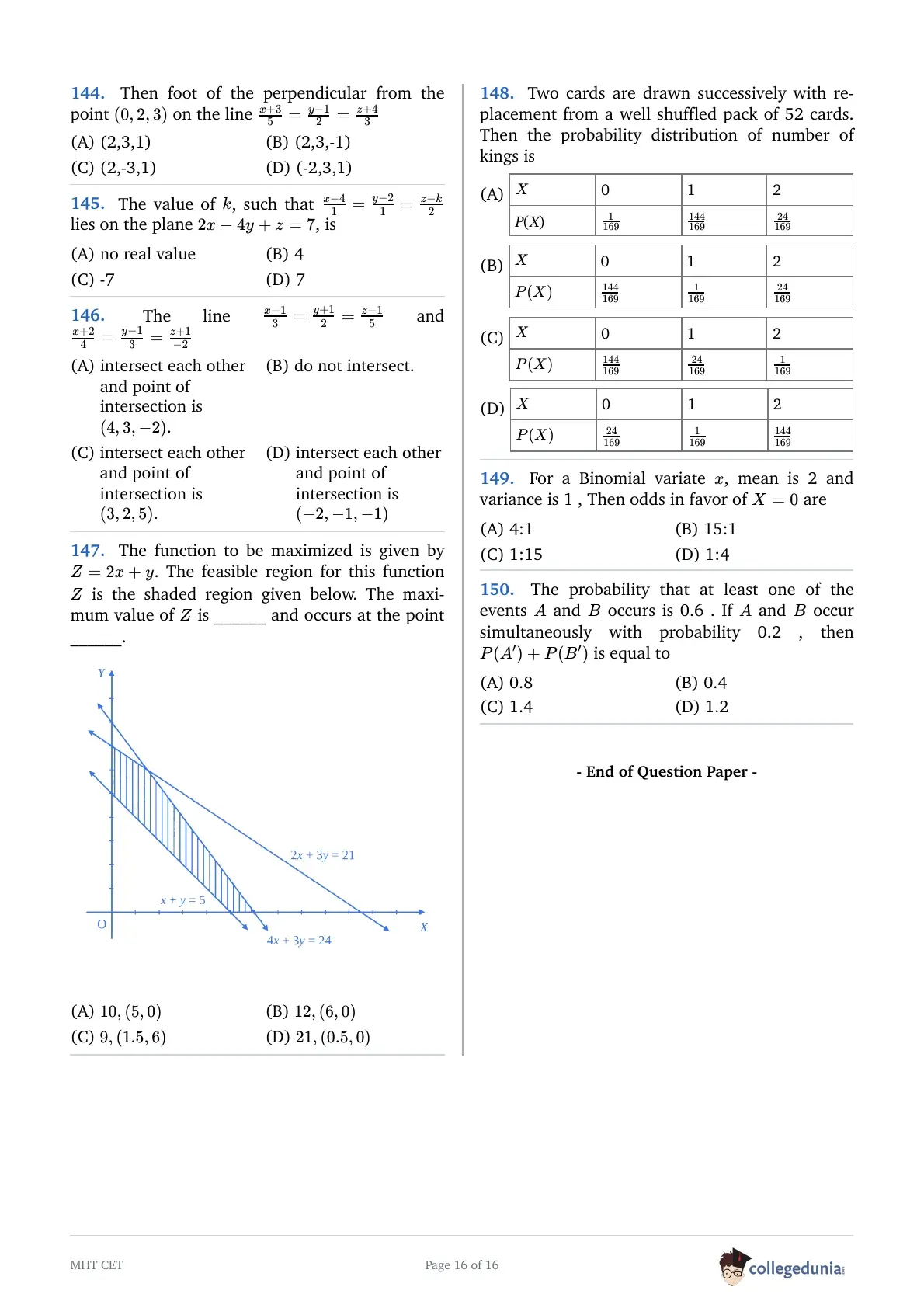
Then foot of the perpendicular from the point \((0,2,3)\) on the line \(\frac{x+3}{5}=\frac{y-1}{2}=\frac{z+4}{3}\)
The value of \(k\), such that \(\frac{x-4}{1}=\frac{y-2}{1}=\frac{z-k}{2}\) lies on the plane \(2x-4y+z=7\), is
The line \(\frac{x-1}{3}=\frac{y+1}{2}=\frac{z-1}{5}\) and \(\frac{x+2}{4}=\frac{y-1}{3}=\frac{z+1}{-2}\)
The function to be maximized is given by \(Z=2x+y\). The feasible region for this function \(Z\) is the shaded region given below. The maximum value of \(Z\) is ______ and occurs at the point ______.

Two cards are drawn successively with replacement from a well shuffled pack of 52 cards. Then the probability distribution of number of kings is
For a Binomial variate \(x\), mean is 2 and variance is 1 , Then odds in favor of \(X=0\) are
The probability that at least one of the events \(A\) and \(B\) occurs is 0.6 . If \(A\) and \(B\) occur simultaneously with probability 0.2 , then \(P(A')+P(B')\) is equal to
MHT CET 2022 PCM Exam Pattern and Marking Scheme
| Parameter | Details |
|---|---|
| Conducting Body | Maharashtra Common Entrance Test Cell (Maharashtra CET Cell) |
| Exam Mode | Online (Computer-Based Test) |
| Duration | 180 minutes (3 hours) |
| Groups / Subjects | PCM (Physics, Chemistry, Mathematics) for Engineering |
| Total Questions |
150 |
| Total Marks | 200 |
| Question Type | Multiple Choice Questions (MCQs) |
| Marks Distribution |
|
| Negative Marking | No |
| Syllabus Weightage |
|



Comments