




MHT CET 2023 May 10 Shift 1 PCM Question Paper is available for download here. Maharashtra State CET Cell conducted MHT CET 2023 PCM Exam on May 10 in Shift 1 from 9 AM to 12 PM in CBT mode.
The MHT CET 2023 PCM question paper includes the following:
- The MHT CET 2023 PCM Question Paper consists of 150 multiple-choice questions (MCQs) totalling 200 marks divided into 3 sections: Physics, Chemistry, and Mathematics, with 50 questions in each subject.
- Physics and Chemistry questions carry 1 mark each while Mathematics questions carry 2 marks each.
- There is no negative marking for incorrect answers.
MHT CET 2023 May 10 Shift 1 PCM Question Paper with Solution PDF
| CD PDF | CD PDF with Solutions |
|---|---|
| Download Collegedunia PDF 1.17 MB | - |
Also Check:
MHT CET 2023 May 10 Shift 1 PCM Questions with Solutions
Physics (Q1 - Q50)
An open organ pipe having fundamental frequency (n) is in unison with a vibrating string. If the tube is dipped in water so that \[75 \%\] of the length of the tube is inside the water then the ratio of fundamental frequency of the air column of dipped tube with that of string will be (Neglect end corrections)
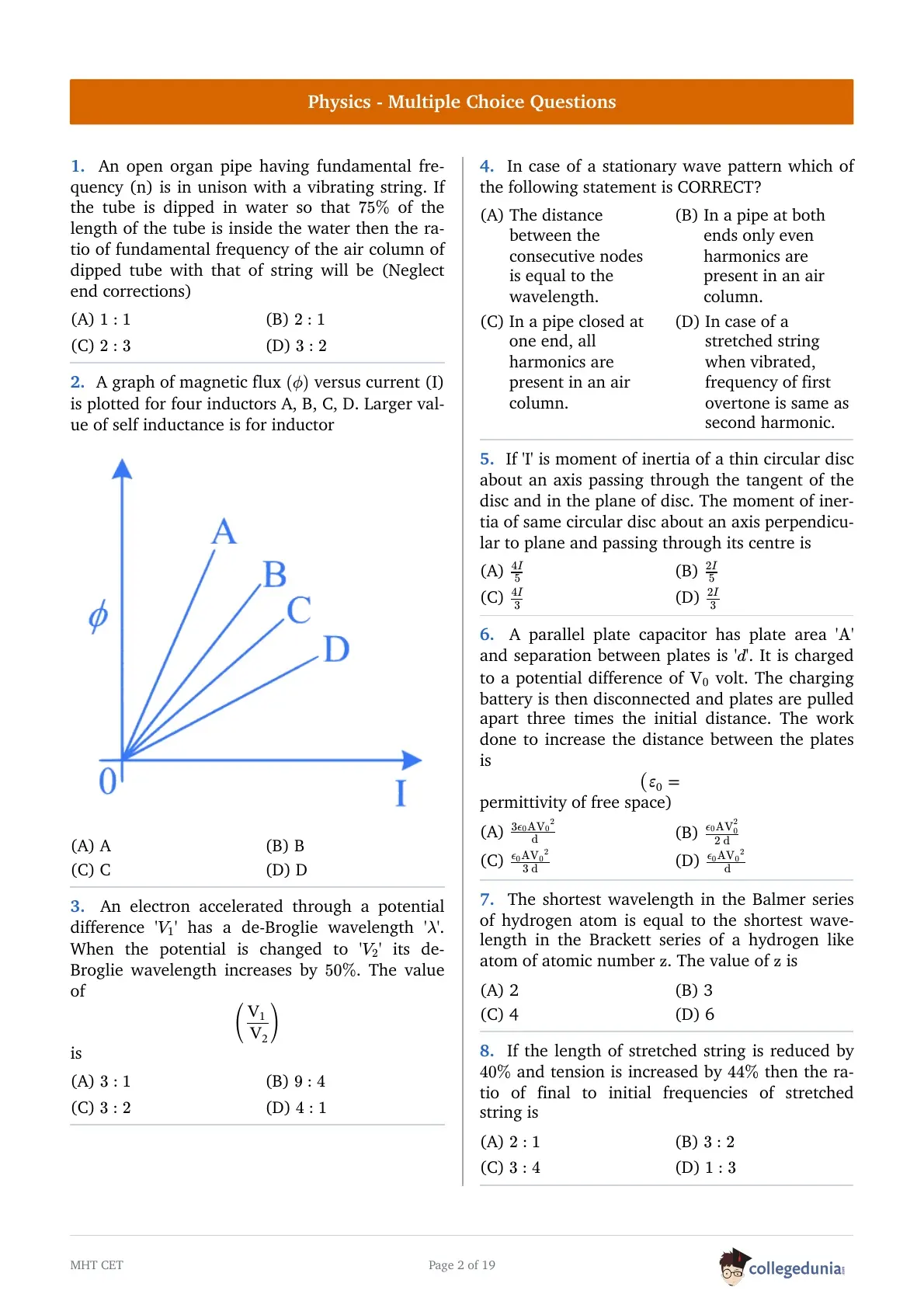
A graph of magnetic flux \[(\phi)\] versus current (I) is plotted for four inductors A, B, C, D. Larger value of self inductance is for inductor

An electron accelerated through a potential difference '\[V_1\]' has a de-Broglie wavelength '\[\lambda\]'. When the potential is changed to '\[V_2\]' its de-Broglie wavelength increases by \[50 \%\]. The value of \[\left(\frac{\mathrm{V}_1}{\mathrm{~V}_2}\right)\] is
In case of a stationary wave pattern which of the following statement is CORRECT?
If 'I' is moment of inertia of a thin circular disc about an axis passing through the tangent of the disc and in the plane of disc. The moment of inertia of same circular disc about an axis perpendicular to plane and passing through its centre is
A parallel plate capacitor has plate area '\[\mathrm{A}\]' and separation between plates is '\[d\]'. It is charged to a potential difference of \[\mathrm{V}_0\] volt. The charging battery is then disconnected and plates are pulled apart three times the initial distance. The work done to increase the distance between the plates is \[\left(\varepsilon_0=\right.\] permittivity of free space)
The shortest wavelength in the Balmer series of hydrogen atom is equal to the shortest wavelength in the Brackett series of a hydrogen like atom of atomic number \[\mathrm{z}\]. The value of \[\mathrm{z}\] is
If the length of stretched string is reduced by \[40 \%\] and tension is increased by \[44 \%\] then the ratio of final to initial frequencies of stretched string is
A square loop of area \[25 \mathrm{~cm}^2\] has a resistance of \[10 \Omega\]. This loop is placed in a uniform magnetic field of magnitude \[40 \mathrm{~T}\]. The plane of loop is perpendicular to the magnetic field. The work done in pulling the loop out of the magnetic field slowly and uniformly in one second, will be
Two capacitors \[\mathrm{C}_1=3 \mu \mathrm{F}\] and \[\mathrm{C}_2=2 \mu \mathrm{F}\] are connected in series across d.c. source of \[100 \mathrm{~V}\]. The ratio of the potential across \[C_2\] to \[C_1\] is
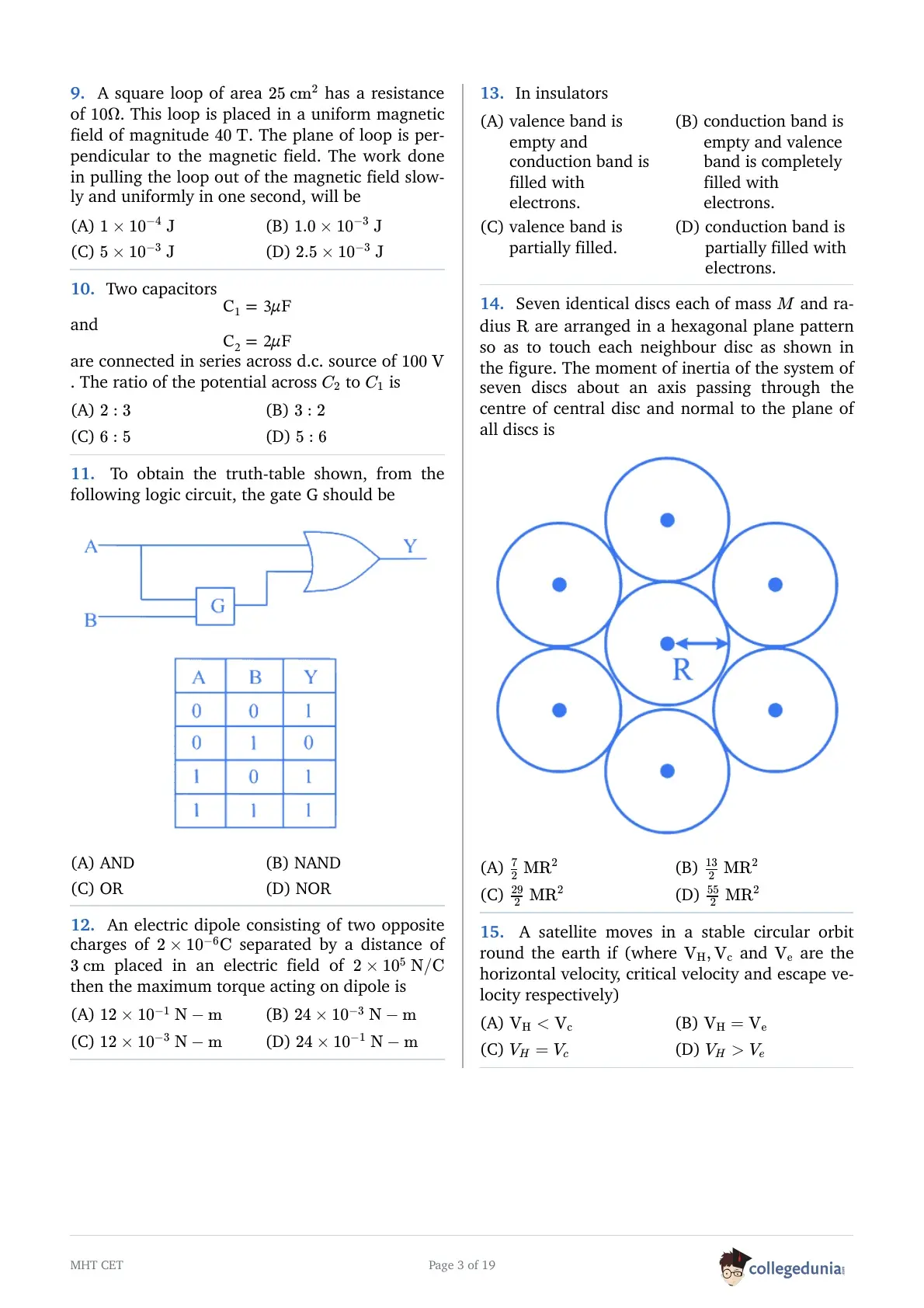
To obtain the truth-table shown, from the following logic circuit, the gate G should be

An electric dipole consisting of two opposite charges of \[2 \times 10^{-6} \mathrm{C}\] separated by a distance of \[3 \mathrm{~cm}\] placed in an electric field of \[2 \times 10^5 \mathrm{~N} / \mathrm{C}\] then the maximum torque acting on dipole is
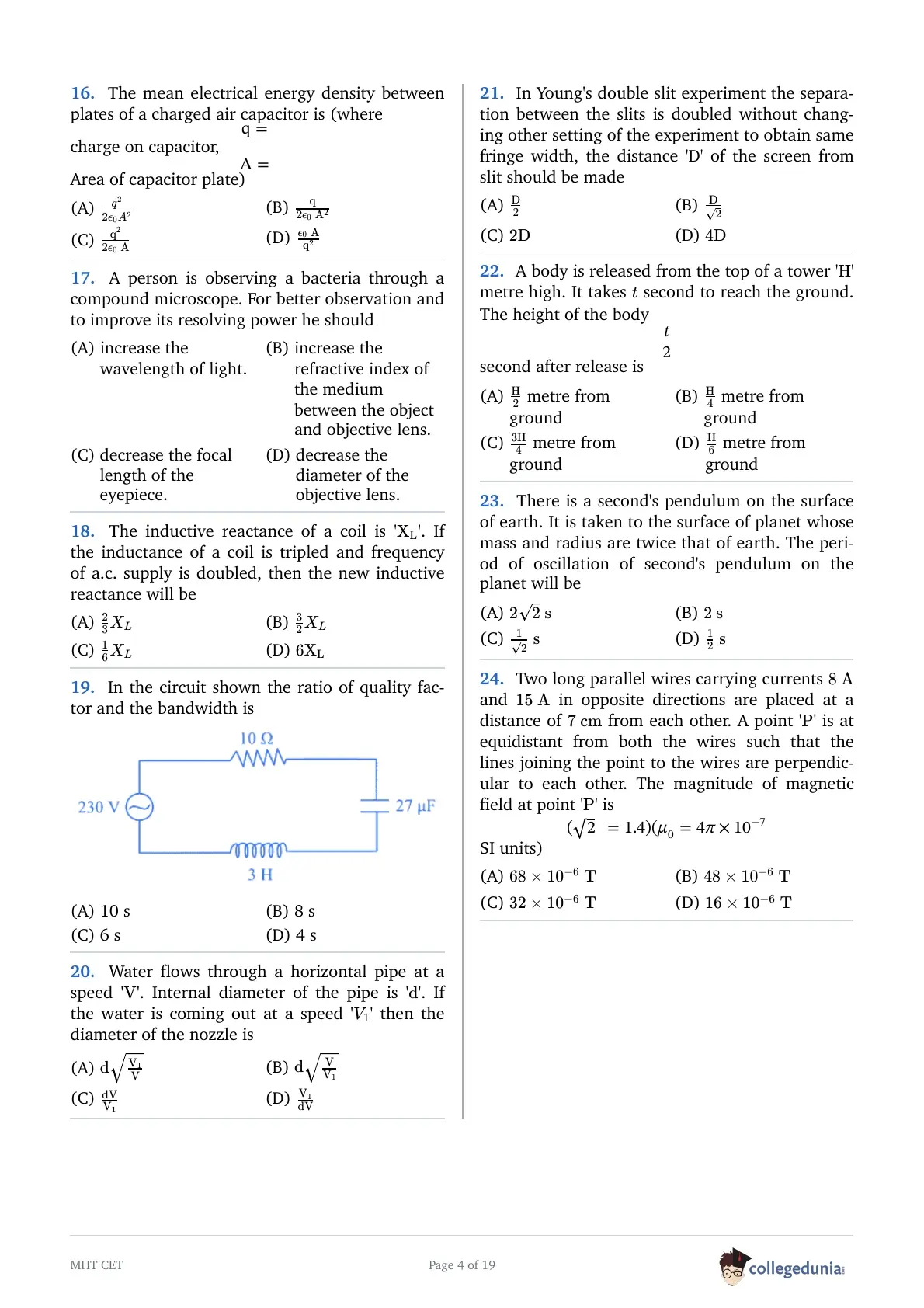
Seven identical discs each of mass \[M\] and radius \[\mathrm{R}\] are arranged in a hexagonal plane pattern so as to touch each neighbour disc as shown in the figure. The moment of inertia of the system of seven discs about an axis passing through the centre of central disc and normal to the plane of all discs is

A satellite moves in a stable circular orbit round the earth if (where \[\mathrm{V}_{\mathrm{H}}, \mathrm{V}_{\mathrm{c}}\] and \[\mathrm{V}_{\mathrm{e}}\] are the horizontal velocity, critical velocity and escape velocity respectively)
The mean electrical energy density between plates of a charged air capacitor is (where \[\mathrm{q}=\] charge on capacitor, \[\mathrm{A}=\] Area of capacitor plate)
A person is observing a bacteria through a compound microscope. For better observation and to improve its resolving power he should
The inductive reactance of a coil is '\[\mathrm{X}_{\mathrm{L}}\]'. If the inductance of a coil is tripled and frequency of a.c. supply is doubled, then the new inductive reactance will be
In the circuit shown the ratio of quality factor and the bandwidth is

Water flows through a horizontal pipe at a speed '\[\mathrm{V}\]'. Internal diameter of the pipe is '\[\mathrm{d}\]'. If the water is coming out at a speed '\[V_1\]' then the diameter of the nozzle is
In Young's double slit experiment the separation between the slits is doubled without changing other setting of the experiment to obtain same fringe width, the distance 'D' of the screen from slit should be made
A body is released from the top of a tower '\[\mathrm{H}\]' metre high. It takes \[t\] second to reach the ground. The height of the body \[\frac{t}{2}\] second after release is
There is a second's pendulum on the surface of earth. It is taken to the surface of planet whose mass and radius are twice that of earth. The period of oscillation of second's pendulum on the planet will be
Two long parallel wires carrying currents \[8 \mathrm{~A}\] and \[15 \mathrm{~A}\] in opposite directions are placed at a distance of \[7 \mathrm{~cm}\] from each other. A point '\[\mathrm{P}\]' is at equidistant from both the wires such that the lines joining the point to the wires are perpendicular to each other. The magnitude of magnetic field at point '\[\mathrm{P}\]' is \[(\sqrt{2}=1.4) ( \mu_0=4 \pi \times 10^{-7}\] SI units)
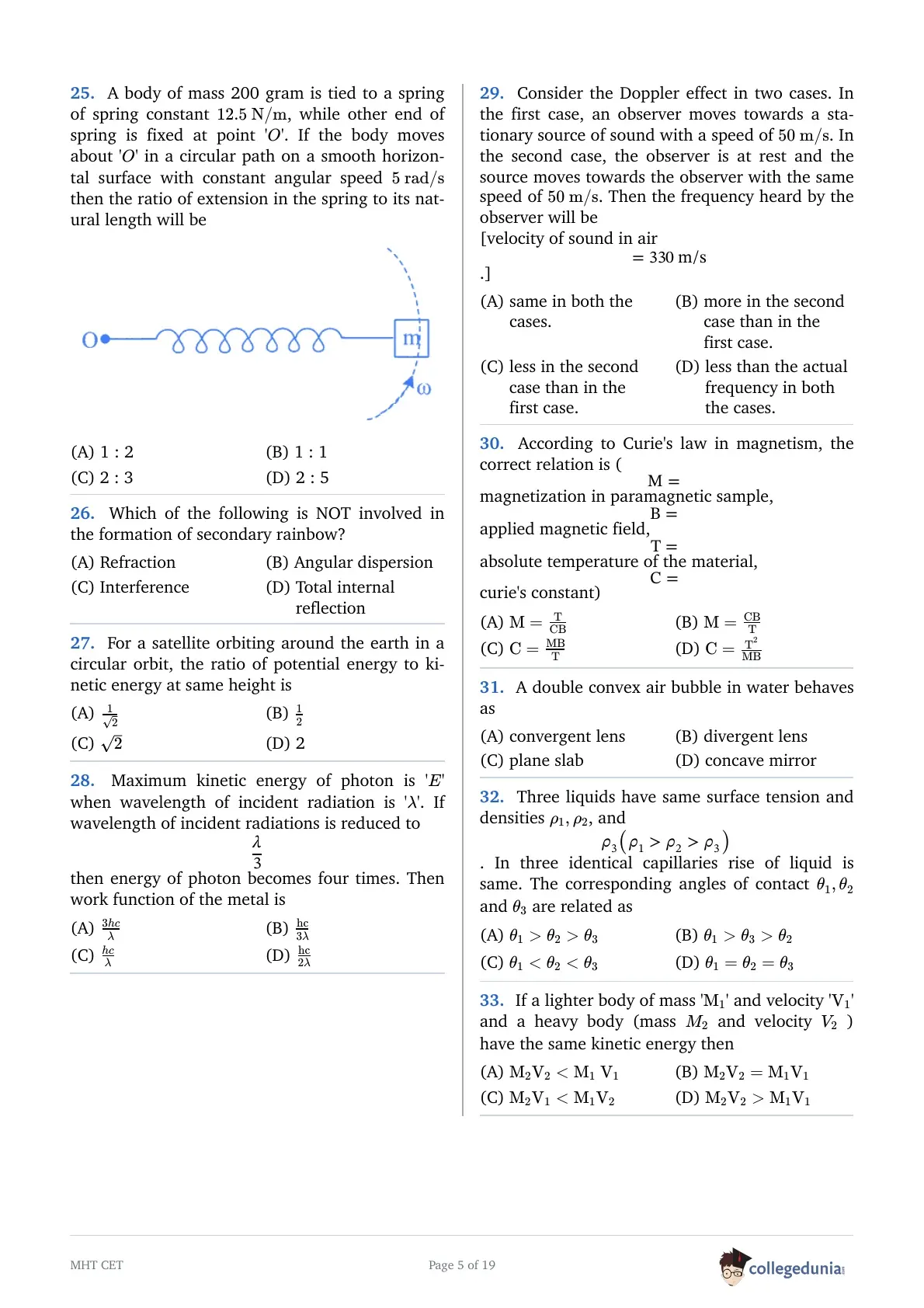
A body of mass 200 gram is tied to a spring of spring constant \[12.5 \mathrm{~N} / \mathrm{m}\], while other end of spring is fixed at point '\[O\]'. If the body moves about '\[O\]' in a circular path on a smooth horizontal surface with constant angular speed \[5 \mathrm{~rad} / \mathrm{s}\] then the ratio of extension in the spring to its natural length will be

Which of the following is NOT involved in the formation of secondary rainbow?
For a satellite orbiting around the earth in a circular orbit, the ratio of potential energy to kinetic energy at same height is
Maximum kinetic energy of photon is '\[E\]' when wavelength of incident radiation is '\[\lambda\]'. If wavelength of incident radiations is reduced to \[\frac{\lambda}{3}\] then energy of photon becomes four times. Then work function of the metal is
Consider the Doppler effect in two cases. In the first case, an observer moves towards a stationary source of sound with a speed of \[50 \mathrm{~m} / \mathrm{s}\]. In the second case, the observer is at rest and the source moves towards the observer with the same speed of \[50 \mathrm{~m} / \mathrm{s}\]. Then the frequency heard by the observer will be
[velocity of sound in air \[=330 \mathrm{~m} / \mathrm{s}\].]
According to Curie's law in magnetism, the correct relation is ( \[\mathrm{M}=\] magnetization in paramagnetic sample, \[\mathrm{B}=\] applied magnetic field, \[\mathrm{T}=\] absolute temperature of the material, \[\mathrm{C}=\] curie's constant)
If a lighter body of mass '\[\mathrm{M}_1\]' and velocity '\[\mathrm{V}_1\]' and a heavy body (mass \[M_2\] and velocity \[V_2\] ) have the same kinetic energy then
Electron of mass '\[\mathrm{m}\]' and charge '\[\mathrm{q}\]' is travelling with speed '\[v\]' along a circular path of radius '\[R\]', at right angles to a uniform magnetic field of intensity '\[B\]'. If the speed of the electron is halved and the magnetic field is doubled, the resulting path would have radius
In a series LR circuit, \[X_L=R\], power factor is \[P_1\]. If a capacitor of capacitance \[C\] with \[X_C=X_L\] is added to the circuit the power factor becomes \[P_2\]. The ratio of \[P_1\] to \[P_2\] will be
If only \[1 \%\] of total current is passed through a galvanometer of resistance '\[G\]' then the resistance of the shunt is
A voltmeter of resistance \[150 \Omega\] connected across a cell of e.m.f. \[3 \mathrm{~V}\] reads \[2.5 \mathrm{~V}\]. What is the internal resistance of the cell?
Two conducting circular loops of radii '\[R_1\]' and '\[R_2\]' are placed in the same plane with their centres coinciding. If \[R_1>R_2\], the mutual inductance \[M\] between them will be directly proportional to
The average force applied on the walls of a closed container depends on \[T^x\] where \[T\] is the temperature of an ideal gas. The value of '\[x\]' is
A black body radiates maximum energy at wavelength '\[\lambda\]' and its emissive power is \[\mathrm{E}\]. Now due to change in temperature of that body, it radiates maximum energy at wavelength \[\frac{2 \lambda}{3}\]. At that temperature emissive power is
A Carnot engine with efficiency \[50 \%\] takes heat from a source at \[600 \mathrm{~K}\]. To increase the efficiency to \[70 \%\], keeping the temperature of the sink same, the new temperature of the source will be
The amplitude of a particle executing S.H.M. is \[3 \mathrm{~cm}\]. The displacement at which its kinetic energy will be \[25 \%\] more than the potential energy is
Two sources of light \[0.6 \mathrm{~mm}\] apart and screen is placed at a distance of \[1.2 \mathrm{~m}\] from them. A light of wavelength \[6000\,\mathop A\limits^o\] used. Then the phase difference between the two light waves interfering on the screen at a point at a distance \[3 \mathrm{~mm}\] from central bright band is
The ratio of longest to shortest wavelength emitted in Paschen series of hydrogen atom is
The height of liquid column raised in a capillary tube of certain radius when dipped in liquid '\[A\]' vertically is \[5 \mathrm{~cm}\]. If the tube is dipped in a similar manner in another liquid '\[B\]' of surface tension and density double the values of liquid '\[A\]', the height of liquid column raised in liquid '\[B\]' would be (Assume angle of contact same)
A particle of mass '\[\mathrm{m}\]' is rotating along a circular path of radius '\[r\]' having angular momentum '\[L\]'. The centripetal force acting on the particle is given by
A sample of gas at temperature \[T\] is adiabatically expanded to double its volume. The work done by the gas in the process is \[\left(\frac{\mathrm{C}_{\mathrm{P}}}{\mathrm{C}_{\mathrm{V}}}=\gamma=\frac{3}{2}\right) \quad(\mathrm{R}=\] gas constant \[)\]
Chemistry (Q51 - Q100)
Conductivity of a solution is \[1.26 \times 10^{-2} \Omega^{-1} \mathrm{~cm}^{-1}\] Calculate molar conductivity for \[0.01 \mathrm{~M}\] solution.
Identify the molecule from following that does NOT involve \[\mathrm{sp}^3\] hybridisation.


Calculate the concentration of \[\mathrm{H}^{+}\] ions in a solution if pOH is 11.

Calculate the edge length of unit cell of metal which crystallises to bcc structure.
(Radius of metal atom \[=173 \mathrm{~pm}\] )
What is new temperature of a gas when its initial volume \[3 \mathrm{~dm}^3\] at \[300 \mathrm{~K}\] is doubled at constant pressure?
Which among the following phenols does NOT correctly match with their IUPAC names?
Which among following statements is NOT true according to principles of green chemistry?
What is the value of effective atomic number of cobalt in \[\left[\mathrm{Co}\left(\mathrm{NH}_3\right)_6\right]^{3+}\] complex if \[\mathrm{Co}(\mathrm{Z}=27)\] ?
For the reaction, \[3 \mathrm{~I}+\mathrm{S}_2 \mathrm{O}_8^{2-} \rightarrow \mathrm{I}_3^{-}+2 \mathrm{SO}_4^{2-}\], at a particular time \[\mathrm{t}, \frac{\mathrm{d}\left[\mathrm{SO}_4^{2-}\right]}{\mathrm{dt}}\] is \[2.2 \times 10^{-2} \mathrm{~mol} \mathrm{~dm}^{-3} \mathrm{~s}^{-1}\]. What is the value of \[-\frac{\mathrm{d}\left[\mathrm{I}^{-}\right]}{\mathrm{dt}}\] ?
What is the total number of Bravais lattices present for different crystal systems?
Identify compound \[\mathrm{Y}\] in the following reaction. \[\mathrm{C}_2 \mathrm{H}_5 \mathrm{Cl}+\mathrm{Y} \stackrel{\Delta}{\longrightarrow} \mathrm{C}_2 \mathrm{H}_5 \mathrm{CN}\]
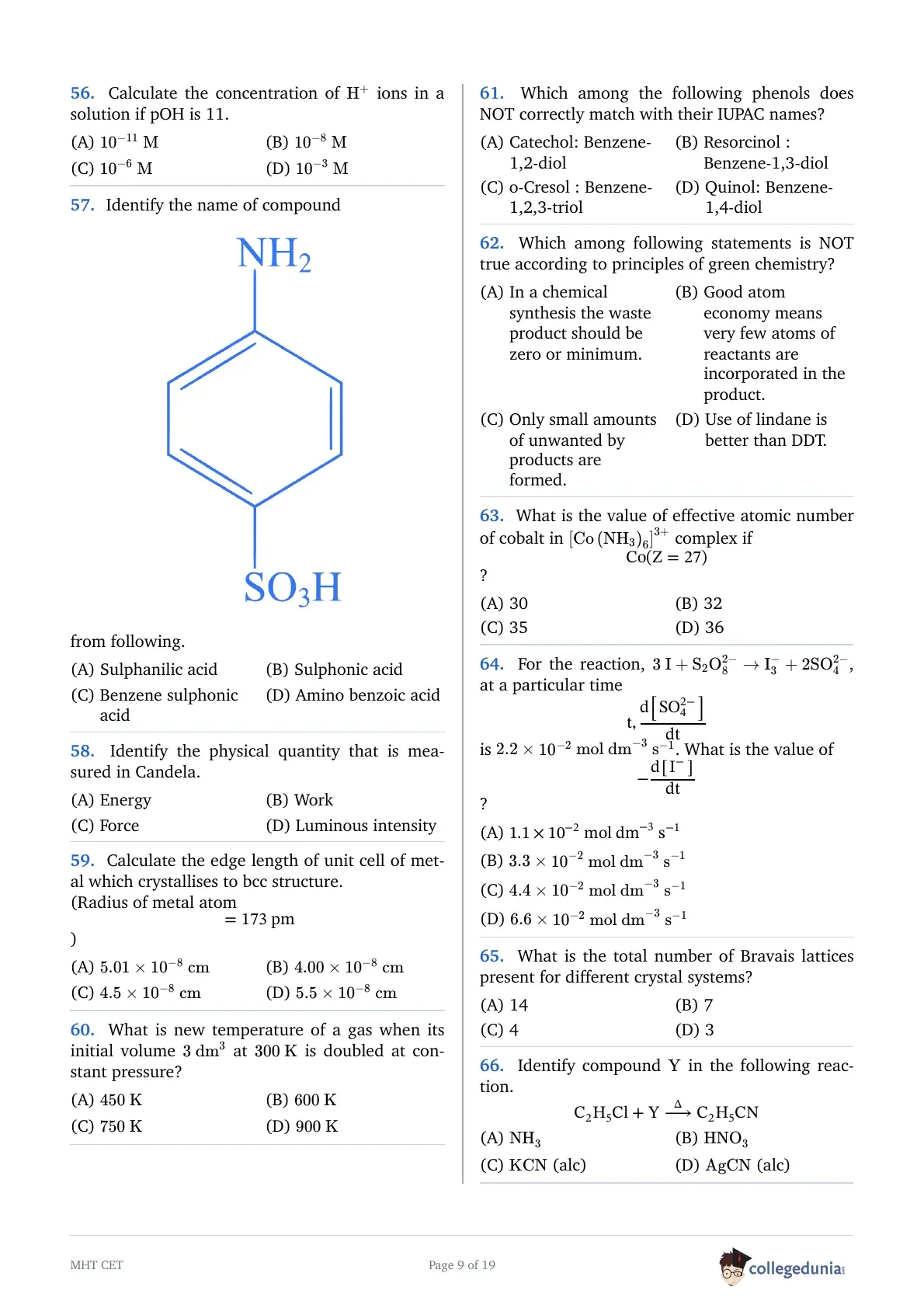
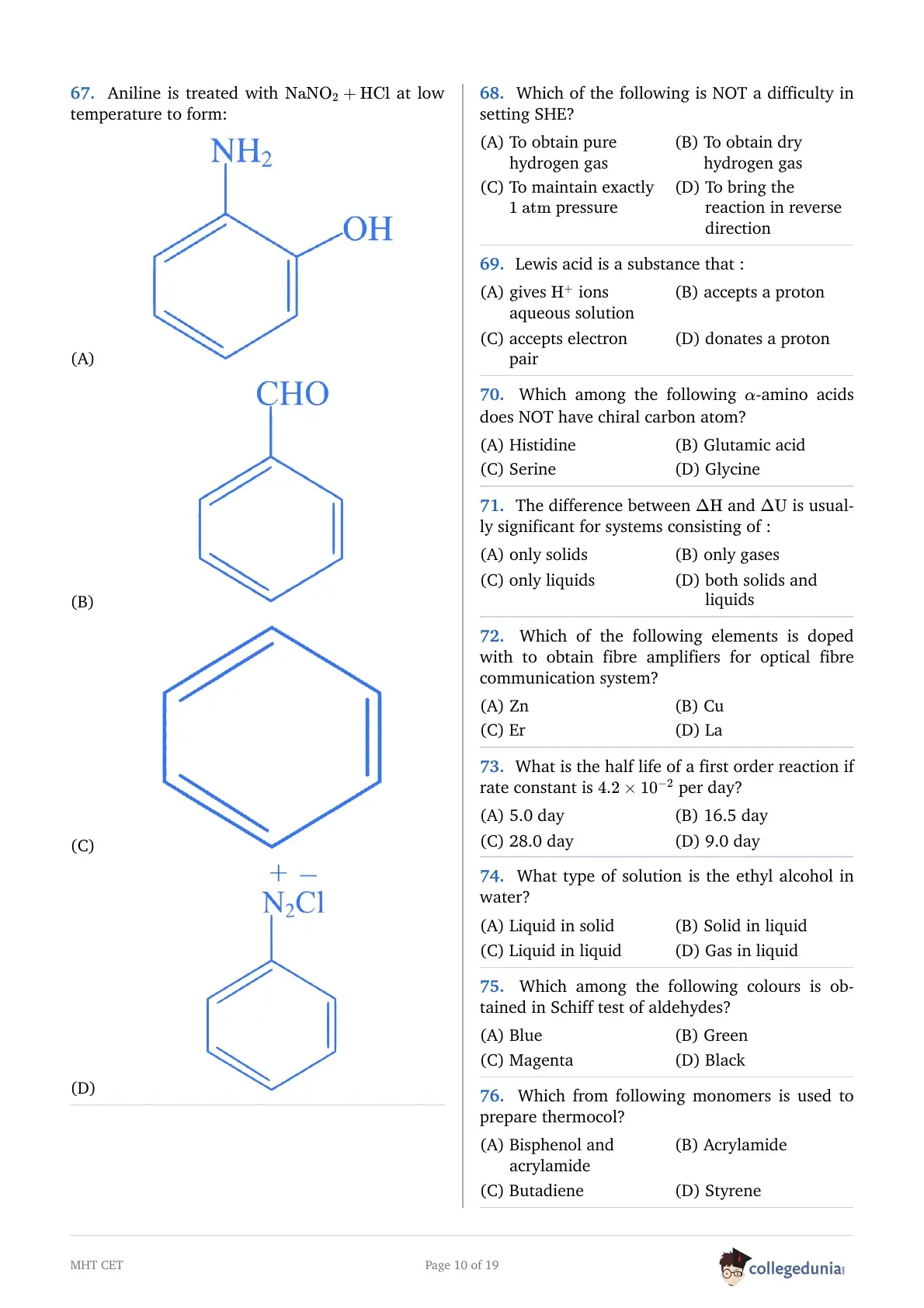
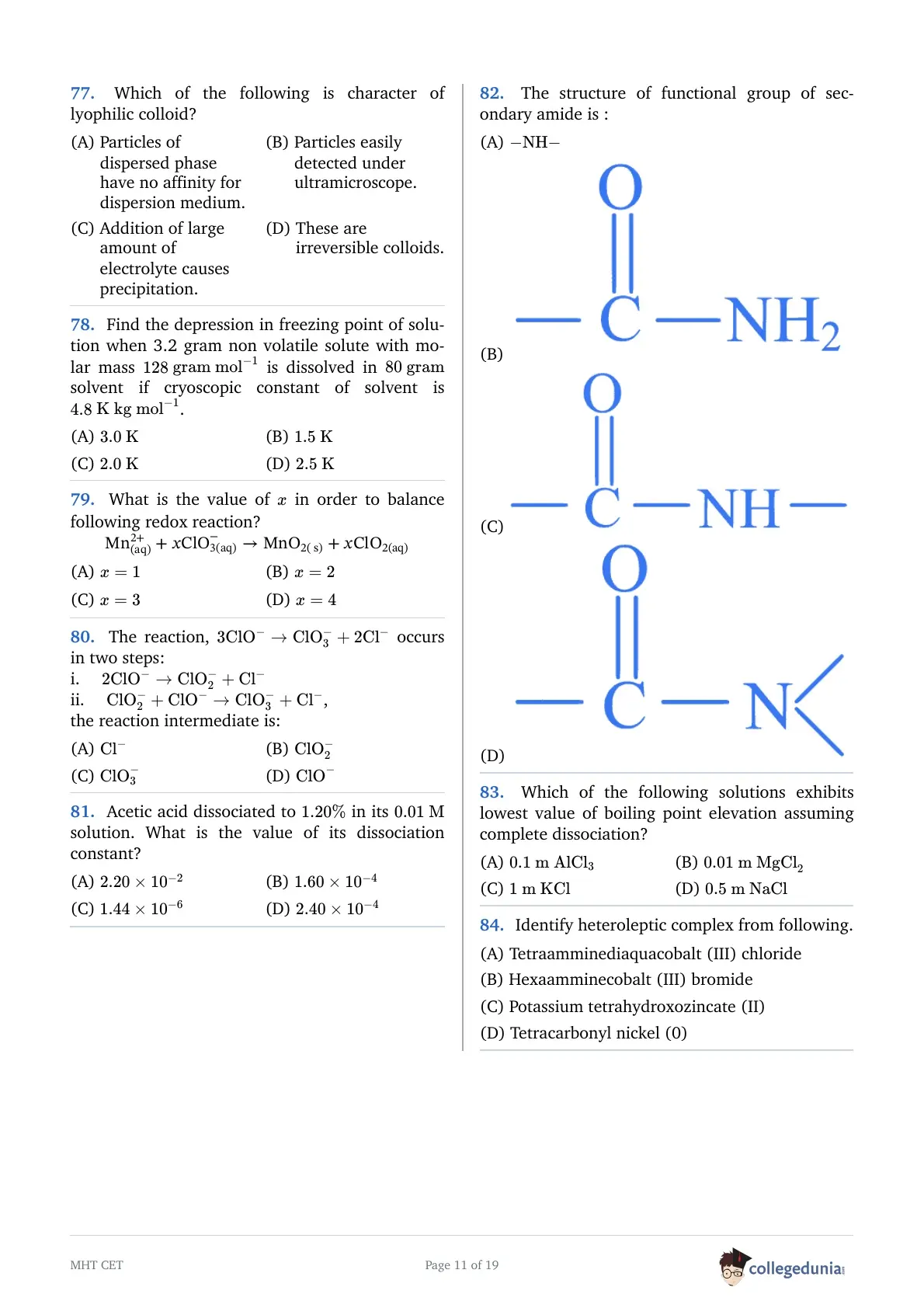
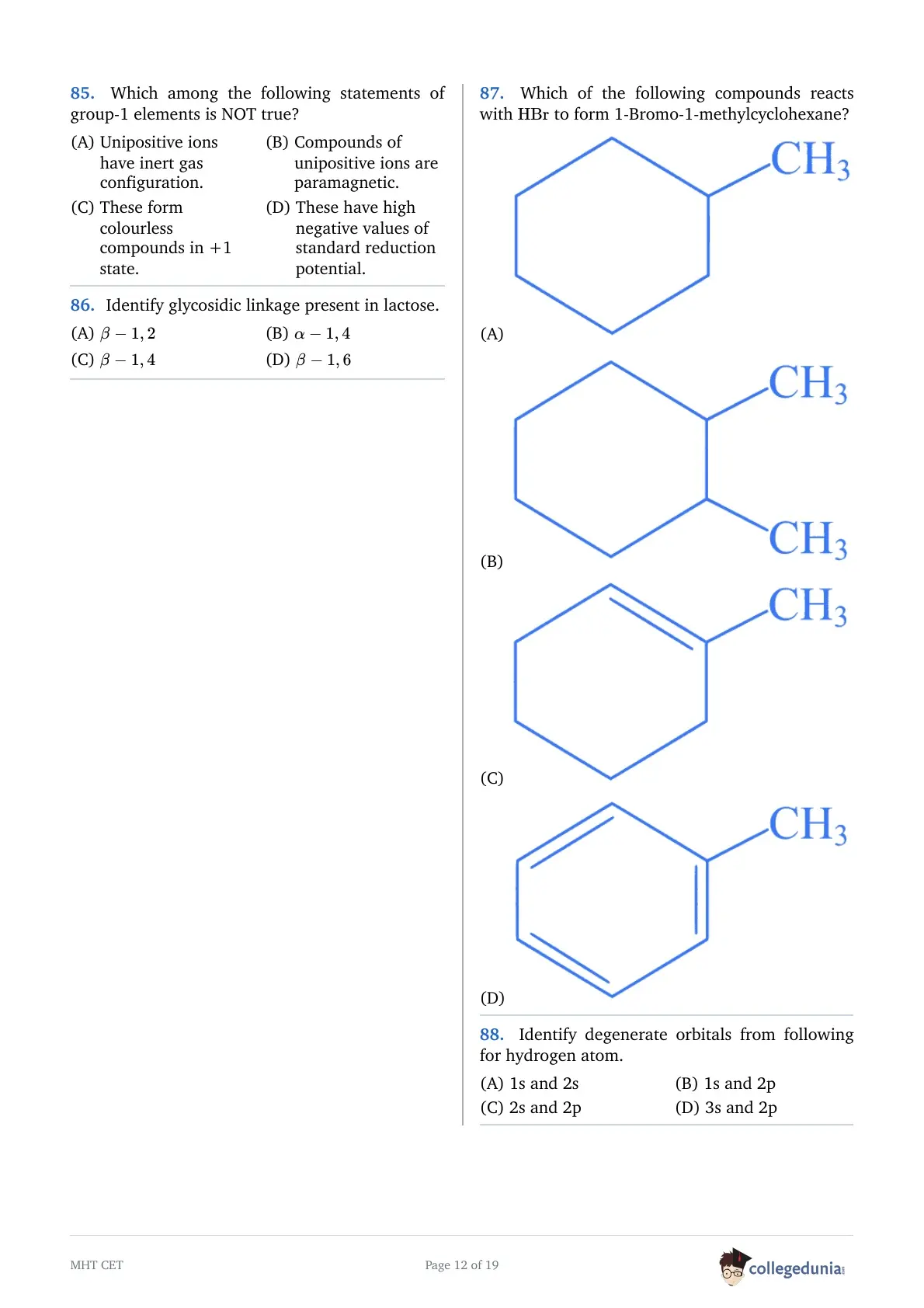
Aniline is treated with \[\mathrm{NaNO}_2+\mathrm{HCl}\] at low temperature to form:
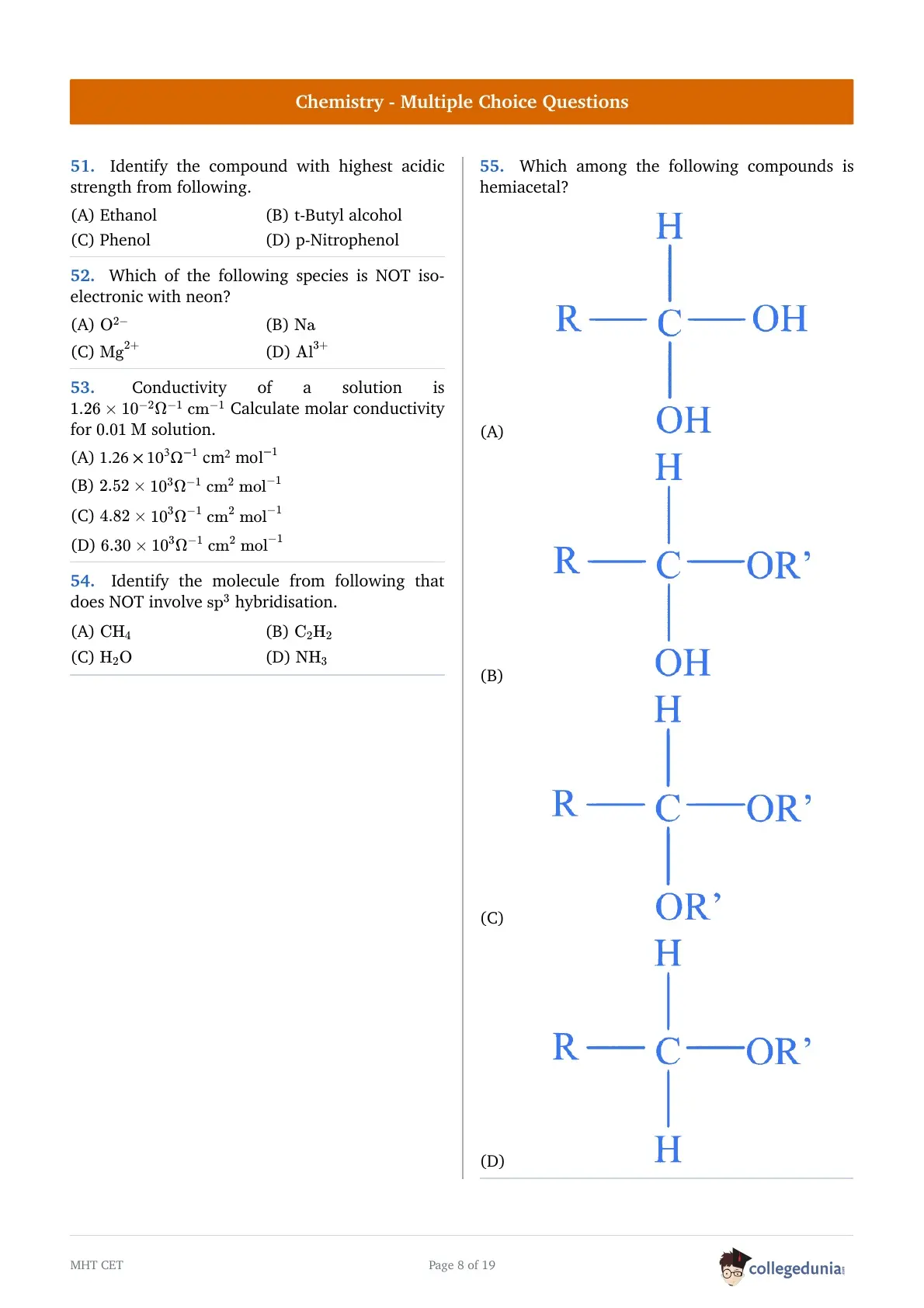
- (A)
![]()
- (B)
![]()
- (C)
![]()
- (D)
![]()


Which among the following \[\alpha\]-amino acids does NOT have chiral carbon atom?
The difference between \[\Delta \mathrm{H}\] and \[\Delta \mathrm{U}\] is usually significant for systems consisting of :
Which of the following elements is doped with to obtain fibre amplifiers for optical fibre communication system?
What is the half life of a first order reaction if rate constant is \[4.2 \times 10^{-2}\] per day?
Which among the following colours is obtained in Schiff test of aldehydes?
Find the depression in freezing point of solution when 3.2 gram non volatile solute with molar mass \[128 \mathrm{~gram} \mathrm{~mol}^{-1}\] is dissolved in \[80 \mathrm{~gram}\] solvent if cryoscopic constant of solvent is \[4.8 \mathrm{~K} \mathrm{~kg} \mathrm{~mol}^{-1}\].
What is the value of \[x\] in order to balance following redox reaction?
\[\mathrm{Mn}_{(\mathrm{aq})}^{2+}+x \mathrm{ClO}_{3(\mathrm{aq})}^{-} \rightarrow \mathrm{MnO}_{2(\mathrm{~s})}+x \mathrm{ClO}_{2(\mathrm{aq})}\]
The reaction, \[3 \mathrm{ClO}^{-} \rightarrow \mathrm{ClO}_3^{-}+2 \mathrm{Cl}^{-}\] occurs in two steps:
i. \[\quad 2 \mathrm{ClO}^{-} \rightarrow \mathrm{ClO}_2^{-}+\mathrm{Cl}^{-}\]
ii. \[\quad \mathrm{ClO}_2^{-}+\mathrm{ClO}^{-} \rightarrow \mathrm{ClO}_3^{-}+\mathrm{Cl}^{-}\],
the reaction intermediate is:
Acetic acid dissociated to \[1.20 \%\] in its \[0.01 \mathrm{~M}\] solution. What is the value of its dissociation constant?
The structure of functional group of secondary amide is :
- (A) \(-\mathrm{NH}-\)
- (B)
![]()
- (C)
![]()
- (D)
![]()


Which of the following solutions exhibits lowest value of boiling point elevation assuming complete dissociation?
Which among the following statements of group-1 elements is NOT true?
Which of the following compounds reacts with \[\mathrm{HBr}\] to form 1-Bromo-1-methylcyclohexane?
- (A)
![]()
- (B)
![]()
- (C)
![]()
- (D)
![]()


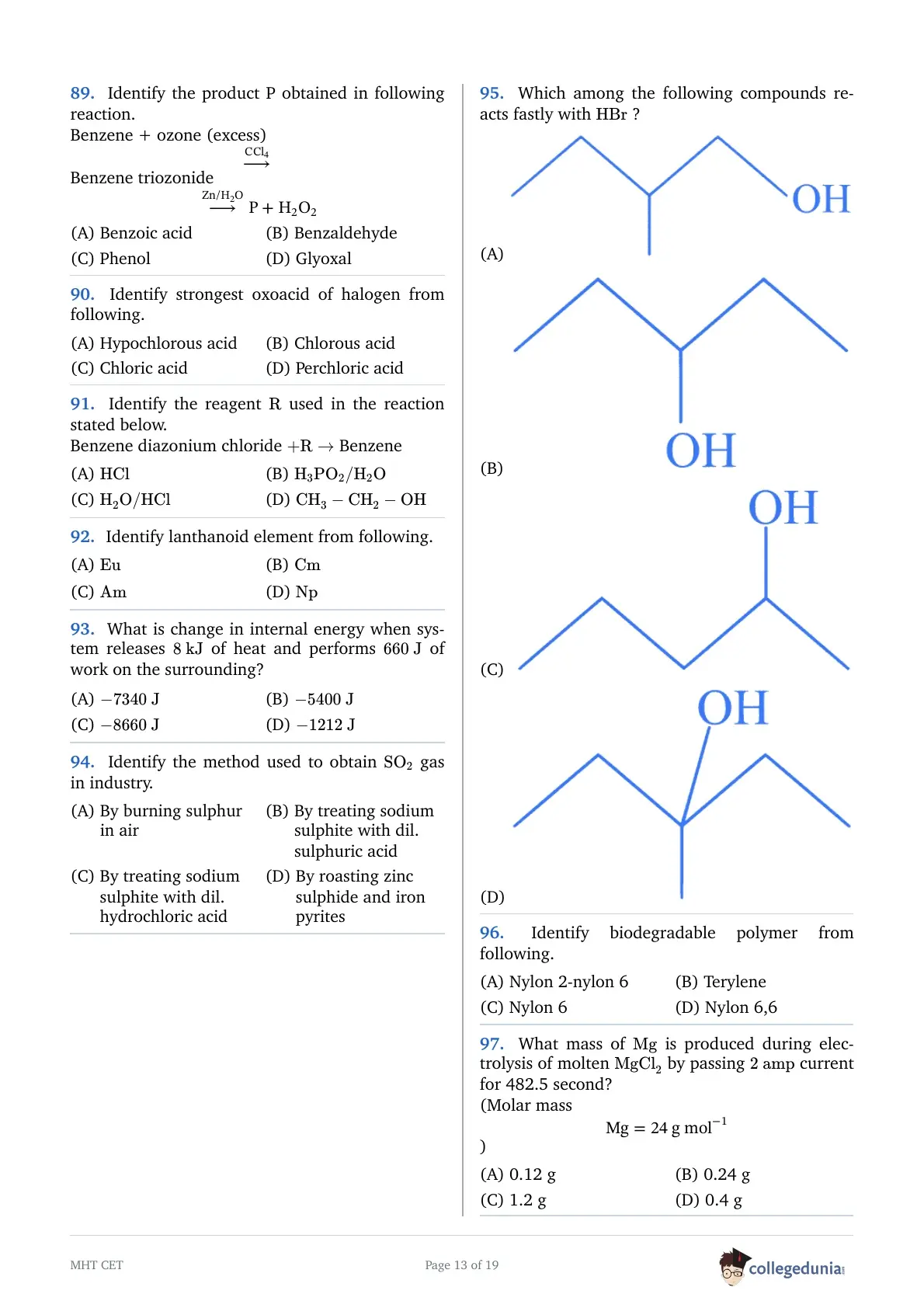
Identify the product P obtained in following reaction.
Benzene + ozone (excess) \[\stackrel{\mathrm{CCl}_4}{\longrightarrow}\]
Benzene triozonide \[\stackrel{\mathrm{Zn} / \mathrm{H}_2 \mathrm{O}}{\longrightarrow} \mathrm{P}+\mathrm{H}_2 \mathrm{O}_2\]
What is change in internal energy when system releases \[8 \mathrm{~kJ}\] of heat and performs \[660 \mathrm{~J}\] of work on the surrounding?
Identify the method used to obtain \[\mathrm{SO}_2\] gas in industry.
Which among the following compounds reacts fastly with \[\mathrm{HBr}\] ?
- (A)
![]()
- (B)
![]()
- (C)
![]()
- (D)
![]()


What mass of \[\mathrm{Mg}\] is produced during electrolysis of molten \[\mathrm{MgCl}_2\] by passing \[2 \mathrm{~amp}\] current for 482.5 second?
(Molar mass \[\mathrm{Mg}=24 \mathrm{~g} \mathrm{~mol}^{-1}\])
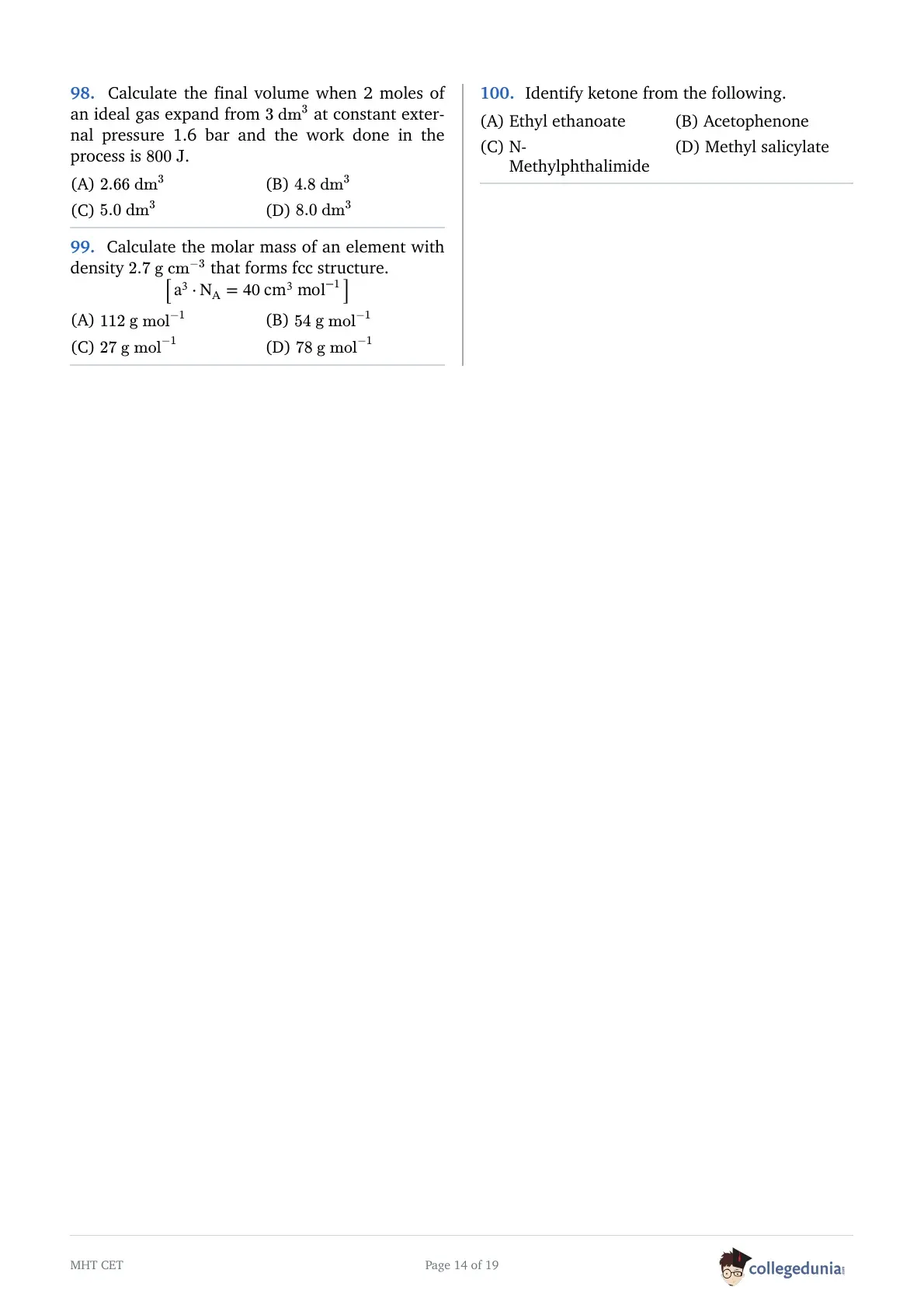
Calculate the final volume when 2 moles of an ideal gas expand from \[3 \mathrm{~dm}^3\] at constant external pressure 1.6 bar and the work done in the process is \[800 \mathrm{~J}\].
Calculate the molar mass of an element with density \[2.7 \mathrm{~g} \mathrm{~cm}^{-3}\] that forms fcc structure. \[\left[\mathrm{a}^3 \cdot \mathrm{N}_{\mathrm{A}}=40 \mathrm{~cm}^3 \mathrm{~mol}^{-1}\right]\]
Mathematics (Q101 - Q150)
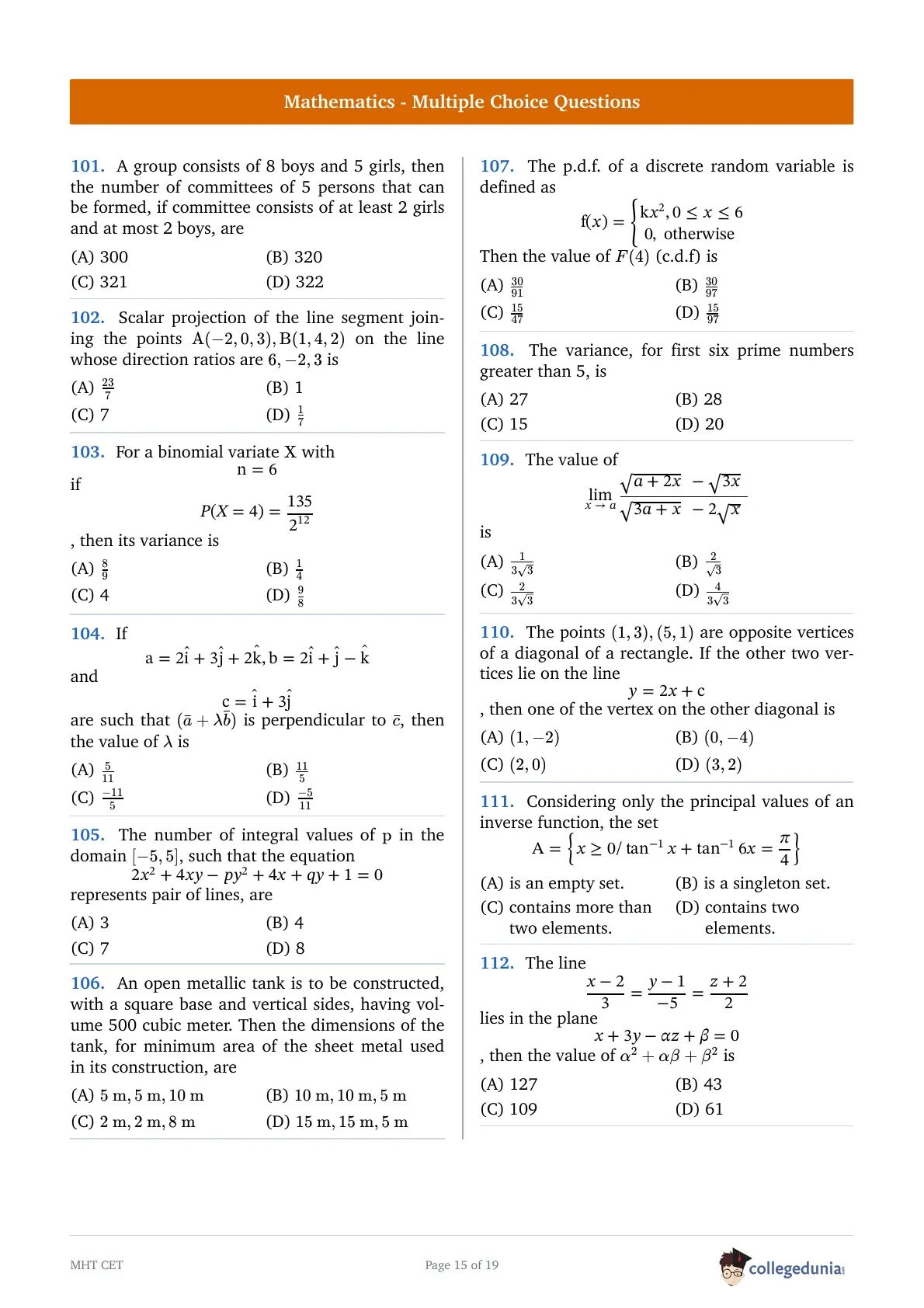
A group consists of 8 boys and 5 girls, then the number of committees of 5 persons that can be formed, if committee consists of at least 2 girls and at most 2 boys, are
Scalar projection of the line segment joining the points \[\mathrm{A}(-2,0,3), \mathrm{B}(1,4,2)\] on the line whose direction ratios are \[6,-2,3\] is
For a binomial variate \[\mathrm{X}\] with \[\mathrm{n}=6\] if \[P(X=4)=\frac{135}{2^{12}}\], then its variance is
If \[\overline{\mathrm{a}}=2 \hat{\mathrm{i}}+3 \hat{\mathrm{j}}+2 \hat{\mathrm{k}}, \overline{\mathrm{b}}=2 \hat{\mathrm{i}}+\hat{\mathrm{j}}-\hat{\mathrm{k}}\] and \[\overline{\mathrm{c}}=\hat{\mathrm{i}}+3 \hat{\mathrm{j}}\] are such that \[(\bar{a}+\lambda \bar{b})\] is perpendicular to \[\bar{c}\], then the value of \[\lambda\] is
The number of integral values of \[\mathrm{p}\] in the domain \[[-5,5]\], such that the equation \[2 x^2+4 x y-p y^2+4 x+q y+1=0\] represents pair of lines, are
An open metallic tank is to be constructed, with a square base and vertical sides, having volume 500 cubic meter. Then the dimensions of the tank, for minimum area of the sheet metal used in its construction, are
The p.d.f. of a discrete random variable is defined as \[\mathrm{f}(x)=\left\{\begin{array}{l} \mathrm{k} x^2, 0 \leq x \leq 6 \\ 0, \text { otherwise } \end{array}\right.\]
Then the value of \[F(4)\] (c.d.f) is
The value of \[\lim _\limits{x \rightarrow a} \frac{\sqrt{a+2 x}-\sqrt{3 x}}{\sqrt{3 a+x}-2 \sqrt{x}}\] is
The Points (1,3), (5,1) are Opposite vertices of a diagonal of a rectangle. If the other two vertices lie on the line y=2x+c, then one of the vertex on the other diagonal is?
Considering only the principal values of an inverse function, the set
\[\mathrm{A}=\left\{x \geq 0 / \tan ^{-1} x+\tan ^{-1} 6 x=\frac{\pi}{4}\right\}\]
The line \[\frac{x-2}{3}=\frac{y-1}{-5}=\frac{z+2}{2}\] lies in the plane \[x+3 y-\alpha z+\beta=0\], then the value of \[\alpha^2+\alpha \beta+\beta^2\] is
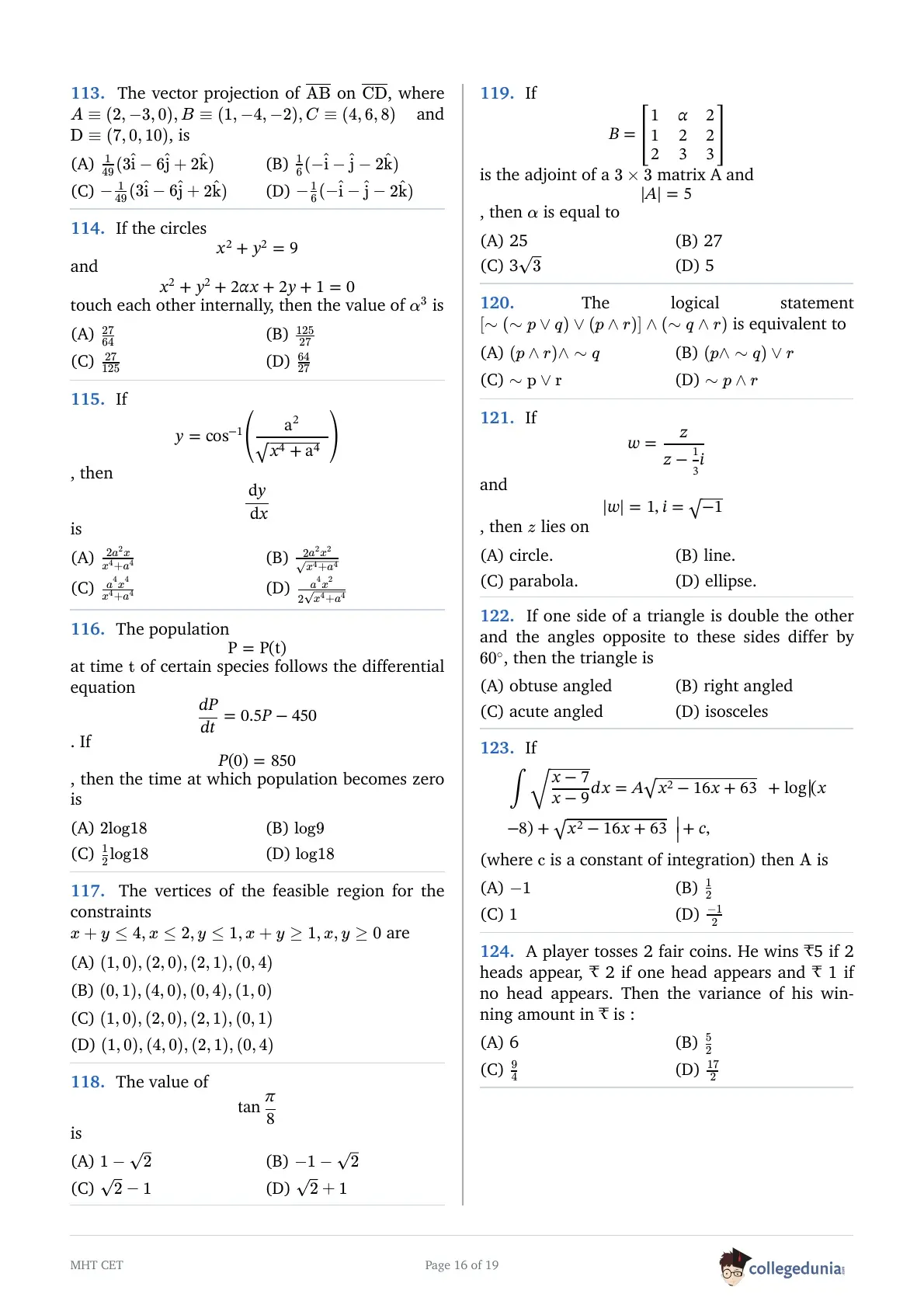
The vector projection of \[\overline{\mathrm{AB}}\] on \[\overline{\mathrm{CD}}\], where \[A \equiv(2,-3,0), B \equiv(1,-4,-2), C \equiv(4,6,8)\] and \[\mathrm{D} \equiv(7,0,10)\], is
If the circles \[x^2+y^2=9\] and \[x^2+y^2+2 \alpha x+2 y+1=0\] touch each other internally, then the value of \[\alpha^3\] is
If \[y=\cos ^{-1}\left(\frac{\mathrm{a}^2}{\sqrt{x^4+\mathrm{a}^4}}\right)\], then \[\frac{\mathrm{d} y}{\mathrm{~d} x}\] is
The population \[\mathrm{P}=\mathrm{P}(\mathrm{t})\] at time \[\mathrm{t}\] of certain species follows the differential equation \[\frac{d P}{d t}=0.5 P-450\]. If \[P(0)=850\], then the time at which population becomes zero is
The vertices of the feasible region for the constraints \[x+y \leq 4, x \leq 2, y \leq 1, x+y \geq 1, x, y \geq 0\] are
If \[B=\left[\begin{array}{lll}1 & \alpha & 2 \\ 1 & 2 & 2 \\ 2 & 3 & 3\end{array}\right]\] is the adjoint of a \[3 \times 3\] matrix A and \[|A|=5\], then \[\alpha\] is equal to
The logical statement \[[\sim(\sim p \vee q) \vee(p \wedge r)] \wedge(\sim q \wedge r)\] is equivalent to
If \[w=\frac{z}{z-\frac{1}{3} i}\] and \[|w|=1, i=\sqrt{-1}\], then \[z\] lies on
If one side of a triangle is double the other and the angles opposite to these sides differ by \[60^{\circ}\], then the triangle is
If \[\int \sqrt{\frac{x-7}{x-9}} d x=A \sqrt{x^2-16 x+63}+\log \left|(x-8)+\sqrt{x^2-16 x+63}\right|+c,\]
(where \[\mathrm{c}\] is a constant of integration) then \[\mathrm{A}\] is
A player tosses 2 fair coins. He wins ₹5 if 2 heads appear, ₹ 2 if one head appears and ₹ 1 if no head appears. Then the variance of his winning amount in ₹ is :
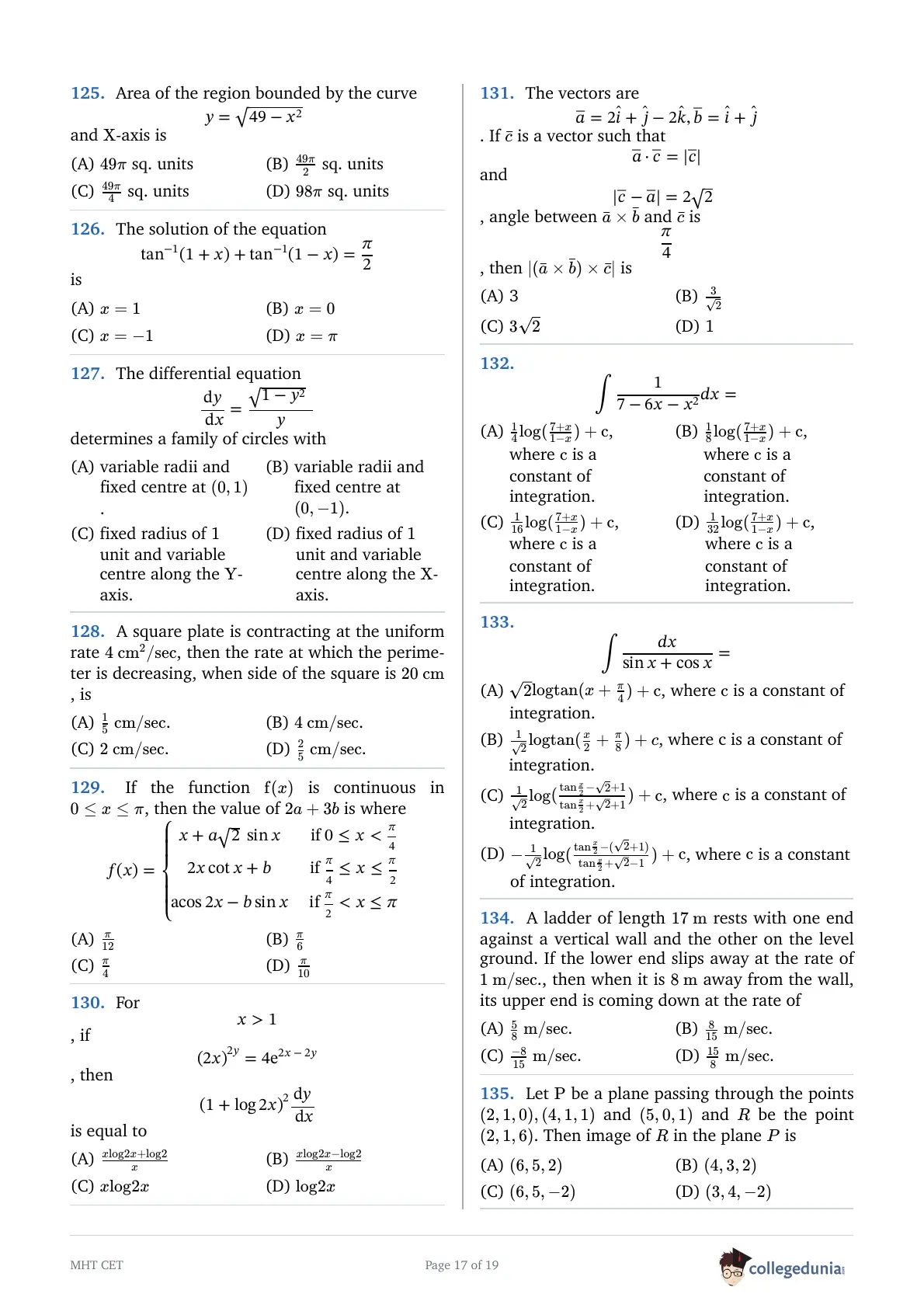
Area of the region bounded by the curve \[y=\sqrt{49-x^2}\] and \[\mathrm{X}\]-axis is
The solution of the equation \[\tan ^{-1}(1+x)+\tan ^{-1}(1-x)=\frac{\pi}{2}\] is
The differential equation \[\frac{\mathrm{d} y}{\mathrm{~d} x}=\frac{\sqrt{1-y^2}}{y}\] determines a family of circles with
A square plate is contracting at the uniform rate \[4 \mathrm{~cm}^2 / \mathrm{sec}\], then the rate at which the perimeter is decreasing, when side of the square is \[20 \mathrm{~cm}\], is
If the function \(\mathrm{f}(x)\) is continuous in \(0 \leq x \leq \pi\), then the value of \(2 a+3 b\) is where
\(f(x)= \begin{cases}x+a \sqrt{2} \sin x & \text { if } 0 \leq x < \frac{\pi}{4} \\ 2 x \cot x+b & \text { if } \frac{\pi}{4} \leq x \leq \frac{\pi}{2} \\ \operatorname{acos} 2 x-b \sin x & \text { if } \frac{\pi}{2} < x \leq \pi\end{cases}\)
For \[x>1\], if \[(2 x)^{2 y}=4 \mathrm{e}^{2 x-2 y}\], then \[(1+\log 2 x)^2 \frac{\mathrm{d} y}{\mathrm{~d} x}\] is equal to
The vectors are \[\bar{a}=2 \hat{i}+\hat{j}-2 \hat{k}, \bar{b}=\hat{i}+\hat{j}\]. If \[\bar{c}\] is a vector such that \[\bar{a} \cdot \bar{c}=|\bar{c}|\] and \[|\bar{c}-\bar{a}|=2 \sqrt{2}\], angle between \[\bar{a} \times \bar{b}\] and \[\bar{c}\] is \[\frac{\pi}{4}\], then \[|(\bar{a} \times \bar{b}) \times \bar{c}|\] is
A ladder of length \[17 \mathrm{~m}\] rests with one end against a vertical wall and the other on the level ground. If the lower end slips away at the rate of \[1 \mathrm{~m} / \mathrm{sec}\]., then when it is \[8 \mathrm{~m}\] away from the wall, its upper end is coming down at the rate of
Let \[\mathrm{P}\] be a plane passing through the points \[(2,1,0),(4,1,1)\] and \[(5,0,1)\] and \[R\] be the point \[(2,1,6)\]. Then image of \[R\] in the plane \[P\] is
The co-ordinates of the point, where the line through \[A(3,4,1)\] and \[B(5,1,6)\] crosses the \[\mathrm{XZ}\]-plane, are
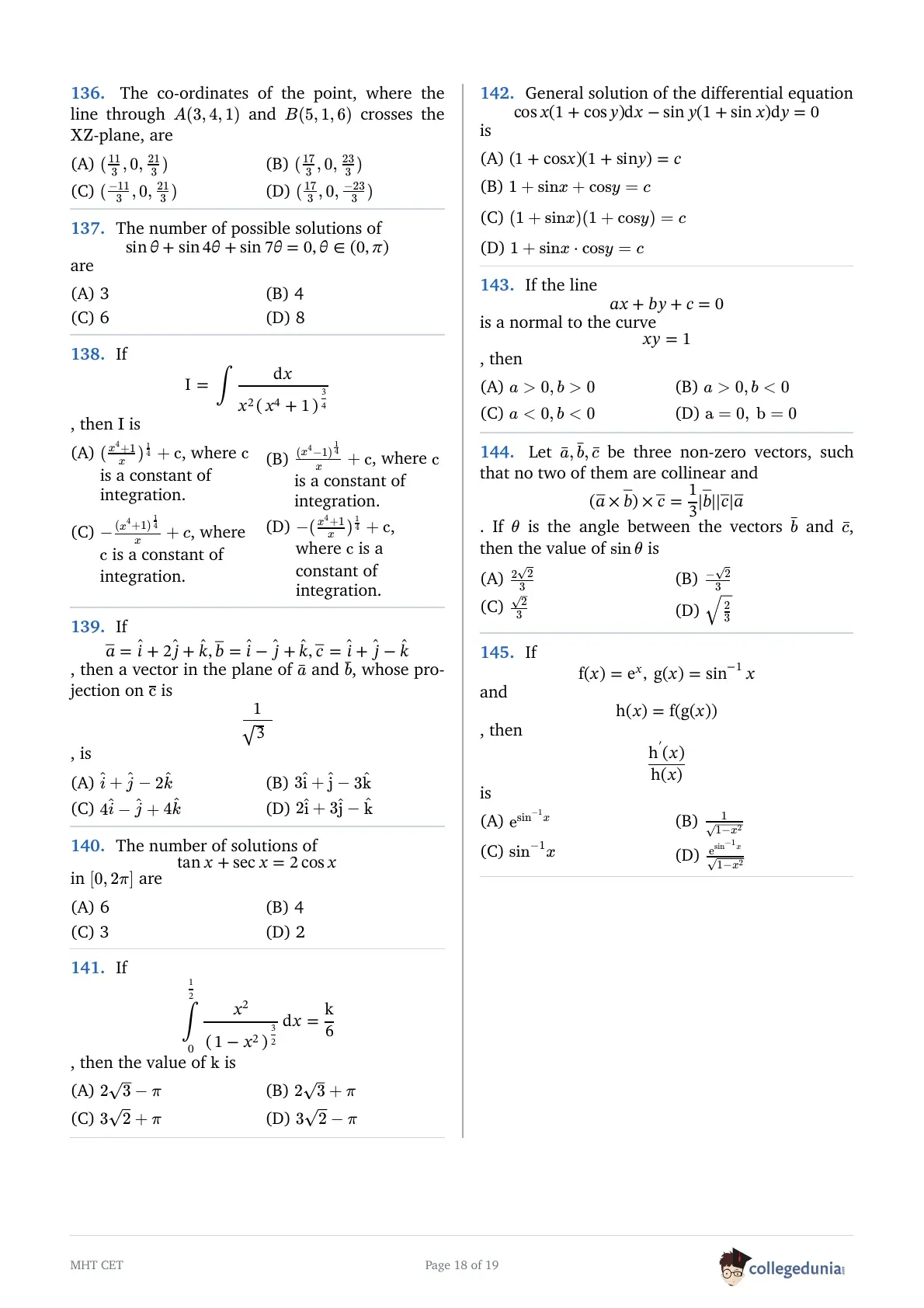
The number of possible solutions of \[\sin \theta+\sin 4 \theta+\sin 7 \theta=0, \theta \in(0, \pi)\] are
If \[\mathrm{I}=\int \frac{\mathrm{d} x}{x^2\left(x^4+1\right)^{\frac{3}{4}}}\], then \[\mathrm{I}\] is
The number of solutions of \[\tan x+\sec x=2 \cos x\] in \[[0,2 \pi]\] are
If \[\int_\limits0^{\frac{1}{2}} \frac{x^2}{\left(1-x^2\right)^{\frac{3}{2}}} \mathrm{~d} x=\frac{\mathrm{k}}{6}\], then the value of \[\mathrm{k}\] is
General Solution of the differential equation:
\(cos\,x(1+cos\,y)dx-sin\,y(1+sin\,x)dy=0\) is:
If the line \[a x+b y+c=0\] is a normal to the curve \[x y=1\], then
Let \[\bar{a}, \bar{b}, \bar{c}\] be three non-zero vectors, such that no two of them are collinear and \[(\bar{a} \times \bar{b}) \times \bar{c}=\frac{1}{3}|\bar{b}||\bar{c}| \bar{a}\]. If \[\theta\] is the angle between the vectors \[\bar{b}\] and \[\bar{c}\], then the value of \[\sin \theta\] is
If \[\mathrm{f}(x)=\mathrm{e}^x, \mathrm{~g}(x)=\sin ^{-1} x\] and \[\mathrm{h}(x)=\mathrm{f}(\mathrm{g}(x))\], then \[\frac{\mathrm{h}^{\prime}(x)}{\mathrm{h}(x)}\] is


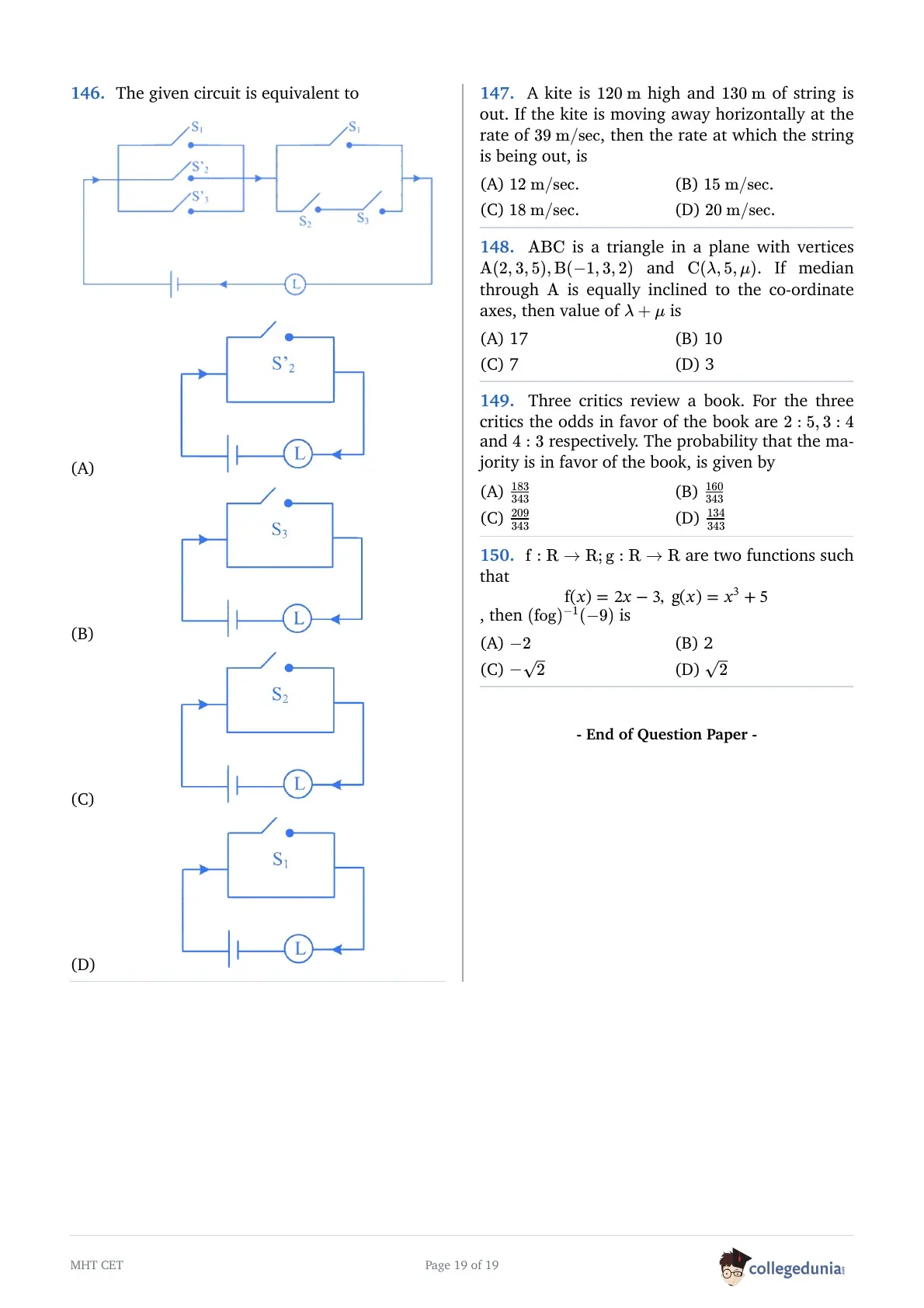
A kite is \[120 \mathrm{~m}\] high and \[130 \mathrm{~m}\] of string is out. If the kite is moving away horizontally at the rate of \[39 \mathrm{~m} / \mathrm{sec}\], then the rate at which the string is being out, is
\[\mathrm{ABC}\] is a triangle in a plane with vertices \[\mathrm{A}(2,3,5), \mathrm{B}(-1,3,2)\] and \[\mathrm{C}(\lambda, 5, \mu)\]. If median through \[\mathrm{A}\] is equally inclined to the co-ordinate axes, then value of \[\lambda+\mu\] is
Three critics review a book. For the three critics the odds in favor of the book are \[2: 5, 3: 4\] and \[4: 3\] respectively. The probability that the majority is in favor of the book, is given by
\[\mathrm{f}: \mathrm{R} \rightarrow \mathrm{R} ; \mathrm{g}: \mathrm{R} \rightarrow \mathrm{R}\] are two functions such that \[\mathrm{f}(x)=2 x-3, \mathrm{~g}(x)=x^3+5\], then \[(\mathrm{fog})^{-1}(-9)\] is
MHT CET 2023 PCM Exam Pattern and Marking Scheme
| Parameter | Details |
|---|---|
| Conducting Body | Maharashtra Common Entrance Test Cell (Maharashtra CET Cell) |
| Exam Mode | Online (Computer-Based Test) |
| Duration | 180 minutes (3 hours) |
| Groups / Subjects | PCM (Physics, Chemistry, Mathematics) for Engineering |
| Total Questions |
150 |
| Total Marks | 200 |
| Question Type | Multiple Choice Questions (MCQs) |
| Marks Distribution |
|
| Negative Marking | No |
| Syllabus Weightage |
|



Comments