MHT CET 2023 May 10 Shift 2 PCM Question Paper is available for download here. Maharashtra State CET Cell conducted MHT CET 2023 PCM Exam on May 10 in Shift 2 from 2 PM to 5 PM in CBT mode.

The MHT CET 2023 PCM question paper includes the following:

  • The MHT CET 2023 PCM Question Paper consists of 150 multiple-choice questions (MCQs) totalling 200 marks divided into 3 sections: Physics, Chemistry, and Mathematics, with 50 questions in each subject.
  • Physics and Chemistry questions carry 1 mark each while Mathematics questions carry 2 marks each.
  • There is no negative marking for incorrect answers.

MHT CET 2023 May 10 Shift 2 PCM Question Paper with Solution PDF

CD PDF CD PDF with Solutions
Download Collegedunia PDF 1.04 MB -

Also Check:

MHT CET 2023 May 10 Shift 2 PCM Questions with Solutions


Physics (Q1 - Q50)

Question 1:

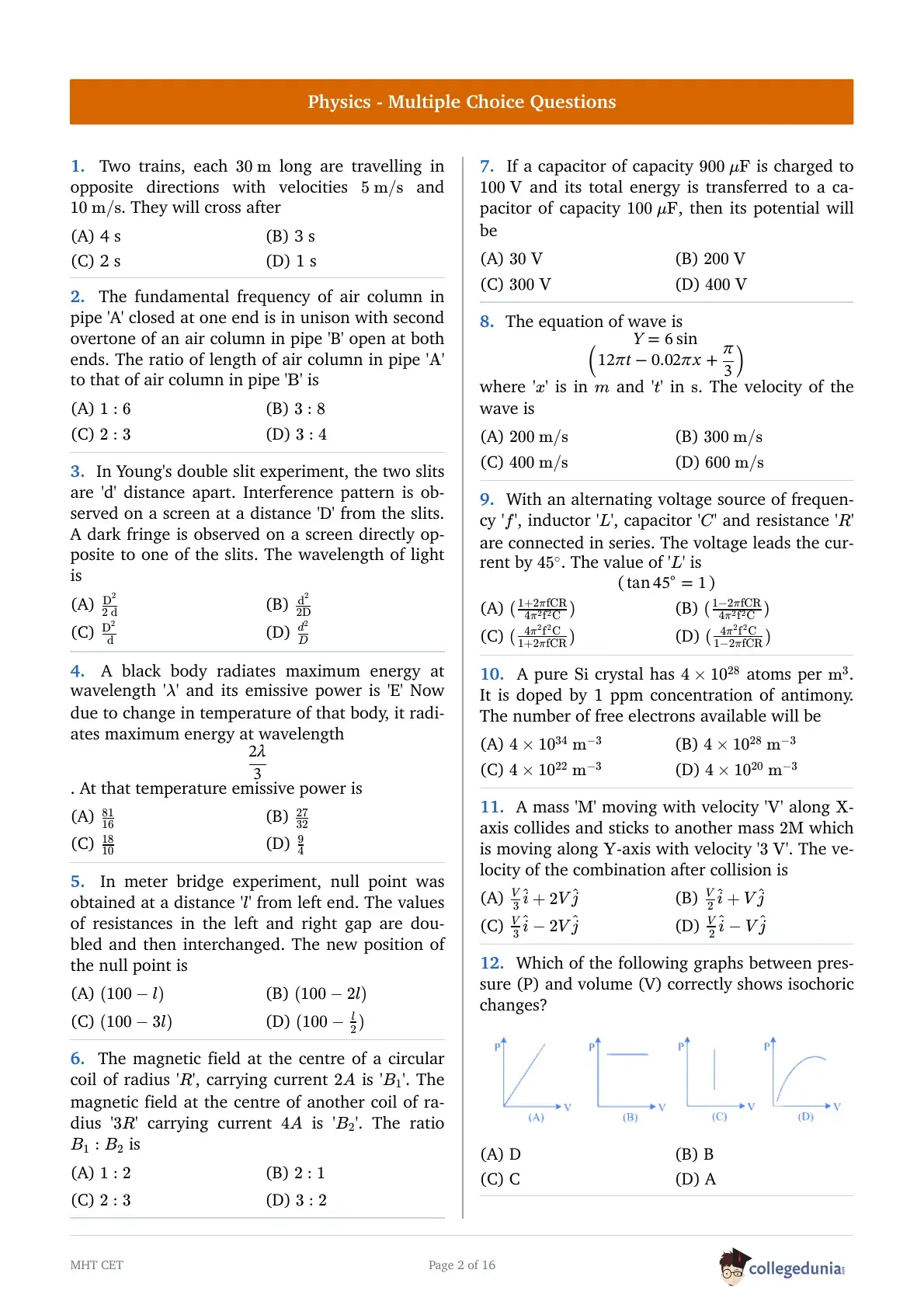
Two trains, each \[30 \mathrm{~m}\] long are travelling in opposite directions with velocities \[5 \mathrm{~m} / \mathrm{s}\] and \[10 \mathrm{~m} / \mathrm{s}\]. They will cross after

  • (A) 4 s
  • (B) 3 s
  • (C) 2 s
  • (D) 1 s

Question 2:

The fundamental frequency of air column in pipe 'A' closed at one end is in unison with second overtone of an air column in pipe 'B' open at both ends. The ratio of length of air column in pipe '\[\mathrm{A}\]' to that of air column in pipe '\[\mathrm{B}\]' is

  • (A) \(1:6\)
  • (B) \(3:8\)
  • (C) \(2:3\)
  • (D) \(3:4\)

Question 3:

In Young's double slit experiment, the two slits are 'd' distance apart. Interference pattern is observed on a screen at a distance 'D' from the slits. A dark fringe is observed on a screen directly opposite to one of the slits. The wavelength of light is

  • (A) \(\frac{\mathrm{D}^{2}}{2\text{ }\mathrm{d}}\)
  • (B) \(\frac{\mathrm{d}^{2}}{2\mathrm{D}}\)
  • (C) \(\frac{\mathrm{D}^{2}}{\text{ }\mathrm{d}}\)
  • (D) \(\frac{d^{2}}{D}\)

Question 5:

In meter bridge experiment, null point was obtained at a distance '\[l\]' from left end. The values of resistances in the left and right gap are doubled and then interchanged. The new position of the null point is

  • (A) \((100-l)\)
  • (B) \((100-2l)\)
  • (C) \((100-3l)\)
  • (D) \((100-\frac{l}{2})\)

Question 6:

The magnetic field at the centre of a circular coil of radius '\[R\]', carrying current \[2 A\] is '\[B_1\]'. The magnetic field at the centre of another coil of radius '\[3 R\]' carrying current \[4 A\] is '\[B_2\]'. The ratio \[B_1:B_2\] is

  • (A) \(1:2\)
  • (B) \(2:1\)
  • (C) \(2:3\)
  • (D) \(3:2\)

Question 7:

If a capacitor of capacity \[900 ~\mu \mathrm{F}\] is charged to \[100 \mathrm{~V}\] and its total energy is transferred to a capacitor of capacity \[100 ~\mu \mathrm{F}\], then its potential will be

  • (A) \(30\text{ }\mathrm{V}\)
  • (B) \(200\text{ }\mathrm{V}\)
  • (C) \(300\text{ }\mathrm{V}\)
  • (D) \(400\text{ }\mathrm{V}\)

Question 8:

The equation of wave is \[Y=6 \sin\] \[\left(12 \pi t-0.02 \pi x+\frac{\pi}{3}\right)\] where '\[x\]' is in \[m\] and '\[t\]' in \[\mathrm{s}\]. The velocity of the wave is

  • (A) \(200\text{ }\mathrm{m}/\mathrm{s}\)
  • (B) \(300\text{ }\mathrm{m}/\mathrm{s}\)
  • (C) \(400\text{ }\mathrm{m}/\mathrm{s}\)
  • (D) \(600\text{ }\mathrm{m}/\mathrm{s}\)

Question 9:

With an alternating voltage source of frequency '\[f\]', inductor '\[L\]', capacitor '\[C\]' and resistance '\[R\]' are connected in series. The voltage leads the current by \[45^{\circ}\]. The value of '\[L\]' is \[\left(\tan 45^{\circ}=1\right)\]

  • (A) \((\frac{1+2\pi \mathrm{fCR}}{4\pi ^{2}\mathrm{f}^{2}\mathrm{C}})\)
  • (B) \((\frac{1-2\pi \mathrm{fCR}}{4\pi ^{2}\mathrm{f}^{2}\mathrm{C}})\)
  • (C) \((\frac{4\pi ^{2}\mathrm{f}^{2}\mathrm{C}}{1+2\pi \mathrm{fCR}})\)
  • (D) \((\frac{4\pi ^{2}\mathrm{f}^{2}\mathrm{C}}{1-2\pi \mathrm{fCR}})\)

Question 10:

A pure \[\mathrm{Si}\] crystal has \[4 \times 10^{28}\] atoms per \[\mathrm{m}^3\]. It is doped by 1 ppm concentration of antimony. The number of free electrons available will be

  • (A) \(4\times 10^{34}\text{ }\mathrm{m}^{-3}\)
  • (B) \(4\times 10^{28}\text{ }\mathrm{m}^{-3}\)
  • (C) \(4\times 10^{22}\text{ }\mathrm{m}^{-3}\)
  • (D) \(4\times 10^{20}\text{ }\mathrm{m}^{-3}\)

Question 11:

A mass '\[\mathrm{M}\]' moving with velocity '\[\mathrm{V}\]' along \[\mathrm{X}\]-axis collides and sticks to another mass \[2 \mathrm{M}\] which is moving along \[\mathrm{Y}\]-axis with velocity '\[3 \mathrm{~V}\]'. The velocity of the combination after collision is

  • (A) \(\frac{V}{3}\hat{i}+2V\hat{j}\)
  • (B) \(\frac{V}{2}\hat{i}+V\hat{j}\)
  • (C) \(\frac{V}{3}\hat{i}-2V\hat{j}\)
  • (D) \(\frac{V}{2}\hat{i}-V\hat{j}\)

Question 12:

Which of the following graphs between pressure (P) and volume (V) correctly shows isochoric changes?

  • (A) D
  • (B) B
  • (C) C
  • (D) A

Question 13:

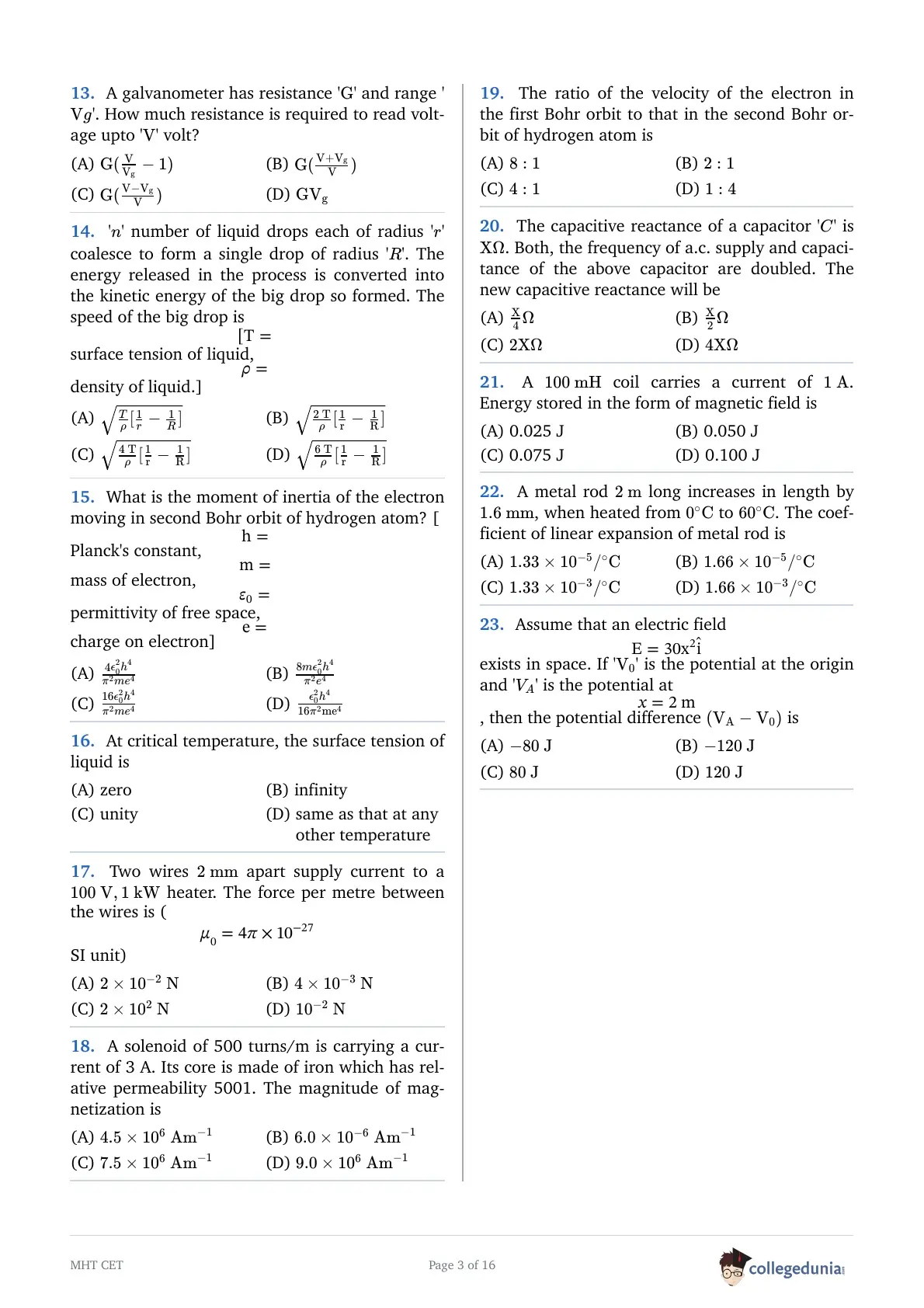
A galvanometer has resistance '\[\mathrm{G}\]' and range '\[\mathrm{V} g\]'. How much resistance is required to read voltage upto '\[\mathrm{V}\]' volt?

  • (A) \(\mathrm{G}(\frac{\mathrm{V}}{\mathrm{V}_{\mathrm{g}}}-1)\)
  • (B) \(\mathrm{G}(\frac{\mathrm{V}+\mathrm{V}_{\mathrm{g}}}{\mathrm{V}})\)
  • (C) \(\mathrm{G}(\frac{\mathrm{V}-\mathrm{V}_{\mathrm{g}}}{\mathrm{V}})\)
  • (D) \(\mathrm{GV}_{\mathrm{g}}\)

Question 14:

'\[n\]' number of liquid drops each of radius '\[r\]' coalesce to form a single drop of radius '\[R\]'. The energy released in the process is converted into the kinetic energy of the big drop so formed. The speed of the big drop is

\[[\mathrm{T}=\] surface tension of liquid, \[\rho=\] density of liquid.]

  • (A) \(\sqrt{\frac{T}{\rho}[\frac{1}{r}-\frac{1}{R}]}\)
  • (B) \(\sqrt{\frac{2\text{ }\mathrm{T}}{\rho}[\frac{1}{\mathrm{r}}-\frac{1}{\mathrm{R}}]}\)
  • (C) \(\sqrt{\frac{4\text{ }\mathrm{T}}{\rho}[\frac{1}{\mathrm{r}}-\frac{1}{\mathrm{R}}]}\)
  • (D) \(\sqrt{\frac{6\text{ }\mathrm{T}}{\rho}[\frac{1}{\mathrm{r}}-\frac{1}{\mathrm{R}}]}\)

Question 15:

What is the moment of inertia of the electron moving in second Bohr orbit of hydrogen atom? [ \[\mathrm{h}=\] Planck's constant, \[\mathrm{m}=\] mass of electron, \[\varepsilon_0=\] permittivity of free space, \[\mathrm{e}=\] charge on electron]

  • (A) \(\frac{4\epsilon _{0}^{2}h^{4}}{\pi ^{2}me^{4}}\)
  • (B) \(\frac{8m\epsilon _{0}^{2}h^{4}}{\pi ^{2}e^{4}}\)
  • (C) \(\frac{16\epsilon _{0}^{2}h^{4}}{\pi ^{2}me^{4}}\)
  • (D) \(\frac{\epsilon _{0}^{2}h^{4}}{16\pi ^{2}\mathrm{me}^{4}}\)

Question 16:

At critical temperature, the surface tension of liquid is

  • (A) zero
  • (B) infinity
  • (C) unity
  • (D) same as that at any other temperature

Question 18:

A solenoid of 500 turns/m is carrying a current of 3 A. Its core is made of iron which has relative permeability 5001. The magnitude of magnetization is

  • (A) \(4.5\times 10^{6}\text{ }\mathrm{Am}^{-1}\)
  • (B) \(6.0\times 10^{-6}\text{ }\mathrm{Am}^{-1}\)
  • (C) \(7.5\times 10^{6}\text{ }\mathrm{Am}^{-1}\)
  • (D) \(9.0\times 10^{6}\text{ }\mathrm{Am}^{-1}\)

Question 19:

The ratio of the velocity of the electron in the first Bohr orbit to that in the second Bohr orbit of hydrogen atom is

  • (A) \(8:1\)
  • (B) \(2:1\)
  • (C) \(4:1\)
  • (D) \(1:4\)

Question 20:

The capacitive reactance of a capacitor '\[C\]' is \[\mathrm{X} \Omega\]. Both, the frequency of a.c. supply and capacitance of the above capacitor are doubled. The new capacitive reactance will be

  • (A) \(\frac{\mathrm{X}}{4}\Omega\)
  • (B) \(\frac{\mathrm{X}}{2}\Omega\)
  • (C) \(2\mathrm{X}\Omega\)
  • (D) \(4\mathrm{X}\Omega\)

Question 21:

A \[100 \mathrm{~mH}\] coil carries a current of \[1 \mathrm{~A}\]. Energy stored in the form of magnetic field is

  • (A) 0.025 J
  • (B) 0.050 J
  • (C) 0.075 J
  • (D) 0.100 J

Question 22:

A metal rod \[2 \mathrm{~m}\] long increases in length by \[1.6 \mathrm{~mm}\], when heated from \[0^{\circ} \mathrm{C}\] to \[60^{\circ} \mathrm{C}\]. The coefficient of linear expansion of metal rod is

  • (A) \(1.33\times 10^{-5}/{}^{\circ}\mathrm{C}\)
  • (B) \(1.66\times 10^{-5}/{}^{\circ}\mathrm{C}\)
  • (C) \(1.33\times 10^{-3}/{}^{\circ}\mathrm{C}\)
  • (D) \(1.66\times 10^{-3}/{}^{\circ}\mathrm{C}\)

Question 23:

Assume that an electric field \[\mathrm{E}=30 \mathrm{x}^2 \hat{\mathrm{i}}\] exists in space. If '\[\mathrm{V}_0\]' is the potential at the origin and '\[V_A\]' is the potential at \[x=2 \mathrm{~m}\], then the potential difference \[\left(\mathrm{V}_{\mathrm{A}}-\mathrm{V}_0\right)\] is

  • (A) \(-80\text{ }\mathrm{J}\)
  • (B) \(-120\text{ }\mathrm{J}\)
  • (C) \(80\text{ }\mathrm{J}\)
  • (D) \(120\text{ }\mathrm{J}\)

Question 24:

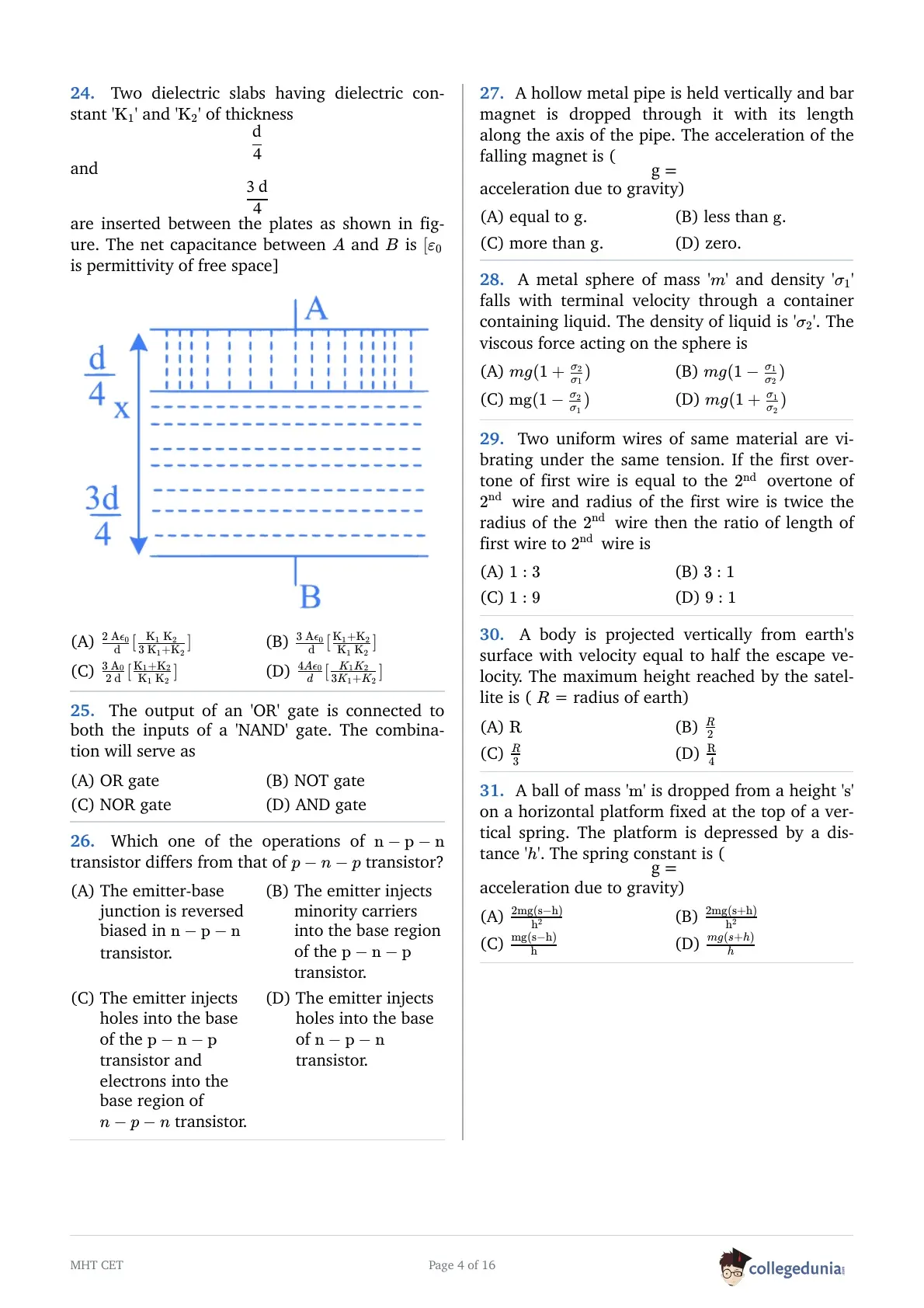
Two dielectric slabs having dielectric constant '\[\mathrm{K}_1\]' and '\[\mathrm{K}_2\]' of thickness \[\frac{\mathrm{d}}{4}\] and \[\frac{3 \mathrm{~d}}{4}\] are inserted between the plates as shown in figure. The net capacitance between \[A\] and \[B\] is \[\left[\varepsilon_0\right.\] is permittivity of free space]

  • (A) \(\frac{2\text{ }\mathrm{A}\epsilon _{0}}{\text{ }\mathrm{d}}[\frac{\mathrm{K}_{1}\text{ }\mathrm{K}_{2}}{3\text{ }\mathrm{K}_{1}+\mathrm{K}_{2}}]\)
  • (B) \(\frac{3\text{ }\mathrm{A}\epsilon _{0}}{\text{ }\mathrm{d}}[\frac{\mathrm{K}_{1}+\mathrm{K}_{2}}{\text{ }\mathrm{K}_{1}\text{ }\mathrm{K}_{2}}]\)
  • (C) \(\frac{3\text{ }\mathrm{A}_{0}}{2\text{ }\mathrm{d}}[\frac{\mathrm{K}_{1}+\mathrm{K}_{2}}{\text{ }\mathrm{K}_{1}\text{ }\mathrm{K}_{2}}]\)
  • (D) \(\frac{4A\epsilon _{0}}{d}[\frac{K_{1}K_{2}}{3K_{1}+K_{2}}]\)

Question 25:

The output of an 'OR' gate is connected to both the inputs of a 'NAND' gate. The combination will serve as

  • (A) OR gate
  • (B) NOT gate
  • (C) NOR gate
  • (D) AND gate

Question 26:

Which one of the operations of \[\mathrm{n}-\mathrm{p}-\mathrm{n}\] transistor differs from that of \[p-n-p\] transistor?

  • (A) The emitter-base junction is reversed biased in \(\mathrm{n}-\mathrm{p}-\mathrm{n}\) transistor.
  • (B) The emitter injects minority carriers into the base region of the \(\mathrm{p}-\mathrm{n}-\mathrm{p}\) transistor.
  • (C) The emitter injects holes into the base of the \(\mathrm{p}-\mathrm{n}-\mathrm{p}\) transistor and electrons into the base region of \(n-p-n\) transistor.
  • (D) The emitter injects holes into the base of \(\mathrm{n}-\mathrm{p}-\mathrm{n}\) transistor.

Question 27:

A hollow metal pipe is held vertically and bar magnet is dropped through it with its length along the axis of the pipe. The acceleration of the falling magnet is ( \[\mathrm{g}=\] acceleration due to gravity)

  • (A) equal to g.
  • (B) less than \(\mathrm{g}\).
  • (C) more than g.
  • (D) zero.

Question 28:

A metal sphere of mass '\[m\]' and density '\[\sigma_1\]' falls with terminal velocity through a container containing liquid. The density of liquid is '\[\sigma_2\]'. The viscous force acting on the sphere is

  • (A) \(mg(1+\frac{\sigma _{2}}{\sigma _{1}})\)
  • (B) \(mg(1-\frac{\sigma _{1}}{\sigma _{2}})\)
  • (C) \(\mathrm{mg}(1-\frac{\sigma _{2}}{\sigma _{1}})\)
  • (D) \(mg(1+\frac{\sigma _{1}}{\sigma _{2}})\)

Question 29:

Two uniform wires of same material are vibrating under the same tension. If the first overtone of first wire is equal to the \[2^{\text {nd }}\] overtone of \[2^{\text {nd }}\] wire and radius of the first wire is twice the radius of the \[2^{\text {nd }}\] wire then the ratio of length of first wire to \[2^{\text {nd }}\] wire is

  • (A) \(1:3\)
  • (B) \(3:1\)
  • (C) \(1:9\)
  • (D) \(9:1\)

Question 30:

A body is projected vertically from earth's surface with velocity equal to half the escape velocity. The maximum height reached by the satellite is ( \[R\] = radius of earth)

  • (A) \(\mathrm{R}\)
  • (B) \(\frac{R}{2}\)
  • (C) \(\frac{R}{3}\)
  • (D) \(\frac{\mathrm{R}}{4}\)

Question 31:

A ball of mass '\[\mathrm{m}\]' is dropped from a height '\[\mathrm{s}\]' on a horizontal platform fixed at the top of a vertical spring. The platform is depressed by a distance '\[h\]'. The spring constant is ( \[\mathrm{g}=\] acceleration due to gravity)

  • (A) \(\frac{2\mathrm{mg}(\mathrm{s}-\mathrm{h})}{\mathrm{h}^{2}}\)
  • (B) \(\frac{2\mathrm{mg}(\mathrm{s}+\mathrm{h})}{\mathrm{h}^{2}}\)
  • (C) \(\frac{\mathrm{mg}(\mathrm{s}-\mathrm{h})}{\mathrm{h}}\)
  • (D) \(\frac{mg(s+h)}{h}\)

Question 32:

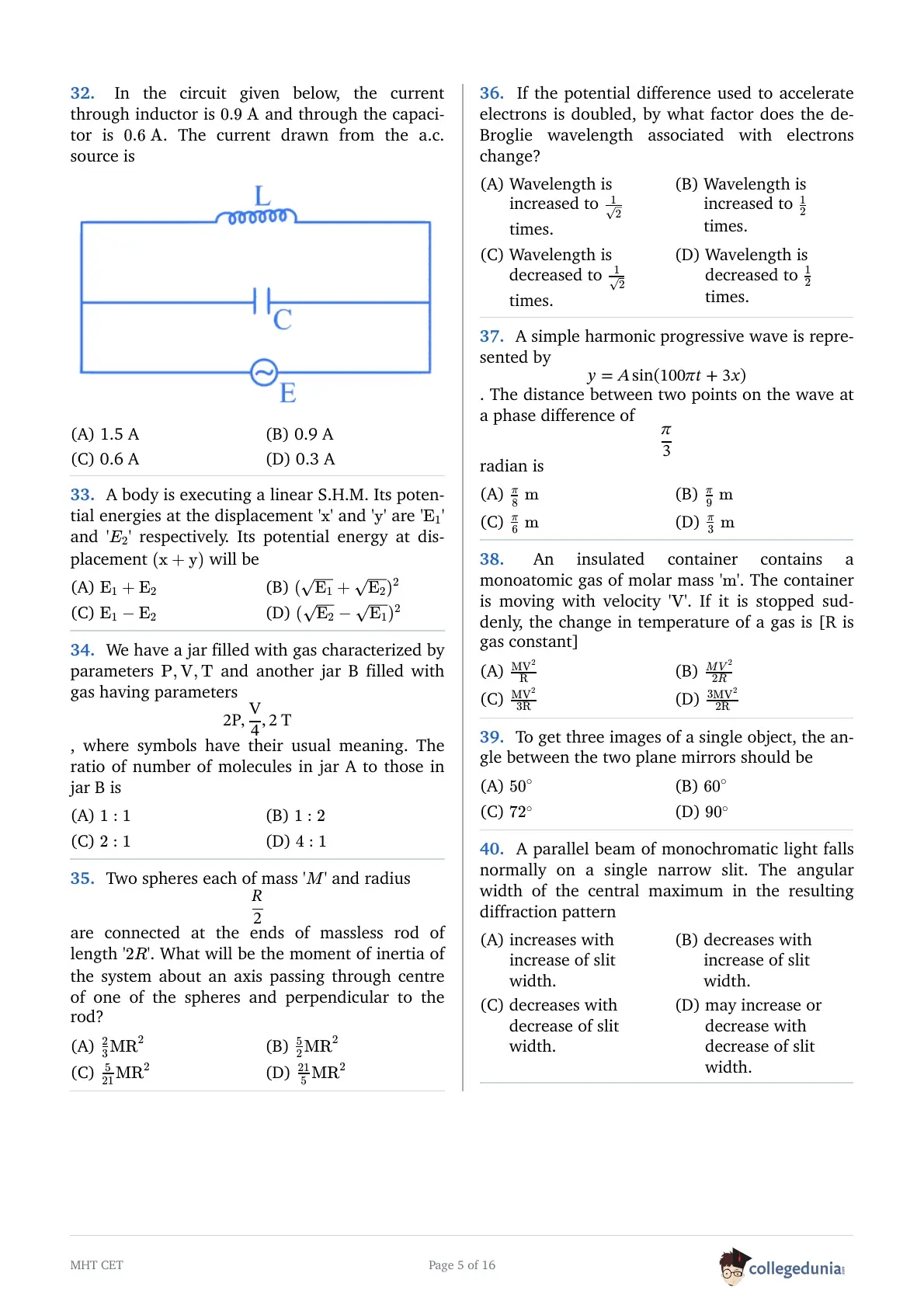
In the circuit given below, the current through inductor is \[0.9 \mathrm{~A}\] and through the capacitor is \[0.6 \mathrm{~A}\]. The current drawn from the a.c. source is

  • (A) 1.5 A
  • (B) 0.9 A
  • (C) 0.6 A
  • (D) 0.3 A

Question 33:

A body is executing a linear S.H.M. Its potential energies at the displacement '\[\mathrm{x}\]' and '\[\mathrm{y}\]' are '\[\mathrm{E}_1\]' and '\[E_2\]' respectively. Its potential energy at displacement \[(\mathrm{x}+\mathrm{y})\] will be

  • (A) \(\mathrm{E}_{1}+\mathrm{E}_{2}\)
  • (B) \((\sqrt{\mathrm{E}_{1}}+\sqrt{\mathrm{E}_{2}})^{2}\)
  • (C) \(\mathrm{E}_{1}-\mathrm{E}_{2}\)
  • (D) \((\sqrt{\mathrm{E}_{2}}-\sqrt{\mathrm{E}_{1}})^{2}\)

Question 34:

We have a jar filled with gas characterized by parameters \[\mathrm{P}, \mathrm{V}, \mathrm{T}\] and another jar B filled with gas having parameters \[2 \mathrm{P}, \frac{\mathrm{V}}{4}, 2 \mathrm{~T}\], where symbols have their usual meaning. The ratio of number of molecules in jar A to those in jar B is

  • (A) \(1:1\)
  • (B) \(1:2\)
  • (C) \(2:1\)
  • (D) \(4:1\)

Question 35:

Two spheres each of mass '\[M\]' and radius \[\frac{R}{2}\] are connected at the ends of massless rod of length '\[2 R\]'. What will be the moment of inertia of the system about an axis passing through centre of one of the spheres and perpendicular to the rod?

  • (A) \(\frac{2}{3}\mathrm{MR}^{2}\)
  • (B) \(\frac{5}{2}\mathrm{MR}^{2}\)
  • (C) \(\frac{5}{21}\mathrm{MR}^{2}\)
  • (D) \(\frac{21}{5}\mathrm{MR}^{2}\)

Question 36:

If the potential difference used to accelerate electrons is doubled, by what factor does the de-Broglie wavelength associated with electrons change?

  • (A) Wavelength is increased to \(\frac{1}{\sqrt{2}}\) times.
  • (B) Wavelength is increased to \(\frac{1}{2}\) times.
  • (C) Wavelength is decreased to \(\frac{1}{\sqrt{2}}\) times.
  • (D) Wavelength is decreased to \(\frac{1}{2}\) times.

Question 37:

A simple harmonic progressive wave is represented by \[y=A \sin (100 \pi t+3 x)\]. The distance between two points on the wave at a phase difference of \[\frac{\pi}{3}\] radian is

  • (A) \(\frac{\pi}{8}\text{ }\mathrm{m}\)
  • (B) \(\frac{\pi}{9}\text{ }\mathrm{m}\)
  • (C) \(\frac{\pi}{6}\text{ }\mathrm{m}\)
  • (D) \(\frac{\pi}{3}\text{ }\mathrm{m}\)

Question 38:

An insulated container contains a monoatomic gas of molar mass '\[\mathrm{m}\]'. The container is moving with velocity '\[\mathrm{V}\]'. If it is stopped suddenly, the change in temperature of a gas is [R is gas constant]

  • (A) \(\frac{\mathrm{MV}^{2}}{\mathrm{R}}\)
  • (B) \(\frac{MV^{2}}{2R}\)
  • (C) \(\frac{\mathrm{MV}^{2}}{3\mathrm{R}}\)
  • (D) \(\frac{3\mathrm{MV}^{2}}{2\mathrm{R}}\)

Question 39:

To get three images of a single object, the angle between the two plane mirrors should be

  • (A) \(50^{\circ}\)
  • (B) \(60^{\circ}\)
  • (C) \(72^{\circ}\)
  • (D) \(90^{\circ}\)

Question 40:

A parallel beam of monochromatic light falls normally on a single narrow slit. The angular width of the central maximum in the resulting diffraction pattern

  • (A) increases with increase of slit width.
  • (B) decreases with increase of slit width.
  • (C) decreases with decrease of slit width.
  • (D) may increase or decrease with decrease of slit width.

Question 41:

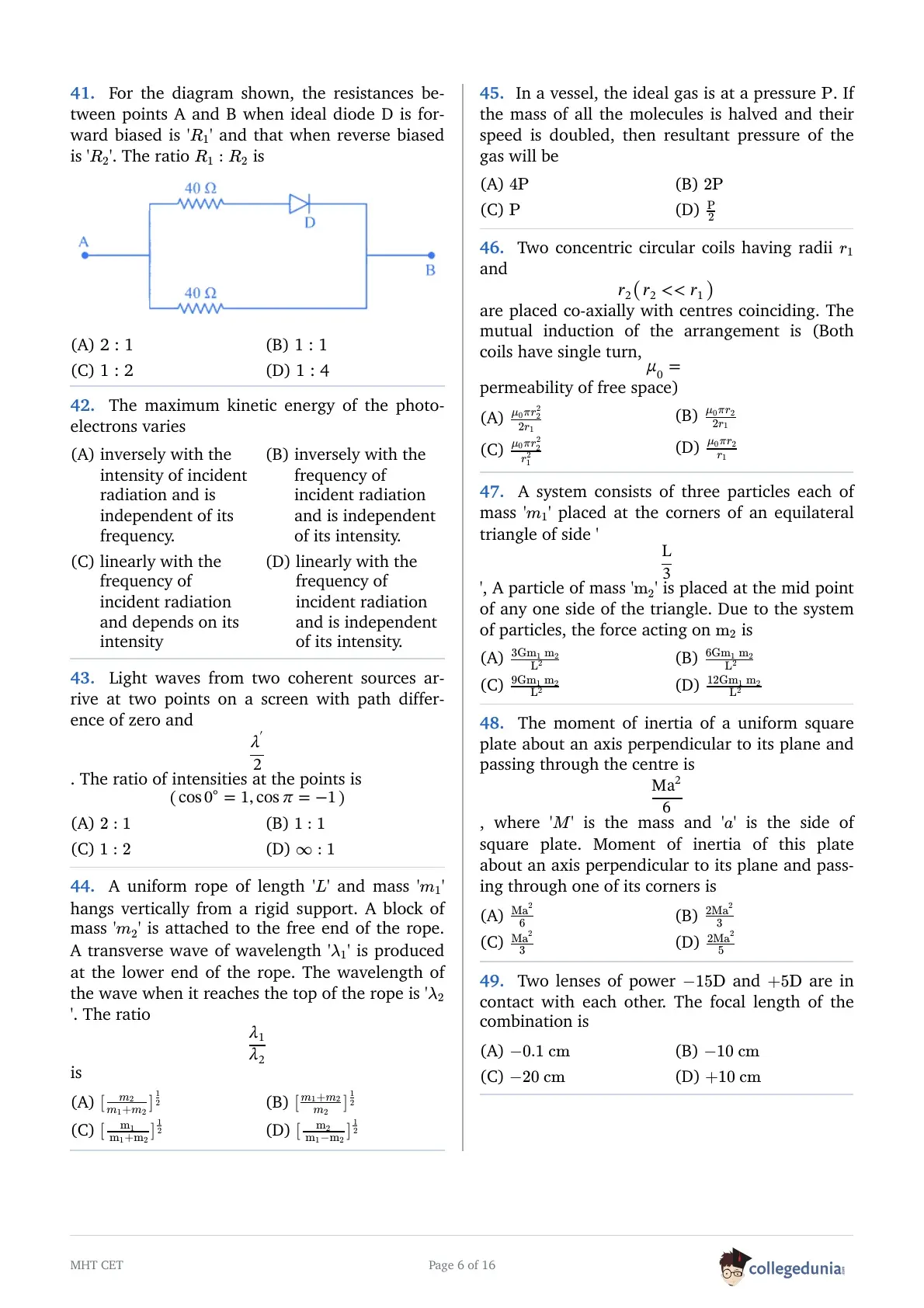
For the diagram shown, the resistances between points A and B when ideal diode D is forward biased is '\[R_1\]' and that when reverse biased is '\[R_2\]'. The ratio \[R_1: R_2\] is

  • (A) 2 : 1
  • (B) 1 : 1
  • (C) 1 : 2
  • (D) 1 : 4

Question 42:

The maximum kinetic energy of the photoelectrons varies

  • (A) inversely with the intensity of incident radiation and is independent of its frequency.
  • (B) inversely with the frequency of incident radiation and is independent of its intensity.
  • (C) linearly with the frequency of incident radiation and depends on its intensity
  • (D) linearly with the frequency of incident radiation and is independent of its intensity.

Question 43:

Light waves from two coherent sources arrive at two points on a screen with path difference of zero and \[\frac{\lambda^{\prime}}{2}\]. The ratio of intensities at the points is \[\left(\cos 0^{\circ}=1, \cos \pi=-1\right)\]

  • (A) \(2:1\)
  • (B) \(1:1\)
  • (C) \(1:2\)
  • (D) \(\infty :1\)

Question 44:

A uniform rope of length '\[L\]' and mass '\[m_1\]' hangs vertically from a rigid support. A block of mass '\[m_2\]' is attached to the free end of the rope. A transverse wave of wavelength '\[\lambda_1\]' is produced at the lower end of the rope. The wavelength of the wave when it reaches the top of the rope is '\[\lambda_2\]'. The ratio \[\frac{\lambda_1}{\lambda_2}\] is

  • (A) \([\frac{m_{2}}{m_{1}+m_{2}}]^{\frac{1}{2}}\)
  • (B) \([\frac{m_{1}+m_{2}}{m_{2}}]^{\frac{1}{2}}\)
  • (C) \([\frac{\mathrm{m}_{1}}{\text{ }\mathrm{m}_{1}+\mathrm{m}_{2}}]^{\frac{1}{2}}\)
  • (D) \([\frac{\mathrm{m}_{2}}{\text{ }\mathrm{m}_{1}-\mathrm{m}_{2}}]^{\frac{1}{2}}\)

Question 45:

In a vessel, the ideal gas is at a pressure \[\mathrm{P}\]. If the mass of all the molecules is halved and their speed is doubled, then resultant pressure of the gas will be

  • (A) \(4\mathrm{P}\)
  • (B) \(2\mathrm{P}\)
  • (C) \(\mathrm{P}\)
  • (D) \(\frac{\mathrm{P}}{2}\)

Question 46:

Two concentric circular coils having radii \(r_1\) and \(r_2\left(r_2 << r_1\right)\) are placed co-axially with centres coinciding. The mutual induction of the arrangement is (Both coils have single turn, \(\mu_0=\) permeability of free space)

  • (A) \(\frac{\mu _{0}\pi r_{2}^{2}}{2r_{1}}\)
  • (B) \(\frac{\mu _{0}\pi r_{2}}{2r_{1}}\)
  • (C) \(\frac{\mu _{0}\pi r_{2}^{2}}{r_{1}^{2}}\)
  • (D) \(\frac{\mu _{0}\pi r_{2}}{r_{1}}\)

Question 47:

A system consists of three particles each of mass '\[m_1\]' placed at the corners of an equilateral triangle of side '\[\frac{\mathrm{L}}{3}\]', A particle of mass '\[\mathrm{m}_2\]' is placed at the mid point of any one side of the triangle. Due to the system of particles, the force acting on \[\mathrm{m}_2\] is

  • (A) \(\frac{3\mathrm{Gm}_{1}\text{ }\mathrm{m}_{2}}{\text{ }\mathrm{L}^{2}}\)
  • (B) \(\frac{6\mathrm{Gm}_{1}\text{ }\mathrm{m}_{2}}{\text{ }\mathrm{L}^{2}}\)
  • (C) \(\frac{9\mathrm{Gm}_{1}\text{ }\mathrm{m}_{2}}{\text{ }\mathrm{L}^{2}}\)
  • (D) \(\frac{12\mathrm{Gm}_{1}\text{ }\mathrm{m}_{2}}{\text{ }\mathrm{L}^{2}}\)

Question 48:

The moment of inertia of a uniform square plate about an axis perpendicular to its plane and passing through the centre is \[\frac{\mathrm{Ma}^2}{6}\], where '\[M\]' is the mass and '\[a\]' is the side of square plate. Moment of inertia of this plate about an axis perpendicular to its plane and passing through one of its corners is

  • (A) \(\frac{\mathrm{Ma}^{2}}{6}\)
  • (B) \(\frac{2\mathrm{Ma}^{2}}{3}\)
  • (C) \(\frac{\mathrm{Ma}^{2}}{3}\)
  • (D) \(\frac{2\mathrm{Ma}^{2}}{5}\)

Question 49:

Two lenses of power \[-15 \mathrm{D}\] and \[+5 \mathrm{D}\] are in contact with each other. The focal length of the combination is

  • (A) \(-0.1\text{ }\mathrm{cm}\)
  • (B) \(-10\text{ }\mathrm{cm}\)
  • (C) \(-20\text{ }\mathrm{cm}\)
  • (D) \(+10\text{ }\mathrm{cm}\)

Question 50:

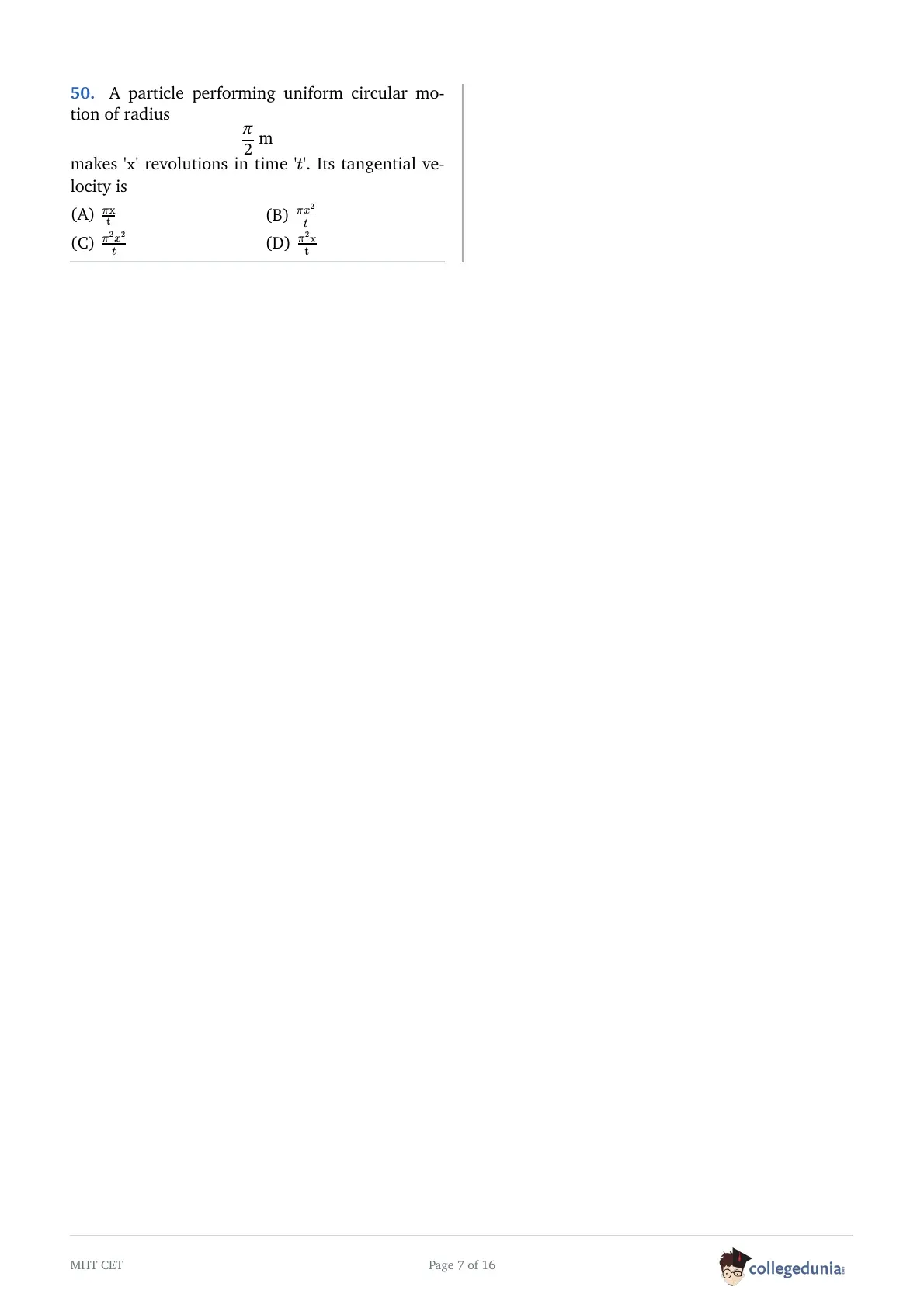
A particle performing uniform circular motion of radius \[\frac{\pi}{2} \mathrm{~m}\] makes '\[\mathrm{x}\]' revolutions in time '\[t\]'. Its tangential velocity is

  • (A) \(\frac{\pi \mathrm{x}}{\mathrm{t}}\)
  • (B) \(\frac{\pi x^{2}}{t}\)
  • (C) \(\frac{\pi ^{2}x^{2}}{t}\)
  • (D) \(\frac{\pi ^{2}\mathrm{x}}{\mathrm{t}}\)

Chemistry (Q51 - Q100)

Question 51:

What is the calculated value of spin only magnetic moment in terms of BM if only one unpaired electron is present in a species?

  • (A) 2.76
  • (B) 2.84
  • (C) 2.2
  • (D) 1.73

Question 52:

Which of the following is tertiary allylic alcohol?

  • (A) Prop-2-en-1-ol
  • (B) But-3-en-2-ol
  • (C) 2-Methylprop-2-en-ol
  • (D) 2-Methylbut-3-en-2-ol

Question 53:

Identify the solvent used in bromination of phenol to obtain 2,4,6-tribromophenol.

  • (A) Chloroform
  • (B) Water
  • (C) Carbon tetrachloride
  • (D) Carbon disulphide

Question 54:

How many moles of nitrogen atoms are present in \[8 \mathrm{~g}\] of ammonium nitrate?

(Molar mass of ammonium nitrate \[=80\] )

  • (A) \(0.1\text{ }\mathrm{mol}\)
  • (B) \(0.2\text{ }\mathrm{mol}\)
  • (C) \(0.4\text{ }\mathrm{mol}\)
  • (D) \(0.8\text{ }\mathrm{mol}\)

Question 55:

Identify the elements undergoing reduction and oxidation respectively in the following redox reaction.

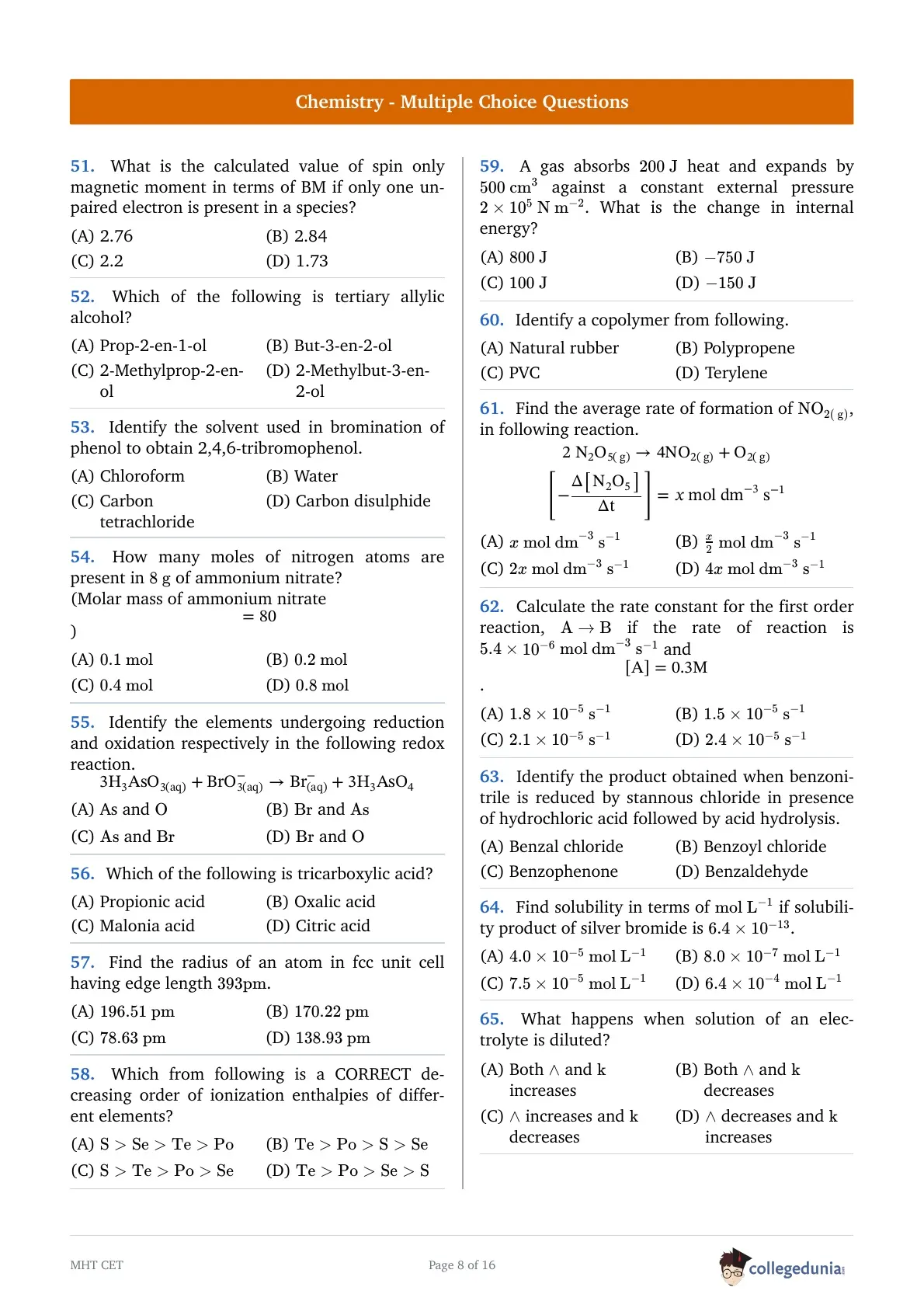
\[3 \mathrm{H}_3 \mathrm{AsO}_{3(\mathrm{aq})}+\mathrm{BrO}_{3(\mathrm{aq})}^{-} \rightarrow \mathrm{Br}_{(\mathrm{aq})}^{-}+3 \mathrm{H}_3 \mathrm{AsO}_4\]

  • (A) As and \(\mathrm{O}\)
  • (B) \(\mathrm{Br}\) and \(\mathrm{As}\)
  • (C) \(\mathrm{As}\) and \(\mathrm{Br}\)
  • (D) \(\mathrm{Br}\) and \(\mathrm{O}\)

Question 56:

Which of the following is tricarboxylic acid?

  • (A) Propionic acid
  • (B) Oxalic acid
  • (C) Malonia acid
  • (D) Citric acid

Question 57:

Find the radius of an atom in fcc unit cell having edge length \[393 \mathrm{pm}\].

  • (A) \(196.51\text{ }\mathrm{pm}\)
  • (B) \(170.22\text{ }\mathrm{pm}\)
  • (C) \(78.63\text{ }\mathrm{pm}\)
  • (D) \(138.93\text{ }\mathrm{pm}\)

Question 58:

Which from following is a CORRECT decreasing order of ionization enthalpies of different elements?

  • (A) \(\mathrm{S}>\mathrm{Se}>\mathrm{Te}>\mathrm{Po}\)
  • (B)

    \(\mathrm{Te}>\mathrm{Po}>\mathrm{S}>\mathrm{Se}\)

  • (C) \(\mathrm{S}>\mathrm{Te}>\mathrm{Po}>\mathrm{Se}\)
  • (D) \(\mathrm{Te}>\mathrm{Po}>\mathrm{Se}>\mathrm{S}\)

Question 59:

A gas absorbs \[200 \mathrm{~J}\] heat and expands by \[500 \mathrm{~cm}^3\] against a constant external pressure \[2 \times 10^5 \mathrm{~N} \mathrm{~m}^{-2}\]. What is the change in internal energy?

  • (A) \(800\text{ }\mathrm{J}\)
  • (B) \(-750\text{ }\mathrm{J}\)
  • (C) \(100\text{ }\mathrm{J}\)
  • (D) \(-150\text{ }\mathrm{J}\)

Question 60:

Identify a copolymer from following.

  • (A) Natural rubber
  • (B) Polypropene
  • (C) PVC
  • (D) Terylene

Question 61:

Find the average rate of formation of \[\mathrm{NO}_{2(\mathrm{~g})}\], in following reaction.

\[\begin{aligned} & 2 \mathrm{~N}_2 \mathrm{O}_{5(\mathrm{~g})} \rightarrow 4 \mathrm{NO}_{2(\mathrm{~g})}+\mathrm{O}_{2(\mathrm{~g})} \\ & {\left[-\frac{\Delta\left[\mathrm{N}_2 \mathrm{O}_5\right]}{\Delta \mathrm{t}}\right]=x \mathrm{~mol} \mathrm{~dm}^{-3} \mathrm{~s}^{-1}} \end{aligned}\]

  • (A) \(x\text{ }\mathrm{mol}\text{ }\mathrm{dm}^{-3}\text{ }\mathrm{s}^{-1}\)
  • (B) \(\frac{x}{2}\text{ }\mathrm{mol}\text{ }\mathrm{dm}^{-3}\text{ }\mathrm{s}^{-1}\)
  • (C) \(2x\text{ }\mathrm{mol}\text{ }\mathrm{dm}^{-3}\text{ }\mathrm{s}^{-1}\)
  • (D) \(4x\text{ }\mathrm{mol}\text{ }\mathrm{dm}^{-3}\text{ }\mathrm{s}^{-1}\)

Question 62:

Calculate the rate constant for the first order reaction, \[\mathrm{A} \rightarrow \mathrm{B}\] if the rate of reaction is \[5.4 \times 10^{-6} \mathrm{~mol} \mathrm{~dm}^{-3} \mathrm{~s}^{-1}\] and \[[\mathrm{A}]=0.3 \mathrm{M}\].

  • (A) \(1.8\times 10^{-5}\text{ }\mathrm{s}^{-1}\)
  • (B) \(1.5\times 10^{-5}\text{ }\mathrm{s}^{-1}\)
  • (C) \(2.1\times 10^{-5}\text{ }\mathrm{s}^{-1}\)
  • (D) \(2.4\times 10^{-5}\text{ }\mathrm{s}^{-1}\)

Question 63:

Identify the product obtained when benzonitrile is reduced by stannous chloride in presence of hydrochloric acid followed by acid hydrolysis.

  • (A) Benzal chloride
  • (B) Benzoyl chloride
  • (C) Benzophenone
  • (D) Benzaldehyde

Question 64:

Find solubility in terms of \[\mathrm{mol} \mathrm{~L}^{-1}\] if solubility product of silver bromide is \[6.4 \times 10^{-13}\].

  • (A) \(4.0\times 10^{-5}\text{ }\mathrm{mol}\text{ }\mathrm{L}^{-1}\)
  • (B) \(8.0\times 10^{-7}\text{ }\mathrm{mol}\text{ }\mathrm{L}^{-1}\)
  • (C) \(7.5\times 10^{-5}\text{ }\mathrm{mol}\text{ }\mathrm{L}^{-1}\)
  • (D) \(6.4\times 10^{-4}\text{ }\mathrm{mol}\text{ }\mathrm{L}^{-1}\)

Question 65:

What happens when solution of an electrolyte is diluted?

  • (A) Both \(\wedge\) and \(\mathrm{k}\) increases
  • (B) Both \(\wedge\) and \(\mathrm{k}\) decreases
  • (C) \(\wedge\) increases and \(\mathrm{k}\) decreases
  • (D) \(\wedge\) decreases and \(\mathrm{k}\) increases

Question 66:

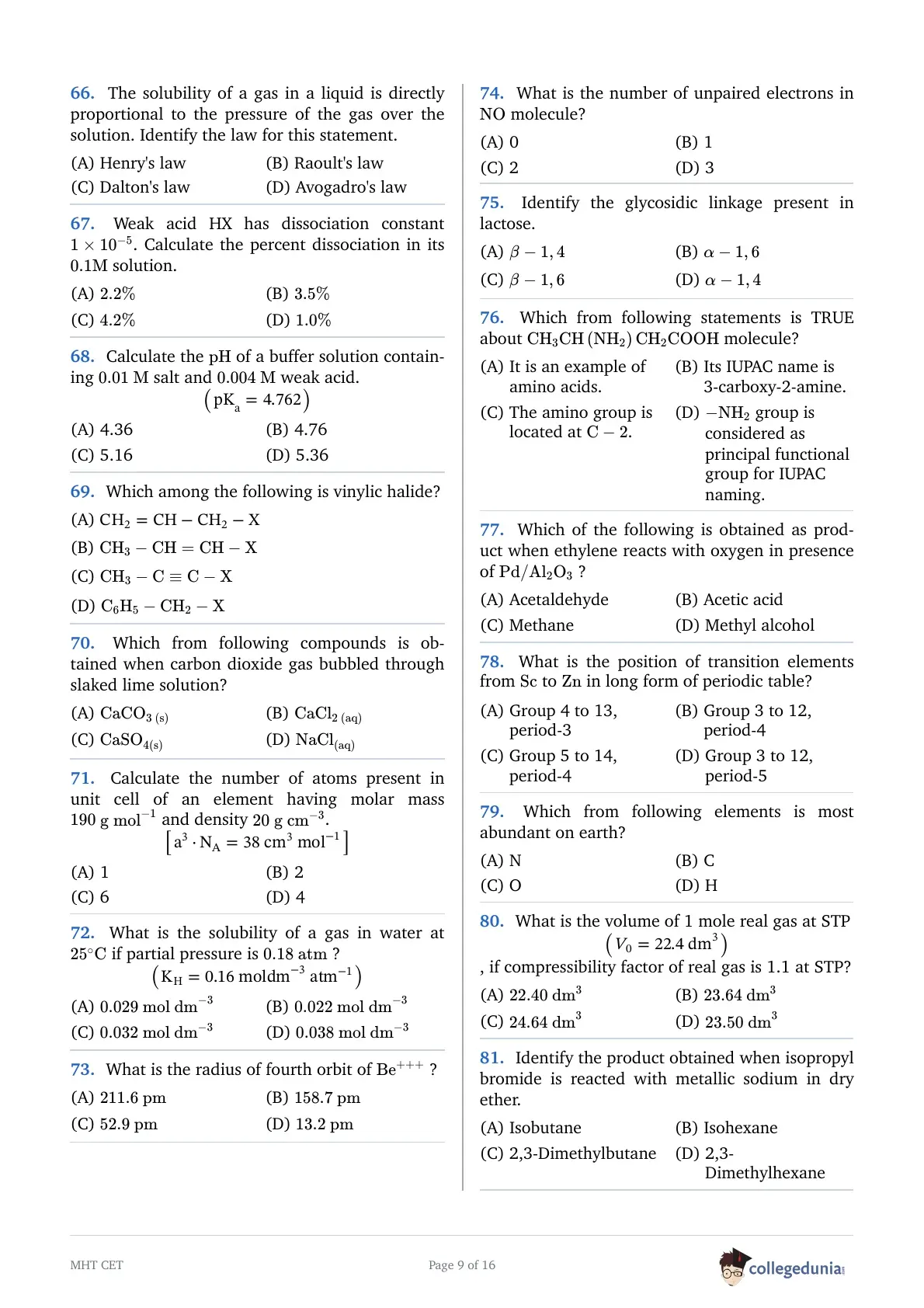
The solubility of a gas in a liquid is directly proportional to the pressure of the gas over the solution. Identify the law for this statement.

  • (A) Henry's law
  • (B) Raoult's law
  • (C) Dalton's law
  • (D) Avogadro's law

Question 67:

Weak acid HX has dissociation constant \[1 \times 10^{-5}\]. Calculate the percent dissociation in its \[0.1 \mathrm{M}\] solution.

  • (A) \(2.2\%\)
  • (B) \(3.5\%\)
  • (C) \(4.2\%\)
  • (D) \(1.0\%\)

Question 68:

Calculate the \[\mathrm{pH}\] of a buffer solution containing \[0.01 ~\mathrm{M}\] salt and \[0.004 \mathrm{~M}\] weak acid.

\[\left(\mathrm{pK}_{\mathrm{a}}=4.762\right)\]

  • (A) 4.36
  • (B) 4.76
  • (C) 5.16
  • (D) 5.36

Question 69:

Which among the following is vinylic halide?

  • (A) \(\mathrm{CH}_{2}=\mathrm{CH}-\mathrm{CH}_{2}-\mathrm{X}\)
  • (B) \(\mathrm{CH}_{3}-\mathrm{CH}=\mathrm{CH}-\mathrm{X}\)
  • (C) \(\mathrm{CH}_{3}-\mathrm{C}\equiv \mathrm{C}-\mathrm{X}\)
  • (D) \(\mathrm{C}_{6}\mathrm{H}_{5}-\mathrm{CH}_{2}-\mathrm{X}\)

Question 70:

Which from following compounds is obtained when carbon dioxide gas bubbled through slaked lime solution?

  • (A) \(\mathrm{CaCO}_{3\text{ (s) }}\)
  • (B) \(\mathrm{CaCl}_{2\text{ (aq) }}\)
  • (C) \(\mathrm{CaSO}_{4(\mathrm{s})}\)
  • (D) \(\mathrm{NaCl}_{(\mathrm{aq})}\)

Question 71:

Calculate the number of atoms present in unit cell of an element having molar mass \[190 \mathrm{~g} \mathrm{~mol}^{-1}\] and density \[20 \mathrm{~g} \mathrm{~cm}^{-3}\].

\[\left[\mathrm{a}^3 \cdot \mathrm{N}_{\mathrm{A}}=38 \mathrm{~cm}^3 \mathrm{~mol}^{-1}\right]\]

  • (A) 1
  • (B) 2
  • (C) 6
  • (D) 4

Question 72:

What is the solubility of a gas in water at \[25^{\circ} \mathrm{C}\] if partial pressure is \[0.18 \mathrm{~atm}\] ?

\[\left(\mathrm{K}_{\mathrm{H}}=0.16 \mathrm{~mol} \mathrm{dm}^{-3} \mathrm{~atm}^{-1}\right)\]

  • (A) \(0.029\text{ }\mathrm{mol}\text{ }\mathrm{dm}^{-3}\)
  • (B) \(0.022\text{ }\mathrm{mol}\text{ }\mathrm{dm}^{-3}\)
  • (C) \(0.032\text{ }\mathrm{mol}\text{ }\mathrm{dm}^{-3}\)
  • (D) \(0.038\text{ }\mathrm{mol}\text{ }\mathrm{dm}^{-3}\)

Question 73:

What is the radius of fourth orbit of \[\mathrm{Be}^{+++}\] ?

  • (A) \(211.6\text{ }\mathrm{pm}\)
  • (B) \(158.7\text{ }\mathrm{pm}\)
  • (C) \(52.9\text{ }\mathrm{pm}\)
  • (D) \(13.2\text{ }\mathrm{pm}\)

Question 74:

What is the number of unpaired electrons in \[\mathrm{NO}\] molecule?

  • (A) 0
  • (B) 1
  • (C) 2
  • (D) 3

Question 75:

Identify the glycosidic linkage present in lactose.

  • (A) \(\beta -1,4\)
  • (B) \(\alpha -1,6\)
  • (C) \(\beta -1,6\)
  • (D) \(\alpha -1,4\)

Question 76:

Which from following statements is TRUE about \[\mathrm{CH}_3 \mathrm{CH}\left(\mathrm{NH}_2\right) \mathrm{CH}_2 \mathrm{COOH}\] molecule?

  • (A) It is an example of amino acids.
  • (B) Its IUPAC name is 3-carboxy-2-amine.
  • (C) The amino group is located at \(\mathrm{C}-2\).
  • (D) \(-\mathrm{NH}_{2}\) group is considered as principal functional group for IUPAC naming.

Question 77:

Which of the following is obtained as product when ethylene reacts with oxygen in presence of \[\mathrm{Pd} / \mathrm{Al}_2 \mathrm{O}_3\] ?

  • (A) Acetaldehyde
  • (B) Acetic acid
  • (C) Methane
  • (D) Methyl alcohol

Question 78:

What is the position of transition elements from \[\mathrm{Sc}\] to \[\mathrm{Zn}\] in long form of periodic table?

  • (A) Group 4 to 13, period-3
  • (B) Group 3 to 12, period-4
  • (C) Group 5 to 14, period-4
  • (D) Group 3 to 12, period-5

Question 79:

Which from following elements is most abundant on earth?

  • (A) N
  • (B) C
  • (C) O
  • (D) H

Question 80:

What is the volume of 1 mole real gas at STP \[\left(V_0=22.4 \mathrm{~dm}^3\right)\], if compressibility factor of real gas is 1.1 at STP?

  • (A) \(22.40\text{ }\mathrm{dm}^{3}\)
  • (B) \(23.64\text{ }\mathrm{dm}^{3}\)
  • (C) \(24.64\text{ }\mathrm{dm}^{3}\)
  • (D) \(23.50\text{ }\mathrm{dm}^{3}\)

Question 81:

Identify the product obtained when isopropyl bromide is reacted with metallic sodium in dry ether.

  • (A) Isobutane
  • (B) Isohexane
  • (C) 2,3-Dimethylbutane
  • (D) 2,3-Dimethylhexane

Question 82:

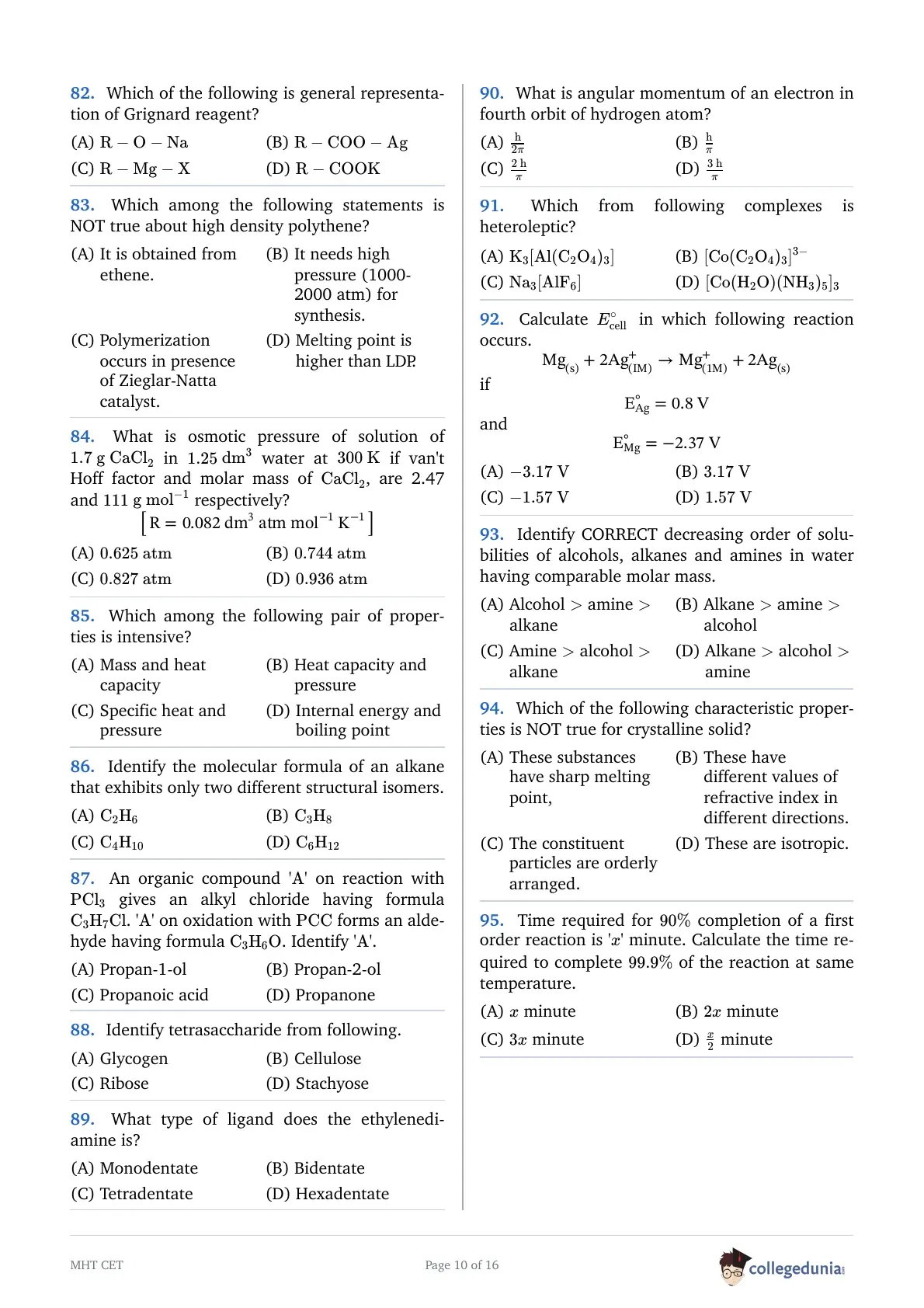
Which of the following is general representation of Grignard reagent?

  • (A) \(\mathrm{R}-\mathrm{O}-\mathrm{Na}\)
  • (B) \(\mathrm{R}-\mathrm{COO}-\mathrm{Ag}\)
  • (C) \(\mathrm{R}-\mathrm{Mg}-\mathrm{X}\)
  • (D) \(\mathrm{R}-\mathrm{COOK}\)

Question 83:

Which among the following statements is NOT true about high density polythene?

  • (A) It is obtained from ethene.
  • (B) It needs high pressure (1000-2000 atm) for synthesis.
  • (C) Polymerization occurs in presence of Zieglar-Natta catalyst.
  • (D) Melting point is higher than LDP.

Question 84:

What is osmotic pressure of solution of \[1.7 \mathrm{~g} \mathrm{~CaCl}_2\] in \[1.25 \mathrm{~dm}^3\] water at \[300 \mathrm{~K}\] if van't Hoff factor and molar mass of \[\mathrm{CaCl}_2\], are 2.47 and \[111 \mathrm{~g} \mathrm{~mol}^{-1}\] respectively?

\[\left[\mathrm{R}=0.082 \mathrm{~dm}^3 \mathrm{~atm} \mathrm{~mol}^{-1} \mathrm{~K}^{-1}\right]\]

  • (A) \(0.625\text{ }\mathrm{atm}\)
  • (B) \(0.744\text{ }\mathrm{atm}\)
  • (C) \(0.827\text{ }\mathrm{atm}\)
  • (D) \(0.936\text{ }\mathrm{atm}\)

Question 85:

Which among the following pair of properties is intensive?

  • (A) Mass and heat capacity
  • (B) Heat capacity and pressure
  • (C) Specific heat and pressure
  • (D) Internal energy and boiling point

Question 86:

Identify the molecular formula of an alkane that exhibits only two different structural isomers.

  • (A) \(\mathrm{C}_{2}\mathrm{H}_{6}\)
  • (B) \(\mathrm{C}_{3}\mathrm{H}_{8}\)
  • (C) \(\mathrm{C}_{4}\mathrm{H}_{10}\)
  • (D) \(\mathrm{C}_{6}\mathrm{H}_{12}\)

Question 87:

An organic compound '\[\mathrm{A}\]' on reaction with \[\mathrm{PCl}_3\] gives an alkyl chloride having formula \[\mathrm{C}_3 \mathrm{H}_7 \mathrm{Cl}\]. '\[\mathrm{A}\]' on oxidation with \[\mathrm{PCC}\] forms an aldehyde having formula \[\mathrm{C}_3 \mathrm{H}_6 \mathrm{O}\]. Identify '\[\mathrm{A}\]'.

  • (A) Propan-1-ol
  • (B) Propan-2-ol
  • (C) Propanoic acid
  • (D) Propanone

Question 88:

Identify tetrasaccharide from following.

  • (A) Glycogen
  • (B) Cellulose
  • (C) Ribose
  • (D) Stachyose

Question 89:

What type of ligand does the ethylenediamine is?

  • (A) Monodentate
  • (B) Bidentate
  • (C) Tetradentate
  • (D) Hexadentate

Question 90:

What is angular momentum of an electron in fourth orbit of hydrogen atom?

  • (A) \(\frac{\mathrm{h}}{2\pi}\)
  • (B) \(\frac{\mathrm{h}}{\pi}\)
  • (C) \(\frac{2\text{ }\mathrm{h}}{\pi}\)
  • (D) \(\frac{3\text{ }\mathrm{h}}{\pi}\)

Question 91:

Which from following complexes is heteroleptic?

  • (A) \(\mathrm{K}_{3}[\mathrm{Al}(\mathrm{C}_{2}\mathrm{O}_{4})_{3}]\)
  • (B) \([\mathrm{Co}(\mathrm{C}_{2}\mathrm{O}_{4})_{3}]^{3-}\)
  • (C) \(\mathrm{Na}_{3}[\mathrm{AlF}_{6}]\)
  • (D) \([\mathrm{Co}(\mathrm{H}_{2}\mathrm{O})(\mathrm{NH}_{3})_{5}]_{3}\)

Question 92:

Calculate \[E_{\text {cell }}^{\circ}\] in which following reaction occurs. \[\mathrm{Mg}_{(\mathrm{s})}+2 \mathrm{Ag}_{(\mathrm{IM})}^{+} \rightarrow \mathrm{Mg}_{(1 \mathrm{M})}^{+}+2 \mathrm{Ag}_{(\mathrm{s})}\] if \[\mathrm{E}_{\mathrm{Ag}}^{\circ}=0.8 \mathrm{~V}\] and \[\mathrm{E}_{\mathrm{Mg}}^{\circ}=-2.37 \mathrm{~V}\]

  • (A) \(-3.17\text{ }\mathrm{V}\)
  • (B) \(3.17\text{ }\mathrm{V}\)
  • (C) \(-1.57\text{ }\mathrm{V}\)
  • (D) \(1.57\text{ }\mathrm{V}\)

Question 93:

Identify CORRECT decreasing order of solubilities of alcohols, alkanes and amines in water having comparable molar mass.

  • (A) Alcohol \(>\) amine \(>\) alkane
  • (B) Alkane \(>\) amine \(>\) alcohol
  • (C) Amine \(>\) alcohol \(>\) alkane
  • (D) Alkane \(>\) alcohol \(>\) amine

Question 94:

Which of the following characteristic properties is NOT true for crystalline solid?

  • (A) These substances have sharp melting point,
  • (B) These have different values of refractive index in different directions.
  • (C) The constituent particles are orderly arranged.
  • (D) These are isotropic.

Question 95:

Time required for \[90 \%\] completion of a first order reaction is '\[x\]' minute. Calculate the time required to complete \[99.9 \%\] of the reaction at same temperature.

  • (A) \(x\) minute
  • (B) \(2x\) minute
  • (C) \(3x\) minute
  • (D) \(\frac{x}{2}\) minute

Question 96:

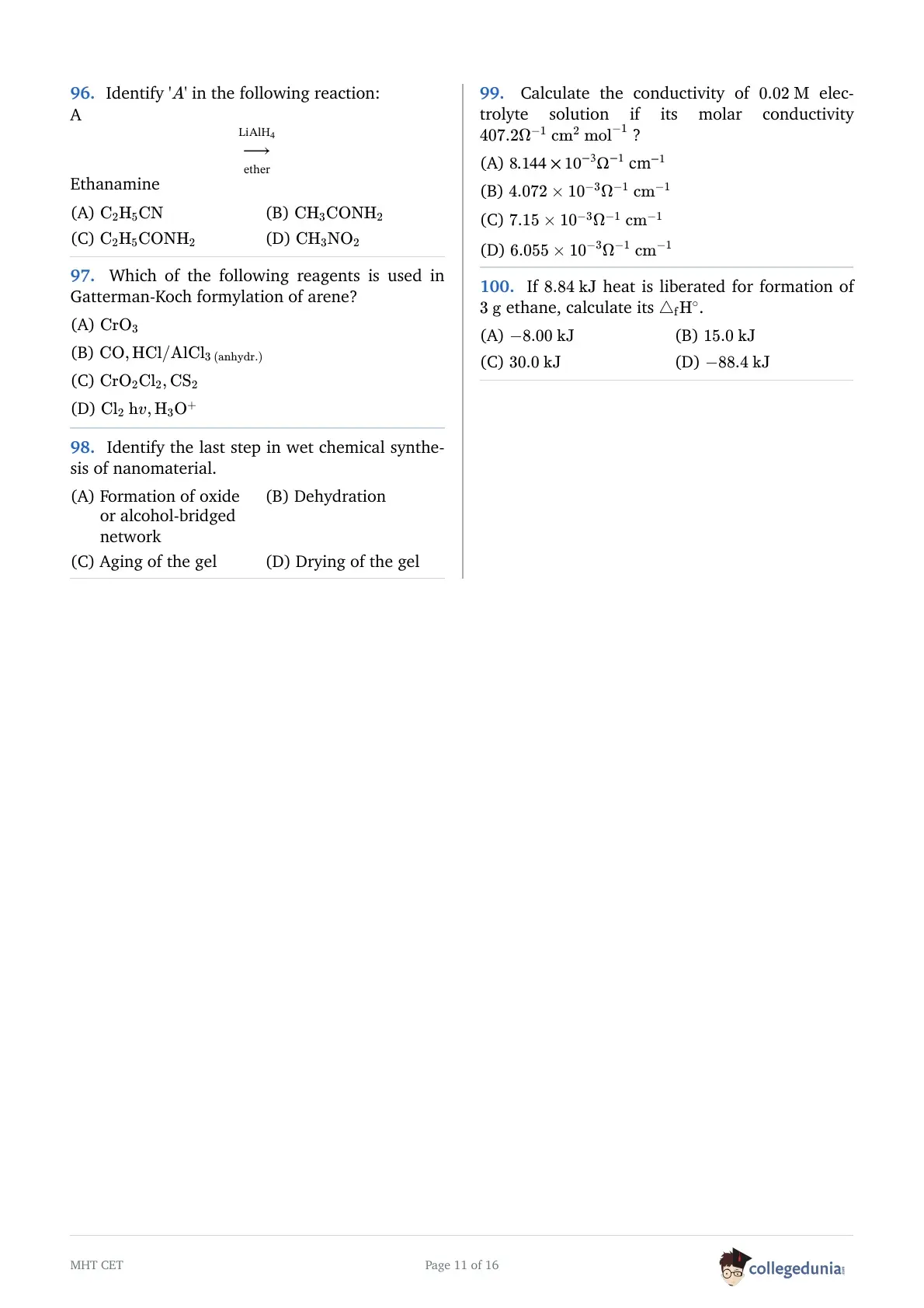
Identify '\[A\]' in the following reaction:

A \[\mathrm{\mathrel{\mathop{\kern0pt\longrightarrow} \limits_{ether}^{LiAl{H_4}}}}\] Ethanamine

  • (A) \(\mathrm{C}_{2}\mathrm{H}_{5}\mathrm{CN}\)
  • (B) \(\mathrm{CH}_{3}\mathrm{CONH}_{2}\)
  • (C) \(\mathrm{C}_{2}\mathrm{H}_{5}\mathrm{CONH}_{2}\)
  • (D) \(\mathrm{CH}_{3}\mathrm{NO}_{2}\)

Question 97:

Which of the following reagents is used in Gatterman-Koch formylation of arene?

  • (A) \(\mathrm{CrO}_{3}\)
  • (B) \(\mathrm{CO},\mathrm{HCl}/\mathrm{AlCl}_{3\text{ }(\mathrm{anhydr}.)}\)
  • (C) \(\mathrm{CrO}_{2}\mathrm{Cl}_{2},\mathrm{CS}_{2}\)
  • (D) \(\mathrm{Cl}_{2}\text{ }\mathrm{h}v,\mathrm{H}_{3}\mathrm{O}^{+}\)

Question 98:

Identify the last step in wet chemical synthesis of nanomaterial.

  • (A) Formation of oxide or alcohol-bridged network
  • (B) Dehydration
  • (C) Aging of the gel
  • (D) Drying of the gel

Question 99:

Calculate the conductivity of \[0.02 \mathrm{~M}\] electrolyte solution if its molar conductivity \[407.2 \Omega^{-1} \mathrm{~cm}^2 \mathrm{~mol}^{-1}\] ?

  • (A) \(8.144\times 10^{-3}\Omega ^{-1}\text{ }\mathrm{cm}^{-1}\)
  • (B) \(4.072\times 10^{-3}\Omega ^{-1}\text{ }\mathrm{cm}^{-1}\)
  • (C) \(7.15\times 10^{-3}\Omega ^{-1}\text{ }\mathrm{cm}^{-1}\)
  • (D) \(6.055\times 10^{-3}\Omega ^{-1}\text{ }\mathrm{cm}^{-1}\)

Question 100:

If \[8.84 \mathrm{~kJ}\] heat is liberated for formation of \[3 \mathrm{~g}\] ethane, calculate its \[\triangle_{\mathrm{f}} \mathrm{H}^{\circ}\].

  • (A) \(-8.00\text{ }\mathrm{kJ}\)
  • (B) \(15.0\text{ }\mathrm{kJ}\)
  • (C) \(30.0\text{ }\mathrm{kJ}\)
  • (D) \(-88.4\text{ }\mathrm{kJ}\)

Mathematics (Q101 - Q150)

Question 101:

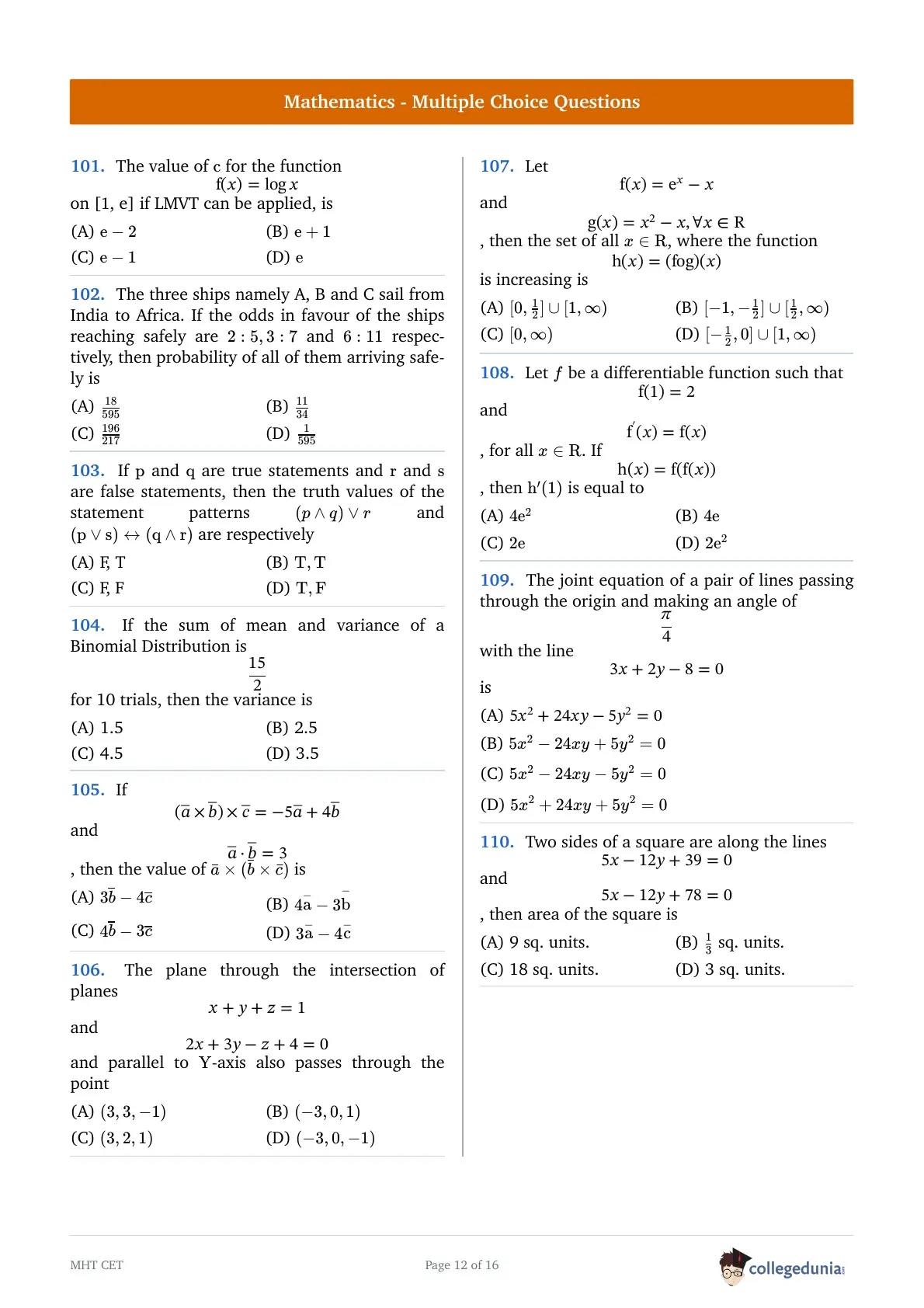
The value of \[\mathrm{c}\] for the function \[\mathrm{f}(x)=\log x\] on [\[1\], e] if LMVT can be applied, is

  • (A) \(\mathrm{e}-2\)
  • (B) \(\mathrm{e}+1\)
  • (C) \(\mathrm{e}-1\)
  • (D) \(\mathrm{e}\)

Question 102:

The three ships namely A, B and C sail from India to Africa. If the odds in favour of the ships reaching safely are \[2: 5,3: 7\] and \[6: 11\] respectively, then probability of all of them arriving safely is

  • (A) \(\frac{18}{595}\)
  • (B) \(\frac{11}{34}\)
  • (C) \(\frac{196}{217}\)
  • (D) \(\frac{1}{595}\)

Question 103:

If \[\mathrm{p}\] and \[\mathrm{q}\] are true statements and \[\mathrm{r}\] and \[\mathrm{s}\] are false statements, then the truth values of the statement patterns \[(p \wedge q) \vee r\] and \[(\mathrm{p} \vee \mathrm{s}) \leftrightarrow(\mathrm{q} \wedge \mathrm{r})\] are respectively

  • (A) F, T
  • (B) \(\mathrm{T},\mathrm{T}\)
  • (C) F, F
  • (D) \(\mathrm{T},\mathrm{F}\)

Question 104:

If the sum of mean and variance of a Binomial Distribution is \[\frac{15}{2}\] for 10 trials, then the variance is

  • (A) 1.5
  • (B) 2.5
  • (C) 4.5
  • (D) 3.5

Question 105:

If \[(\bar{a} \times \bar{b}) \times \bar{c}=-5 \bar{a}+4 \bar{b}\] and \[\bar{a} \cdot \bar{b}=3\], then the value of \[\bar{a} \times(\bar{b} \times \bar{c})\] is

  • (A) \(3\overline{b}-4\overline{c}\)
  • (B) \(4\overset{-}{\mathrm{a}}-3\overset{-}{\mathrm{b}}\)
  • (C) \(4\overline{b}-3\overline{c}\)
  • (D) \(3\overset{-}{\mathrm{a}}-4\overset{-}{\mathrm{c}}\)

Question 106:

The plane through the intersection of planes \[x+y+z=1\] and \[2 x+3 y-z+4=0\] and parallel to \[\mathrm{Y}\]-axis also passes through the point

  • (A) \((3,3,-1)\)
  • (B) \((-3,0,1)\)
  • (C) \((3,2,1)\)
  • (D) \((-3,0,-1)\)

Question 107:

Let \[\mathrm{f}(x)=\mathrm{e}^x-x\] and \[\mathrm{g}(x)=x^2-x, \forall x \in \mathrm{R}\], then the set of all \[x \in \mathrm{R}\], where the function \[\mathrm{h}(x)=(\mathrm{fog})(x)\] is increasing is

  • (A) \([0,\frac{1}{2}]\cup [1,\infty )\)
  • (B) \([-1,-\frac{1}{2}]\cup [\frac{1}{2},\infty )\)
  • (C) \([0,\infty )\)
  • (D) \([-\frac{1}{2},0]\cup [1,\infty )\)

Question 108:

Let \[f\] be a differentiable function such that \[\mathrm{f}(1)=2\] and \[\mathrm{f}^{\prime}(x)=\mathrm{f}(x)\], for all \[x \in \mathrm{R}\]. If \[\mathrm{h}(x)=\mathrm{f}(\mathrm{f}(x))\], then \[\mathrm{h}^{\prime}(1)\] is equal to

  • (A) \(4\mathrm{e}^{2}\)
  • (B) \(4\mathrm{e}\)
  • (C) \(2\mathrm{e}\)
  • (D) \(2\mathrm{e}^{2}\)

Question 109:

The joint equation of a pair of lines passing through the origin and making an angle of \[\frac{\pi}{4}\] with the line \[3 x+2 y-8=0\] is

  • (A) \(5x^{2}+24xy-5y^{2}=0\)
  • (B) \(5x^{2}-24xy+5y^{2}=0\)
  • (C) \(5x^{2}-24xy-5y^{2}=0\)
  • (D) \(5x^{2}+24xy+5y^{2}=0\)

Question 110:

Two sides of a square are along the lines \[5 x-12 y+39=0\] and \[5 x-12 y+78=0\], then area of the square is

  • (A) 9 sq. units.
  • (B) \(\frac{1}{3}\) sq. units.
  • (C) 18 sq. units.
  • (D) 3 sq. units.

Question 111:

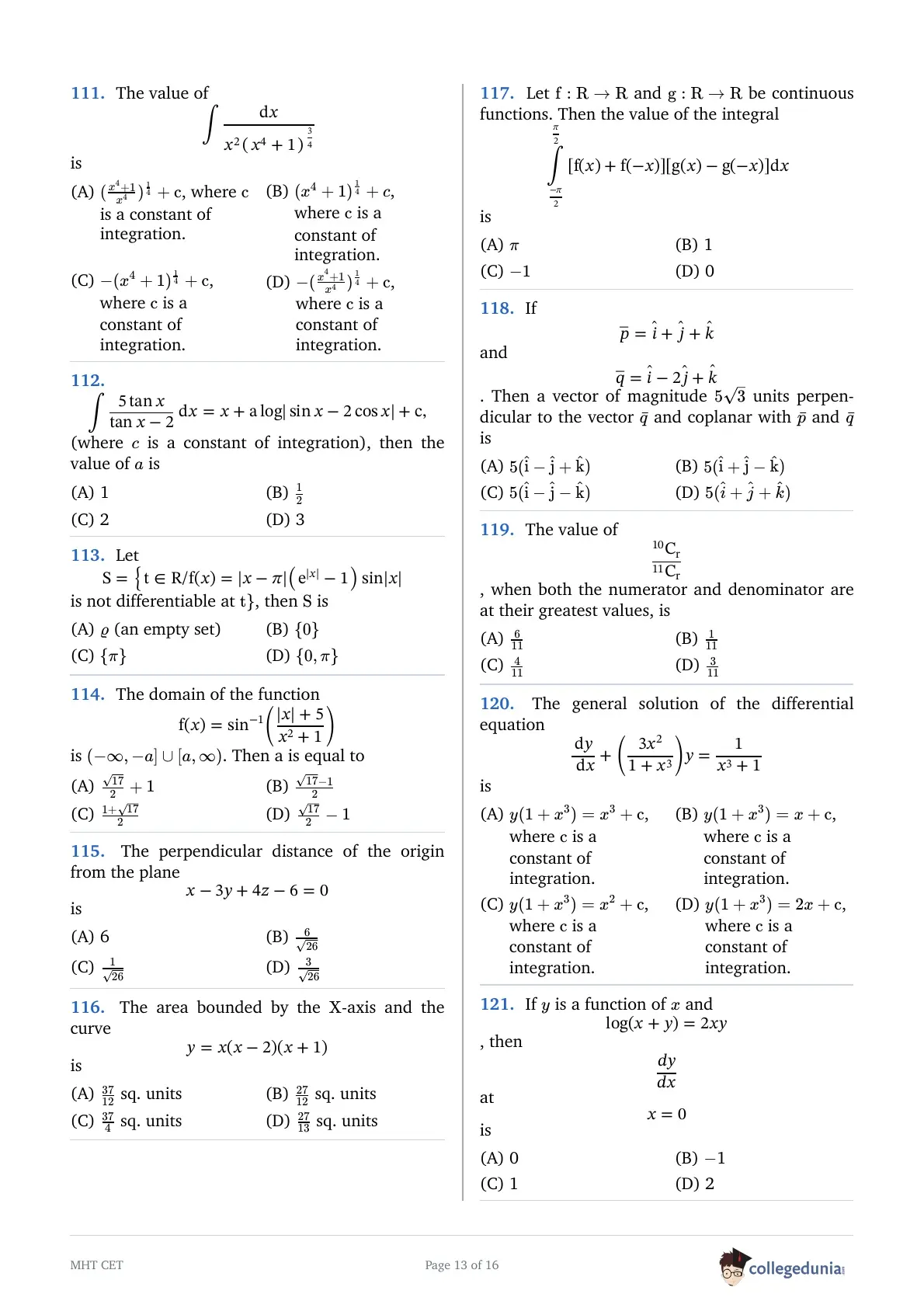
The value of \[\int \frac{\mathrm{d} x}{x^2\left(x^4+1\right)^{\frac{3}{4}}}\] is

  • (A) \((\frac{x^{4}+1}{x^{4}})^{\frac{1}{4}}+\mathrm{c}\), where \(\mathrm{c}\) is a constant of integration.
  • (B) \((x^{4}+1)^{\frac{1}{4}}+c\), where \(\mathrm{c}\) is a constant of integration.
  • (C) \(-(x^{4}+1)^{\frac{1}{4}}+\mathrm{c}\), where \(\mathrm{c}\) is a constant of integration.
  • (D) \(-(\frac{x^{4}+1}{x^{4}})^{\frac{1}{4}}+\mathrm{c}\), where \(\mathrm{c}\) is a constant of integration.

Question 112:

\[\int \frac{5 \tan x}{\tan x-2} \mathrm{~d} x=x+\mathrm{a} \log |\sin x-2 \cos x|+\mathrm{c},\] (where \[c\] is a constant of integration), then the value of \[a\] is

  • (A) 1
  • (B) \(\frac{1}{2}\)
  • (C) 2
  • (D) 3

Question 113:

Let \[\mathrm{S}=\left\{\mathrm{t} \in \mathrm{R} / \mathrm{f}(x)=|x-\pi|\left(\mathrm{e}^{|x|}-1\right) \sin |x|\right.\] is not differentiable at \[\mathrm{t}\}\], then \[\mathrm{S}\] is

  • (A) \(\varrho\) (an empty set)
  • (B) \(\{0\}\)
  • (C) \(\{\pi \}\)
  • (D) \(\{0,\pi \}\)

Question 114:

The domain of the function \[\mathrm{f}(x)=\sin ^{-1}\left(\frac{|x|+5}{x^2+1}\right)\] is \[(-\infty,-a] \cup[a, \infty)\]. Then a is equal to

  • (A) \(\frac{\sqrt{17}}{2}+1\)
  • (B) \(\frac{\sqrt{17}-1}{2}\)
  • (C) \(\frac{1+\sqrt{17}}{2}\)
  • (D) \(\frac{\sqrt{17}}{2}-1\)

Question 115:

The perpendicular distance of the origin from the plane \[x-3 y+4 z-6=0\] is

  • (A) 6
  • (B) \(\frac{6}{\sqrt{26}}\)
  • (C) \(\frac{1}{\sqrt{26}}\)
  • (D) \(\frac{3}{\sqrt{26}}\)

Question 116:

The area bounded by the \[\mathrm{X}\]-axis and the curve \[y=x(x-2)(x+1)\] is

  • (A) \(\frac{37}{12}\) sq. units
  • (B) \(\frac{27}{12}\) sq. units
  • (C) \(\frac{37}{4}\) sq. units
  • (D) \(\frac{27}{13}\) sq. units

Question 117:

Let \[\mathrm{f}: \mathrm{R} \rightarrow \mathrm{R}\] and \[\mathrm{g}: \mathrm{R} \rightarrow \mathrm{R}\] be continuous functions. Then the value of the integral \[\int_\limits{\frac{-\pi}{2}}^{\frac{\pi}{2}}[\mathrm{f}(x)+\mathrm{f}(-x)][\mathrm{g}(x)-\mathrm{g}(-x)] \mathrm{d} x\] is

  • (A) \(\pi\)
  • (B) 1
  • (C) \(-1\)
  • (D) 0

Question 118:

If \[\bar{p}=\hat{i}+\hat{j}+\hat{k}\] and \[\bar{q}=\hat{i}-2 \hat{j}+\hat{k}\]. Then a vector of magnitude \[5 \sqrt{3}\] units perpendicular to the vector \[\bar{q}\] and coplanar with \[\bar{p}\] and \[\bar{q}\] is

  • (A) \(5(\hat{\mathrm{i}}-\hat{\mathrm{j}}+\hat{\mathrm{k}})\)
  • (B) \(5(\hat{\mathrm{i}}+\hat{\mathrm{j}}-\hat{\mathrm{k}})\)
  • (C) \(5(\hat{\mathrm{i}}-\hat{\mathrm{j}}-\hat{\mathrm{k}})\)
  • (D) \(5(\hat{i}+\hat{j}+\hat{k})\)

Question 119:

The value of \[\frac{{ }^{10} \mathrm{C}_{\mathrm{r}}}{{ }^{11} \mathrm{C}_{\mathrm{r}}}\], when both the numerator and denominator are at their greatest values, is

  • (A) \(\frac{6}{11}\)
  • (B) \(\frac{1}{11}\)
  • (C) \(\frac{4}{11}\)
  • (D) \(\frac{3}{11}\)

Question 120:

The general solution of the differential equation \[\frac{\mathrm{d} y}{\mathrm{~d} x}+\left(\frac{3 x^2}{1+x^3}\right) y=\frac{1}{x^3+1}\] is

  • (A) \(y(1+x^{3})=x^{3}+\mathrm{c}\), where \(\mathrm{c}\) is a constant of integration.
  • (B) \(y(1+x^{3})=x+\mathrm{c}\), where \(\mathrm{c}\) is a constant of integration.
  • (C) \(y(1+x^{3})=x^{2}+\mathrm{c}\), where \(\mathrm{c}\) is a constant of integration.
  • (D) \(y(1+x^{3})=2x+\mathrm{c}\), where \(\mathrm{c}\) is a constant of integration.

Question 121:

If \[y\] is a function of \[x\] and \[\log (x+y)=2 x y\], then \[\frac{d y}{d x}\] at \[x=0\] is

  • (A) 0
  • (B) \(-\)1
  • (C) 1
  • (D) 2

Question 122:

The displacement '\[\mathrm{S}\]' of a moving particle at a time \[t\] is given by \[S=5+\frac{48}{t}+t^3\]. Then its acceleration when the velocity is zero, is

  • (A) 12
  • (B) 20
  • (C) 16
  • (D) 24

Question 123:

If \[\bar{a}\] and \[\bar{b}\] are two unit vectors such that \[\bar{a}+2 \bar{b}\] and \[5 \bar{a}-4 \bar{b}\] are perpendicular to each other, then the angle between \[\bar{a}\] and \[\bar{b}\] is

  • (A) \(\frac{\pi}{3}\)
  • (B) \(\frac{\pi}{6}\)
  • (C) \(\frac{\pi}{4}\)
  • (D) \(\frac{2\pi}{3}\)

Question 124:

The value of \[\tan ^{-1}(1)+\cos ^{-1}\left(-\frac{1}{2}\right)+\sin ^{-1}\left(-\frac{1}{2}\right)\] is

  • (A) \(\frac{5\pi}{6}\)
  • (B) \(\frac{\pi}{2}\)
  • (C) \(\frac{2\pi}{3}\)
  • (D) \(\frac{3\pi}{4}\)

Question 125:

\[\int_\limits 0^\pi \frac{x \tan x}{\sec x+\cos x} d x= \]

  • (A) \(\frac{\pi}{8}\)
  • (B) \(-\frac{\pi ^{2}}{8}\)
  • (C) \(\frac{\pi ^{2}}{4}\)
  • (D) \(-\frac{\pi ^{2}}{4}\)

Question 126:

If \[\tan ^{-1} a+\tan ^{-1} b+\tan ^{-1} c=\pi\], then which of the following statement is true?

  • (A) \(a+b-c=abc\)
  • (B) \(a+b+c=2abc\)
  • (C) \(\mathrm{abc}=1\)
  • (D) \(a+b+c=abc\)

Question 127:

If \[\mathrm{f}(x)=\frac{4}{x^4}\left[1-\cos \frac{x}{2}-\cos \frac{x}{4}+\cos \frac{x}{2} \cdot \cos \frac{x}{4}\right]\] is continuous at \[x=0\], then \[\mathrm{f}(0)\] is

  • (A) \(\frac{1}{32}\)
  • (B) \(\frac{1}{16}\)
  • (C) \(\frac{1}{8}\)
  • (D) \(\frac{1}{64}\)

Question 128:

Two lines \[\frac{x-3}{1}=\frac{y+1}{3}=\frac{z-6}{-1}\] and \[\frac{x+5}{7}=\frac{y-2}{-6}=\frac{z-3}{4} \quad\] intersect at the point R. Then reflection of \[\mathrm{R}\] in the \[x y\]-plane has co-ordinates

  • (A) \((2,-4,-7)\)
  • (B) \((2,-4,7)\)
  • (C) \((-2,4,7)\)
  • (D) \((2,4,7)\)

Question 129:

The value of \[\int \frac{\left(x^2-1\right) d x}{x^3 \sqrt{2 x^4-2 x^2+1}}\] is

  • (A) \(2\sqrt{2-\frac{2}{x^{2}}+\frac{1}{x^{4}}}+\mathrm{c}\), where \(\mathrm{c}\) is a constant of integration.
  • (B) \(2\sqrt{2+\frac{2}{x^{2}}+\frac{1}{x^{4}}}+c\), where \(\mathrm{c}\) is a constant of integration.
  • (C) \(\frac{1}{2}\sqrt{2-\frac{2}{x^{2}}+\frac{1}{x^{4}}}+\mathrm{c}\), where \(\mathrm{c}\) is a constant of integration.
  • (D) \(2\sqrt{2-\frac{2}{x^{2}}-\frac{1}{x^{4}}}+c\), where \(\mathrm{c}\) is a constant of integration.

Question 130:

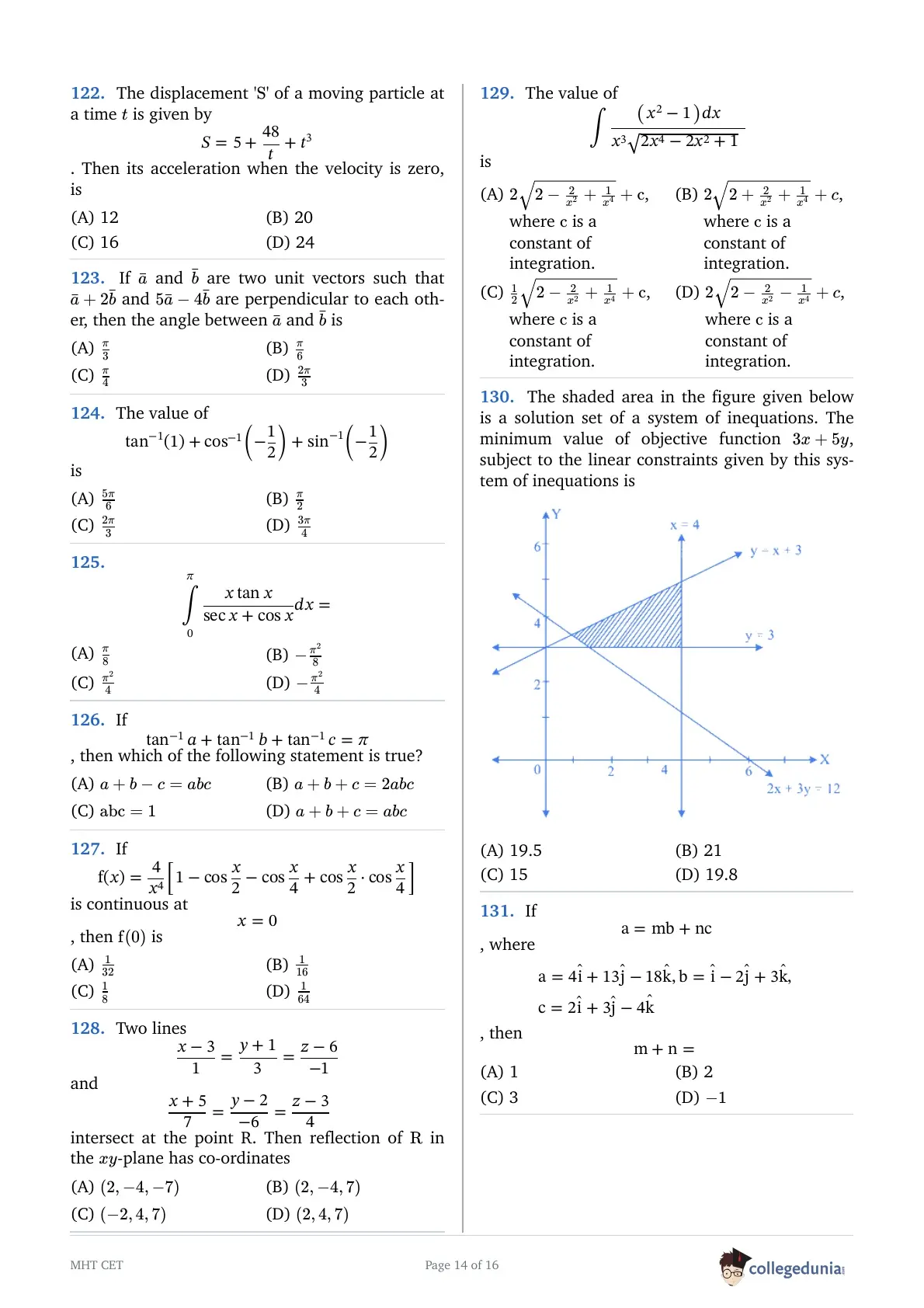
The shaded area in the figure given below is a solution set of a system of inequations. The minimum value of objective function \[3 x+5 y\], subject to the linear constraints given by this system of inequations is

  • (A) 19.5
  • (B) 21
  • (C) 15
  • (D) 19.8

Question 131:

If \[\overline{\mathrm{a}}=\mathrm{m} \overline{\mathrm{b}}+\mathrm{nc}\], where \[\overline{\mathrm{a}}=4 \hat{\mathrm{i}}+13 \hat{\mathrm{j}}-18 \hat{\mathrm{k}}, \overline{\mathrm{b}}=\hat{\mathrm{i}}-2 \hat{\mathrm{j}}+3 \hat{\mathrm{k}}, \overline{\mathrm{c}}=2 \hat{\mathrm{i}}+3 \hat{\mathrm{j}}-4 \hat{\mathrm{k}}\], then \[\mathrm{m}+\mathrm{n}=\]

  • (A) 1
  • (B) 2
  • (C) 3
  • (D) \(-1\)

Question 132:

In a game, 3 coins are tossed. A person is paid ₹ 7 /-, if he gets all heads or all tails; and he is supposed to pay ₹ 3 /-, if he gets one head or two heads. The amount he can expect to win on an average per game is ₹

  • (A) \(-\)0.5
  • (B) 0.5
  • (C) 1
  • (D) \(-\)1

Question 133:

\[\int \mathrm{e}^x\left(1-\cot x+\cot ^2 x\right) \mathrm{d} x=\]

  • (A) \(\mathrm{e}^{x}\cdot \mathrm{cot}x+\mathrm{c}\), where \(\mathrm{c}\) is a constant of integration.
  • (B) \(\mathrm{e}^{x}\cdot \mathrm{cosec}x+\mathrm{c}\), where \(\mathrm{c}\) is a constant of integration.
  • (C) \(-\mathrm{e}^{x}\cdot \mathrm{cot}x+\mathrm{c}\), where \(\mathrm{c}\) is a constant of integration.
  • (D) \(-\mathrm{e}^{x}\cdot \mathrm{cosec}x+\mathrm{c}\), where \(\mathrm{c}\) is a constant of integration.

Question 134:

The parametric equations of the circle \[x^2+y^2+2 x-4 y-4=0\] are

  • (A) \(x=-1+3\mathrm{cos}\theta ,y=2+3\mathrm{sin}\theta\)
  • (B) \(x=1+3\mathrm{cos}\theta ,y=-2+3\mathrm{sin}\theta\)
  • (C) \(x=-1+3\mathrm{sin}\theta ,y=-2+3\mathrm{cos}\theta\)
  • (D) \(x=1+3\mathrm{sin}\theta ,y=-2+3\mathrm{cos}\theta\)

Question 135:

In a triangle \[\mathrm{ABC}\], with usual notations, if \[\mathrm{c}=4\], then value of \[(a-b)^2 \cos ^2 \frac{C}{2}+(a+b)^2 \sin ^2 \frac{C}{2}\] is

  • (A) 4
  • (B) 16
  • (C) 9
  • (D) 25

Question 136:

\[\lim _\limits{x \rightarrow a} \frac{\sqrt{a+2 x}-\sqrt{3 x}}{\sqrt{3 a+x}-2 \sqrt{x}}=\]

  • (A) \(\frac{1}{3\sqrt{3}}\)
  • (B) \(\frac{2}{\sqrt{3}}\)
  • (C) \(\frac{2}{3\sqrt{3}}\)
  • (D) \(\frac{-2}{3\sqrt{3}}\)

Question 137:

If \[B=\left[\begin{array}{ccc}3 & \alpha & -1 \\ 1 & 3 & 1 \\ -1 & 1 & 3\end{array}\right]\] is the adjoint of a \[3 \times 3\] matrix \[\mathrm{A}\] and \[|\mathrm{A}|=4\], then \[\alpha\] is equal to

  • (A) 1
  • (B) 0
  • (C) \(-\)1
  • (D) \(-\)2

Question 138:

If \[x=3 \tan \mathrm{t}\] and \[y=3 \sec \mathrm{t}\], then the value of \[\frac{\mathrm{d}^2 y}{\mathrm{~d} x^2}\] at \[\mathrm{t}=\frac{\pi}{4}\] is

  • (A) \(\frac{-1}{6\sqrt{2}}\)
  • (B) \(\frac{1}{6\sqrt{2}}\)
  • (C) \(\frac{1}{3\sqrt{2}}\)
  • (D) \(\frac{3}{2\sqrt{2}}\)

Question 139:

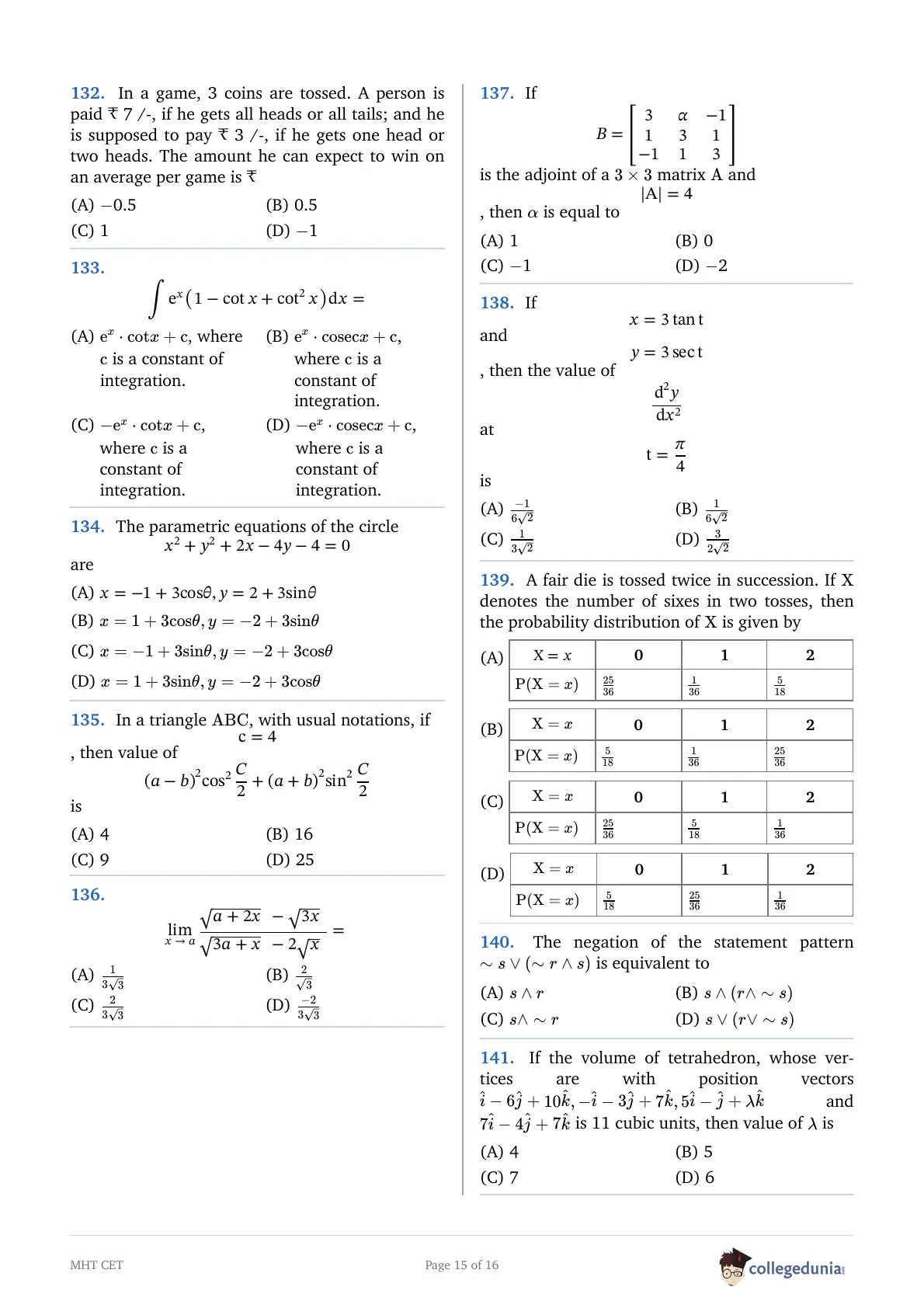
A fair die is tossed twice in succession. If \[\mathrm{X}\] denotes the number of sixes in two tosses, then the probability distribution of \[\mathrm{X}\] is given by

  • (A)
    \(\mathrm{X}=x\)012
    \(\mathrm{P}(\mathrm{X}=x)\)\(\frac{25}{36}\)\(\frac{1}{36}\)\(\frac{5}{18}\)
  • (B)
    \(\mathrm{X}=x\)012
    \(\mathrm{P}(\mathrm{X}=x)\)\(\frac{5}{18}\)\(\frac{1}{36}\)\(\frac{25}{36}\)
  • (C)
    \(\mathrm{X}=x\)012
    \(\mathrm{P}(\mathrm{X}=x)\)\(\frac{25}{36}\)\(\frac{5}{18}\)\(\frac{1}{36}\)
  • (D)
    \(\mathrm{X}=x\)012
    \(\mathrm{P}(\mathrm{X}=x)\)\(\frac{5}{18}\)\(\frac{25}{36}\)\(\frac{1}{36}\)

Question 140:

The negation of the statement pattern \[\sim s \vee(\sim r \wedge s)\] is equivalent to

  • (A) \(s\wedge r\)
  • (B) \(s\wedge (r\wedge \sim s)\)
  • (C) \(s\wedge \sim r\)
  • (D) \(s\vee (r\vee \sim s)\)

Question 141:

If the volume of tetrahedron, whose vertices are with position vectors \[\hat{i}-6 \hat{j}+10 \hat{k},-\hat{i}-3 \hat{j}+7 \hat{k}, 5 \hat{i}-\hat{j}+\lambda \hat{k}\] and \[7 \hat{i}-4 \hat{j}+7 \hat{k}\] is 11 cubic units, then value of \[\lambda\] is

  • (A) 4
  • (B) 5
  • (C) 7
  • (D) 6

Question 142:

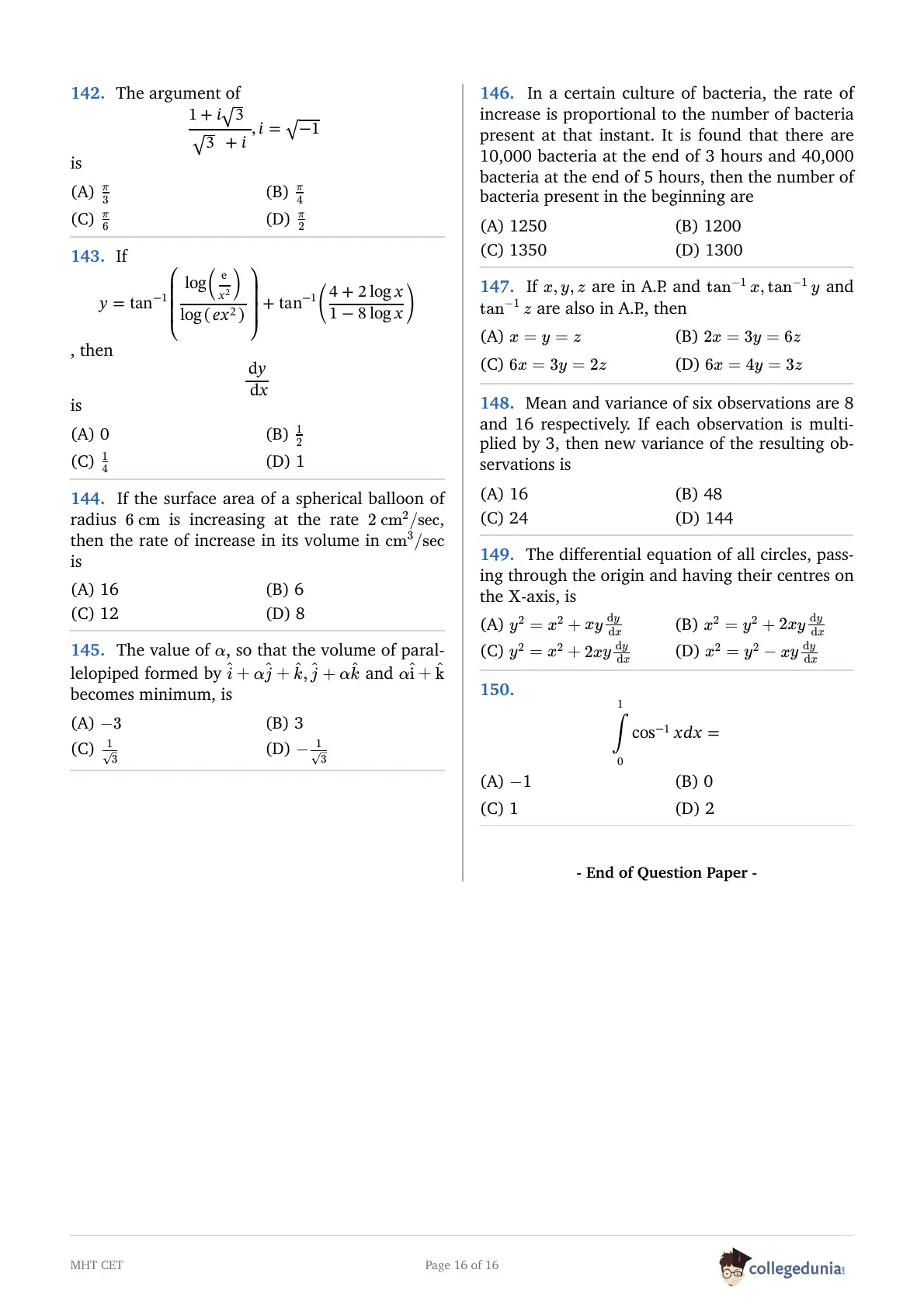
The argument of \[\frac{1+i \sqrt{3}}{\sqrt{3}+i}, i=\sqrt{-1}\] is

  • (A) \(\frac{\pi}{3}\)
  • (B) \(\frac{\pi}{4}\)
  • (C) \(\frac{\pi}{6}\)
  • (D) \(\frac{\pi}{2}\)

Question 143:

If \[y=\tan ^{-1}\left(\frac{\log \left(\frac{\mathrm{e}}{x^2}\right)}{\log \left(e x^2\right)}\right)+\tan ^{-1}\left(\frac{4+2 \log x}{1-8 \log x}\right)\], then \[\frac{\mathrm{d} y}{\mathrm{~d} x}\] is

  • (A) 0
  • (B) \(\frac{1}{2}\)
  • (C) \(\frac{1}{4}\)
  • (D) 1

Question 144:

If the surface area of a spherical balloon of radius \[6 \mathrm{~cm}\] is increasing at the rate \[2 \mathrm{~cm}^2 / \mathrm{sec}\], then the rate of increase in its volume in \[\mathrm{cm}^3 / \mathrm{sec}\] is

  • (A) 16
  • (B) 6
  • (C) 12
  • (D) 8

Question 145:

The value of \[\alpha\], so that the volume of parallelopiped formed by \[\hat{i}+\alpha \hat{j}+\hat{k}, \hat{j}+\alpha \hat{k}\] and \[\alpha \hat{\mathrm{i}}+\hat{\mathrm{k}}\] becomes minimum, is

  • (A) \(-3\)
  • (B) 3
  • (C) \(\frac{1}{\sqrt{3}}\)
  • (D) \(-\frac{1}{\sqrt{3}}\)

Question 146:

In a certain culture of bacteria, the rate of increase is proportional to the number of bacteria present at that instant. It is found that there are 10,000 bacteria at the end of 3 hours and 40,000 bacteria at the end of 5 hours, then the number of bacteria present in the beginning are

  • (A) 1250
  • (B) 1200
  • (C) 1350
  • (D) 1300

Question 147:

If \[x, y, z\] are in A.P. and \[\tan ^{-1} x, \tan ^{-1} y\] and \[\tan ^{-1} z\] are also in A.P., then

  • (A) \(x=y=z\)
  • (B) \(2x=3y=6z\)
  • (C) \(6x=3y=2z\)
  • (D) \(6x=4y=3z\)

Question 148:

Mean and variance of six observations are 8 and 16 respectively. If each observation is multiplied by 3, then new variance of the resulting observations is

  • (A) 16
  • (B) 48
  • (C) 24
  • (D) 144

Question 149:

The differential equation of all circles, passing through the origin and having their centres on the \[\mathrm{X}\]-axis, is

  • (A) \(y^{2}=x^{2}+xy\frac{\mathrm{d}y}{\text{ }\mathrm{d}x}\)
  • (B) \(x^{2}=y^{2}+2xy\frac{\mathrm{d}y}{\text{ }\mathrm{d}x}\)
  • (C) \(y^{2}=x^{2}+2xy\frac{\mathrm{d}y}{\text{ }\mathrm{d}x}\)
  • (D) \(x^{2}=y^{2}-xy\frac{\mathrm{d}y}{\text{ }\mathrm{d}x}\)

Question 150:

\[\int_\limits0^1 \cos ^{-1} x d x=\]

  • (A) \(-\)1
  • (B) 0
  • (C) 1
  • (D) 2

MHT CET 2023 PCM Exam Pattern and Marking Scheme

Parameter Details
Conducting Body Maharashtra Common Entrance Test Cell (Maharashtra CET Cell)
Exam Mode Online (Computer-Based Test)
Duration 180 minutes (3 hours)
Groups / Subjects PCM (Physics, Chemistry, Mathematics) for Engineering
Total Questions

150

Total Marks 200
Question Type Multiple Choice Questions (MCQs)
Marks Distribution
  • Mathematics – 2 marks/question
  • Physics and Chemistry – 1 mark/question
Negative Marking No
Syllabus Weightage
  • Class 12 – 80%
  • Class 11 – 20%