MHT CET 2023 May 11 Shift 1 PCM Question Paper is available for download here. Maharashtra State CET Cell conducted MHT CET 2023 PCM Exam on May 11 in Shift 1 from 9 AM to 12 PM in CBT mode.

The MHT CET 2023 PCM question paper includes the following:

  • The MHT CET 2023 PCM Question Paper consists of 150 multiple-choice questions (MCQs) totalling 200 marks divided into 3 sections: Physics, Chemistry, and Mathematics, with 50 questions in each subject.
  • Physics and Chemistry questions carry 1 mark each while Mathematics questions carry 2 marks each.
  • There is no negative marking for incorrect answers.

MHT CET 2023 May 11 Shift 1 PCM Question Paper with Solution PDF

CD PDF CD PDF with Solutions
Download Collegedunia PDF 1.13 MB -

Also Check:

MHT CET 2023 May 11 Shift 1 PCM Questions with Solutions


Physics (Q1 - Q50)

Question 1:

A coil of radius '\[r\]' is placed on another coil (whose radius is \[\mathrm{R}\] and current flowing through it is changing) so that their centres coincide \[(\mathrm{R} \gg \mathrm{r})\]. If both the coils are coplanar then the mutual inductance between them is ( \[\mu_0=\] permeability of free space)

  • (A) \(\frac{\mu _{0}\pi \mathrm{R}^{2}}{2\mathrm{r}}\)
  • (B) \(\frac{\mu _{0}\pi r^{2}}{2R}\)
  • (C) \(\frac{\mu _{0}\pi r^{2}}{R}\)
  • (D) \(\mu _{0}\pi R^{2}\)

Question 2:

Two capillary tubes of the same diameter are kept vertically in two different liquids whose densities are in the ratio \[4: 3\]. The rise of liquid in two capillaries is '\[h_1\]' and '\[h_2\]' respectively. If the surface tensions of liquids are in the ratio \[6: 5\], the ratio of heights \[\left(\frac{h_1}{h_2}\right)\] is

(Assume that their angles of contact are same)

  • (A) 0.4
  • (B) 0.5
  • (C) 0.8
  • (D) 0.9

Question 3:

Two spherical black bodies of radii '\[r_1\]' and '\[r_2\]' at temperature '\[\mathrm{T}_1\]' and '\[\mathrm{T}_2\]' respectively radiate power in the ratio \[1: 2\] Then \[r_1: r_2\] is

  • (A) \(\frac{1}{2}(\frac{\mathrm{T}_{2}}{\text{ }\mathrm{T}_{1}})^{4}\)
  • (B) \(\frac{1}{\sqrt{2}}(\frac{\mathrm{T}_{2}}{\text{ }\mathrm{T}_{1}})^{2}\)
  • (C) \(2(\frac{\mathrm{T}_{1}}{\text{ }\mathrm{T}_{2}})^{4}\)
  • (D) \(2(\frac{T_{1}}{T_{2}})^{2}\)

Question 4:

For a particle executing S.H.M., its potential energy is 8 times its kinetic energy at certain displacement '\[x\]' from the mean position. If '\[A\]' is the amplitude of S.H.M the value of '\[x\]' is

  • (A) \(\frac{\mathrm{A}\sqrt{2}}{3}\)
  • (B) \(\mathrm{A}\sqrt{3}\)
  • (C) \(\frac{2\sqrt{2}\text{ }\mathrm{A}}{3}\)
  • (D) \(\frac{\mathrm{A}}{\sqrt{2}}\)

Question 5:

The maximum kinetic energies of photoelectrons emitted are \[\mathrm{K}_1\] and \[\mathrm{K}_2\] when lights of wavelengths \[\lambda_1\] and \[\lambda_2\] are incident on a metallic surface. If \[\lambda_1=3 \lambda_2\] then

  • (A) \(\mathrm{K}_{1}=\frac{\mathrm{K}_{2}}{3}\)
  • (B) \(\mathrm{K}_{1}<\frac{\mathrm{K}_{2}}{3}\)
  • (C) \(\mathrm{K}_{1}=3\mathrm{K}_{2}\)
  • (D) \(3\mathrm{K}_{1}=2\mathrm{K}_{2}\)

Question 6:

A particle moves along a circular path with decreasing speed. Hence

  • (A) its resultant acceleration is towards the centre.
  • (B) it moves in a spiral path with decreasing radius.
  • (C) the direction of angular momentum remains constant.
  • (D) its angular momentum remains constant

Question 7:

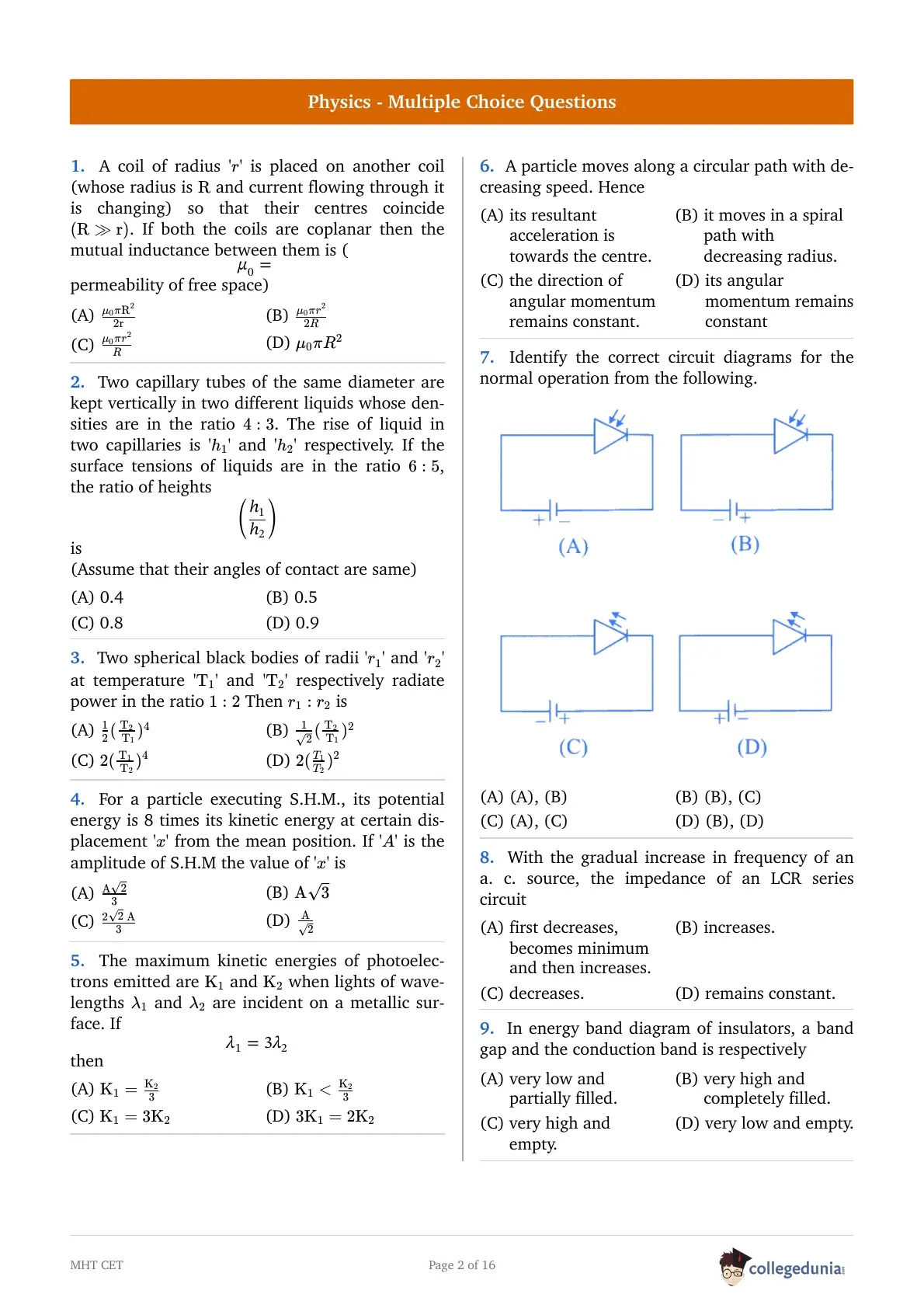
Identify the correct circuit diagrams for the normal operation from the following.

  • (A) (A), (B)
  • (B) (B), (C)
  • (C) (A), (C)
  • (D) (B), (D)

Question 8:

With the gradual increase in frequency of an a. c. source, the impedance of an LCR series circuit

  • (A) first decreases, becomes minimum and then increases.
  • (B) increases.
  • (C) decreases.
  • (D) remains constant.

Question 9:

In energy band diagram of insulators, a band gap and the conduction band is respectively

  • (A) very low and partially filled.
  • (B) very high and completely filled.
  • (C) very high and empty.
  • (D) very low and empty.

Question 10:

Two positively charged identical spheres separated by a distance 'd' exert some force (F) on each other when they are kept in air. If both the spheres are immersed in a liquid of dielectric constant 5 , the force experienced by each is (All other parameters are unchanged.)

  • (A) \(5\text{ }\mathrm{F}\)
  • (B) \(\frac{F}{3}\)
  • (C) \(\frac{F}{4}\)
  • (D) \(\frac{F}{5}\)

Question 11:

A string fixed at both the ends forms standing wave with node separation of \[5 \mathrm{~cm}\]. If the velocity of the wave on the string is \[2 \mathrm{~m} / \mathrm{s}\], then the frequency of vibration of the string is

  • (A) 0.2 Hz
  • (B) 10 Hz
  • (C) 20 Hz
  • (D) 40 Hz

Question 12:

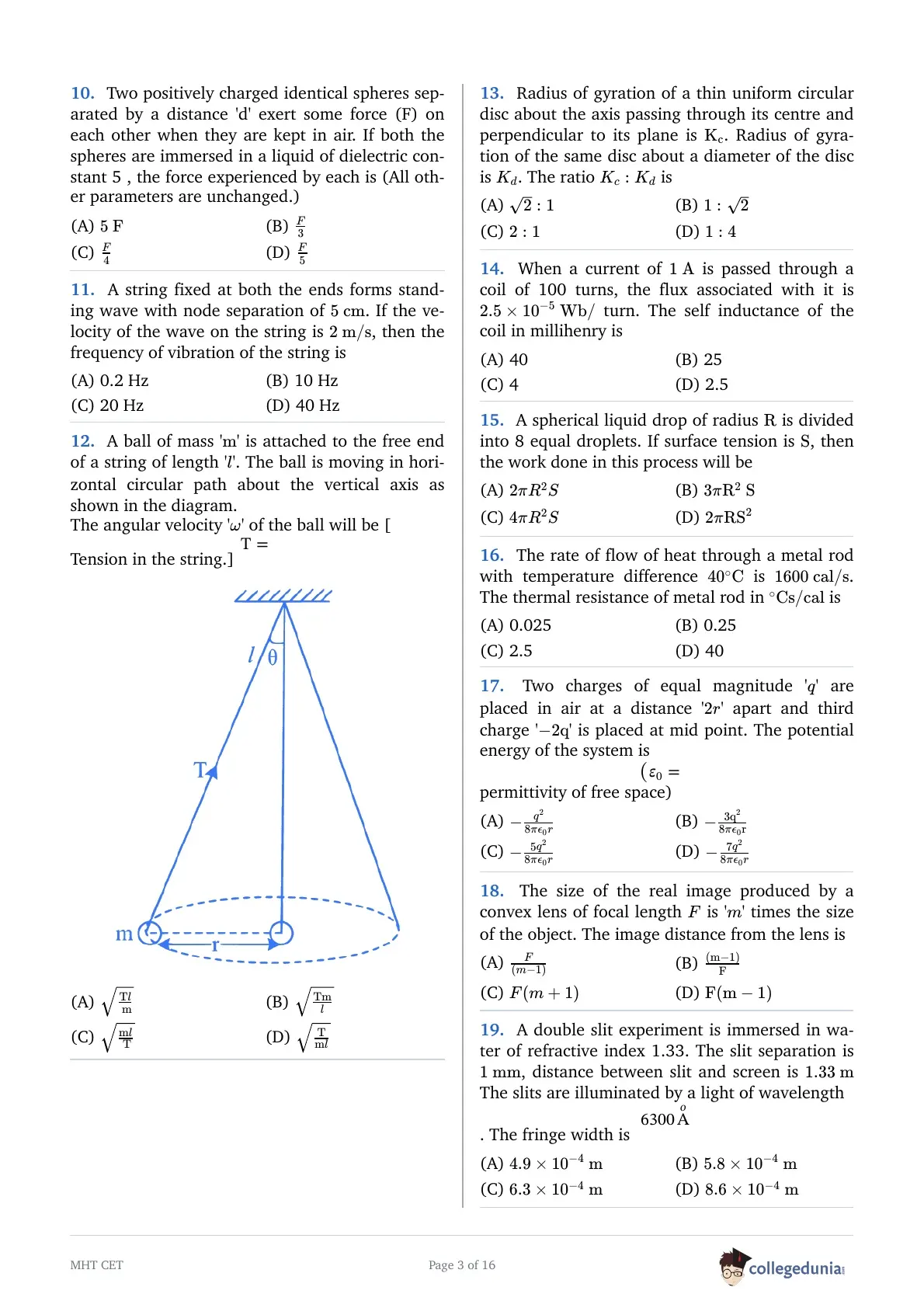
A ball of mass '\[\mathrm{m}\]' is attached to the free end of a string of length '\[l\]'. The ball is moving in horizontal circular path about the vertical axis as shown in the diagram.

The angular velocity '\[\omega\]' of the ball will be [ \[\mathrm{T}=\] Tension in the string.]

  • (A) \(\sqrt{\frac{\mathrm{T}l}{\text{ }\mathrm{m}}}\)
  • (B) \(\sqrt{\frac{\mathrm{Tm}}{l}}\)
  • (C) \(\sqrt{\frac{\mathrm{m}l}{\text{ }\mathrm{T}}}\)
  • (D) \(\sqrt{\frac{\mathrm{T}}{\mathrm{m}l}}\)

Question 13:

Radius of gyration of a thin uniform circular disc about the axis passing through its centre and perpendicular to its plane is \[\mathrm{K}_{\mathrm{c}}\]. Radius of gyration of the same disc about a diameter of the disc is \[K_d\]. The ratio \[K_c: K_d\] is

  • (A) \(\sqrt{2}:1\)
  • (B) \(1:\sqrt{2}\)
  • (C) \(2:1\)
  • (D) \(1:4\)

Question 14:

When a current of \[1 \mathrm{~A}\] is passed through a coil of 100 turns, the flux associated with it is \[2.5 \times 10^{-5} \mathrm{~Wb} /\] turn. The self inductance of the coil in millihenry is

  • (A) 40
  • (B) 25
  • (C) 4
  • (D) 2.5

Question 15:

A spherical liquid drop of radius \[\mathrm{R}\] is divided into 8 equal droplets. If surface tension is \[\mathrm{S}\], then the work done in this process will be

  • (A) \(2\pi R^{2}S\)
  • (B) \(3\pi \mathrm{R}^{2}\text{ }\mathrm{S}\)
  • (C) \(4\pi R^{2}S\)
  • (D) \(2\pi \mathrm{RS}^{2}\)

Question 16:

The rate of flow of heat through a metal rod with temperature difference \[40^{\circ} \mathrm{C}\] is \[1600 \mathrm{~cal} / \mathrm{s}\]. The thermal resistance of metal rod in \[{ }^{\circ} \mathrm{C} \mathrm{s} / \mathrm{cal}\] is

  • (A) 0.025
  • (B) 0.25
  • (C) 2.5
  • (D) 40

Question 17:

Two charges of equal magnitude '\[q\]' are placed in air at a distance '\[2 r\]' apart and third charge '\[-2 \mathrm{q}\]' is placed at mid point. The potential energy of the system is \[\left(\varepsilon_0=\right.\] permittivity of free space)

  • (A) \(-\frac{q^{2}}{8\pi \epsilon _{0}r}\)
  • (B) \(-\frac{3\mathrm{q}^{2}}{8\pi \epsilon _{0}\mathrm{r}}\)
  • (C) \(-\frac{5q^{2}}{8\pi \epsilon _{0}r}\)
  • (D) \(-\frac{7q^{2}}{8\pi \epsilon _{0}r}\)

Question 18:

The size of the real image produced by a convex lens of focal length \[F\] is '\[m\]' times the size of the object. The image distance from the lens is

  • (A) \(\frac{F}{(m-1)}\)
  • (B) \(\frac{(\mathrm{m}-1)}{\mathrm{F}}\)
  • (C) \(F(m+1)\)
  • (D) \(\mathrm{F}(\mathrm{m}-1)\)

Question 19:

A double slit experiment is immersed in water of refractive index 1.33. The slit separation is \[1 \mathrm{~mm}\], distance between slit and screen is \[1.33 \mathrm{~m}\] The slits are illuminated by a light of wavelength \[6300 \mathop A\limits^o\]. The fringe width is

  • (A) \(4.9\times 10^{-4}\text{ }\mathrm{m}\)
  • (B) \(5.8\times 10^{-4}\text{ }\mathrm{m}\)
  • (C) \(6.3\times 10^{-4}\text{ }\mathrm{m}\)
  • (D) \(8.6\times 10^{-4}\text{ }\mathrm{m}\)

Question 20:

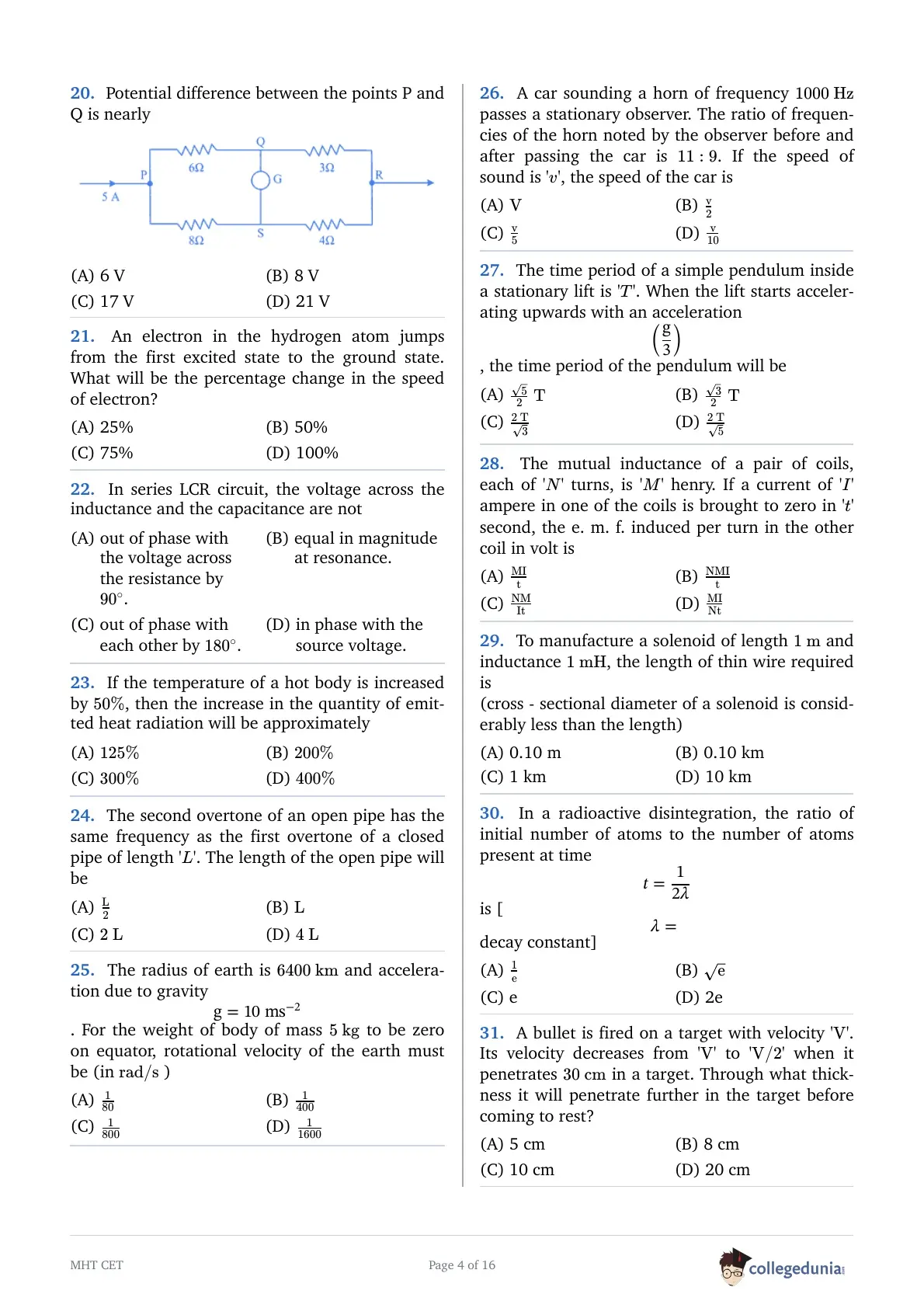
Potential difference between the points P and Q is nearly

  • (A) 6 V
  • (B) 8 V
  • (C) 17 V
  • (D) 21 V

Question 22:

In series LCR circuit, the voltage across the inductance and the capacitance are not

  • (A) out of phase with the voltage across the resistance by \(90^{\circ}\).
  • (B) equal in magnitude at resonance.
  • (C) out of phase with each other by \(180^{\circ}\).
  • (D) in phase with the source voltage.

Question 23:

If the temperature of a hot body is increased by \[50 \%\], then the increase in the quantity of emitted heat radiation will be approximately

  • (A) \(125\%\)
  • (B) \(200\%\)
  • (C) \(300\%\)
  • (D) \(400\%\)

Question 24:

The second overtone of an open pipe has the same frequency as the first overtone of a closed pipe of length '\[L\]'. The length of the open pipe will be

  • (A) \(\frac{\mathrm{L}}{2}\)
  • (B) \(\mathrm{L}\)
  • (C) \(2\text{ }\mathrm{L}\)
  • (D) \(4\text{ }\mathrm{L}\)

Question 25:

The radius of earth is \[6400 \mathrm{~km}\] and acceleration due to gravity \[\mathrm{g}=10 \mathrm{~ms}^{-2}\]. For the weight of body of mass \[5 \mathrm{~kg}\] to be zero on equator, rotational velocity of the earth must be (in \[\mathrm{rad} / \mathrm{s}\] )

  • (A) \(\frac{1}{80}\)
  • (B) \(\frac{1}{400}\)
  • (C) \(\frac{1}{800}\)
  • (D) \(\frac{1}{1600}\)

Question 26:

A car sounding a horn of frequency \[1000 \mathrm{~Hz}\] passes a stationary observer. The ratio of frequencies of the horn noted by the observer before and after passing the car is \[11: 9\]. If the speed of sound is '\[v\]', the speed of the car is

  • (A) \(\mathrm{V}\)
  • (B) \(\frac{\mathrm{v}}{2}\)
  • (C) \(\frac{\mathrm{v}}{5}\)
  • (D) \(\frac{\mathrm{v}}{10}\)

Question 27:

The time period of a simple pendulum inside a stationary lift is '\[T\]'. When the lift starts accelerating upwards with an acceleration \[\left(\frac{\mathrm{g}}{3}\right)\], the time period of the pendulum will be

  • (A) \(\frac{\sqrt{5}}{2}\text{ }\mathrm{T}\)
  • (B) \(\frac{\sqrt{3}}{2}\text{ }\mathrm{T}\)
  • (C) \(\frac{2\text{ }\mathrm{T}}{\sqrt{3}}\)
  • (D) \(\frac{2\text{ }\mathrm{T}}{\sqrt{5}}\)

Question 29:

To manufacture a solenoid of length \[1 \mathrm{~m}\] and inductance \[1 \mathrm{~mH}\], the length of thin wire required is

(cross - sectional diameter of a solenoid is considerably less than the length)

  • (A) 0.10 m
  • (B) 0.10 km
  • (C) 1 km
  • (D) 10 km

Question 30:

In a radioactive disintegration, the ratio of initial number of atoms to the number of atoms present at time \[t=\frac{1}{2 \lambda}\] is [\[\lambda=\] decay constant]

  • (A) \(\frac{1}{\mathrm{e}}\)
  • (B) \(\sqrt{\mathrm{e}}\)
  • (C) e
  • (D) 2e

Question 31:

A bullet is fired on a target with velocity '\[\mathrm{V}\]'. Its velocity decreases from '\[\mathrm{V}\]' to '\[\mathrm{V} / 2\]' when it penetrates \[30 \mathrm{~cm}\] in a target. Through what thickness it will penetrate further in the target before coming to rest?

  • (A) 5 cm
  • (B) 8 cm
  • (C) 10 cm
  • (D) 20 cm

Question 32:

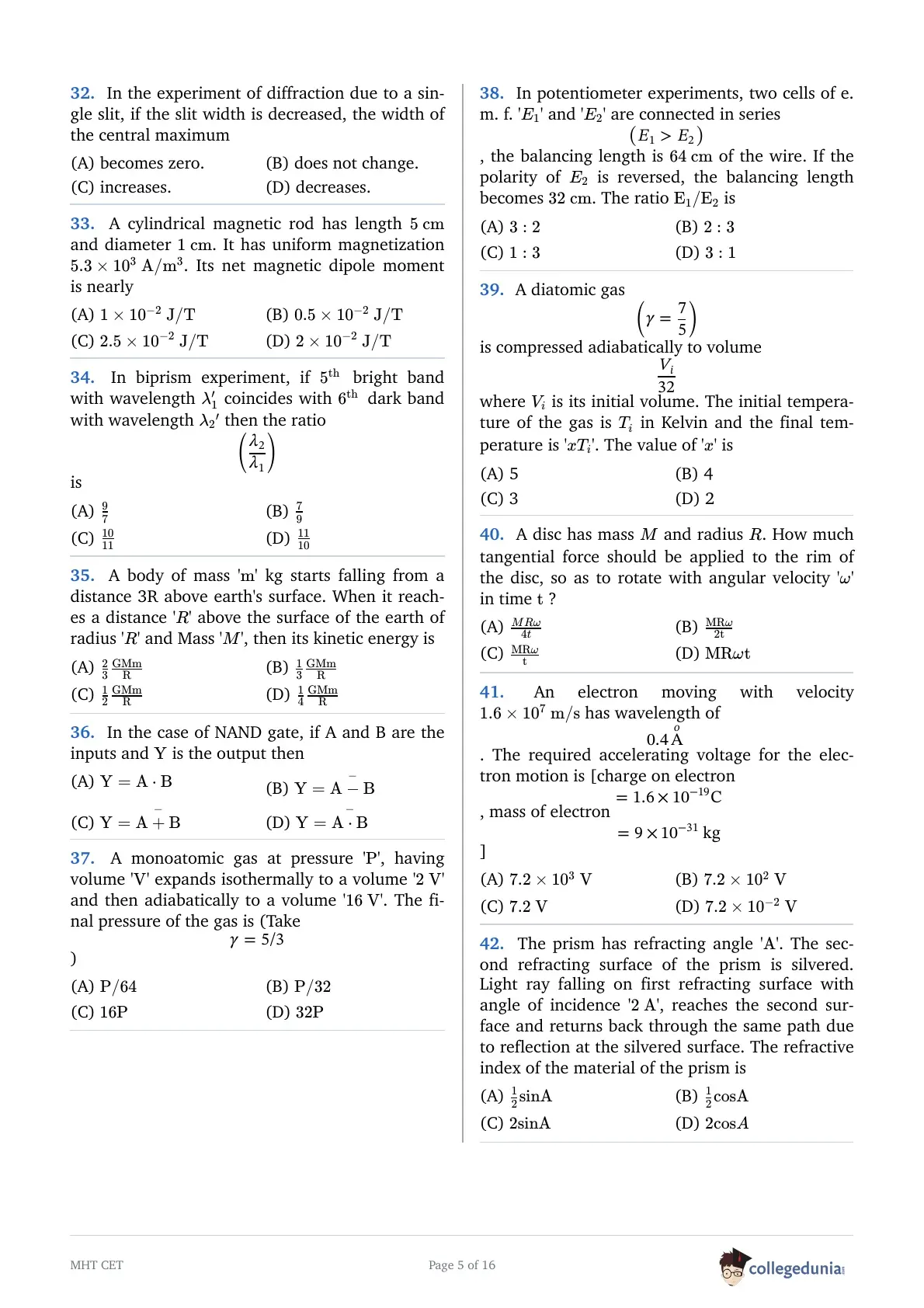
In the experiment of diffraction due to a single slit, if the slit width is decreased, the width of the central maximum

  • (A) becomes zero.
  • (B) does not change.
  • (C) increases.
  • (D) decreases.

Question 33:

A cylindrical magnetic rod has length \[5 \mathrm{~cm}\] and diameter \[1 \mathrm{~cm}\]. It has uniform magnetization \[5.3 \times 10^3 \mathrm{~A} / \mathrm{m}^3\]. Its net magnetic dipole moment is nearly

  • (A) \(1\times 10^{-2}\text{ }\mathrm{J}/\mathrm{T}\)
  • (B) \(0.5\times 10^{-2}\text{ }\mathrm{J}/\mathrm{T}\)
  • (C) \(2.5\times 10^{-2}\text{ }\mathrm{J}/\mathrm{T}\)
  • (D) \(2\times 10^{-2}\text{ }\mathrm{J}/\mathrm{T}\)

Question 34:

In biprism experiment, if \[5^{\text {th }}\] bright band with wavelength \[\lambda_1^{\prime}\] coincides with \[6^{\text {th }}\] dark band with wavelength \[\lambda_2{ }^{\prime}\] then the ratio \[\left(\frac{\lambda_2}{\lambda_1}\right)\] is

  • (A) \(\frac{9}{7}\)
  • (B) \(\frac{7}{9}\)
  • (C) \(\frac{10}{11}\)
  • (D) \(\frac{11}{10}\)

Question 35:

A body of mass '\[\mathrm{m}\]' kg starts falling from a distance 3R above earth's surface. When it reaches a distance '\[R\]' above the surface of the earth of radius '\[R\]' and Mass '\[M\]', then its kinetic energy is

  • (A) \(\frac{2}{3}\frac{\mathrm{GMm}}{\mathrm{R}}\)
  • (B) \(\frac{1}{3}\frac{\mathrm{GMm}}{\mathrm{R}}\)
  • (C) \(\frac{1}{2}\frac{\mathrm{GMm}}{\mathrm{R}}\)
  • (D) \(\frac{1}{4}\frac{\mathrm{GMm}}{\mathrm{R}}\)

Question 36:

In the case of NAND gate, if A and B are the inputs and \[\mathrm{Y}\] is the output then

  • (A) \(\mathrm{Y}=\mathrm{A}\cdot \mathrm{B}\)
  • (B) \(\mathrm{Y}=\overset{-}{\mathrm{A}-\mathrm{B}}\)
  • (C) \(\mathrm{Y}=\overset{-}{\mathrm{A}+\mathrm{B}}\)
  • (D) \(\mathrm{Y}=\overset{-}{\mathrm{A}\cdot \mathrm{B}}\)

Question 37:

A monoatomic gas at pressure '\[\mathrm{P}\]', having volume '\[\mathrm{V}\]' expands isothermally to a volume '\[2 \mathrm{~V}\]' and then adiabatically to a volume '\[16 \mathrm{~V}\]'. The final pressure of the gas is (Take \[\gamma=5 / 3\] )

  • (A) \(\mathrm{P}/64\)
  • (B) \(\mathrm{P}/32\)
  • (C) \(16\mathrm{P}\)
  • (D) \(32\mathrm{P}\)

Question 38:

In potentiometer experiments, two cells of e. m. f. '\[E_1\]' and '\[E_2\]' are connected in series \[\left(E_1>E_2\right)\], the balancing length is \[64 \mathrm{~cm}\] of the wire. If the polarity of \[E_2\] is reversed, the balancing length becomes \[32 \mathrm{~cm}\]. The ratio \[\mathrm{E}_1 / \mathrm{E}_2\] is

  • (A) \(3:2\)
  • (B) \(2:3\)
  • (C) \(1:3\)
  • (D) \(3:1\)

Question 39:

A diatomic gas \[\left(\gamma=\frac{7}{5}\right)\] is compressed adiabatically to volume \[\frac{V_i}{32}\] where \[V_i\] is its initial volume. The initial temperature of the gas is \[T_i\] in Kelvin and the final temperature is '\[x T_i\]'. The value of '\[x\]' is

  • (A) 5
  • (B) 4
  • (C) 3
  • (D) 2

Question 40:

A disc has mass \[M\] and radius \[R\]. How much tangential force should be applied to the rim of the disc, so as to rotate with angular velocity '\[\omega\]' in time \[\mathrm{t}\] ?

  • (A) \(\frac{MR\omega}{4t}\)
  • (B) \(\frac{\mathrm{MR}\omega}{2\mathrm{t}}\)
  • (C) \(\frac{\mathrm{MR}\omega}{\mathrm{t}}\)
  • (D) \(\mathrm{MR}\omega \mathrm{t}\)

Question 41:

An electron moving with velocity \[1.6 \times 10^7 \mathrm{~m} / \mathrm{s}\] has wavelength of \[0.4 \mathop A\limits^o\]. The required accelerating voltage for the electron motion is [charge on electron \[=1.6 \times 10^{-19} \mathrm{C}\], mass of electron \[=9 \times 10^{-31} \mathrm{~kg}\] ]

  • (A) \(7.2\times 10^{3}\text{ }\mathrm{V}\)
  • (B) \(7.2\times 10^{2}\text{ }\mathrm{V}\)
  • (C) \(7.2\text{ }\mathrm{V}\)
  • (D) \(7.2\times 10^{-2}\text{ }\mathrm{V}\)

Question 42:

The prism has refracting angle '\[\mathrm{A}\]'. The second refracting surface of the prism is silvered. Light ray falling on first refracting surface with angle of incidence '\[2 \mathrm{~A}\]', reaches the second surface and returns back through the same path due to reflection at the silvered surface. The refractive index of the material of the prism is

  • (A) \(\frac{1}{2}\mathrm{sinA}\)
  • (B) \(\frac{1}{2}\mathrm{cosA}\)
  • (C) \(2\mathrm{sinA}\)
  • (D) \(2\mathrm{cos}A\)

Question 43:

Two parallel wires of equal lengths are separated by a distance of \[3 \mathrm{~m}\] from each other. The currents flowing through \[1^{\text {st }}\] and \[2^{\text {nd }}\] wire is \[3 \mathrm{~A}\] and 4.5 A respectively in opposite directions. The resultant magnetic field at mid point between the wires \[\left(\mu_0=\right.\] permeability of free space)

  • (A) \(\frac{\mu _{0}}{2\pi}\)
  • (B) \(\frac{3\mu _{0}}{2\pi}\)
  • (C) \(\frac{7\mu _{0}}{2\pi}\)
  • (D) \(\frac{5\mu _{0}}{2\pi}\)

Question 44:

Three point charges \[+\mathrm{q},+2 \mathrm{q}\] and \[+\mathrm{Q}\] are placed at the three vertices of an equilateral triangle. If the potential energy of the system of three charges is zero, the value of \[Q\] in terms of \[q\] is

  • (A) \(\mathrm{Q}=-\frac{2\mathrm{q}}{3}\)
  • (B) \(Q=-\frac{1}{3}q\)
  • (C) \(\mathrm{Q}=\frac{3\mathrm{q}}{2}\)
  • (D) \(Q=\frac{q}{2}\)

Question 45:

If a gas is compressed isothermally then the r.m.s. velocity of the molecules

  • (A) decreases.
  • (B) increases.
  • (C) remains the same.
  • (D) first decreases and then increases.

Question 46:

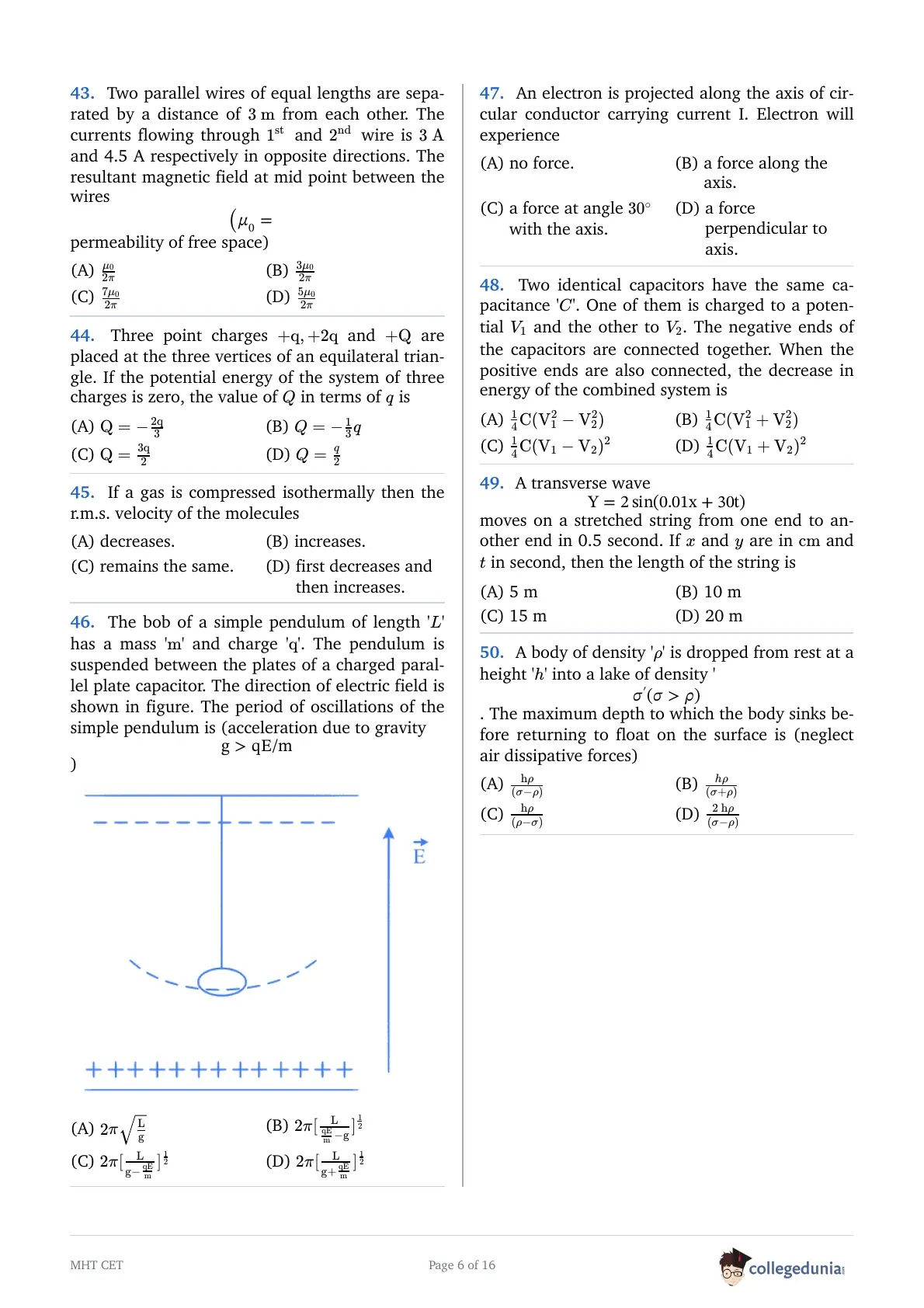
The bob of a simple pendulum of length '\[L\]' has a mass '\[\mathrm{m}\]' and charge '\[\mathrm{q}\]'. The pendulum is suspended between the plates of a charged parallel plate capacitor. The direction of electric field is shown in figure. The period of oscillations of the simple pendulum is (acceleration due to gravity \[\mathrm{g}>\mathrm{qE} / \mathrm{m}\] )

  • (A) \(2\pi \sqrt{\frac{\mathrm{L}}{\mathrm{g}}}\)
  • (B) \(2\pi [\frac{\mathrm{L}}{\frac{\mathrm{qE}}{\mathrm{m}}-\mathrm{g}}]^{\frac{1}{2}}\)
  • (C) \(2\pi [\frac{\mathrm{L}}{\mathrm{g}-\frac{\mathrm{qE}}{\mathrm{m}}}]^{\frac{1}{2}}\)
  • (D) \(2\pi [\frac{\mathrm{L}}{\mathrm{g}+\frac{\mathrm{qE}}{\mathrm{m}}}]^{\frac{1}{2}}\)

Question 47:

An electron is projected along the axis of circular conductor carrying current I. Electron will experience

  • (A) no force.
  • (B) a force along the axis.
  • (C) a force at angle \(30^{\circ}\) with the axis.
  • (D) a force perpendicular to axis.

Question 48:

Two identical capacitors have the same capacitance '\[C\]'. One of them is charged to a potential \[V_1\] and the other to \[V_2\]. The negative ends of the capacitors are connected together. When the positive ends are also connected, the decrease in energy of the combined system is

  • (A) \(\frac{1}{4}\mathrm{C}(\mathrm{V}_{1}^{2}-\mathrm{V}_{2}^{2})\)
  • (B) \(\frac{1}{4}\mathrm{C}(\mathrm{V}_{1}^{2}+\mathrm{V}_{2}^{2})\)
  • (C) \(\frac{1}{4}\mathrm{C}(\mathrm{V}_{1}-\mathrm{V}_{2})^{2}\)
  • (D) \(\frac{1}{4}\mathrm{C}(\mathrm{V}_{1}+\mathrm{V}_{2})^{2}\)

Question 49:

A transverse wave \[\mathrm{Y}=2 \sin (0.01 \mathrm{x}+30 \mathrm{t})\] moves on a stretched string from one end to another end in 0.5 second. If \[x\] and \[y\] are in \[\mathrm{cm}\] and \[t\] in second, then the length of the string is

  • (A) 5 m
  • (B) 10 m
  • (C) 15 m
  • (D) 20 m

Question 50:

A body of density '\[\rho\]' is dropped from rest at a height '\[h\]' into a lake of density '\[\sigma' (\sigma>\rho)\]. The maximum depth to which the body sinks before returning to float on the surface is (neglect air dissipative forces)

  • (A) \(\frac{\mathrm{h}\rho}{(\sigma -\rho )}\)
  • (B) \(\frac{h\rho}{(\sigma +\rho )}\)
  • (C) \(\frac{\mathrm{h}\rho}{(\rho -\sigma )}\)
  • (D) \(\frac{2\text{ }\mathrm{h}\rho}{(\sigma -\rho )}\)

Question 52:

Which of the following is a property of alkali metals?

  • (A) High density
  • (B) Compounds are paramagnetic
  • (C) Form dipositive ions only
  • (D) Most electropositive elements

Question 53:

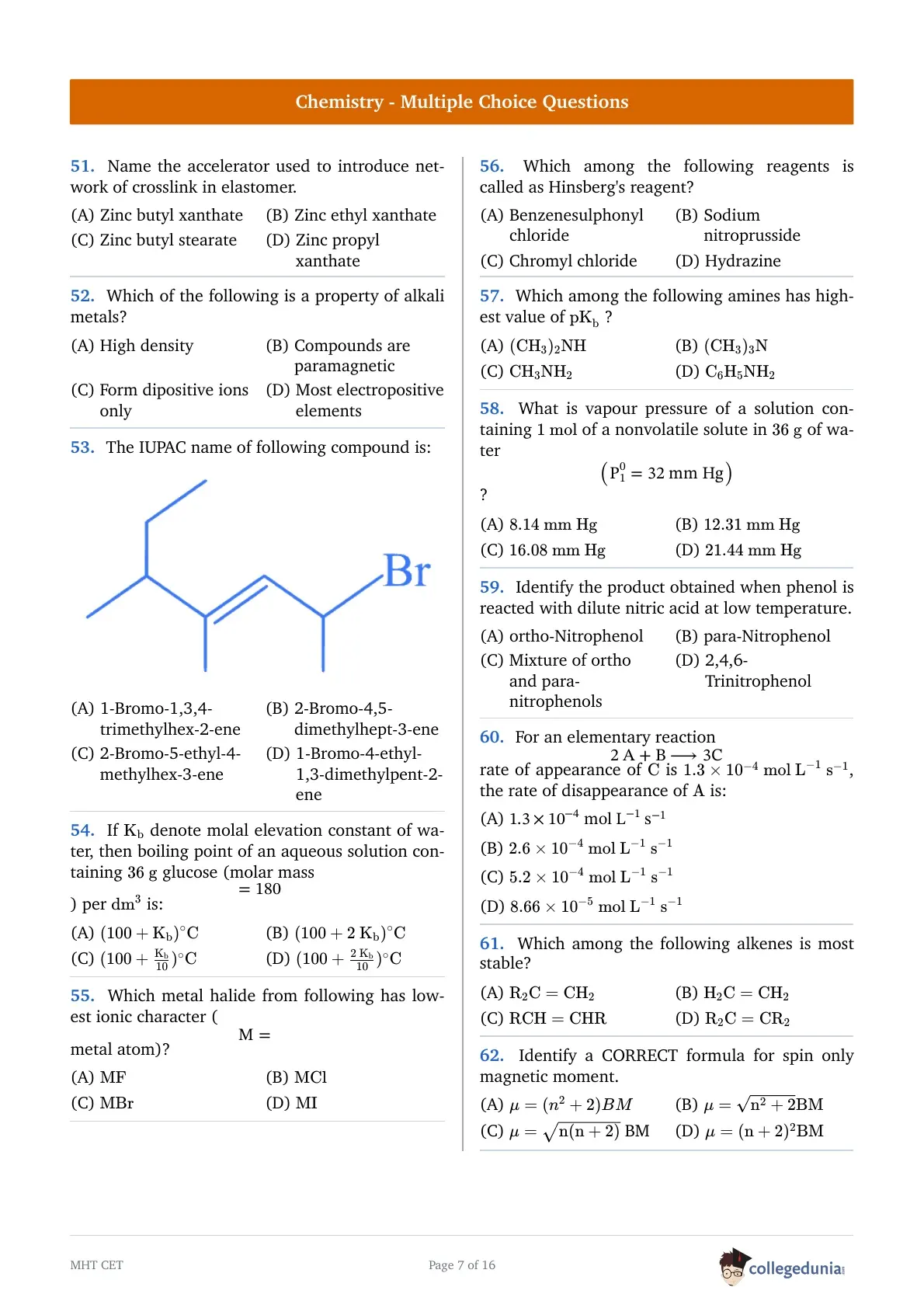
The IUPAC name of following compound is:

  • (A) 1-Bromo-1,3,4-trimethylhex-2-ene
  • (B) 2-Bromo-4,5-dimethylhept-3-ene
  • (C) 2-Bromo-5-ethyl-4-methylhex-3-ene
  • (D) 1-Bromo-4-ethyl-1,3-dimethylpent-2-ene

Question 54:

If \[\mathrm{K}_{\mathrm{b}}\] denote molal elevation constant of water, then boiling point of an aqueous solution containing \[36 \mathrm{~g}\] glucose (molar mass \[=180\] ) per \[\mathrm{dm}^3\] is:

  • (A) \((100+\mathrm{K}_{\mathrm{b}})^{\circ}\mathrm{C}\)
  • (B) \((100+2\text{ }\mathrm{K}_{\mathrm{b}})^{\circ}\mathrm{C}\)
  • (C) \((100+\frac{\mathrm{K}_{\mathrm{b}}}{10}){}^{\circ}\mathrm{C}\)
  • (D) \((100+\frac{2\text{ }\mathrm{K}_{\mathrm{b}}}{10}){}^{\circ}\mathrm{C}\)

Question 55:

Which metal halide from following has lowest ionic character ( \[\mathrm{M}=\] metal atom)?

  • (A) \(\mathrm{MF}\)
  • (B) \(\mathrm{MCl}\)
  • (C) \(\mathrm{MBr}\)
  • (D) \(\mathrm{MI}\)

Question 56:

Which among the following reagents is called as Hinsberg's reagent?

  • (A) Benzenesulphonyl chloride
  • (B) Sodium nitroprusside
  • (C) Chromyl chloride
  • (D) Hydrazine

Question 57:

Which among the following amines has highest value of \[\mathrm{pK}_{\mathrm{b}}\] ?

  • (A) \((\mathrm{CH}_{3})_{2}\mathrm{NH}\)
  • (B) \((\mathrm{CH}_{3})_{3}\mathrm{N}\)
  • (C) \(\mathrm{CH}_{3}\mathrm{NH}_{2}\)
  • (D) \(\mathrm{C}_{6}\mathrm{H}_{5}\mathrm{NH}_{2}\)

Question 58:

What is vapour pressure of a solution containing \[1 \mathrm{~mol}\] of a nonvolatile solute in \[36 \mathrm{~g}\] of water \[\left(\mathrm{P}_1^0=32 \mathrm{~mm} \mathrm{~Hg}\right)\] ?

  • (A) \(8.14\text{ }\mathrm{mm}\text{ }\mathrm{Hg}\)
  • (B) \(12.31\text{ }\mathrm{mm}\text{ }\mathrm{Hg}\)
  • (C) \(16.08\text{ }\mathrm{mm}\text{ }\mathrm{Hg}\)
  • (D) \(21.44\text{ }\mathrm{mm}\text{ }\mathrm{Hg}\)

Question 59:

Identify the product obtained when phenol is reacted with dilute nitric acid at low temperature.

  • (A) ortho-Nitrophenol
  • (B) para-Nitrophenol
  • (C) Mixture of ortho and para-nitrophenols
  • (D) 2,4,6-Trinitrophenol

Question 60:

For an elementary reaction

\[2 \mathrm{~A}+\mathrm{B} \longrightarrow 3 \mathrm{C}\]

rate of appearance of \[\mathrm{C}\] is \[1.3 \times 10^{-4} \mathrm{~mol} \mathrm{~L}^{-1} \mathrm{~s}^{-1}\], the rate of disappearance of \[\mathrm{A}\] is:

  • (A) \(1.3\times 10^{-4}\text{ }\mathrm{mol}\text{ }\mathrm{L}^{-1}\text{ }\mathrm{s}^{-1}\)
  • (B) \(2.6\times 10^{-4}\text{ }\mathrm{mol}\text{ }\mathrm{L}^{-1}\text{ }\mathrm{s}^{-1}\)
  • (C) \(5.2\times 10^{-4}\text{ }\mathrm{mol}\text{ }\mathrm{L}^{-1}\text{ }\mathrm{s}^{-1}\)
  • (D) \(8.66\times 10^{-5}\text{ }\mathrm{mol}\text{ }\mathrm{L}^{-1}\text{ }\mathrm{s}^{-1}\)

Question 61:

Which among the following alkenes is most stable?

  • (A) \(\mathrm{R}_{2}\mathrm{C}=\mathrm{CH}_{2}\)
  • (B) \(\mathrm{H}_{2}\mathrm{C}=\mathrm{CH}_{2}\)
  • (C) \(\mathrm{RCH}=\mathrm{CHR}\)
  • (D) \(\mathrm{R}_{2}\mathrm{C}=\mathrm{CR}_{2}\)

Question 62:

Identify a CORRECT formula for spin only magnetic moment.

  • (A) \(\mu =(n^{2}+2)BM\)
  • (B) \(\mu =\sqrt{\mathrm{n}^{2}+2}\mathrm{BM}\)
  • (C) \(\mu =\sqrt{\mathrm{n}(\mathrm{n}+2)}\) BM
  • (D) \(\mu =(\mathrm{n}+2)^{2}\mathrm{BM}\)

Question 63:

Which of the following salts turns red litmus blue in its aqueous solution?

  • (A) \(\mathrm{NH}_{4}\mathrm{NO}_{3}\)
  • (B) \(\mathrm{NH}_{4}\mathrm{Cl}\)
  • (C) \(\mathrm{NH}_{4}\mathrm{CN}\)
  • (D) \(\mathrm{NH}_{4}\mathrm{F}\)

Question 64:

What is the value of increase in internal energy when system does \[8 \mathrm{~J}\] of work on surrounding by supplying \[40 \mathrm{~J}\] of heat to it?

  • (A) 23 J
  • (B) 32 J
  • (C) 40 J
  • (D) 48 J

Question 65:

Benzonitrile on reduction with stannous chloride in presence of hydrochloric acid followed by acid hydrolysis forms:

  • (A) Benzal chloride
  • (B) Benzoyl chloride
  • (C) Benzophenone
  • (D) Benzaldehyde

Question 66:

Which among the following is TRUE for isobaric process?

  • (A) \(\Delta \mathrm{U}=0\)
  • (B) \(-\Delta \mathrm{U}=-\mathrm{W}\)
  • (C) \(\Delta \mathrm{U}=\mathrm{Q}\)
  • (D) \(\mathrm{Q}_{\mathrm{P}}=\Delta \mathrm{U}+\mathrm{P}_{\mathrm{ext}}\Delta \mathrm{V}\)

Question 67:

Which among the following statements is TRUE about gammexane?

  • (A) It is an isomer of \(\mathrm{BHC}\).
  • (B) It is one of the herbicides.
  • (C) It is obtained from benzene by bromination.
  • (D) It is monochloro derivative of benzene.

Question 68:

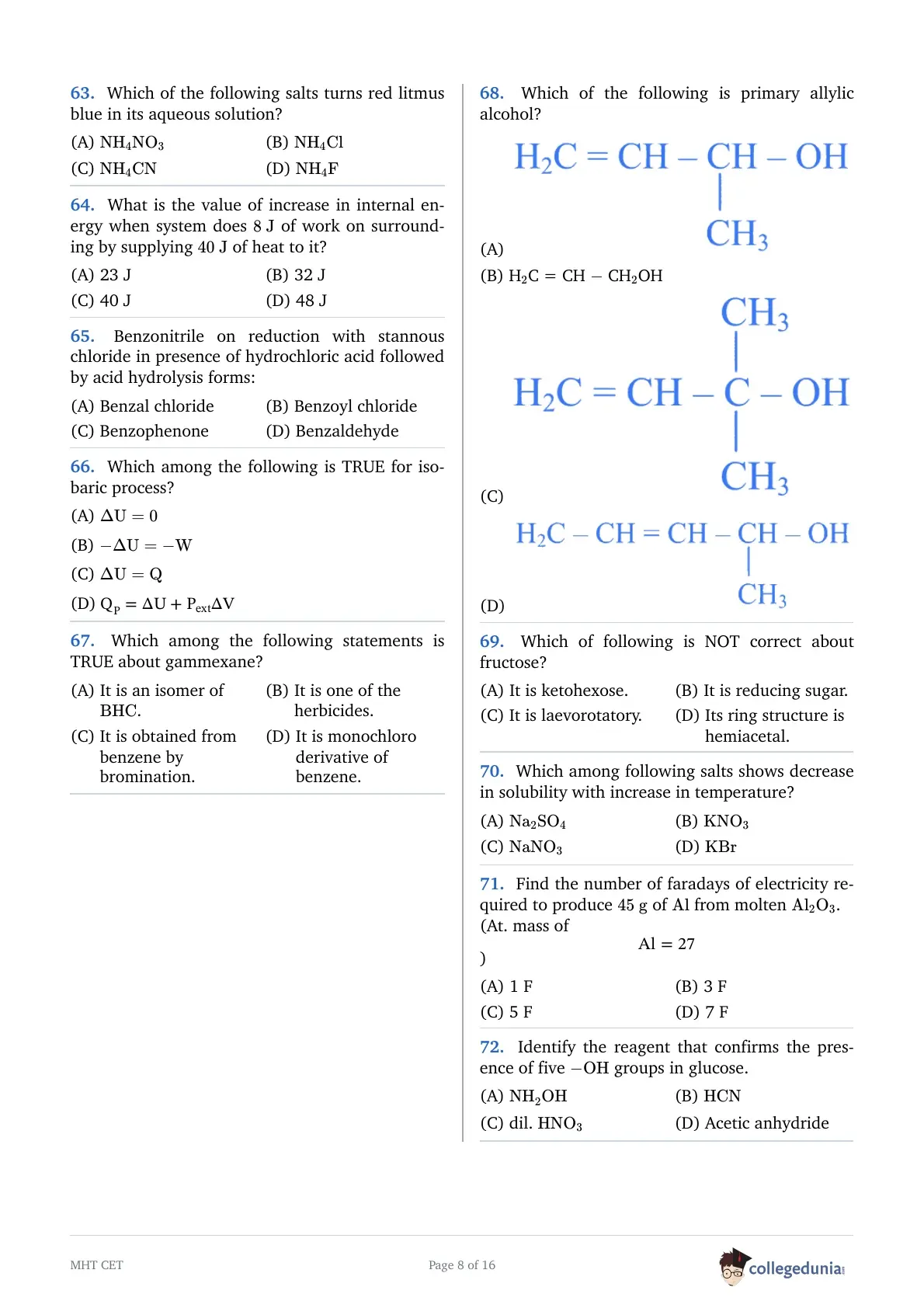
Which of the following is primary allylic alcohol?

  • (A)
  • (B) H\({}_{2}\)C = CH \(-\) CH\({}_{2}\)OH
  • (C)
  • (D)

Question 69:

Which of following is NOT correct about fructose?

  • (A) It is ketohexose.
  • (B) It is reducing sugar.
  • (C) It is laevorotatory.
  • (D) Its ring structure is hemiacetal.

Question 70:

Which among following salts shows decrease in solubility with increase in temperature?

  • (A) \(\mathrm{Na}_{2}\mathrm{SO}_{4}\)
  • (B) \(\mathrm{KNO}_{3}\)
  • (C) \(\mathrm{NaNO}_{3}\)
  • (D) \(\mathrm{KBr}\)

Question 71:

Find the number of faradays of electricity required to produce \[45 \mathrm{~g}\] of \[\mathrm{Al}\] from molten \[\mathrm{Al}_2 \mathrm{O}_3\].

(At. mass of \[\mathrm{Al}=27\] )

  • (A) 1 F
  • (B) 3 F
  • (C) 5 F
  • (D) 7 F

Question 72:

Identify the reagent that confirms the presence of five \[-\mathrm{OH}\] groups in glucose.

  • (A) \(\mathrm{NH}_{2}\mathrm{OH}\)
  • (B) \(\mathrm{HCN}\)
  • (C) dil. \(\mathrm{HNO}_{3}\)
  • (D) Acetic anhydride

Question 73:

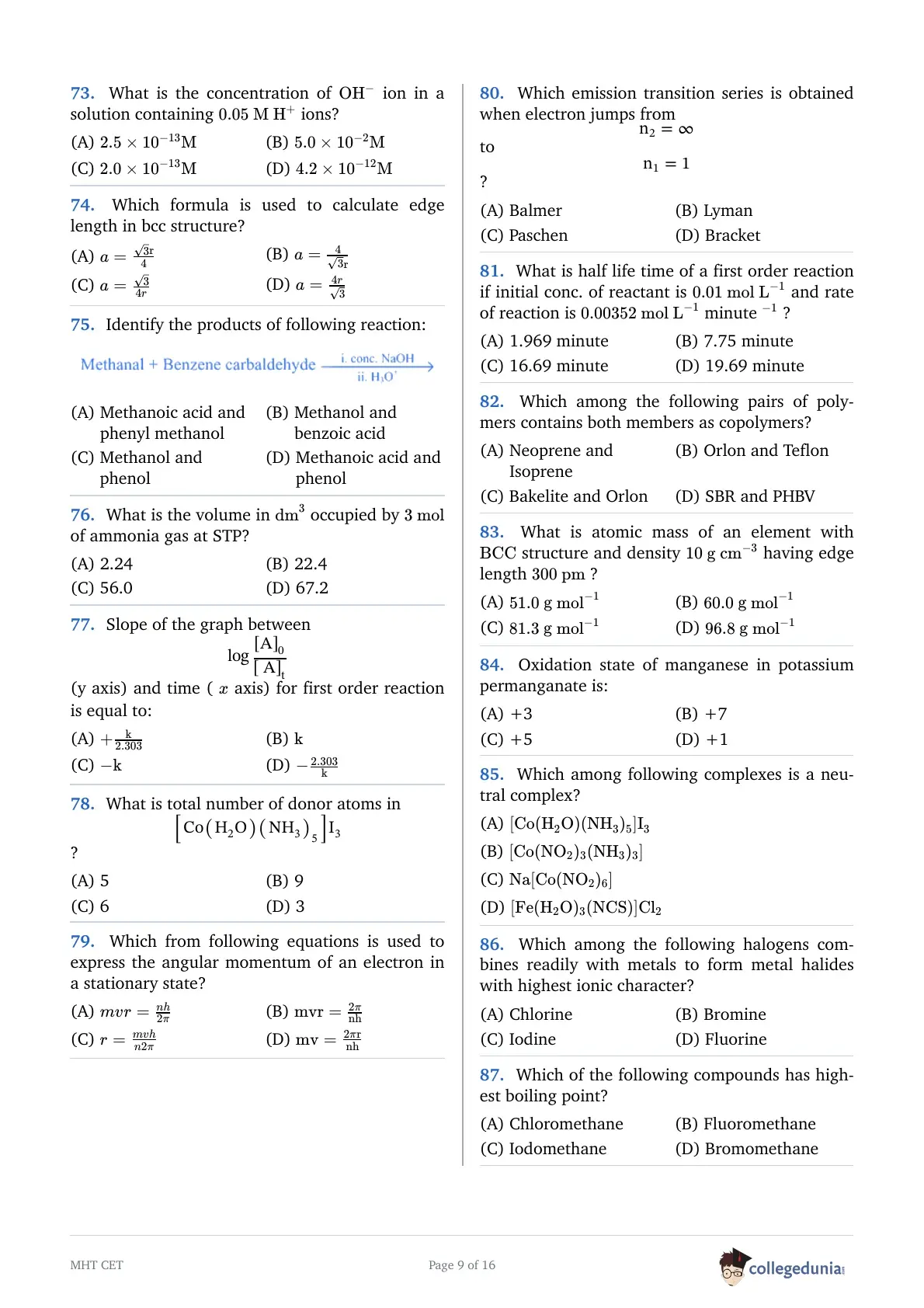
What is the concentration of \[\mathrm{OH}^{-}\] ion in a solution containing \[0.05 \mathrm{~M} \mathrm{~H}^{+}\] ions?

  • (A) \(2.5\times 10^{-13}\mathrm{M}\)
  • (B) \(5.0\times 10^{-2}\mathrm{M}\)
  • (C) \(2.0\times 10^{-13}\mathrm{M}\)
  • (D) \(4.2\times 10^{-12}\mathrm{M}\)

Question 74:

Which formula is used to calculate edge length in bcc structure?

  • (A) \(a=\frac{\sqrt{3}\mathrm{r}}{4}\)
  • (B) \(a=\frac{4}{\sqrt{3}\mathrm{r}}\)
  • (C) \(a=\frac{\sqrt{3}}{4r}\)
  • (D) \(a=\frac{4r}{\sqrt{3}}\)

Question 75:

Identify the products of following reaction:

  • (A) Methanoic acid and phenyl methanol
  • (B) Methanol and benzoic acid
  • (C) Methanol and phenol
  • (D) Methanoic acid and phenol

Question 76:

What is the volume in \[\mathrm{dm}^3\] occupied by \[3 \mathrm{~mol}\] of ammonia gas at STP?

  • (A) 2.24
  • (B) 22.4
  • (C) 56.0
  • (D) 67.2

Question 77:

Slope of the graph between \[\log \frac{[\mathrm{A}]_0}{[\mathrm{~A}]_{\mathrm{t}}}\] (y axis) and time ( \[x\] axis) for first order reaction is equal to:

  • (A) \(+\frac{\mathrm{k}}{2.303}\)
  • (B) \(\mathrm{k}\)
  • (C) \(-\mathrm{k}\)
  • (D) \(-\frac{2.303}{\mathrm{k}}\)

Question 78:

What is total number of donor atoms in \[\left[\mathrm{Co}\left(\mathrm{H}_2 \mathrm{O}\right)\left(\mathrm{NH}_3\right)_5\right] \mathrm{I}_3\] ?

  • (A) 5
  • (B) 9
  • (C) 6
  • (D) 3

Question 79:

Which from following equations is used to express the angular momentum of an electron in a stationary state?

  • (A) \(mvr=\frac{nh}{2\pi}\)
  • (B) \(\mathrm{mvr}=\frac{2\pi}{\mathrm{nh}}\)
  • (C) \(r=\frac{mvh}{n2\pi}\)
  • (D) \(\mathrm{mv}=\frac{2\pi \mathrm{r}}{\mathrm{nh}}\)

Question 80:

Which emission transition series is obtained when electron jumps from \[\mathrm{n}_2=\infty\] to \[\mathrm{n}_1=1\] ?

  • (A) Balmer
  • (B) Lyman
  • (C) Paschen
  • (D) Bracket

Question 81:

What is half life time of a first order reaction if initial conc. of reactant is \[0.01 \mathrm{~mol} \mathrm{~L}^{-1}\] and rate of reaction is \[0.00352 \mathrm{~mol} \mathrm{~L}^{-1}\] minute \[^{-1}\] ?

  • (A) 1.969 minute
  • (B) 7.75 minute
  • (C) 16.69 minute
  • (D) 19.69 minute

Question 82:

Which among the following pairs of polymers contains both members as copolymers?

  • (A) Neoprene and Isoprene
  • (B) Orlon and Teflon
  • (C) Bakelite and Orlon
  • (D) SBR and PHBV

Question 83:

What is atomic mass of an element with \[\mathrm{BCC}\] structure and density \[10 \mathrm{~g} \mathrm{~cm}^{-3}\] having edge length \[300 \mathrm{~pm}\] ?

  • (A) \(51.0\text{ }\mathrm{g}\text{ }\mathrm{mol}^{-1}\)
  • (B) \(60.0\text{ }\mathrm{g}\text{ }\mathrm{mol}^{-1}\)
  • (C) \(81.3\text{ }\mathrm{g}\text{ }\mathrm{mol}^{-1}\)
  • (D) \(96.8\text{ }\mathrm{g}\text{ }\mathrm{mol}^{-1}\)

Question 84:

Oxidation state of manganese in potassium permanganate is:

  • (A) +3
  • (B) +7
  • (C) +5
  • (D) +1

Question 85:

Which among following complexes is a neutral complex?

  • (A) \([\mathrm{Co}(\mathrm{H}_{2}\mathrm{O})(\mathrm{NH}_{3})_{5}]\mathrm{I}_{3}\)
  • (B) \([\mathrm{Co}(\mathrm{NO}_{2})_{3}(\mathrm{NH}_{3})_{3}]\)
  • (C) \(\mathrm{Na}[\mathrm{Co}(\mathrm{NO}_{2})_{6}]\)
  • (D) \([\mathrm{Fe}(\mathrm{H}_{2}\mathrm{O})_{3}(\mathrm{NCS})]\mathrm{Cl}_{2}\)

Question 86:

Which among the following halogens combines readily with metals to form metal halides with highest ionic character?

  • (A) Chlorine
  • (B) Bromine
  • (C) Iodine
  • (D) Fluorine

Question 87:

Which of the following has the highest Boiling Point?

  • (A) Chloromethane
  • (B) Fluoromethane
  • (C) Bromomethane
  • (D) Iodomethane

Question 88:

Identify physisorption from following.

  • (A) \(\mathrm{O}_{2}\) gas deposited on tungsten
  • (B) \(\mathrm{H}_{2}\) gas deposited on nickel
  • (C) \(\mathrm{N}_{2}\) gas deposited on iron
  • (D) All gases deposited on charcoal

Question 89:

Identify the product of following reaction.

Benzoyl chloride \[\stackrel{\mathrm{H}_2 \mathrm{O}}{\longrightarrow}\] product

  • (A) Benzyl alcohol
  • (B) Benzaldehyde
  • (C) Benzoic acid
  • (D) Benzophenone

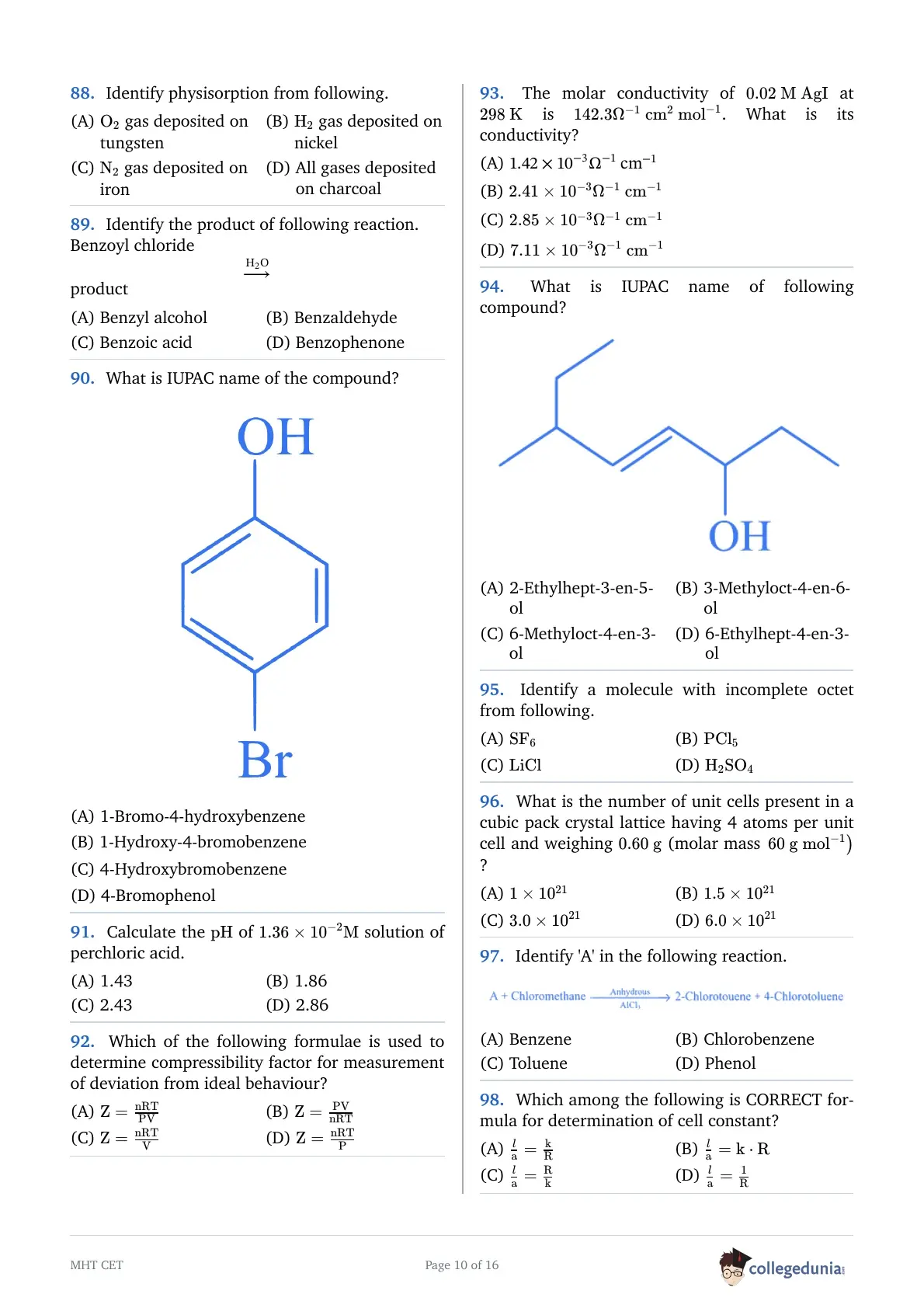
Question 90:

What is IUPAC name of the compound?

  • (A) 1-Bromo-4-hydroxybenzene
  • (B) 1-Hydroxy-4-bromobenzene
  • (C) 4-Hydroxybromobenzene
  • (D) 4-Bromophenol

Question 91:

Calculate the \[\mathrm{pH}\] of \[1.36 \times 10^{-2} \mathrm{M}\] solution of perchloric acid.

  • (A) 1.43
  • (B) 1.86
  • (C) 2.43
  • (D) 2.86

Question 92:

Which of the following formulae is used to determine compressibility factor for measurement of deviation from ideal behaviour?

  • (A) \(\mathrm{Z}=\frac{\mathrm{nRT}}{\mathrm{PV}}\)
  • (B) \(\mathrm{Z}=\frac{\mathrm{PV}}{\mathrm{nRT}}\)
  • (C) \(\mathrm{Z}=\frac{\mathrm{nRT}}{\mathrm{V}}\)
  • (D) \(\mathrm{Z}=\frac{\mathrm{nRT}}{\mathrm{P}}\)

Question 93:

The molar conductivity of \[0.02 \mathrm{~M} \mathrm{~AgI}\] at \[298 \mathrm{~K}\] is \[142.3 \Omega^{-1} \mathrm{~cm}^2 \mathrm{~mol}^{-1}\]. What is its conductivity?

  • (A) \(1.42\times 10^{-3}\Omega ^{-1}\text{ }\mathrm{cm}^{-1}\)
  • (B) \(2.41\times 10^{-3}\Omega ^{-1}\text{ }\mathrm{cm}^{-1}\)
  • (C) \(2.85\times 10^{-3}\Omega ^{-1}\text{ }\mathrm{cm}^{-1}\)
  • (D) \(7.11\times 10^{-3}\Omega ^{-1}\text{ }\mathrm{cm}^{-1}\)

Question 94:

What is IUPAC name of following compound?

  • (A) 2-Ethylhept-3-en-5-ol
  • (B) 3-Methyloct-4-en-6-ol
  • (C) 6-Methyloct-4-en-3-ol
  • (D) 6-Ethylhept-4-en-3-ol

Question 95:

Identify a molecule with incomplete octet from following.

  • (A) \(\mathrm{SF}_{6}\)
  • (B) \(\mathrm{PCl}_{5}\)
  • (C) \(\mathrm{LiCl}\)
  • (D) \(\mathrm{H}_{2}\mathrm{SO}_{4}\)

Question 96:

What is the number of unit cells present in a cubic pack crystal lattice having 4 atoms per unit cell and weighing \[0.60 \mathrm{~g}\] (molar mass \[\left.60 \mathrm{~g} \mathrm{~mol}^{-1}\right)\] ?

  • (A) \(1\times 10^{21}\)
  • (B) \(1.5\times 10^{21}\)
  • (C) \(3.0\times 10^{21}\)
  • (D) \(6.0\times 10^{21}\)

Question 97:

Identify 'A' in the following reaction.

  • (A) Benzene
  • (B) Chlorobenzene
  • (C) Toluene
  • (D) Phenol

Question 98:

Which among the following is CORRECT formula for determination of cell constant?

  • (A) \(\frac{l}{\mathrm{a}}=\frac{\mathrm{k}}{\mathrm{R}}\)
  • (B) \(\frac{l}{\mathrm{a}}=\mathrm{k}\cdot \mathrm{R}\)
  • (C) \(\frac{l}{\mathrm{a}}=\frac{\mathrm{R}}{\mathrm{k}}\)
  • (D) \(\frac{l}{\mathrm{a}}=\frac{1}{\mathrm{R}}\)

Question 99:

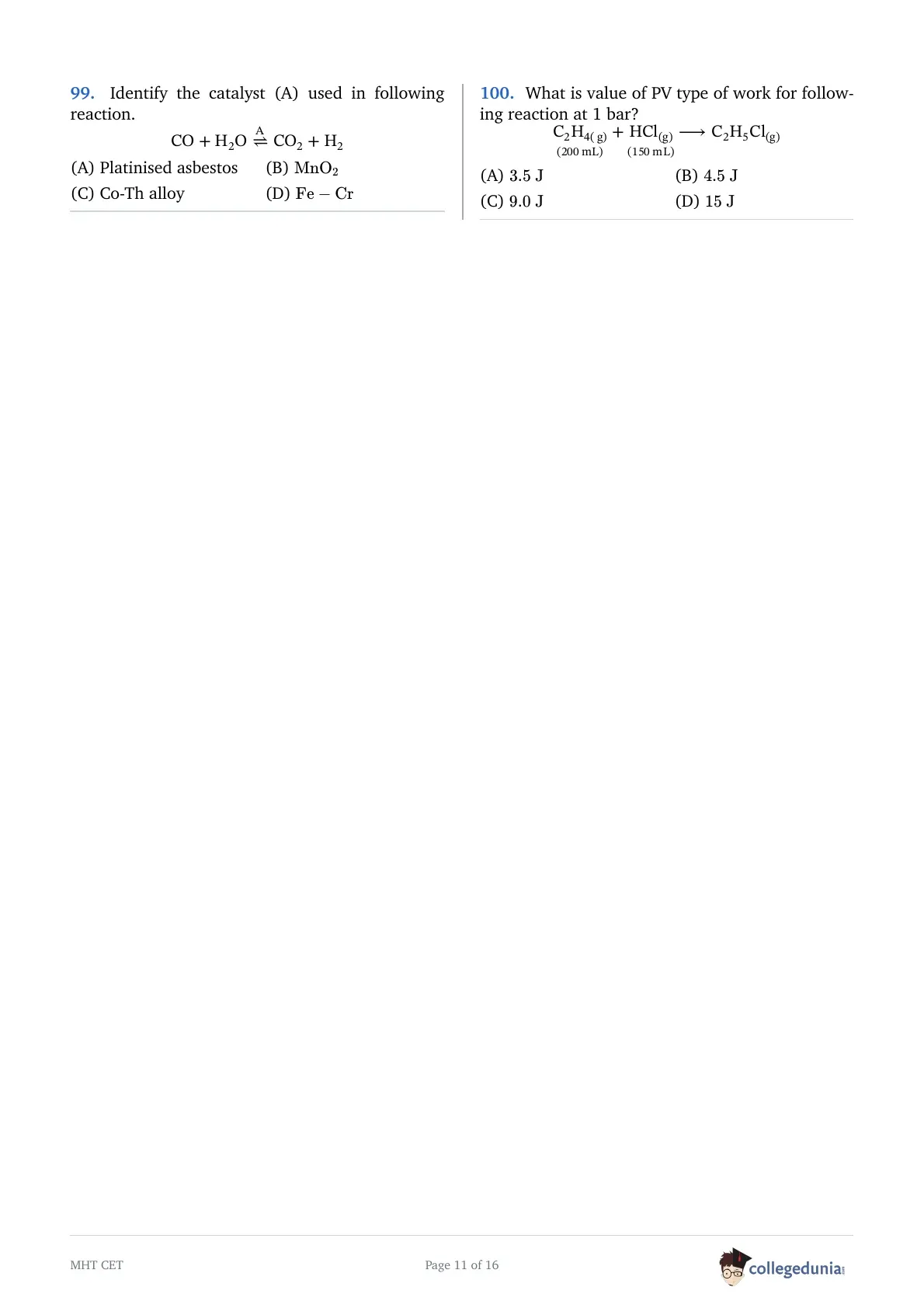
Identify the catalyst (A) used in following reaction.

\[\mathrm{CO}+\mathrm{H}_2 \mathrm{O} \stackrel{\mathrm{A}}{\rightleftharpoons} \mathrm{CO}_2+\mathrm{H}_2\]

  • (A) Platinised asbestos
  • (B) \(\mathrm{MnO}_{2}\)
  • (C) Co-Th alloy
  • (D) \(\mathrm{Fe}-\mathrm{Cr}\)

Question 100:

What is value of PV type of work for following reaction at 1 bar?

\[\underset{(200 \mathrm{~mL})}{\mathrm{C}_2 \mathrm{H}_{4(\mathrm{~g})}}+\underset{(150 \mathrm{~mL})}{\mathrm{HCl}_{(\mathrm{g})}} \longrightarrow \mathrm{C}_2 \mathrm{H}_5 \mathrm{Cl}_{(\mathrm{g})}\]

  • (A) \(3.5\text{ }\mathrm{J}\)
  • (B) \(4.5\text{ }\mathrm{J}\)
  • (C) \(9.0\text{ }\mathrm{J}\)
  • (D) \(15\text{ }\mathrm{J}\)

Mathematics (Q101 - Q150)

Question 101:

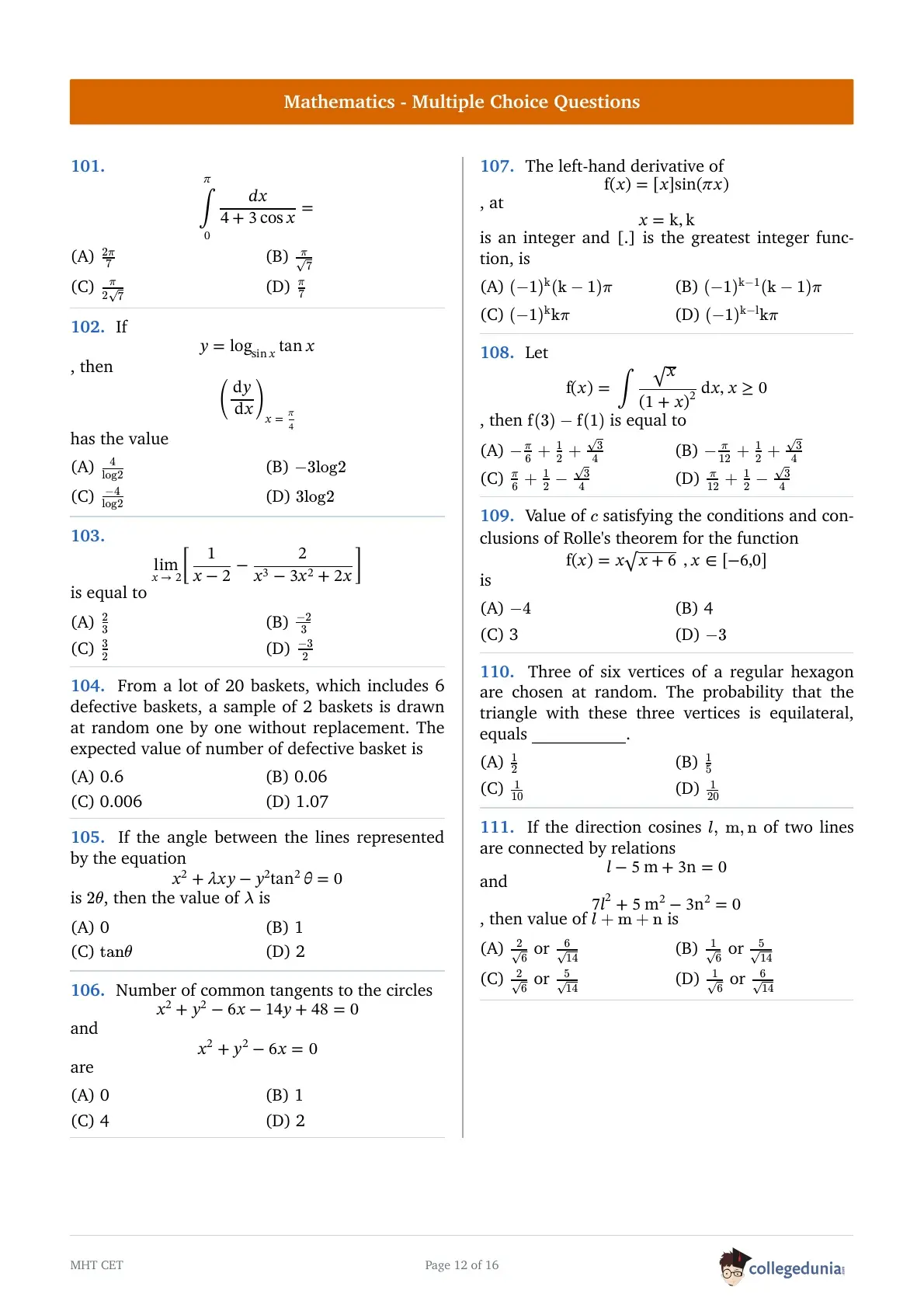
\[\int\limits_0^\pi \frac{d x}{4+3 \cos x}=\]

  • (A) \(\frac{2\pi}{7}\)
  • (B) \(\frac{\pi}{\sqrt{7}}\)
  • (C) \(\frac{\pi}{2\sqrt{7}}\)
  • (D) \(\frac{\pi}{7}\)

Question 102:

If \[y=\log _{\sin x} \tan x\], then \[\left(\frac{\mathrm{d} y}{\mathrm{~d} x}\right)_{x=\frac{\pi}{4}}\] has the value

  • (A) \(\frac{4}{\mathrm{log}2}\)
  • (B) \(-3\mathrm{log}2\)
  • (C) \(\frac{-4}{\mathrm{log}2}\)
  • (D) \(3\mathrm{log}2\)

Question 103:

\[\lim _\limits{x \rightarrow 2}\left[\frac{1}{x-2}-\frac{2}{x^3-3 x^2+2 x}\right]\] is equal to

  • (A) \(\frac{2}{3}\)
  • (B) \(\frac{-2}{3}\)
  • (C) \(\frac{3}{2}\)
  • (D) \(\frac{-3}{2}\)

Question 104:

From a lot of 20 baskets, which includes 6 defective baskets, a sample of 2 baskets is drawn at random one by one without replacement. The expected value of number of defective basket is

  • (A) 0.6
  • (B) 0.06
  • (C) 0.006
  • (D) 1.07

Question 105:

If the angle between the lines represented by the equation \[x^2+\lambda x y-y^2 \tan ^2 \theta=0\] is \[2 \theta\], then the value of \[\lambda\] is

  • (A) 0
  • (B) 1
  • (C) \(\mathrm{tan}\theta\)
  • (D) 2

Question 106:

Number of common tangents to the circles \[x^2+y^2-6 x-14 y+48=0\] and \[x^2+y^2-6 x=0\] are

  • (A) 0
  • (B) 1
  • (C) 4
  • (D) 2

Question 107:

The left-hand derivative of \[\mathrm{f}(x)=[x] \sin (\pi x)\], at \[x=\mathrm{k}, \mathrm{k}\] is an integer and [.] is the greatest integer function, is

  • (A) \((-1)^{\mathrm{k}}(\mathrm{k}-1)\pi\)
  • (B) \((-1)^{\mathrm{k}-1}(\mathrm{k}-1)\pi\)
  • (C) \((-1)^{\mathrm{k}}\mathrm{k}\pi\)
  • (D) \((-1)^{\mathrm{k}-\mathrm{l}}\mathrm{k}\pi\)

Question 108:

Let \[\mathrm{f}(x)=\int \frac{\sqrt{x}}{(1+x)^2} \mathrm{~d} x, x \geq 0\], then \[\mathrm{f}(3)-\mathrm{f}(1)\] is equal to

  • (A) \(-\frac{\pi}{6}+\frac{1}{2}+\frac{\sqrt{3}}{4}\)
  • (B) \(-\frac{\pi}{12}+\frac{1}{2}+\frac{\sqrt{3}}{4}\)
  • (C) \(\frac{\pi}{6}+\frac{1}{2}-\frac{\sqrt{3}}{4}\)
  • (D) \(\frac{\pi}{12}+\frac{1}{2}-\frac{\sqrt{3}}{4}\)

Question 109:

Value of \[c\] satisfying the conditions and conclusions of Rolle's theorem for the function \[\mathrm{f}(x)=x \sqrt{x+6}, x \in[-6,0]\] is

  • (A) \(-4\)
  • (B) 4
  • (C) 3
  • (D) \(-3\)

Question 110:

Three of six vertices of a regular hexagon are chosen at random. The probability that the triangle with these three vertices is equilateral, equals ___________.

  • (A) \(\frac{1}{2}\)
  • (B) \(\frac{1}{5}\)
  • (C) \(\frac{1}{10}\)
  • (D) \(\frac{1}{20}\)

Question 111:

If the direction cosines \[l, \mathrm{~m}, \mathrm{n}\] of two lines are connected by relations \[l-5 \mathrm{~m}+3 \mathrm{n}=0\] and \[7 l^2+5 \mathrm{~m}^2-3 \mathrm{n}^2=0\], then value of \[l+\mathrm{m}+\mathrm{n}\] is

  • (A) \(\frac{2}{\sqrt{6}}\) or \(\frac{6}{\sqrt{14}}\)
  • (B) \(\frac{1}{\sqrt{6}}\) or \(\frac{5}{\sqrt{14}}\)
  • (C) \(\frac{2}{\sqrt{6}}\) or \(\frac{5}{\sqrt{14}}\)
  • (D) \(\frac{1}{\sqrt{6}}\) or \(\frac{6}{\sqrt{14}}\)

Question 112:

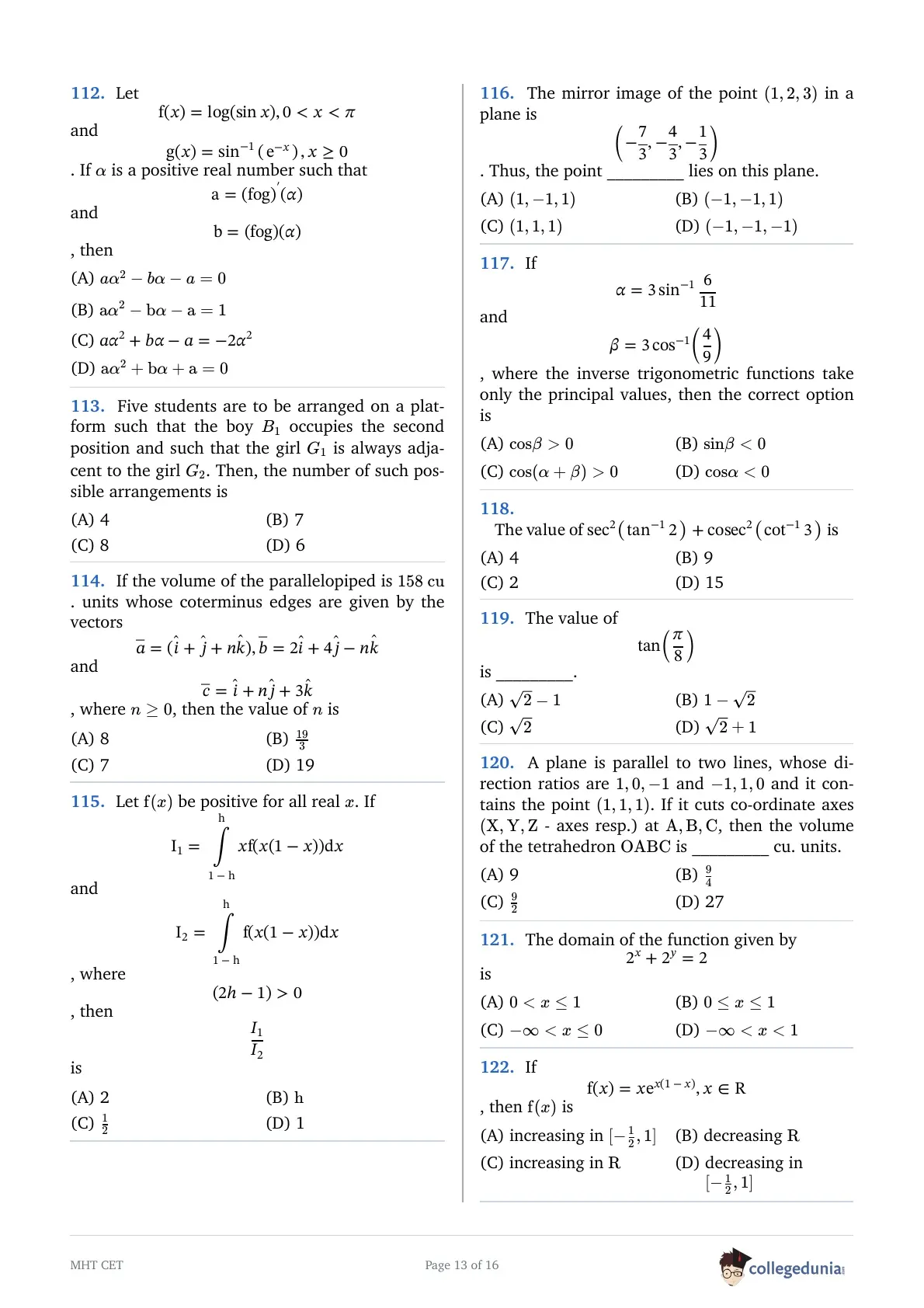
Let \(\mathrm{f}(x)=\log (\sin x), 0 < x < \pi\) and \(\mathrm{g}(x)=\sin ^{-1}\left(\mathrm{e}^{-x}\right), x \geq 0\). If \(\alpha\) is a positive real number such that \(\mathrm{a}=(\mathrm{fog})^{\prime}(\alpha)\) and \(\mathrm{b}=(\mathrm{fog})(\alpha)\), then

  • (A) \(a\alpha ^{2}-b\alpha -a=0\)
  • (B) \(\mathrm{a}\alpha ^{2}-\mathrm{b}\alpha -\mathrm{a}=1\)
  • (C) \(a\alpha ^{2}+b\alpha -a=-2\alpha ^{2}\)
  • (D) \(\mathrm{a}\alpha ^{2}+\mathrm{b}\alpha +\mathrm{a}=0\)

Question 113:

Five students are to be arranged on a platform such that the boy \[B_1\] occupies the second position and such that the girl \[G_1\] is always adjacent to the girl \[G_2\]. Then, the number of such possible arrangements is

  • (A) 4
  • (B) 7
  • (C) 8
  • (D) 6

Question 114:

If the volume of the parallelopiped is \[158 \mathrm{~cu}\]. units whose coterminus edges are given by the vectors \[\bar{a}=(\hat{i}+\hat{j}+n \hat{k}), \bar{b}=2 \hat{i}+4 \hat{j}-n \hat{k}\] and \[\bar{c}=\hat{i}+n \hat{j}+3 \hat{k}\], where \[n \geq 0\], then the value of \[n\] is

  • (A) 8
  • (B) \(\frac{19}{3}\)
  • (C) 7
  • (D) 19

Question 115:

Let \[\mathrm{f}(x)\] be positive for all real \[x\]. If \[\mathrm{I}_1=\int_\limits{1-\mathrm{h}}^{\mathrm{h}} x \mathrm{f}(x(1-x)) \mathrm{d} x\] and \[\mathrm{I}_2=\int_\limits{1-\mathrm{h}}^{\mathrm{h}} \mathrm{f}(x(1-x)) \mathrm{d} x\], where \[(2 h-1)>0\], then \[\frac{I_1}{I_2}\] is

  • (A) 2
  • (B) \(\mathrm{h}\)
  • (C) \(\frac{1}{2}\)
  • (D) 1

Question 116:

The mirror image of the point \[(1,2,3)\] in a plane is \[\left(-\frac{7}{3},-\frac{4}{3},-\frac{1}{3}\right)\]. Thus, the point _________ lies on this plane.

  • (A) \((1,-1,1)\)
  • (B) \((-1,-1,1)\)
  • (C) \((1,1,1)\)
  • (D) \((-1,-1,-1)\)

Question 118:

\[\text { The value of } \sec ^2\left(\tan ^{-1} 2\right)+\operatorname{cosec}^2\left(\cot ^{-1} 3\right) \text { is }\]

  • (A) 4
  • (B) 9
  • (C) 2
  • (D) 15

Question 119:

The value of \[\tan \left(\frac{\pi}{8}\right)\] is _________.

  • (A) \(\sqrt{2}-1\)
  • (B) \(1-\sqrt{2}\)
  • (C) \(\sqrt{2}\)
  • (D) \(\sqrt{2}+1\)

Question 120:

A plane is parallel to two lines, whose direction ratios are \[1,0,-1\] and \[-1,1,0\] and it contains the point \[(1,1,1)\]. If it cuts co-ordinate axes \[(\mathrm{X}, \mathrm{Y}, \mathrm{Z}\] - axes resp.) at \[\mathrm{A}, \mathrm{B}, \mathrm{C}\], then the volume of the tetrahedron \[\mathrm{OABC}\] is _________ cu. units.

  • (A) 9
  • (B) \(\frac{9}{4}\)
  • (C) \(\frac{9}{2}\)
  • (D) 27

Question 121:

The domain of the function given by \[2^x+2^y=2\] is

  • (A) \(0<x\leq 1\)
  • (B) \(0\leq x\leq 1\)
  • (C) \(-\infty <x\leq 0\)
  • (D) \(-\infty <x<1\)

Question 122:

If \[\mathrm{f}(x)=x \mathrm{e}^{x(1-x)}, x \in \mathrm{R}\], then \[\mathrm{f}(x)\] is

  • (A) increasing in \([-\frac{1}{2},1]\)
  • (B) decreasing \(\mathrm{R}\)
  • (C) increasing in \(\mathrm{R}\)
  • (D) decreasing in \([-\frac{1}{2},1]\)

Question 123:

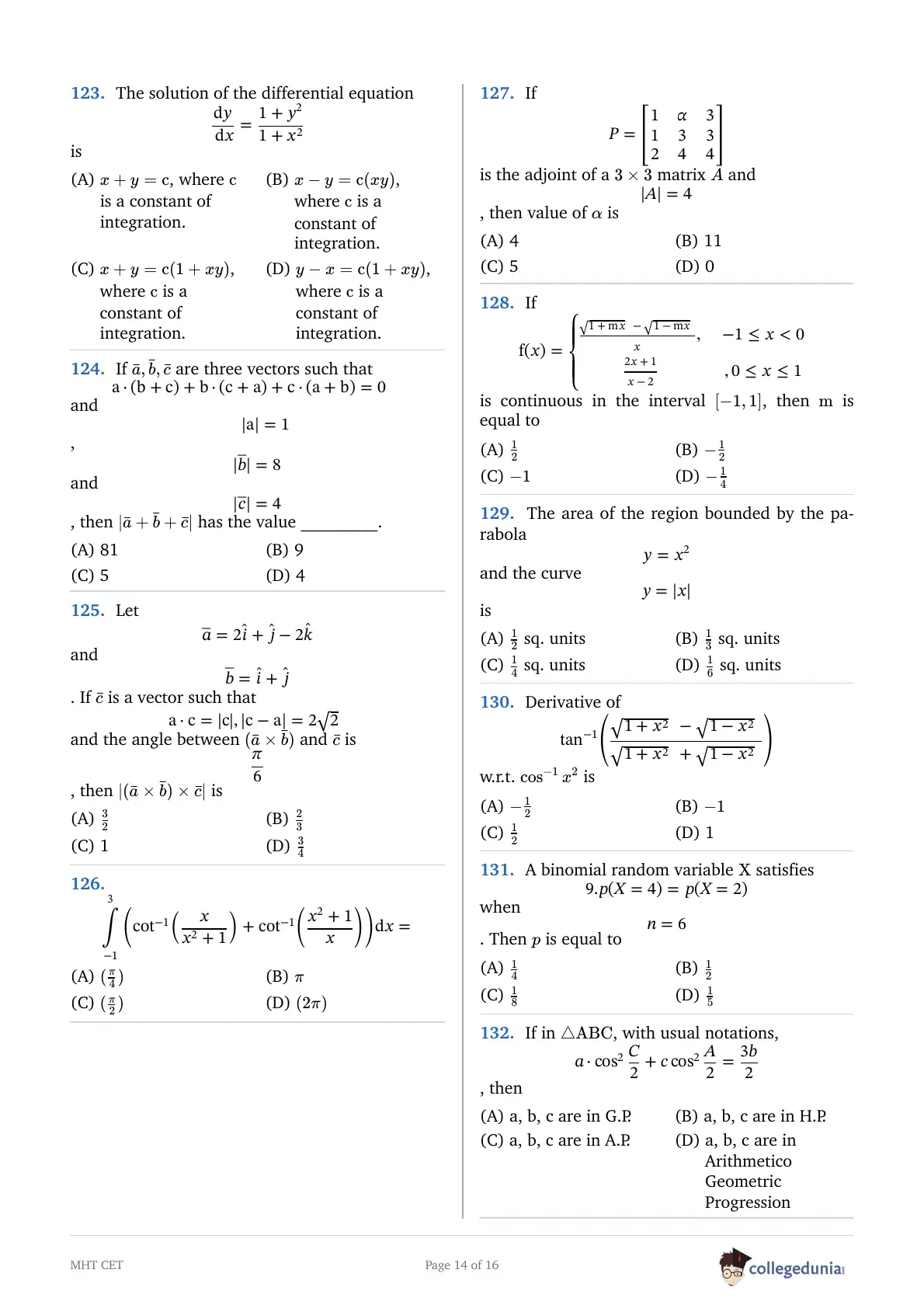
The solution of the differential equation \[\frac{\mathrm{d} y}{\mathrm{~d} x}=\frac{1+y^2}{1+x^2}\] is

  • (A) \(x+y=\mathrm{c}\), where \(\mathrm{c}\) is a constant of integration.
  • (B) \(x-y=\mathrm{c}(xy)\), where \(\mathrm{c}\) is a constant of integration.
  • (C) \(x+y=\mathrm{c}(1+xy)\), where \(\mathrm{c}\) is a constant of integration.
  • (D) \(y-x=\mathrm{c}(1+xy)\), where \(\mathrm{c}\) is a constant of integration.

Question 124:

If \[\bar{a}, \bar{b}, \bar{c}\] are three vectors such that \[\overline{\mathrm{a}} \cdot(\overline{\mathrm{b}}+\overline{\mathrm{c}})+\overline{\mathrm{b}} \cdot(\overline{\mathrm{c}}+\overline{\mathrm{a}})+\overline{\mathrm{c}} \cdot(\overline{\mathrm{a}}+\overline{\mathrm{b}})=0 \quad\] and \[\quad|\overline{\mathrm{a}}|=1\], \[|\bar{b}|=8\] and \[|\bar{c}|=4\], then \[|\bar{a}+\bar{b}+\bar{c}|\] has the value _________.

  • (A) 81
  • (B) 9
  • (C) 5
  • (D) 4

Question 125:

Let \[\bar{a}=2 \hat{i}+\hat{j}-2 \hat{k}\] and \[\bar{b}=\hat{i}+\hat{j}\]. If \[\bar{c}\] is a vector such that \[\overline{\mathrm{a}} \cdot \overline{\mathrm{c}}=|\overline{\mathrm{c}}|,|\overline{\mathrm{c}}-\overline{\mathrm{a}}|=2 \sqrt{2}\] and the angle between \[(\bar{a} \times \bar{b})\] and \[\bar{c}\] is \[\frac{\pi}{6}\], then \[|(\bar{a} \times \bar{b}) \times \bar{c}|\] is

  • (A) \(\frac{3}{2}\)
  • (B) \(\frac{2}{3}\)
  • (C) 1
  • (D) \(\frac{3}{4}\)

Question 127:

If \[P=\left[\begin{array}{lll}1 & \alpha & 3 \\ 1 & 3 & 3 \\ 2 & 4 & 4\end{array}\right]\] is the adjoint of a \[3 \times 3\] matrix \[A\] and \[|A|=4\], then value of \[\alpha\] is

  • (A) 4
  • (B) 11
  • (C) 5
  • (D) 0

Question 128:

If \(\mathrm{f}(x)=\left\{\begin{array}{ll}\frac{\sqrt{1+\mathrm{m} x}-\sqrt{1-\mathrm{m} x}}{x}, & -1 \leq x < 0 \\ \frac{2 x+1}{x-2} & , 0 \leq x \leq 1\end{array}\right.\) is continuous in the interval \([-1,1]\), then \(\mathrm{m}\) is equal to

  • (A) \(\frac{1}{2}\)
  • (B) \(-\frac{1}{2}\)
  • (C) \(-1\)
  • (D) \(-\frac{1}{4}\)

Question 129:

The area of the region bounded by the parabola \[y=x^2\] and the curve \[y=|x|\] is

  • (A) \(\frac{1}{2}\) sq. units
  • (B) \(\frac{1}{3}\) sq. units
  • (C) \(\frac{1}{4}\) sq. units
  • (D) \(\frac{1}{6}\) sq. units

Question 130:

Derivative of \[\tan ^{-1}\left(\frac{\sqrt{1+x^2}-\sqrt{1-x^2}}{\sqrt{1+x^2}+\sqrt{1-x^2}}\right)\] w.r.t. \[\cos ^{-1} x^2\] is

  • (A) \(-\frac{1}{2}\)
  • (B) \(-1\)
  • (C) \(\frac{1}{2}\)
  • (D) 1

Question 131:

A binomial random variable \[\mathrm{X}\] satisfies \[9. p(X=4)=p(X=2)\] when \[n=6\]. Then \[p\] is equal to

  • (A) \(\frac{1}{4}\)
  • (B) \(\frac{1}{2}\)
  • (C) \(\frac{1}{8}\)
  • (D) \(\frac{1}{5}\)

Question 132:

If in \[\triangle \mathrm{ABC}\], with usual notations, \[a \cdot \cos ^2 \frac{C}{2}+c \cos ^2 \frac{A}{2}=\frac{3 b}{2}\], then

  • (A) a, b, c are in G.P.
  • (B) a, b, c are in H.P.
  • (C) a, b, c are in A.P.
  • (D) a, b, c are in Arithmetico Geometric Progression

Question 133:

The lines \[\frac{x-1}{3}=\frac{y+1}{2}=\frac{z-1}{5} \quad\] and \[\frac{x+2}{4}=\frac{y-1}{3}=\frac{z+1}{2}\]

  • (A) intersect each other and point of intersection is \((2,1,3)\)
  • (B) intersect each other and point of intersection is \((3,2,4)\)
  • (C) intersect each other and point of intersection is \((-2,3,3)\)
  • (D) do not intersect.

Question 134:

A curve passes through the point \[\left(1, \frac{\pi}{6}\right)\]. Let the slope of the curve at each point \[(x, y)\] be \[\frac{y}{x}+\sec \left(\frac{y}{x}\right), x>0\], then, the equation of the curve is

  • (A) \(\mathrm{sin}(\frac{y}{x})=\mathrm{log}(x)+\frac{1}{2}\)
  • (B) \(\mathrm{cosec}(\frac{y}{x})=\mathrm{log}(x)+2\)
  • (C) \(\mathrm{sec}(\frac{2y}{x})=\mathrm{log}(x)+2\)
  • (D) \(\mathrm{cos}(\frac{2y}{x})=\mathrm{log}(x)+\frac{1}{2}\)

Question 135:

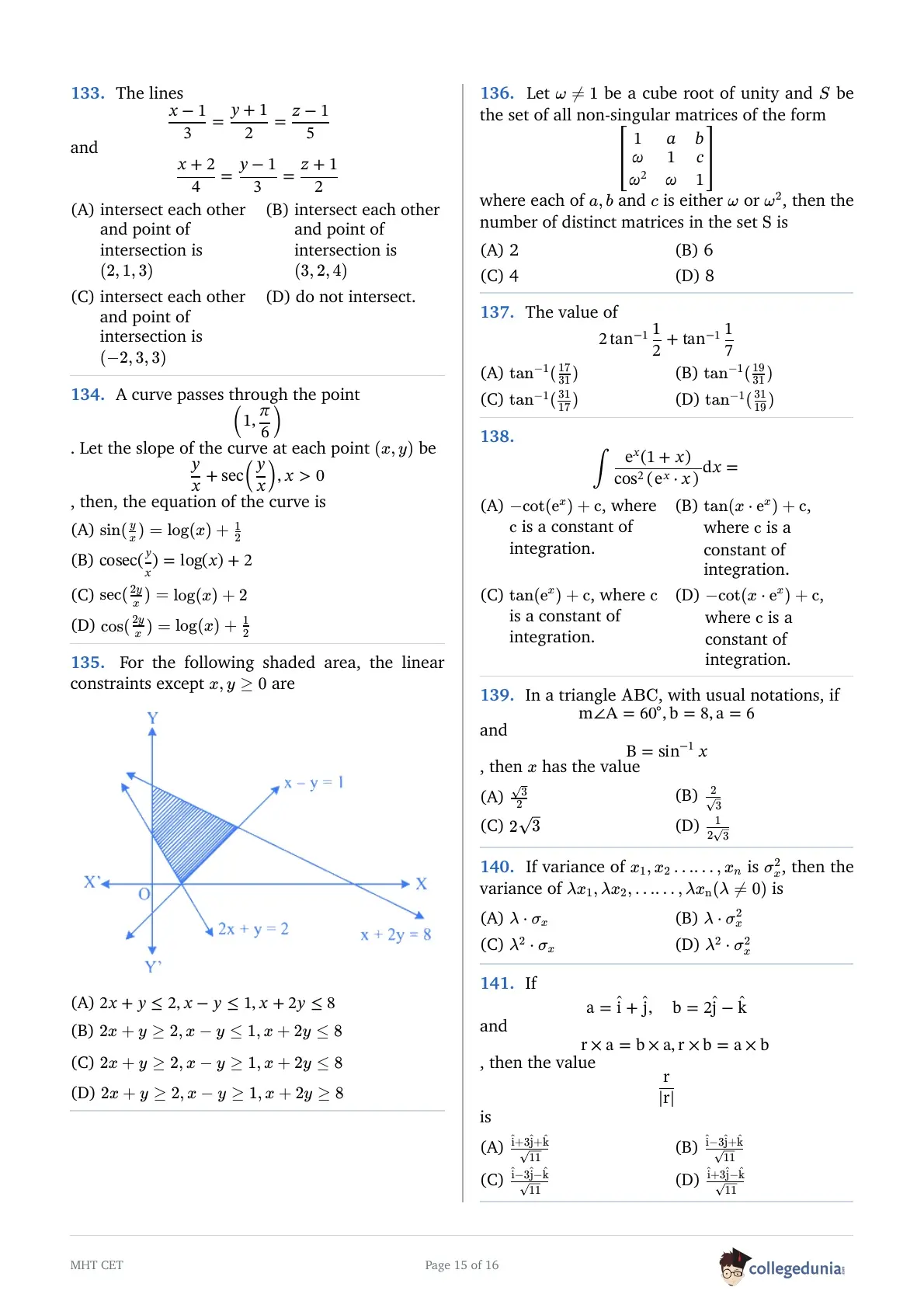
For the following shaded area, the linear constraints except \[x,y \ge 0\] are

  • (A) \(2x+y\leq 2,x-y\leq 1,x+2y\leq 8\)
  • (B) \(2x+y\geq 2,x-y\leq 1,x+2y\leq 8\)
  • (C) \(2x+y\geq 2,x-y\geq 1,x+2y\leq 8\)
  • (D) \(2x+y\geq 2,x-y\geq 1,x+2y\geq 8\)

Question 136:

Let \[\omega \neq 1\] be a cube root of unity and \[S\] be the set of all non-singular matrices of the form \[\left[\begin{array}{ccc}1 & a & b \\ \omega & 1 & c \\ \omega^2 & \omega & 1\end{array}\right]\] where each of \[a, b\] and \[c\] is either \[\omega\] or \[\omega^2\], then the number of distinct matrices in the set \[\mathrm{S}\] is

  • (A) 2
  • (B) 6
  • (C) 4
  • (D) 8

Question 137:

The value of \[2 \tan ^{-1} \frac{1}{2}+\tan ^{-1} \frac{1}{7}\]

  • (A) \(\mathrm{tan}^{-1}(\frac{17}{31})\)
  • (B) \(\mathrm{tan}^{-1}(\frac{19}{31})\)
  • (C) \(\mathrm{tan}^{-1}(\frac{31}{17})\)
  • (D) \(\mathrm{tan}^{-1}(\frac{31}{19})\)

Question 138:

\[\int \frac{\mathrm{e}^x(1+x)}{\cos ^2\left(\mathrm{e}^x \cdot x\right)} \mathrm{d} x=\]

  • (A) \(-\mathrm{cot}(\mathrm{e}^{x})+\mathrm{c}\), where \(\mathrm{c}\) is a constant of integration.
  • (B) \(\mathrm{tan}(x\cdot \mathrm{e}^{x})+\mathrm{c}\), where \(\mathrm{c}\) is a constant of integration.
  • (C) \(\mathrm{tan}(\mathrm{e}^{x})+\mathrm{c}\), where \(\mathrm{c}\) is a constant of integration.
  • (D) \(-\mathrm{cot}(x\cdot \mathrm{e}^{x})+\mathrm{c}\), where \(\mathrm{c}\) is a constant of integration.

Question 140:

If variance of \[x_1, x_2 \ldots \ldots, x_n\] is \[\sigma_x^2\], then the variance of \[\lambda x_1, \lambda x_2, \ldots \ldots, \lambda x_{\mathrm{n}}(\lambda \neq 0)\] is

  • (A) \(\lambda \cdot \sigma _{x}\)
  • (B) \(\lambda \cdot \sigma _{x}^{2}\)
  • (C) \(\lambda ^{2}\cdot \sigma _{x}\)
  • (D) \(\lambda ^{2}\cdot \sigma _{x}^{2}\)

Question 141:

If \[\quad \overline{\mathrm{a}}=\hat{\mathrm{i}}+\hat{\mathrm{j}}, \quad \overline{\mathrm{b}}=2 \hat{\mathrm{j}}-\hat{\mathrm{k}} \quad\] and \[\quad \overline{\mathrm{r}} \times \overline{\mathrm{a}}=\overline{\mathrm{b}} \times \overline{\mathrm{a}}, \overline{\mathrm{r}} \times \overline{\mathrm{b}}=\overline{\mathrm{a}} \times \overline{\mathrm{b}}\], then the value \[\frac{\overline{\mathrm{r}}}{|\overline{\mathrm{r}}|}\] is

  • (A) \(\frac{\hat{\mathrm{i}}+3\hat{\mathrm{j}}+\hat{\mathrm{k}}}{\sqrt{11}}\)
  • (B) \(\frac{\hat{\mathrm{i}}-3\hat{\mathrm{j}}+\hat{\mathrm{k}}}{\sqrt{11}}\)
  • (C) \(\frac{\hat{\mathrm{i}}-3\hat{\mathrm{j}}-\hat{\mathrm{k}}}{\sqrt{11}}\)
  • (D) \(\frac{\hat{\mathrm{i}}+3\hat{\mathrm{j}}-\hat{\mathrm{k}}}{\sqrt{11}}\)

Question 142:

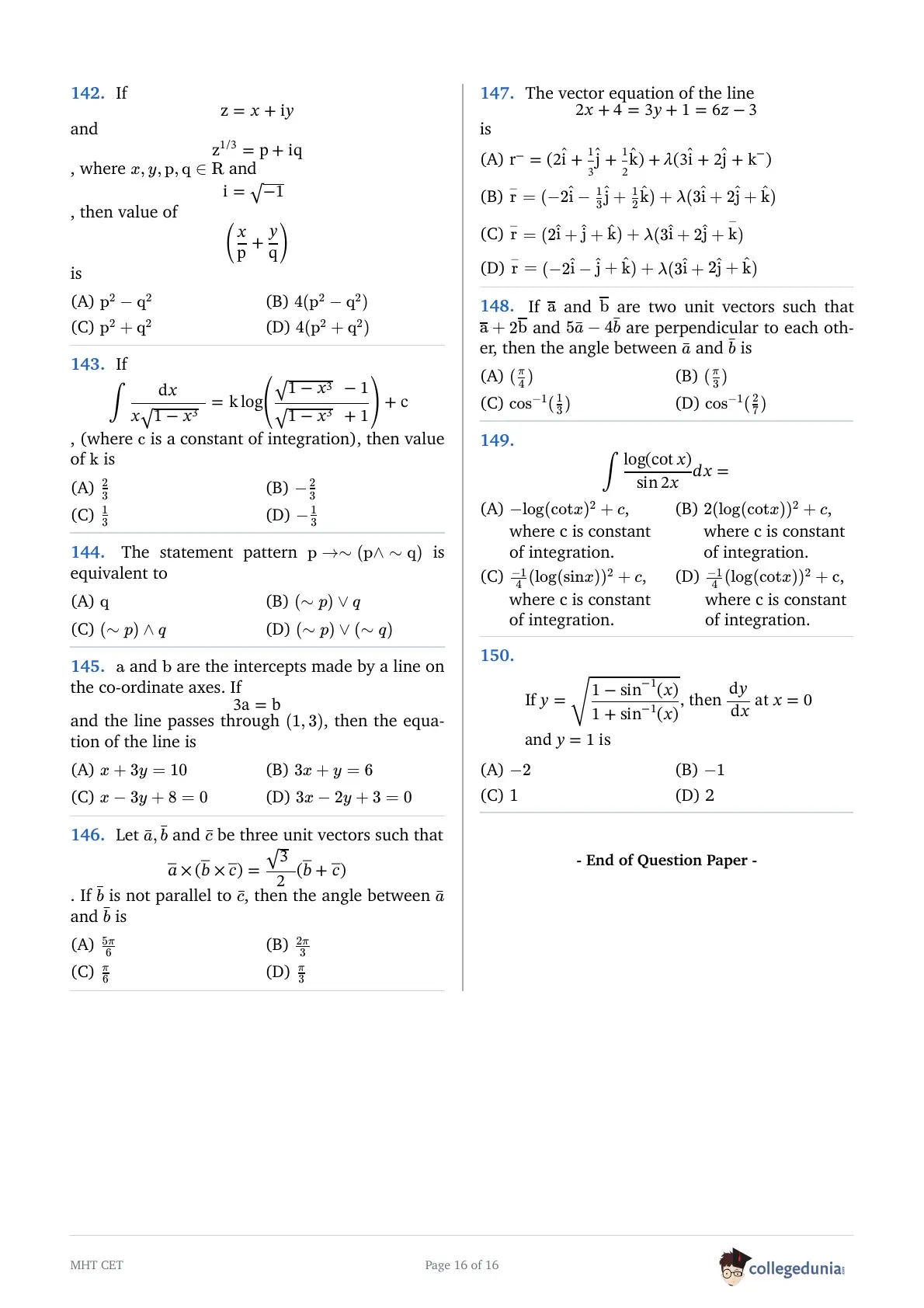
If \[\mathrm{z}=x+\mathrm{i} y\] and \[\mathrm{z}^{1 / 3}=\mathrm{p}+\mathrm{iq}\], where \[x, y, \mathrm{p}, \mathrm{q} \in \mathrm{R}\] and \[\mathrm{i}=\sqrt{-1}\], then value of \[\left(\frac{x}{\mathrm{p}}+\frac{y}{\mathrm{q}}\right)\] is

  • (A) \(\mathrm{p}^{2}-\mathrm{q}^{2}\)
  • (B) \(4(\mathrm{p}^{2}-\mathrm{q}^{2})\)
  • (C) \(\mathrm{p}^{2}+\mathrm{q}^{2}\)
  • (D) \(4(\mathrm{p}^{2}+\mathrm{q}^{2})\)

Question 143:

If \[\int \frac{\mathrm{d} x}{x \sqrt{1-x^3}}=\mathrm{k} \log \left(\frac{\sqrt{1-x^3}-1}{\sqrt{1-x^3}+1}\right)+\mathrm{c}\], (where \[\mathrm{c}\] is a constant of integration), then value of \[\mathrm{k}\] is

  • (A) \(\frac{2}{3}\)
  • (B) \(-\frac{2}{3}\)
  • (C) \(\frac{1}{3}\)
  • (D) \(-\frac{1}{3}\)

Question 144:

The statement pattern \[\mathrm{p} \rightarrow \sim(\mathrm{p} \wedge \sim \mathrm{q})\] is equivalent to

  • (A) \(\mathrm{q}\)
  • (B) \((\sim p)\vee q\)
  • (C) \((\sim p)\wedge q\)
  • (D) \((\sim p)\vee (\sim q)\)

Question 145:

\[\mathrm{a}\] and \[\mathrm{b}\] are the intercepts made by a line on the co-ordinate axes. If \[3 \mathrm{a}=\mathrm{b}\] and the line passes through \[(1,3)\], then the equation of the line is

  • (A) \(x+3y=10\)
  • (B) \(3x+y=6\)
  • (C) \(x-3y+8=0\)
  • (D) \(3x-2y+3=0\)

Question 146:

Let \[\bar{a}, \bar{b}\] and \[\bar{c}\] be three unit vectors such that \[\bar{a} \times(\bar{b} \times \bar{c})=\frac{\sqrt{3}}{2}(\bar{b}+\bar{c})\]. If \[\bar{b}\] is not parallel to \[\bar{c}\], then the angle between \[\bar{a}\] and \[\bar{b}\] is

  • (A) \(\frac{5\pi}{6}\)
  • (B) \(\frac{2\pi}{3}\)
  • (C) \(\frac{\pi}{6}\)
  • (D) \(\frac{\pi}{3}\)

Question 147:

The vector equation of the line \[2 x+4=3 y+1=6 z-3\] is

  • (A) \(\overset{-}{\mathrm{r}}=(2\hat{\mathrm{i}}+\frac{1}{3}\hat{\mathrm{j}}+\frac{1}{2}\hat{\mathrm{k}})+\lambda (3\hat{\mathrm{i}}+2\hat{\mathrm{j}}+\overset{-}{\mathrm{k}})\)
  • (B) \(\overset{-}{\mathrm{r}}=(-2\hat{\mathrm{i}}-\frac{1}{3}\hat{\mathrm{j}}+\frac{1}{2}\hat{\mathrm{k}})+\lambda (3\hat{\mathrm{i}}+2\hat{\mathrm{j}}+\hat{\mathrm{k}})\)
  • (C) \(\overset{-}{\mathrm{r}}=(2\hat{\mathrm{i}}+\hat{\mathrm{j}}+\hat{\mathrm{k}})+\lambda (3\hat{\mathrm{i}}+2\hat{\mathrm{j}}+\overset{-}{\mathrm{k}})\)
  • (D) \(\overset{-}{\mathrm{r}}=(-2\hat{\mathrm{i}}-\hat{\mathrm{j}}+\hat{\mathrm{k}})+\lambda (3\hat{\mathrm{i}}+2\hat{\mathrm{j}}+\hat{\mathrm{k}})\)

Question 148:

If \[\overline{\mathrm{a}}\] and \[\overline{\mathrm{b}}\] are two unit vectors such that \[\overline{\mathrm{a}}+2 \overline{\mathrm{b}}\] and \[5 \bar{a}-4 \bar{b}\] are perpendicular to each other, then the angle between \[\bar{a}\] and \[\bar{b}\] is

  • (A) \((\frac{\pi}{4})\)
  • (B) \((\frac{\pi}{3})\)
  • (C) \(\mathrm{cos}^{-1}(\frac{1}{3})\)
  • (D) \(\mathrm{cos}^{-1}(\frac{2}{7})\)

Question 149:

\[\int \frac{\log (\cot x)}{\sin 2 x} d x=\]

  • (A) \(-\mathrm{log}(\mathrm{cot}x)^{2}+c\), where c is constant of integration.
  • (B) \(2(\mathrm{log}(\mathrm{cot}x))^{2}+c\), where c is constant of integration.
  • (C) \(\frac{-1}{4}(\mathrm{log}(\mathrm{sin}x))^{2}+c\), where c is constant of integration.
  • (D) \(\frac{-1}{4}(\mathrm{log}(\mathrm{cot}x))^{2}+\mathrm{c}\), where c is constant of integration.

Question 150:

\[\text { If } y=\sqrt{\frac{1-\sin ^{-1}(x)}{1+\sin ^{-1}(x)}} \text {, then } \frac{\mathrm{d} y}{\mathrm{~d} x} \text { at } x=0 \text { and } y=1 \text { is }\]

  • (A) \(-2\)
  • (B) \(-1\)
  • (C) 1
  • (D) 2

MHT CET 2023 PCM Exam Pattern and Marking Scheme

Parameter Details
Conducting Body Maharashtra Common Entrance Test Cell (Maharashtra CET Cell)
Exam Mode Online (Computer-Based Test)
Duration 180 minutes (3 hours)
Groups / Subjects PCM (Physics, Chemistry, Mathematics) for Engineering
Total Questions

150

Total Marks 200
Question Type Multiple Choice Questions (MCQs)
Marks Distribution
  • Mathematics – 2 marks/question
  • Physics and Chemistry – 1 mark/question
Negative Marking No
Syllabus Weightage
  • Class 12 – 80%
  • Class 11 – 20%