




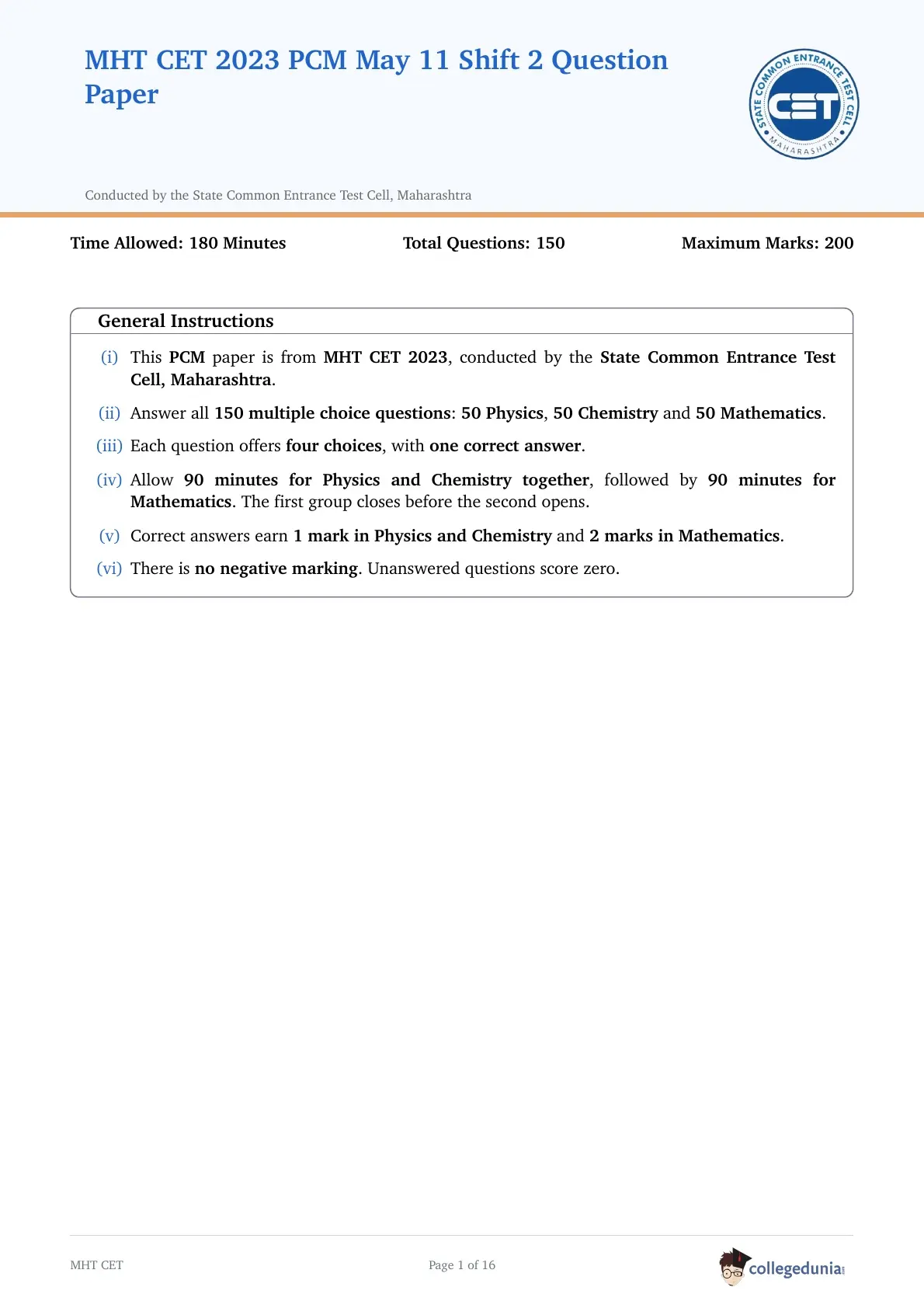
MHT CET 2023 May 11 Shift 2 PCM Question Paper is available for download here. Maharashtra State CET Cell conducted MHT CET 2023 PCM Exam on May 11 in Shift 2 from 2 PM to 5 PM in CBT mode.
The MHT CET 2023 PCM question paper includes the following:
- The MHT CET 2023 PCM Question Paper consists of 150 multiple-choice questions (MCQs) totalling 200 marks divided into 3 sections: Physics, Chemistry, and Mathematics, with 50 questions in each subject.
- Physics and Chemistry questions carry 1 mark each while Mathematics questions carry 2 marks each.
- There is no negative marking for incorrect answers.
MHT CET 2023 May 11 Shift 2 PCM Question Paper with Solution PDF
| CD PDF | CD PDF with Solutions |
|---|---|
| Download Collegedunia PDF 1.19 MB | - |
Also Check:
MHT CET 2023 May 11 Shift 2 PCM Questions with Solutions
Physics (Q1 - Q50)
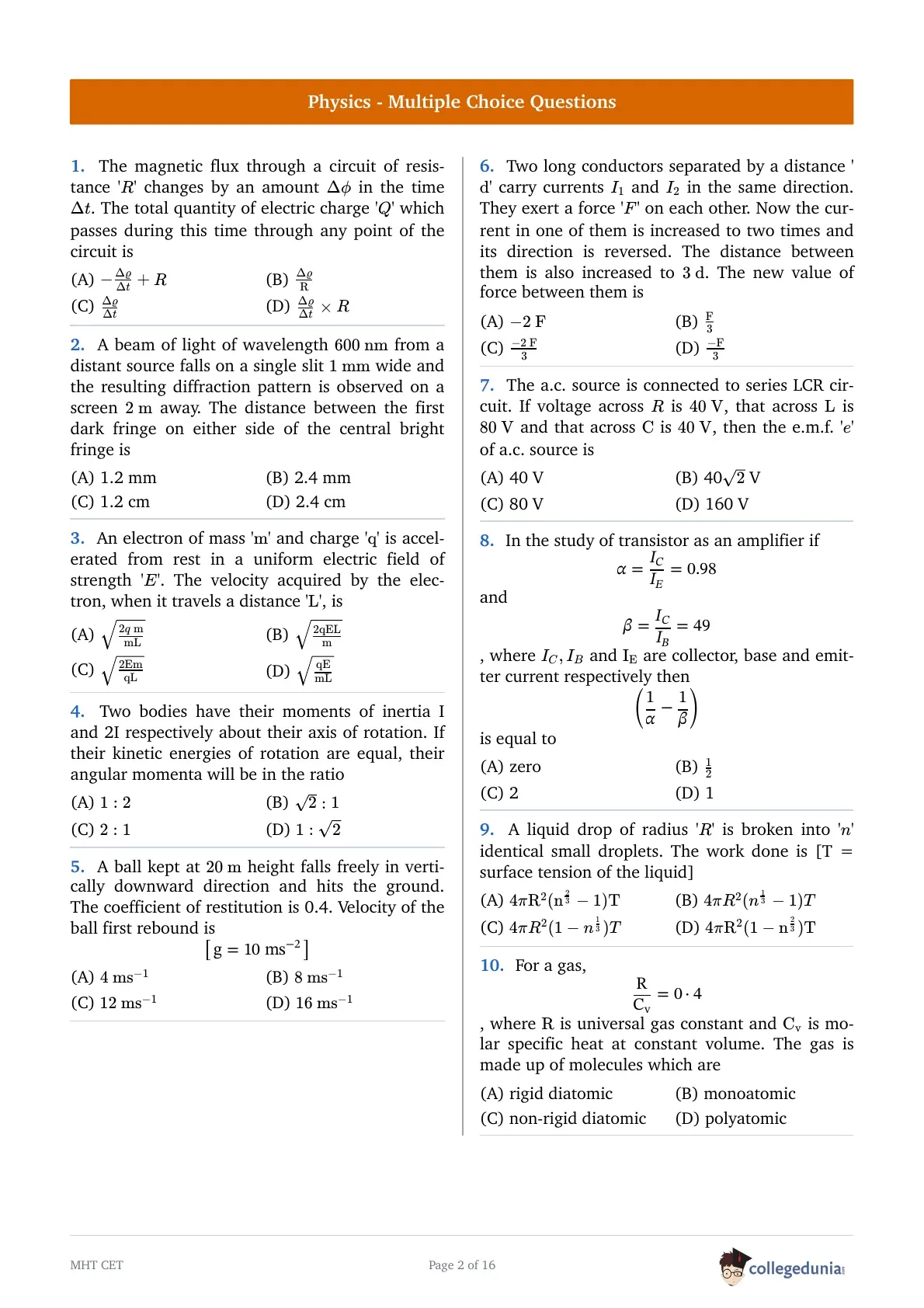
The magnetic flux through a circuit of resistance '\[R\]' changes by an amount \[\Delta \phi\] in the time \[\Delta t\]. The total quantity of electric charge '\[Q\]' which passes during this time through any point of the circuit is
A beam of light of wavelength \[600 \mathrm{~nm}\] from a distant source falls on a single slit \[1 \mathrm{~mm}\] wide and the resulting diffraction pattern is observed on a screen \[2 \mathrm{~m}\] away. The distance between the first dark fringe on either side of the central bright fringe is
An electron of mass '\[\mathrm{m}\]' and charge '\[\mathrm{q}\]' is accelerated from rest in a uniform electric field of strength '\[E\]'. The velocity acquired by the electron, when it travels a distance '\[\mathrm{L}\]', is
Two bodies have their moments of inertia I and 2I respectively about their axis of rotation. If their kinetic energies of rotation are equal, their angular momenta will be in the ratio
A ball kept at \[20 \mathrm{~m}\] height falls freely in vertically downward direction and hits the ground. The coefficient of restitution is 0.4. Velocity of the ball first rebound is \[\left[\mathrm{g}=10 \mathrm{~ms}^{-2}\right]\]
Two long conductors separated by a distance '\[\mathrm{d}\]' carry currents \[I_1\] and \[I_2\] in the same direction. They exert a force '\[F\]' on each other. Now the current in one of them is increased to two times and its direction is reversed. The distance between them is also increased to \[3 \mathrm{~d}\]. The new value of force between them is
The a.c. source is connected to series LCR circuit. If voltage across \[R\] is \[40 \mathrm{~V}\], that across \[\mathrm{L}\] is \[80 \mathrm{~V}\] and that across \[\mathrm{C}\] is \[40 \mathrm{~V}\], then the e.m.f. '\[e\]' of a.c. source is
In the study of transistor as an amplifier if \[\alpha=\frac{I_C}{I_E}=0.98\] and \[\beta=\frac{I_C}{I_B}=49\], where \[I_C, I_B\] and \[\mathrm{I}_{\mathrm{E}}\] are collector, base and emitter current respectively then \[\left(\frac{1}{\alpha}-\frac{1}{\beta}\right)\] is equal to
A liquid drop of radius '\[R\]' is broken into '\[n\]' identical small droplets. The work done is [T = surface tension of the liquid]
For a gas, \[\frac{\mathrm{R}}{\mathrm{C}_{\mathrm{v}}}=0 \cdot 4\], where \[\mathrm{R}\] is universal gas constant and \[\mathrm{C}_{\mathrm{v}}\] is molar specific heat at constant volume. The gas is made up of molecules which are
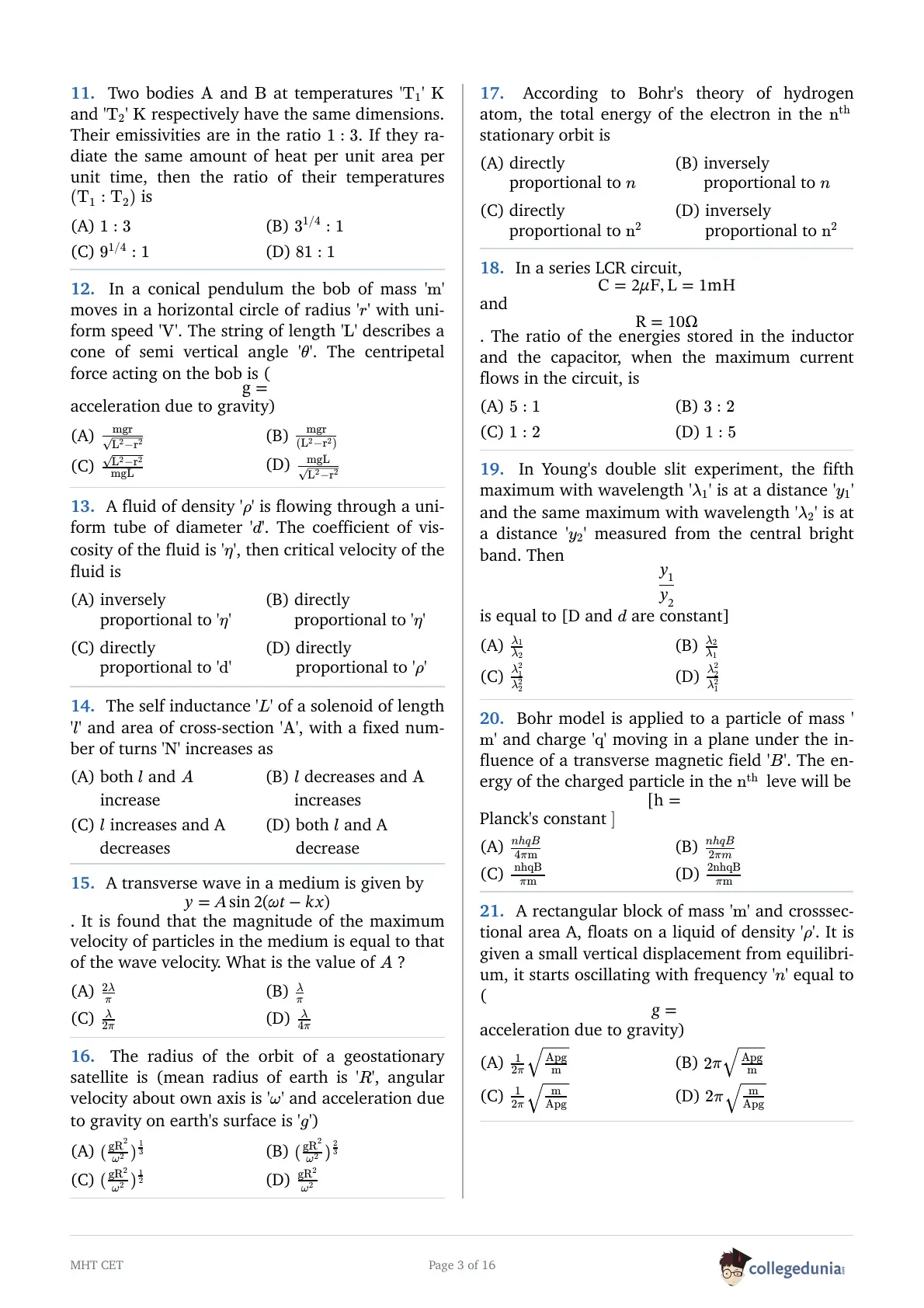
Two bodies \[\mathrm{A}\] and \[\mathrm{B}\] at temperatures '\[\mathrm{T}_1\]' \[\mathrm{K}\] and '\[\mathrm{T}_2\]' \[\mathrm{K}\] respectively have the same dimensions. Their emissivities are in the ratio \[1: 3\]. If they radiate the same amount of heat per unit area per unit time, then the ratio of their temperatures \[\left(\mathrm{T}_1: \mathrm{T}_2\right)\] is
In a conical pendulum the bob of mass '\[\mathrm{m}\]' moves in a horizontal circle of radius '\[r\]' with uniform speed '\[\mathrm{V}\]'. The string of length '\[\mathrm{L}\]' describes a cone of semi vertical angle '\[\theta\]'. The centripetal force acting on the bob is ( \[\mathrm{g}=\] acceleration due to gravity)
A fluid of density '\[\rho\]' is flowing through a uniform tube of diameter '\[d\]'. The coefficient of viscosity of the fluid is '\[\eta\]', then critical velocity of the fluid is
The self inductance '\[L\]' of a solenoid of length '\[l\]' and area of cross-section '\[\mathrm{A}\]', with a fixed number of turns '\[\mathrm{N}\]' increases as
A transverse wave in a medium is given by \[y=A \sin 2(\omega t-k x)\]. It is found that the magnitude of the maximum velocity of particles in the medium is equal to that of the wave velocity. What is the value of \[A\] ?
The radius of the orbit of a geostationary satellite is (mean radius of earth is '\[R\]', angular velocity about own axis is '\[\omega\]' and acceleration due to gravity on earth's surface is '\[g\]')
According to Bohr's theory of hydrogen atom, the total energy of the electron in the \[\mathrm{n}^{\text {th }}\] stationary orbit is
In a series LCR circuit, \[\mathrm{C}=2 \mu \mathrm{F}, \mathrm{L}=1 \mathrm{mH}\] and \[\mathrm{R}=10 \Omega\]. The ratio of the energies stored in the inductor and the capacitor, when the maximum current flows in the circuit, is
In Young's double slit experiment, the fifth maximum with wavelength '\[\lambda_1\]' is at a distance '\[y_1\]' and the same maximum with wavelength '\[\lambda_2\]' is at a distance '\[y_2\]' measured from the central bright band. Then \[\frac{y_1}{y_2}\] is equal to [D and \[d\] are constant]
Bohr model is applied to a particle of mass '\[\mathrm{m}\]' and charge '\[\mathrm{q}\]' moving in a plane under the influence of a transverse magnetic field '\[B\]'. The energy of the charged particle in the \[\mathrm{n}^{\text {th }}\] leve will be \[[\mathrm{h}=\] Planck's constant \[]\]
A rectangular block of mass '\[\mathrm{m}\]' and crosssectional area A, floats on a liquid of density '\[\rho\]'. It is given a small vertical displacement from equilibrium, it starts oscillating with frequency '\[n\]' equal to ( \[g=\] acceleration due to gravity)
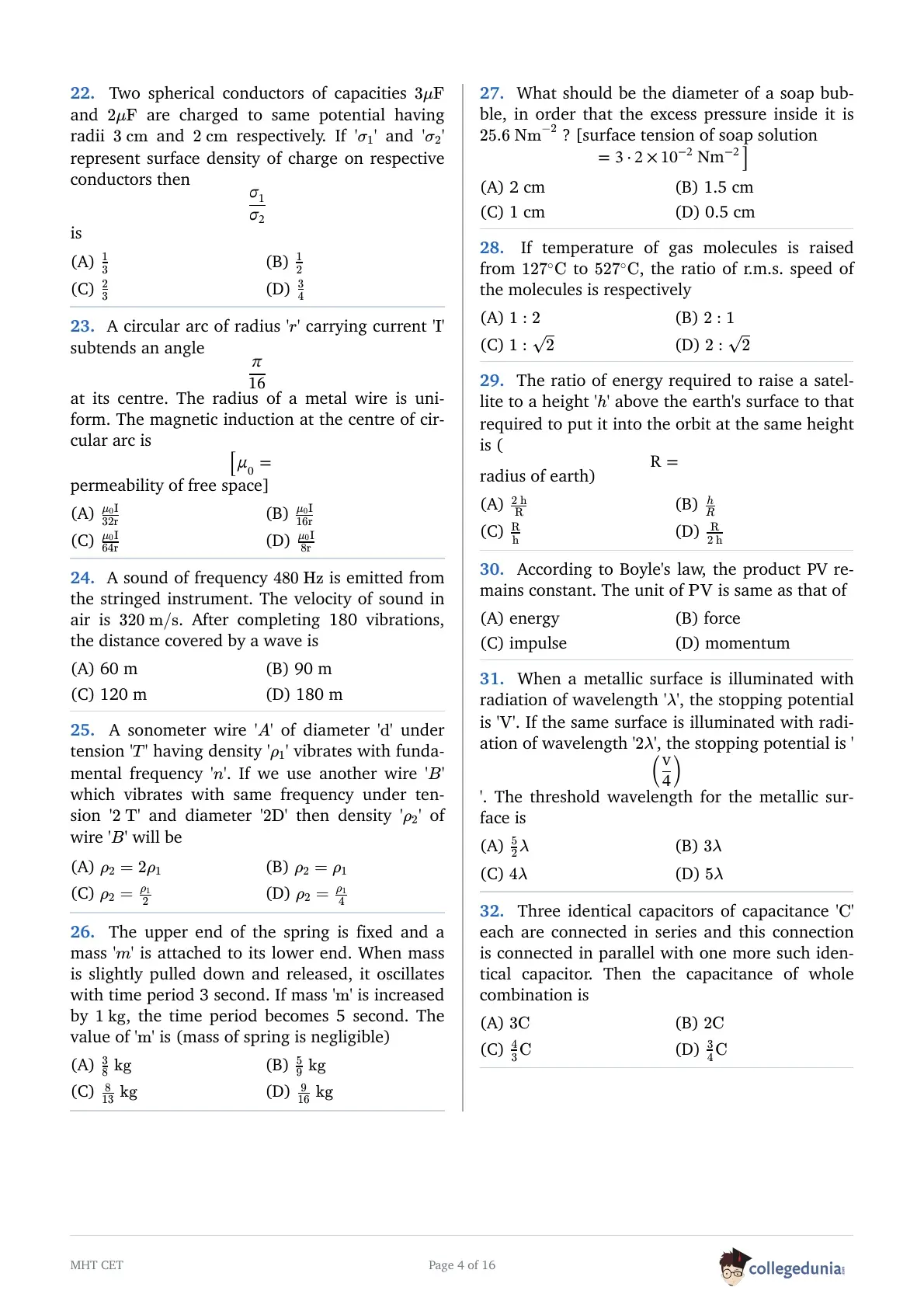
Two spherical conductors of capacities \[3 \mu \mathrm{F}\] and \[2 \mu \mathrm{F}\] are charged to same potential having radii \[3 \mathrm{~cm}\] and \[2 \mathrm{~cm}\] respectively. If '\[\sigma_1\]' and '\[\sigma_2\]' represent surface density of charge on respective conductors then \[\frac{\sigma_1}{\sigma_2}\] is
A circular arc of radius '\[r\]' carrying current '\[\mathrm{I}\]' subtends an angle \[\frac{\pi}{16}\] at its centre. The radius of a metal wire is uniform. The magnetic induction at the centre of circular arc is \[\left[\mu_0=\right.\] permeability of free space]
A sound of frequency \[480 \mathrm{~Hz}\] is emitted from the stringed instrument. The velocity of sound in air is \[320 \mathrm{~m} / \mathrm{s}\]. After completing 180 vibrations, the distance covered by a wave is
A sonometer wire '\[A\]' of diameter '\[\mathrm{d}\]' under tension '\[T\]' having density '\[\rho_1\]' vibrates with fundamental frequency '\[n\]'. If we use another wire '\[B\]' which vibrates with same frequency under tension '\[2 \mathrm{~T}\]' and diameter '\[2 \mathrm{D}\]' then density '\[\rho_2\]' of wire '\[B\]' will be
The upper end of the spring is fixed and a mass '\[m\]' is attached to its lower end. When mass is slightly pulled down and released, it oscillates with time period 3 second. If mass '\[\mathrm{m}\]' is increased by \[1 \mathrm{~kg}\], the time period becomes 5 second. The value of '\[\mathrm{m}\]' is (mass of spring is negligible)
What should be the diameter of a soap bubble, in order that the excess pressure inside it is \[25.6 \mathrm{~Nm}^{-2}\] ? [surface tension of soap solution \[\left.=3 \cdot 2 \times 10^{-2} \mathrm{~Nm}^{-2}\right]\]
If temperature of gas molecules is raised from \[127^{\circ} \mathrm{C}\] to \[527^{\circ} \mathrm{C}\], the ratio of r.m.s. speed of the molecules is respectively
The ratio of energy required to raise a satellite to a height '\[h\]' above the earth's surface to that required to put it into the orbit at the same height is (\[\mathrm{R}=\] radius of earth)
According to Boyle's law, the product PV remains constant. The unit of \[\mathrm{PV}\] is same as that of
When a metallic surface is illuminated with radiation of wavelength '\[\lambda\]', the stopping potential is '\[\mathrm{V}\]'. If the same surface is illuminated with radiation of wavelength '\[2 \lambda\]', the stopping potential is '\[\left(\frac{\mathrm{v}}{4}\right)\]'. The threshold wavelength for the metallic surface is
Three identical capacitors of capacitance '\[\mathrm{C}\]' each are connected in series and this connection is connected in parallel with one more such identical capacitor. Then the capacitance of whole combination is
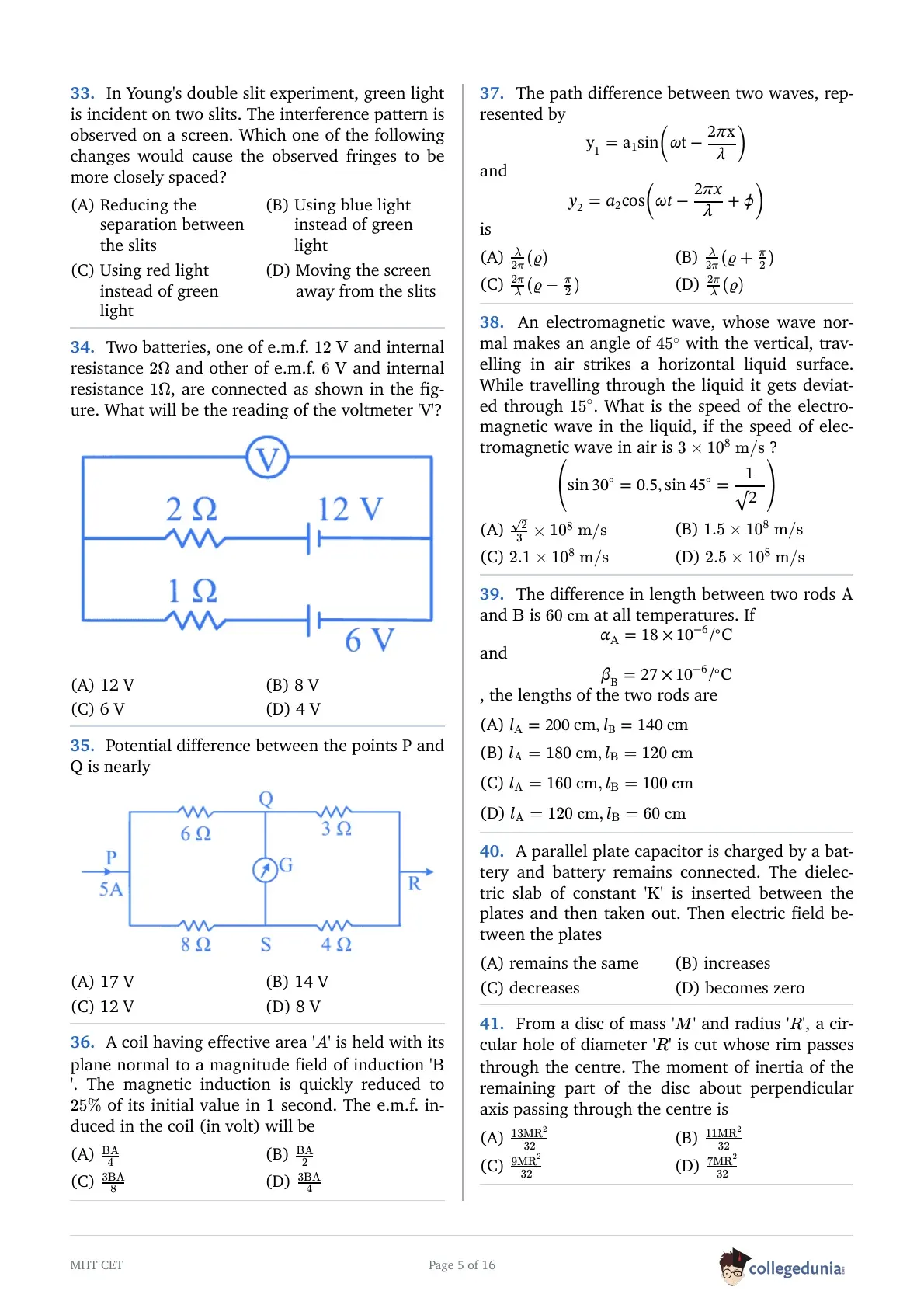
In Young's double slit experiment, green light is incident on two slits. The interference pattern is observed on a screen. Which one of the following changes would cause the observed fringes to be more closely spaced?
Two batteries, one of e.m.f. \[12 \mathrm{~V}\] and internal resistance \[2 \Omega\] and other of e.m.f. \[6 \mathrm{~V}\] and internal resistance \[1 \Omega\], are connected as shown in the figure. What will be the reading of the voltmeter 'V'?


A coil having effective area '\[A\]' is held with its plane normal to a magnitude field of induction '\[\mathrm{B}\]'. The magnetic induction is quickly reduced to \[25 \%\] of its initial value in 1 second. The e.m.f. induced in the coil (in volt) will be
The path difference between two waves, represented by \[\mathrm{y}_1=\mathrm{a}_1 \sin \left(\omega \mathrm{t}-\frac{2 \pi \mathrm{x}}{\lambda}\right)\] and \[y_2=a_2 \cos \left(\omega t-\frac{2 \pi x}{\lambda}+\phi\right)\] is
An electromagnetic wave, whose wave normal makes an angle of \[45^{\circ}\] with the vertical, travelling in air strikes a horizontal liquid surface. While travelling through the liquid it gets deviated through \[15^{\circ}\]. What is the speed of the electromagnetic wave in the liquid, if the speed of electromagnetic wave in air is \[3 \times 10^8 \mathrm{~m} / \mathrm{s}\] ? \[\left(\sin 30^{\circ}=0.5, \sin 45^{\circ}=\frac{1}{\sqrt{2}}\right)\]
The difference in length between two rods \[\mathrm{A}\] and \[\mathrm{B}\] is \[60 \mathrm{~cm}\] at all temperatures. If \[\alpha_{\mathrm{A}}=18 \times 10^{-6} /{ }^{\circ} \mathrm{C}\] and \[\beta_{\mathrm{B}}=27 \times 10^{-6} /{ }^{\circ} \mathrm{C}\], the lengths of the two rods are
A parallel plate capacitor is charged by a battery and battery remains connected. The dielectric slab of constant '\[\mathrm{K}\]' is inserted between the plates and then taken out. Then electric field between the plates
From a disc of mass '\[M\]' and radius '\[R\]', a circular hole of diameter '\[R\]' is cut whose rim passes through the centre. The moment of inertia of the remaining part of the disc about perpendicular axis passing through the centre is
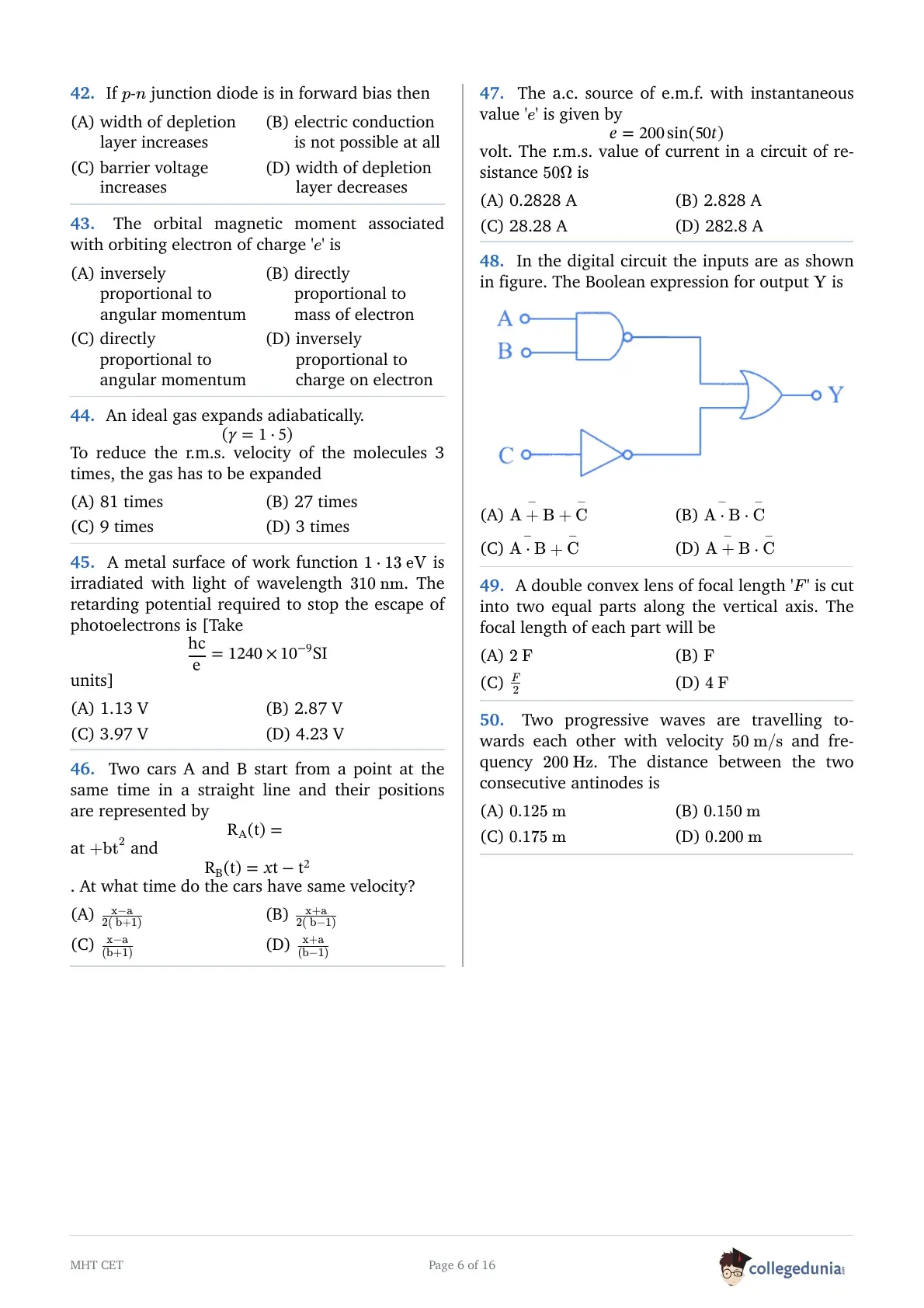
The orbital magnetic moment associated with orbiting electron of charge '\[e\]' is
An ideal gas expands adiabatically. \[(\gamma=1 \cdot 5)\] To reduce the r.m.s. velocity of the molecules 3 times, the gas has to be expanded
A metal surface of work function \[1 \cdot 13 \mathrm{~eV}\] is irradiated with light of wavelength \[310 \mathrm{~nm}\]. The retarding potential required to stop the escape of photoelectrons is [Take \[\frac{\mathrm{hc}}{\mathrm{e}}=1240 \times 10^{-9} \mathrm{SI}\] units]
Two cars A and B start from a point at the same time in a straight line and their positions are represented by \[\mathrm{R}_{\mathrm{A}}(\mathrm{t})=\] at \[+\mathrm{bt}^2\] and \[\mathrm{R}_{\mathrm{B}}(\mathrm{t})=x \mathrm{t}-\mathrm{t}^2\]. At what time do the cars have same velocity?
The a.c. source of e.m.f. with instantaneous value '\[e\]' is given by \[e=200 \sin (50 t)\] volt. The r.m.s. value of current in a circuit of resistance \[50 \Omega\] is
In the digital circuit the inputs are as shown in figure. The Boolean expression for output \[\mathrm{Y}\] is

A double convex lens of focal length '\[F\]' is cut into two equal parts along the vertical axis. The focal length of each part will be
Two progressive waves are travelling towards each other with velocity \[50 \mathrm{~m} / \mathrm{s}\] and frequency \[200 \mathrm{~Hz}\]. The distance between the two consecutive antinodes is
Chemistry (Q51 - Q100)

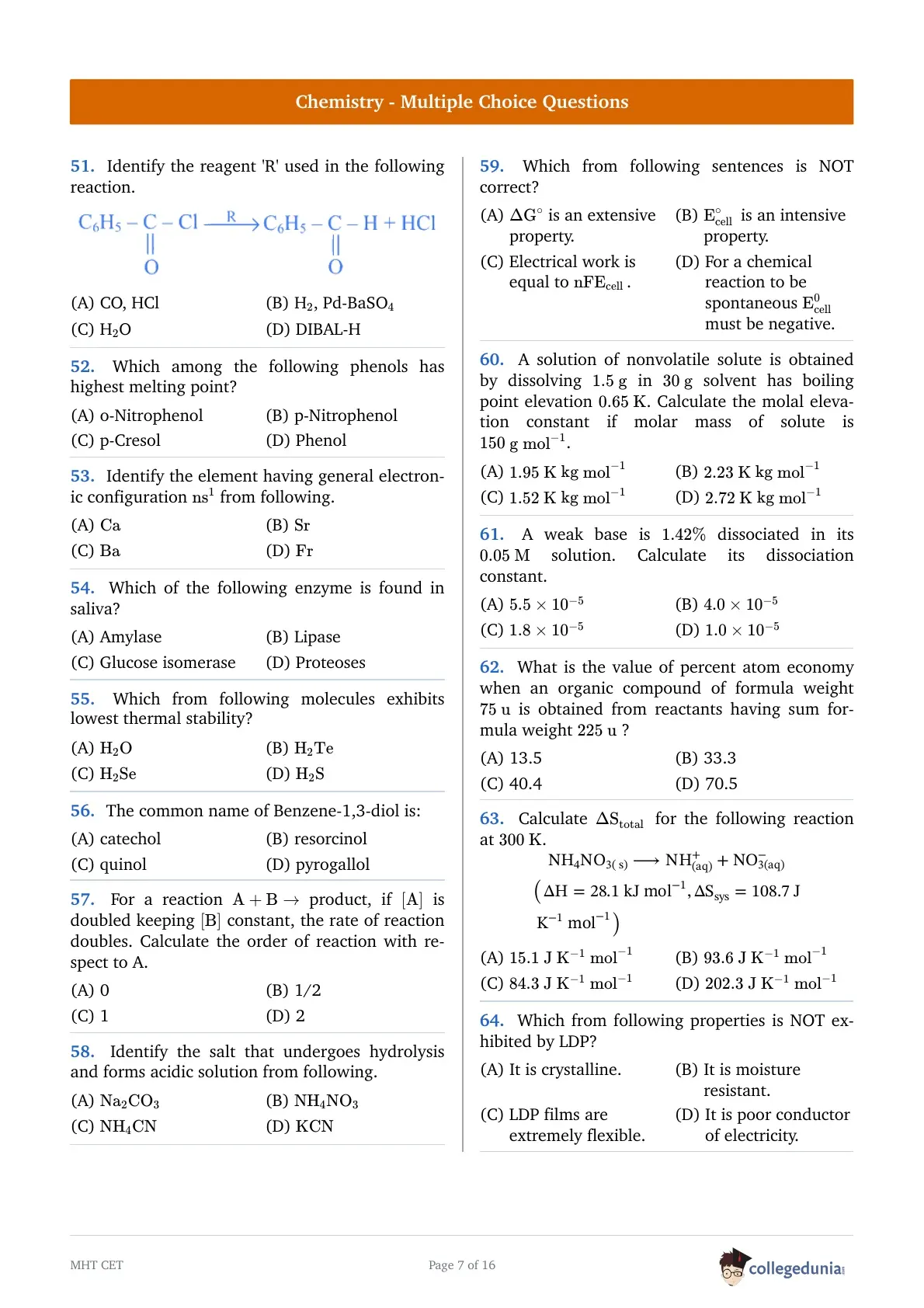
Identify the element having general electronic configuration \[\mathrm{ns}^1\] from following.
For a reaction \[\mathrm{A}+\mathrm{B} \rightarrow\] product, if \[[\mathrm{A}]\] is doubled keeping \[[\mathrm{B}]\] constant, the rate of reaction doubles. Calculate the order of reaction with respect to A.
Identify the salt that undergoes hydrolysis and forms acidic solution from following.
A solution of nonvolatile solute is obtained by dissolving \[1.5 \mathrm{~g}\] in \[30 \mathrm{~g}\] solvent has boiling point elevation \[0.65 \mathrm{~K}\]. Calculate the molal elevation constant if molar mass of solute is \[150 \mathrm{~g} \mathrm{~mol}^{-1}\].
A weak base is \[1.42 \%\] dissociated in its \[0.05 \mathrm{~M}\] solution. Calculate its dissociation constant.
What is the value of percent atom economy when an organic compound of formula weight \[75 \mathrm{~u}\] is obtained from reactants having sum formula weight \[225 \mathrm{~u}\] ?
Calculate \[\Delta \mathrm{S}_{\text {total }}\] for the following reaction at \[300 \mathrm{~K}\].
\[\mathrm{NH}_4 \mathrm{NO}_{3(\mathrm{~s})} \longrightarrow \mathrm{NH}_{(\mathrm{aq})}^{+}+\mathrm{NO}_{3(\mathrm{aq})}^{-}\]
\[\left(\Delta \mathrm{H}=28.1 \mathrm{~kJ} \mathrm{~mol}^{-1}, \Delta \mathrm{S}_{\mathrm{sys}}=108.7 \mathrm{~J} \mathrm{~K}^{-1} \mathrm{~mol}^{-1}\right)\]
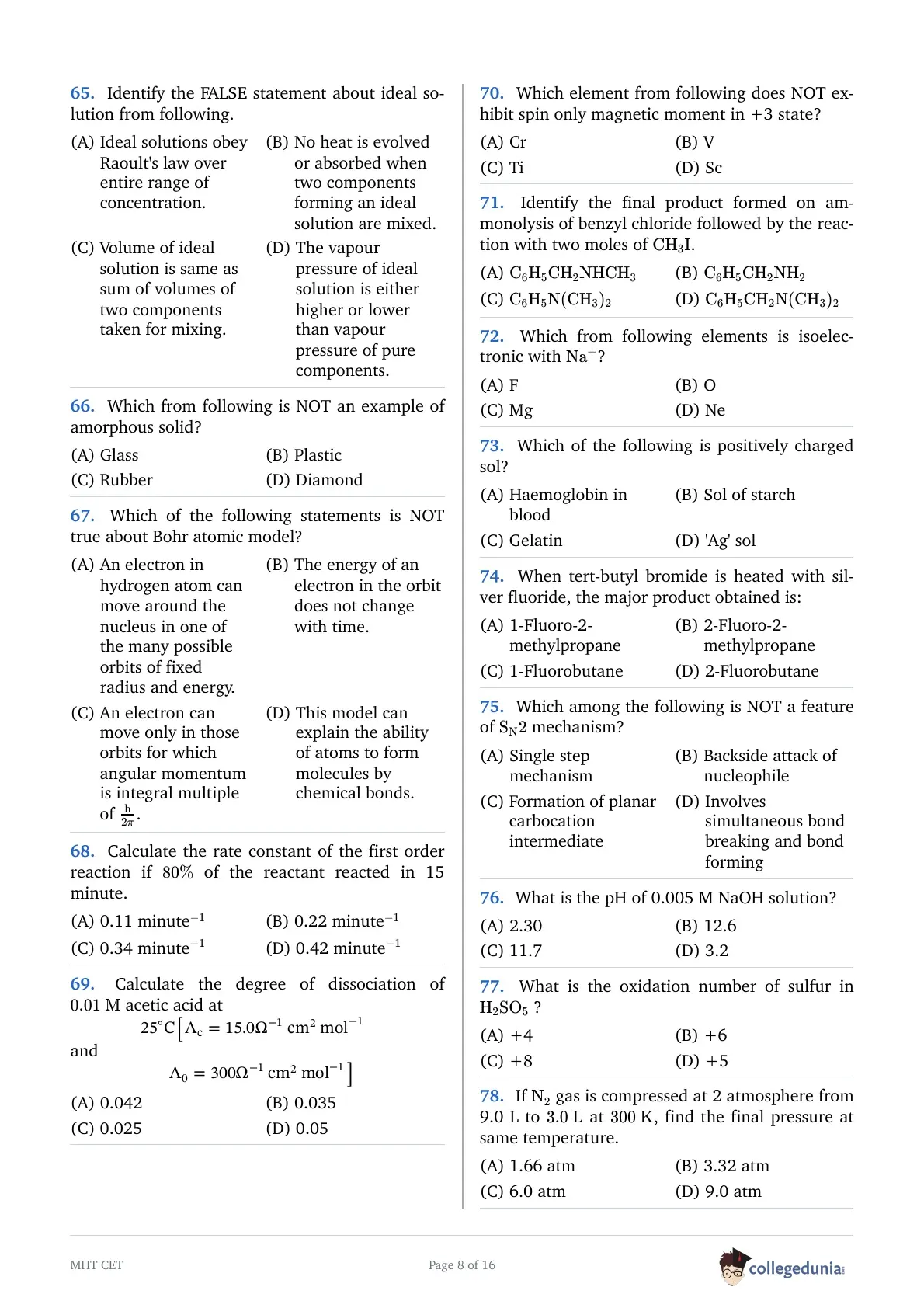
Which of the following statements is NOT true about Bohr atomic model?
Calculate the rate constant of the first order reaction if \[80 \%\] of the reactant reacted in 15 minute.
Calculate the degree of dissociation of \[0.01 \mathrm{~M}\] acetic acid at \[25^{\circ} \mathrm{C}\left[\Lambda_{\mathrm{c}}=15.0 \Omega^{-1} \mathrm{~cm}^2 \mathrm{~mol}^{-1}\right.\] and \[\left.\Lambda_0=300 \Omega^{-1} \mathrm{~cm}^2 \mathrm{~mol}^{-1}\right]\]
Which element from following does NOT exhibit spin only magnetic moment in +3 state?
Identify the final product formed on ammonolysis of benzyl chloride followed by the reaction with two moles of \[\mathrm{CH}_3 \mathrm{I}\].
Which from following elements is isoelectronic with \[\mathrm{Na}^{+}\]?
When tert-butyl bromide is heated with silver fluoride, the major product obtained is:
Which among the following is NOT a feature of \[\mathrm{S}_{\mathrm{N}} 2\] mechanism?
What is the oxidation number of sulfur in \[\mathrm{H}_2 \mathrm{SO}_5\] ?
If \[\mathrm{N}_2\] gas is compressed at 2 atmosphere from 9.0 L to \[3.0 \mathrm{~L}\] at \[300 \mathrm{~K}\], find the final pressure at same temperature.
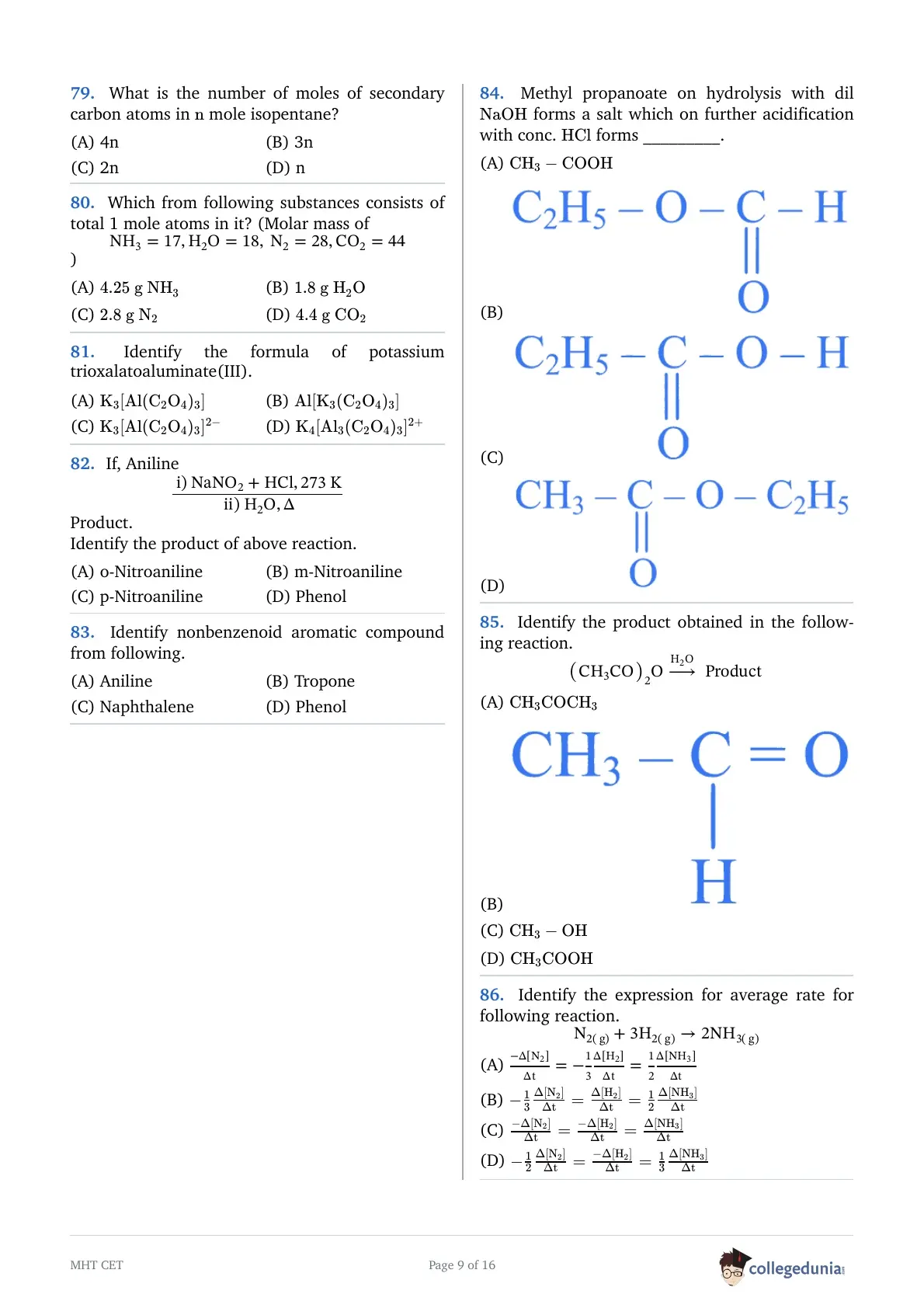
What is the number of moles of secondary carbon atoms in \[\mathrm{n}\] mole isopentane?
Which from following substances consists of total 1 mole atoms in it? (Molar mass of \[\mathrm{NH}_3=17, \mathrm{H}_2 \mathrm{O}=18, \mathrm{~N}_2=28, \mathrm{CO}_2=44\] )
If, Aniline \[\frac{\text { i) } \mathrm{NaNO}_2+\mathrm{HCl}, 273 \mathrm{~K}}{\text { ii) } \mathrm{H}_2 \mathrm{O}, \Delta}\] Product.
Identify the product of above reaction.
Methyl propanoate on hydrolysis with dil \[\mathrm{NaOH}\] forms a salt which on further acidification with conc. \[\mathrm{HCl}\] forms _________.
- (A) \(\mathrm{CH}_{3}-\mathrm{COOH}\)
- (B)
![]()
- (C)
![]()
- (D)
![]()


Identify the product obtained in the following reaction.
\[\left(\mathrm{CH}_3 \mathrm{CO}\right)_2 \mathrm{O} \stackrel{\mathrm{H}_2 \mathrm{O}}{\longrightarrow} \text { Product }\]
- (A) \(\mathrm{CH}_{3}\mathrm{COCH}_{3}\)
- (B)
![]()
- (C) \(\mathrm{CH}_{3}-\mathrm{OH}\)
- (D) \(\mathrm{CH}_{3}\mathrm{COOH}\)

Identify the expression for average rate for following reaction.
\[\mathrm{N}_{2(\mathrm{~g})}+3 \mathrm{H}_{2(\mathrm{~g})} \rightarrow 2 \mathrm{NH}_{3(\mathrm{~g})}\]
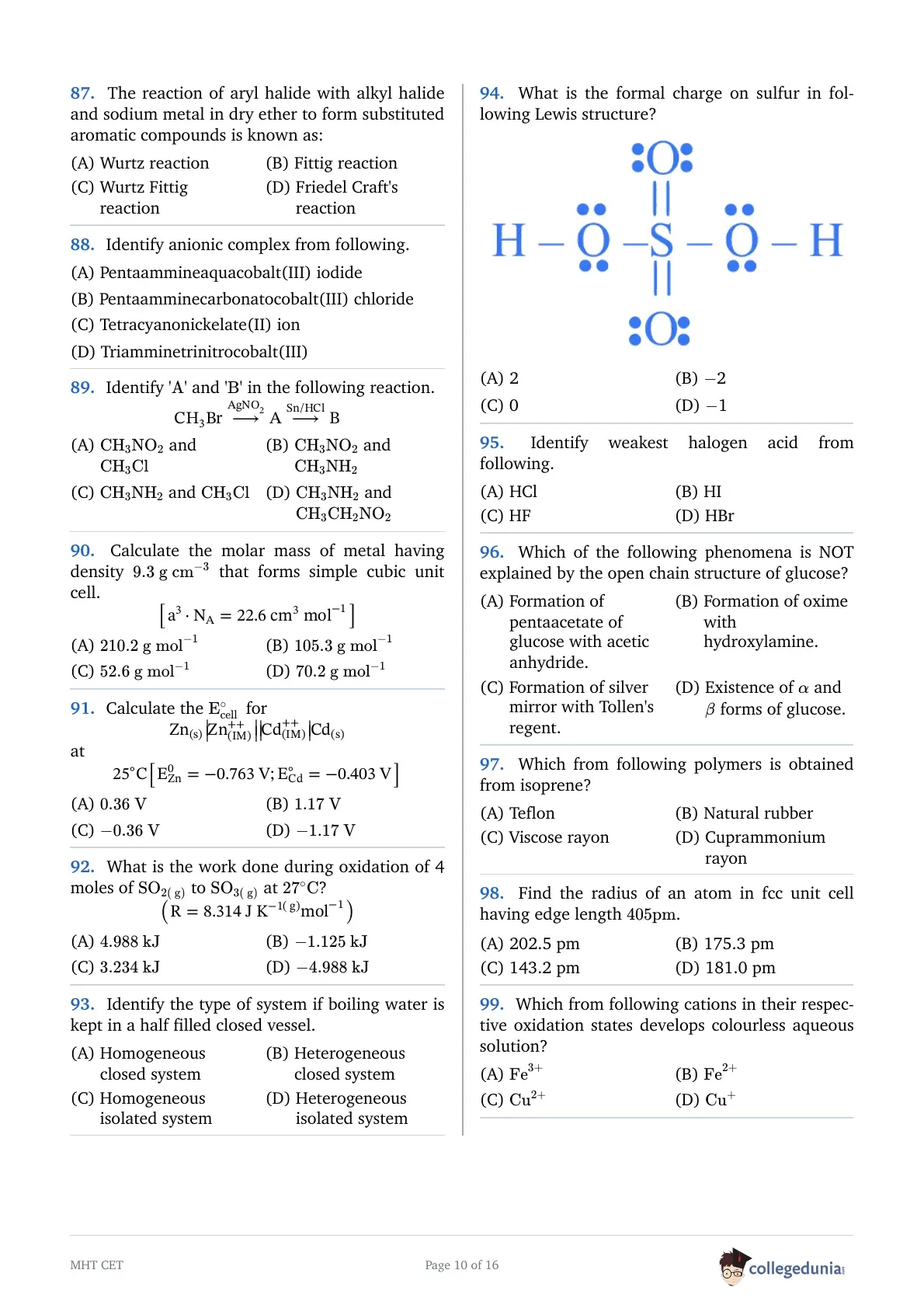
The reaction of aryl halide with alkyl halide and sodium metal in dry ether to form substituted aromatic compounds is known as:
Identify '\[\mathrm{A}\]' and '\[\mathrm{B}\]' in the following reaction.
\[\mathrm{CH}_3 \mathrm{Br} \stackrel{\mathrm{AgNO}_2}{\longrightarrow} \mathrm{A} \stackrel{\mathrm{Sn} / \mathrm{HCl}}{\longrightarrow} \mathrm{B}\]
Calculate the molar mass of metal having density \[9.3 \mathrm{~g} \mathrm{~cm}^{-3}\] that forms simple cubic unit cell. \[\left[\mathrm{a}^3 \cdot \mathrm{N}_{\mathrm{A}}=22.6 \mathrm{~cm}^3 \mathrm{~mol}^{-1}\right]\]
Calculate the \[\mathrm{E}_{\text {cell }}^{\circ}\] for \[\mathrm{Zn}_{(\mathrm{s})}\left|\mathrm{Zn}_{(\mathrm{IM})}^{++}\right|\left|\mathrm{Cd}_{(\mathrm{IM})}^{++}\right| \mathrm{Cd}_{(\mathrm{s})}\] at \[25^{\circ} \mathrm{C}\left[\mathrm{E}_{\mathrm{Zn}}^0=-0.763 \mathrm{~V} ; \mathrm{E}_{\mathrm{Cd}}^{\circ}=-0.403 \mathrm{~V}\right]\]
What is the work done during oxidation of 4 moles of \[\mathrm{SO}_{2(\mathrm{~g})}\] to \[\mathrm{SO}_{3(\mathrm{~g})}\] at \[27^{\circ} \mathrm{C}\]?
\[\left(\mathrm{R}=8.314 \mathrm{~J} \mathrm{~K}^{-1(\mathrm{~g})} \mathrm{mol}^{-1}\right)\]
Identify the type of system if boiling water is kept in a half filled closed vessel.

Which of the following phenomena is NOT explained by the open chain structure of glucose?
Find the radius of an atom in fcc unit cell having edge length \[405 \mathrm{pm}\].
Which from following cations in their respective oxidation states develops colourless aqueous solution?
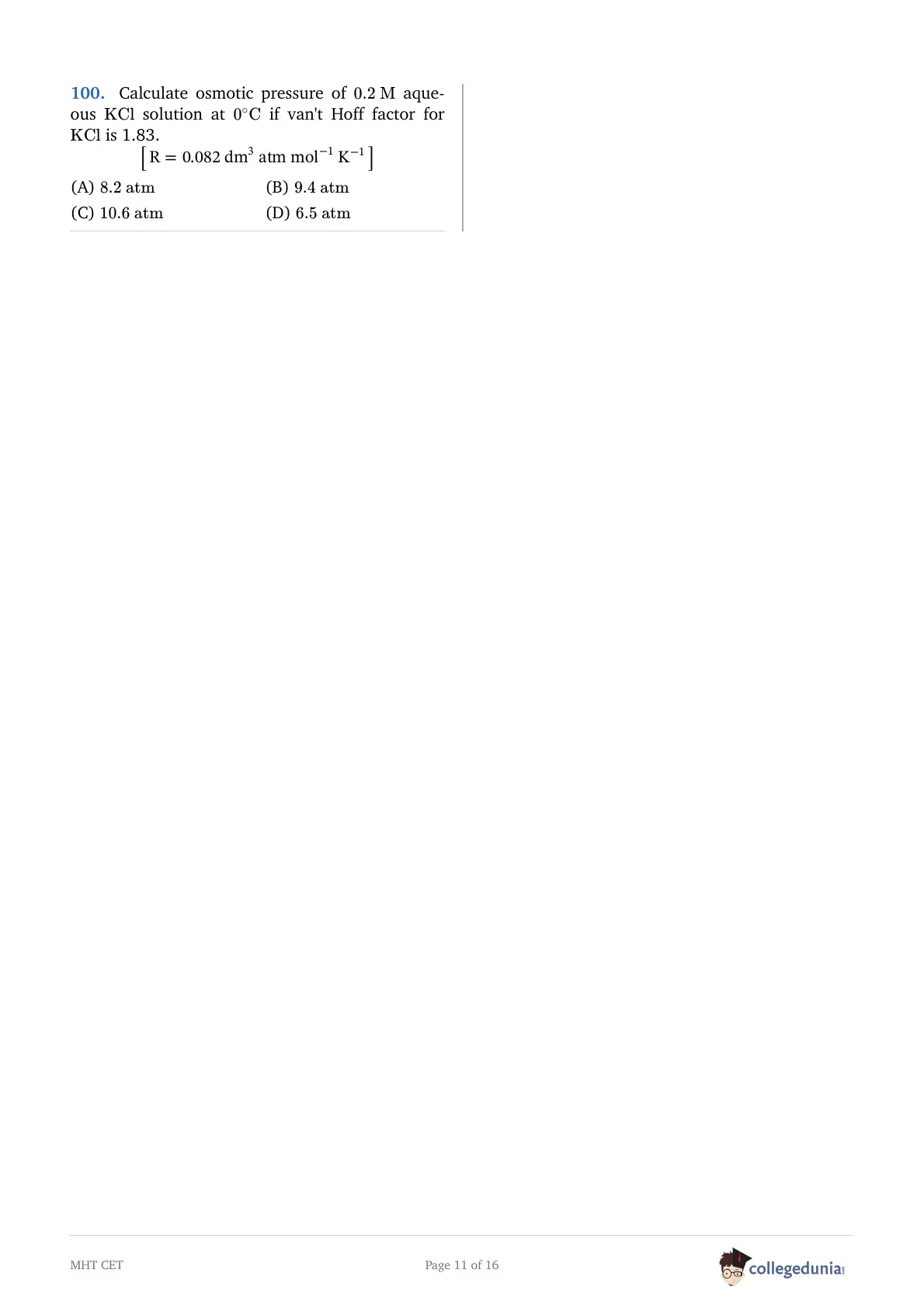
Calculate osmotic pressure of \[0.2 \mathrm{~M}\] aqueous \[\mathrm{KCl}\] solution at \[0^{\circ} \mathrm{C}\] if van't Hoff factor for \[\mathrm{KCl}\] is 1.83. \[\left[\mathrm{R}=0.082 \mathrm{~dm}^3 \mathrm{~atm} \mathrm{~mol}^{-1} \mathrm{~K}^{-1}\right]\]
Mathematics (Q101 - Q150)
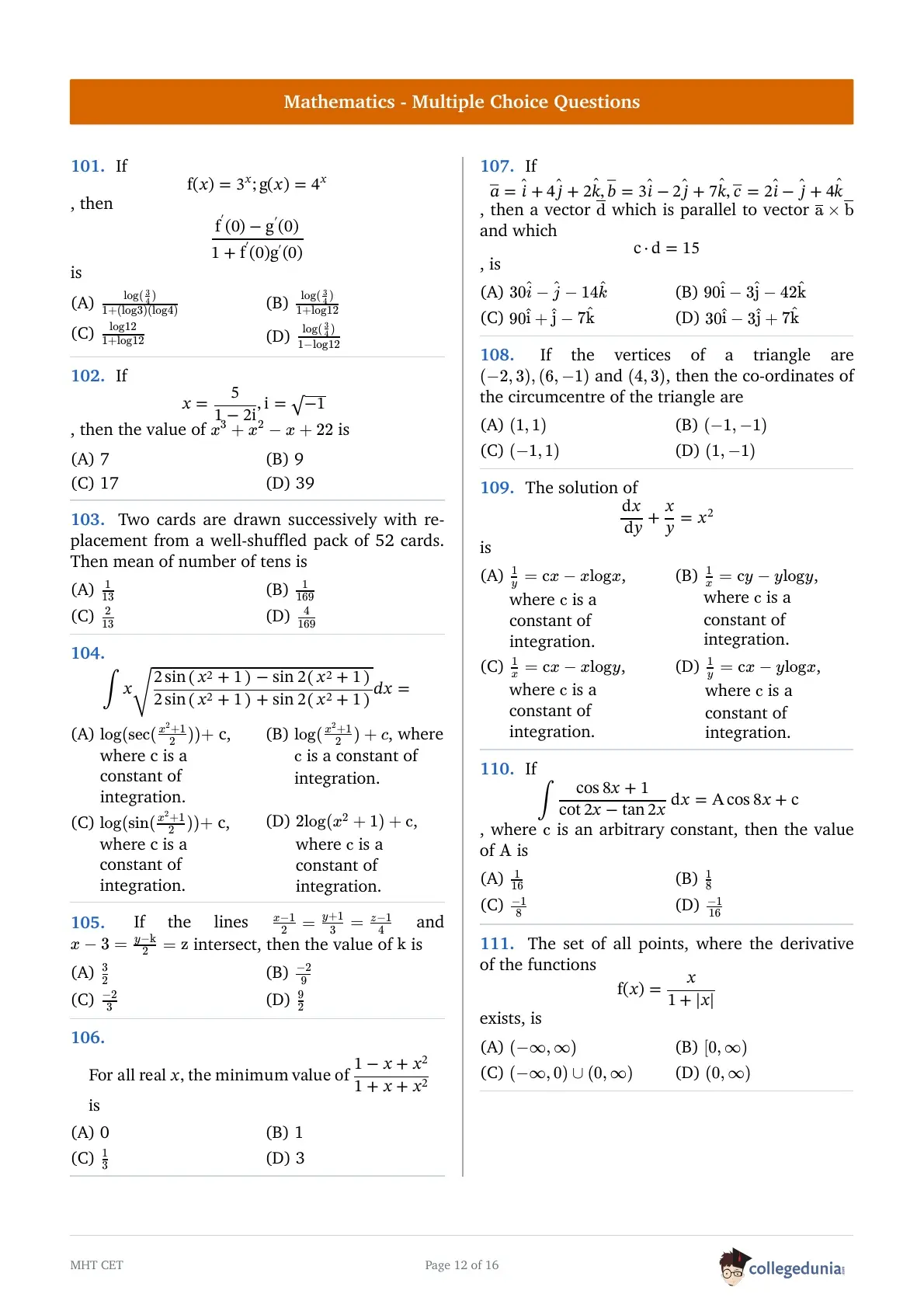
If \[\mathrm{f}(x)=3^x ; \mathrm{g}(x)=4^x\], then \[\frac{\mathrm{f}^{\prime}(0)-\mathrm{g}^{\prime}(0)}{1+\mathrm{f}^{\prime}(0) \mathrm{g}^{\prime}(0)}\] is
If \[x=\frac{5}{1-2 \mathrm{i}}, \mathrm{i}=\sqrt{-1}\], then the value of \[x^3+x^2-x+22\] is
Two cards are drawn successively with replacement from a well-shuffled pack of 52 cards. Then mean of number of tens is
\[\int x \sqrt{\frac{2 \sin \left(x^2+1\right)-\sin 2\left(x^2+1\right)}{2 \sin \left(x^2+1\right)+\sin 2\left(x^2+1\right)}} d x=\]
If the lines \(\frac{x-1}{2}=\frac{y+1}{3}=\frac{z-1}{4}\) and \(x-3=\frac{y-\mathrm{k}}{2}=\mathrm{z}\) intersect, then the value of \(\mathrm{k}\) is
\[\text { For all real } x \text {, the minimum value of } \frac{1-x+x^2}{1+x+x^2} \text { is }\]
If the vertices of a triangle are \[(-2,3),(6,-1)\] and \[(4,3)\], then the co-ordinates of the circumcentre of the triangle are
The solution of \[\frac{\mathrm{d} x}{\mathrm{~d} y}+\frac{x}{y}=x^2\] is
If \[\int \frac{\cos 8 x+1}{\cot 2 x-\tan 2 x} \mathrm{~d} x=\mathrm{A} \cos 8 x+\mathrm{c}\], where \[\mathrm{c}\] is an arbitrary constant, then the value of \[\mathrm{A}\] is
The set of all points, where the derivative of the functions \[\mathrm{f}(x)=\frac{x}{1+|x|}\] exists, is
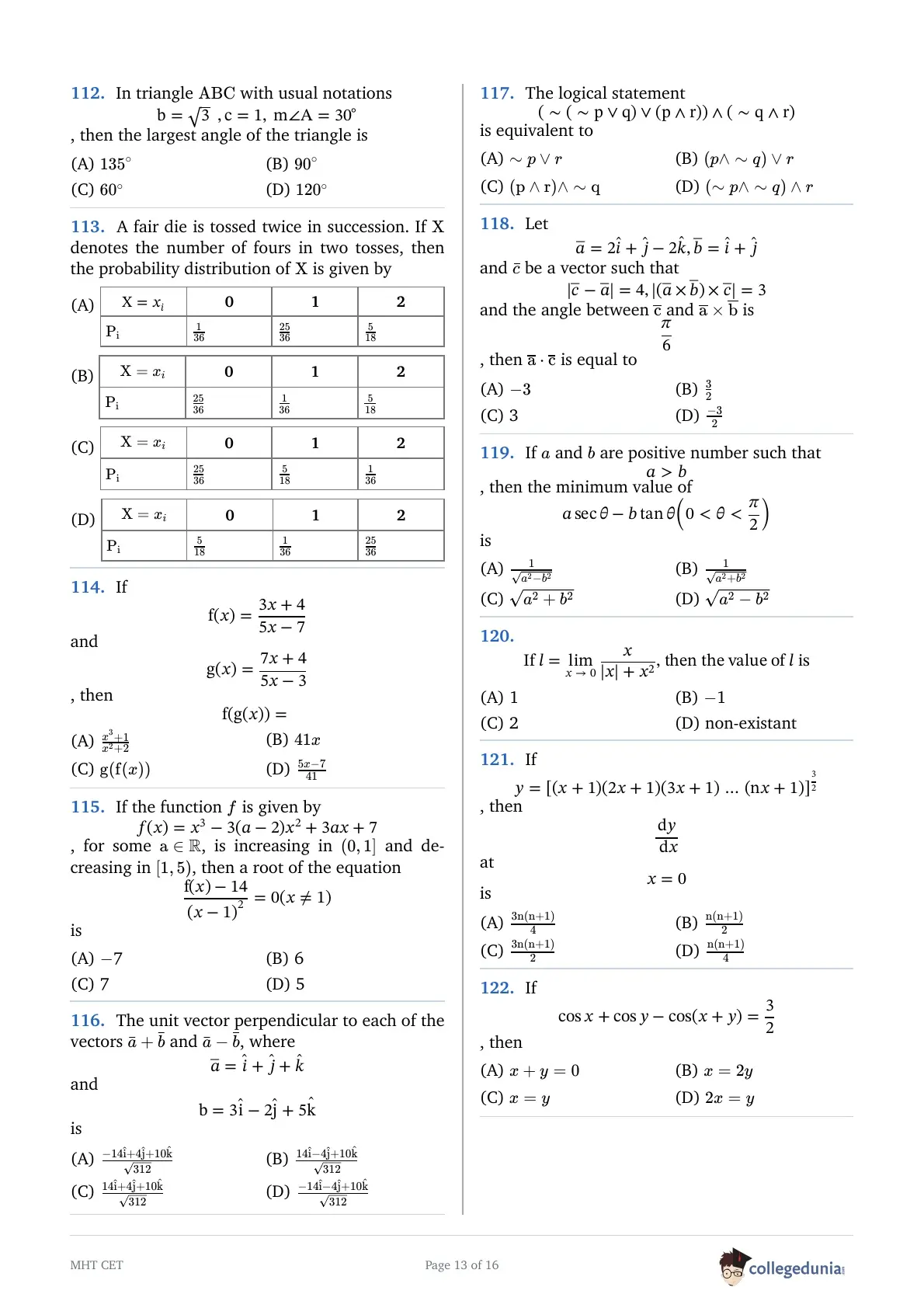
In triangle \[\mathrm{ABC}\] with usual notations \[\mathrm{b}=\sqrt{3}, \mathrm{c}=1, \mathrm{~m} \angle \mathrm{A}=30^{\circ}\], then the largest angle of the triangle is
A fair die is tossed twice in succession. If \[\mathrm{X}\] denotes the number of fours in two tosses, then the probability distribution of \[\mathrm{X}\] is given by
If \[\mathrm{f}(x)=\frac{3 x+4}{5 x-7}\] and \[\mathrm{g}(x)=\frac{7 x+4}{5 x-3}\], then \[\mathrm{f}(\mathrm{g}(x))=\]
If the function \[f\] is given by \[f(x)=x^3-3(a-2) x^2+3 a x+7\], for some \[\mathrm{a} \in \mathbb{R}\], is increasing in \[(0,1]\] and decreasing in \[[1,5)\], then a root of the equation \[\frac{\mathrm{f}(x)-14}{(x-1)^2}=0(x \neq 1)\] is
The unit vector perpendicular to each of the vectors \[\bar{a}+\bar{b}\] and \[\bar{a}-\bar{b}\], where \[\bar{a}=\hat{i}+\hat{j}+\hat{k}\] and \[\overline{\mathrm{b}}=3 \hat{\mathrm{i}}-2 \hat{\mathrm{j}}+5 \hat{\mathrm{k}}\] is
The logical statement \[(\sim(\sim \mathrm{p} \vee \mathrm{q}) \vee(\mathrm{p} \wedge \mathrm{r})) \wedge(\sim \mathrm{q} \wedge \mathrm{r})\] is equivalent to
Let \[\bar{a}=2 \hat{i}+\hat{j}-2 \hat{k}, \bar{b}=\hat{i}+\hat{j}\] and \[\bar{c}\] be a vector such that \[|\bar{c}-\bar{a}|=4,|(\bar{a} \times \bar{b}) \times \bar{c}|=3\] and the angle between \[\overline{\mathrm{c}}\] and \[\overline{\mathrm{a}} \times \overline{\mathrm{b}}\] is \[\frac{\pi}{6}\], then \[\overline{\mathrm{a}} \cdot \overline{\mathrm{c}}\] is equal to
If \(a\) and \(b\) are positive number such that \(a>b\), then the minimum value of \(a \sec \theta-b \tan \theta\left(0 < \theta < \frac{\pi}{2}\right)\) is
\[\text { If } l=\lim _\limits{x \rightarrow 0} \frac{x}{|x|+x^2} \text {, then the value of } l \text { is }\]
If \[y=[(x+1)(2 x+1)(3 x+1) \ldots(\mathrm{n} x+1)]^{\frac{3}{2}}\], then \[\frac{\mathrm{d} y}{\mathrm{~d} x}\] at \[x=0\] is
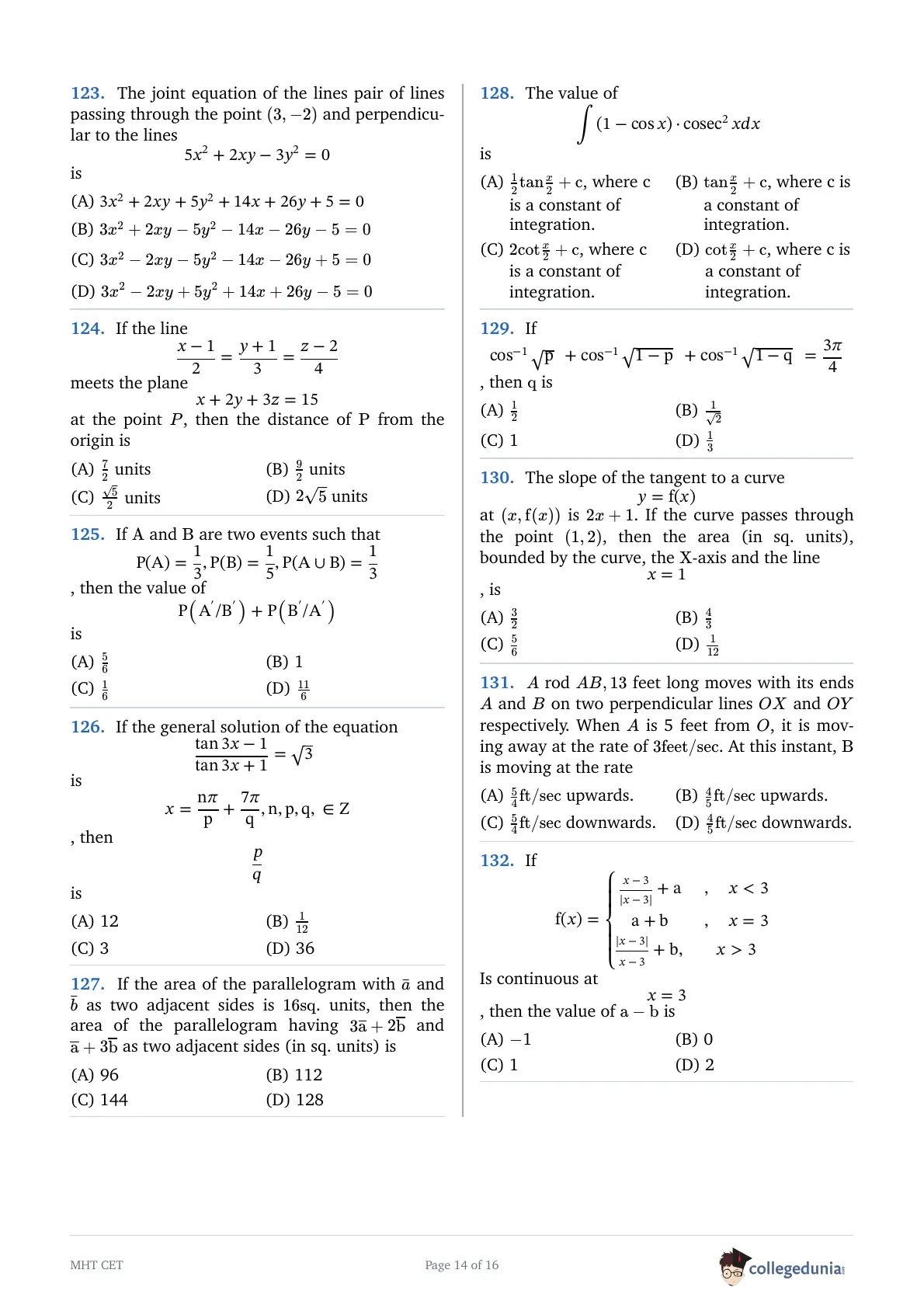
The joint equation of the lines pair of lines passing through the point \[(3,-2)\] and perpendicular to the lines \[5 x^2+2 x y-3 y^2=0\] is
If the line \[\frac{x-1}{2}=\frac{y+1}{3}=\frac{z-2}{4}\] meets the plane \[x+2 y+3 z=15\] at the point \[P\], then the distance of \[\mathrm{P}\] from the origin is
If \[\mathrm{A}\] and \[\mathrm{B}\] are two events such that \[\mathrm{P}(\mathrm{A})=\frac{1}{3}, \mathrm{P}(\mathrm{B})=\frac{1}{5}, \mathrm{P}(\mathrm{A} \cup \mathrm{B})=\frac{1}{3}\], then the value of \[\mathrm{P}\left(\mathrm{A}^{\prime} / \mathrm{B}^{\prime}\right)+\mathrm{P}\left(\mathrm{B}^{\prime} / \mathrm{A}^{\prime}\right)\] is
If the general solution of the equation \[\frac{\tan 3 x-1}{\tan 3 x+1}=\sqrt{3}\] is \[x=\frac{\mathrm{n} \pi}{\mathrm{p}}+\frac{7 \pi}{\mathrm{q}}, \mathrm{n}, \mathrm{p}, \mathrm{q}, \in \mathrm{Z}\], then \[\frac{p}{q}\] is
If the area of the parallelogram with \[\bar{a}\] and \[\bar{b}\] as two adjacent sides is \[16 \mathrm{sq}\]. units, then the area of the parallelogram having \[3 \overline{\mathrm{a}}+2 \overline{\mathrm{b}}\] and \[\overline{\mathrm{a}}+3 \overline{\mathrm{b}}\] as two adjacent sides (in sq. units) is
The value of \[\int(1-\cos x) \cdot \operatorname{cosec}^2 x d x\] is
If \[\cos ^{-1} \sqrt{\mathrm{p}}+\cos ^{-1} \sqrt{1-\mathrm{p}}+\cos ^{-1} \sqrt{1-\mathrm{q}}=\frac{3 \pi}{4}\], then \[\mathrm{q}\] is
The slope of the tangent to a curve \[y=\mathrm{f}(x)\] at \[(x, \mathrm{f}(x))\] is \[2 x+1\]. If the curve passes through the point \[(1,2)\], then the area (in sq. units), bounded by the curve, the \[\mathrm{X}\]-axis and the line \[x=1\], is
\[A\] rod \[A B, 13\] feet long moves with its ends \[A\] and \[B\] on two perpendicular lines \[O X\] and \[O Y\] respectively. When \[A\] is 5 feet from \[O\], it is moving away at the rate of \[3 \mathrm{feet} / \mathrm{sec}\]. At this instant, \[\mathrm{B}\] is moving at the rate
If \(\mathrm{f}(x)=\left\{\begin{array}{cc}\frac{x-3}{|x-3|}+\mathrm{a} & , \quad x < 3 \\ \mathrm{a}+\mathrm{b} & , \quad x=3 \\ \frac{|x-3|}{x-3}+\mathrm{b}, & x>3\end{array}\right.\)
Is continuous at \(x=3\), then the value of \(\mathrm{a}-\mathrm{b}\) is
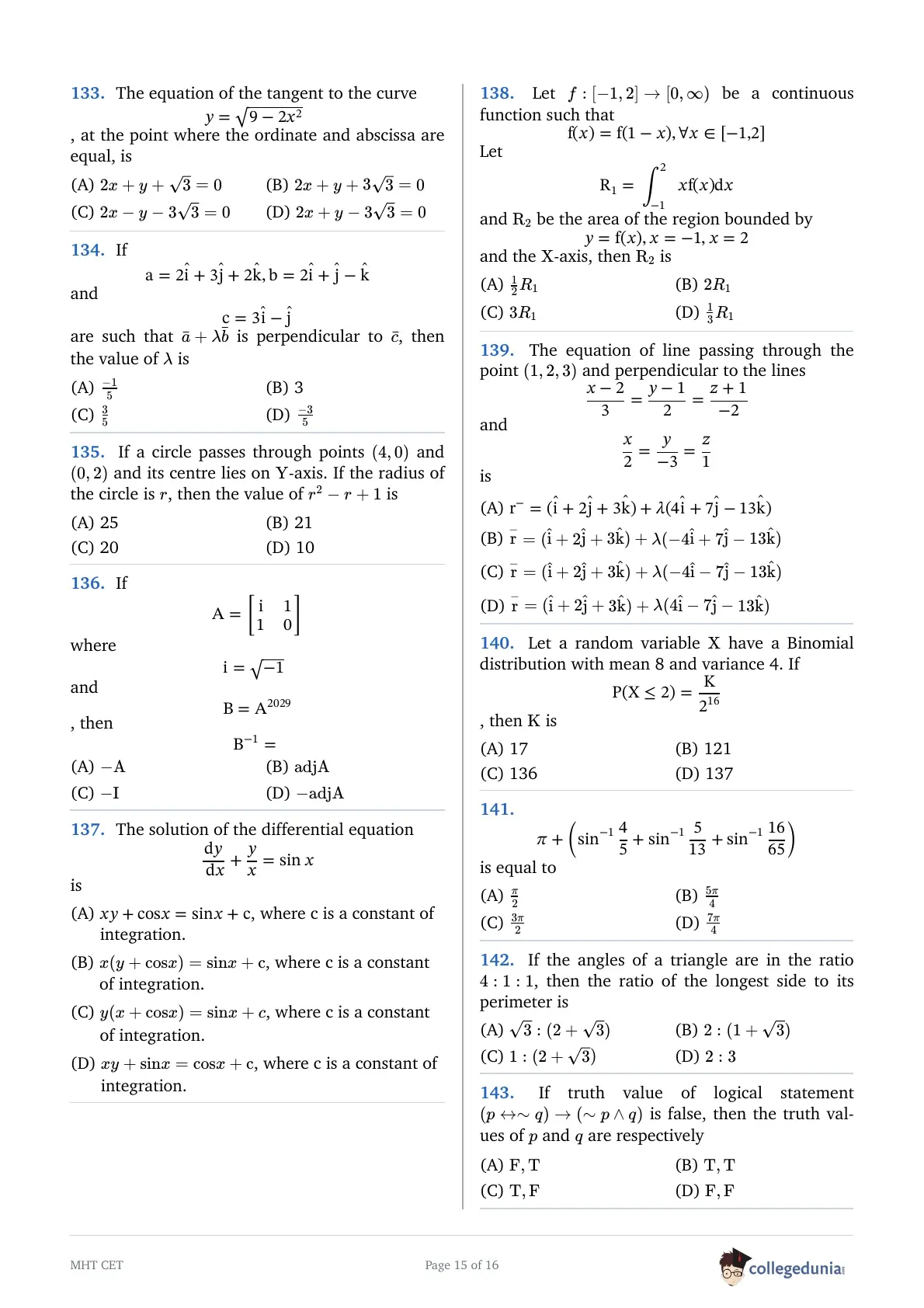
The equation of the tangent to the curve \[y=\sqrt{9-2 x^2}\], at the point where the ordinate and abscissa are equal, is
If \[\overline{\mathrm{a}}=2 \hat{\mathrm{i}}+3 \hat{\mathrm{j}}+2 \hat{\mathrm{k}}, \overline{\mathrm{b}}=2 \hat{\mathrm{i}}+\hat{\mathrm{j}}-\hat{\mathrm{k}}\] and \[\overline{\mathrm{c}}=3 \hat{\mathrm{i}}-\hat{\mathrm{j}}\] are such that \[\bar{a}+\lambda \bar{b}\] is perpendicular to \[\bar{c}\], then the value of \[\lambda\] is
If a circle passes through points \[(4,0)\] and \[(0,2)\] and its centre lies on \[\mathrm{Y}\]-axis. If the radius of the circle is \[r\], then the value of \[r^2-r+1\] is
If \[\mathrm{A}=\left[\begin{array}{ll}\mathrm{i} & 1 \\ 1 & 0\end{array}\right]\] where \[\mathrm{i}=\sqrt{-1}\] and \[\mathrm{B}=\mathrm{A}^{2029}\], then \[\mathrm{B}^{-1}=\]
The solution of the differential equation \[\frac{\mathrm{d} y}{\mathrm{~d} x}+\frac{y}{x}=\sin x\] is
Let \[f:[-1,2] \rightarrow[0, \infty)\] be a continuous function such that \[\mathrm{f}(x)=\mathrm{f}(1-x), \forall x \in[-1,2]\]
Let \[\mathrm{R}_1=\int_{-1}^2 x \mathrm{f}(x) \mathrm{d} x\] and \[\mathrm{R}_2\] be the area of the region bounded by \[y=\mathrm{f}(x), x=-1, x=2\] and the \[\mathrm{X}\]-axis, then \[\mathrm{R}_2\] is
The equation of line passing through the point \[(1,2,3)\] and perpendicular to the lines \[\frac{x-2}{3}=\frac{y-1}{2}=\frac{z+1}{-2}\] and \[\frac{x}{2}=\frac{y}{-3}=\frac{z}{1}\] is
Let a random variable \[\mathrm{X}\] have a Binomial distribution with mean 8 and variance 4. If \[\mathrm{P}(\mathrm{X} \leq 2)=\frac{\mathrm{K}}{2^{16}}\], then \[\mathrm{K}\] is
\[\pi+\left(\sin ^{-1} \frac{4}{5}+\sin ^{-1} \frac{5}{13}+\sin ^{-1} \frac{16}{65}\right)\] is equal to
If the angles of a triangle are in the ratio \[4: 1: 1\], then the ratio of the longest side to its perimeter is
If truth value of logical statement \[(p \leftrightarrow \sim q) \rightarrow(\sim p \wedge q)\] is false, then the truth values of \[p\] and \[q\] are respectively
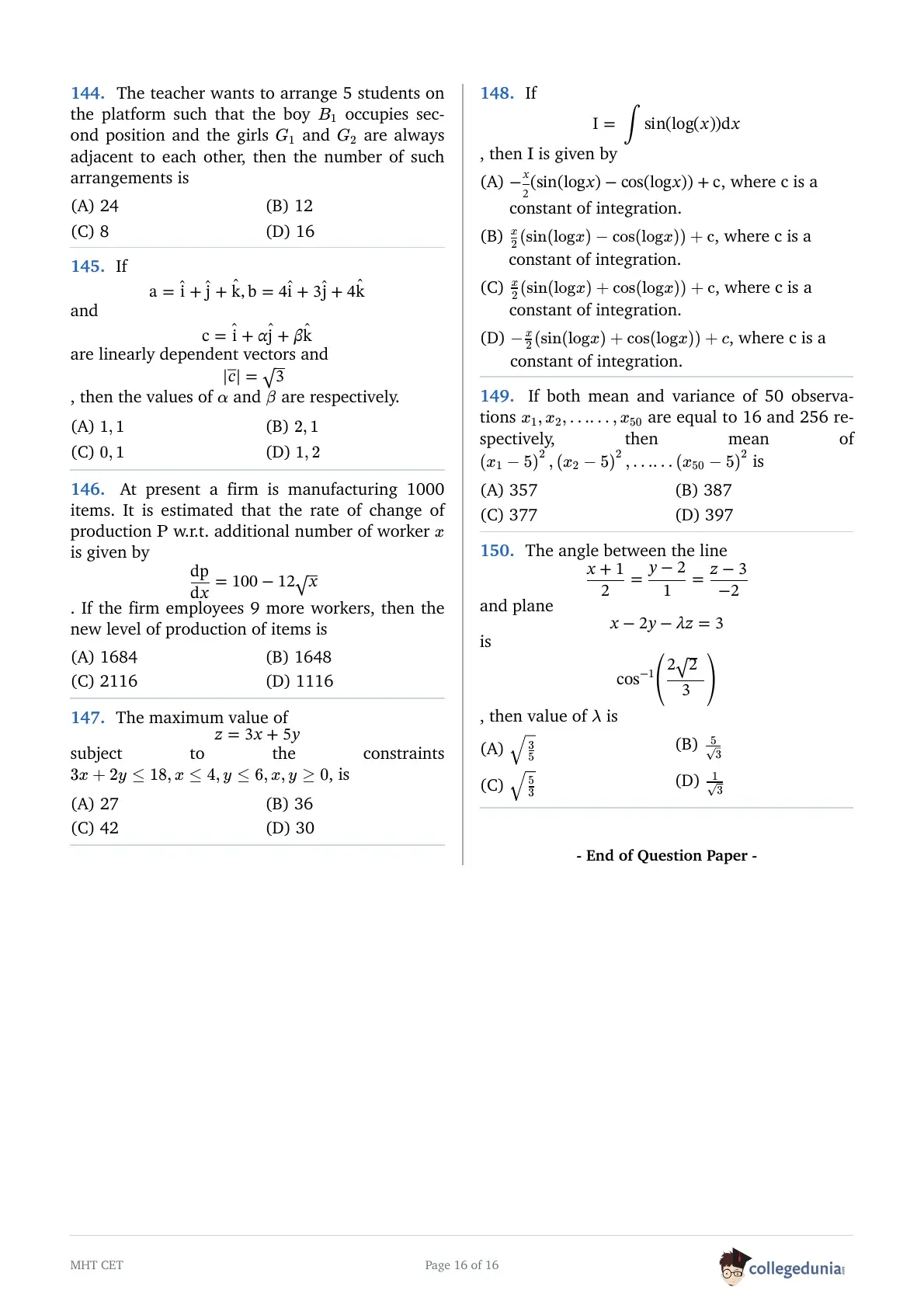
The teacher wants to arrange 5 students on the platform such that the boy \[B_1\] occupies second position and the girls \[G_1\] and \[G_2\] are always adjacent to each other, then the number of such arrangements is
If \[\overline{\mathrm{a}}=\hat{\mathrm{i}}+\hat{\mathrm{j}}+\hat{\mathrm{k}}, \overline{\mathrm{b}}=4 \hat{\mathrm{i}}+3 \hat{\mathrm{j}}+4 \hat{\mathrm{k}}\] and \[\overline{\mathrm{c}}=\hat{\mathrm{i}}+\alpha \hat{\mathrm{j}}+\beta \hat{\mathrm{k}}\] are linearly dependent vectors and \[|\bar{c}|=\sqrt{3}\], then the values of \[\alpha\] and \[\beta\] are respectively.
At present a firm is manufacturing 1000 items. It is estimated that the rate of change of production \[\mathrm{P}\] w.r.t. additional number of worker \[x\] is given by \[\frac{\mathrm{dp}}{\mathrm{d} x}=100-12 \sqrt{x}\]. If the firm employees 9 more workers, then the new level of production of items is
The maximum value of \[z=3 x+5 y\] subject to the constraints \[3 x+2 y \leq 18, x \leq 4, y \leq 6, x, y \geq 0\], is
If \[\mathrm{I}=\int \sin (\log (x)) \mathrm{d} x\], then \[\mathrm{I}\] is given by
If both mean and variance of 50 observations \(x_1, x_2, \ldots, x_{50}\) are equal to 16 and 256 respectively, then mean of \((x_1-5)^2, (x_2-5)^2, \ldots, (x_{50}-5)^2\) is
The angle between the line \[\frac{x+1}{2}=\frac{y-2}{1}=\frac{z-3}{-2}\] and plane \[x-2 y-\lambda z=3\] is \[\cos ^{-1}\left(\frac{2 \sqrt{2}}{3}\right)\], then value of \[\lambda\] is
MHT CET 2023 PCM Exam Pattern and Marking Scheme
| Parameter | Details |
|---|---|
| Conducting Body | Maharashtra Common Entrance Test Cell (Maharashtra CET Cell) |
| Exam Mode | Online (Computer-Based Test) |
| Duration | 180 minutes (3 hours) |
| Groups / Subjects | PCM (Physics, Chemistry, Mathematics) for Engineering |
| Total Questions |
150 |
| Total Marks | 200 |
| Question Type | Multiple Choice Questions (MCQs) |
| Marks Distribution |
|
| Negative Marking | No |
| Syllabus Weightage |
|



Comments