




MHT CET 2023 May 12 Shift 1 PCM Question Paper is available for download here. Maharashtra State CET Cell conducted MHT CET 2023 PCM Exam on May 12 in Shift 1 from 9 AM to 12 PM in CBT mode.
The MHT CET 2023 PCM question paper includes the following:
- The MHT CET 2023 PCM Question Paper consists of 150 multiple-choice questions (MCQs) totalling 200 marks divided into 3 sections: Physics, Chemistry, and Mathematics, with 50 questions in each subject.
- Physics and Chemistry questions carry 1 mark each while Mathematics questions carry 2 marks each.
- There is no negative marking for incorrect answers.
MHT CET 2023 May 12 Shift 1 PCM Question Paper with Solution PDF
| CD PDF | CD PDF with Solutions |
|---|---|
| Download Collegedunia PDF 1.18 MB | - |
Also Check:
MHT CET 2023 May 12 Shift 1 PCM Questions with Solutions
Physics (Q1 - Q50)
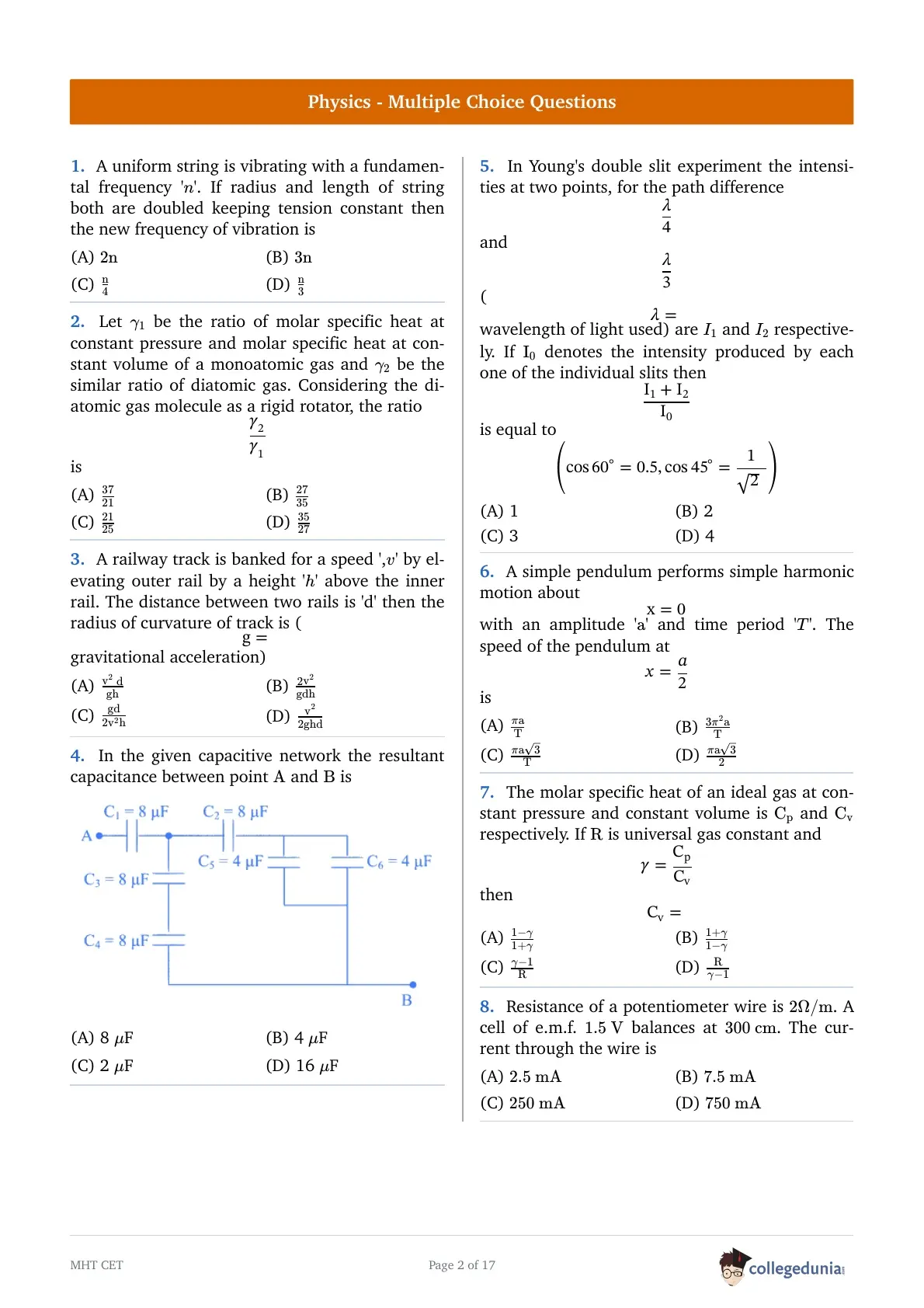
A uniform string is vibrating with a fundamental frequency '\[n\]'. If radius and length of string both are doubled keeping tension constant then the new frequency of vibration is
Let \[\gamma_1\] be the ratio of molar specific heat at constant pressure and molar specific heat at constant volume of a monoatomic gas and \[\gamma_2\] be the similar ratio of diatomic gas. Considering the diatomic gas molecule as a rigid rotator, the ratio \[\frac{\gamma_2}{\gamma_1}\] is
A railway track is banked for a speed ',\[v\]' by elevating outer rail by a height '\[h\]' above the inner rail. The distance between two rails is 'd' then the radius of curvature of track is ( \[\mathrm{g}=\] gravitational acceleration)
In the given capacitive network the resultant capacitance between point \[\mathrm{A}\] and \[\mathrm{B}\] is

In Young's double slit experiment the intensities at two points, for the path difference \[\frac{\lambda}{4}\] and \[\frac{\lambda}{3}\] (\[\lambda=\] wavelength of light used) are \[I_1\] and \[I_2\] respectively. If \[\mathrm{I}_0\] denotes the intensity produced by each one of the individual slits then \[\frac{\mathrm{I}_1+\mathrm{I}_2}{\mathrm{I}_0}\] is equal to \[\left(\cos 60^{\circ}=0.5, \cos 45^{\circ}=\frac{1}{\sqrt{2}}\right)\]
A simple pendulum performs simple harmonic motion about \[\mathrm{x}=0\] with an amplitude '\[\mathrm{a}\]' and time period '\[T\]'. The speed of the pendulum at \[x=\frac{a}{2}\] is
The molar specific heat of an ideal gas at constant pressure and constant volume is \[\mathrm{C}_{\mathrm{p}}\] and \[\mathrm{C}_{\mathrm{v}}\] respectively. If \[\mathrm{R}\] is universal gas constant and \[\gamma=\frac{\mathrm{C}_{\mathrm{p}}}{\mathrm{C}_{\mathrm{v}}}\] then \[\mathrm{C}_{\mathrm{v}}=\]
Resistance of a potentiometer wire is \[2 \Omega / \mathrm{m}\]. A cell of e.m.f. \[1.5 \mathrm{~V}\] balances at \[300 \mathrm{~cm}\]. The current through the wire is
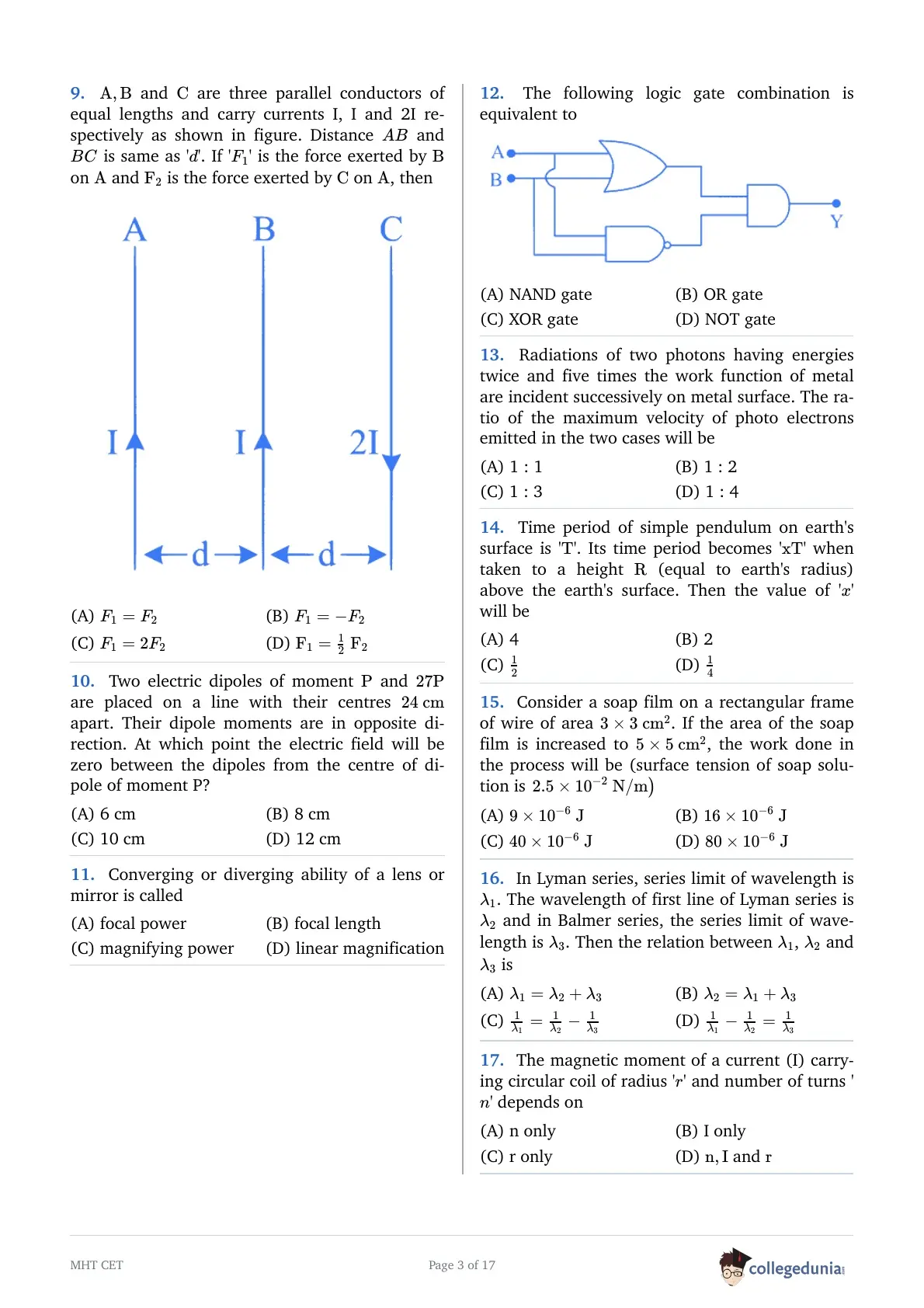
\[\mathrm{A}, \mathrm{B}\] and \[\mathrm{C}\] are three parallel conductors of equal lengths and carry currents I, I and 2I respectively as shown in figure. Distance \[A B\] and \[B C\] is same as '\[d\]'. If '\[F_1\]' is the force exerted by \[\mathrm{B}\] on \[\mathrm{A}\] and \[\mathrm{F}_2\] is the force exerted by \[\mathrm{C}\] on \[\mathrm{A}\], then

Two electric dipoles of moment \[\mathrm{P}\] and \[27 \mathrm{P}\] are placed on a line with their centres \[24 \mathrm{~cm}\] apart. Their dipole moments are in opposite direction. At which point the electric field will be zero between the dipoles from the centre of dipole of moment P?

Radiations of two photons having energies twice and five times the work function of metal are incident successively on metal surface. The ratio of the maximum velocity of photo electrons emitted in the two cases will be
Time period of simple pendulum on earth's surface is '\[\mathrm{T}\]'. Its time period becomes '\[\mathrm{xT}\]' when taken to a height \[\mathrm{R}\] (equal to earth's radius) above the earth's surface. Then the value of '\[x\]' will be
Consider a soap film on a rectangular frame of wire of area \[3 \times 3 \mathrm{~cm}^2\]. If the area of the soap film is increased to \[5 \times 5 \mathrm{~cm}^2\], the work done in the process will be (surface tension of soap solution is \[\left.2.5 \times 10^{-2} \mathrm{~N} / \mathrm{m}\right)\]
In Lyman series, series limit of wavelength is \[\lambda_1\]. The wavelength of first line of Lyman series is \[\lambda_2\] and in Balmer series, the series limit of wavelength is \[\lambda_3\]. Then the relation between \[\lambda_1\], \[\lambda_2\] and \[\lambda_3\] is
The magnetic moment of a current (I) carrying circular coil of radius '\[r\]' and number of turns '\[n\]' depends on
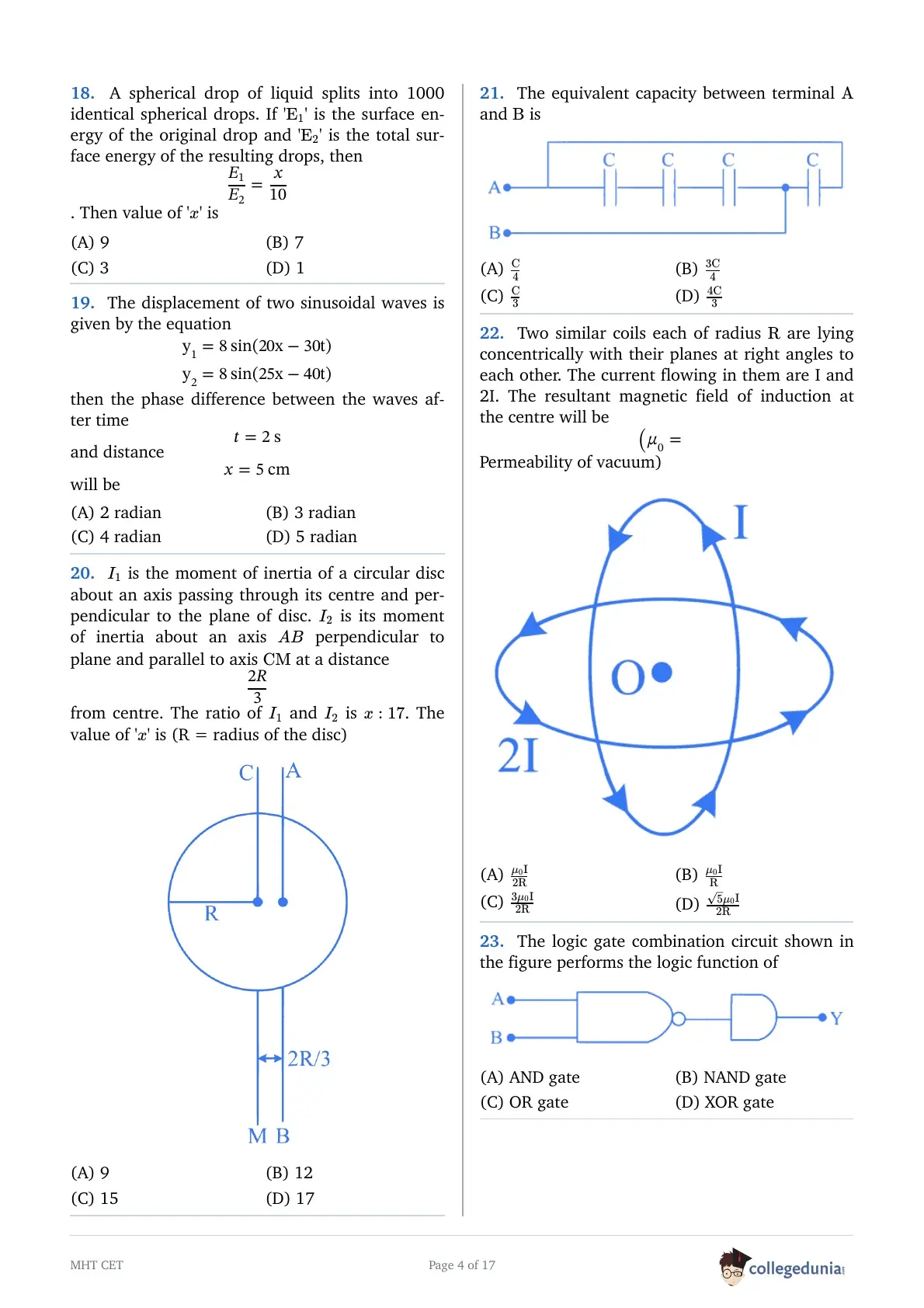
A spherical drop of liquid splits into 1000 identical spherical drops. If '\[\mathrm{E}_1\]' is the surface energy of the original drop and '\[\mathrm{E}_2\]' is the total surface energy of the resulting drops, then \[\frac{E_1}{E_2}=\frac{x}{10}\]. Then value of '\[x\]' is
The displacement of two sinusoidal waves is given by the equation
\[\begin{aligned} & \mathrm{y}_1=8 \sin (20 \mathrm{x}-30 \mathrm{t}) \\ & \mathrm{y}_2=8 \sin (25 \mathrm{x}-40 \mathrm{t}) \end{aligned}\]
then the phase difference between the waves after time \[t=2 \mathrm{~s}\] and distance \[x=5 \mathrm{~cm}\] will be
\[I_1\] is the moment of inertia of a circular disc about an axis passing through its centre and perpendicular to the plane of disc. \[I_2\] is its moment of inertia about an axis \[A B\] perpendicular to plane and parallel to axis \[\mathrm{CM}\] at a distance \[\frac{2 R}{3}\] from centre. The ratio of \[I_1\] and \[I_2\] is \[x: 17\]. The value of '\[x\]' is (R = radius of the disc)

The equivalent capacity between terminal \[\mathrm{A}\] and \[\mathrm{B}\] is

Two similar coils each of radius \[\mathrm{R}\] are lying concentrically with their planes at right angles to each other. The current flowing in them are I and 2I. The resultant magnetic field of induction at the centre will be \[\left(\mu_0=\right.\] Permeability of vacuum)

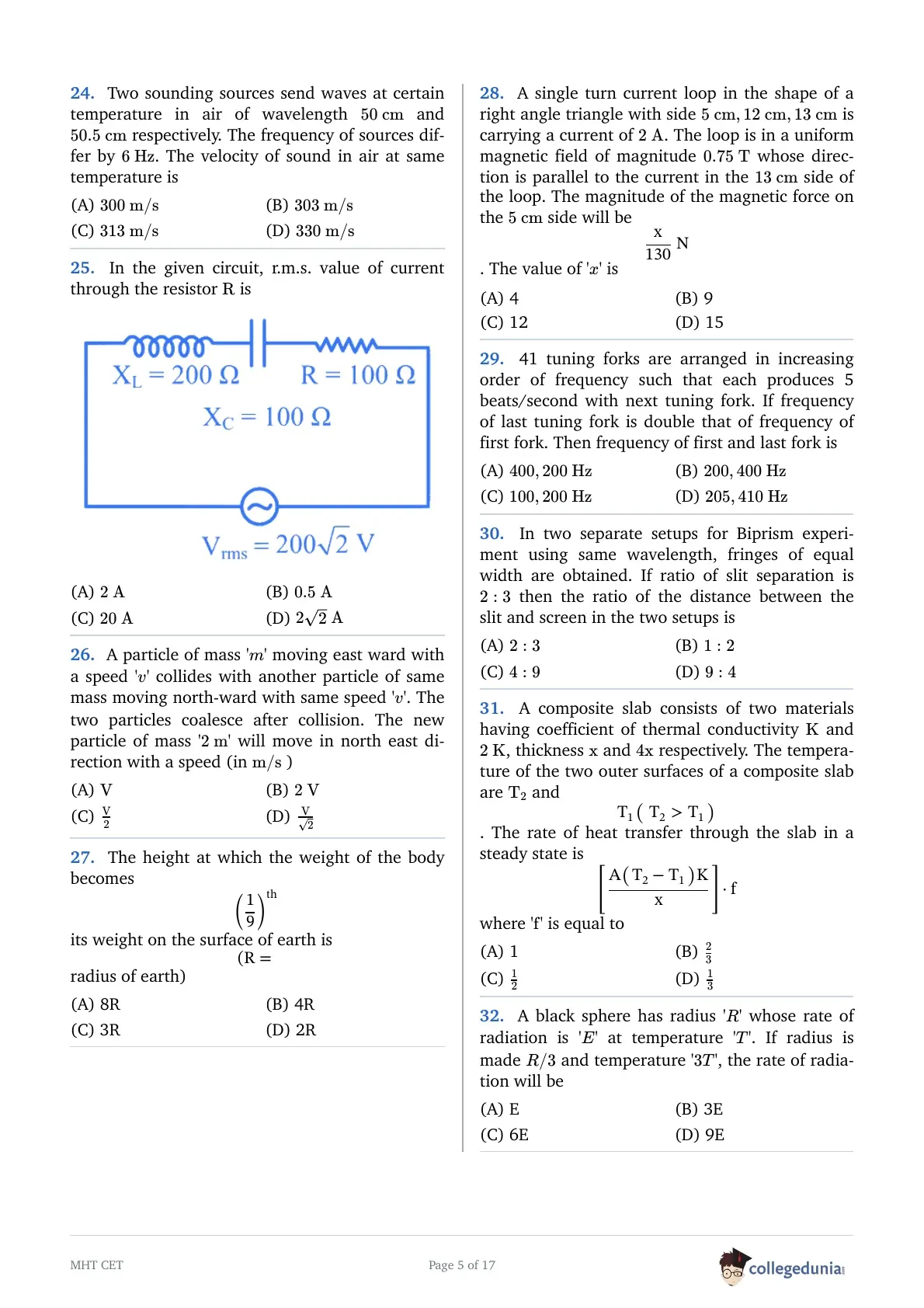
Two sounding sources send waves at certain temperature in air of wavelength \[50 \mathrm{~cm}\] and \[50.5 \mathrm{~cm}\] respectively. The frequency of sources differ by \[6 \mathrm{~Hz}\]. The velocity of sound in air at same temperature is
In the given circuit, r.m.s. value of current through the resistor \[\mathrm{R}\] is

A particle of mass '\[m\]' moving east ward with a speed '\[v\]' collides with another particle of same mass moving north-ward with same speed '\[v\]'. The two particles coalesce after collision. The new particle of mass '\[2 \mathrm{~m}\]' will move in north east direction with a speed (in \[\mathrm{m} / \mathrm{s}\] )
The height at which the weight of the body becomes \[\left(\frac{1}{9}\right)^{\text {th }}\] its weight on the surface of earth is \[(\mathrm{R}=\] radius of earth)
A single turn current loop in the shape of a right angle triangle with side \[5 \mathrm{~cm}, 12 \mathrm{~cm}, 13 \mathrm{~cm}\] is carrying a current of \[2 \mathrm{~A}\]. The loop is in a uniform magnetic field of magnitude \[0.75 \mathrm{~T}\] whose direction is parallel to the current in the \[13 \mathrm{~cm}\] side of the loop. The magnitude of the magnetic force on the \[5 \mathrm{~cm}\] side will be \[\frac{\mathrm{x}}{130} \mathrm{~N}\]. The value of '\[x\]' is
41 tuning forks are arranged in increasing order of frequency such that each produces 5 beats/second with next tuning fork. If frequency of last tuning fork is double that of frequency of first fork. Then frequency of first and last fork is
In two separate setups for Biprism experiment using same wavelength, fringes of equal width are obtained. If ratio of slit separation is \[2: 3\] then the ratio of the distance between the slit and screen in the two setups is
A composite slab consists of two materials having coefficient of thermal conductivity \[\mathrm{K}\] and \[2 \mathrm{~K}\], thickness \[\mathrm{x}\] and \[4 \mathrm{x}\] respectively. The temperature of the two outer surfaces of a composite slab are \[\mathrm{T}_2\] and \[\mathrm{T}_1\left(\mathrm{~T}_2 > \mathrm{T}_1\right)\]. The rate of heat transfer through the slab in a steady state is \[\left[\frac{\mathrm{A}\left(\mathrm{T}_2-\mathrm{T}_1\right) \mathrm{K}}{\mathrm{x}}\right] \cdot \mathrm{f}\] where '\[\mathrm{f}\]' is equal to
A black sphere has radius '\[R\]' whose rate of radiation is '\[E\]' at temperature '\[T\]'. If radius is made \[R / 3\] and temperature '\[3 T\]', the rate of radiation will be
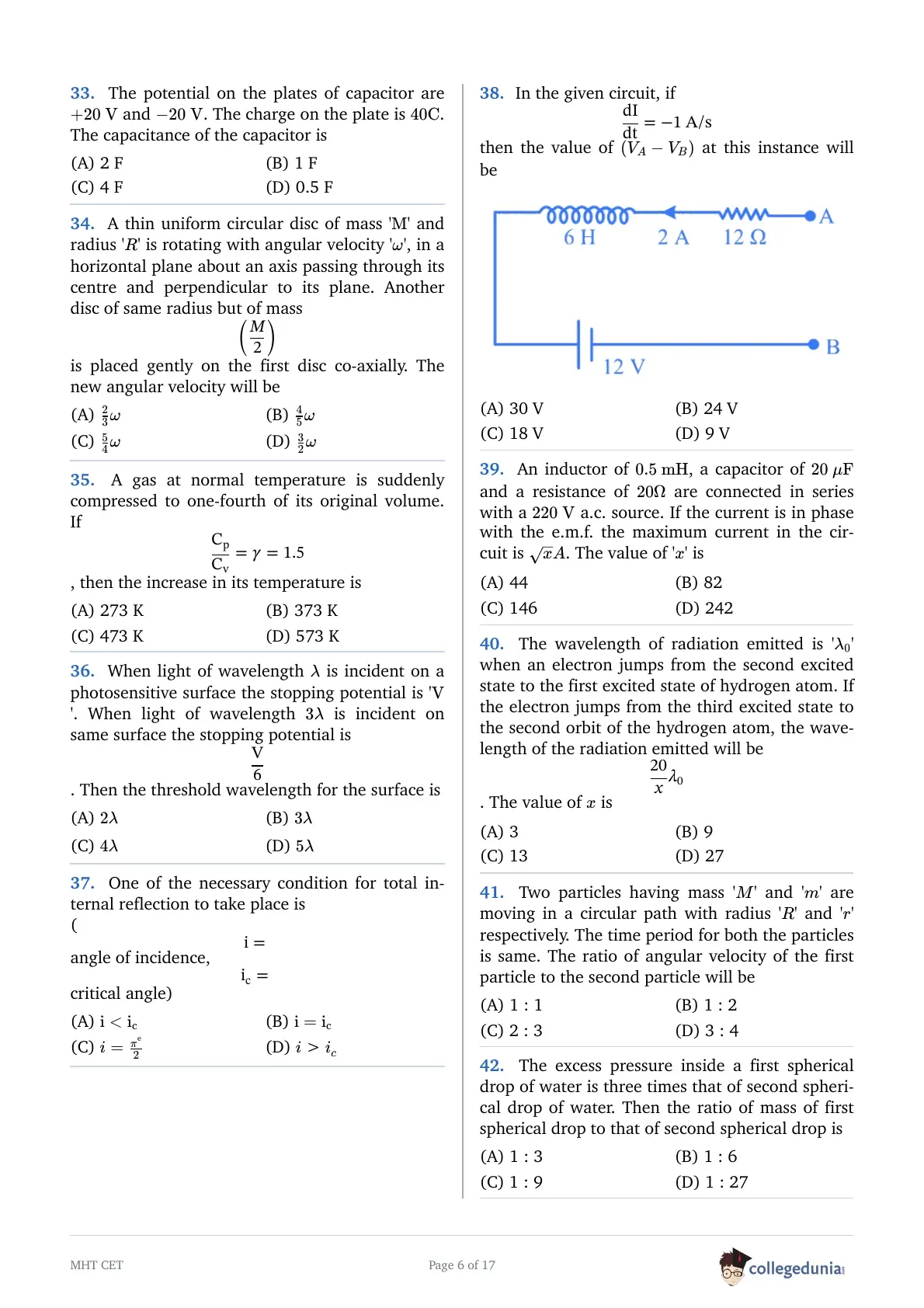
The potential on the plates of capacitor are \[+20 \mathrm{~V}\] and \[-20 \mathrm{~V}\]. The charge on the plate is \[40 \mathrm{C}\]. The capacitance of the capacitor is
A thin uniform circular disc of mass '\[\mathrm{M}\]' and radius '\[R\]' is rotating with angular velocity '\[\omega\]', in a horizontal plane about an axis passing through its centre and perpendicular to its plane. Another disc of same radius but of mass \[\left(\frac{M}{2}\right)\] is placed gently on the first disc co-axially. The new angular velocity will be
A gas at normal temperature is suddenly compressed to one-fourth of its original volume. If \[\frac{\mathrm{C}_{\mathrm{p}}}{\mathrm{C}_{\mathrm{v}}}=\gamma=1.5\], then the increase in its temperature is
When light of wavelength \[\lambda\] is incident on a photosensitive surface the stopping potential is '\[\mathrm{V}\]'. When light of wavelength \[3 \lambda\] is incident on same surface the stopping potential is \[\frac{\mathrm{V}}{6}\]. Then the threshold wavelength for the surface is
One of the necessary condition for total internal reflection to take place is
( \[\mathrm{i}=\] angle of incidence, \[\mathrm{i}_{\mathrm{c}}=\] critical angle)
In the given circuit, if \[\frac{\mathrm{dI}}{\mathrm{dt}}=-1 \mathrm{~A} / \mathrm{s}\] then the value of \[\left(V_A-V_B\right)\] at this instance will be

An inductor of \[0.5 \mathrm{~mH}\], a capacitor of \[20 ~\mu \mathrm{F}\] and a resistance of \[20 \Omega\] are connected in series with a \[220 \mathrm{~V}\] a.c. source. If the current is in phase with the e.m.f. the maximum current in the circuit is \[\sqrt{x} A\]. The value of '\[x\]' is
The wavelength of radiation emitted is '\[\lambda_0\]' when an electron jumps from the second excited state to the first excited state of hydrogen atom. If the electron jumps from the third excited state to the second orbit of the hydrogen atom, the wavelength of the radiation emitted will be \[\frac{20}{x} \lambda_0\]. The value of \[x\] is
Two particles having mass '\[M\]' and '\[m\]' are moving in a circular path with radius '\[R\]' and '\[r\]' respectively. The time period for both the particles is same. The ratio of angular velocity of the first particle to the second particle will be
The excess pressure inside a first spherical drop of water is three times that of second spherical drop of water. Then the ratio of mass of first spherical drop to that of second spherical drop is
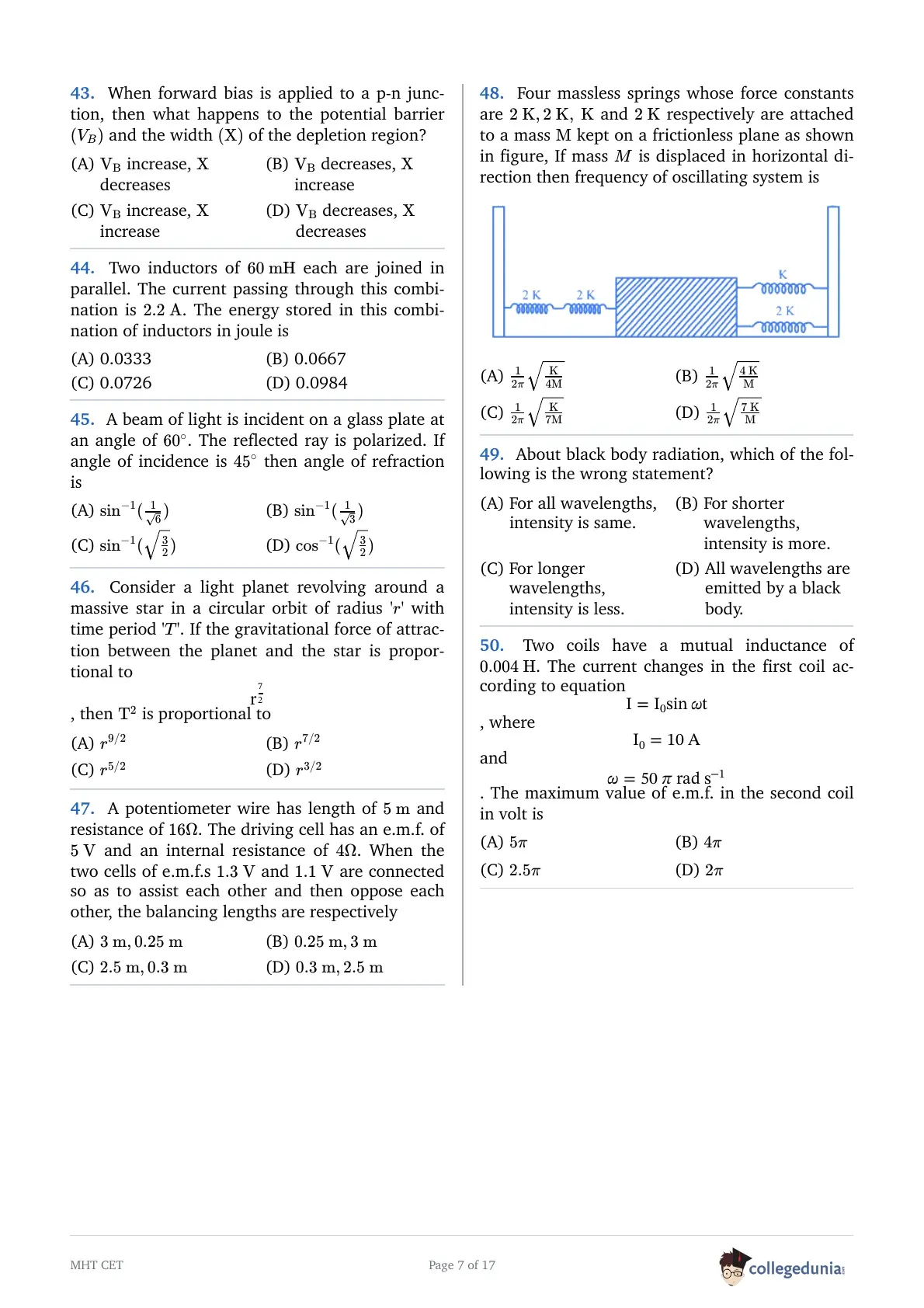
When forward bias is applied to a p-n junction, then what happens to the potential barrier \[\left(V_B\right)\] and the width \[(\mathrm{X})\] of the depletion region?
Two inductors of \[60 \mathrm{~mH}\] each are joined in parallel. The current passing through this combination is \[2.2 \mathrm{~A}\]. The energy stored in this combination of inductors in joule is
A beam of light is incident on a glass plate at an angle of \[60^{\circ}\]. The reflected ray is polarized. If angle of incidence is \[45^{\circ}\] then angle of refraction is
A potentiometer wire has length of \[5 \mathrm{~m}\] and resistance of \[16 \Omega\]. The driving cell has an e.m.f. of \[5 \mathrm{~V}\] and an internal resistance of \[4 \Omega\]. When the two cells of e.m.f.s \[1.3 \mathrm{~V}\] and \[1.1 \mathrm{~V}\] are connected so as to assist each other and then oppose each other, the balancing lengths are respectively
Four massless springs whose force constants are \[2 \mathrm{~K}, 2 \mathrm{~K}, \mathrm{~K}\] and \[2 \mathrm{~K}\] respectively are attached to a mass \[\mathrm{M}\] kept on a frictionless plane as shown in figure, If mass \[M\] is displaced in horizontal direction then frequency of oscillating system is

About black body radiation, which of the following is the wrong statement?
Two coils have a mutual inductance of \[0.004 \mathrm{~H}\]. The current changes in the first coil according to equation \[\mathrm{I}=\mathrm{I}_0 \sin \omega \mathrm{t}\], where \[\mathrm{I}_0=10 \mathrm{~A}\] and \[\omega=50 ~\pi \mathrm{~rad} ~\mathrm{s}^{-1}\]. The maximum value of e.m.f. in the second coil in volt is
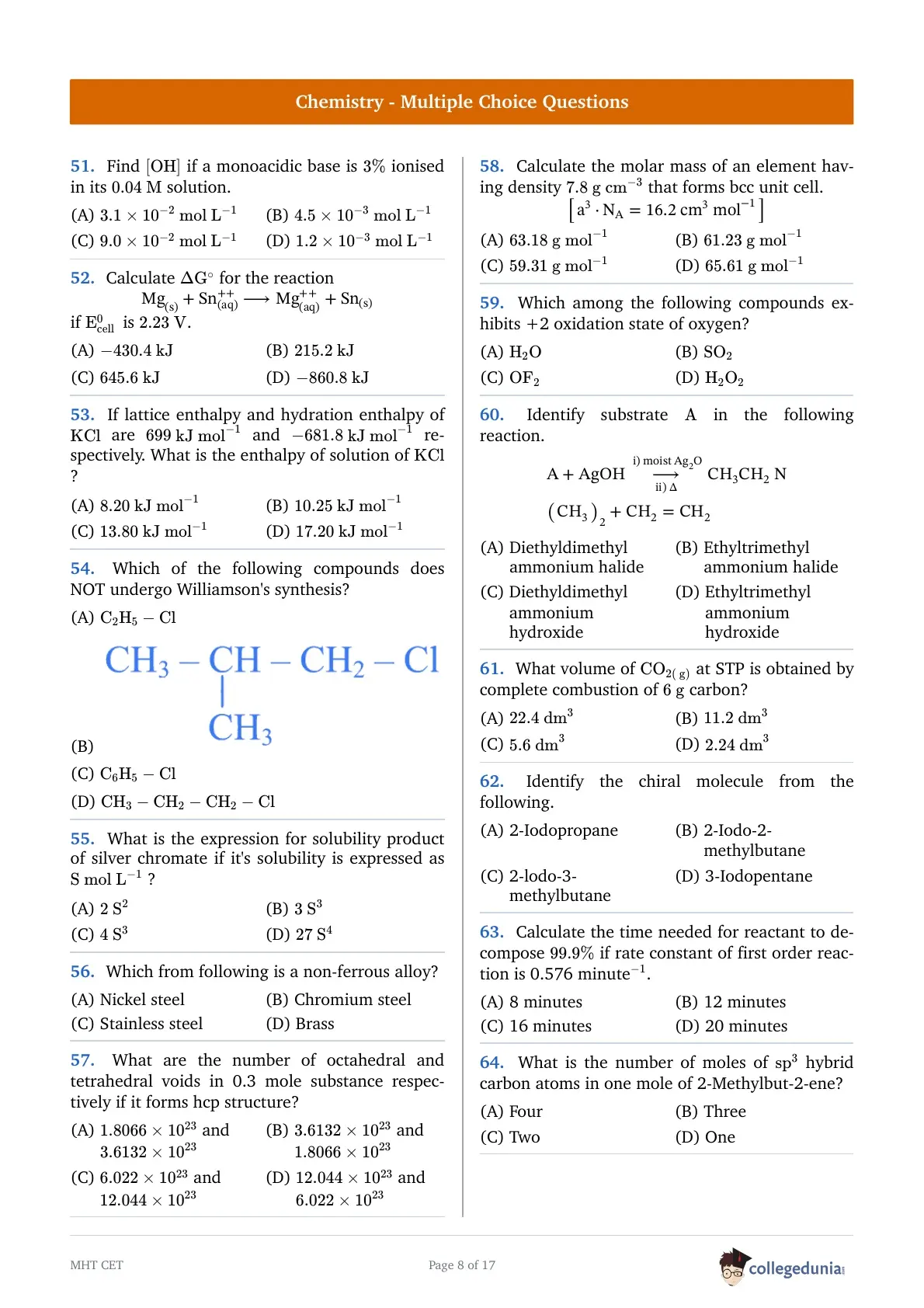
Chemistry (Q51 - Q100)
Find \[[\mathrm{OH}]\] if a monoacidic base is \[3 \%\] ionised in its \[0.04 \mathrm{~M}\] solution.
Calculate \[\Delta \mathrm{G}^{\circ}\] for the reaction \[\mathrm{Mg}_{(\mathrm{s})}+\mathrm{Sn}_{(\mathrm{aq})}^{++} \longrightarrow \mathrm{Mg}_{(\mathrm{aq})}^{++}+\mathrm{Sn}_{(\mathrm{s})}\] if \[\mathrm{E}_{\text {cell }}^0\] is \[2.23 \mathrm{~V}\].
If lattice enthalpy and hydration enthalpy of \[\mathrm{KCl}\] are \[699 \mathrm{~kJ} \mathrm{~mol}^{-1}\] and \[-681.8 \mathrm{~kJ} \mathrm{~mol}^{-1}\] respectively. What is the enthalpy of solution of \[\mathrm{KCl}\] ?
Which of the following compounds does NOT undergo Williamson's synthesis?
- (A) \(\mathrm{C}_{2}\mathrm{H}_{5}-\mathrm{Cl}\)
- (B)
![]()
- (C) \(\mathrm{C}_{6}\mathrm{H}_{5}-\mathrm{Cl}\)
- (D) \(\mathrm{CH}_{3}-\mathrm{CH}_{2}-\mathrm{CH}_{2}-\mathrm{Cl}\)

What is the expression for solubility product of silver chromate if it's solubility is expressed as \[\mathrm{S} \mathrm{~mol} \mathrm{~L}^{-1}\] ?
What are the number of octahedral and tetrahedral voids in 0.3 mole substance respectively if it forms hcp structure?
Calculate the molar mass of an element having density \[7.8 \mathrm{~g} \mathrm{~cm}^{-3}\] that forms bcc unit cell. \[\left[\mathrm{a}^3 \cdot \mathrm{N}_{\mathrm{A}}=16.2 \mathrm{~cm}^3 \mathrm{~mol}^{-1}\right]\]
Which among the following compounds exhibits +2 oxidation state of oxygen?
Identify substrate \[\mathrm{A}\] in the following reaction.
\[\mathrm{A}+\mathrm{AgOH} \underset{\mathrm{ii)}~\Delta}{\stackrel{\text { i) moist } \mathrm{Ag}_2 \mathrm{O}}{\longrightarrow}} \mathrm{CH}_3 \mathrm{CH}_2 \mathrm{~N}\left(\mathrm{CH}_3\right)_2+\mathrm{CH}_2=\mathrm{CH}_2\]
What volume of \[\mathrm{CO}_{2(\mathrm{~g})}\] at STP is obtained by complete combustion of \[6 \mathrm{~g}\] carbon?
Calculate the time needed for reactant to decompose \[99.9 \%\] if rate constant of first order reaction is 0.576 minute\[^{-1}\].
What is the number of moles of \[\mathrm{sp}^3\] hybrid carbon atoms in one mole of 2-Methylbut-2-ene?
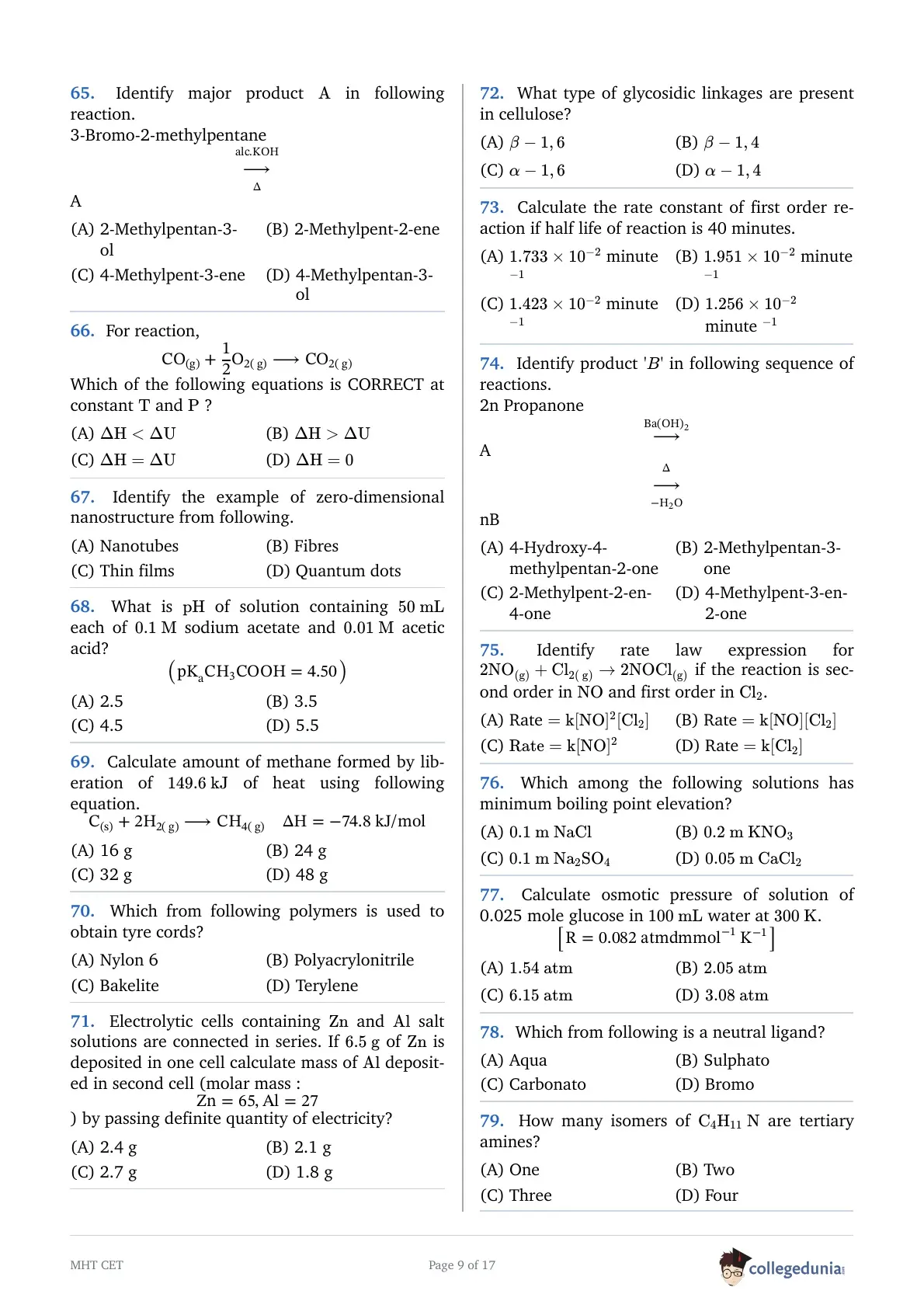
Identify major product \[\mathrm{A}\] in following reaction.
3-Bromo-2-methylpentane \[\mathrm{\mathrel{\mathop{\kern0pt\longrightarrow} \limits_\Delta ^{alc.KOH}}}\] A
For reaction, \[\mathrm{CO}_{(\mathrm{g})}+\frac{1}{2} \mathrm{O}_{2(\mathrm{~g})} \longrightarrow \mathrm{CO}_{2(\mathrm{~g})}\]
Which of the following equations is CORRECT at constant \[\mathrm{T}\] and \[\mathrm{P}\] ?
Identify the example of zero-dimensional nanostructure from following.
What is \[\mathrm{pH}\] of solution containing \[50 \mathrm{~mL}\] each of \[0.1 \mathrm{~M}\] sodium acetate and \[0.01 \mathrm{~M}\] acetic acid? \[\left(\mathrm{pK}_{\mathrm{a}} \mathrm{CH}_3 \mathrm{COOH}=4.50\right)\]
Calculate amount of methane formed by liberation of \[149.6 \mathrm{~kJ}\] of heat using following equation.
\[\mathrm{C}_{(\mathrm{s})}+2 \mathrm{H}_{2(\mathrm{~g})} \longrightarrow \mathrm{CH}_{4(\mathrm{~g})} \quad \Delta \mathrm{H}=-74.8 \mathrm{~kJ} / \mathrm{mol}\]
Electrolytic cells containing \[\mathrm{Zn}\] and \[\mathrm{Al}\] salt solutions are connected in series. If \[6.5 \mathrm{~g}\] of \[\mathrm{Zn}\] is deposited in one cell calculate mass of \[\mathrm{Al}\] deposited in second cell (molar mass : \[\mathrm{Zn}=65, \mathrm{Al}=27\] ) by passing definite quantity of electricity?
Calculate the rate constant of first order reaction if half life of reaction is 40 minutes.
Identify product '\[B\]' in following sequence of reactions.
2n Propanone \[\mathrm{\buildrel {Ba{{(OH)}_2}} \over \longrightarrow}\] A \[\mathrm{\mathrel{\mathop{\kern0pt\longrightarrow} \limits_{ - {H_2}O}^\Delta }}\] nB
Identify rate law expression for \[2 \mathrm{NO}_{(\mathrm{g})}+\mathrm{Cl}_{2(\mathrm{~g})} \rightarrow 2 \mathrm{NOCl}_{(\mathrm{g})}\] if the reaction is second order in \[\mathrm{NO}\] and first order in \[\mathrm{Cl}_2\].
Which among the following solutions has minimum boiling point elevation?
Calculate osmotic pressure of solution of 0.025 mole glucose in \[100 \mathrm{~mL}\] water at \[300 \mathrm{~K}\]. \[\left[\mathrm{R}=0.082 \mathrm{~atm} \mathrm{dm} \mathrm{mol}^{-1} \mathrm{~K}^{-1}\right]\]
How many isomers of \[\mathrm{C}_4 \mathrm{H}_{11} \mathrm{~N}\] are tertiary amines?
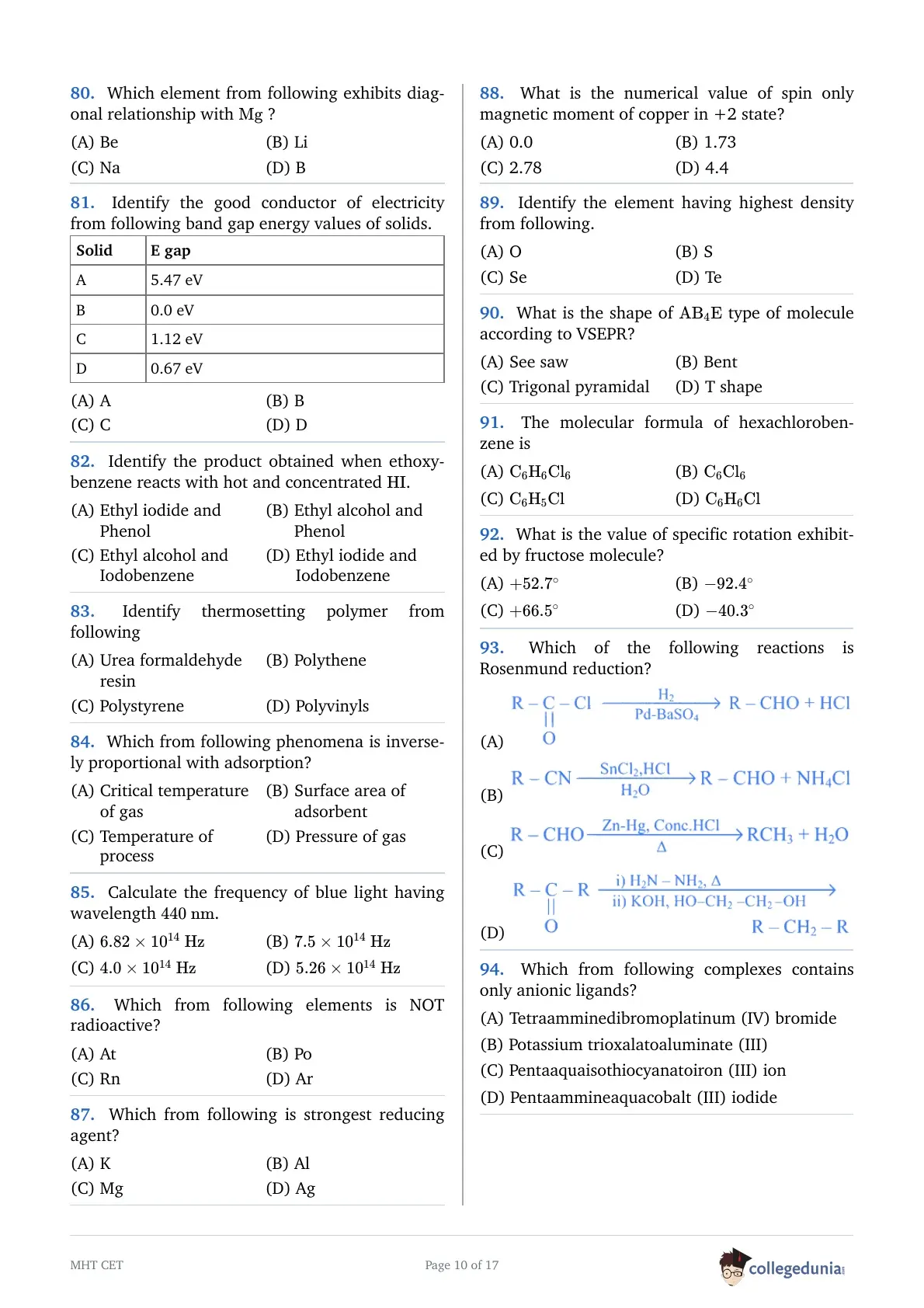
Which element from following exhibits diagonal relationship with \[\mathrm{Mg}\] ?
Identify the good conductor of electricity from following band gap energy values of solids.
| Solid | E gap |
|---|---|
| A | 5.47 eV |
| B | 0.0 eV |
| C | 1.12 eV |
| D | 0.67 eV |
Identify the product obtained when ethoxybenzene reacts with hot and concentrated \[\mathrm{HI}\].
Which from following phenomena is inversely proportional with adsorption?
Calculate the frequency of blue light having wavelength \[440 \mathrm{~nm}\].
What is the numerical value of spin only magnetic moment of copper in +2 state?
What is the shape of \[\mathrm{AB}_4 \mathrm{E}\] type of molecule according to VSEPR?
What is the value of specific rotation exhibited by fructose molecule?
Which of the following reactions is Rosenmund reduction?
- (A)
![]()
- (B)
![]()
- (C)
![]()
- (D)
![]()


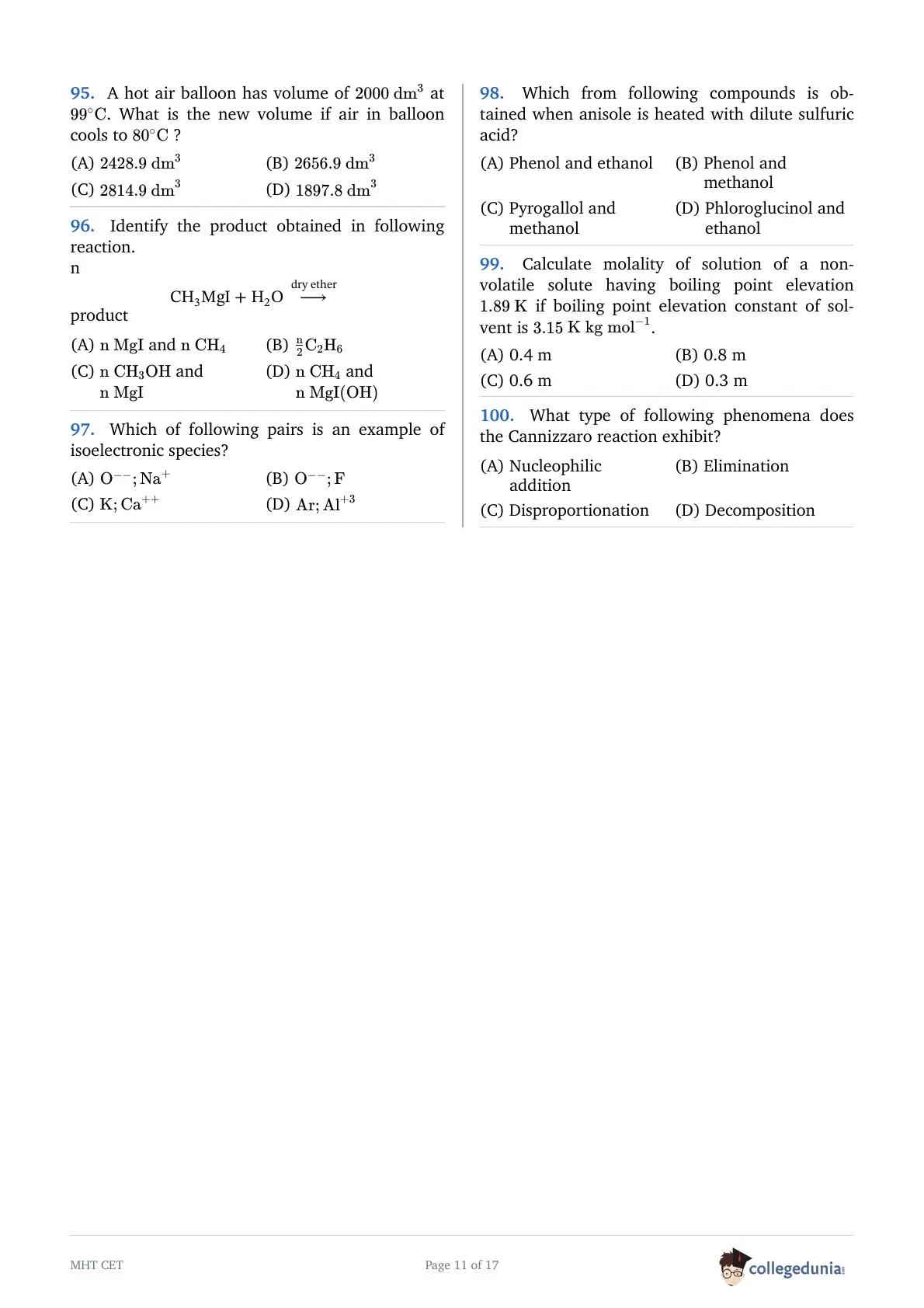
A hot air balloon has volume of \[2000 \mathrm{~dm}^3\] at \[99^{\circ} \mathrm{C}\]. What is the new volume if air in balloon cools to \[80^{\circ} \mathrm{C}\] ?
Identify the product obtained in following reaction.
n \[\mathrm{CH}_3 \mathrm{MgI}+\mathrm{H}_2 \mathrm{O} \stackrel{\text { dry ether }}{\longrightarrow}\] product
Which from following compounds is obtained when anisole is heated with dilute sulfuric acid?
Calculate molality of solution of a nonvolatile solute having boiling point elevation \[1.89 \mathrm{~K}\] if boiling point elevation constant of solvent is \[3.15 \mathrm{~K} \mathrm{~kg} \mathrm{~mol}^{-1}\].
What type of following phenomena does the Cannizzaro reaction exhibit?
Mathematics (Q101 - Q150)
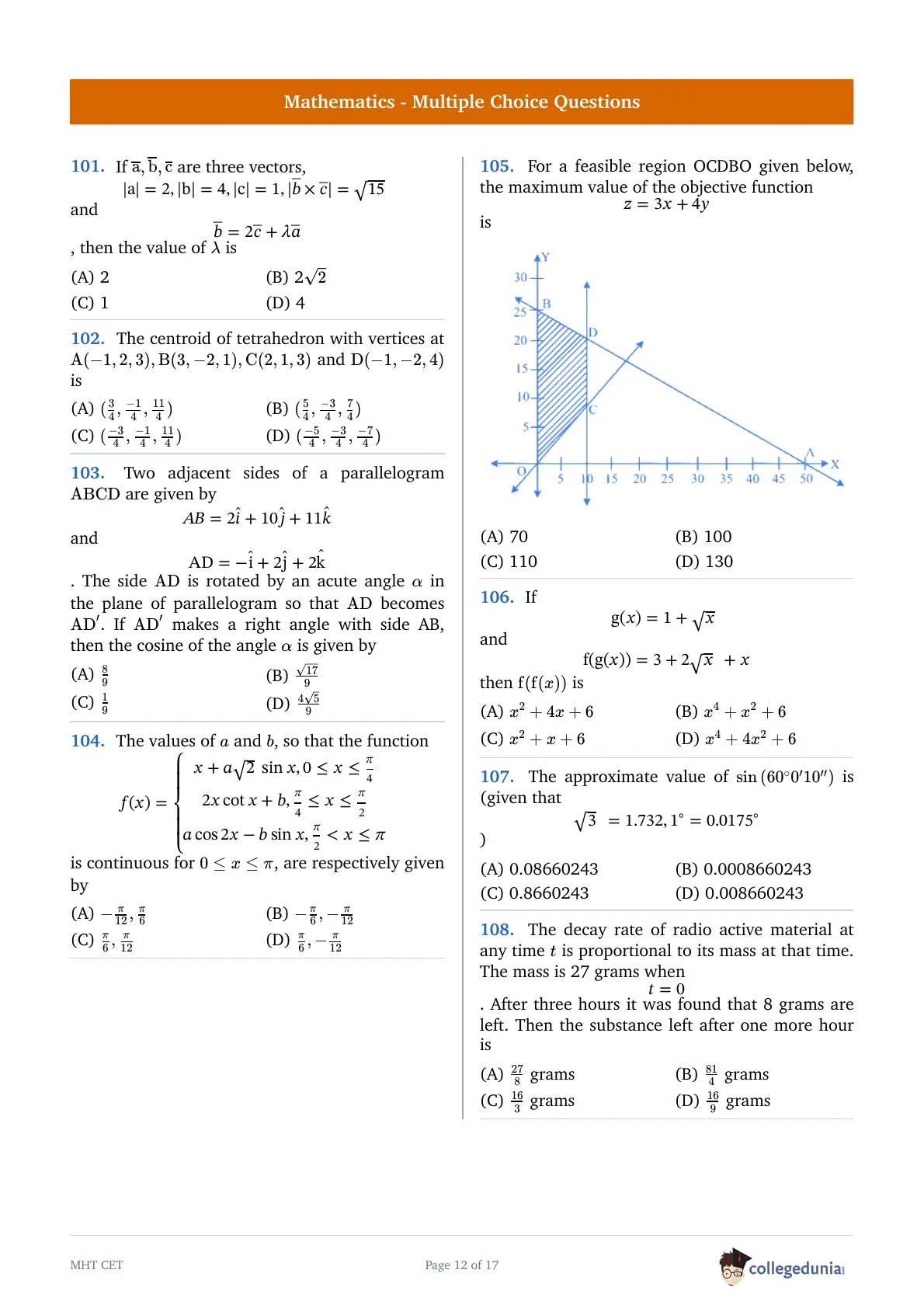
If \[\overline{\mathrm{a}}, \overline{\mathrm{b}}, \overline{\mathrm{c}}\] are three vectors, \[|\overline{\mathrm{a}}|=2,|\overline{\mathrm{b}}|=4,|\overline{\mathrm{c}}|=1, |\bar{b} \times \bar{c}|=\sqrt{15}\] and \[\bar{b}=2 \bar{c}+\lambda \bar{a}\], then the value of \[\lambda\] is
The centroid of tetrahedron with vertices at \[\mathrm{A}(-1,2,3), \mathrm{B}(3,-2,1), \mathrm{C}(2,1,3)\] and \[\mathrm{D}(-1,-2,4)\] is
Two adjacent sides of a parallelogram \[\mathrm{ABCD}\] are given by \[\overline{A B}=2 \hat{i}+10 \hat{j}+11 \hat{k}\] and \[\overline{\mathrm{AD}}=-\hat{\mathrm{i}}+2 \hat{\mathrm{j}}+2 \hat{\mathrm{k}}\]. The side \[\mathrm{AD}\] is rotated by an acute angle \[\alpha\] in the plane of parallelogram so that \[\mathrm{AD}\] becomes \[\mathrm{AD}^{\prime}\]. If \[\mathrm{AD}^{\prime}\] makes a right angle with side AB, then the cosine of the angle \[\alpha\] is given by
The values of \(a\) and \(b\), so that the function
\(f(x)=\left\{\begin{array}{l} x+a \sqrt{2} \sin x, 0 \leq x \leq \frac{\pi}{4} \\ 2 x \cot x+b, \frac{\pi}{4} \leq x \leq \frac{\pi}{2} \\ a \cos 2 x-b \sin x, \frac{\pi}{2} < x \leq \pi \end{array}\right.\)
is continuous for \(0 \leq x \leq \pi\), are respectively given by
For a feasible region OCDBO given below, the maximum value of the objective function \[z=3 x+4 y\] is

If \[\mathrm{g}(x)=1+\sqrt{x}\] and \[\mathrm{f}(\mathrm{g}(x))=3+2 \sqrt{x}+x\] then \[\mathrm{f}(\mathrm{f}(x))\] is
The approximate value of \[\sin \left(60^{\circ} 0^{\prime} 10^{\prime \prime}\right)\] is (given that \[\sqrt{3}=1.732,1^{\circ}=0.0175^{\circ}\] )
The decay rate of radio active material at any time \[t\] is proportional to its mass at that time. The mass is 27 grams when \[t=0\]. After three hours it was found that 8 grams are left. Then the substance left after one more hour is
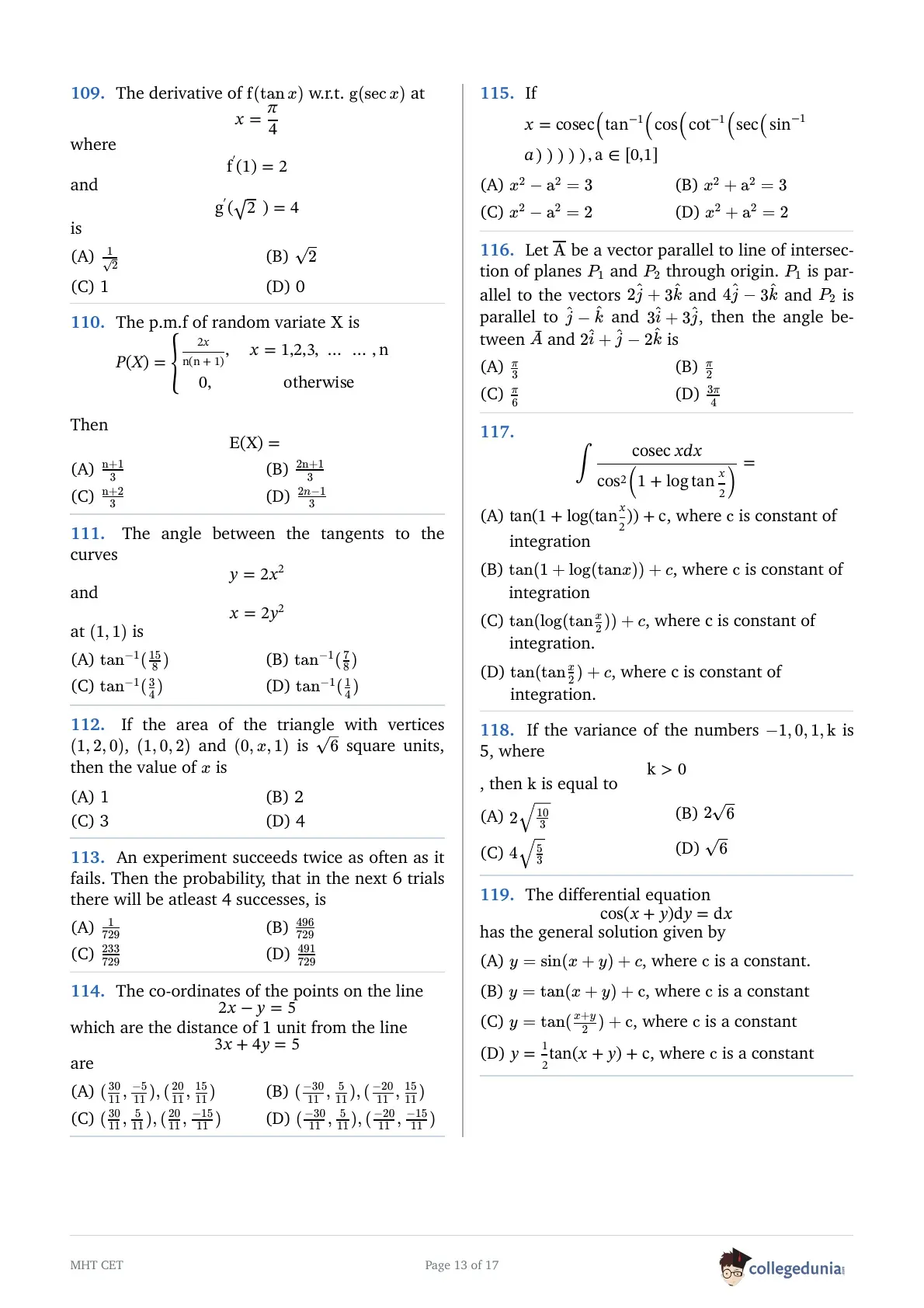
The derivative of \[\mathrm{f}(\tan x)\] w.r.t. \[\mathrm{g}(\sec x)\] at \[x=\frac{\pi}{4}\] where \[\mathrm{f}^{\prime}(1)=2\] and \[\mathrm{g}^{\prime}(\sqrt{2})=4\] is
The p.m.f of random variate \[\mathrm{X}\] is \[P(X)= \begin{cases}\frac{2 x}{\mathrm{n}(\mathrm{n}+1)}, & x=1,2,3, \ldots \ldots, \mathrm{n} \\ 0, & \text { otherwise }\end{cases}\]
Then \[\mathrm{E}(\mathrm{X})=\]
The angle between the tangents to the curves \[y=2 x^2\] and \[x=2 y^2\] at \[(1,1)\] is
If the area of the triangle with vertices \[(1,2,0)\], \[(1,0,2)\] and \[(0, x, 1)\] is \[\sqrt{6}\] square units, then the value of \(x\) is
An experiment succeeds twice as often as it fails. Then the probability, that in the next 6 trials there will be atleast 4 successes, is
The co-ordinates of the points on the line \[2 x-y=5\] which are the distance of 1 unit from the line \[3 x+4 y=5\] are
If \[x=\operatorname{cosec}\left(\tan ^{-1}\left(\cos \left(\cot ^{-1}\left(\sec \left(\sin ^{-1} a\right)\right)\right)\right)\right), \mathrm{a} \in[0,1]\]
Let \[\overline{\mathrm{A}}\] be a vector parallel to line of intersection of planes \[P_1\] and \[P_2\] through origin. \[P_1\] is parallel to the vectors \[2 \hat{j}+3 \hat{k}\] and \[4 \hat{j}-3 \hat{k}\] and \[P_2\] is parallel to \[\hat{j}-\hat{k}\] and \[3 \hat{i}+3 \hat{j}\], then the angle between \[\bar{A}\] and \[2 \hat{i}+\hat{j}-2 \hat{k}\] is
\[\int \frac{\operatorname{cosec} x d x}{\cos ^2\left(1+\log \tan \frac{x}{2}\right)}=\]
If the variance of the numbers \[-1,0,1, \mathrm{k}\] is 5, where \[\mathrm{k} > 0\], then \[\mathrm{k}\] is equal to
The differential equation \[\cos (x+y) \mathrm{d} y=\mathrm{d} x\] has the general solution given by
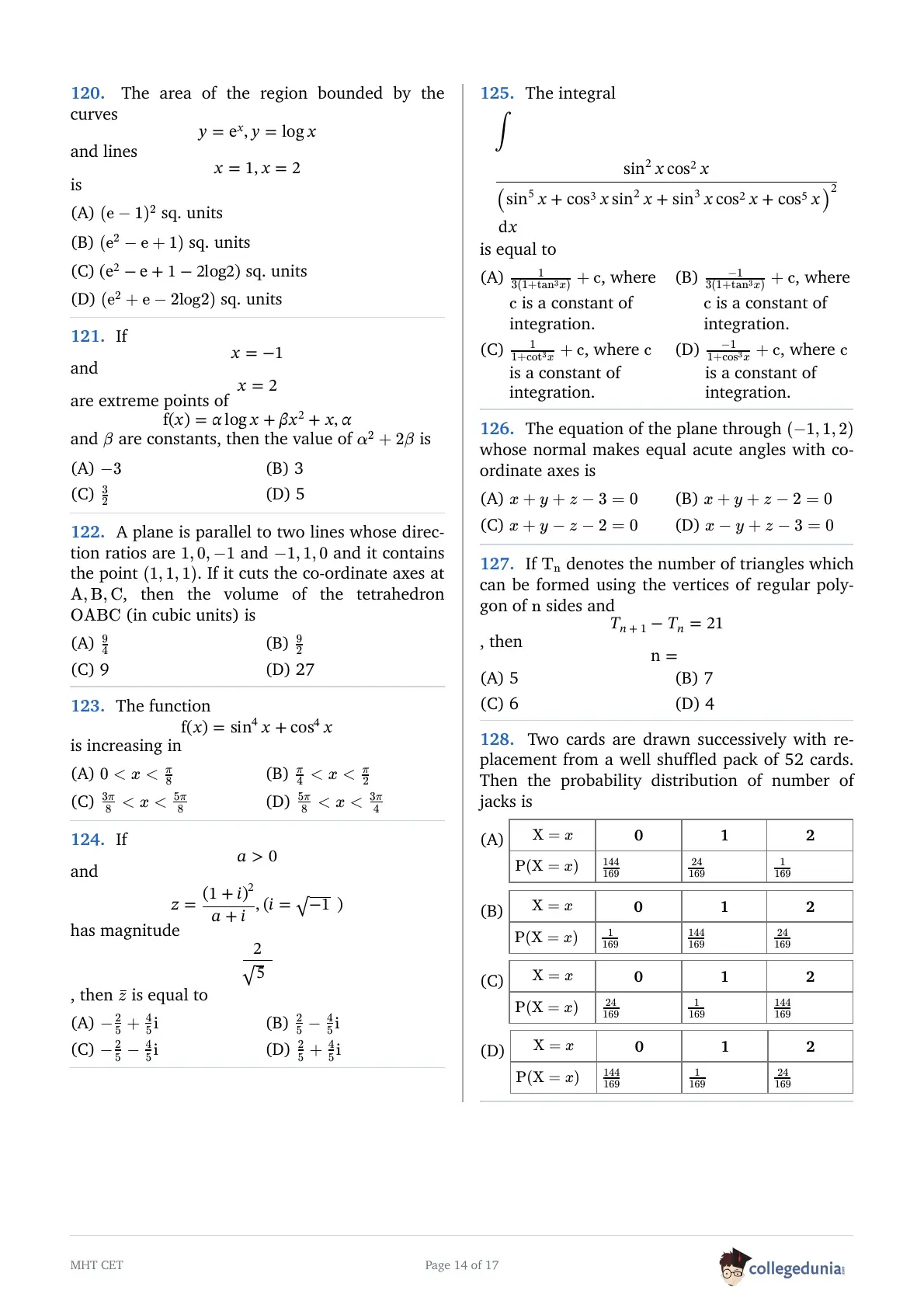
The area of the region bounded by the curves \[y=\mathrm{e}^x, y=\log x\] and lines \[x=1, x=2\] is
If \[x=-1\] and \[x=2\] are extreme points of \[\mathrm{f}(x)=\alpha \log x+\beta x^2+x, \alpha\] and \[\beta\] are constants, then the value of \[\alpha^2+2 \beta\] is
A plane is parallel to two lines whose direction ratios are \[1,0,-1\] and \[-1,1,0\] and it contains the point \[(1,1,1)\]. If it cuts the co-ordinate axes at \[\mathrm{A}, \mathrm{B}, \mathrm{C}\], then the volume of the tetrahedron \[\mathrm{OABC}\] (in cubic units) is
If \[a > 0\] and \[z=\frac{(1+i)^2}{a+i},(i=\sqrt{-1})\] has magnitude \[\frac{2}{\sqrt{5}}\], then \[\bar{z}\] is equal to
The integral \[\int \frac{\sin ^2 x \cos ^2 x}{\left(\sin ^5 x+\cos ^3 x \sin ^2 x+\sin ^3 x \cos ^2 x+\cos ^5 x\right)^2} \mathrm{~d} x\] is equal to
The equation of the plane through \[(-1,1,2)\] whose normal makes equal acute angles with co-ordinate axes is
If \[\mathrm{T}_{\mathrm{n}}\] denotes the number of triangles which can be formed using the vertices of regular polygon of \[\mathrm{n}\] sides and \[T_{n+1}-T_n=21\], then \[\mathrm{n}=\]
Two cards are drawn successively with replacement from a well shuffled pack of 52 cards. Then the probability distribution of number of jacks is
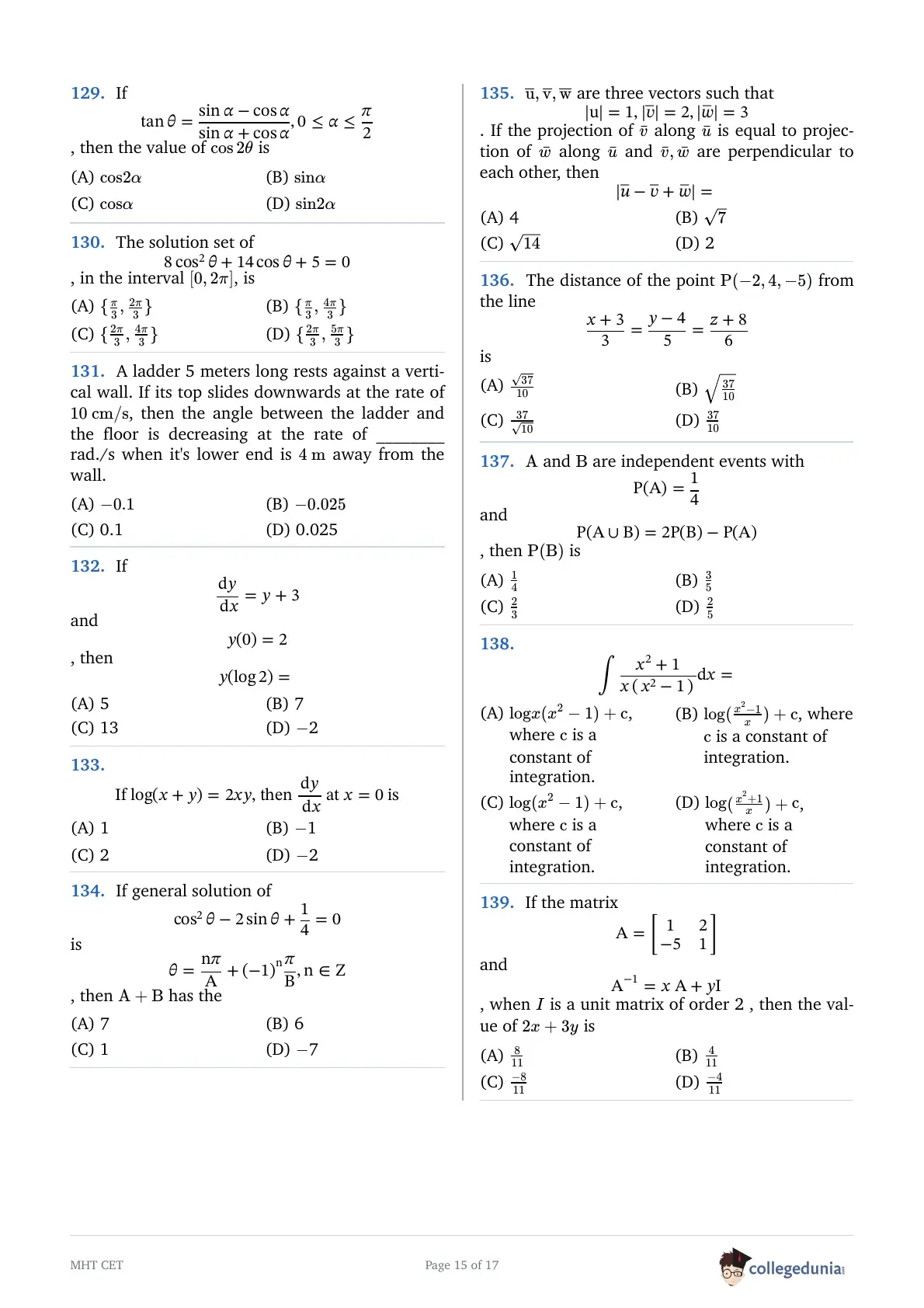
If \[\tan \theta=\frac{\sin \alpha-\cos \alpha}{\sin \alpha+\cos \alpha}, 0 \leq \alpha \leq \frac{\pi}{2}\], then the value of \[\cos 2 \theta\] is
The solution set of \[8 \cos ^2 \theta+14 \cos \theta+5=0\], in the interval \[[0,2 \pi]\], is
A ladder 5 meters long rests against a vertical wall. If its top slides downwards at the rate of \[10 \mathrm{~cm} / \mathrm{s}\], then the angle between the ladder and the floor is decreasing at the rate of ________ rad./s when it's lower end is \[4 \mathrm{~m}\] away from the wall.
If \[\frac{\mathrm{d} y}{\mathrm{~d} x}=y+3\] and \[y(0)=2\], then \[y(\log 2)=\]
\[\text { If } \log (x+y)=2 x y \text {, then } \frac{\mathrm{d} y}{\mathrm{~d} x} \text { at } x=0 \text { is }\]
If general solution of \[\cos ^2 \theta-2 \sin \theta+\frac{1}{4}=0\] is \[\theta=\frac{\mathrm{n} \pi}{\mathrm{A}}+(-1)^{\mathrm{n}} \frac{\pi}{\mathrm{B}}, \mathrm{n} \in \mathrm{Z}\], then \[\mathrm{A}+\mathrm{B}\] has the
\[\overline{\mathrm{u}}, \overline{\mathrm{v}}, \overline{\mathrm{w}}\] are three vectors such that \[|\overline{\mathrm{u}}|=1, |\bar{v}|=2,|\bar{w}|=3\]. If the projection of \[\bar{v}\] along \[\bar{u}\] is equal to projection of \[\bar{w}\] along \[\bar{u}\] and \[\bar{v}, \bar{w}\] are perpendicular to each other, then \[|\bar{u}-\bar{v}+\bar{w}|=\]
The distance of the point \[\mathrm{P}(-2,4,-5)\] from the line \[\frac{x+3}{3}=\frac{y-4}{5}=\frac{z+8}{6}\] is
\[\mathrm{A}\] and \[\mathrm{B}\] are independent events with \[\mathrm{P}(\mathrm{A})=\frac{1}{4}\] and \[\mathrm{P}(\mathrm{A} \cup \mathrm{B})=2 \mathrm{P}(\mathrm{B})-\mathrm{P}(\mathrm{A})\], then \[\mathrm{P}(\mathrm{B})\] is
If the matrix \[\mathrm{A}=\left[\begin{array}{cc}1 & 2 \\ -5 & 1\end{array}\right]\] and \[\mathrm{A}^{-1}=x \mathrm{~A}+y \mathrm{I}\], when \[I\] is a unit matrix of order 2 , then the value of \[2 x+3 y\] is
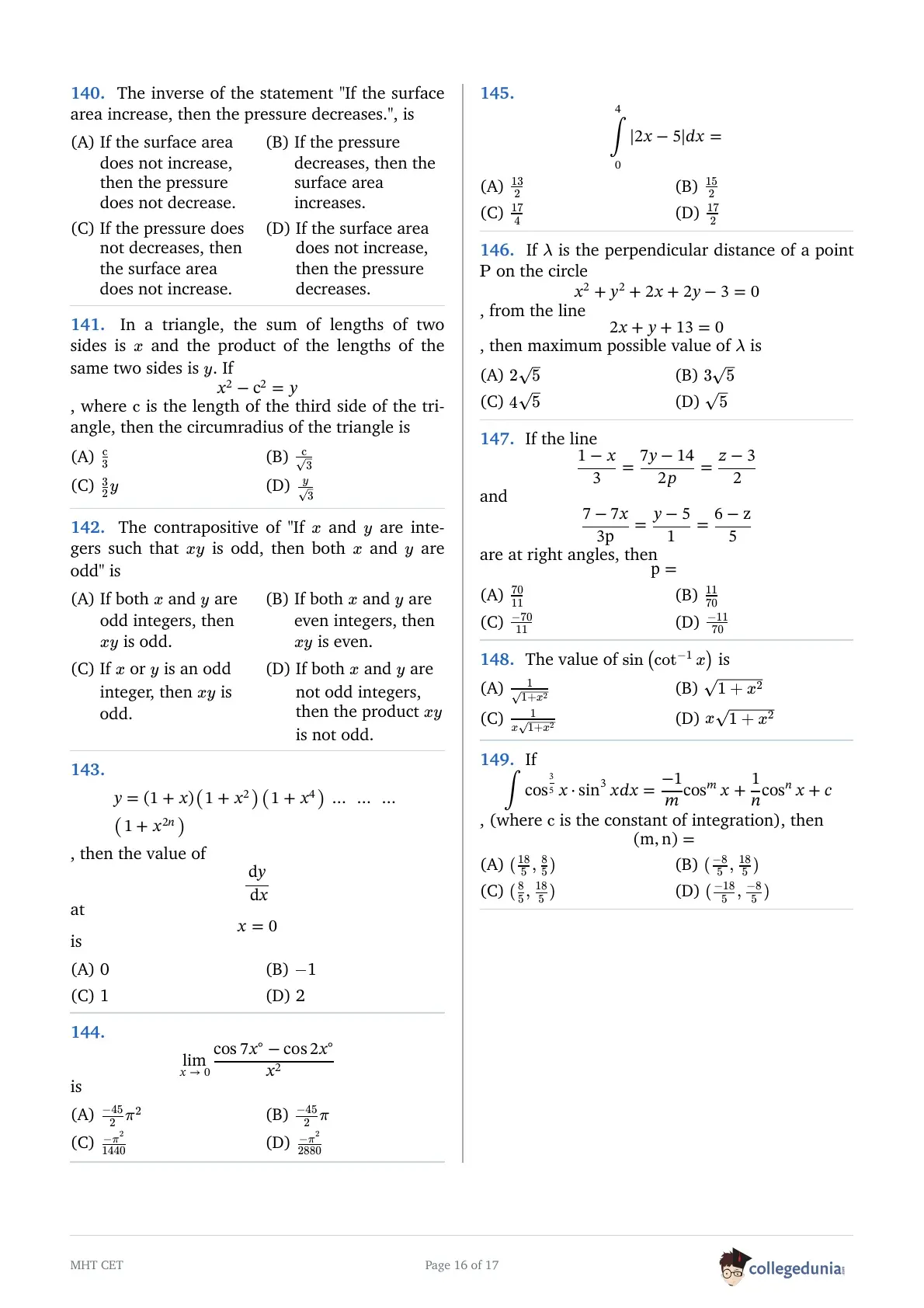
The inverse of the statement "If the surface area increase, then the pressure decreases.", is
In a triangle, the sum of lengths of two sides is \[x\] and the product of the lengths of the same two sides is \[y\]. If \[x^2-\mathrm{c}^2=y\], where \[\mathrm{c}\] is the length of the third side of the triangle, then the circumradius of the triangle is
The contrapositive of "If \[x\] and \[y\] are integers such that \[x y\] is odd, then both \[x\] and \[y\] are odd" is
\[y=(1+x)\left(1+x^2\right)\left(1+x^4\right) \ldots \ldots \ldots\left(1+x^{2 n}\right)\], then the value of \[\frac{\mathrm{d} y}{\mathrm{~d} x}\] at \[x=0\] is
\[\lim _\limits{x \rightarrow 0} \frac{\cos 7 x^{\circ}-\cos 2 x^{\circ}}{x^2}\] is
If \[\lambda\] is the perpendicular distance of a point \[\mathrm{P}\] on the circle \[x^2+y^2+2 x+2 y-3=0\], from the line \[2 x+y+13=0\], then maximum possible value of \[\lambda\] is
If the line \[\frac{1-x}{3}=\frac{7 y-14}{2 p}=\frac{z-3}{2}\] and \[\frac{7-7 x}{3 \mathrm{p}}=\frac{y-5}{1}=\frac{6-\mathrm{z}}{5}\] are at right angles, then \[\mathrm{p}=\]
If \[\int \cos ^{\frac{3}{5}} x \cdot \sin ^3 x d x=\frac{-1}{m} \cos ^m x+\frac{1}{n} \cos ^n x+c\], (where \[\mathrm{c}\] is the constant of integration), then \[(\mathrm{m}, \mathrm{n})=\]
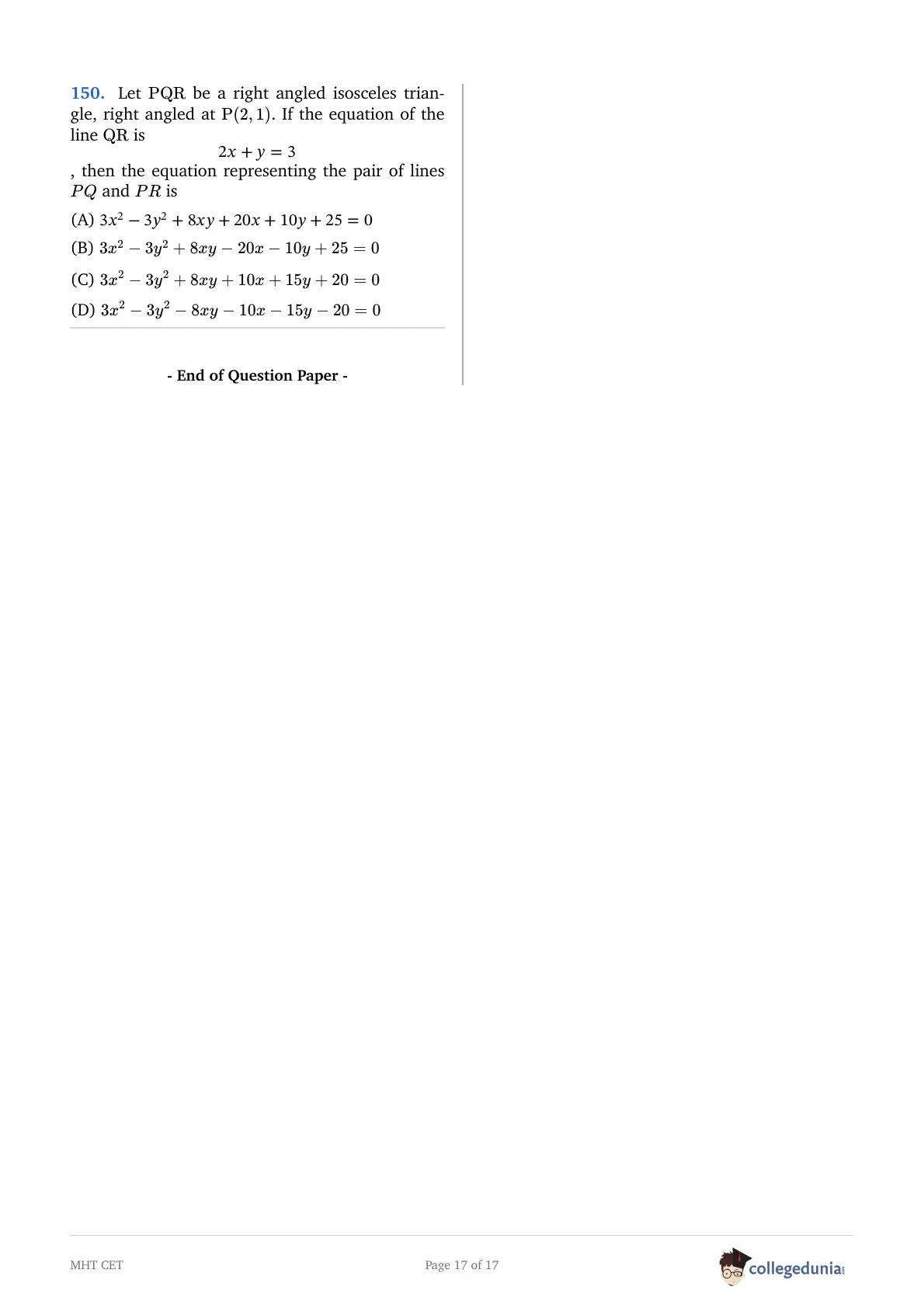
Let \[\mathrm{PQR}\] be a right angled isosceles triangle, right angled at \[\mathrm{P}(2,1)\]. If the equation of the line \[\mathrm{QR}\] is \[2 x+y=3\], then the equation representing the pair of lines \[P Q\] and \[P R\] is
MHT CET 2023 PCM Exam Pattern and Marking Scheme
| Parameter | Details |
|---|---|
| Conducting Body | Maharashtra Common Entrance Test Cell (Maharashtra CET Cell) |
| Exam Mode | Online (Computer-Based Test) |
| Duration | 180 minutes (3 hours) |
| Groups / Subjects | PCM (Physics, Chemistry, Mathematics) for Engineering |
| Total Questions |
150 |
| Total Marks | 200 |
| Question Type | Multiple Choice Questions (MCQs) |
| Marks Distribution |
|
| Negative Marking | No |
| Syllabus Weightage |
|



Comments