




MHT CET 2023 May 12 Shift 2 PCM Question Paper is available for download here. Maharashtra State CET Cell conducted MHT CET 2023 PCM Exam on May 12 in Shift 2 from 2 PM to 5 PM in CBT mode.
The MHT CET 2023 PCM question paper includes the following:
- The MHT CET 2023 PCM Question Paper consists of 150 multiple-choice questions (MCQs) totalling 200 marks divided into 3 sections: Physics, Chemistry, and Mathematics, with 50 questions in each subject.
- Physics and Chemistry questions carry 1 mark each while Mathematics questions carry 2 marks each.
- There is no negative marking for incorrect answers.
MHT CET 2023 May 12 Shift 2 PCM Question Paper with Solution PDF
| CD PDF | CD PDF with Solutions |
|---|---|
| Download Collegedunia PDF 1.10 MB | - |
Also Check:
MHT CET 2023 May 12 Shift 2 PCM Questions with Solutions
Physics (Q1 - Q50)
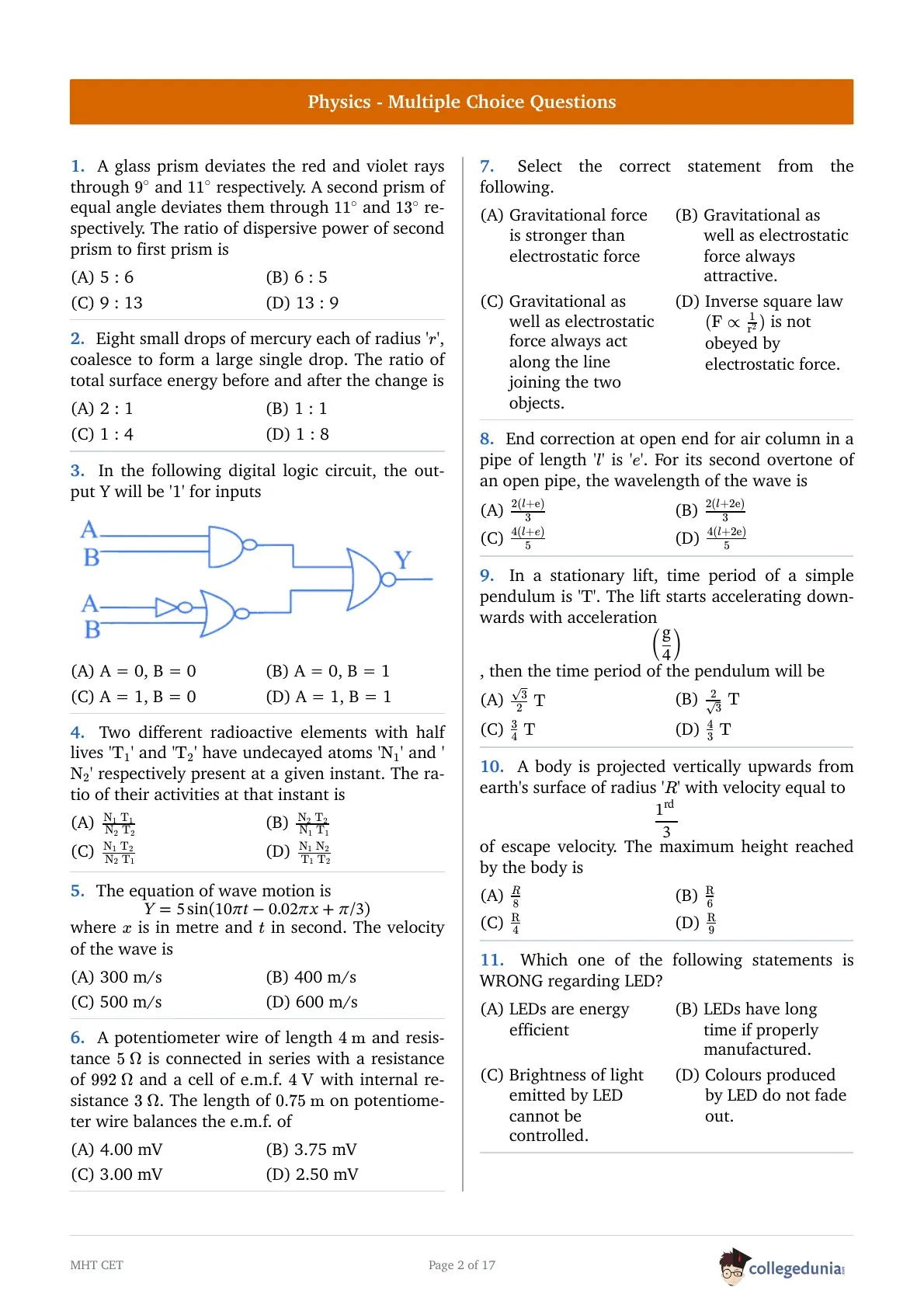
A glass prism deviates the red and violet rays through \[9^{\circ}\] and \[11^{\circ}\] respectively. A second prism of equal angle deviates them through \[11^{\circ}\] and \[13^{\circ}\] respectively. The ratio of dispersive power of second prism to first prism is
Eight small drops of mercury each of radius '\[r\]', coalesce to form a large single drop. The ratio of total surface energy before and after the change is
In the following digital logic circuit, the output Y will be '1' for inputs

Two different radioactive elements with half lives '\[\mathrm{T}_1\]' and '\[\mathrm{T}_2\]' have undecayed atoms '\[\mathrm{N}_1\]' and '\[\mathrm{N}_2\]' respectively present at a given instant. The ratio of their activities at that instant is
The equation of wave motion is \[Y=5 \sin (10 \pi t -0.02 \pi x+\pi / 3)\] where \[x\] is in metre and \[t\] in second. The velocity of the wave is
A potentiometer wire of length \[4 \mathrm{~m}\] and resistance \[5 ~\Omega\] is connected in series with a resistance of \[992 ~\Omega\] and a cell of e.m.f. \[4 \mathrm{~V}\] with internal resistance \[3 ~\Omega\]. The length of \[0.75 \mathrm{~m}\] on potentiometer wire balances the e.m.f. of
End correction at open end for air column in a pipe of length '\[l\]' is '\[e\]'. For its second overtone of an open pipe, the wavelength of the wave is
In a stationary lift, time period of a simple pendulum is '\[\mathrm{T}\]'. The lift starts accelerating downwards with acceleration \[\left(\frac{\mathrm{g}}{4}\right)\], then the time period of the pendulum will be
A body is projected vertically upwards from earth's surface of radius '\[R\]' with velocity equal to \[\frac{1^{\text {rd }}}{3}\] of escape velocity. The maximum height reached by the body is
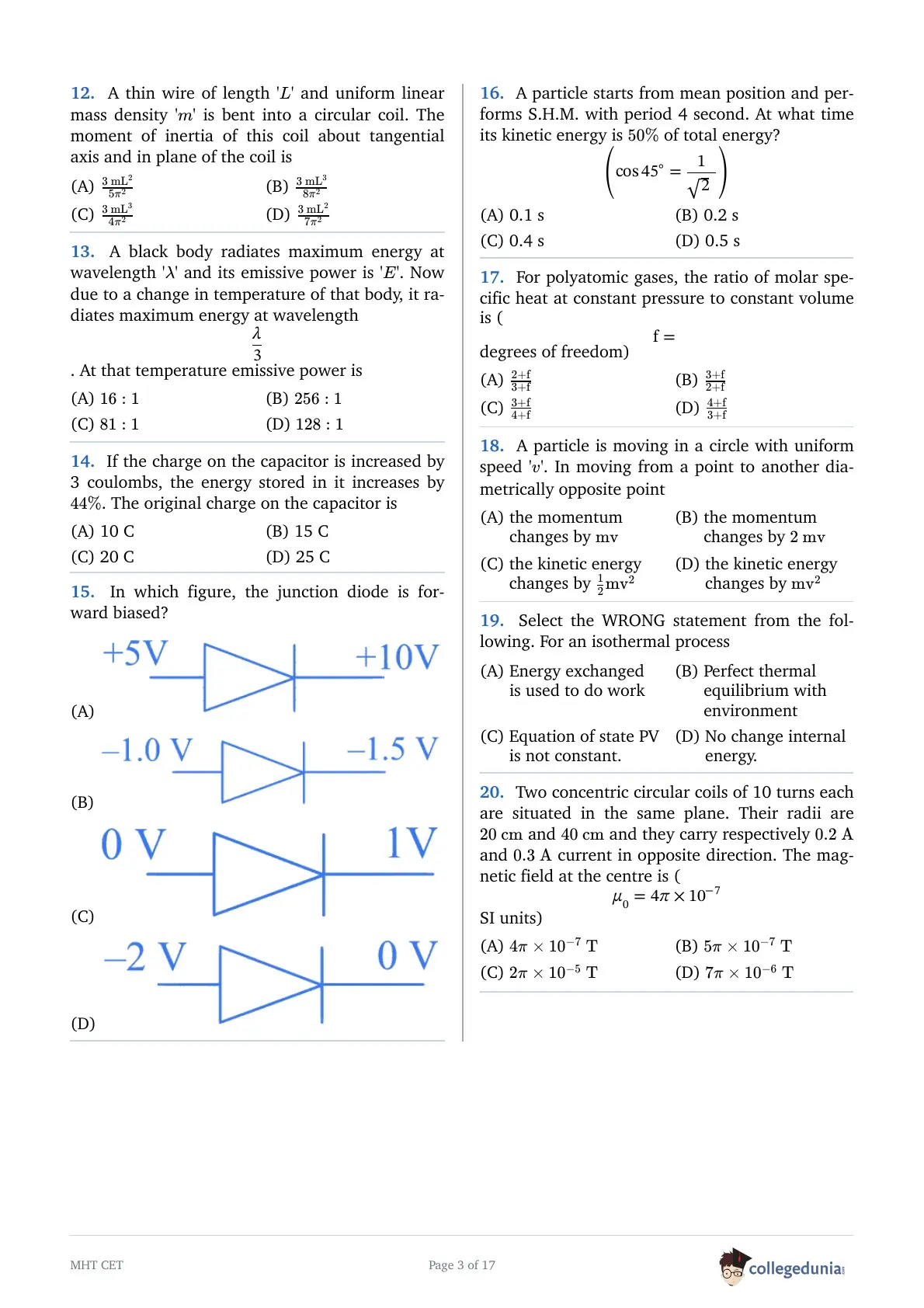
A thin wire of length '\[L\]' and uniform linear mass density '\[m\]' is bent into a circular coil. The moment of inertia of this coil about tangential axis and in plane of the coil is
A black body radiates maximum energy at wavelength '\[\lambda\]' and its emissive power is '\[E\]'. Now due to a change in temperature of that body, it radiates maximum energy at wavelength \[\frac{\lambda}{3}\]. At that temperature emissive power is
If the charge on the capacitor is increased by 3 coulombs, the energy stored in it increases by \[44 \%\]. The original charge on the capacitor is
In which figure, the junction diode is forward biased?
- (A)
![]()
- (B)
![]()
- (C)
![]()
- (D)
![]()


A particle starts from mean position and performs S.H.M. with period 4 second. At what time its kinetic energy is \[50 \%\] of total energy?
\[\left(\cos 45^{\circ}=\frac{1}{\sqrt{2}}\right)\]
For polyatomic gases, the ratio of molar specific heat at constant pressure to constant volume is ( \[\mathrm{f}=\] degrees of freedom)
A particle is moving in a circle with uniform speed '\[v\]'. In moving from a point to another diametrically opposite point
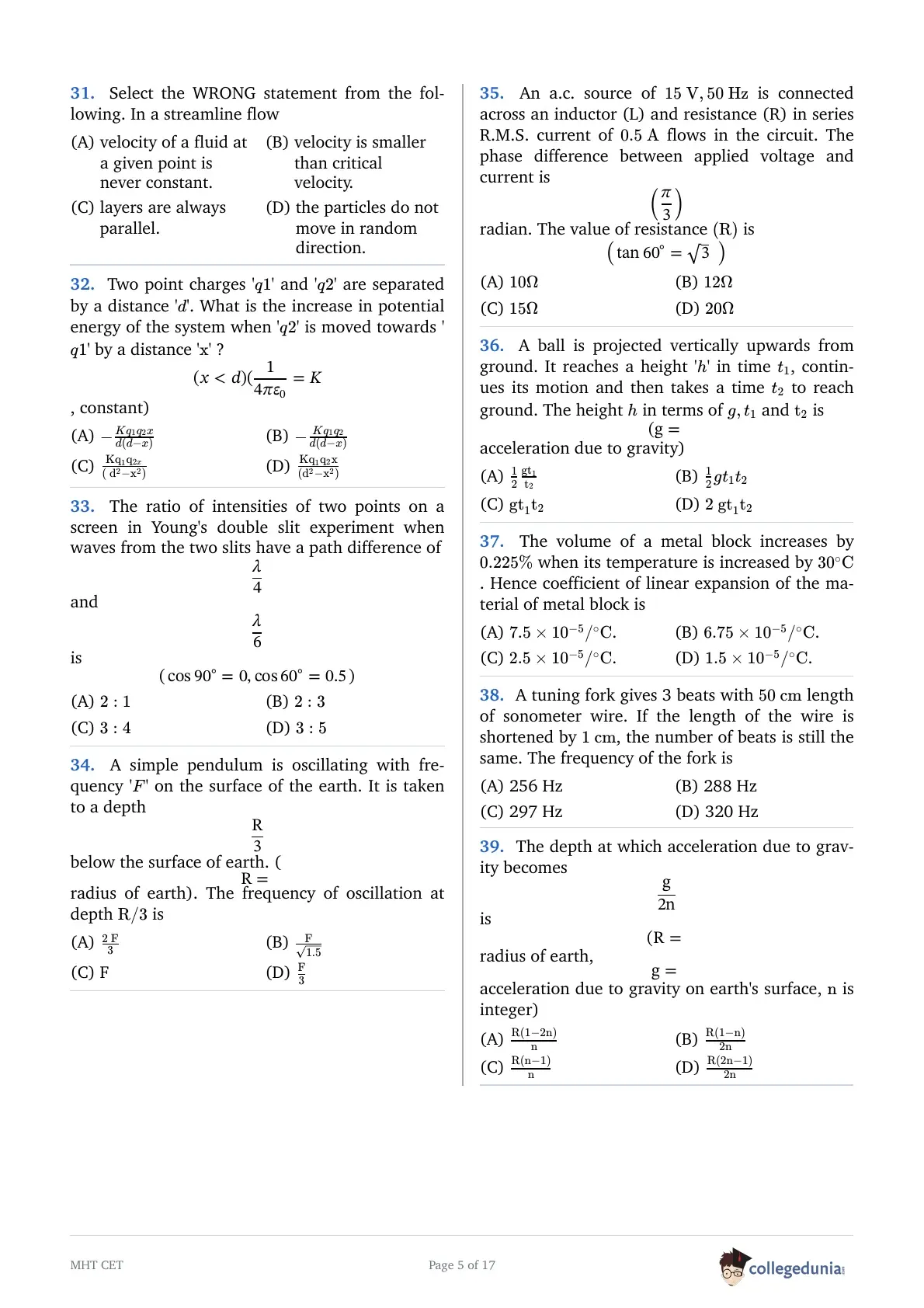
Select the WRONG statement from the following. For an isothermal process
Two concentric circular coils of 10 turns each are situated in the same plane. Their radii are \[20 \mathrm{~cm}\] and \[40 \mathrm{~cm}\] and they carry respectively \[0.2 \mathrm{~A}\] and \[0.3 \mathrm{~A}\] current in opposite direction. The magnetic field at the centre is (\[\mu_0=4 \pi \times 10^{-7}\] SI units)
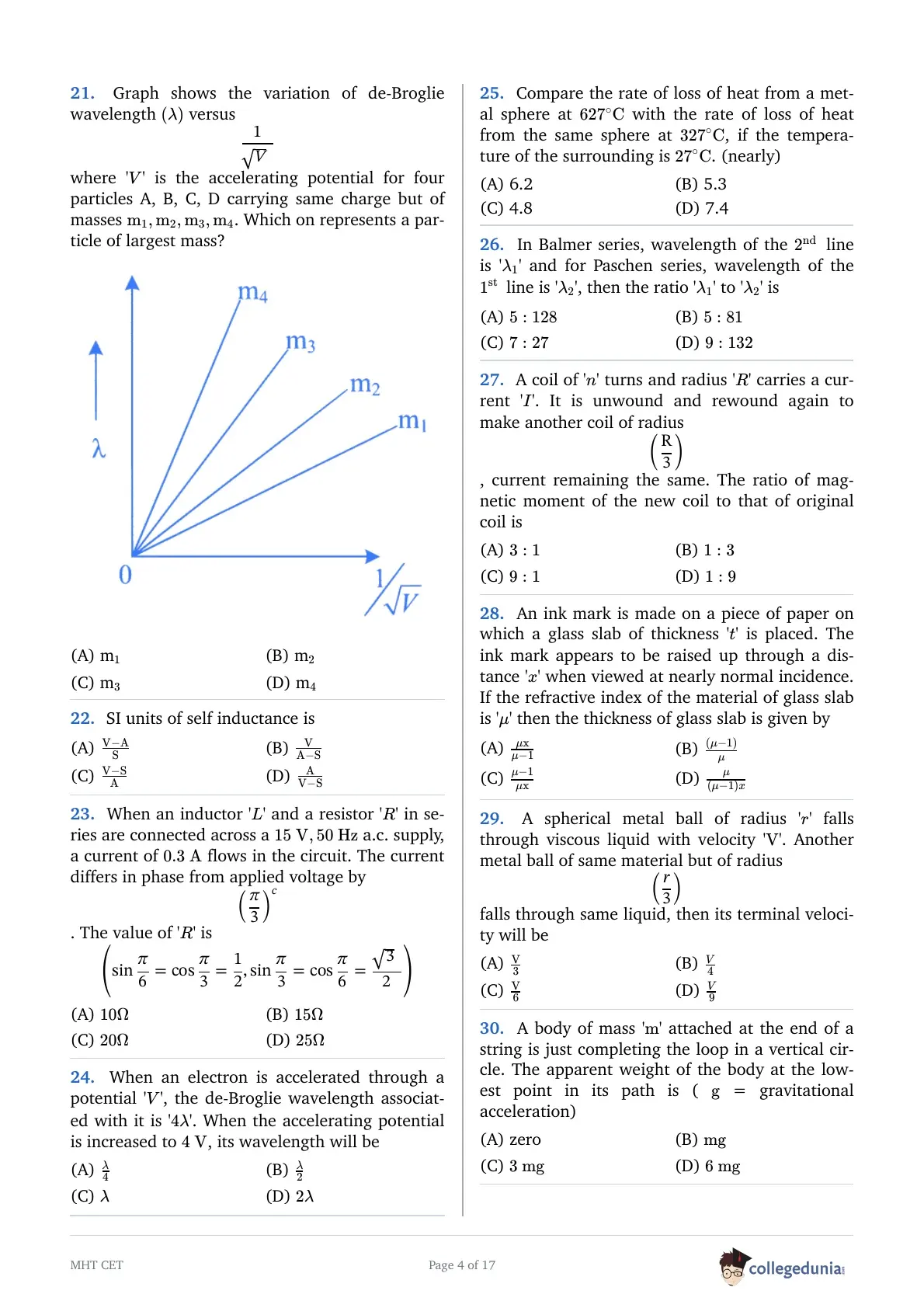
Graph shows the variation of de-Broglie wavelength \[(\lambda)\] versus \[\frac{1}{\sqrt{V}}\] where '\[V\]' is the accelerating potential for four particles A, B, C, D carrying same charge but of masses \[\mathrm{m_1, m_2, m_3, m_4}\]. Which on represents a particle of largest mass?

When an inductor '\[L\]' and a resistor '\[R\]' in series are connected across a \[15 \mathrm{~V}, 50 \mathrm{~Hz}\] a.c. supply, a current of \[0.3 \mathrm{~A}\] flows in the circuit. The current differs in phase from applied voltage by \[\left(\frac{\pi}{3}\right)^c\]. The value of '\[R\]' is \[\left(\sin \frac{\pi}{6}=\cos \frac{\pi}{3}=\frac{1}{2}, \sin \frac{\pi}{3}=\cos \frac{\pi}{6}=\frac{\sqrt{3}}{2}\right)\]
When an electron is accelerated through a potential '\[V\]', the de-Broglie wavelength associated with it is '\[4 \lambda\]'. When the accelerating potential is increased to \[4 \mathrm{~V}\], its wavelength will be
Compare the rate of loss of heat from a metal sphere at \[627^{\circ} \mathrm{C}\] with the rate of loss of heat from the same sphere at \[327^{\circ} \mathrm{C}\], if the temperature of the surrounding is \[27^{\circ} \mathrm{C}\]. (nearly)
In Balmer series, wavelength of the \[2^{\text {nd }}\] line is '\[\lambda_1\]' and for Paschen series, wavelength of the \[1^{\text {st }}\] line is '\[\lambda_2\]', then the ratio '\[\lambda_1\]' to '\[\lambda_2\]' is
A coil of '\[n\]' turns and radius '\[R\]' carries a current '\[I\]'. It is unwound and rewound again to make another coil of radius \[\left(\frac{\mathrm{R}}{3}\right)\], current remaining the same. The ratio of magnetic moment of the new coil to that of original coil is
An ink mark is made on a piece of paper on which a glass slab of thickness '\[t\]' is placed. The ink mark appears to be raised up through a distance '\[x\]' when viewed at nearly normal incidence. If the refractive index of the material of glass slab is '\[\mu\]' then the thickness of glass slab is given by
A spherical metal ball of radius '\[r\]' falls through viscous liquid with velocity '\[\mathrm{V}\]'. Another metal ball of same material but of radius \[\left(\frac{r}{3}\right)\] falls through same liquid, then its terminal velocity will be
A body of mass '\[\mathrm{m}\]' attached at the end of a string is just completing the loop in a vertical circle. The apparent weight of the body at the lowest point in its path is ( \[\mathrm{g}\] = gravitational acceleration)
The ratio of intensities of two points on a screen in Young's double slit experiment when waves from the two slits have a path difference of \[\frac{\lambda}{4}\] and \[\frac{\lambda}{6}\] is
\[\left(\cos 90^{\circ}=0, \cos 60^{\circ}=0.5\right)\]
A simple pendulum is oscillating with frequency '\[F\]' on the surface of the earth. It is taken to a depth \[\frac{\mathrm{R}}{3}\] below the surface of earth. ( \[\mathrm{R}=\] radius of earth). The frequency of oscillation at depth \[\mathrm{R} / 3\] is
An a.c. source of \[15 \mathrm{~V}, 50 \mathrm{~Hz}\] is connected across an inductor (L) and resistance (R) in series R.M.S. current of \[0.5 \mathrm{~A}\] flows in the circuit. The phase difference between applied voltage and current is \[\left(\frac{\pi}{3}\right)\] radian. The value of resistance \[(\mathrm{R})\] is \[\left(\tan 60^{\circ}=\sqrt{3}\right)\]
A ball is projected vertically upwards from ground. It reaches a height '\[h\]' in time \[t_1\], continues its motion and then takes a time \[t_2\] to reach ground. The height \(h\) in terms of \[g, t_1\] and \[\mathrm{t}_2\] is \[(\mathrm{g}=\] acceleration due to gravity)
The volume of a metal block increases by \[0.225 \%\] when its temperature is increased by \[30^{\circ} \mathrm{C}\]. Hence coefficient of linear expansion of the material of metal block is
A tuning fork gives 3 beats with \[50 \mathrm{~cm}\] length of sonometer wire. If the length of the wire is shortened by \[1 \mathrm{~cm}\], the number of beats is still the same. The frequency of the fork is
The depth at which acceleration due to gravity becomes \[\frac{\mathrm{g}}{2 \mathrm{n}}\] is \[(\mathrm{R}=\] radius of earth, \[\mathrm{g}=\] acceleration due to gravity on earth's surface, \[\mathrm{n}\] is integer)
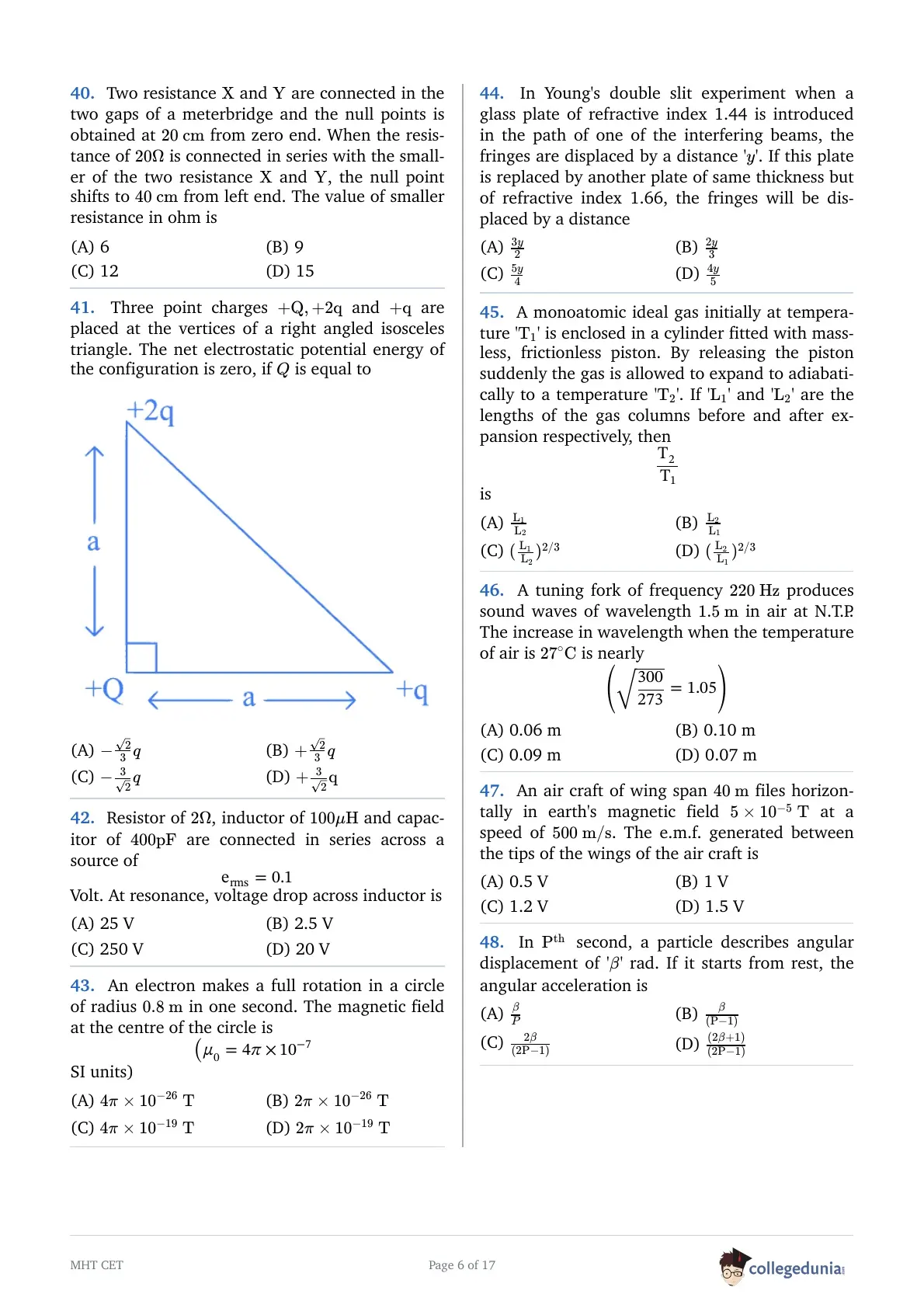
Two resistance \[\mathrm{X}\] and \[\mathrm{Y}\] are connected in the two gaps of a meterbridge and the null points is obtained at \[20 \mathrm{~cm}\] from zero end. When the resistance of \[20 \Omega\] is connected in series with the smaller of the two resistance \[\mathrm{X}\] and \[\mathrm{Y}\], the null point shifts to \[40 \mathrm{~cm}\] from left end. The value of smaller resistance in ohm is
Three point charges \[\mathrm{+Q,+2q}\] and \[+\mathrm{q}\] are placed at the vertices of a right angled isosceles triangle. The net electrostatic potential energy of the configuration is zero, if \[Q\] is equal to

Resistor of \[2\Omega\], inductor of \[100 \mu \mathrm{H}\] and capacitor of \[400 \mathrm{pF}\] are connected in series across a source of \[\mathrm{e}_{\mathrm{rms}}=0.1\] Volt. At resonance, voltage drop across inductor is
An electron makes a full rotation in a circle of radius \[0.8 \mathrm{~m}\] in one second. The magnetic field at the centre of the circle is \[\left(\mu_0=4 \pi \times 10^{-7}\right.\] SI units)
In Young's double slit experiment when a glass plate of refractive index 1.44 is introduced in the path of one of the interfering beams, the fringes are displaced by a distance '\[y\]'. If this plate is replaced by another plate of same thickness but of refractive index 1.66, the fringes will be displaced by a distance
A monoatomic ideal gas initially at temperature '\[\mathrm{T}_1\]' is enclosed in a cylinder fitted with massless, frictionless piston. By releasing the piston suddenly the gas is allowed to expand to adiabatically to a temperature '\[\mathrm{T}_2\]'. If '\[\mathrm{L}_1\]' and '\[\mathrm{L}_2\]' are the lengths of the gas columns before and after expansion respectively, then \[\frac{\mathrm{T}_2}{\mathrm{~T}_1}\] is
A tuning fork of frequency \[220 \mathrm{~Hz}\] produces sound waves of wavelength \[1.5 \mathrm{~m}\] in air at N.T.P. The increase in wavelength when the temperature of air is \[27^{\circ} \mathrm{C}\] is nearly \[\left(\sqrt{\frac{300}{273}}=1.05\right)\]
An air craft of wing span \[40 \mathrm{~m}\] files horizontally in earth's magnetic field \[5 \times 10^{-5} \mathrm{~T}\] at a speed of \[500 \mathrm{~m} / \mathrm{s}\]. The e.m.f. generated between the tips of the wings of the air craft is
In \[\mathrm{P}^{\text {th }}\] second, a particle describes angular displacement of '\[\beta\]' rad. If it starts from rest, the angular acceleration is
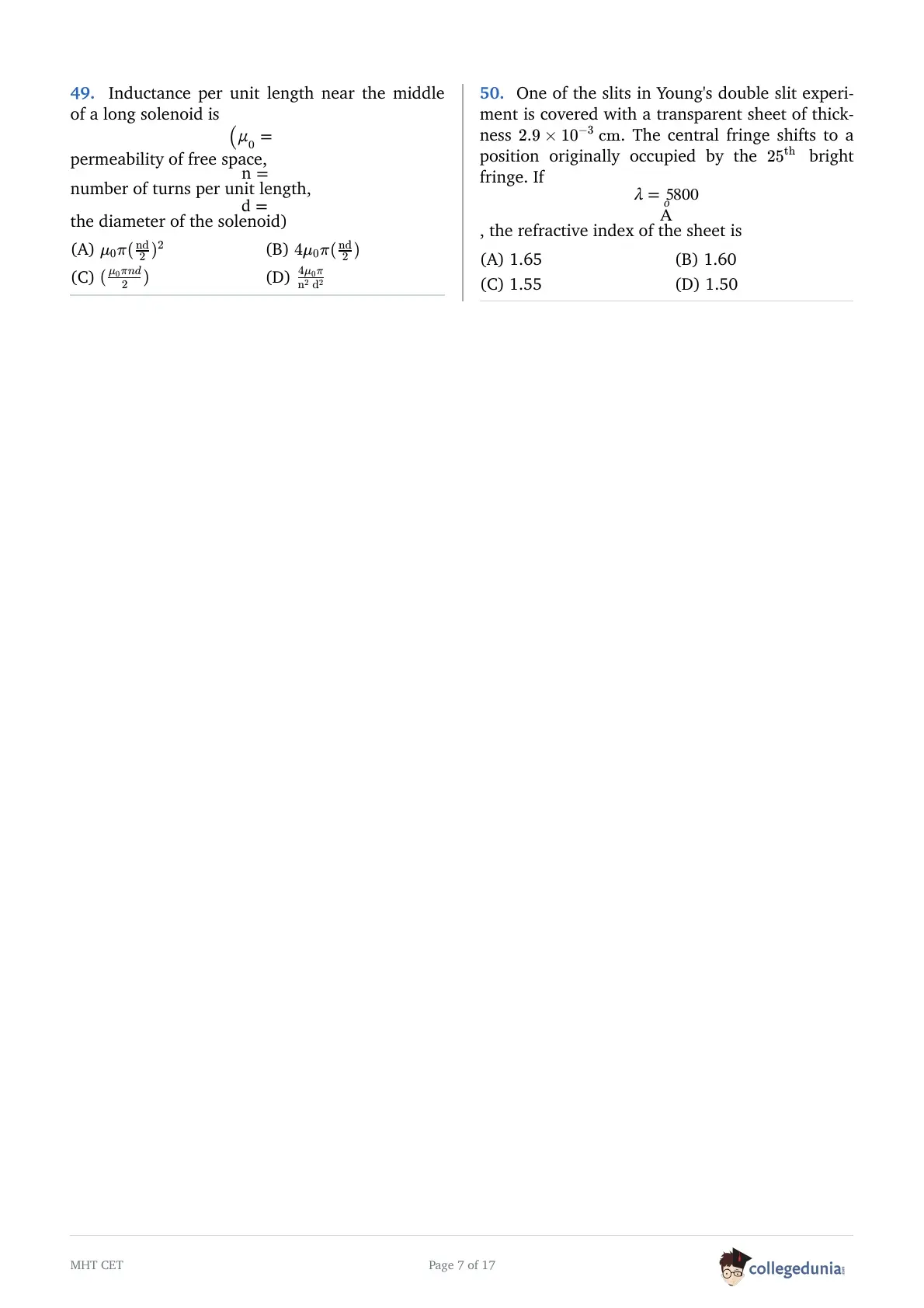
Inductance per unit length near the middle of a long solenoid is \[\left(\mu_0=\right.\] permeability of free space, \[\mathrm{n}=\] number of turns per unit length, \[\mathrm{d}=\] the diameter of the solenoid)
One of the slits in Young's double slit experiment is covered with a transparent sheet of thickness \[2.9 \times 10^{-3} \mathrm{~cm}\]. The central fringe shifts to a position originally occupied by the \[25^{\text {th }}\] bright fringe. If \[\lambda=5800\] \[\mathop A\limits^o \], the refractive index of the sheet is
Chemistry (Q51 - Q100)
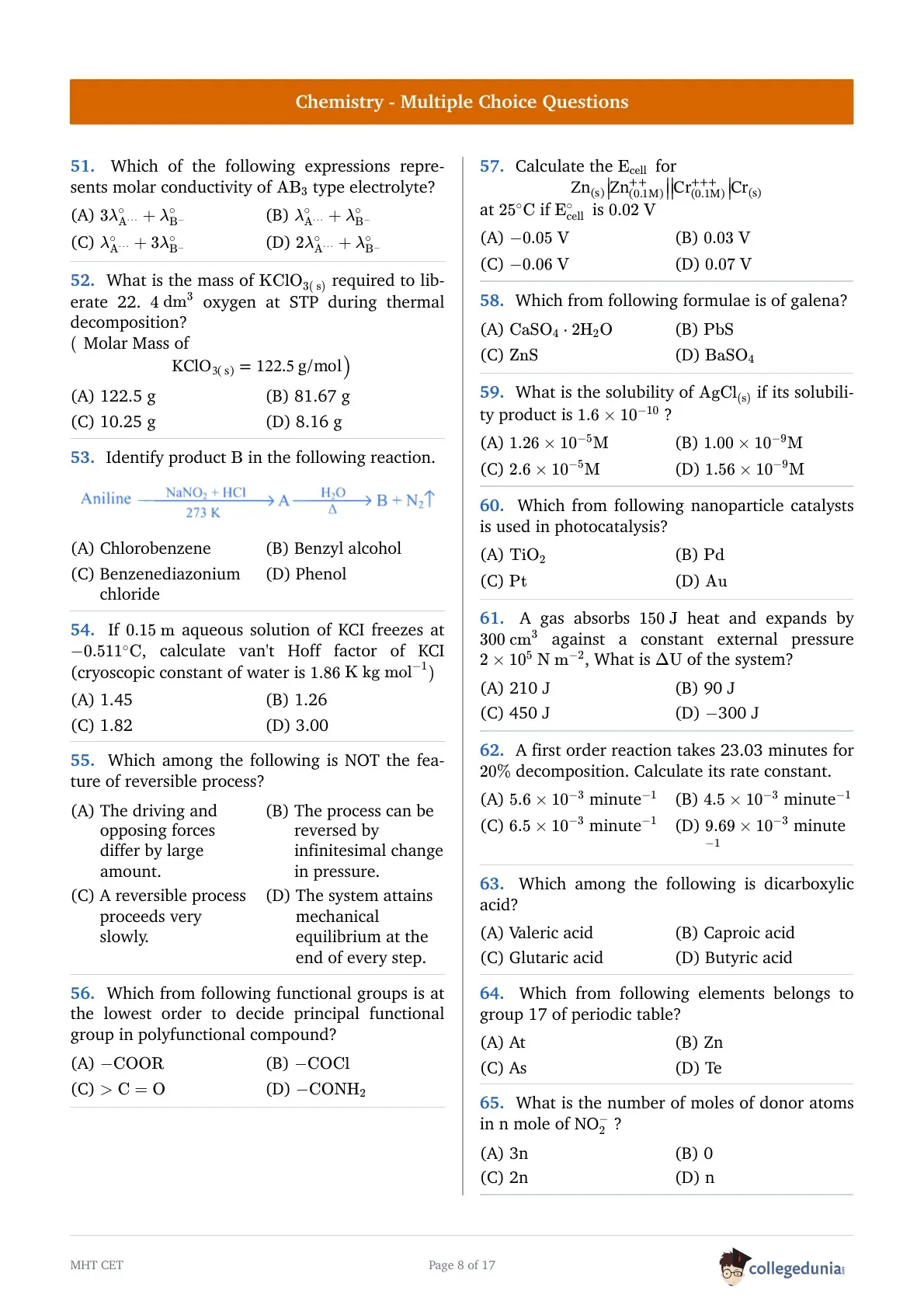
Which of the following expressions represents molar conductivity of \[\mathrm{AB}_3\] type electrolyte?
What is the mass of \[\mathrm{KClO}_{3(\mathrm{~s})}\] required to liberate 22. \[4 \mathrm{~dm}^3\] oxygen at STP during thermal decomposition?
\[\left(\right.\] Molar Mass of \[\left.\mathrm{KClO}_{3(\mathrm{~s})}=122.5 \mathrm{~g} / \mathrm{mol}\right)\]

If \[0.15 \mathrm{~m}\] aqueous solution of KCI freezes at \[-0.511^{\circ} \mathrm{C}\], calculate van't Hoff factor of KCI (cryoscopic constant of water is \[1.86 \mathrm{~K} \mathrm{~kg} \mathrm{~mol}^{-1})\]
Which from following functional groups is at the lowest order to decide principal functional group in polyfunctional compound?
Calculate the \[\mathrm{E}_{\text {cell }}\] for \[\mathrm{Zn}_{(\mathrm{s})}\left|\mathrm{Zn}_{(0.1 \mathrm{M})}^{++}\right|\left|\mathrm{Cr}_{(0.1 \mathrm{M})}^{+++}\right| \mathrm{Cr}_{(\mathrm{s})}\] at \[25^{\circ} \mathrm{C}\] if \[\mathrm{E}_{\text {cell }}^{\circ}\] is \[0.02 \mathrm{~V}\]
What is the solubility of \[\mathrm{AgCl}_{(\mathrm{s})}\] if its solubility product is \[1.6 \times 10^{-10}\] ?
Which from following nanoparticle catalysts is used in photocatalysis?
A gas absorbs \[150 \mathrm{~J}\] heat and expands by \[300 \mathrm{~cm}^3\] against a constant external pressure \[2 \times 10^5 \mathrm{~N} \mathrm{~m}^{-2}\], What is \[\Delta \mathrm{U}\] of the system?
A first order reaction takes 23.03 minutes for \[20 \%\] decomposition. Calculate its rate constant.
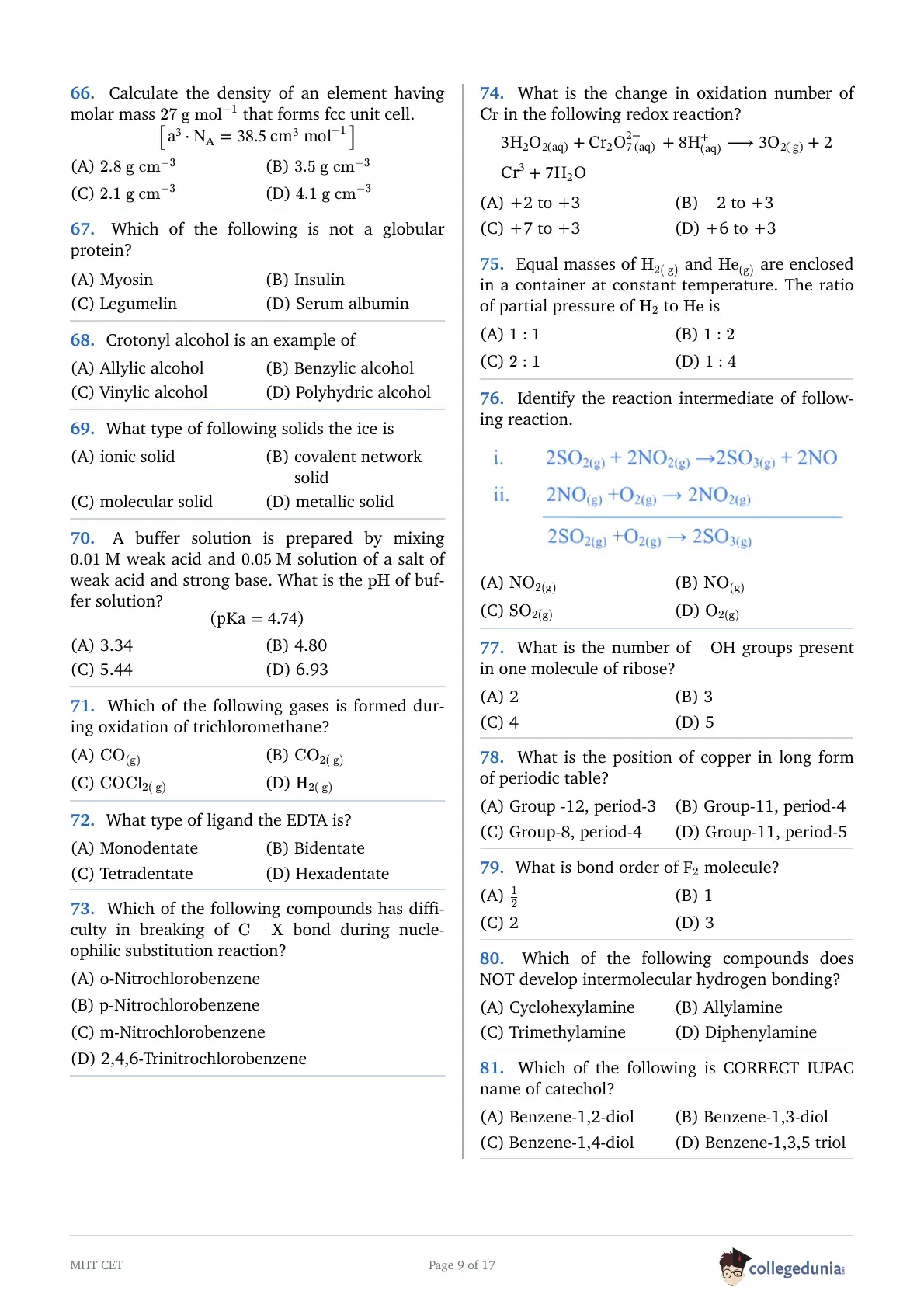
Calculate the density of an element having molar mass \[27 \mathrm{~g} \mathrm{~mol}^{-1}\] that forms fcc unit cell. \[\left[\mathrm{a}^3 \cdot \mathrm{N}_{\mathrm{A}}=38.5 \mathrm{~cm}^3 \mathrm{~mol}^{-1}\right]\]
A buffer solution is prepared by mixing \[0.01 \mathrm{~M}\] weak acid and \[0.05 \mathrm{~M}\] solution of a salt of weak acid and strong base. What is the \[\mathrm{pH}\] of buffer solution? \[(\mathrm{pKa}=4.74)\]
Which of the following gases is formed during oxidation of trichloromethane?
Which of the following compounds has difficulty in breaking of \[\mathrm{C}-\mathrm{X}\] bond during nucleophilic substitution reaction?
What is the change in oxidation number of \[\mathrm{Cr}\] in the following redox reaction?
\[3 \mathrm{H}_2 \mathrm{O}_{2(\mathrm{aq})}+\mathrm{Cr}_2 \mathrm{O}_{7 \text { (aq) }}^{2-}+8 \mathrm{H}_{(\mathrm{aq})}^{+} \longrightarrow 3 \mathrm{O}_{2(\mathrm{~g})}+2 \mathrm{Cr}^3+7 \mathrm{H}_2 \mathrm{O}\]
Equal masses of \[\mathrm{H}_{2(\mathrm{~g})}\] and \[\mathrm{He}_{(\mathrm{g})}\] are enclosed in a container at constant temperature. The ratio of partial pressure of \[\mathrm{H}_2\] to \[\mathrm{He}\] is

What is the number of \[-\]OH groups present in one molecule of ribose?
Which of the following compounds does NOT develop intermolecular hydrogen bonding?
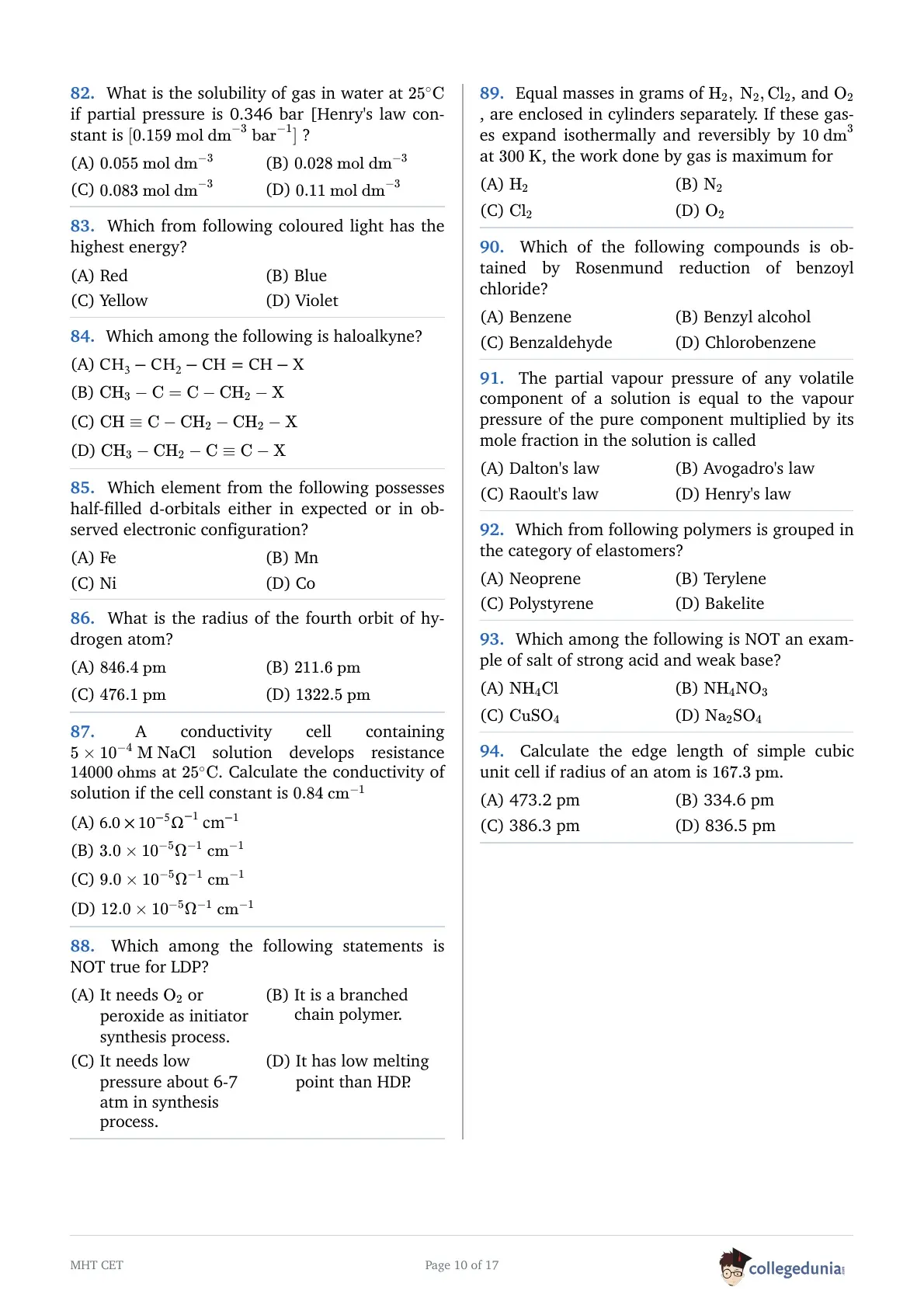
What is the solubility of gas in water at \[25^{\circ} \mathrm{C}\] if partial pressure is 0.346 bar [Henry's law constant is \[[0.159 \mathrm{~mol} \mathrm{~dm}^{-3} \mathrm{~bar}^{-1}]\] ?
Which element from the following possesses half-filled d-orbitals either in expected or in observed electronic configuration?
A conductivity cell containing \[5 \times 10^{-4} \mathrm{~M} \mathrm{~NaCl}\] solution develops resistance \[14000 \mathrm{~ohms}\] at \[25^{\circ} \mathrm{C}\]. Calculate the conductivity of solution if the cell constant is \[0.84 \mathrm{~cm}^{-1}\]
Equal masses in grams of \[\mathrm{H}_2, \mathrm{~N}_2, \mathrm{Cl}_2\], and \[\mathrm{O}_2\], are enclosed in cylinders separately. If these gases expand isothermally and reversibly by \[10 \mathrm{~dm}^3\] at \[300 \mathrm{~K}\], the work done by gas is maximum for
Which of the following compounds is obtained by Rosenmund reduction of benzoyl chloride?
The partial vapour pressure of any volatile component of a solution is equal to the vapour pressure of the pure component multiplied by its mole fraction in the solution is called
Which from following polymers is grouped in the category of elastomers?
Which among the following is NOT an example of salt of strong acid and weak base?
Calculate the edge length of simple cubic unit cell if radius of an atom is \[167.3 \mathrm{~pm}\].

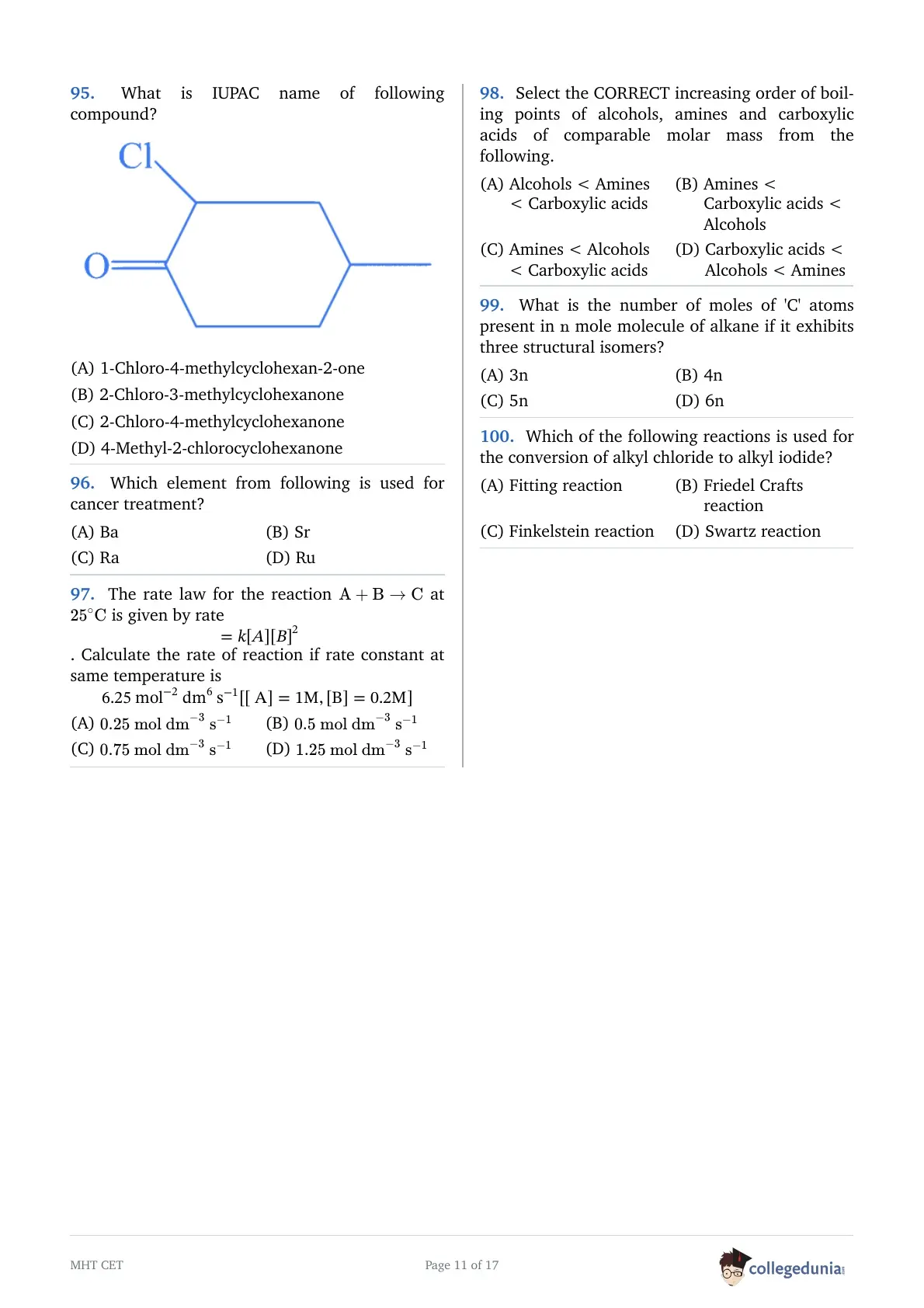
The rate law for the reaction \[\mathrm{A}+\mathrm{B} \rightarrow \mathrm{C}\] at \[25^{\circ} \mathrm{C}\] is given by rate \[=k[A][B]^2\]. Calculate the rate of reaction if rate constant at same temperature is \[6.25 \mathrm{~mol}^{-2} \mathrm{~dm}^6 \mathrm{~s}^{-1}[[\mathrm{~A}]=1 \mathrm{M},[\mathrm{B}]=0.2 \mathrm{M}]\]
Select the CORRECT increasing order of boiling points of alcohols, amines and carboxylic acids of comparable molar mass from the following.
What is the number of moles of 'C' atoms present in \[\mathrm{n}\] mole molecule of alkane if it exhibits three structural isomers?
Which of the following reactions is used for the conversion of alkyl chloride to alkyl iodide?
Mathematics (Q101 - Q150)
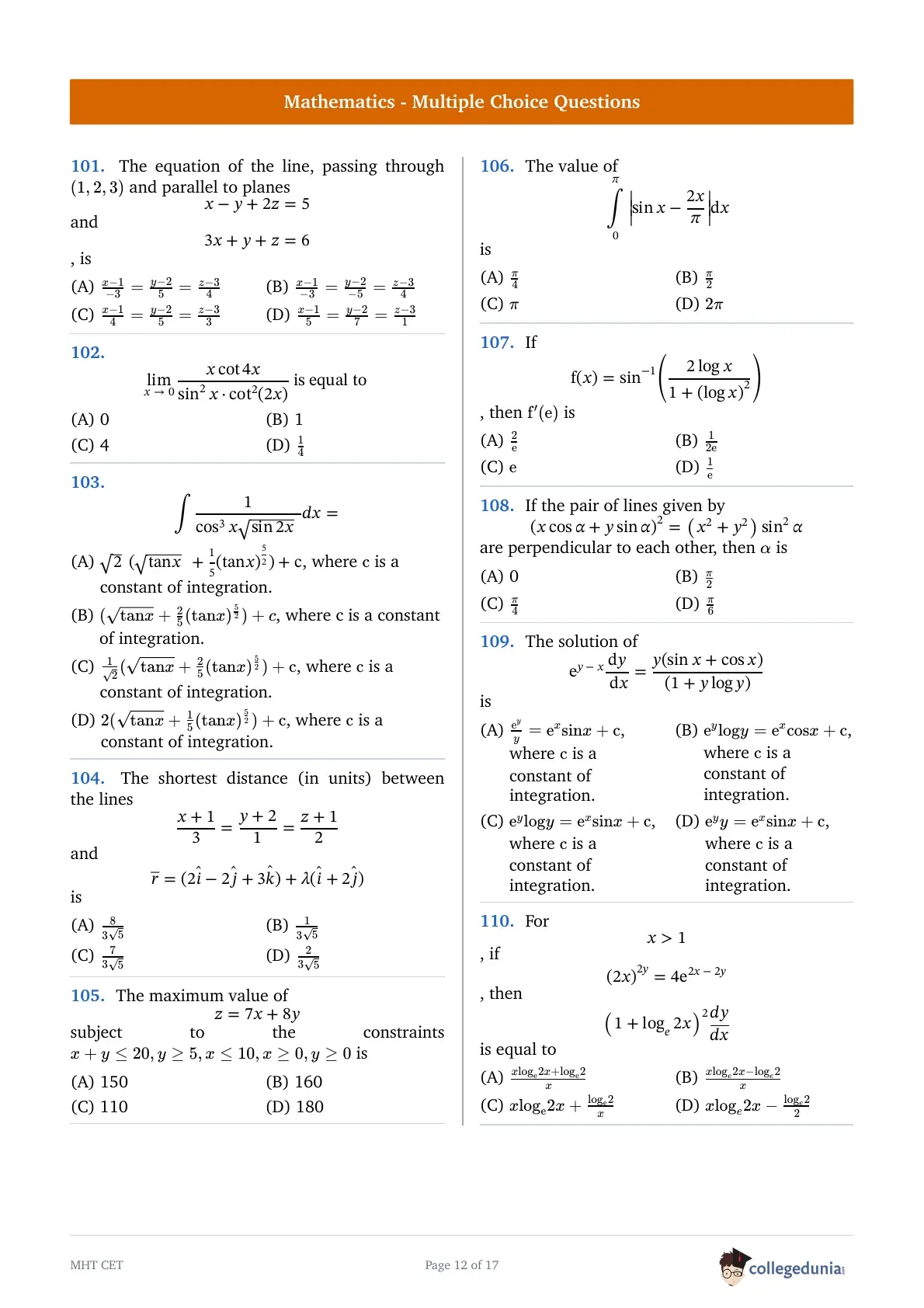
The equation of the line, passing through \[(1,2,3)\] and parallel to planes \[x-y+2 z=5\] and \[3 x+y+z=6\], is
\[\lim _\limits{x \rightarrow 0} \frac{x \cot 4 x}{\sin ^2 x \cdot \cot ^2(2 x)} \text { is equal to }\]
The shortest distance (in units) between the lines \[\frac{x+1}{3}=\frac{y+2}{1}=\frac{z+1}{2}\] and \[\bar{r}=(2 \hat{i}-2 \hat{j}+3 \hat{k})+\lambda(\hat{i}+2 \hat{j})\] is
The maximum value of \[z=7 x+8 y\] subject to the constraints \[x+y \leq 20, y \geq 5, x \leq 10, x \geq 0, y \geq 0\] is
The value of \[\int_\limits0^\pi\left|\sin x-\frac{2 x}{\pi}\right| \mathrm{d} x\] is
If \[\mathrm{f}(x)=\sin ^{-1}\left(\frac{2 \log x}{1+(\log x)^2}\right)\], then \[\mathrm{f}^{\prime}(\mathrm{e})\] is
If the pair of lines given by \[(x \cos \alpha+y \sin \alpha)^2=\left(x^2+y^2\right) \sin ^2 \alpha\] are perpendicular to each other, then \[\alpha\] is
The solution of \[\mathrm{e}^{y-x} \frac{\mathrm{d} y}{\mathrm{~d} x}=\frac{y(\sin x+\cos x)}{(1+y \log y)}\] is
For \[x>1\], if \[(2 x)^{2 y}=4 \mathrm{e}^{2 x-2 y}\], then \[\left(1+\log _e 2 x\right)^2 \frac{d y}{d x}\] is equal to
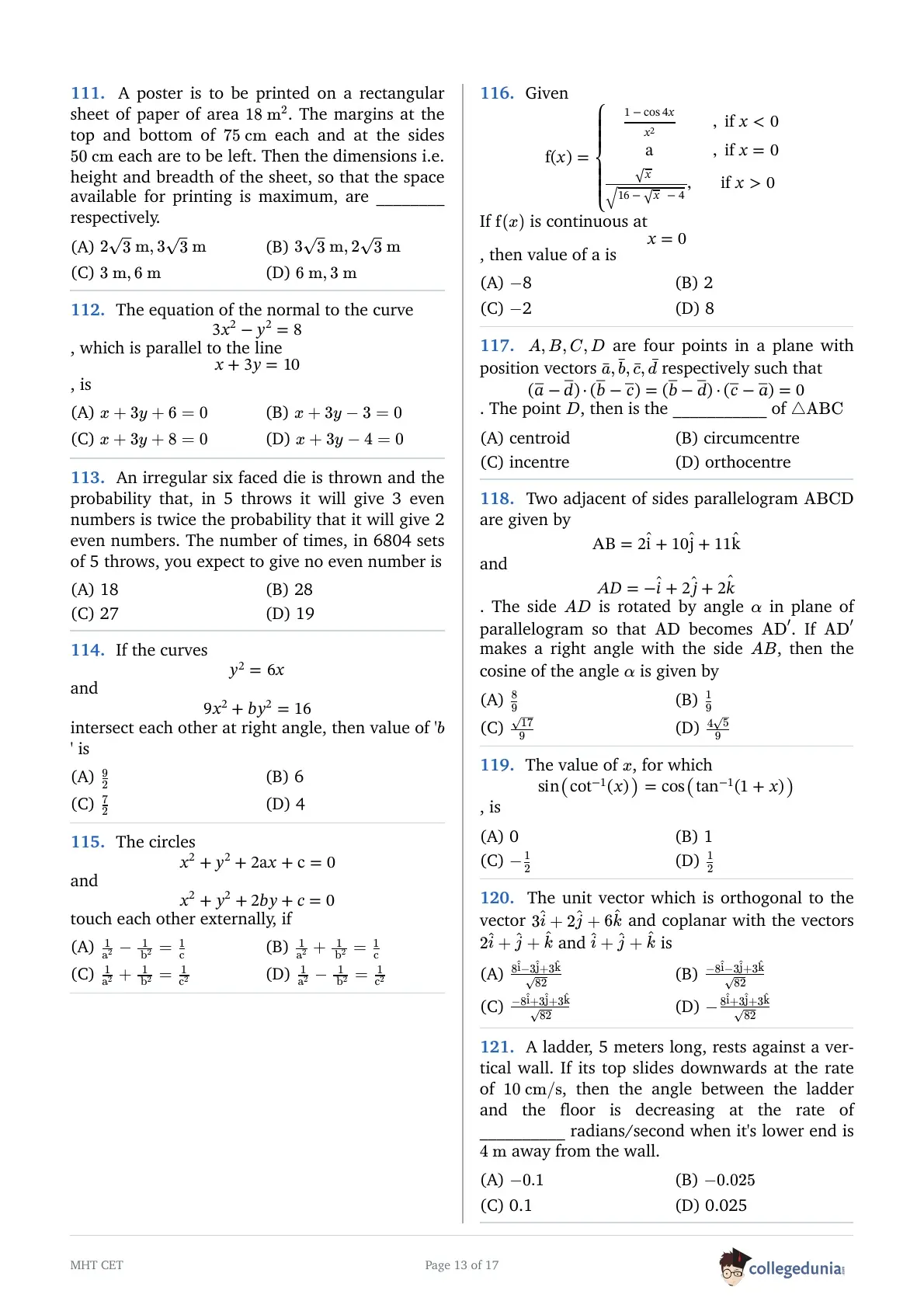
A poster is to be printed on a rectangular sheet of paper of area \[18 \mathrm{~m}^2\]. The margins at the top and bottom of \[75 \mathrm{~cm}\] each and at the sides \[50 \mathrm{~cm}\] each are to be left. Then the dimensions i.e. height and breadth of the sheet, so that the space available for printing is maximum, are ________ respectively.
The equation of the normal to the curve \[3 x^2-y^2=8\], which is parallel to the line \[x+3 y=10\], is
An irregular six faced die is thrown and the probability that, in 5 throws it will give 3 even numbers is twice the probability that it will give 2 even numbers. The number of times, in 6804 sets of 5 throws, you expect to give no even number is
If the curves \[y^2=6 x\] and \[9 x^2+b y^2=16\] intersect each other at right angle, then value of '\[b\]' is
The circles \[x^2+y^2+2 \mathrm{a} x+\mathrm{c}=0\] and \[x^2+y^2+2 b y+c=0\] touch each other externally, if
\[A, B, C, D\] are four points in a plane with position vectors \[\bar{a}, \bar{b}, \bar{c}, \bar{d}\] respectively such that \[(\bar{a}-\bar{d}) \cdot(\bar{b}-\bar{c})=(\bar{b}-\bar{d}) \cdot(\bar{c}-\bar{a})=0\]. The point \[D\], then is the ___________ of \[\triangle \mathrm{ABC}\]
Two adjacent of sides parallelogram \[\mathrm{ABCD}\] are given by \[\overline{\mathrm{AB}}=2 \hat{\mathrm{i}}+10 \hat{\mathrm{j}}+11 \hat{\mathrm{k}}\] and \[\overline{A D}=-\hat{i}+2 \hat{j}+2 \hat{k}\]. The side \[A D\] is rotated by angle \[\alpha\] in plane of parallelogram so that \[\mathrm{AD}\] becomes \[\mathrm{AD}^{\prime}\]. If \[\mathrm{AD}^{\prime}\] makes a right angle with the side \[A B\], then the cosine of the angle \[\alpha\] is given by
The value of \[x\], for which \[\sin \left(\cot ^{-1}(x)\right)=\cos \left(\tan ^{-1}(1+x)\right)\], is
The unit vector which is orthogonal to the vector \[3 \hat{i}+2 \hat{j}+6 \hat{k}\] and coplanar with the vectors \[2 \hat{i}+\hat{j}+\hat{k}\] and \[\hat{i}+\hat{j}+\hat{k}\] is
A ladder, 5 meters long, rests against a vertical wall. If its top slides downwards at the rate of \[10 \mathrm{~cm} / \mathrm{s}\], then the angle between the ladder and the floor is decreasing at the rate of __________ radians/second when it's lower end is \[4 \mathrm{~m}\] away from the wall.
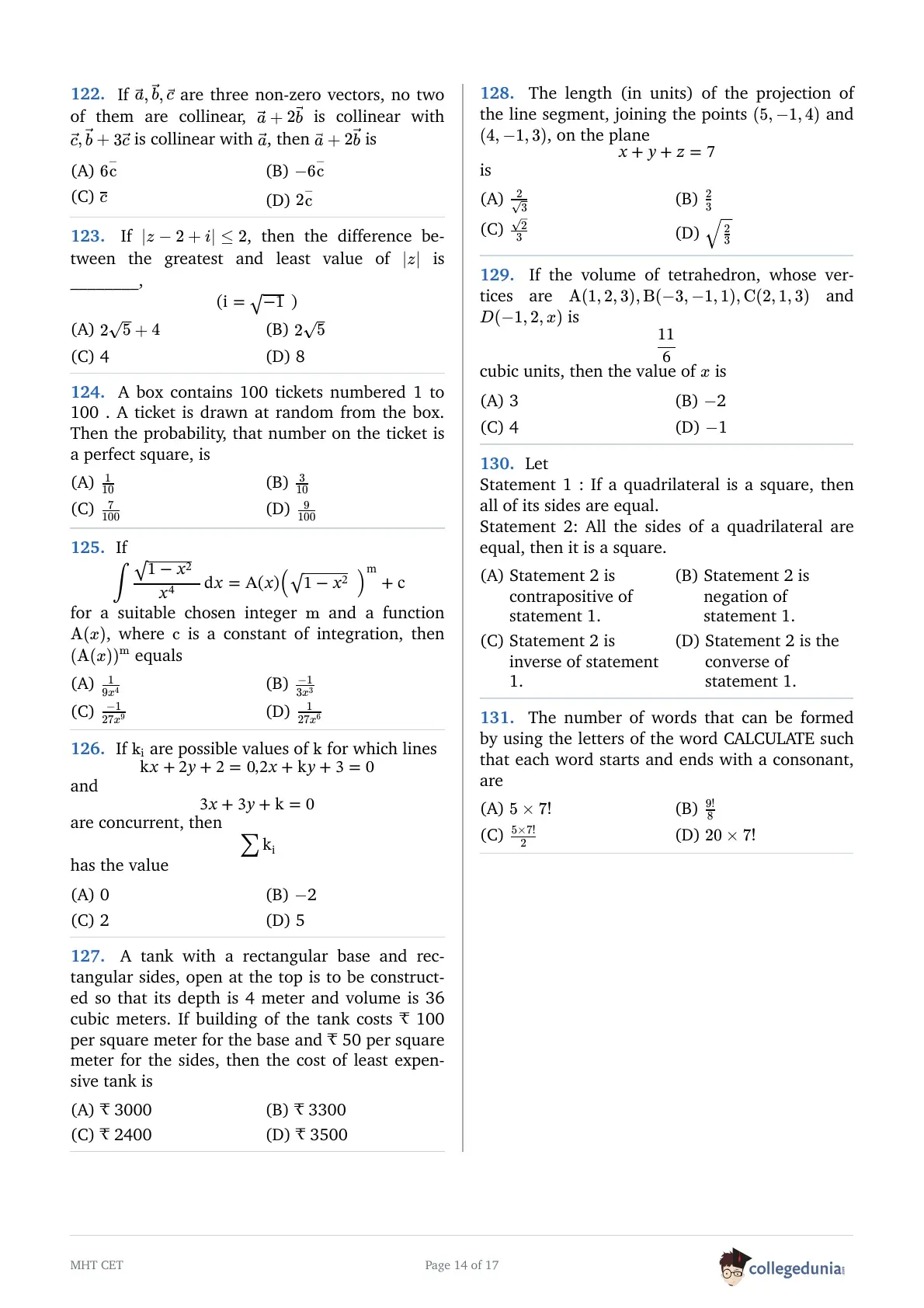
If \[\vec{a}, \vec{b}, \vec{c}\] are three non-zero vectors, no two of them are collinear, \[\vec{a}+2 \vec{b}\] is collinear with \[\vec{c}, \vec{b}+3 \vec{c}\] is collinear with \[\vec{a}\], then \[\vec{a}+2 \vec{b}\] is
If \[|z-2+i| \leq 2\], then the difference between the greatest and least value of \[|z|\] is ________, \[(\mathrm{i}=\sqrt{-1})\]
A box contains 100 tickets numbered 1 to 100 . A ticket is drawn at random from the box. Then the probability, that number on the ticket is a perfect square, is
If \[\int \frac{\sqrt{1-x^2}}{x^4} \mathrm{~d} x=\mathrm{A}(x)\left(\sqrt{1-x^2}\right)^{\mathrm{m}}+\mathrm{c}\] for a suitable chosen integer \[\mathrm{m}\] and a function \[\mathrm{A}(x)\], where \[\mathrm{c}\] is a constant of integration, then \[(\mathrm{A}(x))^{\mathrm{m}}\] equals
If \[\mathrm{k}_{\mathrm{i}}\] are possible values of \[\mathrm{k}\] for which lines \[\mathrm{k} x+2 y+2=0,2 x+\mathrm{k} y+3=0\] and \[3 x+3 y+\mathrm{k}=0\] are concurrent, then \[\sum \mathrm{k}_{\mathrm{i}}\] has the value
A tank with a rectangular base and rectangular sides, open at the top is to be constructed so that its depth is 4 meter and volume is 36 cubic meters. If building of the tank costs ₹ 100 per square meter for the base and ₹ 50 per square meter for the sides, then the cost of least expensive tank is
The length (in units) of the projection of the line segment, joining the points \[(5,-1,4)\] and \[(4,-1,3)\], on the plane \[x+y+z=7\] is
If the volume of tetrahedron, whose vertices are \[\mathrm{A}(1,2,3), \mathrm{B}(-3,-1,1), \mathrm{C}(2,1,3)\] and \[D(-1,2, x)\] is \[\frac{11}{6}\] cubic units, then the value of \[x\] is
Let
Statement 1 : If a quadrilateral is a square, then all of its sides are equal.
Statement 2: All the sides of a quadrilateral are equal, then it is a square.
The number of words that can be formed by using the letters of the word CALCULATE such that each word starts and ends with a consonant, are


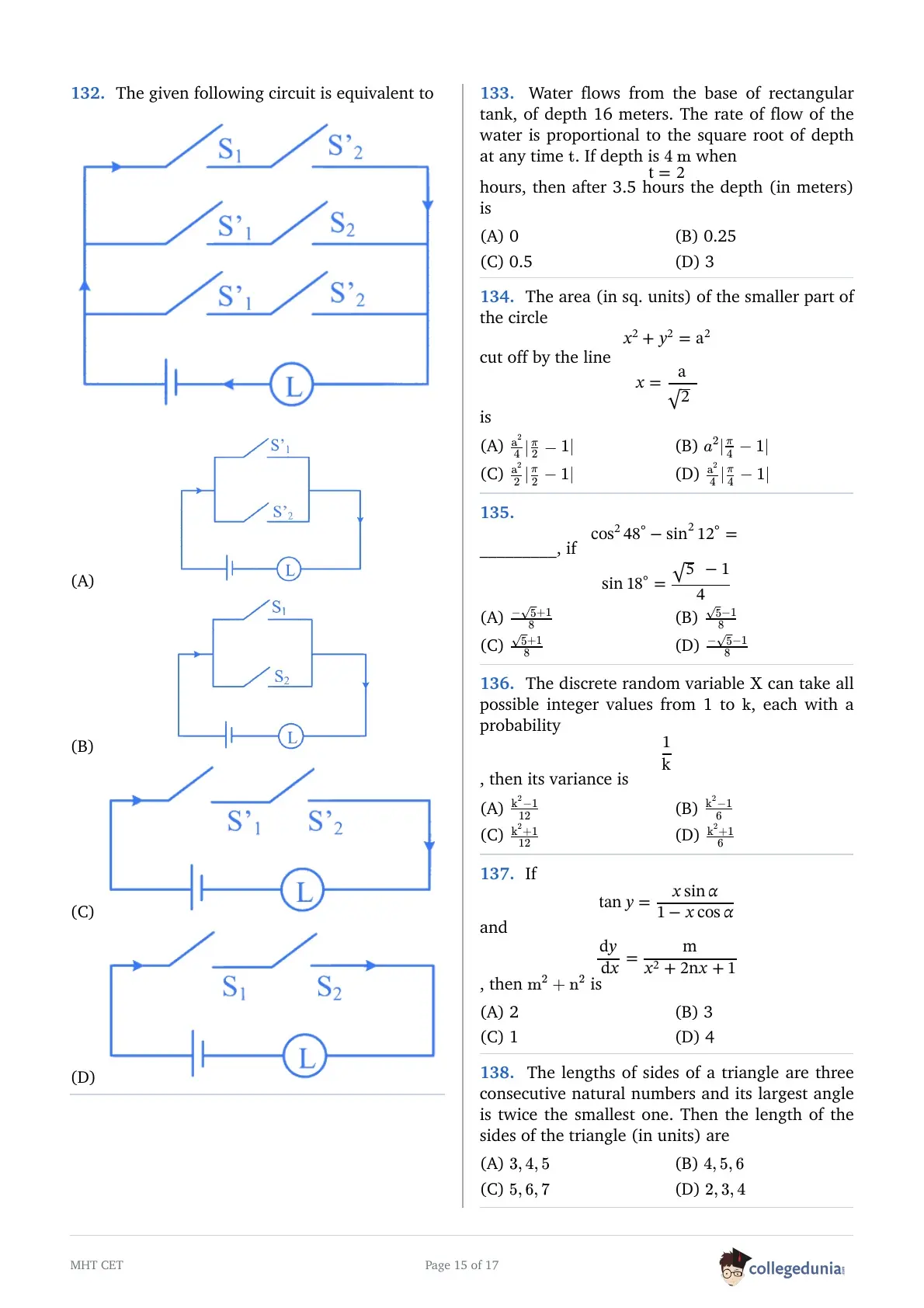
Water flows from the base of rectangular tank, of depth 16 meters. The rate of flow of the water is proportional to the square root of depth at any time \[\mathrm{t}\]. If depth is \[4 \mathrm{~m}\] when \[\mathrm{t}=2\] hours, then after 3.5 hours the depth (in meters) is
The area (in sq. units) of the smaller part of the circle \[x^2+y^2=\mathrm{a}^2\] cut off by the line \[x=\frac{\mathrm{a}}{\sqrt{2}}\] is
\(\cos ^2 48^{\circ}-\sin ^2 12^{\circ}=\) _________, if \(\sin 18^{\circ}=\frac{\sqrt{5}-1}{4}\)
The discrete random variable \[\mathrm{X}\] can take all possible integer values from 1 to \[\mathrm{k}\], each with a probability \[\frac{1}{\mathrm{k}}\], then its variance is
If \[\tan y=\frac{x \sin \alpha}{1-x \cos \alpha}\] and \[\frac{\mathrm{d} y}{\mathrm{~d} x}=\frac{\mathrm{m}}{x^2+2 \mathrm{n} x+1}\], then \[\mathrm{m}^2+\mathrm{n}^2\] is
The lengths of sides of a triangle are three consecutive natural numbers and its largest angle is twice the smallest one. Then the length of the sides of the triangle (in units) are
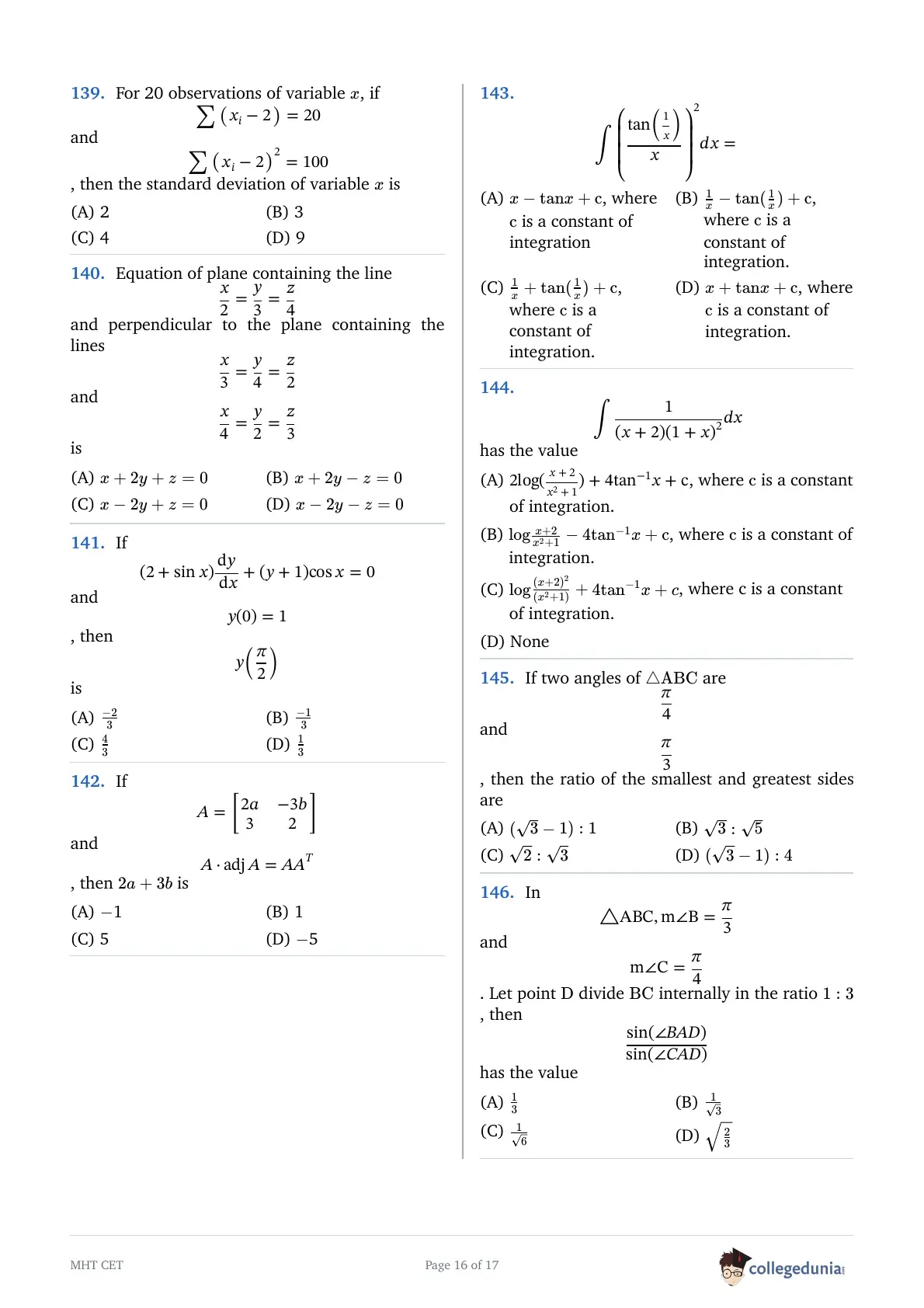
For 20 observations of variable \(x\), if \[\sum\left(x_i-2\right)=20\] and \[\sum\left(x_i-2\right)^2=100\], then the standard deviation of variable \[x\] is
Equation of plane containing the line \[\frac{x}{2}=\frac{y}{3}=\frac{z}{4}\] and perpendicular to the plane containing the lines \[\frac{x}{3}=\frac{y}{4}=\frac{z}{2}\] and \[\frac{x}{4}=\frac{y}{2}=\frac{z}{3}\] is
If \[(2+\sin x) \frac{\mathrm{d} y}{\mathrm{~d} x}+(y+1) \cos x=0\] and \[y(0)=1\], then \[y\left(\frac{\pi}{2}\right)\] is
If \[A=\left[\begin{array}{cc}2 a & -3 b \\ 3 & 2\end{array}\right]\] and \[A \cdot \operatorname{adj} A=A A^T\], then \[2 a+3 b\] is
If two angles of \[\triangle \mathrm{ABC}\] are \[\frac{\pi}{4}\] and \[\frac{\pi}{3}\], then the ratio of the smallest and greatest sides are
In \[\triangle \mathrm{ABC}, \mathrm{m} \angle \mathrm{B}=\frac{\pi}{3}\] and \[\mathrm{m} \angle \mathrm{C}=\frac{\pi}{4}\]. Let point \[\mathrm{D}\] divide \[\mathrm{BC}\] internally in the ratio \[1: 3\], then \[\frac{\sin (\angle B A D)}{\sin (\angle C A D)}\] has the value
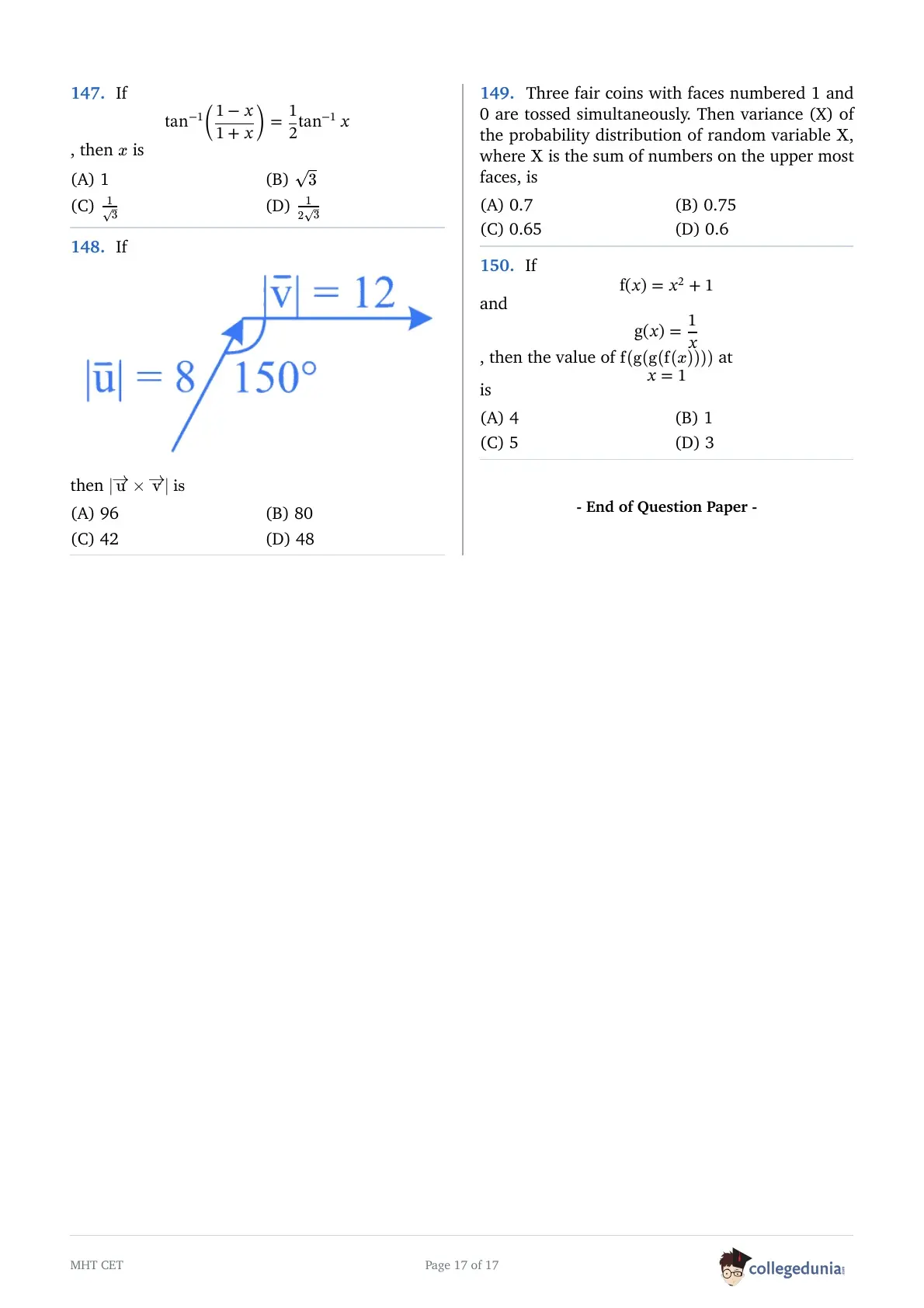
If \[\tan ^{-1}\left(\frac{1-x}{1+x}\right)=\frac{1}{2} \tan ^{-1} x\], then \[x\] is

Three fair coins with faces numbered 1 and 0 are tossed simultaneously. Then variance (X) of the probability distribution of random variable \[\mathrm{X}\], where \[\mathrm{X}\] is the sum of numbers on the upper most faces, is
If \[\mathrm{f}(x)=x^2+1\] and \[\mathrm{g}(x)=\frac{1}{x}\], then the value of \[\mathrm{f}(\mathrm{g}(\mathrm{g}(\mathrm{f}(x))))\] at \[x=1\] is
MHT CET 2023 PCM Exam Pattern and Marking Scheme
| Parameter | Details |
|---|---|
| Conducting Body | Maharashtra Common Entrance Test Cell (Maharashtra CET Cell) |
| Exam Mode | Online (Computer-Based Test) |
| Duration | 180 minutes (3 hours) |
| Groups / Subjects | PCM (Physics, Chemistry, Mathematics) for Engineering |
| Total Questions |
150 |
| Total Marks | 200 |
| Question Type | Multiple Choice Questions (MCQs) |
| Marks Distribution |
|
| Negative Marking | No |
| Syllabus Weightage |
|



Comments