




MHT CET 2023 May 9 Shift 1 PCM Question Paper is available for download here. Maharashtra State CET Cell conducted MHT CET 2023 PCM Exam on May 9 in Shift 1 from 9 AM to 12 PM in CBT mode.
The MHT CET 2023 PCM question paper includes the following:
- The MHT CET 2023 PCM Question Paper consists of 150 multiple-choice questions (MCQs) totalling 200 marks divided into 3 sections: Physics, Chemistry, and Mathematics, with 50 questions in each subject.
- Physics and Chemistry questions carry 1 mark each while Mathematics questions carry 2 marks each.
- There is no negative marking for incorrect answers.
MHT CET 2023 May 9 Shift 1 PCM Question Paper with Solution PDF
| CD PDF | CD PDF with Solutions |
|---|---|
| Download Collegedunia PDF 1.10 MB | - |
Also Check:
MHT CET 2023 May 9 Shift 1 PCM Questions with Solutions
Physics (Q1 - Q50)
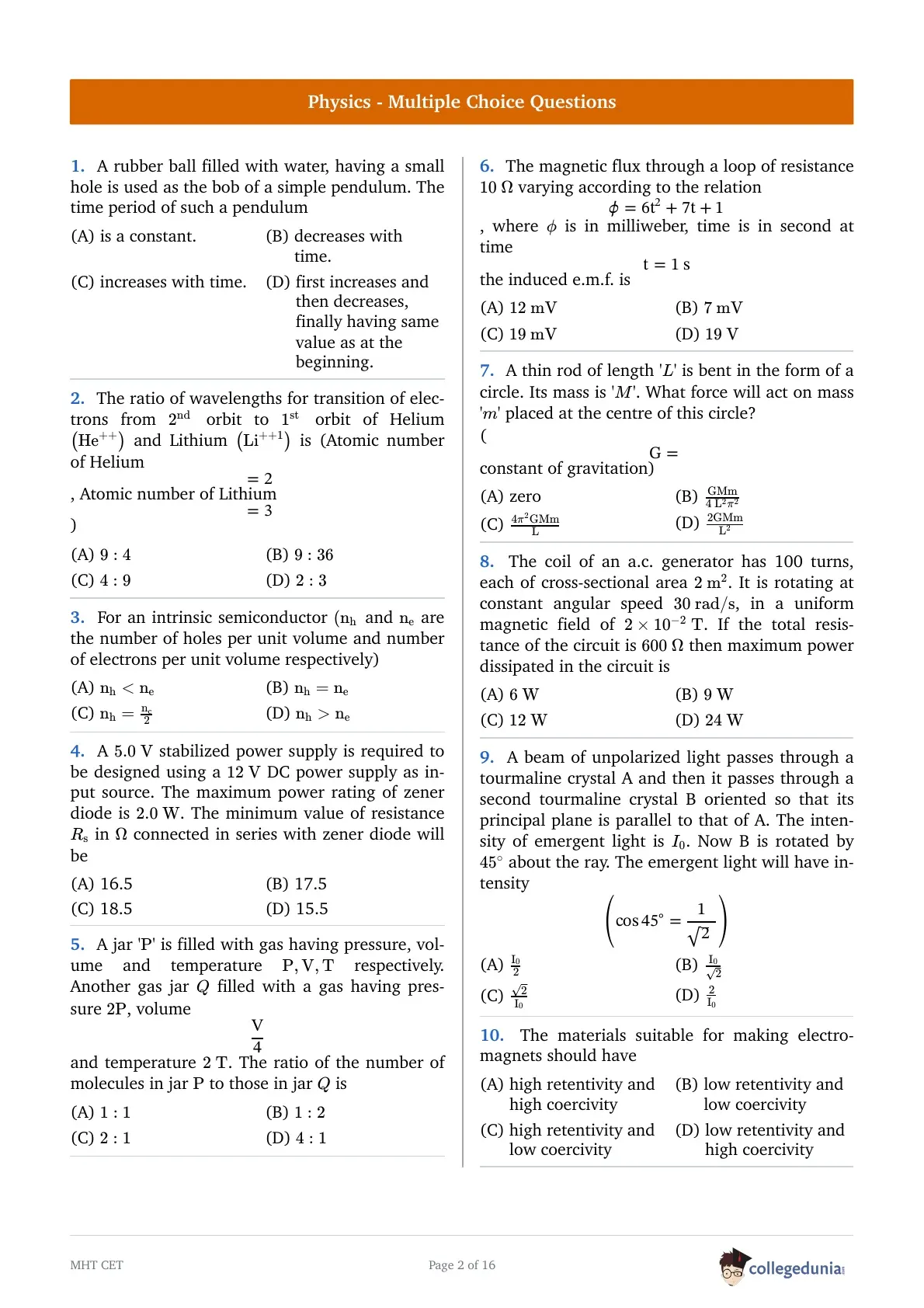
A rubber ball filled with water, having a small hole is used as the bob of a simple pendulum. The time period of such a pendulum
The ratio of wavelengths for transition of electrons from 2nd orbit to \(1^{st}\) orbit of Helium \((He^{+})\) and Lithium \((Li^{++})\) is (Atomic number of Helium = 2, Atomic number of Lithium = 3)
For an intrinsic semiconductor (\(n_h\) and \(n_e\) are the number of holes per unit volume and number of electrons per unit volume respectively)
A 5.0 V stabilized power supply is required to be designed using a 12 V DC power supply as input source. The maximum power rating of zener diode is 2.0 W. The minimum value of resistance \(R_s\) in \(\Omega\) connected in series with zener diode will be
A jar 'P' is filled with gas having pressure, volume and temperature P, V, T respectively. Another gas jar Q filled with a gas having pressure 2P, volume \(\frac{V}{4}\) and temperature 2T. The ratio of the number of molecules in jar P to those in jar Q is
The magnetic flux through a loop of resistance 10 \(\Omega\) varying according to the relation \(\phi=6t^{2}+7t+1\), where \(\phi\) is in milliweber, time is in second at time t=1 s the induced e.m.f. is
A thin rod of length 'L' is bent in the form of a circle. Its mass is 'M'. What force will act on mass 'm' placed at the centre of this circle? (G = constant of gravitation)
The coil of an a.c. generator has 100 turns, each of cross-sectional area \(2 \text{ m}^2\). It is rotating at constant angular speed \(30 \text{ rad/s}\), in a uniform magnetic field of \(2\times10^{-2}\text{ T}\). If the total resistance of the circuit is 600 \(\Omega\) then maximum power dissipated in the circuit is
A beam of unpolarized light passes through a tourmaline crystal A and then it passes through a second tourmaline crystal B oriented so that its principal plane is parallel to that of A. The intensity of emergent light is \(I_0\). Now B is rotated by \(45^{\circ}\) about the ray. The emergent light will have intensity \(\left(\cos 45^{\circ}=\frac{1}{\sqrt{2}}\right)\)
The materials suitable for making electromagnets should have
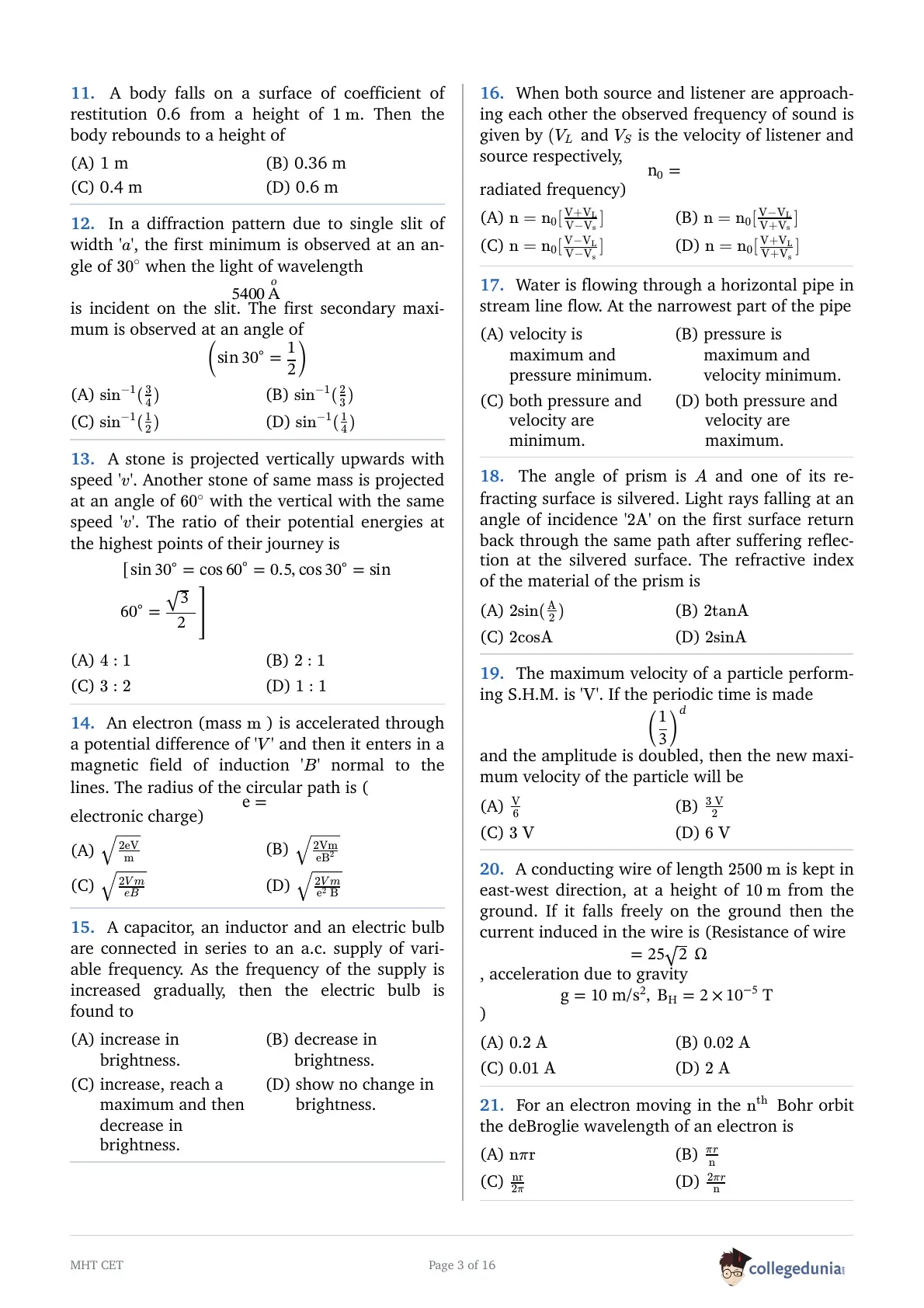
A body falls on a surface of coefficient of restitution 0.6 from a height of 1 m. Then the body rebounds to a height of
In a diffraction pattern due to single slit of width 'a', the first minimum is observed at an angle of 30° when the light of wavelength \(5400\text{ \AA}\) is incident on the slit. The first secondary maximum is observed at an angle of (\(\sin 30^\circ = \frac{1}{2}\))
A stone is projected vertically upwards with speed '\(v\)'. Another stone of same mass is projected at an angle of \(60^{\circ}\) with the vertical with the same speed '\(v\)'. The ratio of their potential energies at the highest points of their journey is \(\left[\sin 30^{\circ}=\cos 60^{\circ}=0.5, \cos 30^{\circ}=\sin 60^{\circ}=\frac{\sqrt{3}}{2}\right]\)
An electron (mass \(\mathrm{m}\) ) is accelerated through a potential difference of '\(V\)' and then it enters in a magnetic field of induction '\(B\)' normal to the lines. The radius of the circular path is (\(\mathrm{e}=\) electronic charge)
A capacitor, an inductor and an electric bulb are connected in series to an a.c. supply of variable frequency. As the frequency of the supply is increased gradually, then the electric bulb is found to
When both source and listener are approaching each other the observed frequency of sound is given by \(\left(V_L\right.\) and \(V_S\) is the velocity of listener and source respectively, \(\mathrm{n}_0=\) radiated frequency)
Water is flowing through a horizontal pipe in stream line flow. At the narrowest part of the pipe
The angle of prism is A and one of its refracting surface is silvered. Light rays falling at an angle of incidence '2A' on the first surface return back through the same path after suffering reflection at the silvered surface. The refractive index of the material of the prism is
The maximum velocity of a particle performing S.H.M. is 'V'. If the periodic time is made \(\left(\frac{1}{3}\right)^{rd}\) and the amplitude is doubled, then the new maximum velocity of the particle will be
A conducting wire of length 2500 m is kept in east-west direction, at a height of 10 m from the ground. If it falls freely on the ground then the current induced in the wire is (Resistance of wire \(= 25\sqrt{2} \;\Omega\), acceleration due to gravity \(g=10\text{ m/s}^2\), \(B_H=2\times10^{-5}\text{ T}\))
For an electron moving in the \[\mathrm{n}^{\text {th }}\] Bohr orbit the deBroglie wavelength of an electron is
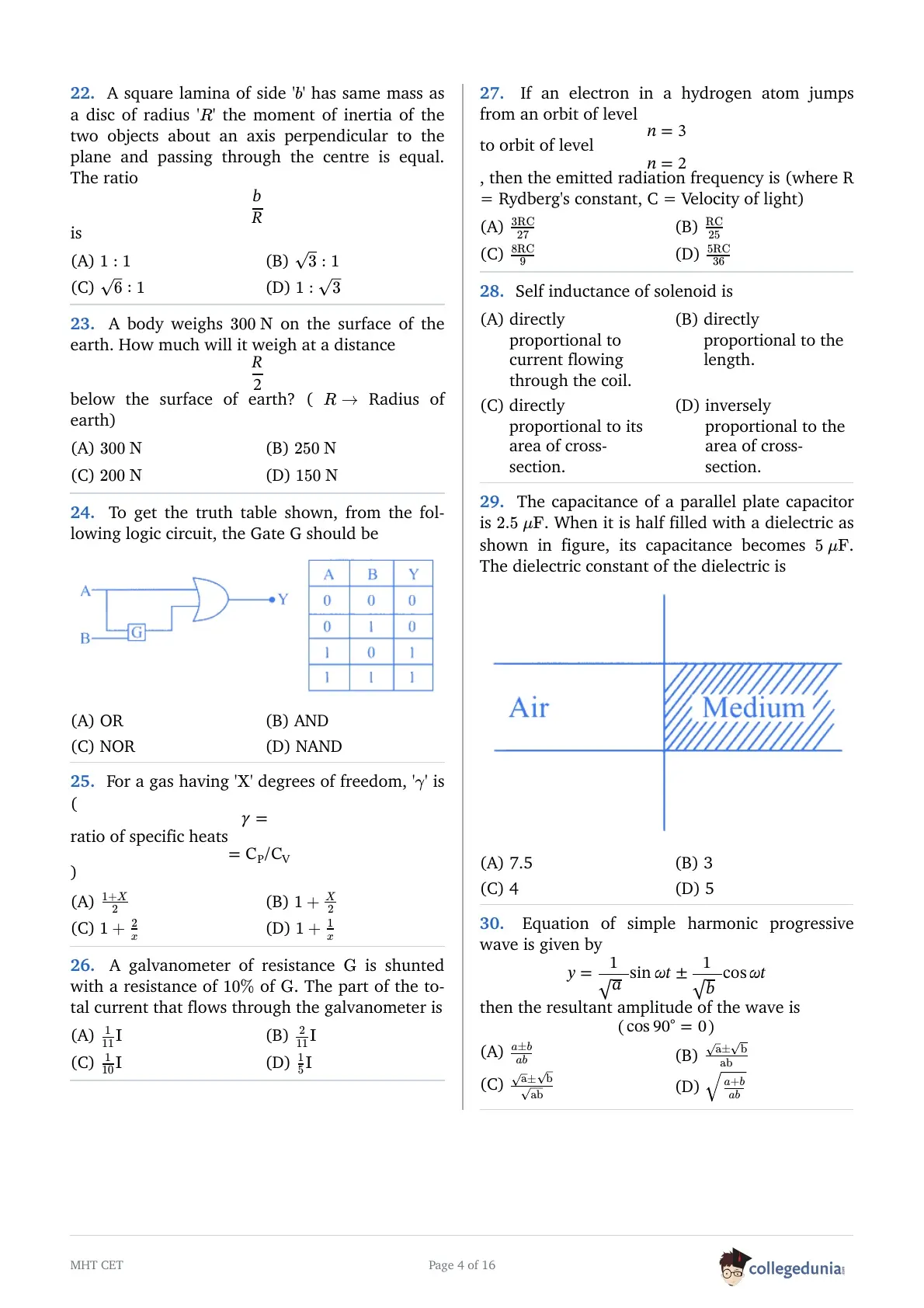
A square lamina of side 'b' has same mass as a disc of radius 'R'. The moment of inertia of the two objects about an axis perpendicular to the plane and passing through the centre is equal. The ratio \(\frac{b}{R}\) is
A body weighs 300 N on the surface of the earth. How much will it weigh at a distance \(\frac{R}{2}\) below the surface of earth? (\(R \rightarrow\) Radius of earth)
To get the truth table shown, from the following logic circuit, the Gate G should be }

For a gas having \(X\) degrees of freedom, \(\gamma\) is
A galvanometer of resistance G is shunted with a resistance of 10% of G. The part of the total current that flows through the galvanometer is
If an electron in a hydrogen atom jumps from an orbit of level \(n=3\) to orbit of level \(n=2\), then the emitted radiation frequency is (where \(R=\) Rydberg's constant, \(C=\) Velocity of light)
Self inductance of solenoid is
The capacitance of a parallel plate capacitor is 2.5 µF. When it is half filled with a dielectric as shown in figure, its capacitance becomes 5 μF. The dielectric constant of the dielectric is

Equation of simple harmonic progressive wave is given by \(y=\frac{1}{\sqrt{a}}\sin(\omega t)\pm \frac{1}{\sqrt{b}}\cos(\omega t)\). Then the resultant amplitude of the wave is (\(\cos 90^{\circ}=0\)):
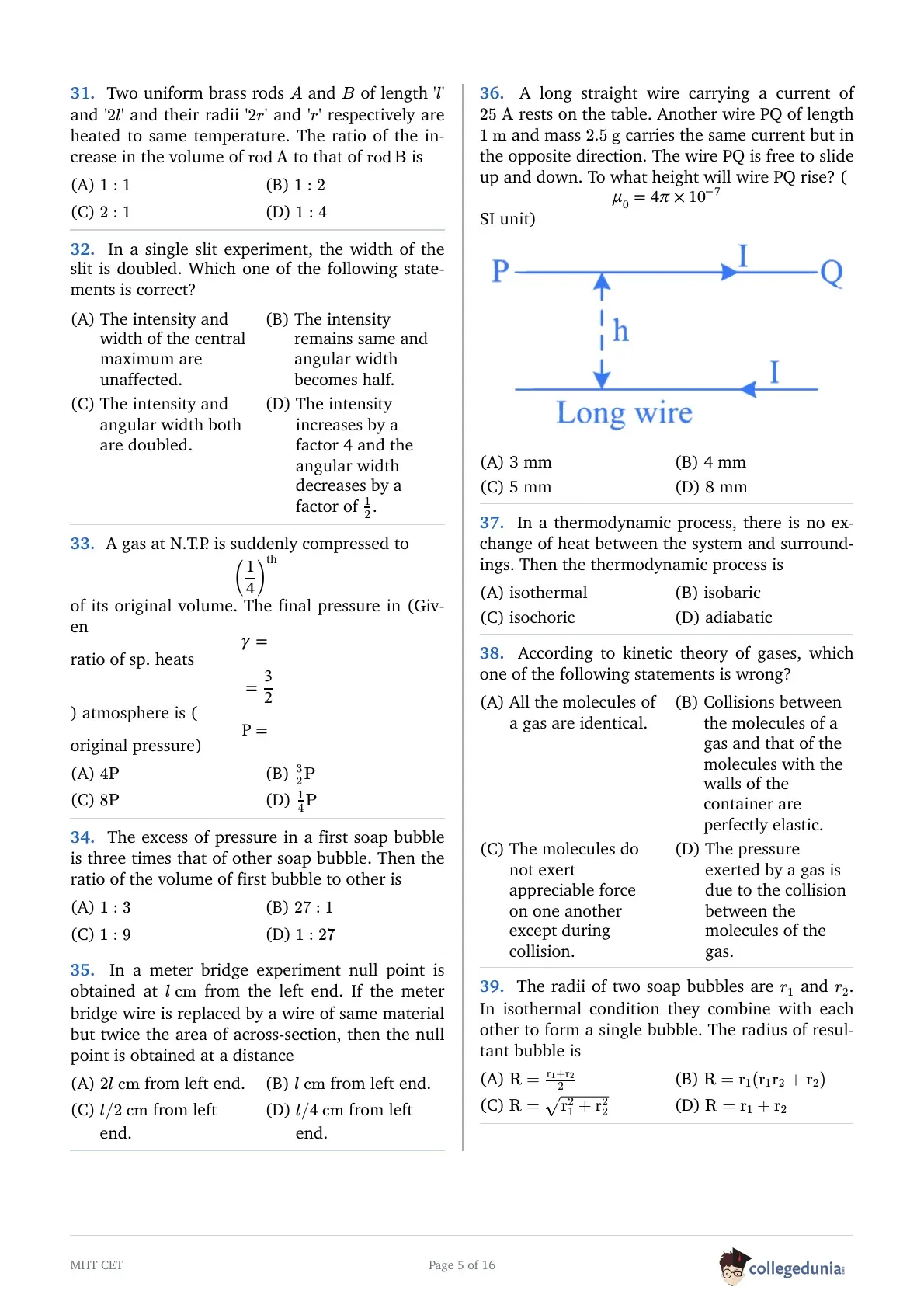
Two uniform brass rods A and B of length 'l' and '2l' and their radii '2r' and 'r' respectively are heated to same temperature. The ratio of the increase in the volume of rod A to that of rod B is
In a single slit experiment, the width of the slit is doubled. Which one of the following statements is correct?
A gas at N.T.P. is suddenly compressed to \((\frac{1}{4})^{th}\) of its original volume. The final pressure in atmosphere is (Given \(\gamma = \frac{3}{2}\) and \(P = \) original pressure)
The excess of pressure in a first soap bubble is three times that of other soap bubble. Then the ratio of the volume of first bubble to other is
In a meter bridge experiment null point is obtained at \(l\) cm from the left end. If the meter bridge wire is replaced by a wire of same material but twice the area of across-section, then the null point is obtained at a distance
A long straight wire carrying a current of 25 A rests on the table. Another wire PQ of length 1 m and mass 2.5 g carries the same current but in the opposite direction. To what height (\(h\)) will wire PQ rise? (\(\mu_0 = 4\pi \times 10^{-7}\) SI unit)}

In a thermodynamic process, there is no exchange of heat between the system and surroundings. Then the thermodynamic process is
According to kinetic theory of gases, which one of the following statements is wrong?
The radii of two soap bubbles are \(r_1\) and \(r_2\). In isothermal condition they combine with each other to form a single bubble. The radius of resultant bubble is
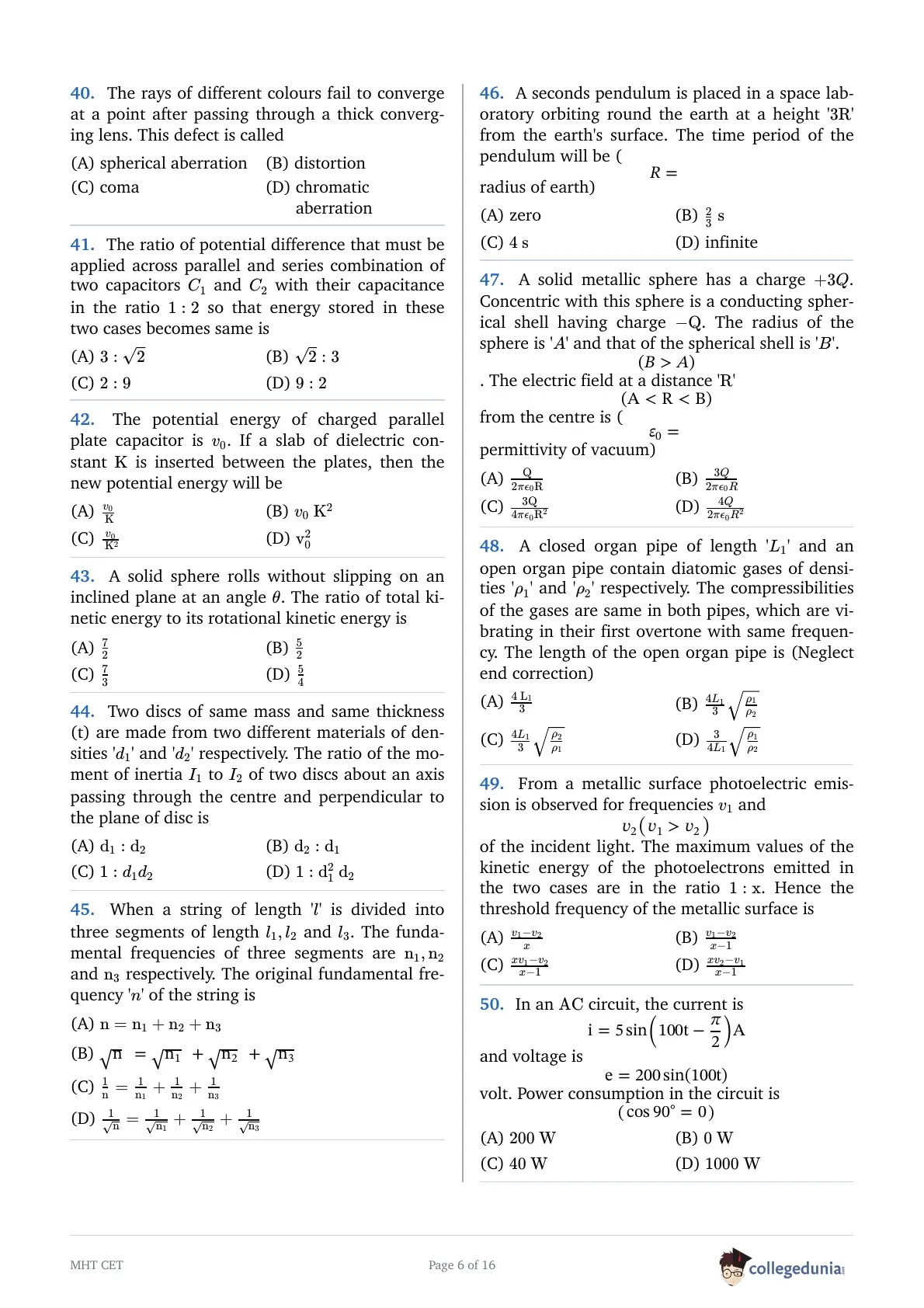
The rays of different colours fail to converge at a point after passing through a thick converging lens. This defect is called
The ratio of potential difference that must be applied across parallel and series combination of two capacitors \(C_{1}\) and \(C_{2}\) with their capacitance in the ratio 1: 2 so that energy stored in these two cases becomes same is
The potential energy of charged parallel plate capacitor is \(v_0\). If a slab of dielectric constant \(\mathrm{K}\) is inserted between the plates, then the new potential energy will be
A solid sphere rolls without slipping on an inclined plane at an angle \(\theta\). The ratio of total kinetic energy to its rotational kinetic energy is
Two discs of same mass and same thickness (t) are made from two different materials of densities \(d_{1}\) and \(d_{2}\) respectively. The ratio of the moment of inertia \(I_{1}\) to \(I_{2}\) of two discs about an axis passing through the centre and perpendicular to the plane of disc is
When a string of length '\(l\)' is divided into three segments of length \(l_1, l_2\) and \(l_3\). The fundamental frequencies of three segments are \(\mathrm{n}_1, \mathrm{n}_2\) and \(\mathrm{n}_3\) respectively. The original fundamental frequency '\(n\)' of the string is
A seconds pendulum is placed in a space laboratory orbiting round the earth at a height '3R' from the earth's surface. The time period of the pendulum will be (R = radius of earth)
A solid metallic sphere has a charge \(+3 Q\). Concentric with this sphere is a conducting spherical shell having charge \(-\mathrm{Q}\). The radius of the sphere is '\(A\)' and that of the spherical shell is '\(B\)'. \((B > A)\). The electric field at a distance '\(\mathrm{R}\)' \((\mathrm{A} < \mathrm{R} < \mathrm{B})\) from the centre is ( \(\varepsilon_0=\) permittivity of vacuum)
A closed organ pipe of length '\(L_1\)' and an open organ pipe contain diatomic gases of densities '\(\rho_1\)' and '\(\rho_2\)' respectively. The compressibilities of the gases are same in both pipes, which are vibrating in their first overtone with same frequency. The length of the open organ pipe is (Neglect end correction)
From a metallic surface photoelectric emission is observed for frequencies \[v_1\] and \[v_2\left(v_1 > v_2\right)\] of the incident light. The maximum values of the kinetic energy of the photoelectrons emitted in the two cases are in the ratio \[1: \mathrm{x}\]. Hence the threshold frequency of the metallic surface is
In an AC circuit, the current is \(i=5 \sin(100t - \frac{\pi}{2})\) A and voltage is \(e=200 \sin(100t)\) volt. Power consumption in the circuit is (\(\cos 90^{\circ}=0\))
Chemistry (Q51 - Q100)
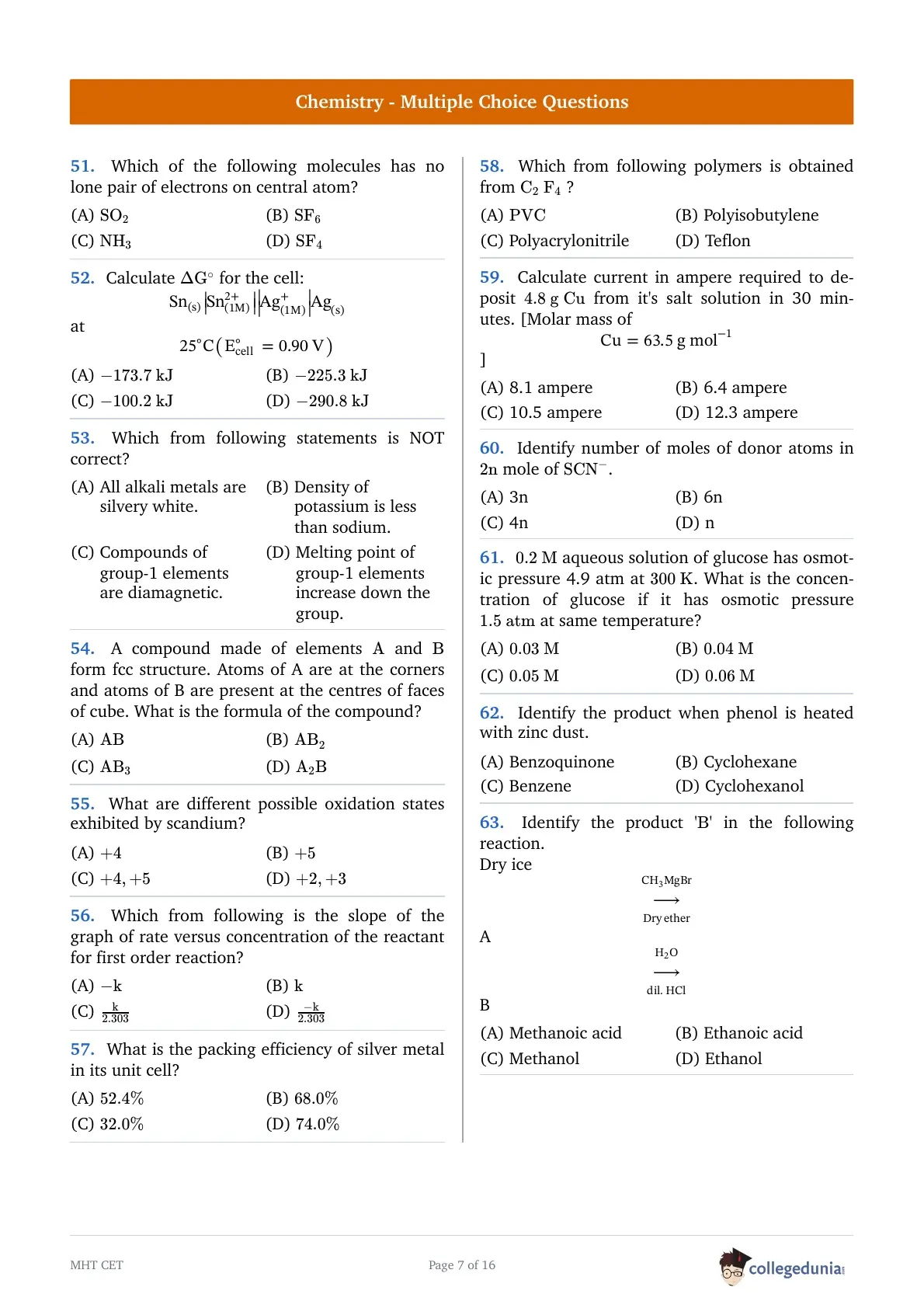
Which of the following molecules has no lone pair of electrons on central atom?
Calculate \(\Delta G^{\circ}\) for the cell: \(Sn_{(s)}|Sn_{(1M)}^{2+}||Ag_{(1M)}^{+}|Ag_{(s)}\) at \(25^{\circ}C (E_{cell}^{\circ}=0.90~V)\)
Which from following statements is NOT correct?
A compound made of elements A and B form fcc structure. Atoms of A are at the corners and atoms of B are present at the centres of faces of cube. What is the formula of the compound?
What are different possible oxidation states exhibited by scandium?
Which from following is the slope of the graph of rate versus concentration of the reactant for first order reaction?
What is the packing efficiency of silver metal in its unit cell?
Which from following polymers is obtained from \(C_{2}F_{4}\)?
Calculate current in ampere required to deposit 4.8 g Cu from it's salt solution in 30 minutes. [Molar mass of \(Cu=63.5\text{ g mol}^{-1}\)]
Identify number of moles of donor atoms in 2n mole of SCN.
0.2 M aqueous solution of glucose has osmotic pressure 4.9 atm at 300 K. What is the concentration of glucose if it has osmotic pressure 1.5 atm at same temperature?
Identify the product when phenol is heated with zinc dust.
Identify the product '\[\mathrm{B}\]' in the following reaction.
Dry ice \[\mathrm{\mathrel{\mathop{\kern0pt\longrightarrow} \limits_{Dry\,ether}^{C{H_3}MgBr}}}\] A \[\mathrm{\mathrel{\mathop{\kern0pt\longrightarrow} \limits_{dil.\,HCl}^{{H_2}O}}}\] B
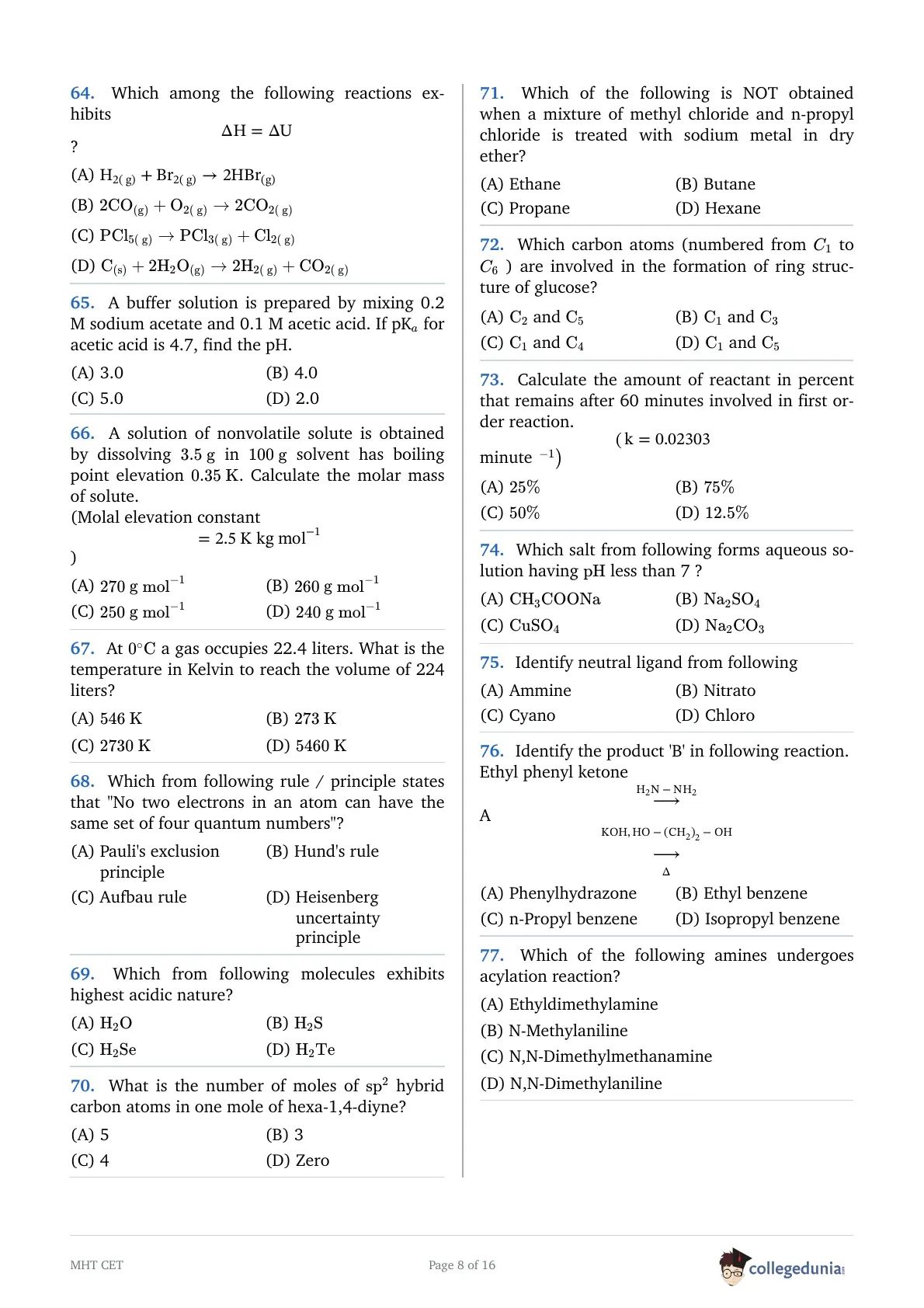
Which among the following reactions exhibits \(\Delta H=\Delta U\)?
A buffer solution is prepared by mixing 0.2 M sodium acetate and 0.1 M acetic acid. If \(pK_{a}\) for acetic acid is 4.7, find the pH.
A solution of nonvolatile solute is obtained by dissolving 3.5 g in 100 g solvent has boiling point elevation 0.35 K. Calculate the molar mass of solute. (Molal elevation constant = \(2.5\text{ K kg mol}^{-1}\))
At \(0^\circ\text{C}\) a gas occupies 22.4 liters. What is the temperature in Kelvin to reach the volume of 224 liters?
Which from following rule / principle states that "No two electrons in an atom can have the same set of four quantum numbers"?
What is the number of moles of \(sp^2\) hybrid carbon atoms in one mole of hexa-1,4-diyne?
Which of the following is NOT obtained when a mixture of methyl chloride and n-propyl chloride is treated with sodium metal in dry ether?
Which carbon atoms (numbered from \[C_1\] to \[C_6\] ) are involved in the formation of ring structure of glucose?
Calculate the amount of reactant in percent that remains after 60 minutes involved in first order reaction. (\(k=0.02303\text{ minute}^{-1}\))
Which salt from following forms aqueous solution having pH less than 7?
Identify neutral ligand from following.
Identify the product 'B' in following reaction.
Ethyl phenyl ketone \[\mathrm{\buildrel {{H_2}N - N{H_2}} \over \longrightarrow}\] A \[\mathrm{\mathrel{\mathop{\kern0pt\longrightarrow} \limits_\Delta ^{KOH,HO - {{(C{H_2})}_2} - OH}}}\]
Which of the following amines undergoes acylation reaction?

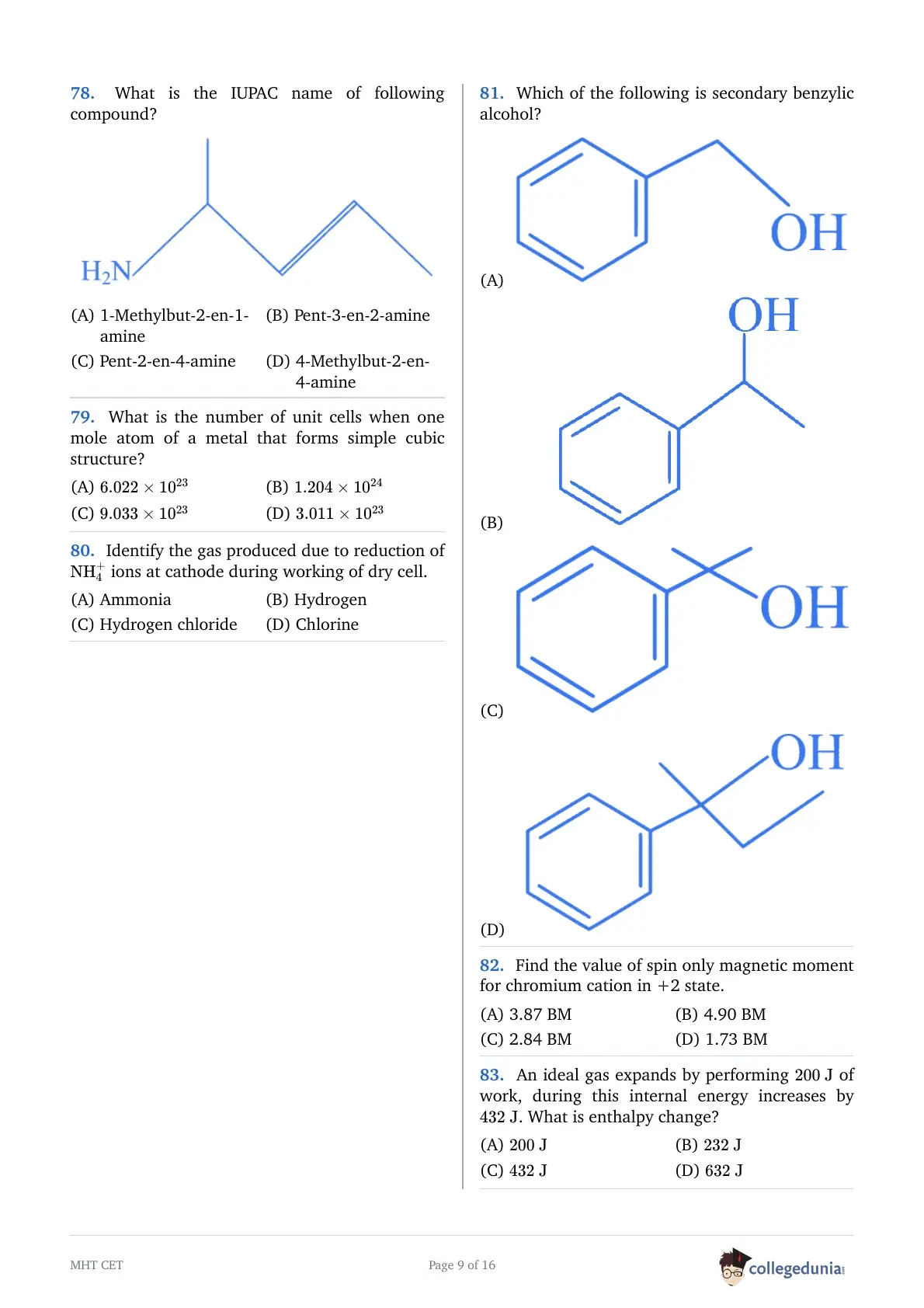
What is the number of unit cells when one mole atom of a metal that forms simple cubic structure?
Identify the gas produced due to reduction of \(NH_{4}^{+}\) ions at cathode during working of dry cell.
Which of the following is secondary benzylic alcohol?
- (A)
![]()
- (B)
![]()
- (C)
![]()
- (D)
![]()


Find the value of spin only magnetic moment for chromium cation in +2 state.
An ideal gas expands by performing 200 J of work, during this internal energy increases by 432 J. What is enthalpy change?
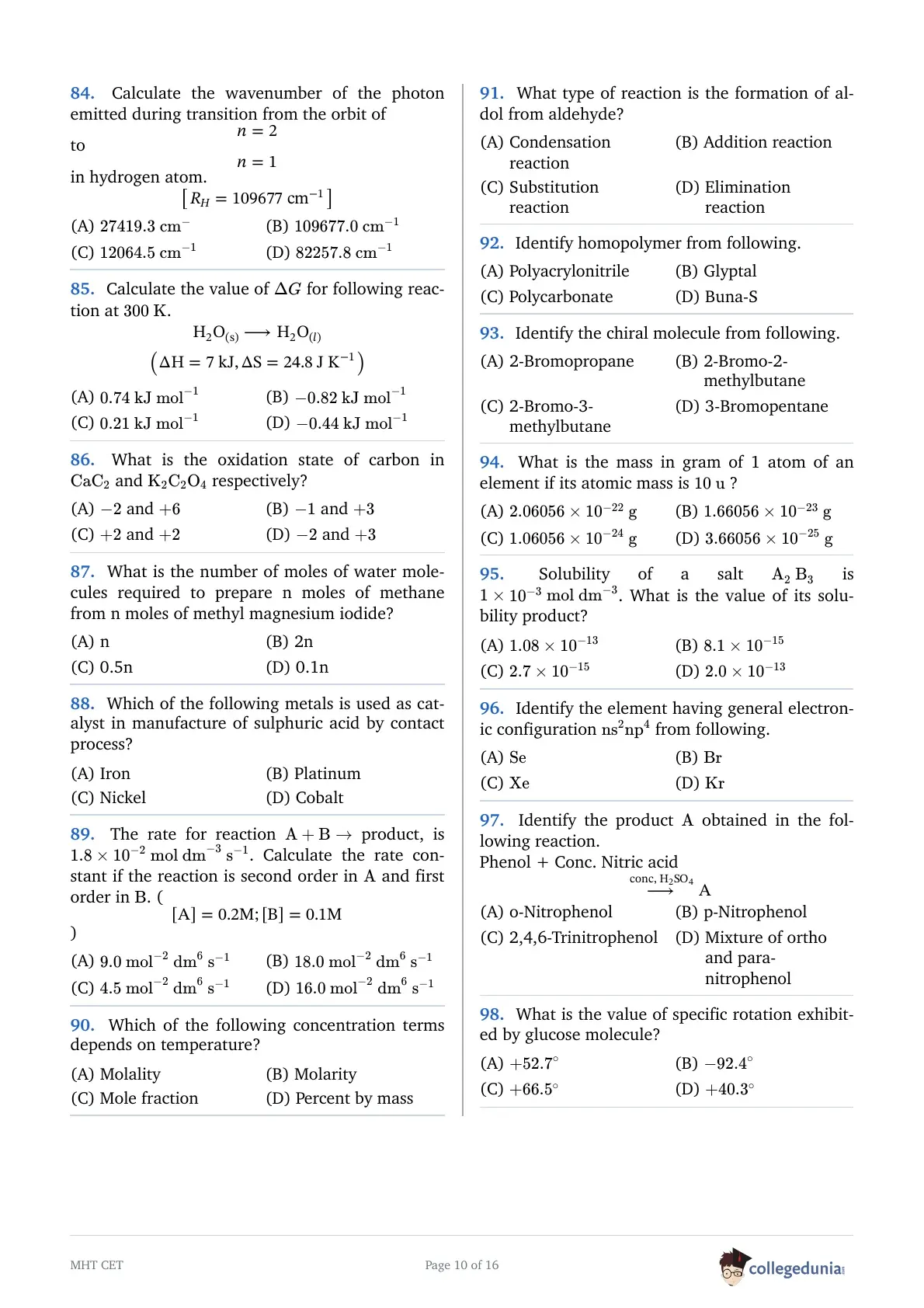
Calculate the wavenumber of the photon emitted during transition from the orbit of \(n=2\) to \(n=1\) in hydrogen atom. [ \(R_{H}=109677\text{ cm}^{-1}\)]
Calculate the value of \(\Delta G\) for following reaction at 300 K.
\(H_{2}O_{(s)}\longrightarrow H_{2}O_{(l)}\)
\((\Delta H=7\text{ kJ}, \Delta S=24.8\text{ J K}^{-1})\)
What is the oxidation state of carbon in \(CaC_{2}\) and \(K_{2}C_{2}O_{4}\) respectively?
What is the number of moles of water molecules required to prepare n moles of methane from n moles of methyl magnesium iodide?
Which of the following metals is used as catalyst in manufacture of sulphuric acid by contact process?
The rate for reaction A + B \(\rightarrow\) product, is \(1.8\times10^{-2}\text{ mol dm}^{-3}\text{s}^{-1}\). Calculate the rate constant if the reaction is second order in A and first order in B. \(([A]=0.2\text{ M}; [B]=0.1\text{ M})\)
Which of the following concentration terms depends on temperature?
What type of reaction is the formation of aldol from aldehyde?
Identify homopolymer from following.
Identify the chiral molecule from following.
What is the mass in gram of 1 atom of an element if its atomic mass is 10 u?
Solubility of a salt \(A_{2}B_{3}\) is \(1\times10^{-3}\text{ mol dm}^{-3}\). What is the value of its solubility product?
Identify the element having general electronic configuration \(ns^{2}np^{4}\) from following.
Identify the product A obtained in the following reaction.
Phenol + Conc. Nitric acid \(\xrightarrow{\text{Conc. } H_2SO_4}\) A
What is the value of specific rotation exhibited by glucose molecule?
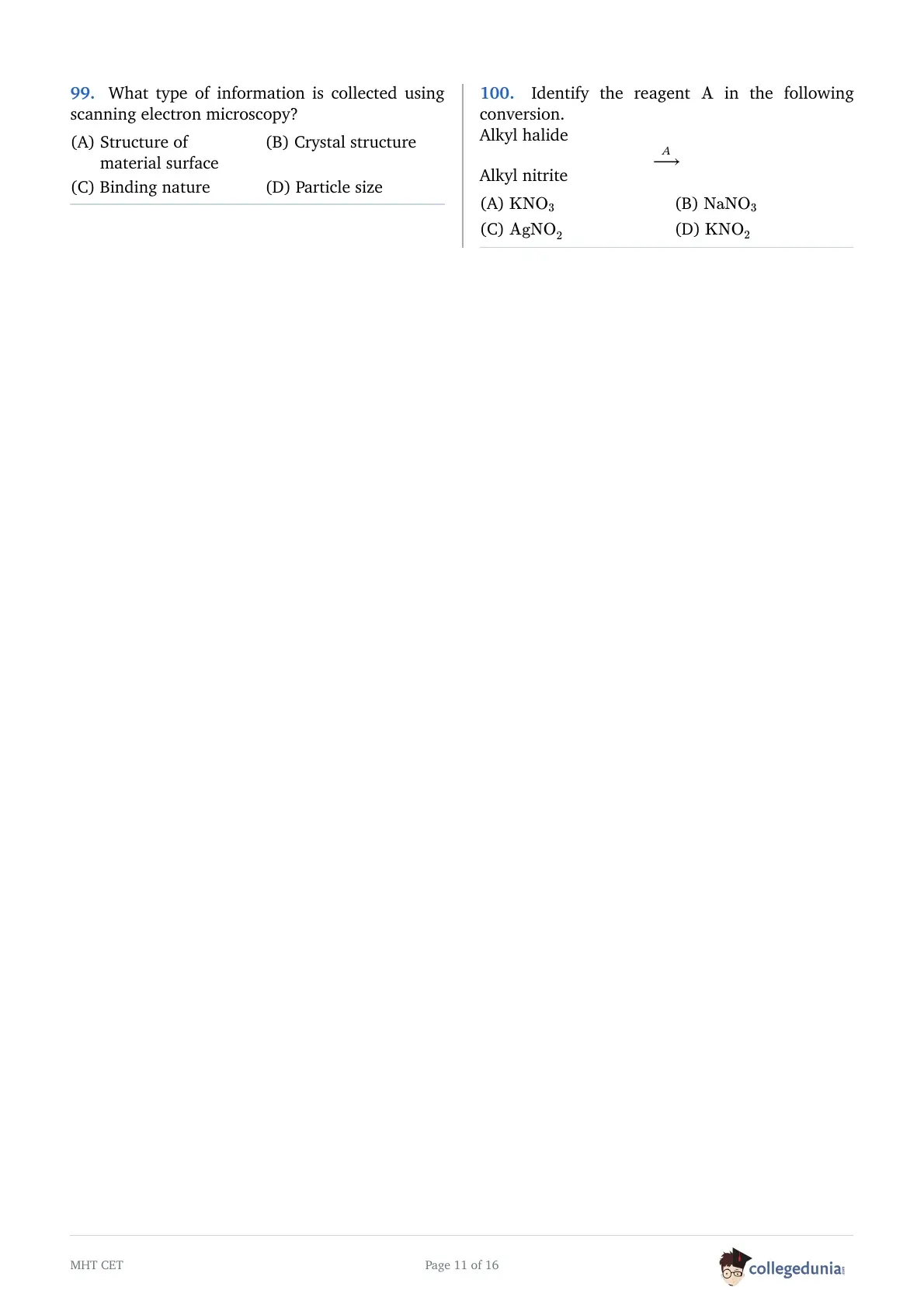
What type of information is collected using scanning electron microscopy?
Identify the reagent A in the following conversion.
Alkyl halide \(\rightarrow\) Alkyl nitrite
Mathematics (Q101 - Q150)
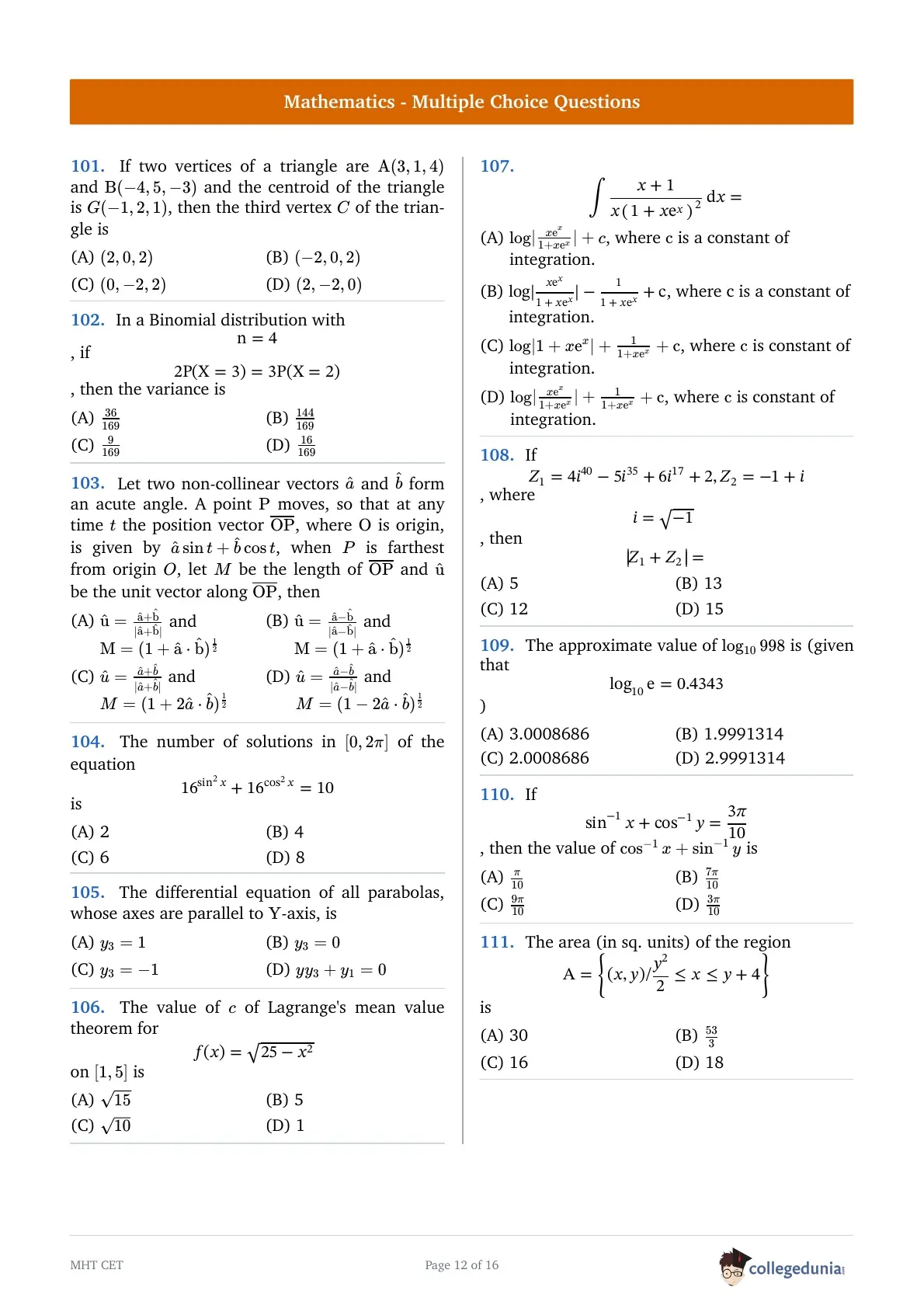
If two vertices of a triangle are \(A(3,1,4)\) and \(B(-4,5,-3)\) and the centroid of the triangle is \(G(-1,2,1),\) then the third vertex C of the triangle is
In a Binomial distribution with \(n=4\) if \(2P(X=3)=3P(X=2)\), then the variance is
Let two non-collinear vectors \(\hat{a}\) and \(\hat{b}\) form an acute angle. A point \(\mathrm{P}\) moves, so that at any time \(t\) the position vector \(\overline{\mathrm{OP}}\), where \(\mathrm{O}\) is origin, is given by \(\hat{a} \sin t+\hat{b} \cos t\), when \(P\) is farthest from origin \(O\), let \(M\) be the length of \(\overline{\mathrm{OP}}\) and \(\hat{\mathrm{u}}\) be the unit vector along \(\overline{\mathrm{OP}}\), then
The number of solutions in \([0,2\pi]\) of the equation \(16^{\sin^{2}x}+16^{\cos^{2}x}=10\) is
The differential equation of all parabolas, whose axes are parallel to Y-axis, is
The value of c of Lagrange's mean value theorem for \(f(x)=\sqrt{25-x^{2}}\) on \([1,5]\) is
\[\int \frac{x+1}{x\left(1+x \mathrm{e}^x\right)^2} \mathrm{~d} x=\]
If \(Z_{1}=4i^{40}-5i^{35}+6i^{17}+2\), \(Z_{2}=-1+i\) where \(i=\sqrt{-1}\), then \(|Z_{1}+Z_{2}|=\)
The approximate value of \(\log_{10} 998\) is (given that \(\log_{10}e=0.4343\))
If \(\sin^{-1}x+\cos^{-1}y=\frac{3\pi}{10}\), then the value of \(\cos^{-1}x+\sin^{-1}y\) is
The area (in sq. units) of the region bounded by the parabola \(x = \frac{y^2}{2}\) and the line \(x = y + 4\) is
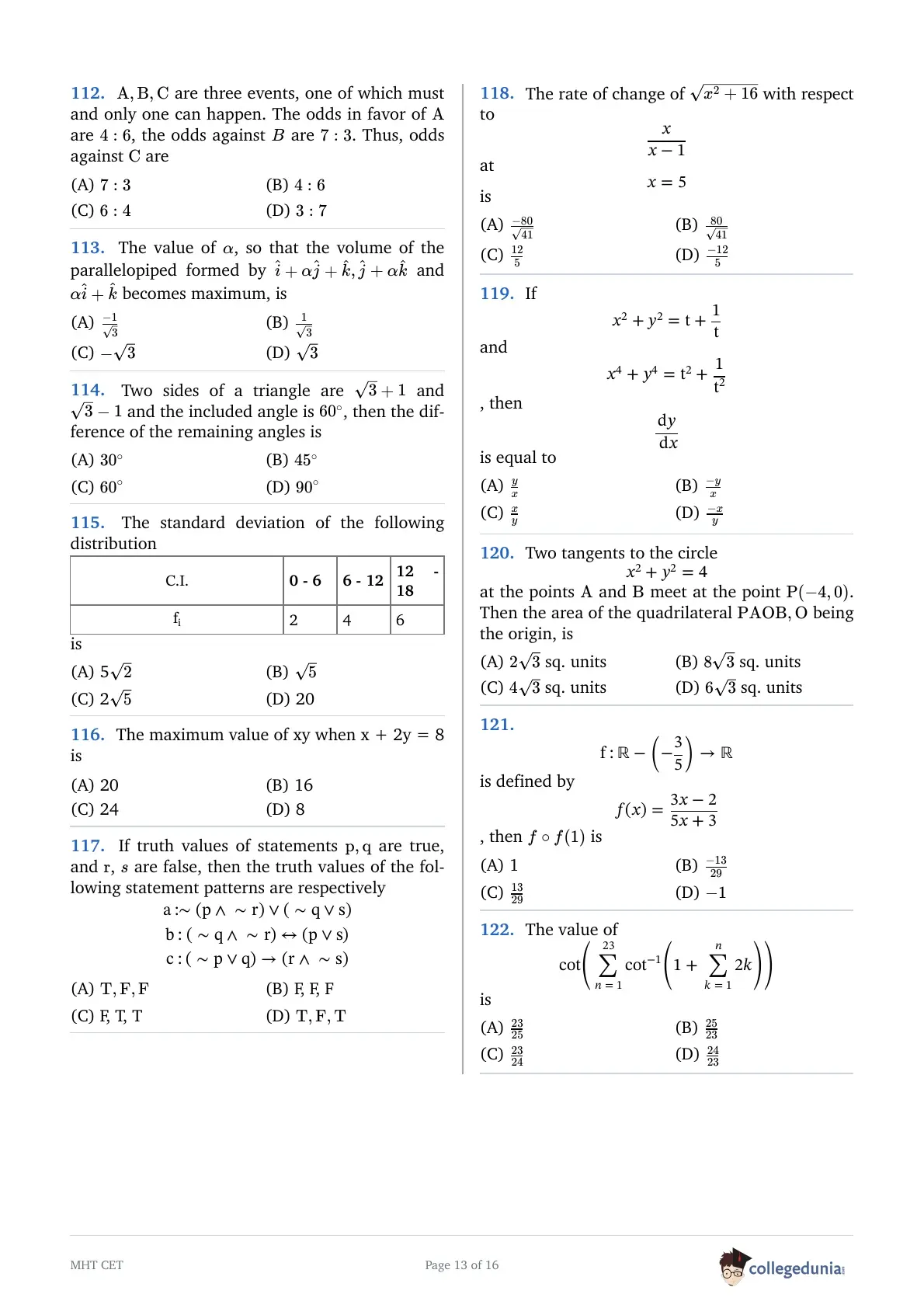
A, B, C are three events, one of which must and only one can happen. The odds in favor of A are \(4:6\), the odds against B are \(7:3\). Thus, odds against C are
The value of \(\alpha\), so that the volume of the parallelopiped formed by \(\hat{i}+\alpha \hat{j}+\hat{k}, \hat{j}+\alpha \hat{k}\) and \(\alpha \hat{i}+\hat{k}\) becomes maximum, is
Two sides of a triangle are \(\sqrt{3}+1\) and \(\sqrt{3}-1\) and the included angle is \(60^\circ\), then the difference of the remaining angles is
The standard deviation of the following distribution
| \[\mathrm{C.I.}\] | 0 - 6 | 6 - 12 | 12 - 18 |
|---|---|---|---|
| \[\mathrm{f_i}\] | 2 | 4 | 6 |
The maximum value of \(xy\) when \(x+2y=8\) is
If truth values of statements p, q are true, and r, s are false, then the truth values of the following statement patterns are respectively:
\(a:\sim(p\wedge\sim r)\vee(\sim q\vee s)\)
\(b:(\sim q\wedge\sim r)\leftrightarrow(p\vee s)\)
\(c:(\sim p\vee q)\rightarrow(r\wedge\sim s)\)
The rate of change of \(\sqrt{x^2+16}\) with respect to \(\frac{x}{x-1}\) at \(x=5\) is
If \(x^{2}+y^{2}=t+\frac{1}{t}\) and \(x^{4}+y^{4}=t^{2}+\frac{1}{t^{2}}\), then \(\frac{dy}{dx}\) is equal to
Two tangents to the circle \(x^{2}+y^{2}=4\) at the points A and B meet at the point \(P(-4,0)\). Then the area of the quadrilateral PAOB, O being the origin, is
If \(f(x)=\frac{3x-2}{5x+3}\) where \(f:\mathbb{R}-\{-\frac{3}{5}\}\rightarrow\mathbb{R}\) is defined, then \(f\circ f(1)\) is
The value of \(\cot\left(\sum_{n=1}^{23}\cot^{-1}\left(1+\sum_{k=1}^{n}2k\right)\right)\) is
An object is moving in the clockwise direction around the unit circle \(x^2+y^2=1\). As it passes through the point \(\left(\frac{1}{2}, \frac{\sqrt{3}}{2}\right)\), its \(y\)-co-ordinate is decreasing at the rate of 3 units per sec. The rate at which the \(x\)-co-ordinate changes at this point is
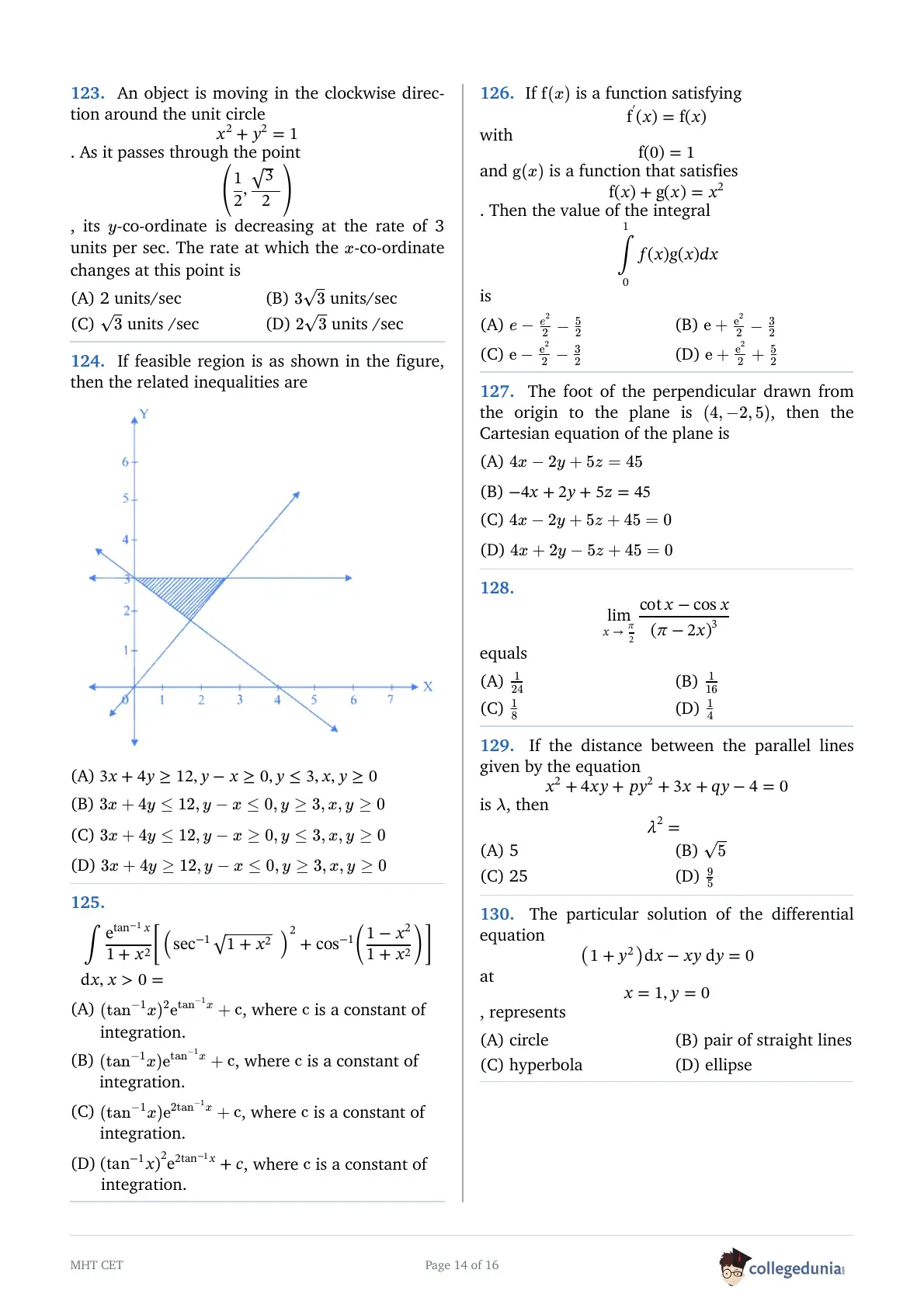
If feasible region is as shown in the figure, then the related inequalities are}

\(\int \frac{\mathrm{e}^{\tan ^{-1} x}}{1+x^2}\left[\left(\sec ^{-1} \sqrt{1+x^2}\right)^2+\cos ^{-1}\left(\frac{1-x^2}{1+x^2}\right)\right] \mathrm{d} x, x > 0=\)
If \(\mathrm{f}(x)\) is a function satisfying \(\mathrm{f}^{\prime}(x)=\mathrm{f}(x)\) with \(\mathrm{f}(0)=1\) and \(\mathrm{g}(x)\) is a function that satisfies \(\mathrm{f}(x)+\mathrm{g}(x)=x^2\). Then the value of the integral \(\int_\limits0^1 f(x) g(x) d x\) is
The foot of the perpendicular drawn from the origin to the plane is \((4,-2,5)\), then the Cartesian equation of the plane is
\(\lim _\limits{x \rightarrow \frac{\pi}{2}} \frac{\cot x-\cos x}{(\pi-2 x)^3}\) equals
If the distance between the parallel lines given by the equation \(x^{2}+4xy+py^{2}+3x+qy-4=0\) is \(\lambda\), then \(\lambda^{2}=\)
The particular solution of the differential equation \((1+y^{2})dx-xy \, dy=0\) at \(x=1\), \(y=0\), represents
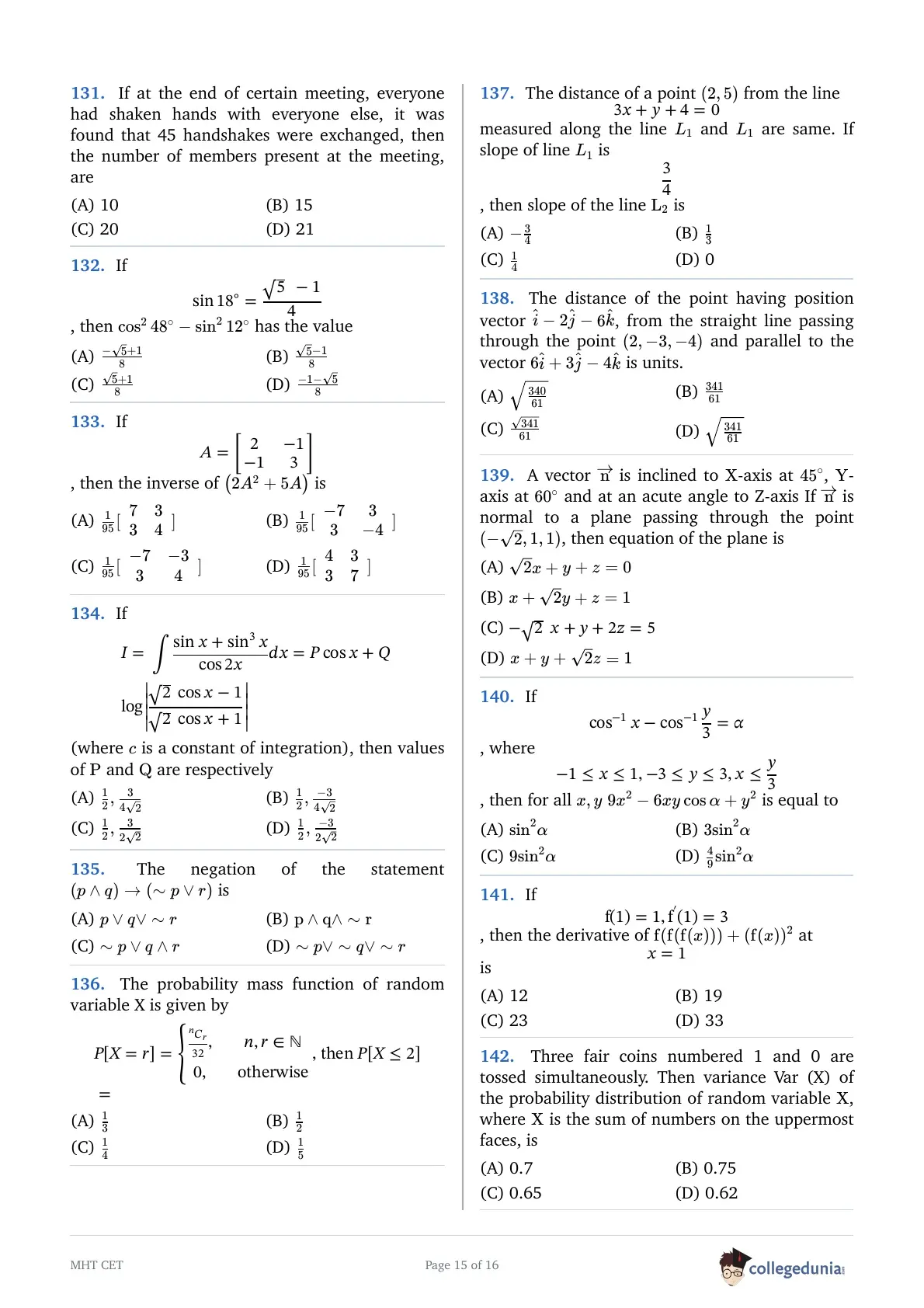
If at the end of certain meeting, everyone had shaken hands with everyone else, it was found that 45 handshakes were exchanged, then the number of members present at the meeting, are
If \(\sin 18^{\circ}=\frac{\sqrt{5}-1}{4}\), then \(\cos ^2 48^{\circ}-\sin ^2 12^{\circ}\) has the value
If \(A=\begin{bmatrix}2 & -1\\ -1 & 3\end{bmatrix}\), then the inverse of \((2A^{2}+5A)\) is
If \(I=\int \frac{\sin x+\sin ^3 x}{\cos 2 x} d x=P \cos x+Q \log \left|\frac{\sqrt{2} \cos x-1}{\sqrt{2} \cos x+1}\right|\) (where \(c\) is a constant of integration), then values of \(\mathrm{P}\) and \(\mathrm{Q}\) are respectively
The negation of the statement \((p\wedge q)\rightarrow(\sim p\vee r)\) is
The probability mass function of random variable X is given by
\[P[X=r]=\left\{\begin{array}{ll}
\frac{{ }^n C_r}{32}, & n, r \in \mathbb{N} \\
0, & \text { otherwise }
\end{array} \text {, then } P[X \leq 2]=\right.\]
The distance of a point (2, 5) from the line \(3x+y+4=0\) measured along the line \(L_{1}\) and \(L_{2}\) are same. If slope of line \(L_{1}\) is \(\frac{3}{4}\), then slope of the line \(L_{2}\) is
The distance of the point having position vector \(\hat{i}-2 \hat{j}-6 \hat{k}\), from the straight line passing through the point \((2,-3,-4)\) and parallel to the vector \(6 \hat{i}+3 \hat{j}-4 \hat{k}\) is units.
A vector \(\vec{n}\) is inclined to X-axis at 45°, Y-axis at 60° and at an acute angle to Z-axis. If \(\vec{n}\) is normal to a plane passing through the point \((-\sqrt{2},1,1)\) then equation of the plane is
If \(\cos^{-1}x-\cos^{-1}\frac{y}{3}=\alpha\), where \(-1\le x\le1\), \(-3\le y\le3\), \(x\le\frac{y}{3}\), then for all \(x, y\), \(9x^{2}-6xy\cos\alpha+y^{2}\) is equal to
If \(f(1)=1\), \(f^{\prime}(1)=3\), then the derivative of \(f(f(f(x)))+(f(x))^{2}\) at \(x=1\) is
Three fair coins numbered 1 and 0 are tossed simultaneously. Then variance Var (X) of the probability distribution of random variable \[\mathrm{X}\], where \[\mathrm{X}\] is the sum of numbers on the uppermost faces, is
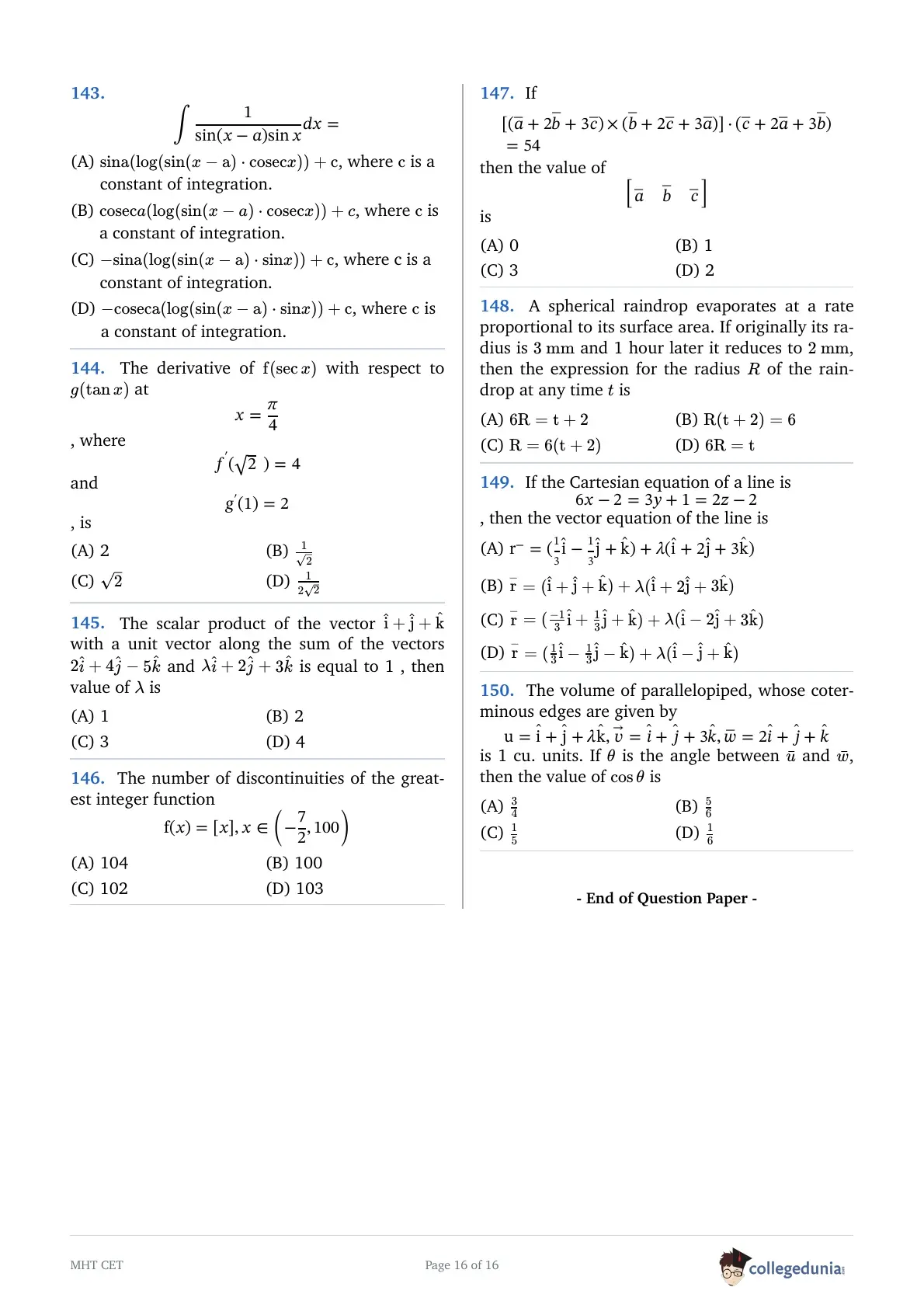
\(\int\frac{1}{\sin(x-a)\sin x}dx=\)
The derivative of \(\mathrm{f}(\sec x)\) with respect to \(g(\tan x)\) at \(x=\frac{\pi}{4}\), where \(f^{\prime}(\sqrt{2})=4\) and \(g^{\prime}(1)=2\), is
The scalar product of the vector \(\hat{i}+\hat{j}+\hat{k}\) with a unit vector along the sum of the vectors \(2\hat{i}+4\hat{j}-5\hat{k}\) and \(\lambda\hat{i}+2\hat{j}+3\hat{k}\) is equal to 1, then value of \(\lambda\) is
The number of discontinuities of the greatest integer function \(f(x)=[x]\), \(x\in(-\frac{7}{2},100)\)
If \([(\overline{a}+2\overline{b}+3\overline{c})\times(\overline{b}+2\overline{c}+3\overline{a})]\cdot(\overline{c}+2\overline{a}+3\overline{b})=54\) then the value of \([\overline{a}\overline{b}\overline{c}]\) is
A spherical raindrop evaporates at a rate proportional to its surface area. If originally its radius is 3 mm and 1 hour later it reduces to 2 mm, then the expression for the radius R of the raindrop at any time t is
If the Cartesian equation of a line is \(6x-2=3y+1=2z-2\), then the vector equation of the line is
The volume of parallelopiped, whose coterminous edges are given by \(\overline{u}=\hat{i}+\hat{j}+\lambda\hat{k}, \vec{v}=\hat{i}+\hat{j}+3\hat{k}, \overline{w}=2\hat{i}+\hat{j}+\hat{k}\) is 1 cu. units. If \(\theta\) is the angle between \(\overline{u}\) and \(\overline{w}\), then the value of \(\cos\theta\) is
MHT CET 2023 PCM Exam Pattern and Marking Scheme
| Parameter | Details |
|---|---|
| Conducting Body | Maharashtra Common Entrance Test Cell (Maharashtra CET Cell) |
| Exam Mode | Online (Computer-Based Test) |
| Duration | 180 minutes (3 hours) |
| Groups / Subjects | PCM (Physics, Chemistry, Mathematics) for Engineering |
| Total Questions |
150 |
| Total Marks | 200 |
| Question Type | Multiple Choice Questions (MCQs) |
| Marks Distribution |
|
| Negative Marking | No |
| Syllabus Weightage |
|



Comments