




MHT CET 2023 May 9 Shift 2 PCM Question Paper is available for download here. Maharashtra State CET Cell conducted MHT CET 2023 PCM Exam on May 9 in Shift 2 from 2 PM to 5 PM in CBT mode.
The MHT CET 2023 PCM question paper includes the following:
- The MHT CET 2023 PCM Question Paper consists of 150 multiple-choice questions (MCQs) totalling 200 marks divided into 3 sections: Physics, Chemistry, and Mathematics, with 50 questions in each subject.
- Physics and Chemistry questions carry 1 mark each while Mathematics questions carry 2 marks each.
- There is no negative marking for incorrect answers.
MHT CET 2023 May 9 Shift 2 PCM Question Paper with Solution PDF
| CD PDF | CD PDF with Solutions |
|---|---|
| Download Collegedunia PDF 1.11 MB | - |
Also Check:
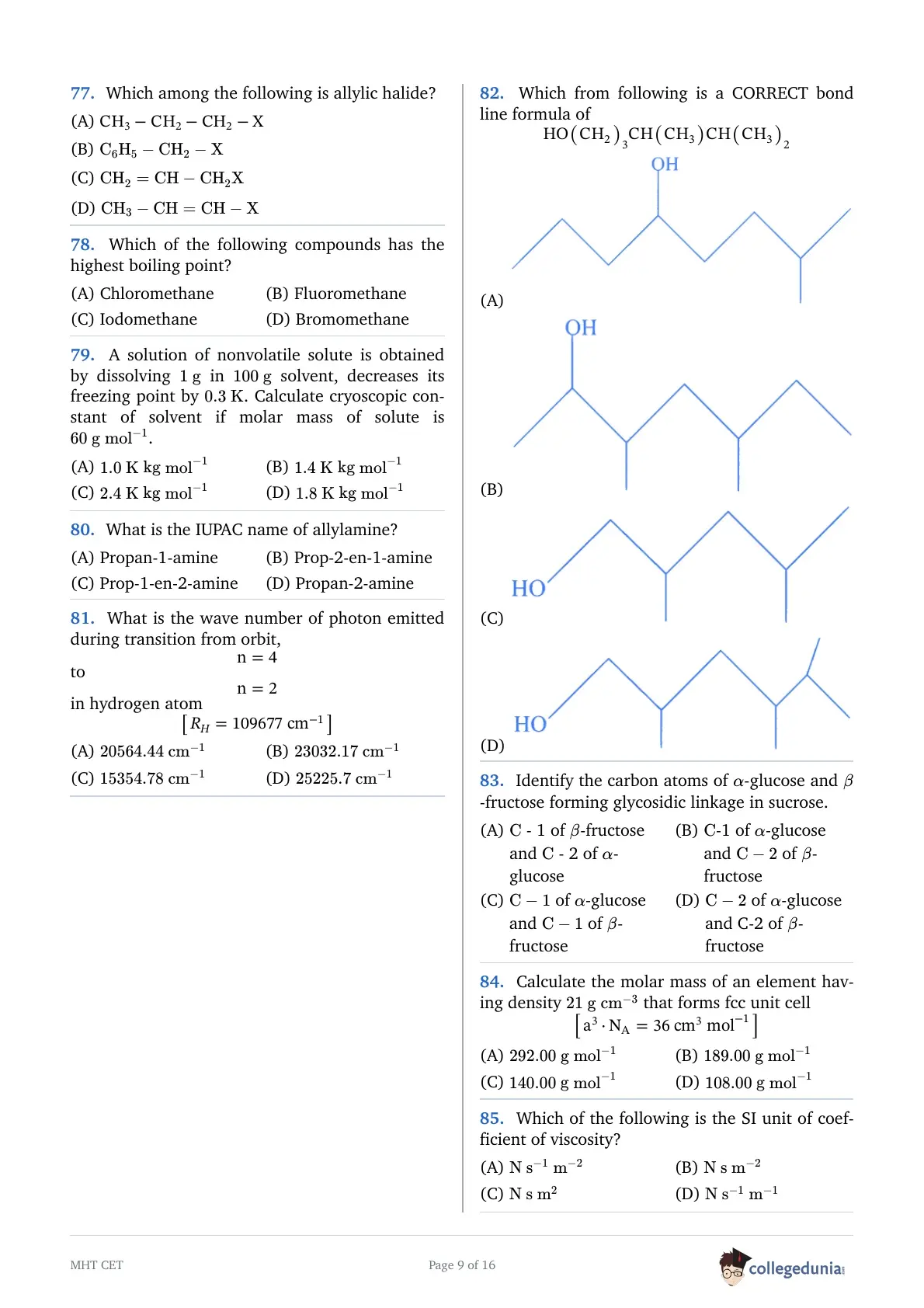
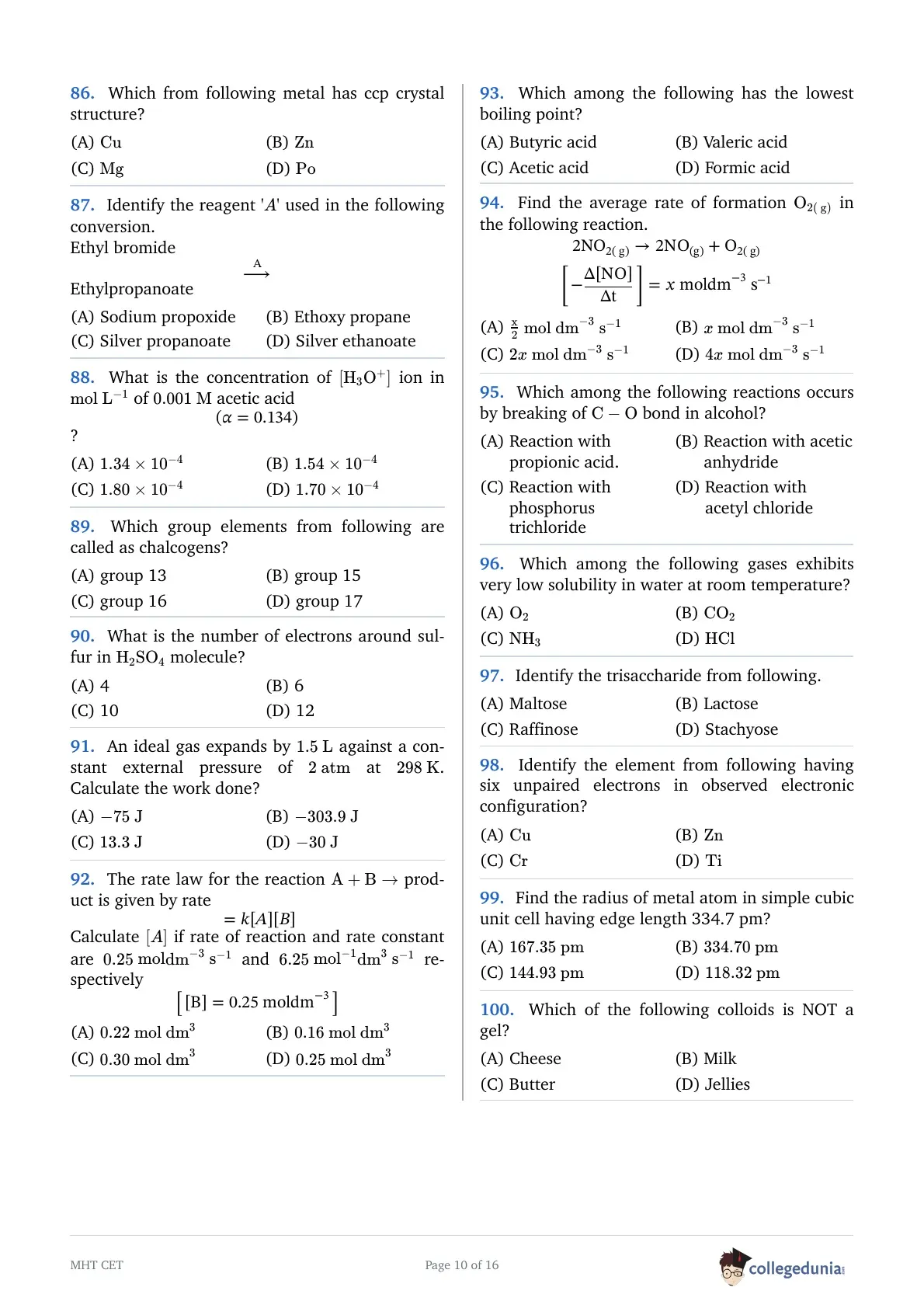
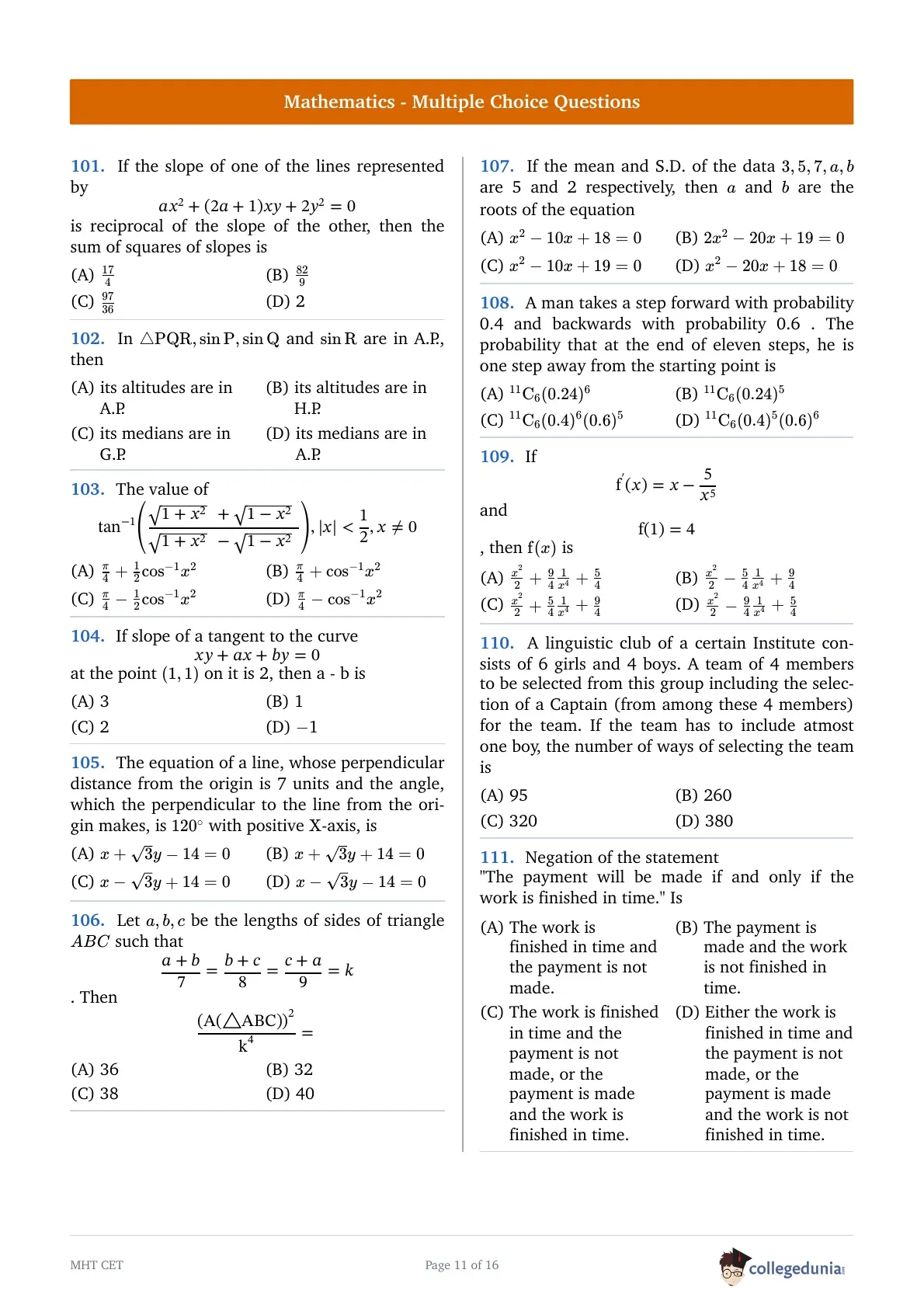
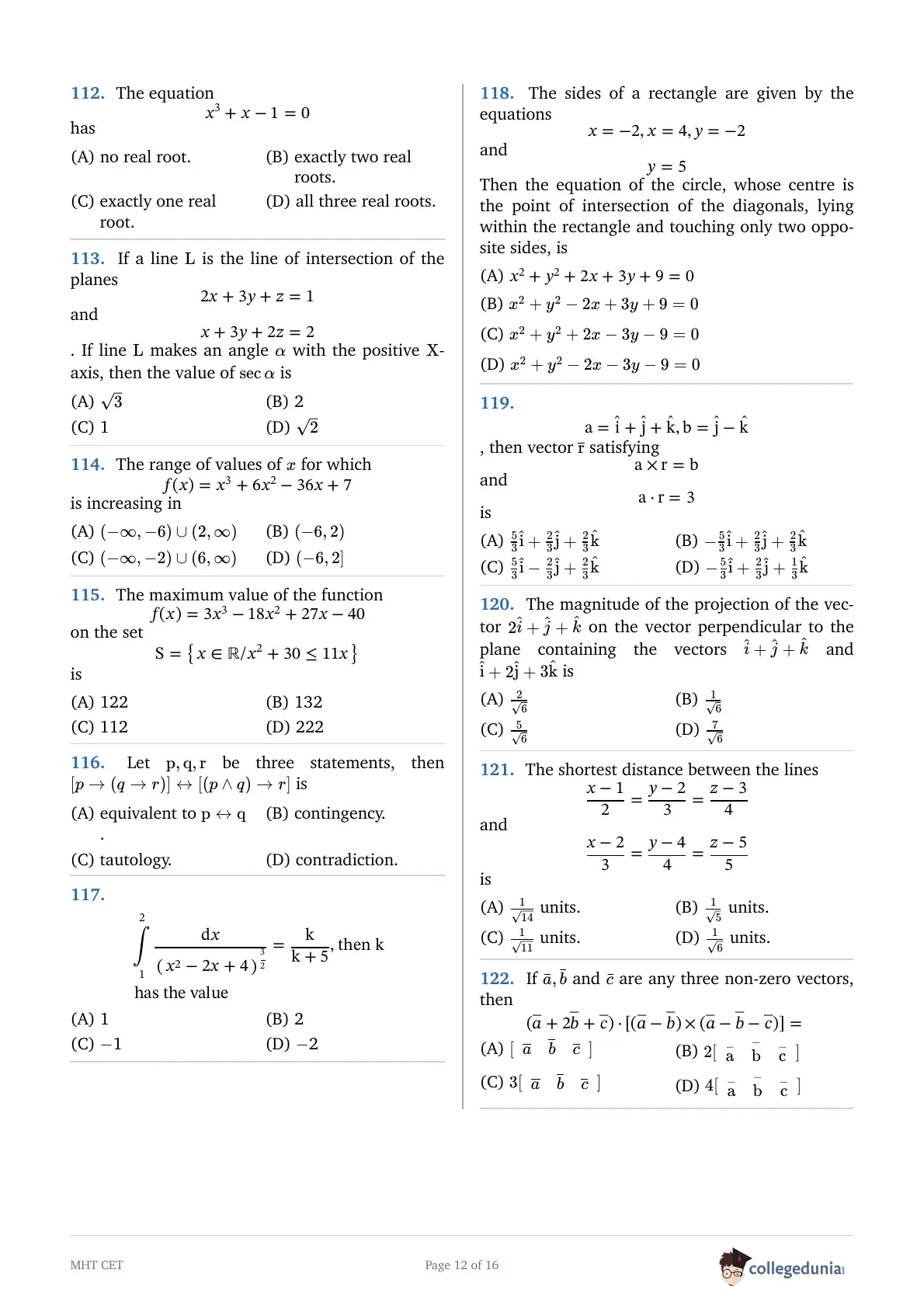
MHT CET 2023 May 9 Shift 2 PCM Questions with Solutions
Physics (Q1 - Q50)
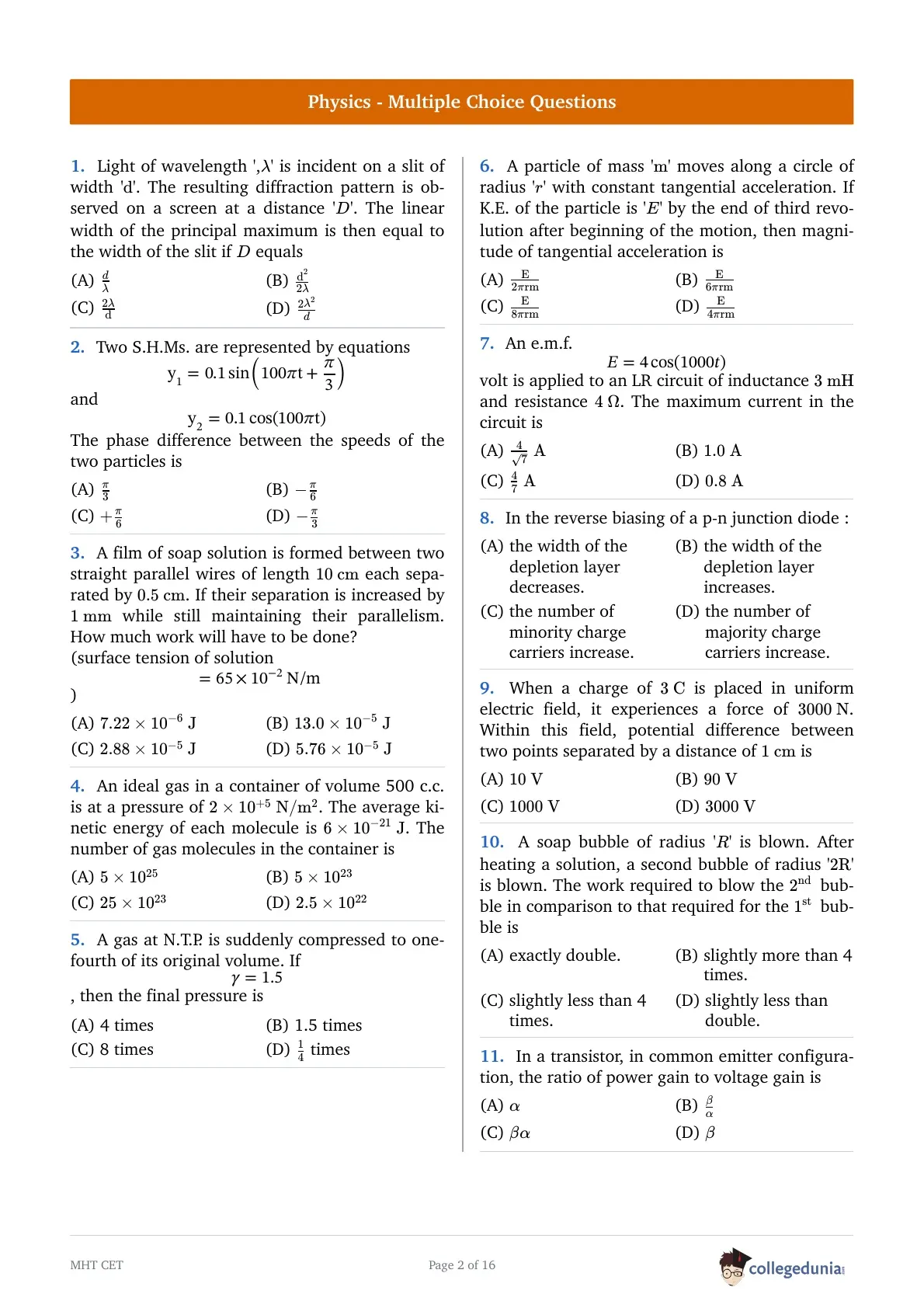
Light of wavelength ',\[\lambda\]' is incident on a slit of width '\[\mathrm{d}\]'. The resulting diffraction pattern is observed on a screen at a distance '\[D\]'. The linear width of the principal maximum is then equal to the width of the slit if \[D\] equals
Two S.H.Ms. are represented by equations \[\mathrm{y}_1=0.1 \sin \left(100 \pi \mathrm{t}+\frac{\pi}{3}\right)\] and \[\mathrm{y}_2=0.1 \cos (100 \pi \mathrm{t})\] The phase difference between the speeds of the two particles is
A film of soap solution is formed between two straight parallel wires of length \[10 \mathrm{~cm}\] each separated by \[0.5 \mathrm{~cm}\]. If their separation is increased by \[1 \mathrm{~mm}\] while still maintaining their parallelism. How much work will have to be done?
(surface tension of solution \[=65 \times 10^{-2} \mathrm{~N} / \mathrm{m}\] )
An ideal gas in a container of volume 500 c.c. is at a pressure of \[2 \times 10^{+5} \mathrm{~N} / \mathrm{m}^2\]. The average kinetic energy of each molecule is \[6 \times 10^{-21} \mathrm{~J}\]. The number of gas molecules in the container is
A gas at N.T.P. is suddenly compressed to onefourth of its original volume. If \[\gamma=1.5\], then the final pressure is
A particle of mass '\[\mathrm{m}\]' moves along a circle of radius '\[r\]' with constant tangential acceleration. If K.E. of the particle is '\[E\]' by the end of third revolution after beginning of the motion, then magnitude of tangential acceleration is
An e.m.f. \[E=4 \cos (1000 t)\] volt is applied to an LR circuit of inductance \[3 \mathrm{~mH}\] and resistance \[4 ~\Omega\]. The maximum current in the circuit is
When a charge of \[3 ~\mathrm{C}\] is placed in uniform electric field, it experiences a force of \[3000 \mathrm{~N}\]. Within this field, potential difference between two points separated by a distance of \[1 \mathrm{~cm}\] is
A soap bubble of radius '\[R\]' is blown. After heating a solution, a second bubble of radius '\[2 \mathrm{R}\]' is blown. The work required to blow the \[2^{\text {nd }}\] bubble in comparison to that required for the \[1^{\text {st }}\] bubble is
In a transistor, in common emitter configuration, the ratio of power gain to voltage gain is
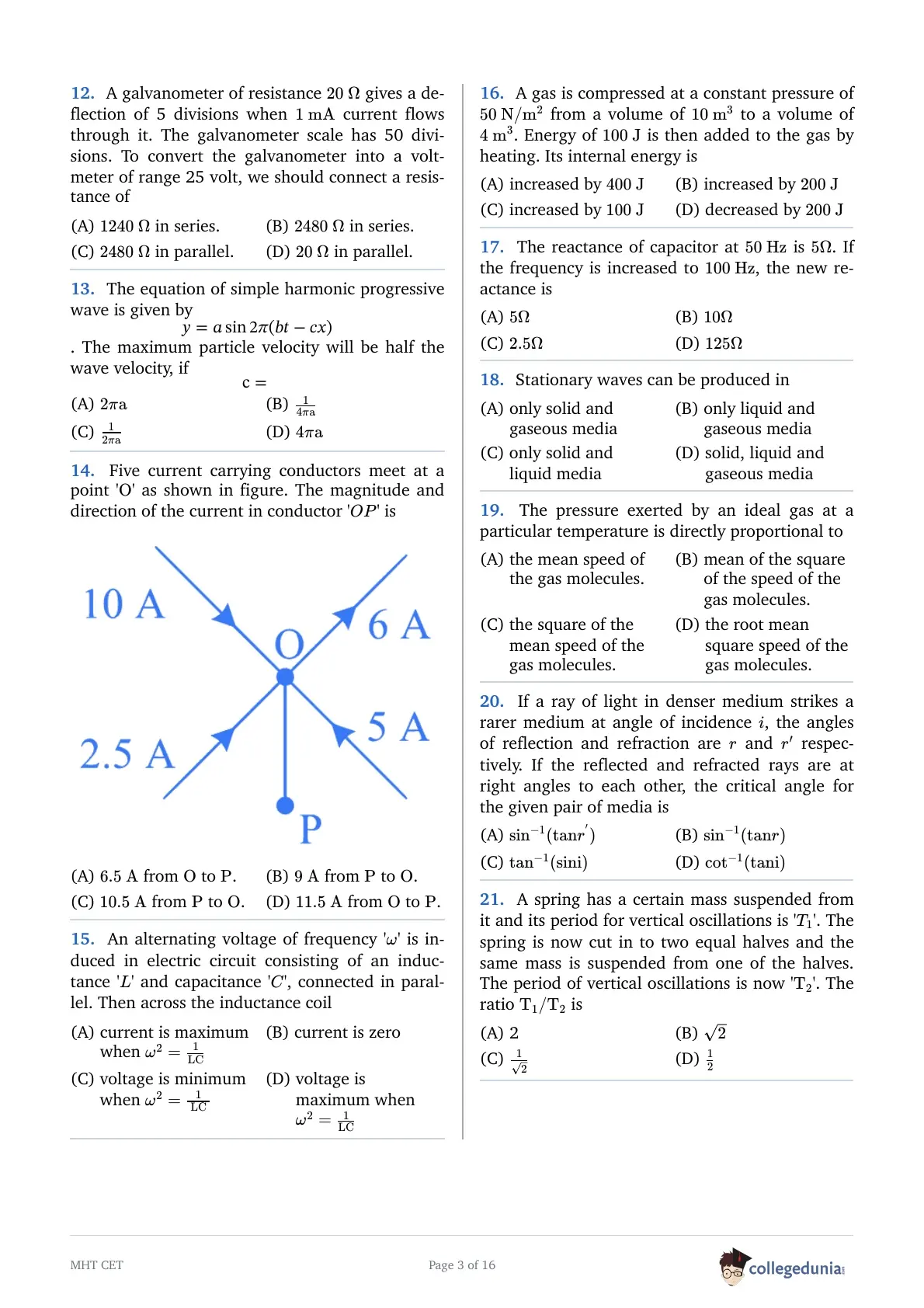
A galvanometer of resistance \[20 ~\Omega\] gives a deflection of 5 divisions when \[1 \mathrm{~mA}\] current flows through it. The galvanometer scale has 50 divisions. To convert the galvanometer into a voltmeter of range 25 volt, we should connect a resistance of
The equation of simple harmonic progressive wave is given by \[y=a \sin 2 \pi(b t-c x)\]. The maximum particle velocity will be half the wave velocity, if \[\mathrm{c}=\]
Five current carrying conductors meet at a point '\[\mathrm{O}\]' as shown in figure. The magnitude and direction of the current in conductor '\[O P\]' is

An alternating voltage of frequency '\[\omega\]' is induced in electric circuit consisting of an inductance '\[L\]' and capacitance '\[C\]', connected in parallel. Then across the inductance coil
A gas is compressed at a constant pressure of \[50 \mathrm{~N} / \mathrm{m}^2\] from a volume of \[10 \mathrm{~m}^3\] to a volume of \[4 \mathrm{~m}^3\]. Energy of \[100 \mathrm{~J}\] is then added to the gas by heating. Its internal energy is
The reactance of capacitor at \[50 \mathrm{~Hz}\] is \[5 \Omega\]. If the frequency is increased to \[100 \mathrm{~Hz}\], the new reactance is
The pressure exerted by an ideal gas at a particular temperature is directly proportional to
If a ray of light in denser medium strikes a rarer medium at angle of incidence \[i\], the angles of reflection and refraction are \[r\] and \[r^{\prime}\] respectively. If the reflected and refracted rays are at right angles to each other, the critical angle for the given pair of media is
A spring has a certain mass suspended from it and its period for vertical oscillations is '\[T_1\]'. The spring is now cut in to two equal halves and the same mass is suspended from one of the halves. The period of vertical oscillations is now '\[\mathrm{T}_2\]'. The ratio \[\mathrm{T}_1 / \mathrm{T}_2\] is
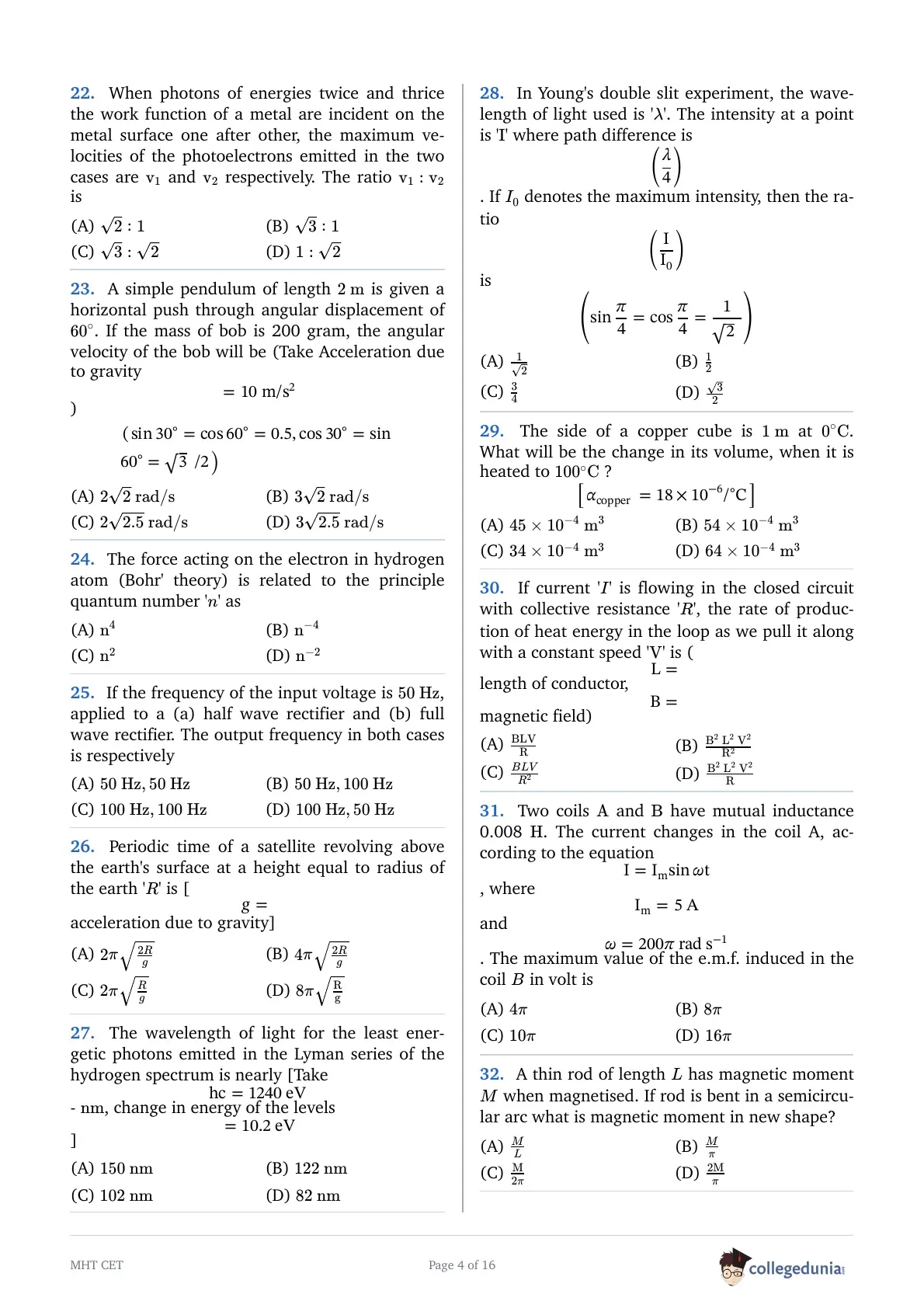
When photons of energies twice and thrice the work function of a metal are incident on the metal surface one after other, the maximum velocities of the photoelectrons emitted in the two cases are \[\mathrm{v}_1\] and \[\mathrm{v}_2\] respectively. The ratio \[\mathrm{v}_1: \mathrm{v}_2\] is
A simple pendulum of length \[2 \mathrm{~m}\] is given a horizontal push through angular displacement of \[60^{\circ}\]. If the mass of bob is 200 gram, the angular velocity of the bob will be (Take Acceleration due to gravity \[=10 \mathrm{~m} / \mathrm{s}^2\] ) \[\left(\sin 30^{\circ}=\cos 60^{\circ}=0.5, \cos 30^{\circ}=\sin 60^{\circ}=\sqrt{3} / 2\right)\]
The force acting on the electron in hydrogen atom (Bohr' theory) is related to the principle quantum number '\[n\]' as
If the frequency of the input voltage is \[50 \mathrm{~Hz}\], applied to a (a) half wave rectifier and (b) full wave rectifier. The output frequency in both cases is respectively
Periodic time of a satellite revolving above the earth's surface at a height equal to radius of the earth '\[R\]' is [ \[g=\] acceleration due to gravity]
The wavelength of light for the least energetic photons emitted in the Lyman series of the hydrogen spectrum is nearly [Take \[\mathrm{hc}=1240 ~\mathrm{eV}\] - \[\mathrm{nm}\], change in energy of the levels \[=10.2 ~\mathrm{eV}\] ]
In Young's double slit experiment, the wavelength of light used is '\[\lambda\]'. The intensity at a point is '\[\mathrm{I}\]' where path difference is \[\left(\frac{\lambda}{4}\right)\]. If \[I_0\] denotes the maximum intensity, then the ratio \[\left(\frac{\mathrm{I}}{\mathrm{I}_0}\right)\] is
\[\left(\sin \frac{\pi}{4}=\cos \frac{\pi}{4}=\frac{1}{\sqrt{2}}\right)\]
The side of a copper cube is \[1 \mathrm{~m}\] at \[0^{\circ} \mathrm{C}\]. What will be the change in its volume, when it is heated to \[100^{\circ} \mathrm{C}\] ? \[\left[\alpha_{\text {copper }}=18 \times 10^{-6} /{ }^{\circ} \mathrm{C}\right]\]
If current '\[I\]' is flowing in the closed circuit with collective resistance '\[R\]', the rate of production of heat energy in the loop as we pull it along with a constant speed '\[\mathrm{V}\]' is ( \[\mathrm{L}=\] length of conductor, \[\mathrm{B}=\] magnetic field)
Two coils \[\mathrm{A}\] and \[\mathrm{B}\] have mutual inductance 0.008 \[\mathrm{H}\]. The current changes in the coil A, according to the equation \[\mathrm{I}=\mathrm{I}_{\mathrm{m}} \sin \omega \mathrm{t}\], where \[\mathrm{I}_{\mathrm{m}}=5 \mathrm{~A}\] and \[\omega=200 \pi ~\mathrm{rad} ~\mathrm{s}^{-1}\]. The maximum value of the e.m.f. induced in the coil \[B\] in volt is
A thin rod of length \[L\] has magnetic moment \[M\] when magnetised. If rod is bent in a semicircular arc what is magnetic moment in new shape?
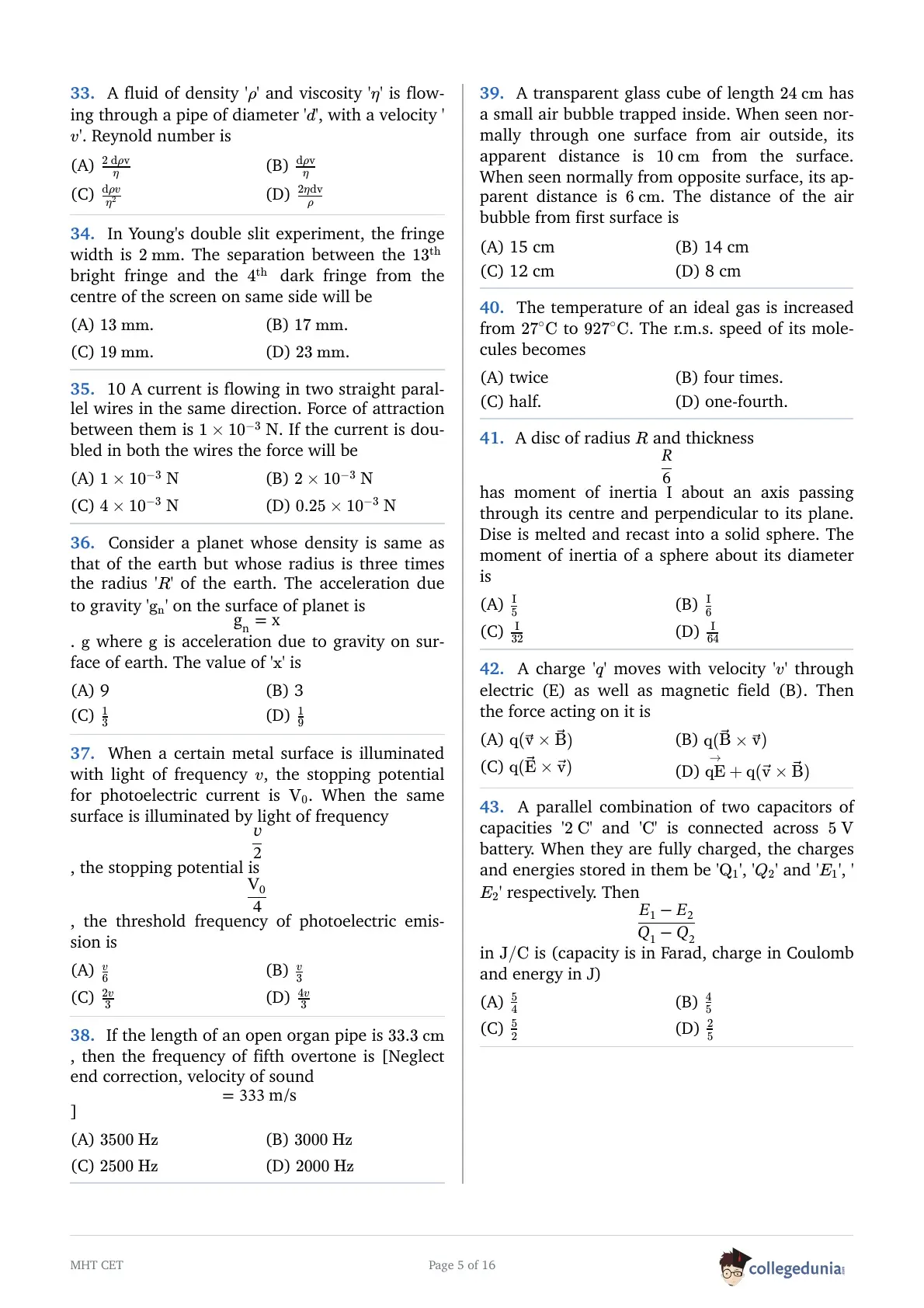
A fluid of density '\[\rho\]' and viscosity '\[\eta\]' is flowing through a pipe of diameter '\[d\]', with a velocity '\[v\]'. Reynold number is
In Young's double slit experiment, the fringe width is \[2 \mathrm{~mm}\]. The separation between the \[13^{\text {th }}\] bright fringe and the \[4^{\text {th }}\] dark fringe from the centre of the screen on same side will be
10 A current is flowing in two straight parallel wires in the same direction. Force of attraction between them is \[1 \times 10^{-3} \mathrm{~N}\]. If the current is doubled in both the wires the force will be
Consider a planet whose density is same as that of the earth but whose radius is three times the radius '\[R\]' of the earth. The acceleration due to gravity '\[\mathrm{g}_{\mathrm{n}}\]' on the surface of planet is \[\mathrm{g}_{\mathrm{n}}=\mathrm{x}\]. \[\mathrm{g}\] where \[\mathrm{g}\] is acceleration due to gravity on surface of earth. The value of '\[\mathrm{x}\]' is
When a certain metal surface is illuminated with light of frequency \[v\], the stopping potential for photoelectric current is \[\mathrm{V}_0\]. When the same surface is illuminated by light of frequency \[\frac{v}{2}\], the stopping potential is \[\frac{\mathrm{V}_0}{4}\], the threshold frequency of photoelectric emission is
If the length of an open organ pipe is \[33.3 \mathrm{~cm}\], then the frequency of fifth overtone is [Neglect end correction, velocity of sound \[=333 \mathrm{~m} / \mathrm{s}\] ]
A transparent glass cube of length \[24 \mathrm{~cm}\] has a small air bubble trapped inside. When seen normally through one surface from air outside, its apparent distance is \[10 \mathrm{~cm}\] from the surface. When seen normally from opposite surface, its apparent distance is \[6 \mathrm{~cm}\]. The distance of the air bubble from first surface is
The temperature of an ideal gas is increased from \[27^{\circ} \mathrm{C}\] to \[927^{\circ} \mathrm{C}\]. The r.m.s. speed of its molecules becomes
A disc of radius \[R\] and thickness \[\frac{R}{6}\] has moment of inertia I about an axis passing through its centre and perpendicular to its plane. Dise is melted and recast into a solid sphere. The moment of inertia of a sphere about its diameter is
A charge '\[q\]' moves with velocity '\[v\]' through electric (E) as well as magnetic field (B). Then the force acting on it is
A parallel combination of two capacitors of capacities '\[2 ~\mathrm{C}\]' and '\[\mathrm{C}\]' is connected across \[5 \mathrm{~V}\] battery. When they are fully charged, the charges and energies stored in them be '\[\mathrm{Q}_1\]', '\[Q_2\]' and '\[E_1\]', '\[E_2\]' respectively. Then \[\frac{E_1-E_2}{Q_1-Q_2}\] in \[\mathrm{J} / \mathrm{C}\] is (capacity is in Farad, charge in Coulomb and energy in J)
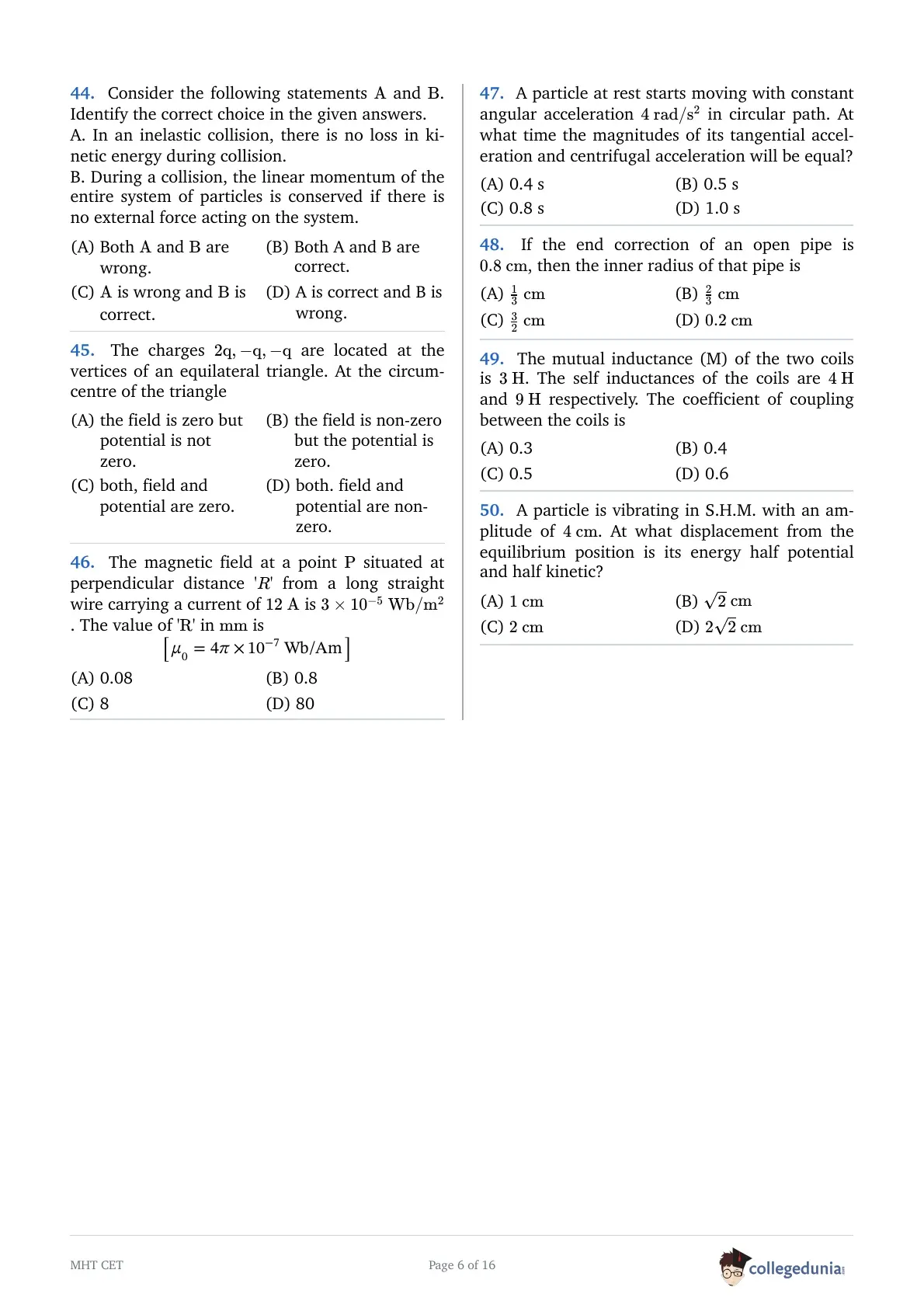
Consider the following statements \[\mathrm{A}\] and \[\mathrm{B}\]. Identify the correct choice in the given answers.
A. In an inelastic collision, there is no loss in kinetic energy during collision.
B. During a collision, the linear momentum of the entire system of particles is conserved if there is no external force acting on the system.
The charges \[2 \mathrm{q},-\mathrm{q},-\mathrm{q}\] are located at the vertices of an equilateral triangle. At the circumcentre of the triangle
The magnetic field at a point \[\mathrm{P}\] situated at perpendicular distance '\[R\]' from a long straight wire carrying a current of \[12 \mathrm{~A}\] is \[3 \times 10^{-5} \mathrm{~Wb} / \mathrm{m}^2\]. The value of '\[\mathrm{R}\]' in \[\mathrm{mm}\] is \[\left[\mu_0=4 \pi \times 10^{-7} \mathrm{~Wb} / \mathrm{Am}\right]\]
A particle at rest starts moving with constant angular acceleration \[4 ~\mathrm{rad} / \mathrm{s}^2\] in circular path. At what time the magnitudes of its tangential acceleration and centrifugal acceleration will be equal?
If the end correction of an open pipe is \[0.8 \mathrm{~cm}\], then the inner radius of that pipe is
The mutual inductance (M) of the two coils is \[3 ~\mathrm{H}\]. The self inductances of the coils are \[4 ~\mathrm{H}\] and \[9 ~\mathrm{H}\] respectively. The coefficient of coupling between the coils is
A particle is vibrating in S.H.M. with an amplitude of \[4 \mathrm{~cm}\]. At what displacement from the equilibrium position is its energy half potential and half kinetic?
Chemistry (Q51 - Q100)
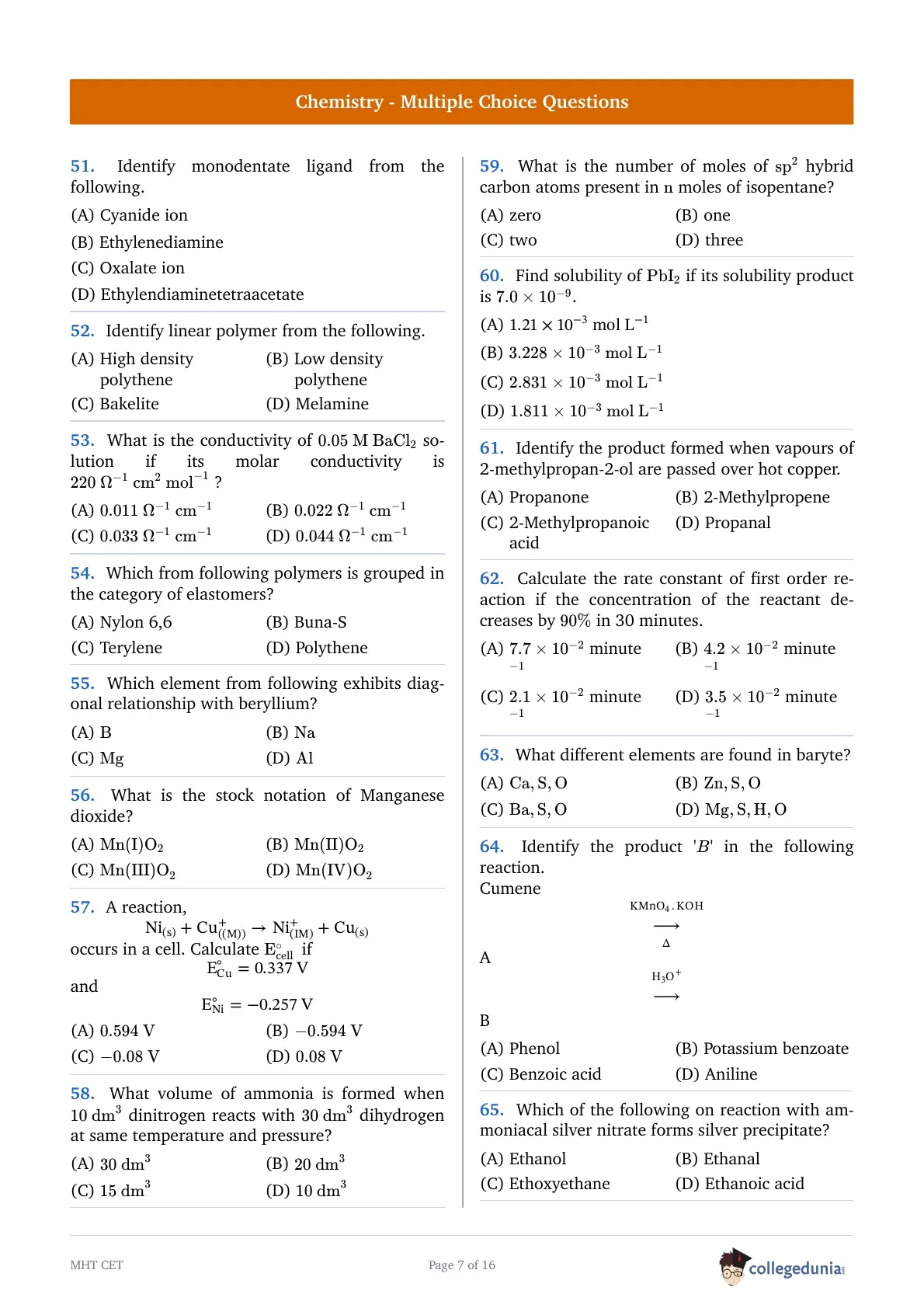
What is the conductivity of \[0.05 ~\mathrm{M} ~\mathrm{BaCl}_2\] solution if its molar conductivity is \[220 ~\Omega^{-1} \mathrm{~cm}^2 \mathrm{~mol}^{-1}\] ?
Which from following polymers is grouped in the category of elastomers?
Which element from following exhibits diagonal relationship with beryllium?
A reaction, \[\mathrm{Ni}_{(\mathrm{s})}+\mathrm{Cu}_{(\mathrm{(M)})}^{+} \rightarrow \mathrm{Ni}_{(\mathrm{IM})}^{+}+\mathrm{Cu}_{(\mathrm{s})}\] occurs in a cell. Calculate \[\mathrm{E}_{\text {cell }}^{\circ}\] if \[\mathrm{E}_{\mathrm{Cu}}^{\circ}=0.337 \mathrm{~V}\] and \[\mathrm{E}_{\mathrm{Ni}}^{\circ}=-0.257 \mathrm{~V}\]
What volume of ammonia is formed when \[10 ~\mathrm{dm}^3\] dinitrogen reacts with \[30 ~\mathrm{dm}^3\] dihydrogen at same temperature and pressure?
What is the number of moles of \[\mathrm{sp}^2\] hybrid carbon atoms present in \[\mathrm{n}\] moles of isopentane?
Find solubility of \[\mathrm{PbI}_2\] if its solubility product is \[7.0 \times 10^{-9}\].
Identify the product formed when vapours of 2-methylpropan-2-ol are passed over hot copper.
Calculate the rate constant of first order reaction if the concentration of the reactant decreases by \[90 \%\] in 30 minutes.
Identify the product '\[B\]' in the following reaction.
Cumene \[\mathrm{\mathrel{\mathop{\kern0pt\longrightarrow} \limits_\Delta ^{KMn{O_4}\,.\,KOH}}}\] A \[\mathrm{\mathrel{\mathop{\kern0pt\longrightarrow} \limits_{}^{{H_3}{O^ + }}}}\] B
Which of the following on reaction with ammoniacal silver nitrate forms silver precipitate?
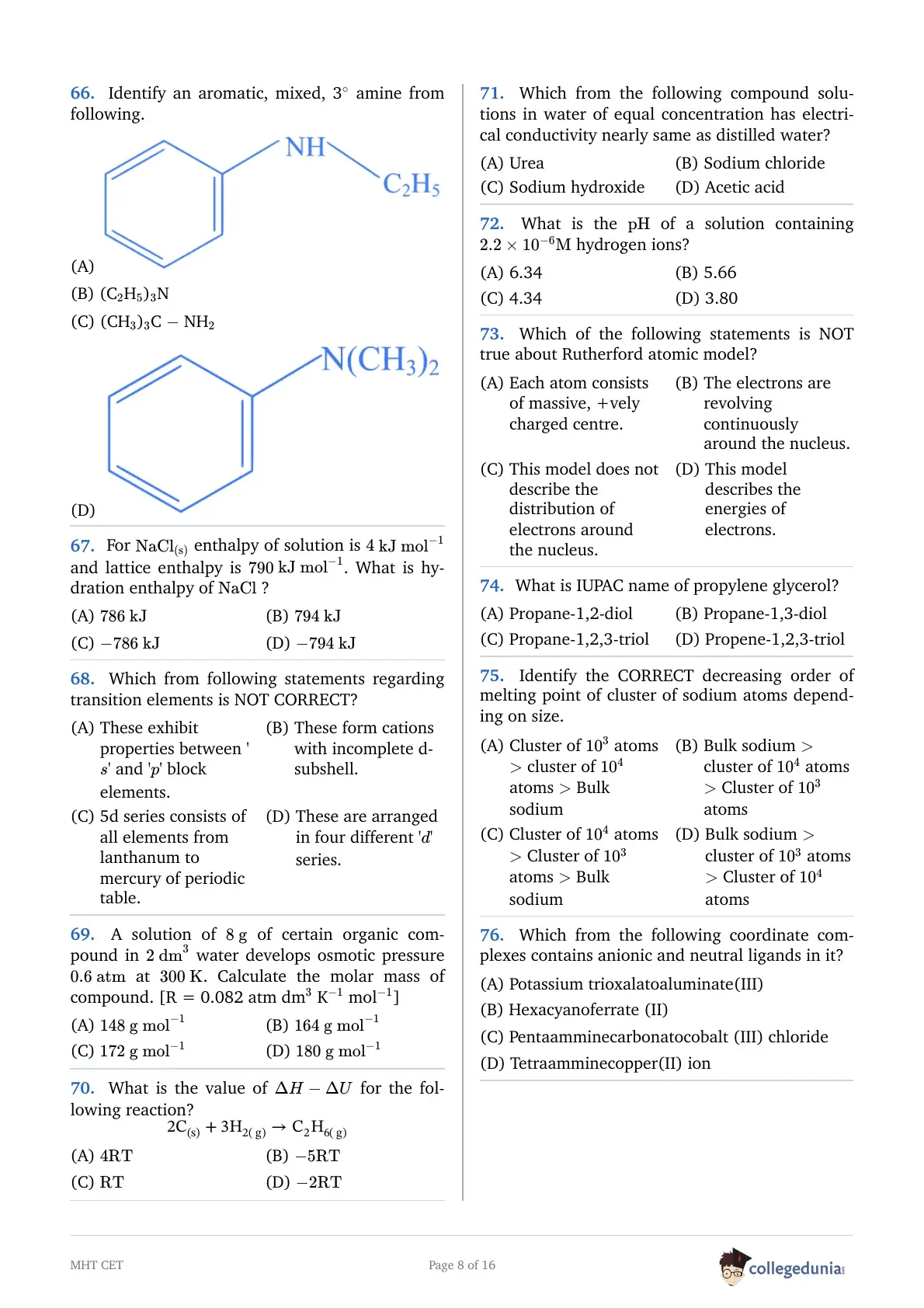
Identify an aromatic, mixed, 3\[^\circ\] amine from following.
- (A)
![]()
- (B) (C\({}_{2}\)H\({}_{5}\))\({}_{3}\)N
- (C) (CH\({}_{3}\))\({}_{3}\)C \(-\) NH\({}_{2}\)
- (D)
![]()


For \[\mathrm{NaCl}_{(\mathrm{s})}\] enthalpy of solution is \[4 \mathrm{~kJ} \mathrm{~mol}^{-1}\] and lattice enthalpy is \[790 \mathrm{~kJ} \mathrm{~mol}^{-1}\]. What is hydration enthalpy of \[\mathrm{NaCl}\] ?
Which from following statements regarding transition elements is NOT CORRECT?
A solution of \[8 \mathrm{~g}\] of certain organic compound in \[2 ~\mathrm{dm}^3\] water develops osmotic pressure \[0.6 \mathrm{~atm}\] at \[300 \mathrm{~K}\]. Calculate the molar mass of compound. [R = 0.082 atm dm\[^3\] K\[^{-1}\] mol\[^{-1}\]]
What is the value of \[\Delta H-\Delta U\] for the following reaction?
\[2 \mathrm{C}_{(\mathrm{s})}+3 \mathrm{H}_{2(\mathrm{~g})} \rightarrow \mathrm{C}_2 \mathrm{H}_{6(\mathrm{~g})}\]
Which from the following compound solutions in water of equal concentration has electrical conductivity nearly same as distilled water?
What is the \[\mathrm{pH}\] of a solution containing \[2.2 \times 10^{-6} \mathrm{M}\] hydrogen ions?
Which of the following statements is NOT true about Rutherford atomic model?
Identify the CORRECT decreasing order of melting point of cluster of sodium atoms depending on size.
Which from the following coordinate complexes contains anionic and neutral ligands in it?
Which of the following has the highest Boiling Point?
A solution of nonvolatile solute is obtained by dissolving \[1 \mathrm{~g}\] in \[100 \mathrm{~g}\] solvent, decreases its freezing point by \[0.3 \mathrm{~K}\]. Calculate cryoscopic constant of solvent if molar mass of solute is \[60 \mathrm{~g} \mathrm{~mol}^{-1}\].
What is the wave number of photon emitted during transition from orbit, \[\mathrm{n}=4\] to \[\mathrm{n}=2\] in hydrogen atom \[\left[R_H=109677 \mathrm{~cm}^{-1}\right]\]
Identify the carbon atoms of \[\alpha\]-glucose and \[\beta\]-fructose forming glycosidic linkage in sucrose.
Calculate the molar mass of an element having density \[21 \mathrm{~g} \mathrm{~cm}^{-3}\] that forms fcc unit cell \[\left[\mathrm{a}^3 \cdot \mathrm{N}_{\mathrm{A}}=36 \mathrm{~cm}^3 \mathrm{~mol}^{-1}\right]\]
Identify the reagent '\[A\]' used in the following conversion.
Ethyl bromide \[\stackrel{\mathrm{A}}{\longrightarrow}\] Ethylpropanoate
What is the concentration of \[\left[\mathrm{H}_3 \mathrm{O}^{+}\right]\] ion in \[\mathrm{mol} ~\mathrm{L}^{-1}\] of \[0.001 ~\mathrm{M}\] acetic acid \[(\alpha=0.134)\] ?
What is the number of electrons around sulfur in \[\mathrm{H}_2 \mathrm{SO}_4\] molecule?
An ideal gas expands by \[1.5 \mathrm{~L}\] against a constant external pressure of \[2 \mathrm{~atm}\] at \[298 \mathrm{~K}\]. Calculate the work done?
The rate law for the reaction \[\mathrm{A}+\mathrm{B} \rightarrow\] product is given by rate \[=k[A][B]\] Calculate \[[A]\] if rate of reaction and rate constant are \[0.25 \mathrm{~mol} \mathrm{dm}^{-3} \mathrm{~s}^{-1}\] and \[6.25 \mathrm{~mol}^{-1} \mathrm{dm}^3 \mathrm{~s}^{-1}\] respectively \[\left[[\mathrm{B}]=0.25 \mathrm{~mol} \mathrm{dm}^{-3}\right]\]
Find the average rate of formation \[\mathrm{O}_{2(\mathrm{~g})}\] in the following reaction.
\[\begin{aligned} & 2 \mathrm{NO}_{2(\mathrm{~g})} \rightarrow 2 \mathrm{NO}_{(\mathrm{g})}+\mathrm{O}_{2(\mathrm{~g})} \\ & {\left[-\frac{\Delta[\mathrm{NO}]}{\Delta \mathrm{t}}\right]=x \mathrm{~mol} \mathrm{dm}^{-3} \mathrm{~s}^{-1}} \end{aligned}\]
Which among the following reactions occurs by breaking of \[\mathrm{C}-\mathrm{O}\] bond in alcohol?
Which among the following gases exhibits very low solubility in water at room temperature?
Identify the element from following having six unpaired electrons in observed electronic configuration?
Find the radius of metal atom in simple cubic unit cell having edge length 334.7 pm?
Mathematics (Q101 - Q150)
If the slope of one of the lines represented by \[a x^2+(2 a+1) x y+2 y^2=0\] is reciprocal of the slope of the other, then the sum of squares of slopes is
In \[\triangle \mathrm{PQR}, \sin \mathrm{P}, \sin \mathrm{Q}\] and \[\sin \mathrm{R}\] are in A.P., then
The value of \(\tan ^{-1}\left(\frac{\sqrt{1+x^2}+\sqrt{1-x^2}}{\sqrt{1+x^2}-\sqrt{1-x^2}}\right), |x| \lt \frac{1}{2}, x \neq 0\)
If slope of a tangent to the curve \[x y+a x+b y=0\] at the point \[(1,1)\] on it is 2, then a - b is
The equation of a line, whose perpendicular distance from the origin is 7 units and the angle, which the perpendicular to the line from the origin makes, is \[120^{\circ}\] with positive \[\mathrm{X}\]-axis, is
Let \[a, b, c\] be the lengths of sides of triangle \[A B C\] such that \[\frac{a+b}{7}=\frac{b+c}{8}=\frac{c+a}{9}=k\]. Then \[\frac{(\mathrm{A}(\triangle \mathrm{ABC}))^2}{\mathrm{k}^4}=\]
If the mean and S.D. of the data \[3,5,7, a, b\] are 5 and 2 respectively, then \[a\] and \[b\] are the roots of the equation
A man takes a step forward with probability 0.4 and backwards with probability 0.6 . The probability that at the end of eleven steps, he is one step away from the starting point is
If \[\mathrm{f}^{\prime}(x)=x-\frac{5}{x^5}\] and \[\mathrm{f}(1)=4\], then \[\mathrm{f}(x)\] is
A linguistic club of a certain Institute consists of 6 girls and 4 boys. A team of 4 members to be selected from this group including the selection of a Captain (from among these 4 members) for the team. If the team has to include atmost one boy, the number of ways of selecting the team is
Negation of the statement
"The payment will be made if and only if the work is finished in time." Is
If a line \[\mathrm{L}\] is the line of intersection of the planes \[2 x+3 y+z=1\] and \[x+3 y+2 z=2\]. If line \[\mathrm{L}\] makes an angle \[\alpha\] with the positive \[\mathrm{X}\]-axis, then the value of \[\sec \alpha\] is
The range of values of \[x\] for which \[f(x)=x^3+6 x^2-36 x+7\] is increasing in
The maximum value of the function \[f(x)=3 x^3-18 x^2+27 x-40\] on the set \[\mathrm{S}=\left\{x \in \mathbb{R} / x^2+30 \leq 11 x\right\}\] is
Let \[\mathrm{p}, \mathrm{q}, \mathrm{r}\] be three statements, then \[[p \rightarrow(q \rightarrow r)] \leftrightarrow[(p \wedge q) \rightarrow r]\] is
\[\int_\limits1^2 \frac{\mathrm{d} x}{\left(x^2-2 x+4\right)^{\frac{3}{2}}}=\frac{\mathrm{k}}{\mathrm{k}+5} \text {, then } \mathrm{k} \text { has the value }\]
\[\overline{\mathrm{a}}=\hat{\mathrm{i}}+\hat{\mathrm{j}}+\hat{\mathrm{k}}, \overline{\mathrm{b}}=\hat{\mathrm{j}}-\hat{\mathrm{k}}\], then vector \[\overline{\mathrm{r}}\] satisfying \[\overline{\mathrm{a}} \times \overline{\mathrm{r}}=\overline{\mathrm{b}}\] and \[\overline{\mathrm{a}} \cdot \overline{\mathrm{r}}=3\] is
The magnitude of the projection of the vector \[2 \hat{i}+\hat{j}+\hat{k}\] on the vector perpendicular to the plane containing the vectors \[\hat{i}+\hat{j}+\hat{k}\] and \[\hat{\mathrm{i}}+2 \hat{\mathrm{j}}+3 \hat{\mathrm{k}}\] is
The shortest distance between the lines \[\frac{x-1}{2}=\frac{y-2}{3}=\frac{z-3}{4}\] and \[\frac{x-2}{3}=\frac{y-4}{4}=\frac{z-5}{5}\] is
If \[\bar{a}, \bar{b}\] and \[\bar{c}\] are any three non-zero vectors, then \[(\bar{a}+2 \bar{b}+\bar{c}) \cdot[(\bar{a}-\bar{b}) \times(\bar{a}-\bar{b}-\bar{c})]=\]
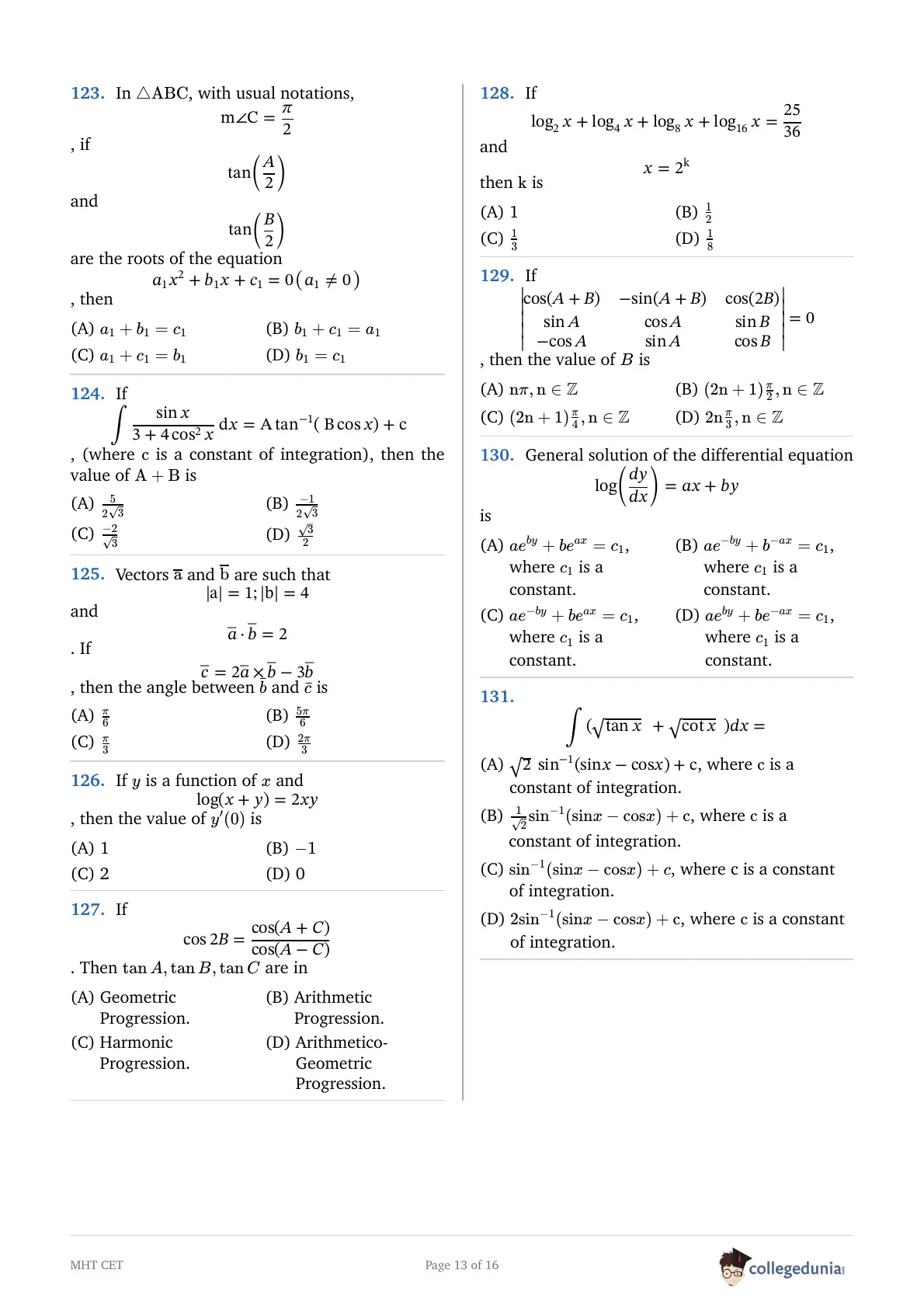
In \[\triangle \mathrm{ABC}\], with usual notations, \[\mathrm{m} \angle \mathrm{C}=\frac{\pi}{2}\], if \[\tan \left(\frac{A}{2}\right)\] and \[\tan \left(\frac{B}{2}\right)\] are the roots of the equation \[a_1 x^2+b_1 x+c_1=0\left(a_1 \neq 0\right)\], then
If \[\int \frac{\sin x}{3+4 \cos ^2 x} \mathrm{~d} x=\mathrm{A} \tan ^{-1}(\mathrm{~B} \cos x)+\mathrm{c}\], (where \[\mathrm{c}\] is a constant of integration), then the value of \[\mathrm{A}+\mathrm{B}\] is
Vectors \[\overline{\mathrm{a}}\] and \[\overline{\mathrm{b}}\] are such that \[|\overline{\mathrm{a}}|=1 ;|\overline{\mathrm{b}}|=4\] and \[\bar{a} \cdot \bar{b}=2\]. If \[\bar{c}=2 \bar{a} \times \bar{b}-3 \bar{b}\], then the angle between \[\bar{b}\] and \[\bar{c}\] is
If \[y\] is a function of \[x\] and \[\log (x+y)=2 x y\], then the value of \[y^{\prime}(0)\] is
If \[\cos 2 B=\frac{\cos (A+C)}{\cos (A-C)}\]. Then \[\tan A, \tan B, \tan C\] are in
If \[\log _2 x+\log _4 x+\log _8 x+\log _{16} x=\frac{25}{36}\] and \[x=2^{\mathrm{k}}\] then \[\mathrm{k}\] is
If \[\left|\begin{array}{ccc}\cos (A+B) & -\sin (A+B) & \cos (2 B) \\ \sin A & \cos A & \sin B \\ -\cos A & \sin A & \cos B\end{array}\right|=0\], then the value of \[B\] is
General solution of the differential equation \[\log \left(\frac{d y}{d x}\right)=a x+b y\] is
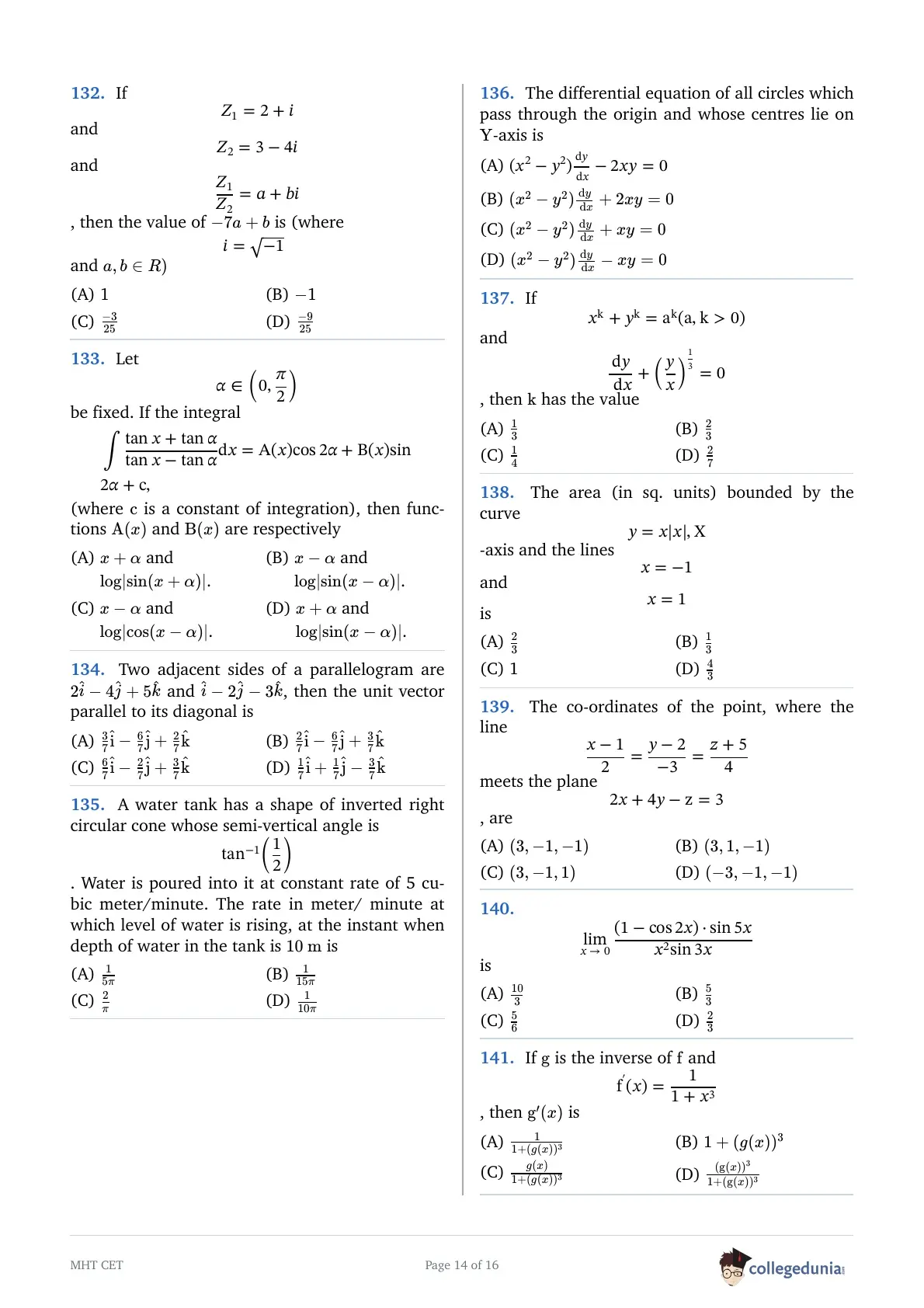
If \[Z_1=2+i\] and \[Z_2=3-4 i\] and \[\frac{\overline{Z_1}}{\overline{Z_2}}=a+b i\], then the value of \[-7 a+b\] is (where \[i=\sqrt{-1}\] and \[a, b \in R)\]
Let \[\alpha \in\left(0, \frac{\pi}{2}\right)\] be fixed. If the integral \[\int \frac{\tan x+\tan \alpha}{\tan x-\tan \alpha} \mathrm{d} x=\mathrm{A}(x) \cos 2 \alpha+\mathrm{B}(x) \sin 2 \alpha+\mathrm{c},\] (where \[\mathrm{c}\] is a constant of integration), then functions \[\mathrm{A}(x)\] and \[\mathrm{B}(x)\] are respectively
Two adjacent sides of a parallelogram are \[2 \hat{i}-4 \hat{j}+5 \hat{k}\] and \[\hat{i}-2 \hat{j}-3 \hat{k}\], then the unit vector parallel to its diagonal is
A water tank has a shape of inverted right circular cone whose semi-vertical angle is \[\tan ^{-1}\left(\frac{1}{2}\right)\]. Water is poured into it at constant rate of 5 cubic meter/minute. The rate in meter/ minute at which level of water is rising, at the instant when depth of water in the tank is \[10 \mathrm{~m}\] is
The differential equation of all circles which pass through the origin and whose centres lie on \[\mathrm{Y}\]-axis is
If \[x^{\mathrm{k}}+y^{\mathrm{k}}=\mathrm{a}^{\mathrm{k}}(\mathrm{a}, \mathrm{k}>0)\] and \[\frac{\mathrm{d} y}{\mathrm{~d} x}+\left(\frac{y}{x}\right)^{\frac{1}{3}}=0\], then \[\mathrm{k}\] has the value
The area (in sq. units) bounded by the curve \[y=x|x|, \mathrm{X}\]-axis and the lines \[x=-1\] and \[x=1\] is
The co-ordinates of the point, where the line \[\frac{x-1}{2}=\frac{y-2}{-3}=\frac{z+5}{4}\] meets the plane \[2 x+4 y-\mathrm{z}=3\], are
\[\lim _\limits{x \rightarrow 0} \frac{(1-\cos 2 x) \cdot \sin 5 x}{x^2 \sin 3 x}\] is
If \[\mathrm{g}\] is the inverse of \[\mathrm{f}\] and \[\mathrm{f}^{\prime}(x)=\frac{1}{1+x^3}\], then \[\mathrm{g}^{\prime}(x)\] is
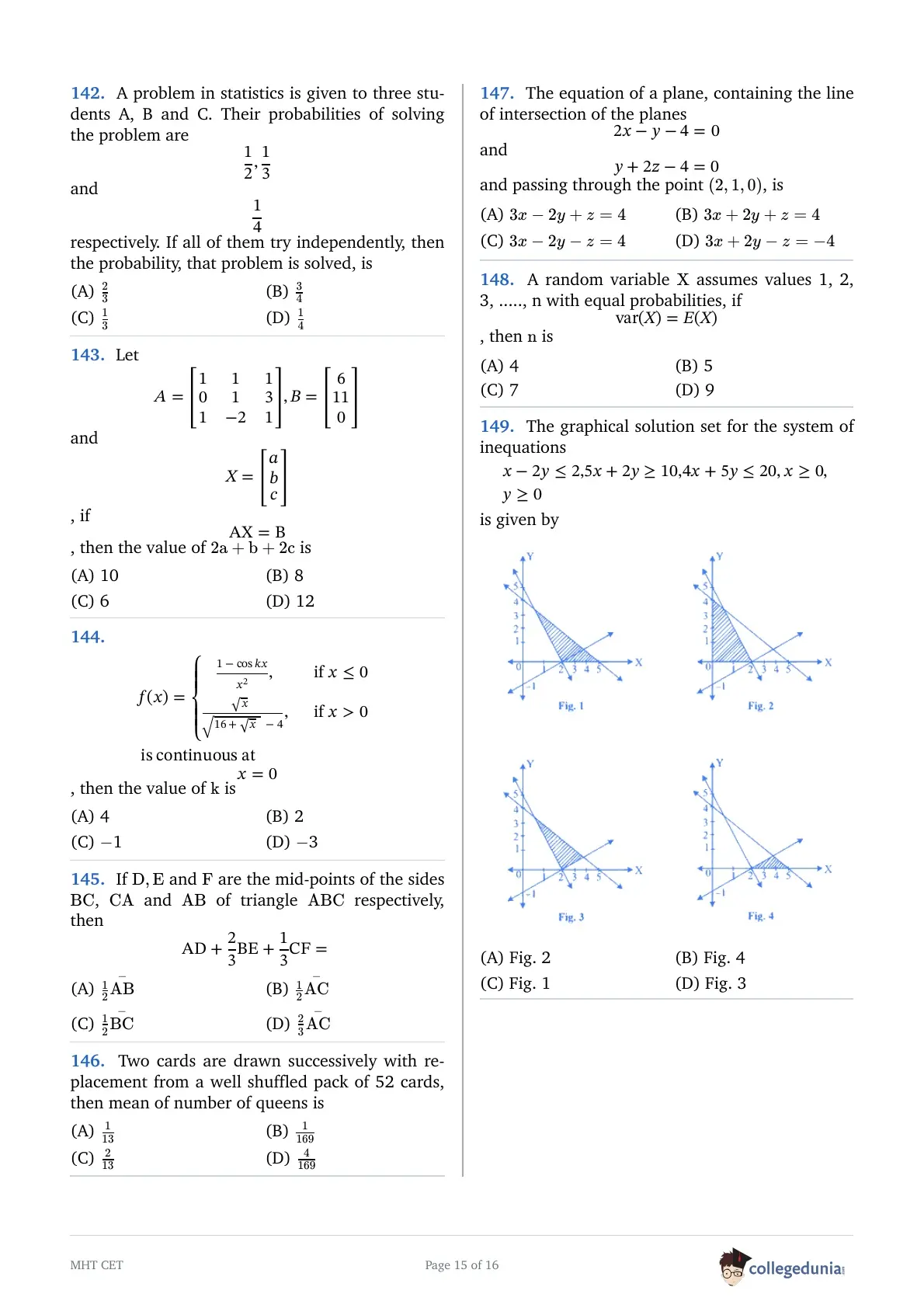
A problem in statistics is given to three students A, B and C. Their probabilities of solving the problem are \[\frac{1}{2}, \frac{1}{3}\] and \[\frac{1}{4}\] respectively. If all of them try independently, then the probability, that problem is solved, is
Let \[A=\left[\begin{array}{ccc}1 & 1 & 1 \\ 0 & 1 & 3 \\ 1 & -2 & 1\end{array}\right], B=\left[\begin{array}{c}6 \\ 11 \\ 0\end{array}\right]\] and \[X=\left[\begin{array}{l}a \\ b \\ c\end{array}\right]\], if \[\mathrm{AX}=\mathrm{B}\], then the value of \[2 \mathrm{a}+\mathrm{b}+2 \mathrm{c}\] is
\[f(x)=\left\{\begin{array}{ll} \frac{1-\cos k x}{x^2}, & \text { if } x \leq 0 \\ \frac{\sqrt{x}}{\sqrt{16+\sqrt{x}}-4}, & \text { if } x>0 \end{array}\right. \text { is continuous at }\] \[x=0\], then the value of \[\mathrm{k}\] is
If \[\mathrm{D}, \mathrm{E}\] and \[\mathrm{F}\] are the mid-points of the sides \[\mathrm{BC}\], \[\mathrm{CA}\] and \[\mathrm{AB}\] of triangle \[\mathrm{ABC}\] respectively, then \[\overline{\mathrm{AD}}+\frac{2}{3} \overline{\mathrm{BE}}+\frac{1}{3} \overline{\mathrm{CF}}=\]
Two cards are drawn successively with replacement from a well shuffled pack of 52 cards, then mean of number of queens is
The equation of a plane, containing the line of intersection of the planes \[2 x-y-4=0\] and \[y+2 z-4=0\] and passing through the point \[(2,1,0)\], is
A random variable \[\mathrm{X}\] assumes values 1, 2, 3, ....., n with equal probabilities, if \[\operatorname{var}(X)=E(X)\], then \[\mathrm{n}\] is
The graphical solution set for the system of inequations \[x-2 y \leq 2,5 x+2 y \geq 10,4 x+5 y \leq 20, x \geq 0, y \geq 0\] is given by

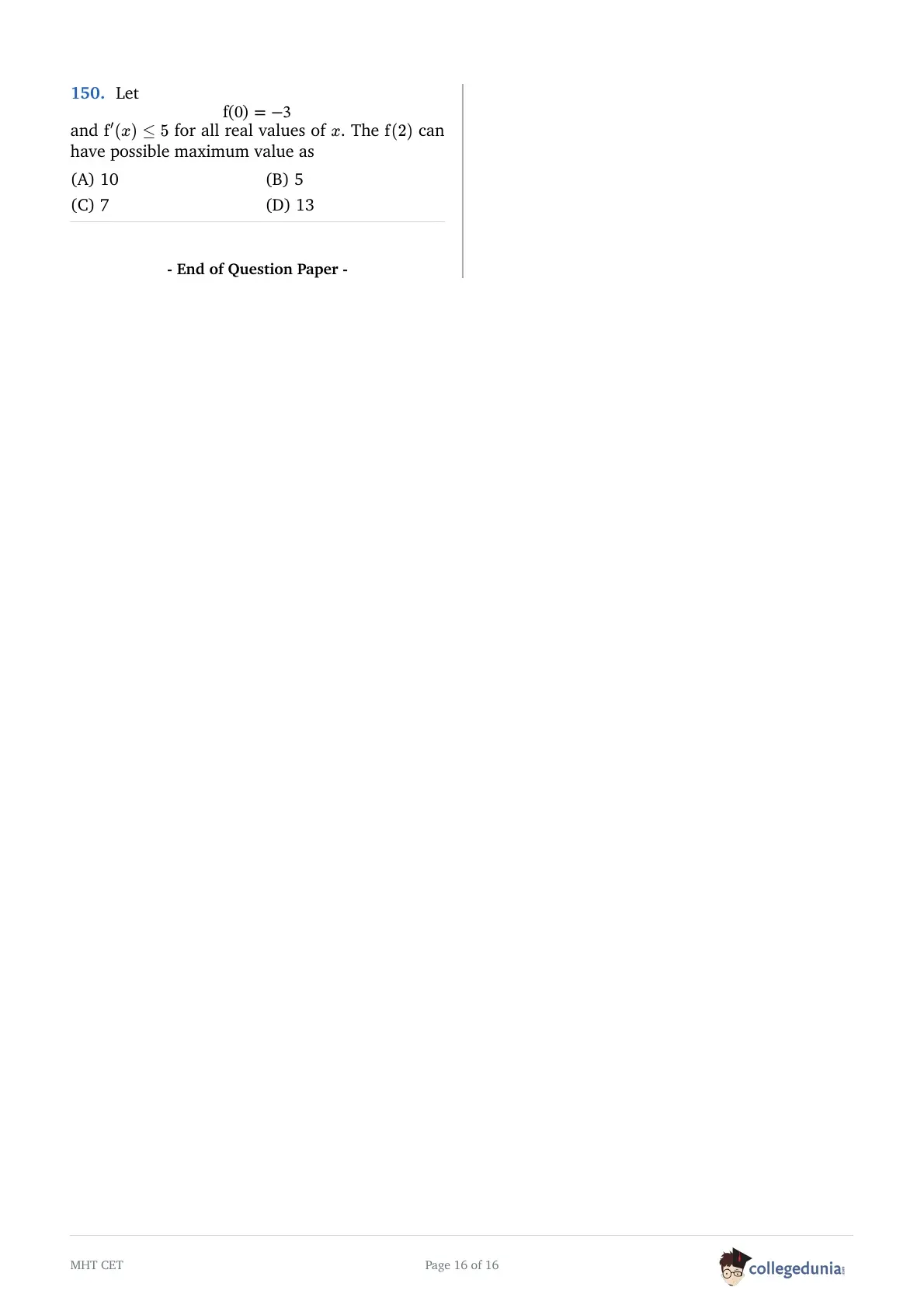
Let \[\mathrm{f}(0)=-3\] and \[\mathrm{f}^{\prime}(x) \leq 5\] for all real values of \[x\]. The \[\mathrm{f}(2)\] can have possible maximum value as
MHT CET 2023 PCM Exam Pattern and Marking Scheme
| Parameter | Details |
|---|---|
| Conducting Body | Maharashtra Common Entrance Test Cell (Maharashtra CET Cell) |
| Exam Mode | Online (Computer-Based Test) |
| Duration | 180 minutes (3 hours) |
| Groups / Subjects | PCM (Physics, Chemistry, Mathematics) for Engineering |
| Total Questions |
150 |
| Total Marks | 200 |
| Question Type | Multiple Choice Questions (MCQs) |
| Marks Distribution |
|
| Negative Marking | No |
| Syllabus Weightage |
|



Comments