




MHT CET 2026 April 17 Shift 2 PCM Question Paper is available for download here. Maharashtra State CET Cell conducted MHT CET 2026 PCM Exam on April 17 in Shift 2 from 2 AM to 5 PM in CBT mode.
- The MHT CET 2026 PCM Question Paper consists of 150 multiple-choice questions (MCQs) totalling 200 marks divided into 3 sections: Physics, Chemistry, and Mathematics, with 50 questions in each subject.
- Physics and Chemistry questions carry 1 mark each while Mathematics questions carry 2 marks each.
- There is no negative marking for incorrect answers.
Also Check: MHT CET 2026 April 17 Shift 1 PCM Question Paper
Download MHT CET 2026 April 17 Shift 2 PCM Question Paper with Solutions PDF from the links provided below. Based on initial student reaction, MHT CET 2026 April 17 Shift 2 PCM Paper was easy to moderate level.
MHT CET 2026 April 17 Shift 2 PCM Question Paper PDF Download
| MHT CET 2026 April 17 Shift 2 Question Paper | Download PDF | Check Solution |














MHT CET 2026 April 17 Shift 2 PCM Questions with Solutions
Physics Section (Questions 1 to 50)
There are two vectors \(\overset{⃗}{A} = 6\hat{i}+9\hat{j}-\hat{k}\) and \(\overset{⃗}{B} = 2\hat{i}+3\hat{j}-p\hat{k}\) which have the same direction. The value of 'p' is
A force 'F' is applied on a square plate of side 'L'. If the percentage error in determining 'L' is 3% and that in 'F' is 2% then the percentage error in determining the pressure is
A ball P is projected at an angle of \(60^{\circ}\) with the vertical with certain initial speed. Another ball Q of the same mass as that of ball P is projected vertically upwards with the same initial speed as that of P. At the highest point, the ratio of potential energy of ball P to that of ball Q is
\((sin30^{\circ} = 0.5)\)
A machine gun fires a bullet of mass 40g with a speed of \(600\text{ ms}^{-1}\). The person holding the gun can bare maximum force of 168N on it. The number of bullets that can be fired from the gun per second is
Radius of gyration of a thin uniform circular disc about the axis passing through its centre and perpendicular to its plane is \(K_c\). Radius of gyration of the same disc about a diamter of the disc is \(K_d\). the ratio \(K_d:K_c\) is
A solid sphere of radius R and mass M is rotating about its diameter. The moment of intertia of the solid sphere rotating about an axis at a distance \(\frac{R}{3}\) from the centre and parallel to that diameter is
A mass tied to a string is whirled in a horizontal circular path with a constant angular velocity and its angular momentum is 'L'. If the length of the string is now halved, keeping angular velocity same then the angular momentum will be
Two planets A and B are orbiting around the sun. The distances of the two planets A and B from the sun are \(r_A\) and \(r_B\) respectively. Also \(r_B = 225\,r_A\). If the orbital speed of the planet A is 'V' then the orbital speed of planet B will be
When a capillary tube of radius 'r' is immersed in water, rise of water is upto height 'h'. The mass of water in capillary tube is 'm'. When another capillary tube of radius 'xr' is immersed in water, the mass of water that will rise in this tube is
The excess pressure inside the first soap bubble is three times that inside the second soap bubble. The ratio of the volume of the first soap bubble to the volume of the second soap bubble is
Two soap bubbles, A and B, have radii in the ratio \(3:2\). The excess pressure inside the bubble A to that of B is in the ratio
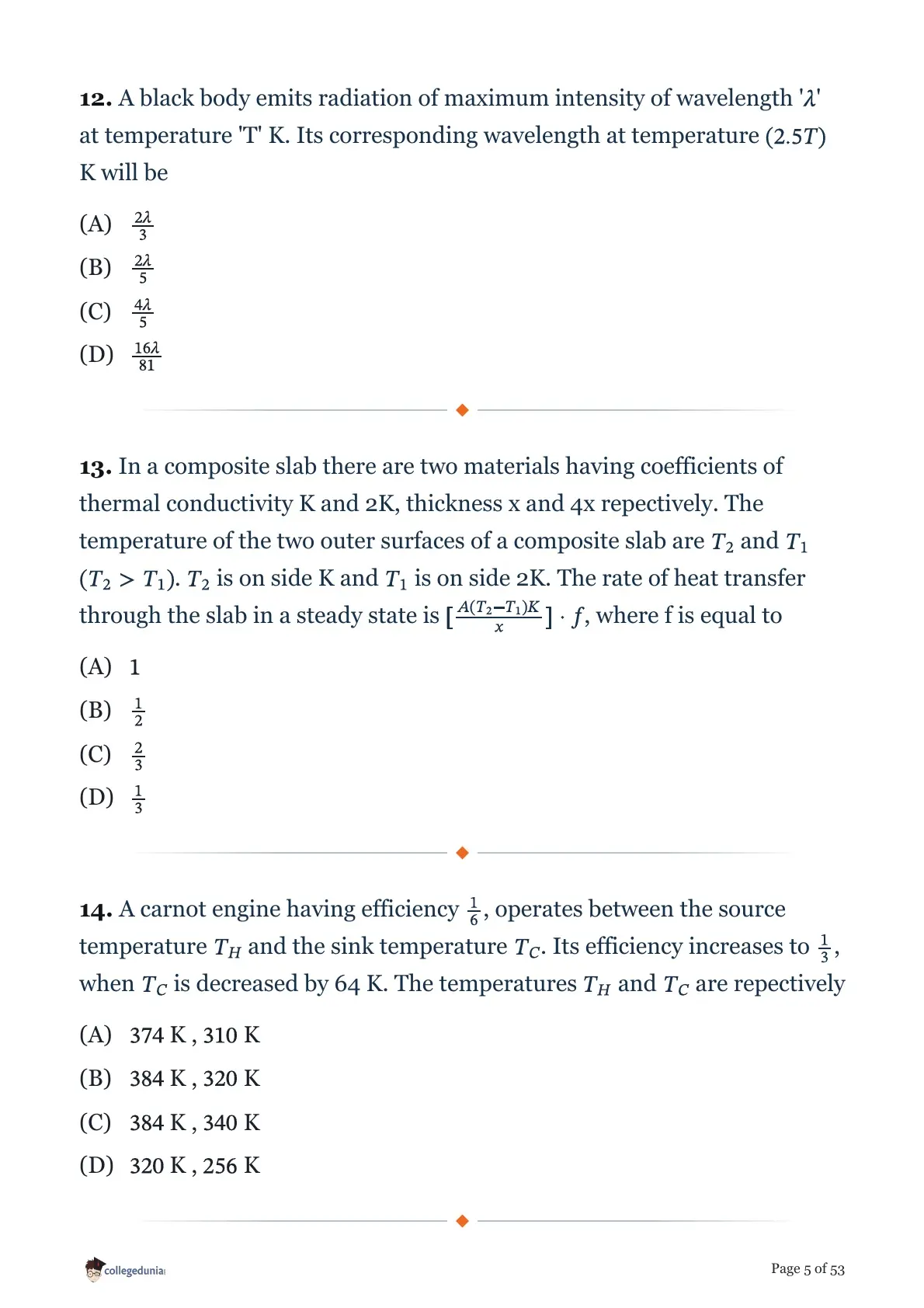
A black body emits radiation of maximum intensity of wavelength '\(λ\)' at temperature 'T' K. Its corresponding wavelength at temperature \((2.5T)\) K will be
In a composite slab there are two materials having coefficients of thermal conductivity K and 2K, thickness x and 4x repectively. The temperature of the two outer surfaces of a composite slab are \(T_2\) and \(T_1\) \((T_2 > T_1)\). \(T_2\) is on side K and \(T_1\) is on side 2K. The rate of heat transfer through the slab in a steady state is \([\frac{A(T_2-T_1)K}{x}]\cdot f\), where f is equal to
A carnot engine having efficiency \(\frac{1}{6}\), operates between the source temperature \(T_H\) and the sink temperature \(T_C\). Its efficiency increases to \(\frac{1}{3}\), when \(T_C\) is decreased by 64 K. The temperatures \(T_H\) and \(T_C\) are repectively
A thermodynamic system is compressed adiabatically, then its temperature
Two cylinders A and B fitted with pistons contain equal amount of an ideal diatomic gas at 303 K. The piston of cylinder A is free to move and that of cylinder B is held fixed. The same amount of heat is given to the gas in each cylinder. If the rise in temperature of the gas in cylinder B is 63 K then the rise in temperature of the gas in A is
The temperature at which r.m.s. velocity of hydrogen molecules is 4.5 times that of an oxygen molecule at \(47^{\circ}\) C is (molecular weight of hydrogen and oxygen are 2 and 32 respectively)
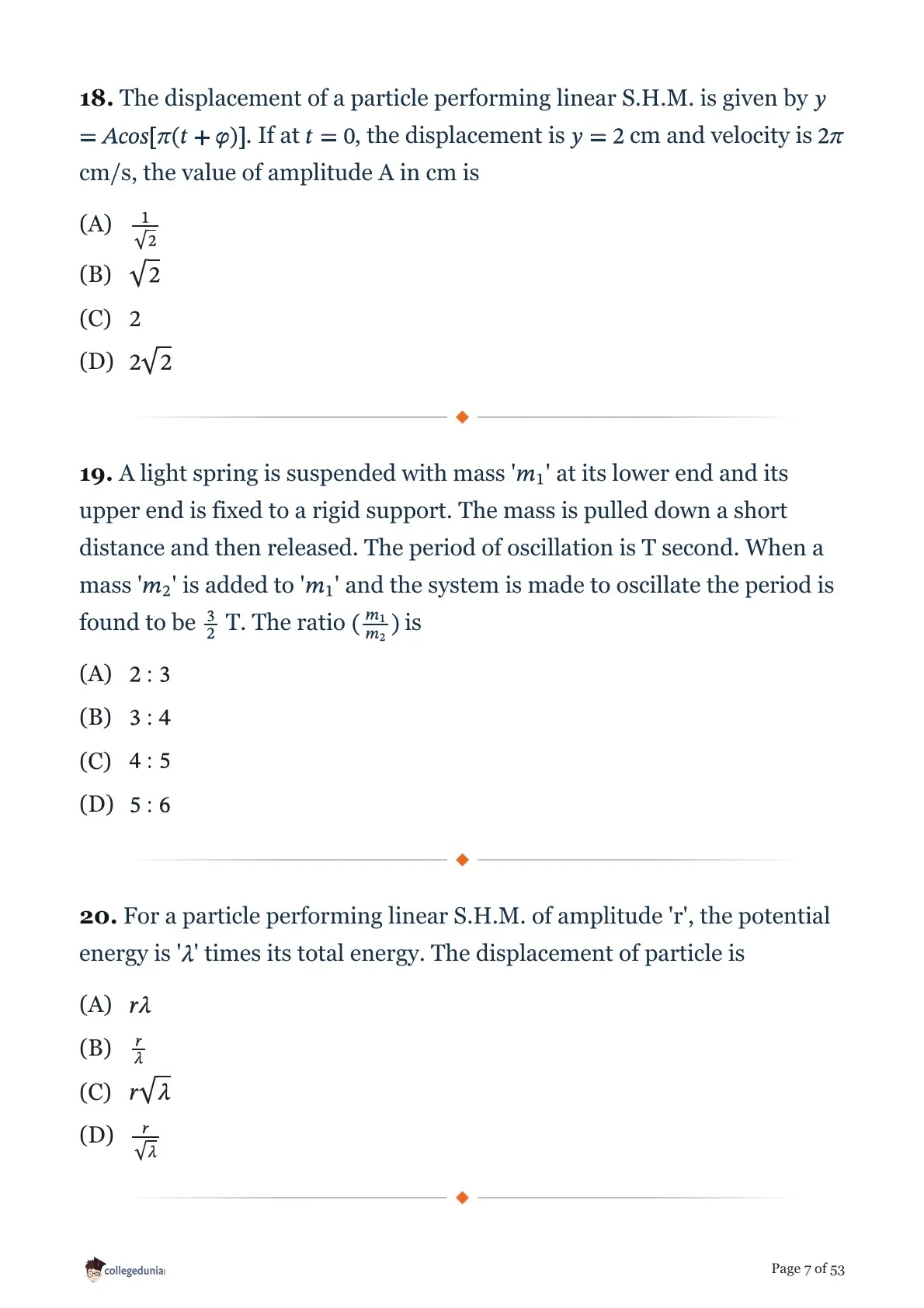
The displacement of a particle performing linear S.H.M. is given by \(y = Acos[π(t+φ)]\). If at \(t = 0\), the displacement is \(y = 2\) cm and velocity is \(2π\) cm/s, the value of amplitude A in cm is
A light spring is suspended with mass '\(m_1\)' at its lower end and its upper end is fixed to a rigid support. The mass is pulled down a short distance and then released. The period of oscillation is T second. When a mass '\(m_2\)' is added to '\(m_1\)' and the system is made to oscillate the period is found to be \(\frac{3}{2}\) T. The ratio \((\frac{m_1}{m_2})\) is
For a particle performing linear S.H.M. of amplitude 'r', the potential energy is '\(λ\)' times its total energy. The displacement of particle is
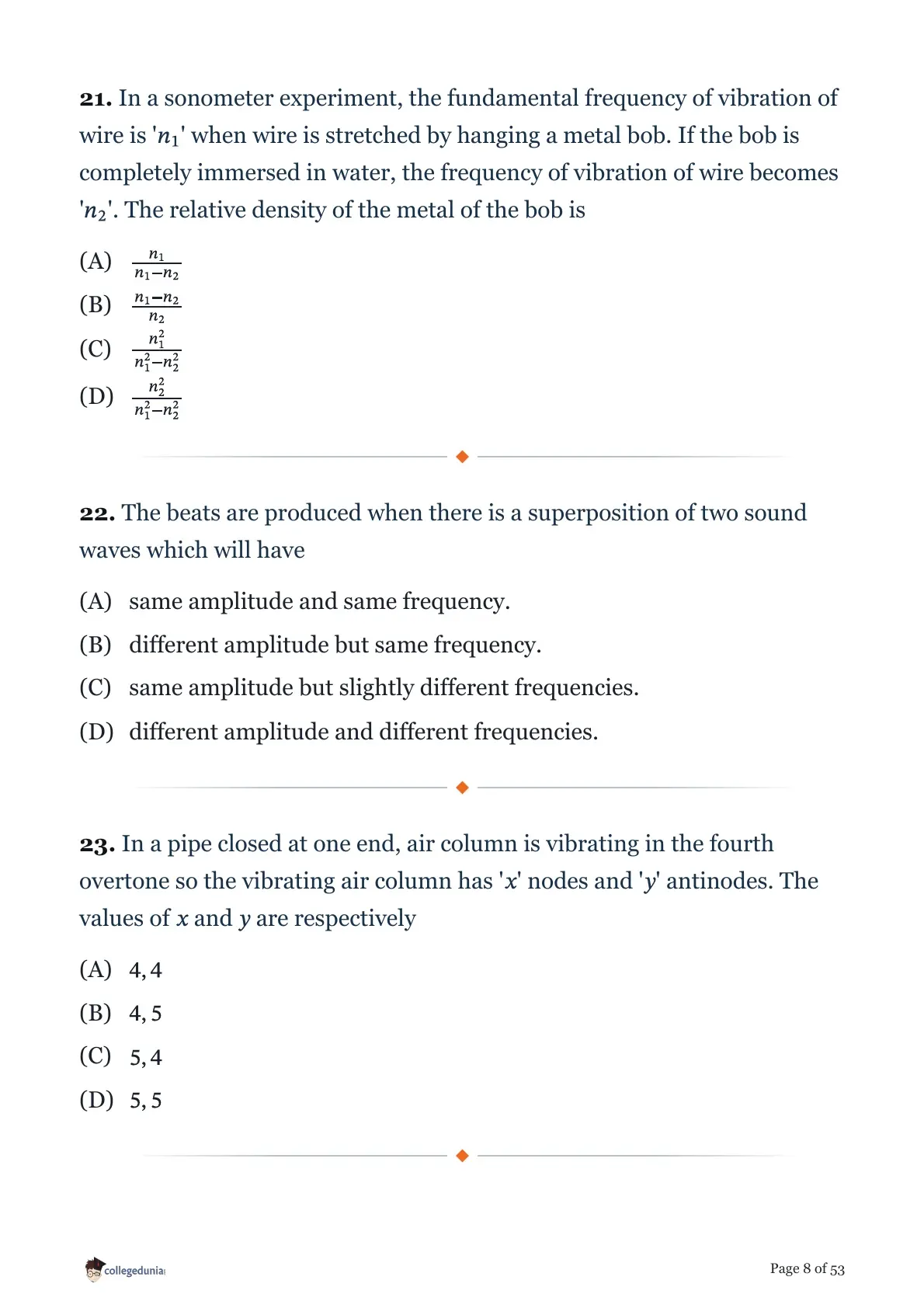
In a sonometer experiment, the fundamental frequency of vibration of wire is '\(n_1\)' when wire is stretched by hanging a metal bob. If the bob is completely immersed in water, the frequency of vibration of wire becomes '\(n_2\)'. The relative density of the metal of the bob is
The beats are produced when there is a superposition of two sound waves which will have
In a pipe closed at one end, air column is vibrating in the fourth overtone so the vibrating air column has '\(x\)' nodes and '\(y\)' antinodes. The values of \(x\) and \(y\) are respectively
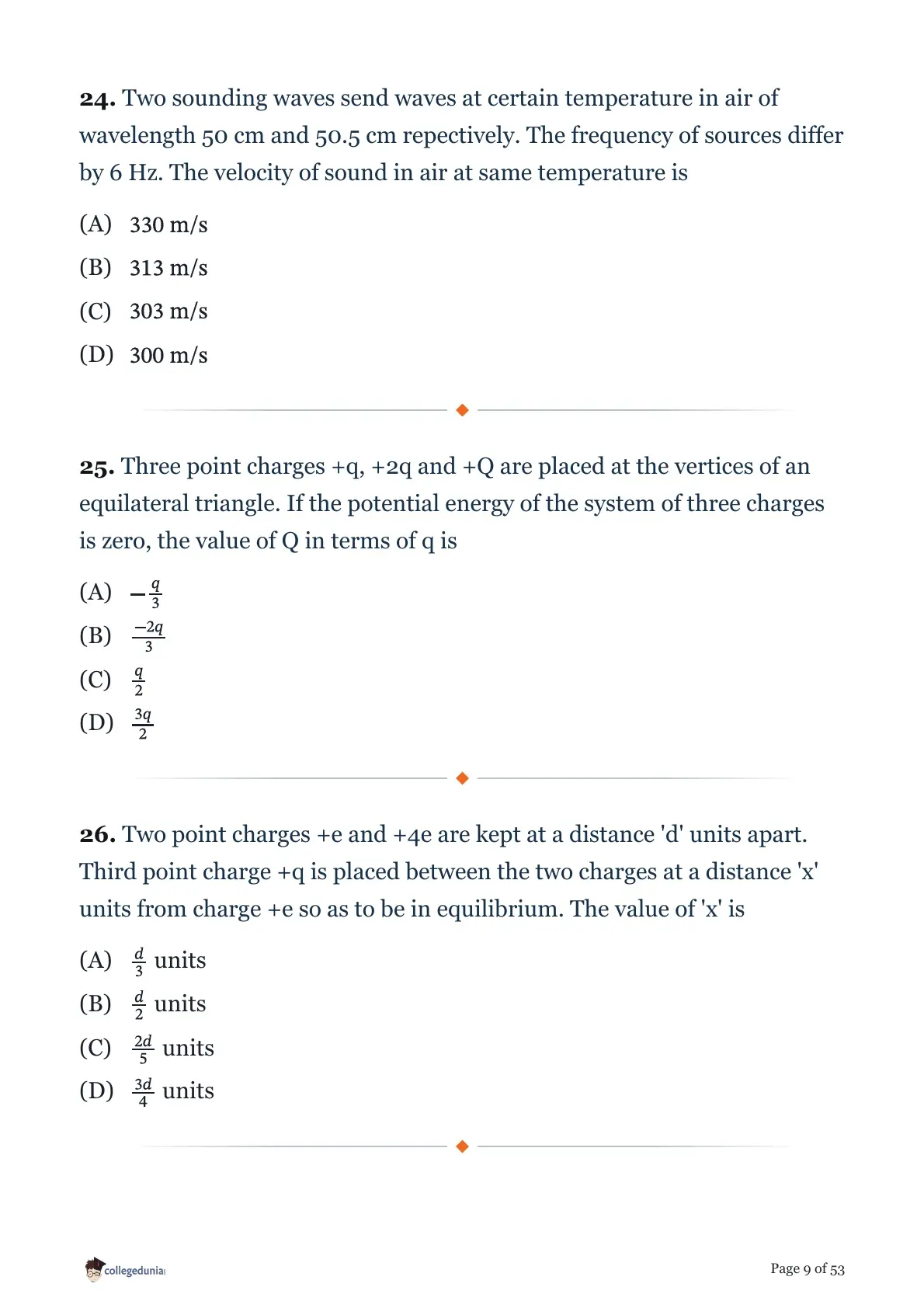
Two sounding waves send waves at certain temperature in air of wavelength 50 cm and 50.5 cm repectively. The frequency of sources differ by 6 Hz. The velocity of sound in air at same temperature is
Three point charges +q, +2q and +Q are placed at the vertices of an equilateral triangle. If the potential energy of the system of three charges is zero, the value of Q in terms of q is
Two point charges +e and +4e are kept at a distance 'd' units apart. Third point charge +q is placed between the two charges at a distance 'x' units from charge +e so as to be in equilibrium. The value of 'x' is
Two indentical metal plates are given charges \(q_1\) and \(q_2\) \((q_2 < q_1)\) respectively. They are brought close together to form a parallel plate capacitor with capacitance 'C'. The potential difference 'V' between the plates is
If the equivalent capacitance between points A and B of the combination of capacitors shown in figure, is 6C, the capacitor \(C^1\) is

A current of 9A enters point P of an equilateral triangle PQR having three wires of \(3\Omega\) each and leaves by point R. The currents \(I_1\) and \(I_2\) are respectively

The current passing through the galvanometer is 4 % of the total current in the curcuit. If the resistance of the galvanometer is 'G', the shunt resistance 'S' connected across the galvanometer is
Two wires of same length are bent to form the circular loop with two turns and a square loop of one turn. Both of them carry same current. The ratio of magnetic moment of circular loop of two turns to that of square loop is
The magnetic field at a distance 'r' from a long straight wire carrying current I is 0.4 tesla. The magnetic field at a distance 2r will be
In the cyclotron, as radius of the circular path of the charged particle increases, (\(ω\) = angular velocity, V = linear velocity)
Two planar concentric rings of metal wire having radii '\(r_1\)' and '\(r_2\)' (with \(r_1 > r_2\)) are placed in air. The current 'I' is flowing through the coil of larger radius. The mutual inductance between the coils is given by ( \(μ_0\) = permeability of free space)
Two coils having self-inductance \(L_1 = 75\) mH and \(L_2 = 48\) mH are coupled with each other. If the mutual inductance of the coils is 37.2 mH, then coefficient of coupling will be
A straight line conductor of length 0.4 m is moved with a speed of \(7.0\text{ ms}^{-1}\) perpendicular to magnetic field of intensity \(0.8\text{ Wb m}^{-2}\). The induced e.m.f. across the conductor is
In LCR circuit, at a particular angular frequency the capacitive reactance and inductive reactance is same. If the angular frequency is doubled, the ratio of the reactance of the capacitor to that of the inductor will be
In an a.c. circuit with pure capacitance 'C' and a.c. source \(E = E_0sinωt\), the equation of instantaneous current is given by
In a series LCR circuit alternating e.m.f. and current are given by the equations \(V = V_0sin(ωt)\) and \(I = I_0sin(ωt+\frac{π}{3})\) respectively. The average power dissipated in the circuit over one cycle of a.c. is \((cos60^{\circ} = 0.5)\)
A ray of light incident on one face of an equilateral glass prism having refractive index \(\sqrt{2}\), produces the emergent ray which just grazes along the adjacent face. The value of angle of incidence is \((sin90^{\circ} = 1)\)
\((sin30^{\circ} = \frac{1}{2})(sin45^{\circ} = \frac{1}{\sqrt{2}})\)
An unpolarised light of intensity \(64\text{ Wm}^{-2}\) passes through three polarizers successively such that the transmission axis of last polarizer is crossed with the first. The intensity of the emerging light is \(6\text{ Wm}^{-2}\). The angle between the transmission axis of the first two polarizers is
In Young's experiment, the intensity ratio of the maxima and minima in an interference pattern produced by two coherent sources is \(36:1\). The ratio of the amplitudes of the two individual sources will be
For obtaining maximum contrast between the bright and dark fringes in an interference pattern, the intensities of the two light coherent sources should be
The ratio of the accelerating potentials required to accelerate (i) an \(α\)-particle and (ii) a proton to have the same de Broglie wavelength associated with them is
(mass of \(α\) - particle = \(6.4\times 10^{-27}\) kg, mass of proton = \(1.6\times 10^{-27}\) kg)
In photoelectric effect, keeping the frequency of incident radiation and accelerating potential fixed, if the intensity of incident light is increased,
In Bohr's atomic model, the energy of the electron is 'E' in the second orbit of hydrogen atom. So the energy of the electron in the third orbit of helium atom \((Z = 2)\) will be
The activity of a radioactive sample is measured as \(N_0\) counts per minute at time \(t = 0\) and \(\frac{N_0}{e}\) counts per minute at time \(t = 3\) minute. The time (in minute) in which the activity reduces to half the value, is
In the following digital circuit, the output 'Y' will be '1' (one) for inputs 'A' and 'B' having values

In common emitter configuration of transistor amplifier, \(r_i\), \(R_L\) and \(β\) represent the input resistance, load resistance and the a.c. current gain respectively. The voltage gain \(A_V\) and power gain \(A_P\) are represented in magnitude respectively by
A semiconductor X is made by doping a germanium crystal with indium \((Z = 49)\). A second semiconductor Y is made by doping germanium crystal with arsenic \((Z = 33)\). Both are joined end to end and connected to a battery as shown. Which of the following statements is correct?

Chemistry Section (Questions 51 to 100)
How many moles of potassium chlorate are heated to produce \(11\cdot 2\) L oxygen at STP ?
Find the energy of third stationary orbit of Bohr's model of hydrogen atom if the energy of ground state is \(-E\) J
Which of the following statements regarding Pi \((π)\) bond is NOT true ?
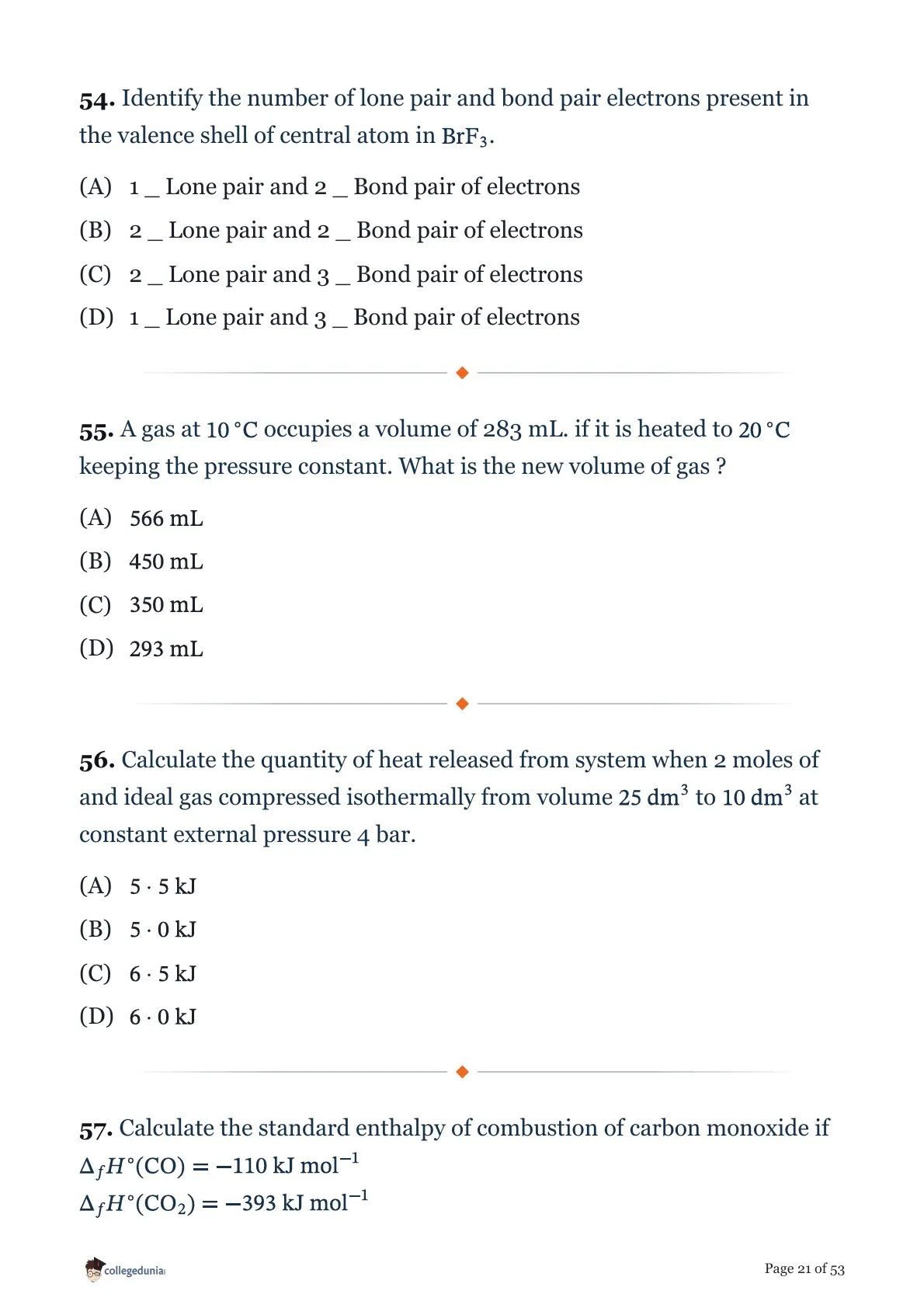
Identify the number of lone pair and bond pair electrons present in the valence shell of central atom in \(\text{BrF}_3\).
A gas at \(10\,^{\circ}\text{C}\) occupies a volume of 283 mL. if it is heated to \(20\,^{\circ}\text{C}\) keeping the pressure constant. What is the new volume of gas ?
Calculate the quantity of heat released from system when 2 moles of and ideal gas compressed isothermally from volume \(25\text{ dm}^3\) to \(10\text{ dm}^3\) at constant external pressure 4 bar.
Calculate the standard enthalpy of combustion of carbon monoxide if
\(\Delta _fH^{\circ}(\text{CO}) = -110\text{ kJ mol}^{-1}\)
\(\Delta _fH^{\circ}(\text{CO}_2) = -393\text{ kJ mol}^{-1}\)
Which of the following processes is an endothermic ?
The solubility of sapringly soluble salt \(\text{AB}_2\) is \(18\cdot 78\times 10^{-4}\text{ g/dm}^3\) What is its solubility product ? (Molar mass of \(\text{AB}_2 = 187\cdot 8\text{ g mol}^{-1}\))
What is the pH of resulting solution when \(20\text{ mL }\frac{M}{10}\text{ NaOH}\) and \(10\text{ mL }\frac{M}{10}\text{ H}_2\text{SO}_4\) are mixed together ?
Which of the following is correct relationship between solubility and solubility product for silver oxalate ?
Identify oxidation number of Sulphur respectively in \(\text{SO}_2\) and \(\text{SO}_4^{2-}\) .
Identify colour change when NaCl solution is titrated against \(\text{AgNO}_3\) solution using fluorescein indicator.
Which from the following metal chlorides does not contain water of crystallisation ?
What is the name of second lower homologue of \(\text{CH}_3(\text{CH}_2)_2\text{COOH}\) ?
How many chiral carbon atoms are present in 2-Iodo-3, 4, 5-trimethylhexane ?
Identify the product 'B' in the following reaction
\(\text{Toluene}\overset{\text{Chromyl chloride}/\text{CS}_2\,}{\rightarrow }A\overset{\text{H}_3\text{O}^+\,}{\rightarrow }B\)
Identify the 'A' in the following reaction.
\(\text{CaC}_2+\text{H}_2\text{O}\rightarrow \text{A}+\text{Ca(OH)}_2\)
Calculate the number of atoms in 1 g metal that forms bcc crystal structure \([ρ\times a^3 = 6\cdot 6\times 10^{-22}\text{ g}]\)
Which of the following dopants is used in germanium to form n-type semiconductor ?
Calculate the void volume of bcc unit cell if volume of unit cell is \(8\cdot 0\times 10^{-23}\text{ cm}^3\)
Calculate the molar mass of a nonvolatile solute if 6.4 g of it dissolved in 100 g water produces a relative lowering in vapour pressure of \(0\cdot 016\) at 300 K.
Calculate the cryoscopic constant of a solvent if depression in freezing point of \(0\cdot 3\) m solution of nonelectrolyte is \(0\cdot 48\) K
Identify the correct statement from following.
What is the change in oxidation number of Pb at positive electrode of lead accumulator acting as galvanic cell ?
The graphical variation of molar conductivity \((\Lambda )\) against square root of molar concentration \((\sqrt{c})\) of certain electrolyte 'X' is linear with intercept on y axis. Identify X from following.
If standard reduction potential \((E^0)\) of \((\text{Al}_{(aq)}^{+3}|\text{Al}_{(s)})\), \((\text{Fe}_{(aq)}^{+2}|\text{Fe}_{(s)})\), \((\text{Cu}_{(aq)}^{+2}|\text{Cu}_{(s)})\) and \((\text{Ag}_{(aq)}^{+1}|\text{Ag}_{(s)})\) are \(-1\cdot 66\) V, \(-0\cdot 44\) V, \(+0\cdot 34\) V and \(+0\cdot 79\) V respectively. Which of the following reaction is non spontaneous ?
For the reaction \(2\text{NOBr}_{(g)}\rightarrow 2\text{NO}_{(g)}+\text{Br}_{2(g)}\) rate law is \(r = k[\text{NOBr}]^2\), if rate constant is \(1\cdot 62\text{ mol dm}^{-3}\text{ s}^{-1}\) and concentration of NOBr is \(2\times 10^{-3}\text{ mol L}^{-1}\). What is the rate of reaction ?
In first order reaction 20 millimole of reactant is reduced to 10 millimole in \(1\cdot 151\) minute. Find rate constant.
Which of the following is an example of second order reaction ?
Which of the following noble gases exhibits higher oxidation states ?
Which from following pair of elements in their respective oxidation states develops same value of calculated spin only magnetic moment ?
What is the atomic number of first post actinoid element ?
What is the EAN of metal ion in \([\text{Cu(NH}_3)_4]^{2+}\) ?
Identify a ligand with lowest field strength among the following.
Identify the product obtained when 2-chlorobutane is heated with aqueous solution of potassium hydroxide.
Identify the product obtained when 2- Chloro - 2 - methylbutane is reacted with sodium metal in presence of dry ether?
Which among the following has highest melting point ?
Which of the following alcohols on addition of Lucas reagent reacts fast and turns the reagent turbid instantly.
Which among the following does NOT undergo Williamson's synthesis?
- (A) \(\text{C}_2\text{H}_5\text{Br}\)
- (B)
![]()
- (C) \(\text{C}_6\text{H}_5-\text{Br}\)
- (D) \(\text{C}_6\text{H}_5-\text{CH}_2-\text{Br}\)

Identify the product 'Y' in the following reaction \(\text{Benzonitrile}\overset{\text{C}_6\text{H}_5\text{MgBr}/\text{dry ether}\,}{\rightarrow }X\overset{\text{H}_3\text{O}^+\,}{\rightarrow }Y+\text{MgBr(OH)}+\text{NH}_3\)

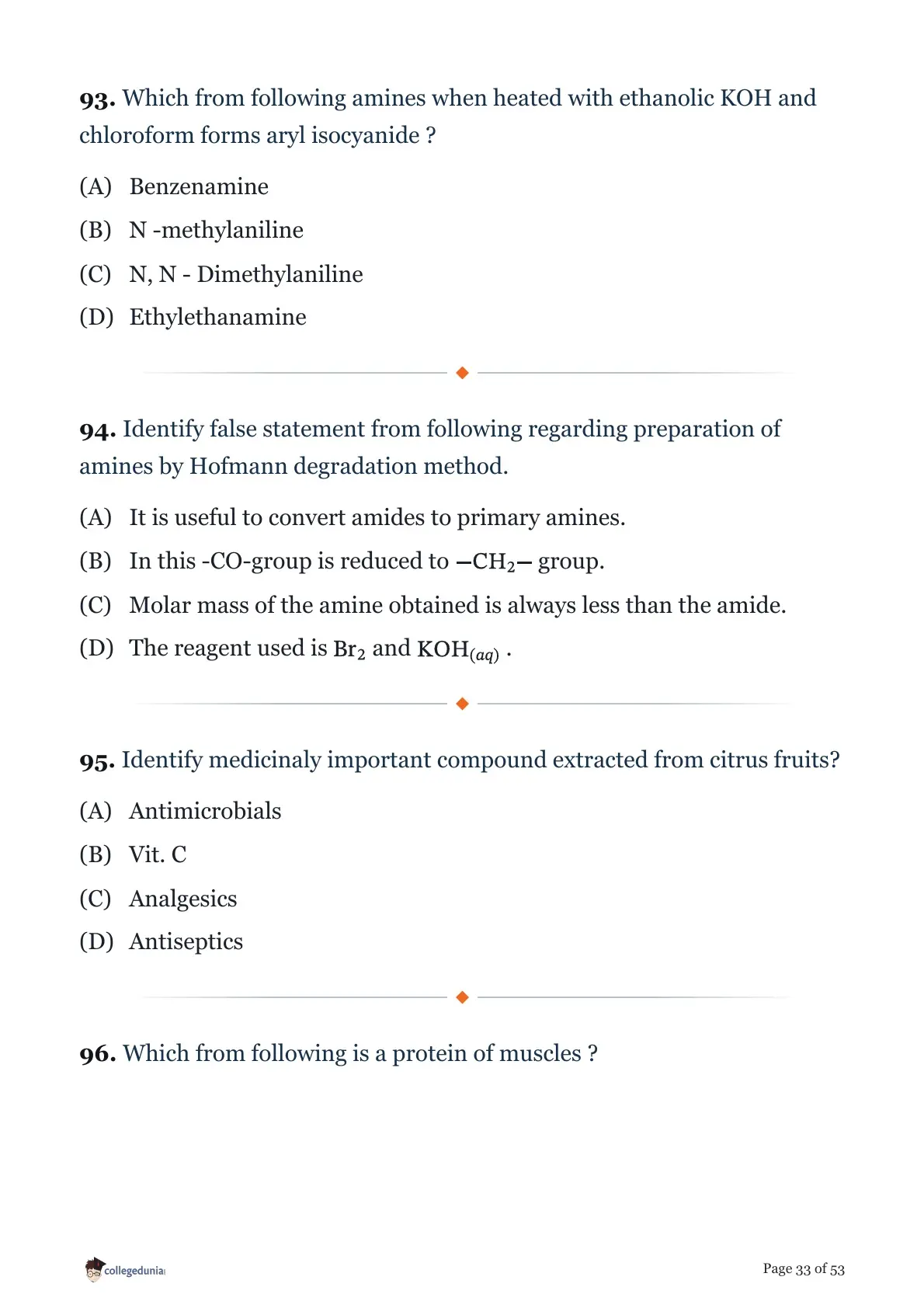
Which from following amines when heated with ethanolic KOH and chloroform forms aryl isocyanide ?
Identify false statement from following regarding preparation of amines by Hofmann degradation method.
Identify medicinaly important compound extracted from citrus fruits?
Which from following is a protein of muscles ?
Which from following enzymes cleaves glycosidic bond in sucrose?
Which from following polymer is obtained by addition polymerization?
- (A)
![]()
- (B) \([\text{NH}-(\text{CH}_2)_5-\text{CO}]_n\)
- (C)
![]()
- (D)
![]()


Identify the polymer used to prepare disposable cups and plates.
Which from following is a first stage in preparation of viscose rayon ?
- (A) \(\text{Cell}-\text{OH}+\text{NaOH}\)
- (B)
![]()
- (C)
![]()
- (D)
![]()


Mathematics Section (Questions 101 to 150)
If \(tanA\) and \(tanB\) are the roots of the equation \(5x^2-4x+1 = 0\), then the value of \(A+B\) is...
\(\frac{(cos2θ+isin2θ)^7}{(cos4θ+isin4θ)^3} =\)
In a test, there are 5 questions of the 'true or false' type. No student has got all the answers correct and the sequence of answers for every student is unique. The maximum number of students who could have appeared for the test is....
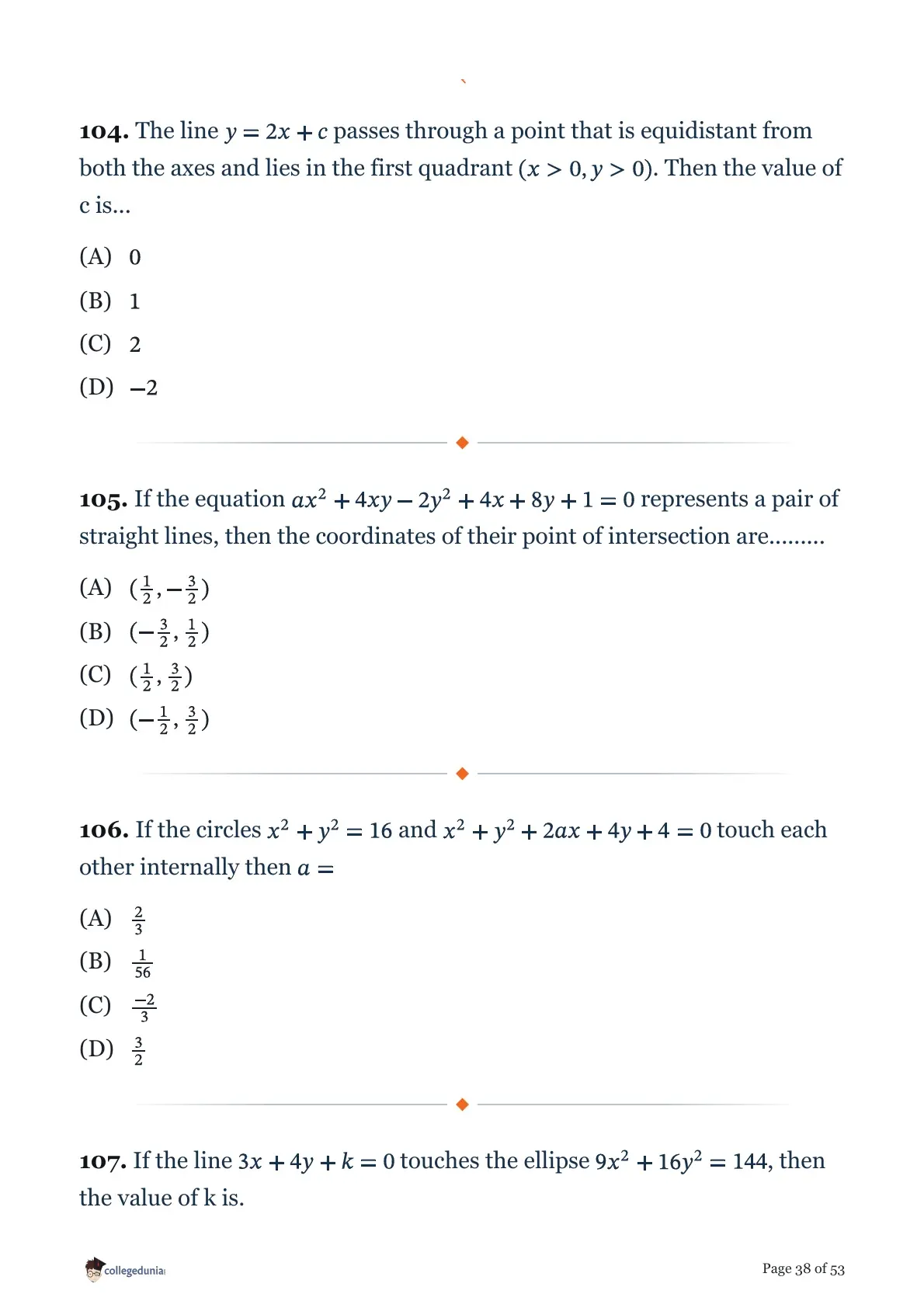
The line \(y = 2x+c\) passes through a point that is equidistant from both the axes and lies in the first quadrant \((x > 0,y > 0)\). Then the value of c is...
If the equation \(ax^2+4xy-2y^2+4x+8y+1 = 0\) represents a pair of straight lines, then the coordinates of their point of intersection are.........
If the circles \(x^2+y^2 = 16\) and \(x^2+y^2+2ax+4y+4 = 0\) touch each other internally then \(a =\)
If the line \(3x+4y+k = 0\) touches the ellipse \(9x^2+16y^2 = 144\), then the value of k is.
Which of the following statements is/are False?
\(S_1:\exists \,n\in N\), such that \(n^2+n+2\) is divisible by 4.
\(S_2:\exists \,x\in N\), such that \(x-17 < 20\).
\(S_3:\forall \,n\in N,\,x^2+3x-10 = 0\).
\(S_4:\forall \,n\in N,\,n^2\geq 1\).
The negation of \((p∧q)\rightarrow ((p∨r)\rightarrow \,\sim q)\) is equivalent to ...
The statement pattern \([(p∧q)\rightarrow (\sim p∨r)]∨[(\sim p∨r)\rightarrow (p∧q)]\) is
In \(△ABC\), with usual notation, if cot A, cot B, cot C are in arithmetic progression, then
If \(A = \left[ \begin{array}{cc}1 & -tan\frac{θ}{2} \\ tan\frac{θ}{2} & 1\end{array} \right]\) and \(B = \left[ \begin{array}{cc}1 & tan\frac{θ}{2} \\ -tan\frac{θ}{2} & 1\end{array} \right]\) then \(A^{-1}B\) is equal to
If \(A = \left[ \begin{array}{ccc}3 & 0 & 0 \\ 0 & -5 & 0 \\ 0 & 0 & 7\end{array} \right]\); \(B = \left[ \begin{array}{ccc}-1 & 0 & 0 \\ 0 & 2 & 0 \\ 0 & 0 & 4\end{array} \right]\) then, \((2A+3B)^{-1} =\) _______
If \(sin^{-1}(x-2)+cos^{-1}(x)+tan^{-1}(x+2)+cot^{-1}(x+4) = sec^{-1}(\sqrt{k})-\frac{π}{2}\), then \(cos(2\,\text{cosec}^{-1}\sqrt{k-1}) = \ldots\)
\(sin(3sin^{-1}(\frac{1}{5})) =\)
\(cos^{-1}(cos\frac{4π}{3})+sin^{-1}(sin\frac{4π}{3}) = \ldots\)
If \(f(x) = \frac{1-x}{1+x}\), then \(f(f(cosx)) =\)
If the function \(f(x) = \frac{4\sqrt{2}(sin3x+sinx)}{2sin2xsin\frac{3x}{2}+cos\frac{5x}{2}-cos\frac{3x}{2}}\) for \(x\neq \frac{π}{2}\) is continuous at \(x = \frac{π}{2}\), then the value of \(f(\frac{π}{2})\) is equal to
If \(f(x) = cosx\,cos2x\,cos4x\,cos8x\,cos16x\), then \(f^'(\frac{π}{4}) =\)
If \(y = \frac{1}{3x+5}\), then the value of \(\frac{d^9y}{dx^9}\) is..
The derivative of \(tan^{-1}(\frac{\sqrt{1+x^2}-1}{x})\) with respect to \(tan^{-1}(\frac{x}{\sqrt{1-x^2}})\) at \(x = \frac{1}{2}\) is
If \(y = \sqrt{cosx^2+\sqrt{cosx^2+\sqrt{cosx^2+\ldots \infty }}}\) and \(\frac{dy}{dx} = \frac{f(x)}{2y-1}\) then, \(\int f(x)\,dx = \ldots\)
If \(f(x) = cot^{-1}(\frac{3x-x^3}{1-3x^2})\) and \(g(x) = cos^{-1}(\frac{1-x^2}{1+x^2})\), then \(\underset{x\rightarrow a}{lim}\frac{f(x)-f(a)}{g(x)-g(a)}\), \((0 < a < \frac{1}{2})\) is
The coordinates of the points on the curve \(4y = x^2\) that are nearest to the point \((0,5)\) are ...
The equation of the tangent to the curve \(y = \sqrt{9-3x^2}\) at the point where the ordinate and abscissa equal is...
If the line \(y = 4x-5\) is tangent to the curve \(y^2 = ax^3+b\) at the point \((2,3)\), then the value of \(7a-2b\) is...
If \(\int \frac{sinx}{sin4x}\,dx = αlog\frac{1+sinx}{1-sinx}+βlog\frac{1+\sqrt{2}sinx}{1-\sqrt{2}sinx}+c\), then the value of \(32(α+β^2) =\)
If \(\int f(x)\,dx = g(x)\) then \(\int x^3f(x^2)\,dx\) is equal to
If \(\int \frac{3x+7}{x^2-3x+2}\,dx = mlog(\frac{x-2}{x-1})+nlog(x-2)+c\), where \(m,n\in R\) and \(c\) is an integration constant, then \(m+n =\)
If \(f(x) = \frac{sin^{-1}x}{\sqrt{1-x^2}}\) and \(g(x) = e^{sin^{-1}x}\), then the value of \(\int f(x)g(x)\,dx = \ldots\)
The function \(f(x) = \int _0^x\frac{dt}{1+cost}\) satisfies which of the following differential equations?
If \(\int _a^b(x^2-x)\,dx = 18,\int _a^bx^3\,dx = 0\), then \(a+b\) is equal to
The value of the definite integral \(\int _0^π\frac{1}{5+4cosx}\,dx\) is equal to ...
Let \(f(x) = x-[x]\) for every real number \(x\), where \([x]\) is integral part of \(x\). then \(\int _{-1}^1f(x)\,dx\) is
The area of the region bounded by curves \(y = sinx,y = cosx\) and the lines \(x = 0\), \(x = \frac{π}{4}\) is
The general solution of the differential equation \(secy+(x-e^{siny})\frac{dy}{dx} = 0\) is...
The general solution of the differential equations \(\frac{dy}{dx} = (9x+y+5)^2\) is...
Let \(\overset{⃗}{a}\) and \(\overset{⃗}{b}\) be linearly independent vectors such that
\(|\overset{⃗}{a}| = \sqrt{3},|\overset{⃗}{b}| = 3\) and \(|\overset{⃗}{a}-\overset{⃗}{b}| = 4\).
If \(\overset{⃗}{a}\times (2\hat{i}+2\hat{j}-\hat{k}) = (2\hat{i}+2\hat{j}-\hat{k})\times \overset{⃗}{b}\) and \(|(\overset{⃗}{a}+\overset{⃗}{b})\cdot (3\hat{i}+4\hat{j}+2\hat{k})| = \sqrt{λ}\), then \(λ = \ldots\)
The value of \(b\) such that the scalar product of the vector \(\hat{i}+\hat{j}+\hat{k}\) with the unit vector parallel to the sum of the vectors \(2\hat{i}+4\hat{j}-5\hat{k}\) and \(b\hat{i}+2\hat{j}+3\hat{k}\) is one, is...
If \(|\overset{⃗}{a}\cdot \overset{⃗}{b}| = |\overset{⃗}{a}\times \overset{⃗}{b}|\), \(\overset{⃗}{a}\cdot \overset{⃗}{b} < 0\) and \(θ\) is the angle between \(\overset{⃗}{a}\) and \(\overset{⃗}{b}\), then the value of \(sinθ+tanθ\) is...
Let \(\overset{⃗}{a} = λ\hat{i}+\hat{j}+\hat{k},\overset{⃗}{b} = 2\hat{i}+4\hat{j}+4\hat{k},\overset{⃗}{c} = \hat{i}+μ\hat{j}+\hat{k}\)
If \(\overset{⃗}{a}\) is parallel to \(\overset{⃗}{b}\) and \(\overset{⃗}{b}\) is perpendicular to \(\overset{⃗}{c}\) then \(λ-μ = \ldots\)
The equation of the perpendicular line from the point \((2,-3,1)\) to the line \(\frac{x+1}{2} = \frac{y-3}{3} = \frac{z+2}{-1}\) is
The angle between the line \(x-1 = 2-y = \frac{2z-6}{4}\) and the plane \(\overset{⃗}{r}\cdot (2\hat{i}+\hat{j}+\hat{k}) = 10\) is
The sum of the coordinates of one of the points on the line \(\frac{x-2}{1} = \frac{y+3}{-2} = \frac{z+5}{2}\) which is at a distance of 3 units from the point \((2,-3,-5)\) is ...
If A and B are the feet of the perpendiculars drawn from \((1,2,3)\) to planes \(YZ\) and \(ZX\), then the equation of the plane passing through the points A, B and the origin is
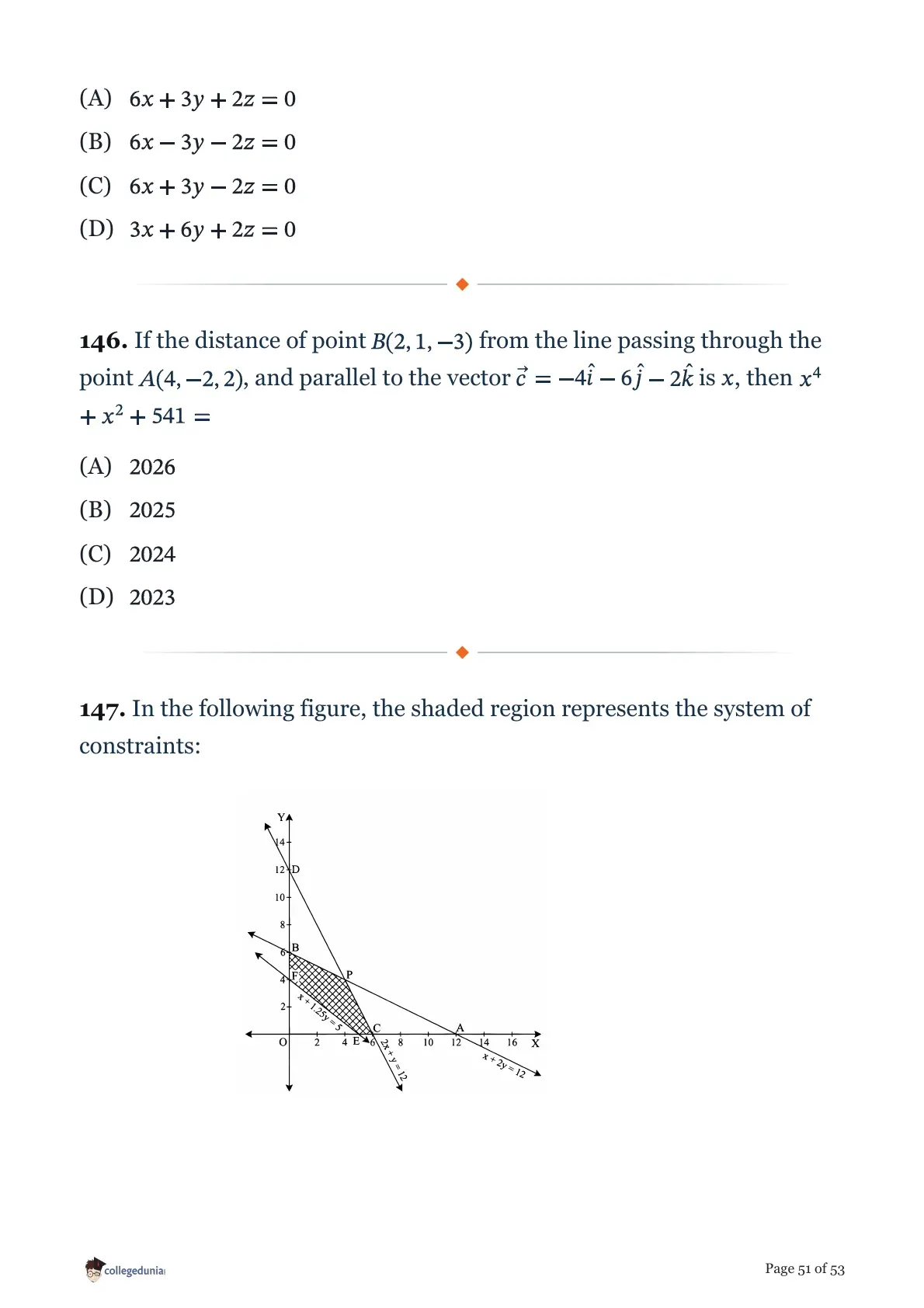
If the distance of point \(B(2,1,-3)\) from the line passing through the point \(A(4,-2,2)\), and parallel to the vector \(\overset{⃗}{c} = -4\hat{i}-6\hat{j}-2\hat{k}\) is \(x\), then \(x^4+x^2+541 =\)
In the following figure, the shaded region represents the system of constraints:

On average, one out of 10 persons is busy. If six persons are selected at random, then the probability that at least 5 of them will be busy is...
If a discrete random variable \(X\) takes the values \(1,2,3,4\) such that \(2P(X = 1) = 3P(X = 2) = P(X = 3) = 5P(X = 4)\), then \(P(X = 4) = \ldots\)
Three numbers are chosen from 1 to 30. The probability that minimum is 10 and maximum is 26 is _______
MHT CET PCM Exam Pattern 2026
| Parameter | Details |
|---|---|
| Conducting Body | Maharashtra Common Entrance Test Cell (Maharashtra CET Cell) |
| Exam Mode | Online (Computer-Based Test) |
| Duration | 180 minutes (3 hours) |
| Groups / Subjects | PCM (Physics, Chemistry, Mathematics) for Engineering |
| Total Questions |
150 |
| Total Marks | 200 |
| Question Type | Multiple Choice Questions (MCQs) |
| Marks Distribution |
|
| Negative Marking | No |
| Syllabus Weightage |
|



Comments