




MHT CET 2026 April 18 Shift 2 PCM Question Paper is available for download here. Maharashtra State CET Cell conducted MHT CET 2026 PCM Exam on April 18 in Shift 2 from 2 AM to 5 PM in CBT mode.
- The MHT CET 2026 PCM Question Paper consists of 150 multiple-choice questions (MCQs) totalling 200 marks divided into 3 sections: Physics, Chemistry, and Mathematics, with 50 questions in each subject.
- Physics and Chemistry questions carry 1 mark each while Mathematics questions carry 2 marks each.
- There is no negative marking for incorrect answers.
Also Check: MHT CET 2026 April 18 Shift 1 PCM Question Paper
Download MHT CET 2026 April 18 Shift 2 PCM Question Paper with Solutions PDF from the links provided below. Based on initial student reaction, MHT CET 2026 April 18 Shift 2 PCM Paper was of moderate level.
MHT CET 2026 April 18 Shift 2 PCM Question Paper PDF Download
| MHT CET 2026 April 18 Shift 2 Question Paper | Download PDF | Check Solution |


















MHT CET 2026 April 18 Shift 2 PCM Questions with Solutions
Physics Section (Questions 1 to 50)
If a unit vector is represented by \(\overset{⃗}{U} = 0.9\,\hat{i}-0.2\,\hat{j}+m\hat{k}\), then the value of m is
The maximum error in the measurement of the density and mass of the uniform cube are 8% and 2% respectively. Hence, the maximum error in the measurement of length will be
For a projectile motion, the range R is 'n' times the maximum height H. So the angle of projection is
An inextensible string passing over a smooth pulley connects two blocks of masses \(m_1\) and \(m_2\) (\(m_2 > m_1\)) vertically. If the acceleration of the system is \((\frac{g}{n})\), then the ratio of masses \((\frac{m_2}{m_1})\) is
Given identical rings are arranged in a hexagonal plane pattern so as to touch each neighbouring ring as shown in figure. Each ring has mass M and radius R. The moment of inertia of the system of seven rings about an axis passing through the centre of central ring and normal to plane of all rings is

A kathak dancer is standing on horizontal surface with folded hands. In the begining dancer is rotating about his central axis and his kinetic energy is 'K' at that time. The kathak dancer now stretches his arms so that the moment of inertia of the dancer becomes three times and the angular velocity becomes one-third. The kinetic energy of the dancer now is
A solid sphere rolls without slipping on an inclied plane at an angle \(θ\). The ratio of total kinetic energy to its rotational kinetic energy is
The acceleration due to gravity at a height 'h' above the surface of earth is '\(g_h\)'. At the depth 90 km below the earth's surface the acceleration due to gravity is also '\(g_h\)'. The value of 'h' is
An incompressible fluid (ideal fluid) is flowing through non uniform cross-sectional tube PQ as shown in the figure from end P to end Q. If \(K_P\) and \(K_Q\) are the kinetic energy per unit volume of the fluid at end P and end Q respectively, then

In case of fluid flowing on horizontal surface the flow of fluid becomes unsteady when Reynolds number (Rn) is
If the shape of the liquid surface is curved, then
A black body radiates maximum energy at wavelength '\(λ\)' at temperature \(T_1\) and its emissive power is E. When the temperature of the body is changed to \(T_2\), it radiates maximum energy at wavelength \(\frac{2λ}{3}\), then the emissive power will become
A body cools from a temperature \(3θ\) to \(2θ\) in 10 minute. The room temperature is \(θ\). The temperature of the body at the end of the next 10 minute is '\(x\)'. Assuming that Newton's law of cooling is applicable, the value of '\(x\)' will be
An ideal monoatomic gas is taken around the cycle ABCDA as shown in the P.V diagram. The work done during the cycle is

An ideal gas with pressure P, volume V and temperature T is expanded isothermally to volume 2V and a final pressure \(P_i\). The same gas is expanded adiabatically to a volume 2V then the final pressure is \(P_a\). In terms of \(γ\), the ratio of the two specific heats for the gas, the ratio \(P_i/P_a\) is
At a pressure P and temperature T, 7 gram of oxygen occupies a volume V. The equation of state will be (Molecular weight of Oxygen \(= 32\))
When the r.m.s. velocity of a gas is denoted by '\(v\)' at temperature '\(T\)'. Out of the following relations, the true one is
Three masses 100g, 300g and 500g are suspended at the end of a spring as shown in figure and are in equilibrium. When the 500 g mass is removed, the system oscillates with a period of 3 second. When the 300 g mass is also removed, it will oscillate with a period of

Two particles A and B of equal masses are suspended from two massless springs of spring constants \(K_A\) and \(K_B\) respectively. The maximum velocities of the particles during oscillations are equal. The ratio of the amplitude of 'B' to that of 'A' is
A particle of mass '\(m\)' is executing S.H.M. about the origin on x-axis with frequency \(\sqrt{\frac{Ka}{πm}}\), where K is a constant and a is the amplitude of S.H.M. If '\(x\)' is the displacement of a particle at time '\(t\)', the potential energy of a particle will be
In an organ pipe closed at one end produces a fundamental note of frequency '\(ν\)'. The pipe is cut into two pipes of equal length. The fundamental frequencies produced in the two pipes are
The fundamental frequency '\(n\)' of the tuning fork is 288 Hz, it will not resonate with the frequency
A wire of length 'L' and linear density 'm' is stretched between two rigid supports with tension 'T'. It is observed that wire resonates in the \(P^{th}\) harmonic at a frequency of 320 Hz and resonates again at next higher frequency of 400 Hz in two successive modes. The value of 'P' is
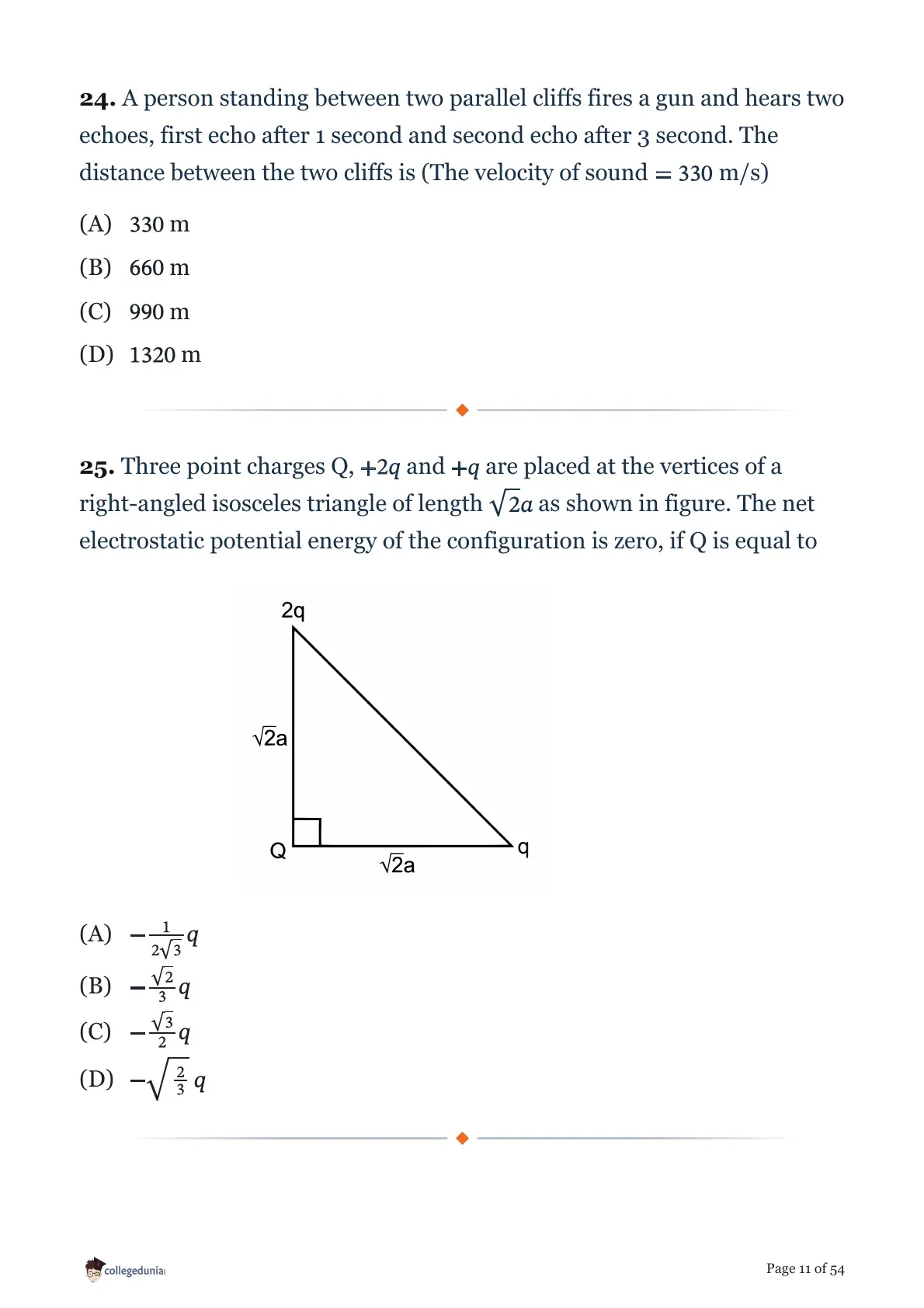
A person standing between two parallel cliffs fires a gun and hears two echoes, first echo after 1 second and second echo after 3 second. The distance between the two cliffs is (The velocity of sound \(= 330\) m/s)
Three point charges Q, \(+2q\) and \(+q\) are placed at the vertices of a right-angled isosceles triangle of length \(\sqrt{2}a\) as shown in figure. The net electrostatic potential energy of the configuration is zero, if Q is equal to

Two equal point charges exert a force F on each other when they are placed distance 'd' apart in air. When they are placed distance 'D' apart in a medium of dielectric constant K, they exert the same force. The distance D is equal to
Figure shows a network of five capacitors connected to a supply voltage 'V'. The equivalent capacitance and the energy stored in the network is respectively

Three identical capacitors connected in series have net capacitance '\(x\)'. Then they are connected in parallel. The ratio of energy stored in series configuration to that in parallel configuration is (if both configurations are connected to the same source)
When cell of E.M.F. '\(E_1\)' is connected to potentiometer wire the balancing length is '\(l_1\)'. Another cell of E.M.F. '\(E_2\)' (\(E_1 > E_2\)) is connected along with \(E_1\) so as two cells oppose each other, the balancing length is '\(l_2\)'. The ratio \(E_1:E_2\) is
In the following network,
\(I_1 = -0.4\,\text{A}\) , \(I_4 = 1\,\text{A}\) , \(I_5 = 0.4\,\text{A}\)
The values of \(I_2\), \(I_3\) and \(I_6\) are respectively

A particle of charge '\(q\)' and mass '\(m\)' moves in a circular orbit of radius '\(r\)' with angular speed '\(ω\)'. The ratio of the magnitude of its magnetic moment to that of its angular momentum depends upon
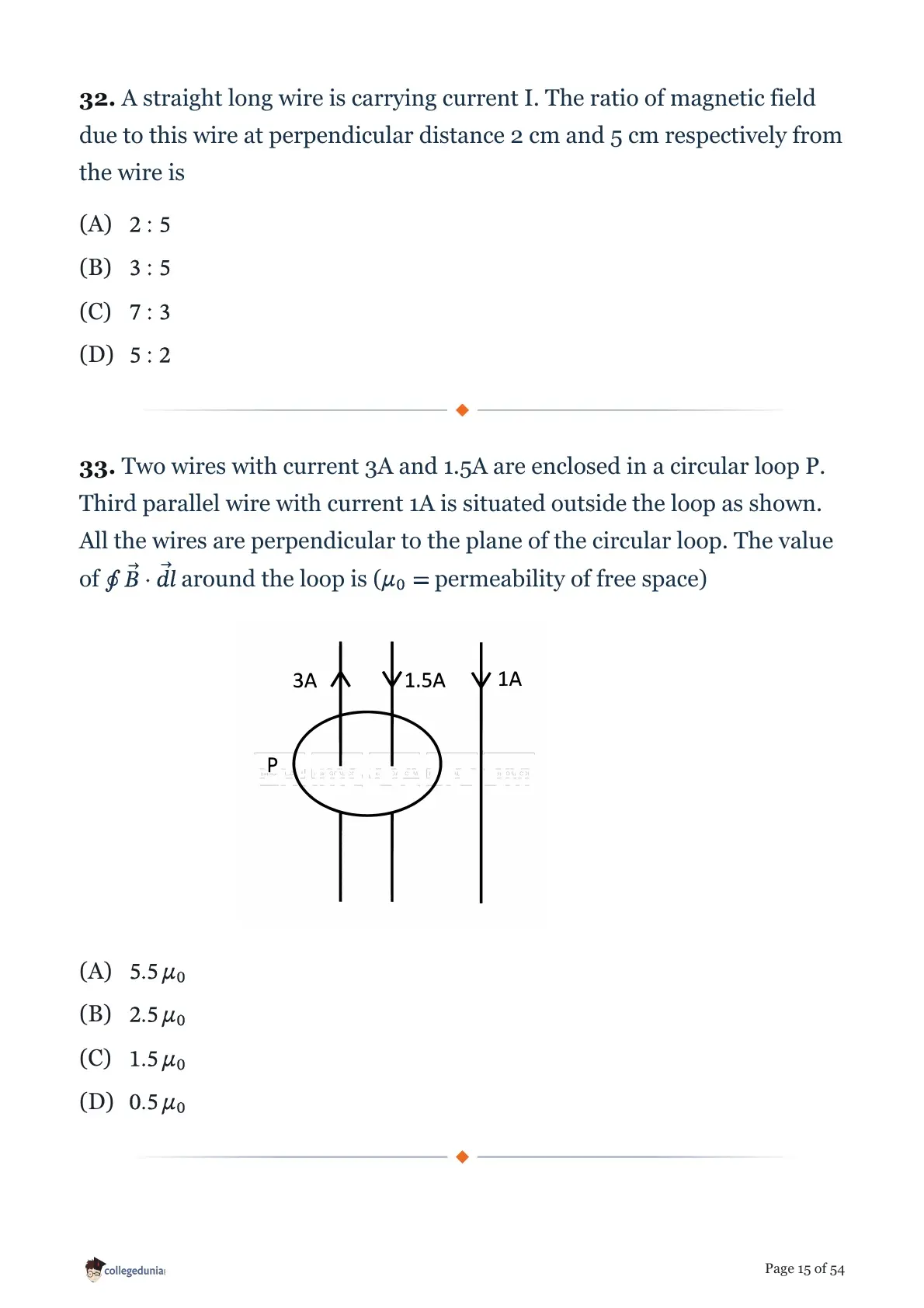
A straight long wire is carrying current I. The ratio of magnetic field due to this wire at perpendicular distance 2 cm and 5 cm respectively from the wire is
Two wires with current 3A and 1.5A are enclosed in a circular loop P. Third parallel wire with current 1A is situated outside the loop as shown. All the wires are perpendicular to the plane of the circular loop. The value of \(\oint \overset{⃗}{B}\cdot \overset{⃗}{dl}\) around the loop is (\(μ_0 =\) permeability of free space)

Two coils A and B have 180 and 360 turns respectively. The current of 1A flows through both the coils. Due to current of 1A in coil A, flux per turn of \(0.8\times 10^{-3}\) Wb is linked with coil A. Due to current of 1A in coil B, flux per turn of \(1\times 10^{-3}\) Wb is linked with coil B. The self inductance of coil A is \(L_A\) and the self inductance of coil B is \(L_B\). The ratio \(L_A\) to \(L_B\) is
If current of 4 A produces magnetic flux of \(3\times 10^{-3}\) Wb through a coil of 400 turns, the energy stored in the coil will be

A series combination of resistor 'R' and capacitor 'C' is connected to an a.c. source of angular frequency '\(ω\)'. Keeping the voltage same, if the frequency is changed to \((\frac{ω}{3})\) the current becomes half of the original current. Then the ratio of capacitive reactance and resistance is

In an LCR series circuit, the potential difference across the terminals of the inductor, capacitor and resistor is 60 V, 30 V and 40 V respectively. Then supply voltage will be equal to
Refractive index of a glass convex lens is \(1.5\). The radius of curvature of each of the two surfaces of the lens is 40 cm. The ratio of the power of the lens when immersed in a liquid of refractive index \(1.25\) to that when placed in air is
In a biprism experiment, fifth dark fringe is obtained at a point. A thin transparent film of refractive index '\(μ\)' is placed in one of the interfering paths. Now \(7^{th}\) bright fringe is obtained at the same point. If '\(λ\)' is the wavelength of light used, the thickness of film is equal to
A plane wavefront of width \(x\), is incident on an air-water interface and the corresponding refracted wavefront has a width y as shown in figure. The refreactive index of air with respect to water in terms of distances w and z is

In an optical instrument- microscope, the wavelength of light used are \(λ_1 = 6800\) Å and \(λ_2 = 5100\) Å. The ratio of the resolving power of microscope corresponding to '\(λ_1\)' to that for '\(λ_2\)' is
The maximum kinetic energies of photoelectrons emitted are \(K_1\) and \(K_2\) when light of wavelength \(λ_1\) and \(λ_2\) respectively are incident on a metallic surface. If \(λ_1 = 3λ_2\) then
The de Broglie wavelength of the electron in the ground state is \(λ_1\) and that in the \(n = 3\) level is \(λ_3\) then \(λ_3\) is given by
If the difference between \((n+1)^{th}\) Bohr radius and \(n^{th}\) Bohr radius is given by \((n-1)^{th}\) Bohr radius, then the value of n is
Two samples A and B contain equal amount of radioactive substances. If \((\frac{1}{8})^{th}\) of sample A and \((\frac{1}{128})^{th}\) of sample B, remain after 9 hours, then the ratio of half life period of B to that of A is
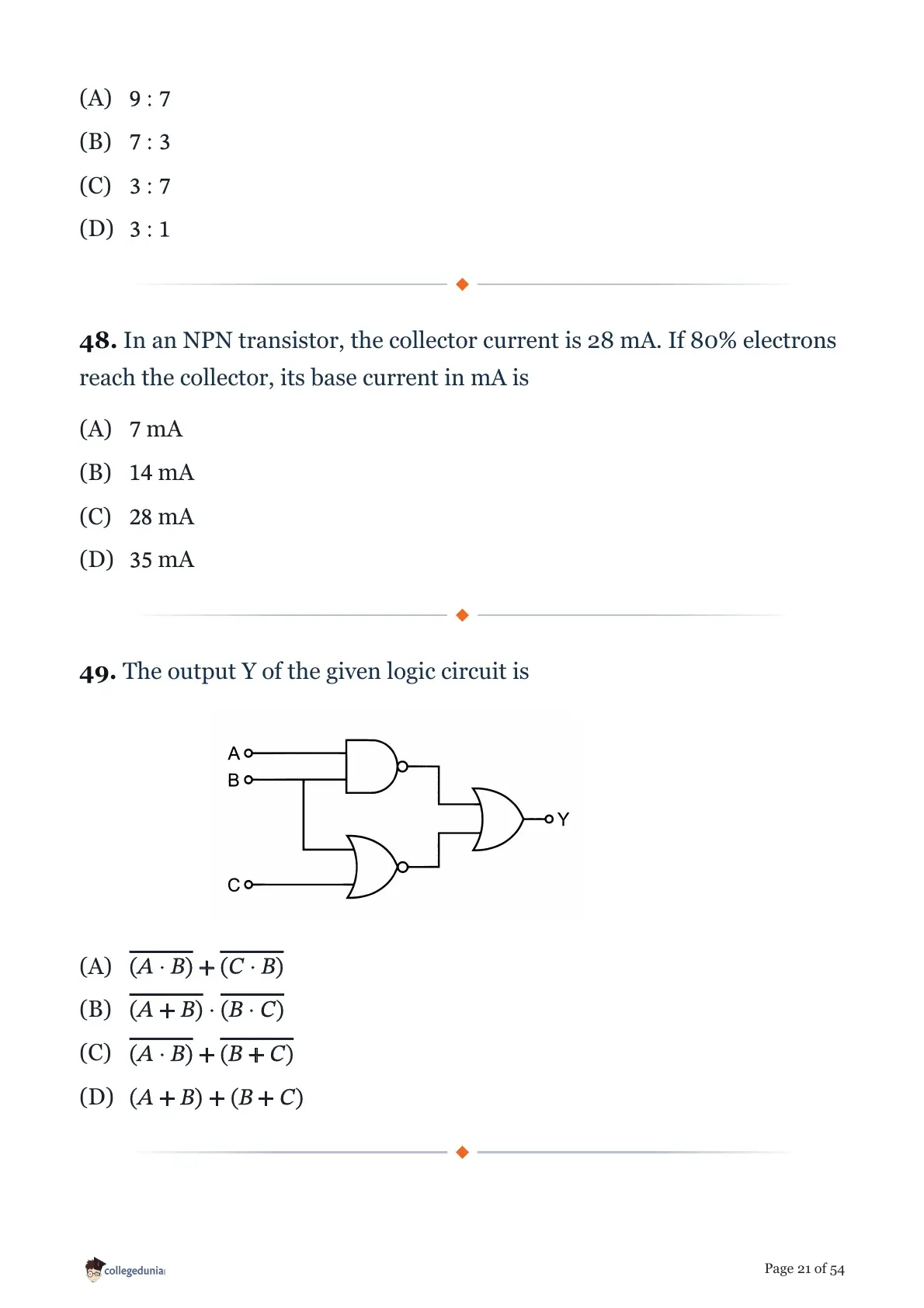
In an NPN transistor, the collector current is 28 mA. If 80% electrons reach the collector, its base current in mA is

For intrinsic semiconductor, if \(n_h\) and \(n_e\) represent the number of holes per unit volume and the number of free electrons per unit volume respectively then
Chemistry Section (Questions 51 to 100)
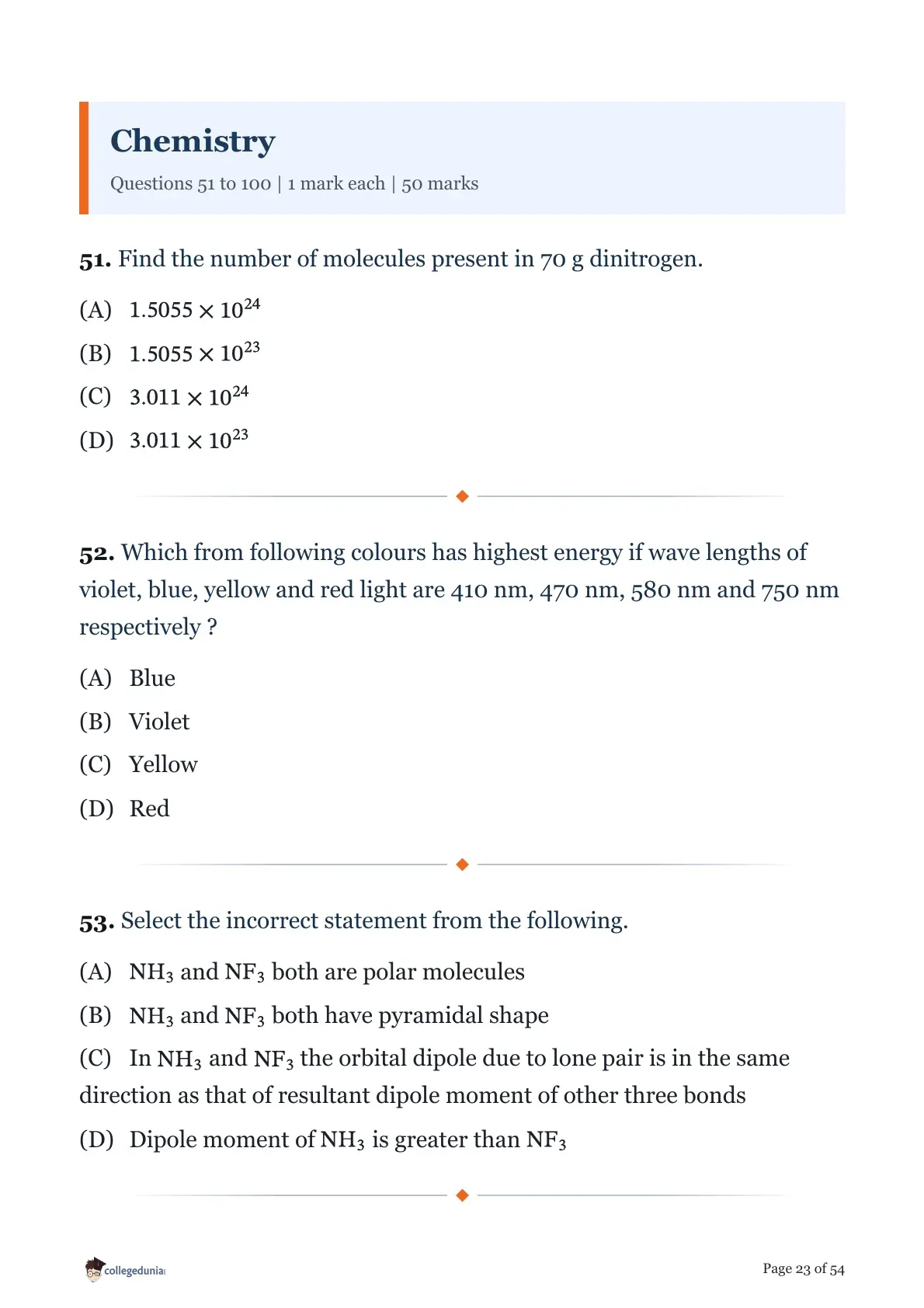
Find the number of molecules present in 70 g dinitrogen.
Which from following colours has highest energy if wave lengths of violet, blue, yellow and red light are 410 nm, 470 nm, 580 nm and 750 nm respectively ?
Select the incorrect statement from the following.
Which from following gases is least soluble in water at same temperature and pressure ?
Which of the following ethers is gaseous at room temperature ?
A container contains mixture of He and Ne gases at certain temperature. He is 20 % by mass of mixture. What is the ratio of partial pressure of Helium to Neon ?
1 mole of an ideal gas is compressed isothermally and reversibly from initial pressure \(x\) kPa to final pressure \(2x\) kPa at 300 K. Find the work done \((R = 8.314 \text{J K}^{-1}\text{mol}^{-1})\)
Which of the following is the correct expression of the first law of thermodynamics for adiabatic processes ?
Calculate the standard enthalpy change for the following reaction,
\(2\text{C}_2\text{H}_6\text{(g)}+7\text{O}_2\text{(g)}⟶4\text{CO}_2\text{(g)}+6\text{H}_2\text{O}\text{(l)}\)
Given, \(\Delta _fH^{\circ}(\text{C}_2\text{H}_6) = -85 \text{kJ mol}^{-1}\)
\(\Delta _fH^{\circ}(\text{CO}_2) = -390 \text{kJ mol}^{-1}\)
\(\Delta _fH^{\circ}(\text{H}_2\text{O}) = -285 \text{kJ mol}^{-1}\)
The solubility of salt \(\text{AX}_2\) is \(6\times 10^{-12} \text{mol dm}^{-3}\). What is solubility product of the salt ?
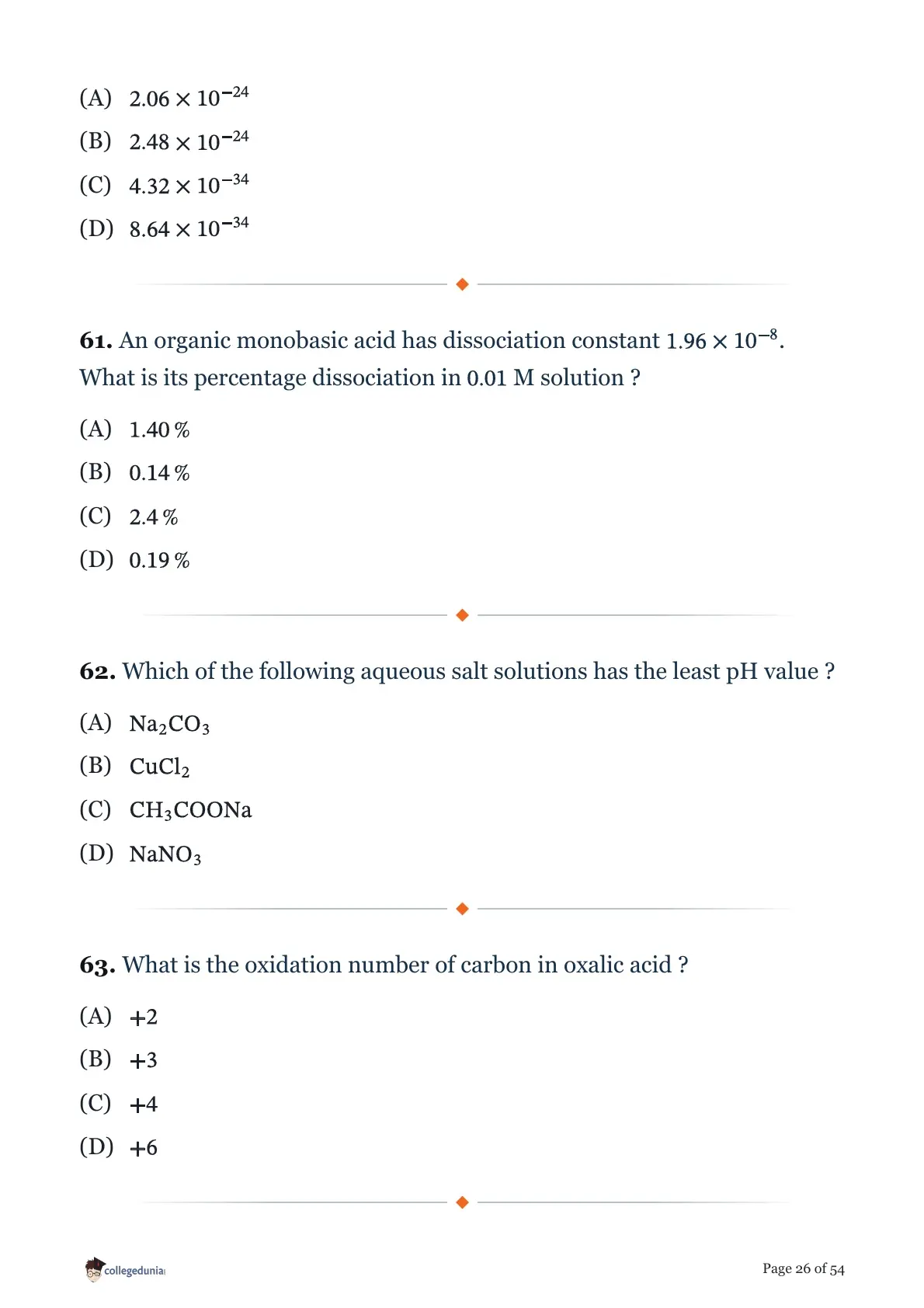
An organic monobasic acid has dissociation constant \(1.96\times 10^{-8}\). What is its percentage dissociation in \(0.01\) M solution ?
Which of the following aqueous salt solutions has the least pH value ?
What is the oxidation number of carbon in oxalic acid ?
What is the general formula of halide salts of alkali metals if M is a metal atom ?
Which from following compounds is NOT optically active?
Which from following compounds does NOT contain double bond in it ?
Which of the following is NOT terminal alkyne ?

Calculate the number of unit cell in \(0.5\) g metal if the product of volume and density of unit cell is \(6.65\times 10^{-23}\) g
What is the total number of adjacent unit cells shared by each face particle of fcc unit cell ?
A metal forms fcc structure. Calculate the volume of fcc unit cell in \(\text{cm}^3\) if void volume is \(1.66\times 10^{-23} \text{cm}^3\).
Calculate the mole fraction of solute in solution if vapour pressure of a solution and pure solvent are 27 mm Hg and 30 mm Hg respectively at 298 K.
Calculate the molar mass of nonelectrolyte solute when 6 gram of it is dissolved in 1 \(\text{dm}^3\) water has osmotic pressure \(2.4 \text{atm}\) at 300 K \((R = 0.0821 \text{atm dm}^3 \text{K}^{-1} \text{mol}^{-1})\)
A galvanic cell consist copper electrode and standard hydrogen electrode. If \(E^{\circ}(\text{Cu}_{(aq)}^{+2}|\text{Cu}_{(s)}) = +0.34\,\text{V}\), then identify a reaction taking place at positive electrode during working of cell.
If standard reduction potential of Zn, Ni and Fe are \(-0.76\,\text{V}\), \(-0.23\,\text{V}\) and \(-0.44\,\text{V}\) respectively. For the reaction (Stated below) to be spontaneous find out electrodes X and Y considering above electrode potentials
\(\text{X}_{(s)}+\text{Y}_{(aq)}^{+2}⟶\text{X}_{(aq)}^{+2}+\text{Y}_{(s)}\)
If standard reduction potential of four electrodes A, B, C, D are \(+2.5\,\text{V},+3.0\,\text{V},-2.0\,\text{V}\) and \(-1.5\,\text{V}\) respectively. When is the standard emf of cell maximum?
Which of the following is an example of fractional order reaction ?
What is the time required for 75 % completion of a first order reaction if rate constant is \(23.03 \text{minute}^{-1}\) ?
For a reaction \(\text{A}⟶\) product, \(k = 2\times 10^{-2} \text{s}^{-1}\). If the initial concentration of A is \(1.0 \text{mol dm}^{-3}\) find the value of \(log\frac{1}{[A]_t}\) after 100 second ?
Which of the following is an example of macromolecular colloid?
Which of the following reactions exhibits the reducing property of ozone ?
What is the oxidation state of chlorine in its weakest oxoacid?
Which from following pair of elements in their respective oxidation states have same number of unpaired electrons ?
Which lanthanoid from following exhibits \(f^{14}\) configuration in +3 state?
What is EAN for metal ion in \([\text{Fe(CN)}_6]^{3-}\) ?
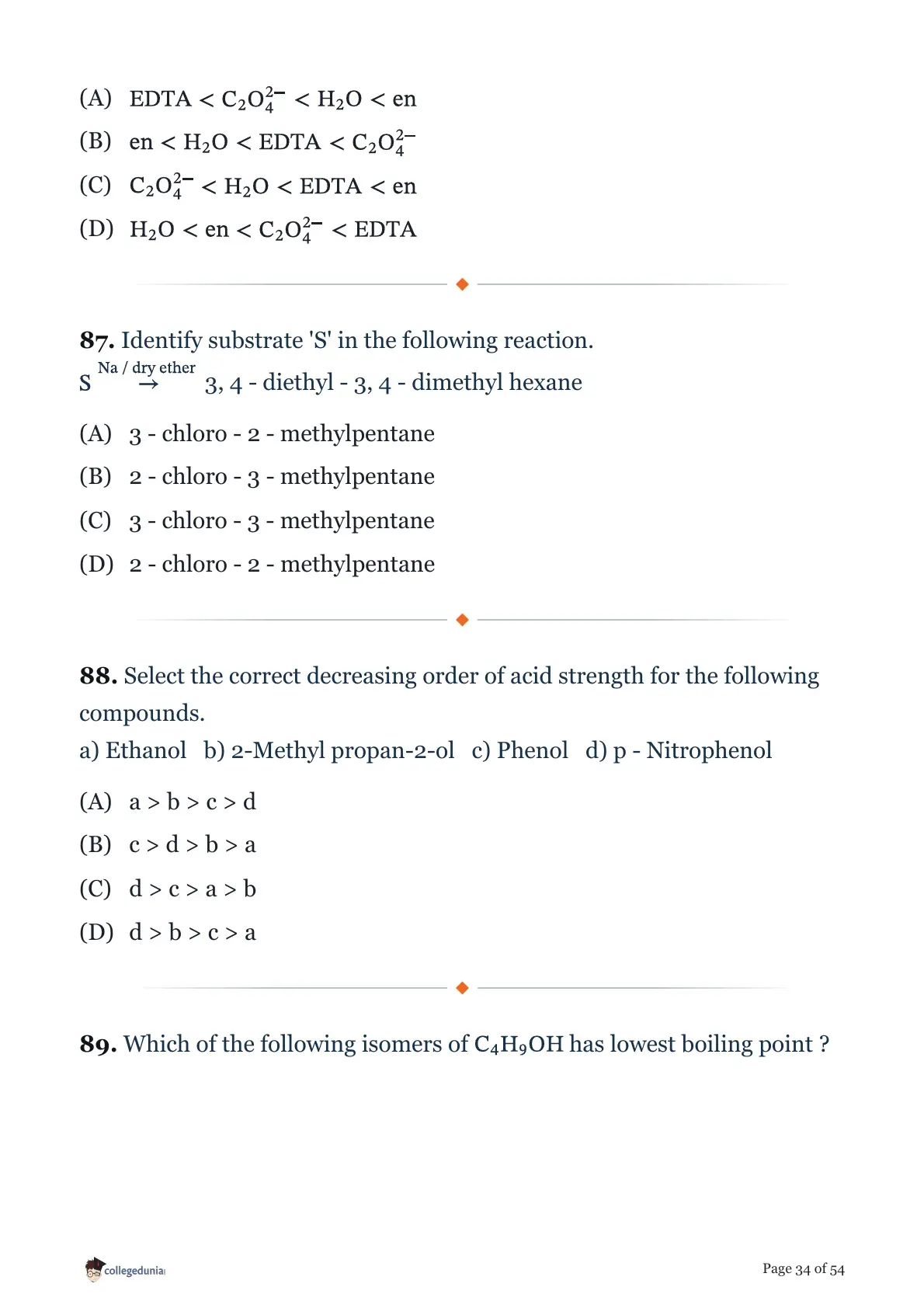
Which of the following is a correct increasing order of ligand field strength ?
Identify substrate 'S' in the following reaction.
\(\text{S}\overset{\text{Na / dry ether}\,}{\rightarrow }\) 3, 4 - diethyl - 3, 4 - dimethyl hexane
Select the correct decreasing order of acid strength for the following compounds.
a) Ethanol b) 2-Methyl propan-2-ol c) Phenol d) p - Nitrophenol
Which of the following isomers of \(\text{C}_4\text{H}_9\text{OH}\) has lowest boiling point ?
Identify the 'product' in the following reaction.
Pent - 3 - enenitrile \(\rightarrow _{\text{H}_3\text{O}^+\,}^{\text{Al H (i-Bu)}_2\,}\) Product
Identify the product obtained when isopropyl magnesium chloride in dry ether reacts with dry ice forming a complex, hydrolysed further.
What is the number of moles of hydrogen atoms needed to obtain one mole ethanamine from acetamide using \(\text{LiAl H}_4\) /ether as reducing agent.
Identify 'B' in the following reaction
Ethyl cyanide \(\overset{\text{H}_2\text{O}\,}{\rightarrow }\text{A}\overset{\text{H}_2\text{O / dil HCl}\,}{\rightarrow }\text{B}+\text{NH}_3\)
Which from following amines when heated with ethanolic KOH and chloroform does NOT produce foul smell ?
Identify glycosidic linkage in lactose.
Identify a protein present in nails
Identify the use of LDP from following.
What is a starting material used to obtain viscose rayon ?
Which of the following is the use of HDPE ?
Which from following plants is useful to extract analgesic compound from it ?
Mathematics Section (Questions 101 to 150)
The difference between the roots of the equation \(x^2+2x+4 = 0\) is \(\ldots\) (where \(i = \sqrt{-1}\))
In a test, there are 7 questions of the type 'True or False'. No student got all the answers correct. If the sequence of answers for every student is unique, then the maximum number of students who appeared for the test is \(\ldots\)
Let \(f_k(x) = \frac{1}{k}(cos^kx+sin^kx)\) where \(k\in N\), then \(f_6(x)-f_4(x) = \ldots\)
The coordinates of the orthocenter of the triangle whose sides are represented by the lines \(4x-7y+10 = 0\), \(x+y = 5\) and \(7x+4y = 15\) are \(\ldots\)
The combined equation of lines parallel to the coordinate axes and passing through the point of intersection of lines represented by \(x^2-6xy+5y^2+10x-14y+9 = 0\) is \(\ldots\)
The number of circles passing through the origin and touching the lines \(x+y = 1\) and \(x-y = 1\) is \(\ldots\)
A parabola has its focus on the positive X-axis and the Y-axis as its directrix. If \(P(α,4)\) is a point on this parabola such that the tangent to the parabola at point P passes through the origin, then the distance of P from origin is
If \(\underset{x\rightarrow k}{lim}\frac{x^3-k^3}{x^2-k^2} = \underset{x\rightarrow 0}{lim}\frac{1-cos(2x)}{xsinx}\), then the value of \(k\) is \(\ldots\)
In a switching circuit, if the combination \((S_1∧S_2)\) is connected in parallel to the combination \((S_1^'∧S_2^')\), then the room is lit only when \(\ldots\)
If the truth value of the statement pattern \((\sim p∧q)∨(\sim p∧\sim q)∨(p∧\sim q)\) is \(F\), then the truth values of \((p∨\sim q)\) and \((p\rightarrow q)\) are \(\ldots\) respectively.
The minimum number of switches in the simplified form of the following switching circuit is

In \(△ABC\), with usual notations, if \(\Delta\) denotes the area of triangle \(ABC\) then the value of \(2s(b+c-a)tan(\frac{A}{2})\) is equal to \(\ldots\)
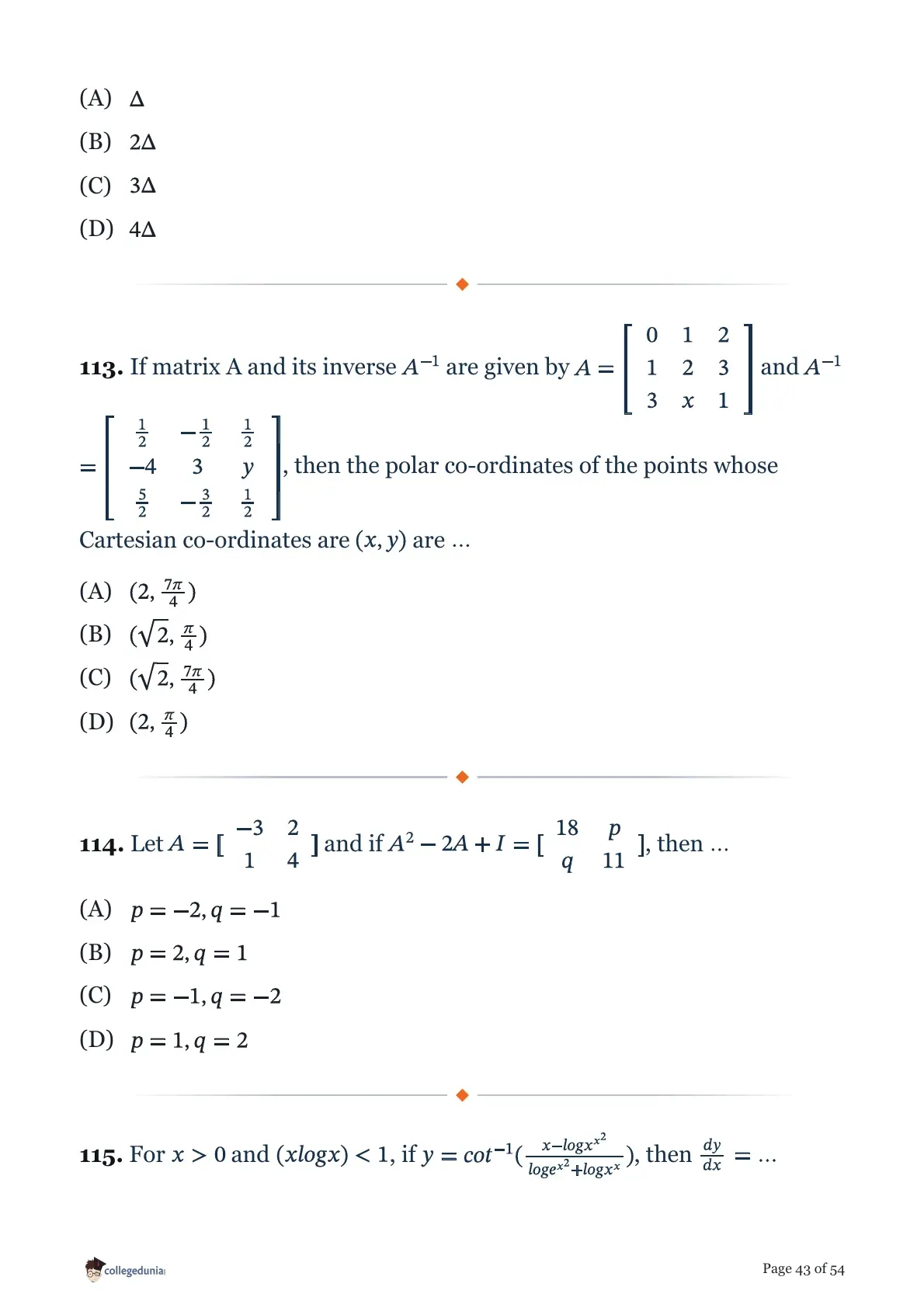
If matrix A and its inverse \(A^{-1}\) are given by \(A = \left[ \begin{array}{ccc}0 & 1 & 2 \\ 1 & 2 & 3 \\ 3 & x & 1\end{array} \right]\) and \(A^{-1} = \left[ \begin{array}{ccc}\frac{1}{2} & -\frac{1}{2} & \frac{1}{2} \\ -4 & 3 & y \\ \frac{5}{2} & -\frac{3}{2} & \frac{1}{2}\end{array} \right]\), then the polar co-ordinates of the points whose Cartesian co-ordinates are \((x,y)\) are \(\ldots\)
Let \(A = [\begin{array}{cc}-3 & 2 \\ 1 & 4\end{array}]\) and if \(A^2-2A+I = [\begin{array}{cc}18 & p \\ q & 11\end{array}]\), then \(\ldots\)
For \(x > 0\) and \((xlogx) < 1\), if \(y = cot^{-1}(\frac{x-logx^{x^2}}{loge^{x^2}+logx^x})\), then \(\frac{dy}{dx} = \ldots\)
For \(x > 0\), if \(sin(cos^{-1}x+tan^{-1}x)-cos(sin^{-1}x+tan^{-1}x) = sin(cot^{-1}2)\) then \(x =\)
If \(tan^{-1}ax+tan^{-1}3x = \frac{π}{4}\), where \(3ax^2 < 1\), then value of \(a\) for \(x = \frac{1}{6}\) is \(\ldots\)
\(sec^2(tan^{-1}3)-tan^2(sec^{-1}3) =\)
The domain of the function \(f(x) = \sqrt{\frac{x}{1+x}}\) is \(\ldots\)
If \(f(x) = \frac{3^x+3^{-x}-2}{tanx\cdot log(1+x)}\) for \(x\neq 0\), is continuous at \(x = 0\), then the value of \(f(0)\) is equal to \(\ldots\)
If \(\int f^'(x)\cdot e^{x^2}\,dx = (x-1)\cdot e^{x^2}+k\), where \(k\) is constant of integration, then \(f(x) = \ldots\)
Let \(y = \sqrt[p]{x^3y}\). If \(\frac{dy}{dx} = \frac{3}{2}\) when \(y = 1\), then the value of \(p\) is equal to \(\ldots\)
If \(f^'(x) = sin^2x\) and \(y = f(\frac{2x-1}{x^2+1})\), then \(\frac{dy}{dx}\) at \(x = 1\) is
If \(f:R\rightarrow R\) is an even function then
Let \(g(x) = f(x)+f(1-x)\) and \(f^{''}(x) < 0,0\leq x\leq 1\), then \(\ldots\)
If the function \(f(x) = ax^2+bx+sinx\) satisfies all the conditions of Rolle's theorem on \([0,π]\) and the slope of the tangent to the curve \(y = f(x)\) at \(x = \frac{π}{4}\) is zero, then \(a-b =\)
If a particle moves such that the displacement (s) is proportional to the square of the velocity (v), then its acceleration (a) is
If \(\int e^{x+tan^{-1}x}(\frac{x^2+2}{sec^2(tan^{-1}x)})dx = e^{f(x)}+c\), then \(\ldots\)
Let \(f(x) = x\), \(f_1(x) = f(logx)\), \(f_2(x) = f_1(logx)\), \(f_3(x) = f_2(logx)\), \(\ldots\) and so on. Then \(\int \frac{1}{f(x)\,f_1(x)\,f_2(x)\,\ldots f_{2026}(x)}\,dx = \ldots\)
If \(\int _0^2x(2-x)^b\,dx = \frac{32}{7}\), where \(b\in N\) then \(b =\)
\(\int _0^2|4x-5|\,dx = \ldots\)
If the area bounded by \(y = x^3+ax\) (where \(a > 0\)), the \(x\)-axis and the lines \(x = -2\) and \(x = 1\) is \(\frac{37}{4}\) square units, then \(\ldots\)
The rate of disintegration of a radioactive element at any time is proportional to its mass at that time, where \(k\) \((k > 0)\) is the constant of proportionality. The time during which an original mass of 1.5 gm will disintegrate to a mass of 0.5 gm is \(\ldots\)
The differential equation of the family of all parabolas whose axis is the \(y\)-axis is \(\ldots\)
The integrating factor of the differential equation \(x\frac{dy}{dx}+2y = x^2logx\) is
A spherical raindrop evaporates at a rate proportional to its surface area. The differential equation involving the rate of change of its radius \(r\) with time '\(t\)' is \(\ldots\) (where \(k\) is a positive constant)
The order and degree of the differential equation \(\sqrt{⎷1+\frac{1}{(\frac{dy}{dx})^2}} = (\frac{d^2y}{dx^2})^{\frac{3}{2}}\) are \(\ldots\)
The equation of the plane passing through the points having position vectors \((\overset{̄}{a}+\overset{̄}{b}),(\overset{̄}{b}+\overset{̄}{c})\) and \((\overset{̄}{a}+\overset{̄}{c})\) is \(\ldots\)
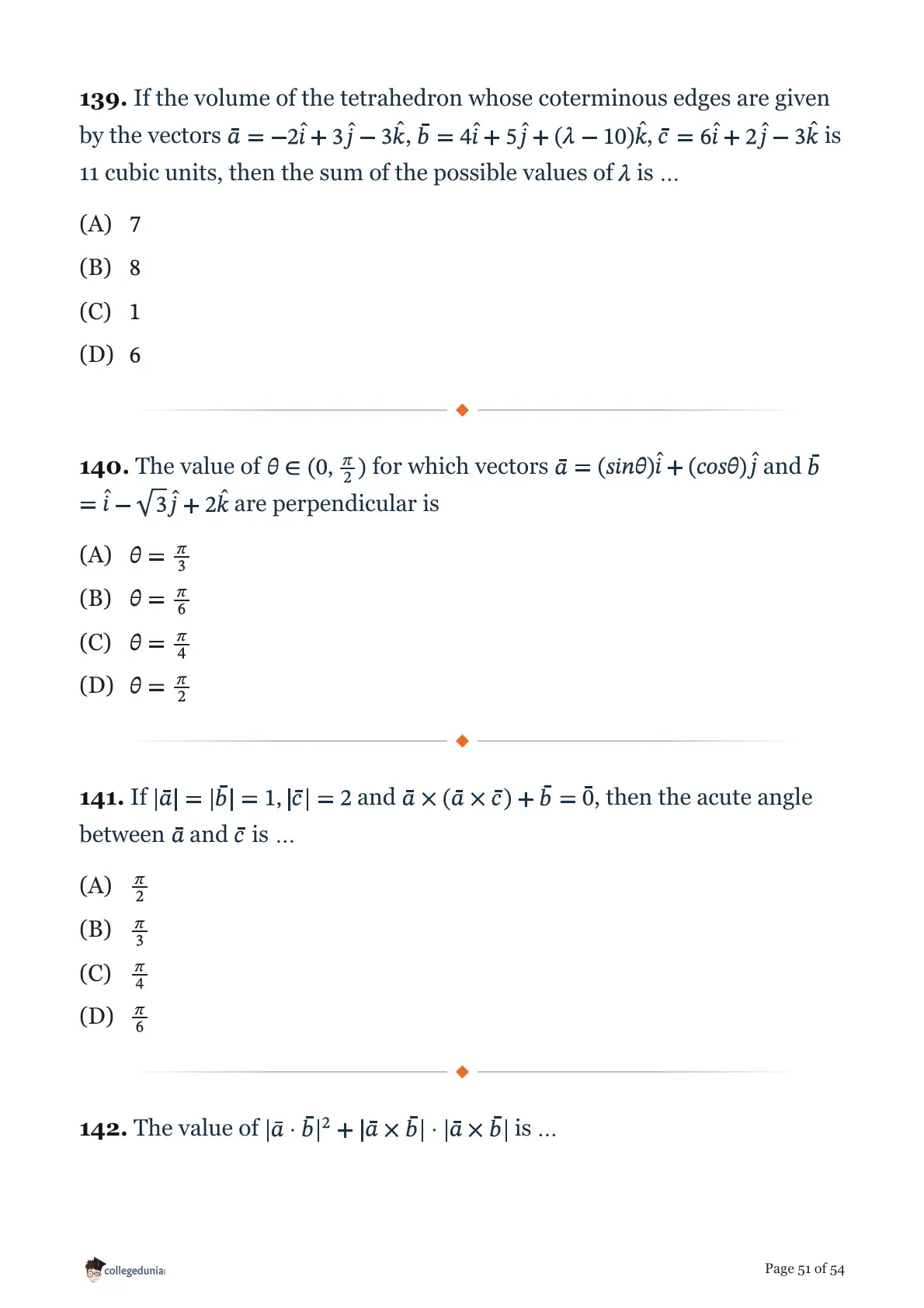
If the volume of the tetrahedron whose coterminous edges are given by the vectors \(\overset{̄}{a} = -2\hat{i}+3\hat{j}-3\hat{k}\), \(\overset{̄}{b} = 4\hat{i}+5\hat{j}+(λ-10)\hat{k}\), \(\overset{̄}{c} = 6\hat{i}+2\hat{j}-3\hat{k}\) is 11 cubic units, then the sum of the possible values of \(λ\) is \(\ldots\)
The value of \(θ\in (0,\frac{π}{2})\) for which vectors \(\overset{̄}{a} = (sinθ)\hat{i}+(cosθ)\hat{j}\) and \(\overset{̄}{b} = \hat{i}-\sqrt{3}\hat{j}+2\hat{k}\) are perpendicular is
If \(|\overset{̄}{a}| = |\overset{̄}{b}| = 1,|\overset{̄}{c}| = 2\) and \(\overset{̄}{a}\times (\overset{̄}{a}\times \overset{̄}{c})+\overset{̄}{b} = \overset{̄}{0}\), then the acute angle between \(\overset{̄}{a}\) and \(\overset{̄}{c}\) is \(\ldots\)
The value of \(|\overset{̄}{a}\cdot \overset{̄}{b}|^2+|\overset{̄}{a}\times \overset{̄}{b}|\cdot |\overset{̄}{a}\times \overset{̄}{b}|\) is \(\ldots\)
If \(\overset{̄}{a}\cdot \overset{̄}{b} = β\) and \(\overset{̄}{a}\times \overset{̄}{b} = \overset{̄}{c}\) then \(\overset{̄}{a} =\)
If the equation of a plane passing through \(A(1,p,2)\), \(B(3,2,4)\) and parallel to the z axis, is \(3x-2y-q = 0\), then \(\ldots\)
The angle between the line \(\overset{̄}{r} = (\hat{i}+2\hat{j}+\hat{k})+λ(\hat{i}+\hat{j}+\hat{k})\) and the plane \(\overset{̄}{r}\cdot (2\hat{i}-\hat{j}+\hat{k}) = 8\) is \(\ldots\)
The acute angle between the lines \(2x = 3y = -z\) and \(6x = -y = -4z\) is \(\ldots\)
The maximum value of \(z = 4x+y\) subject to the constraints \(x+y\leq 5,2x+y\leq 7,3x+2y\leq 11,x\geq 0,y\geq 0\) is \(\ldots\)
A fair die is thrown 4 times. If getting a prime number on the die is considered as a success, then the probability of getting no success at all is \(\ldots\)
If the p. d. f. of a continuous random variable X is given by \(f(x) = \{\begin{array}{cc}k(9+8x-x^2), & \text{for }-1\leq x\leq 4 \\ 0, & \text{otherwise}\end{array}\) then the value of \(k\) is \(\ldots\)
In an entrance test, there are multiple choice questions. There are four possible answers to each question, only one of which is correct. The probability that a student knows the answer to a question is 90%. If he gets the correct answer to a question, then the probability that he was guessing is
MHT CET PCM Exam Pattern 2026
| Parameter | Details |
|---|---|
| Conducting Body | Maharashtra Common Entrance Test Cell (Maharashtra CET Cell) |
| Exam Mode | Online (Computer-Based Test) |
| Duration | 180 minutes (3 hours) |
| Groups / Subjects | PCM (Physics, Chemistry, Mathematics) for Engineering |
| Total Questions |
150 |
| Total Marks | 200 |
| Question Type | Multiple Choice Questions (MCQs) |
| Marks Distribution |
|
| Negative Marking | No |
| Syllabus Weightage |
|



Comments