




MHT CET 2026 April 18 Shift 1 PCM Question Paper is available for download here. Maharashtra State CET Cell conducted MHT CET 2026 PCM Exam on April 18 in Shift 1 from 9 AM to 12 PM in CBT mode.
- The MHT CET 2026 PCM Question Paper consists of 150 multiple-choice questions (MCQs) totalling 200 marks divided into 3 sections: Physics, Chemistry, and Mathematics, with 50 questions in each subject.
- Physics and Chemistry questions carry 1 mark each while Mathematics questions carry 2 marks each.
- There is no negative marking for incorrect answers.
Also Check: MHT CET 2026 April 18 Shift 2 PCM Question Paper
Download MHT CET 2026 April 18 Shift 1 PCM Question Paper with Solutions PDF from the links provided below. Based on initial student reaction, MHT CET 2026 April 18 Shift 1 PCM Paper was of moderate level.
MHT CET 2026 April 18 Shift 1 PCM Question Paper PDF Download
| MHT CET 2026 April 18 Shift 1 Question Paper | Download PDF | Check Solution |








MHT CET 2026 April 18 Shift 1 PCM Questions with Solutions
Physics Section (Questions 1 to 50)
The angle made by vector \(\overset{⃗}{A} = 2\hat{i}+3\hat{j}\) with x-axis and that with y-axis are respectively.
If two resistors of resistances have values \(R_1 = (350\pm 3) \Omega\) and \(R_2 = (140\pm 4) \Omega\). The percentage error for the sum and difference of \(R_1\) and \(R_2\) are respectively
A body moves along a circular path of diameter \(30 \text{cm}\). It starts from one end of diameter, moves along the circular path and reaches the other end of diameter in 3 second. The angular speed of the body in radian per second is
A block of mass M is lying on a horizontal frictionless surface. One end of the uniform rope of half the mass of the block is fixed to the block which is pulled in the horizontal direction by applying a force F at the other end. The tension in the middle of the rope will be
The angular momentum of a rotating body is 'L'. When the frequency of rotating body is tripled and its kinetic energy is made one-third, the new angular momentum becomes
A solid cylinder and a solid sphere having the same mass and radius roll down on the same smooth inclined plane. The ratio of the acceleration of the cylinder \((a_c)\) to that of the sphere \((a_s)\) is
The radius of gyration K of a hollow sphere of mass M and radius R about an axis XY is equal to R as shown in figure. The distance of that axis from the center of the sphere is h. The value of h is

The lengths of seconds pendulums on the surface of the earth and at an altitude '\(h\)' from the surface of the earth are \(l_s\) and \(l_h\) respectively. The radius of the earth is
Time period of a simple pendulum is \(T_1\) when on the earth's surface and \(T_2\) when taken to a height '2R' above the earth's surface, where 'R' is the radius of the earth. The ratio \(T_1:T_2\) is
The pressure at half the depth of a lake is equal to two-third pressure at the bottom of the lake. So the depth 'h' of the lake is (\(ρ\) = density of water in the lake, \(g\) = acceleration due to gravity, \(P_0\) = atmospheric pressure).
A spherical object is falling under gravity through a viscous fluid. The sphere attains the terminal velocity when
A piston of cross-sectional area \(2.5\times 10^{-2} \text{m}^2\) is used in a hydraulic lift to exert a force of \(250 \text{N}\) on water. The cross-sectional area of the other piston which supports a car of mass \(3000 \text{kg}\) is (\(g = 9.8 \text{m/s}^2\))
Two spherical black bodies of radii \(R_1\) and \(R_2\) having surface temperature \(T_1\) and \(T_2\) respectively, radiate the same power. The ratio of \(R_1\) to \(R_2\) will be
The ratio of thermal conductivity of two rods of different materials is \(4:3\). The two rods have same area of cross-section and same thermal resistance. The lengths of rods are in the ratio
In thermodynamic process for free expansion, select the 'WRONG' statement out of the following options.
Which of the following graphs between pressure and volume of a gas correctly shows isochoric process in thermodynamics?

The r.m.s. speed of hydrogen at S.T.P. is '\(u\)' \(\text{m/s}\). If the gas is heated at constant pressure till its volume becomes three times, the final temperature of the gas and the r.m.s. speed are respectively
An ideal gas is heated from \(27^{\circ}\text{C}\) to \(627^{\circ}\text{C}\) at constant pressure. If initial volume of gas is \(4 \text{m}^3\), then the new volume of the gas will be

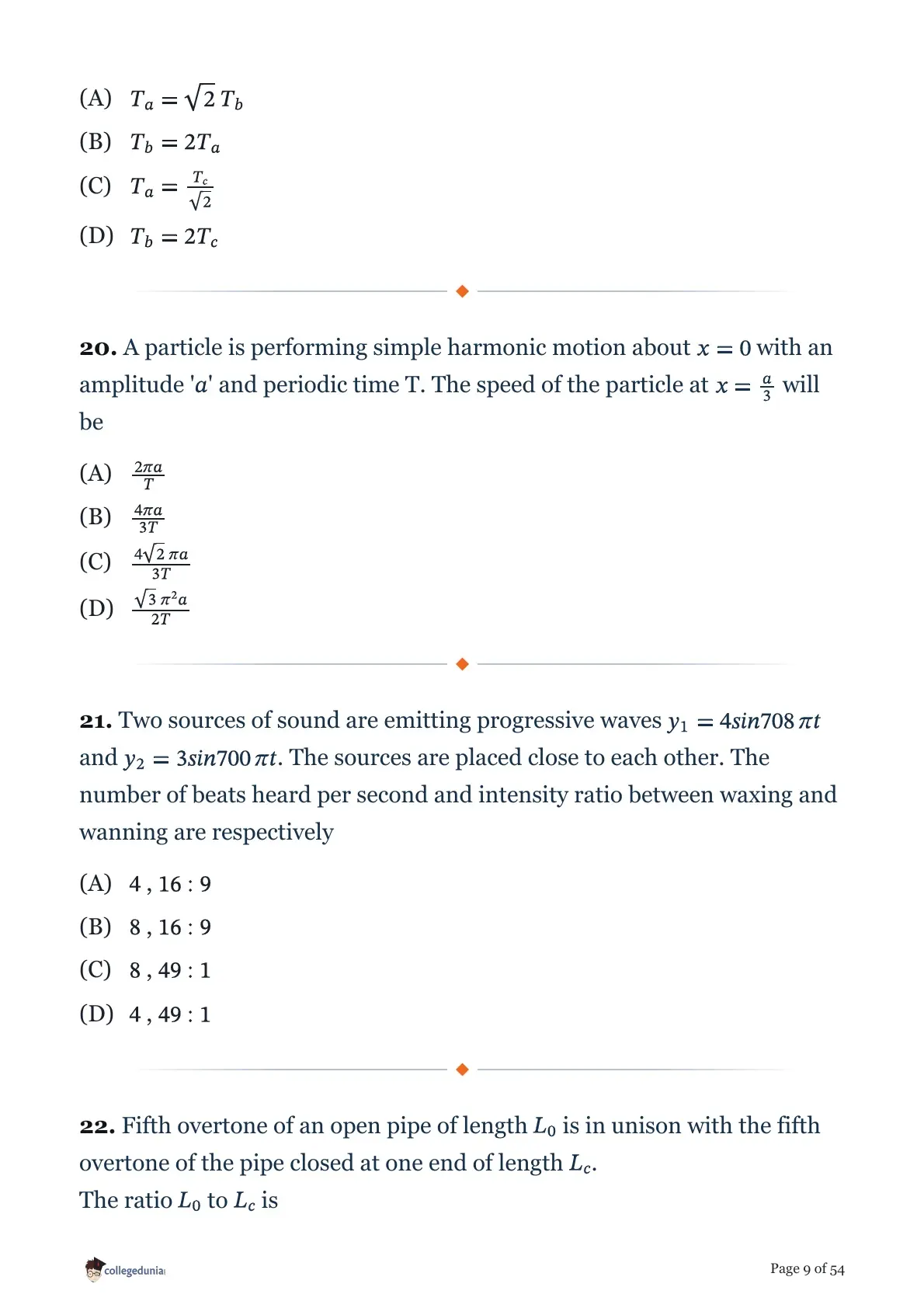
All the springs in fig (a), (b) and (c) are identical, each one having force constant K. Mass m is attached to each system. If \(T_a\), \(T_b\) and \(T_c\) are the periodic time of oscillations of the three systems in fig (a), (b) and (c) respectively, then
A particle is performing simple harmonic motion about \(x = 0\) with an amplitude '\(a\)' and periodic time T. The speed of the particle at \(x = \frac{a}{3}\) will be
Two sources of sound are emitting progressive waves \(y_1 = 4sin708\,πt\) and \(y_2 = 3sin700\,πt\). The sources are placed close to each other. The number of beats heard per second and intensity ratio between waxing and wanning are respectively
Fifth overtone of an open pipe of length \(L_0\) is in unison with the fifth overtone of the pipe closed at one end of length \(L_c\).
The ratio \(L_0\) to \(L_c\) is
The lengths of the two pipes open at both ends are L and \((L+L_1)\). If they are sounded together, the beat frequency will be
(\(v\) = velocity of sound in air)
The number of waves counted by an observer on the sea-coast in one minute is 54. If the wavelength of the waves is \(5 \text{m}\) then the velocity of the waves in \(\text{m/s}\) will be
When a dipole placed parallel to electric field is rotating through \(π^c\), the work done is W. The work done in rotating the dipole through \((\frac{π}{3})^c\) is
(\(cos0^{\circ} = 1\), \(cos60^{\circ} = \frac{1}{2}\), \(cos180^{\circ} = -1\))
The point charges \(+q\), \(-q\), \(-q\), \(+q\), \(+Q\) and \(-q\) are placed at the vertices of a regular hexagon ABCDEF as shown in the figure.

The electric field at the centre of the hexagon 'O' due to the five charges at A, B, C, D and F is thrice the electric field at centre 'O' due to charge \(+Q\) at E alone. The value of Q is
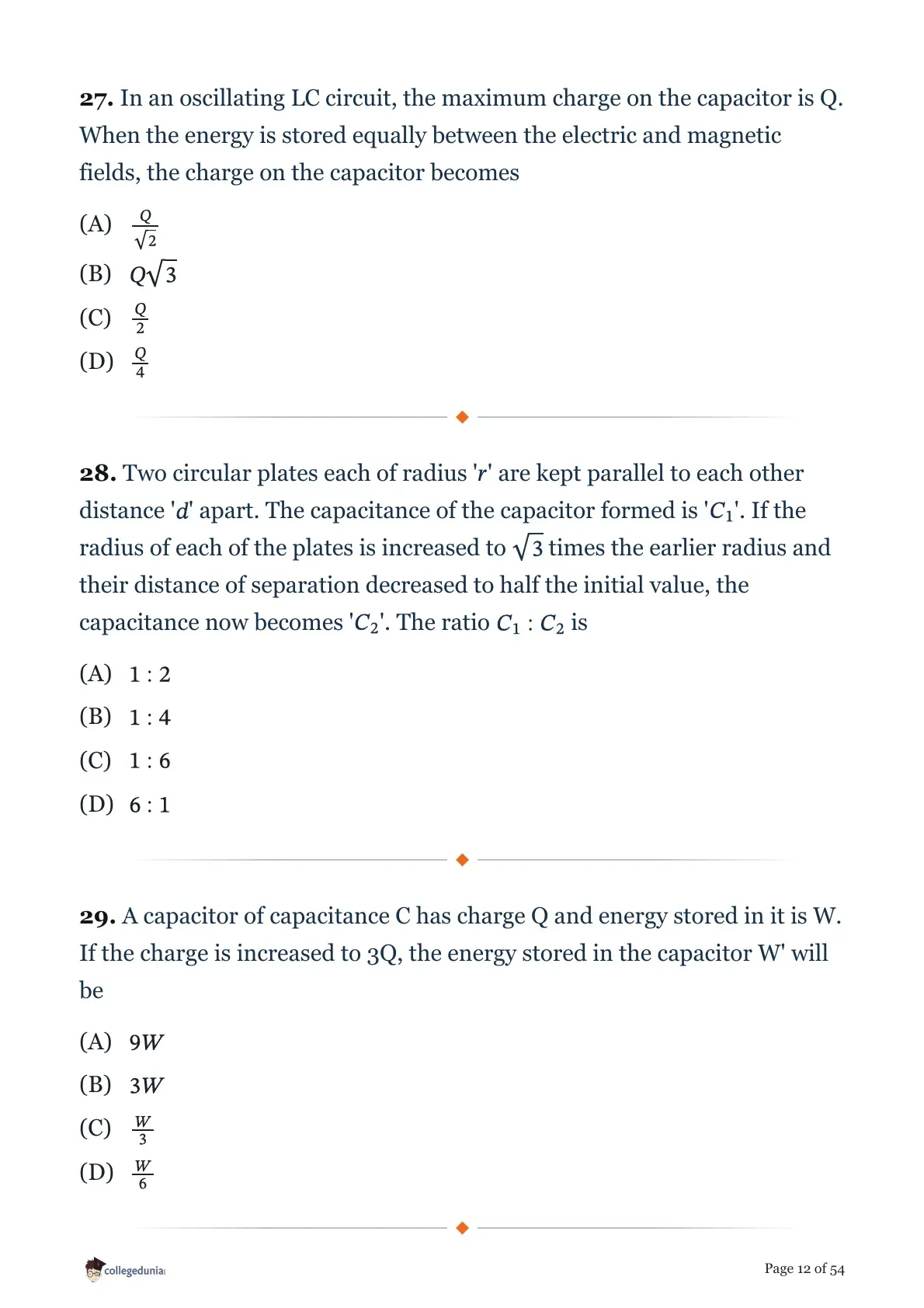
In an oscillating LC circuit, the maximum charge on the capacitor is Q. When the energy is stored equally between the electric and magnetic fields, the charge on the capacitor becomes
Two circular plates each of radius '\(r\)' are kept parallel to each other distance '\(d\)' apart. The capacitance of the capacitor formed is '\(C_1\)'. If the radius of each of the plates is increased to \(\sqrt{3}\) times the earlier radius and their distance of separation decreased to half the initial value, the capacitance now becomes '\(C_2\)'. The ratio \(C_1:C_2\) is
A capacitor of capacitance C has charge Q and energy stored in it is W. If the charge is increased to 3Q, the energy stored in the capacitor W' will be
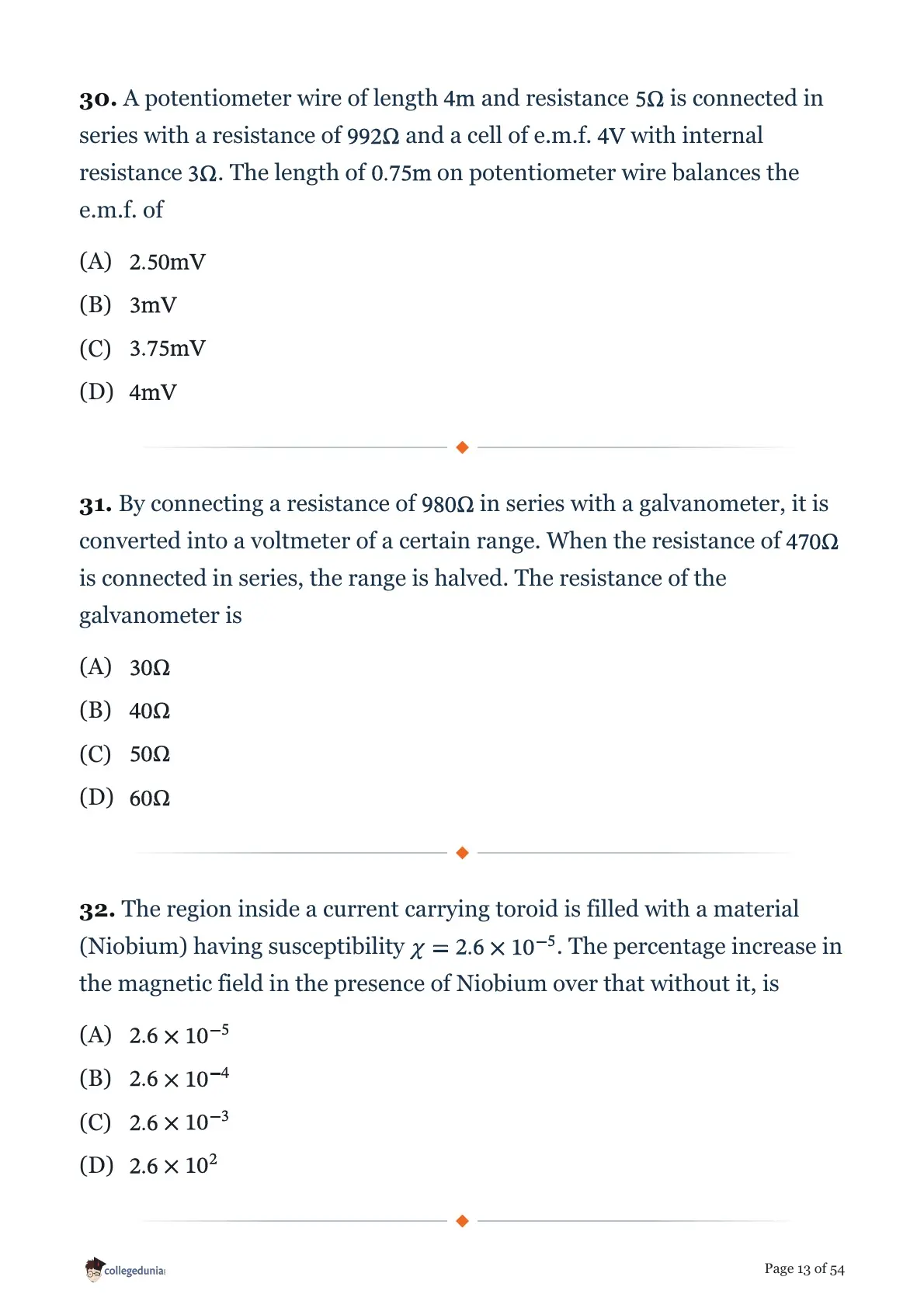
A potentiometer wire of length \(4 \text{m}\) and resistance \(5 \Omega\) is connected in series with a resistance of \(992 \Omega\) and a cell of e.m.f. \(4 \text{V}\) with internal resistance \(3 \Omega\). The length of \(0.75 \text{m}\) on potentiometer wire balances the e.m.f. of
By connecting a resistance of \(980 \Omega\) in series with a galvanometer, it is converted into a voltmeter of a certain range. When the resistance of \(470 \Omega\) is connected in series, the range is halved. The resistance of the galvanometer is
The region inside a current carrying toroid is filled with a material (Niobium) having susceptibility \(χ = 2.6\times 10^{-5}\). The percentage increase in the magnetic field in the presence of Niobium over that without it, is
In the following figure, the magnitude of the magnetic field at point 'O' will be

The ratio of magnetic field at the centre of the current carrying circular loop and its magnetic moment is '\(x\)'. When both the current and radius are tripled, then the ratio will be
In the circuit shown, when the current '\(i\)' is \(3\text{A}\) and increasing at the rate of \(1\text{A/s}\) the measurement of the potential difference between A and B is \(12 \text{V}\). But when the same current \(3\text{A}\) is decreasing at the rate of \(1\text{A/s}\), the measured potential difference \(V_{AB}\) between A and B is \(6\text{V}\). The value of 'R' in the circuit is

Two coils have a mutual inductance of \(0.005 \text{H}\). The current changes in the first coil according to equation \(I = I_0sinωt\), where \(I_0 = 10 \text{A}\) and \(ω = 60π \text{rad s}^{-1}\). The maximum values of e.m.f. in the second coil in volt will be
The magnetic potential energy stored in a certain inductor is \(49 \text{mJ}\) when the current in the inductor is \(70 \text{mA}\). The inductance of the inductor is
An a.c. source is applied to a series LR circuit with \(X_L = 3R\) and power factor is \(X_1\). Now a capacitor with \(X_c = R\) is added in series to LR circuit and power factor is \(X_2\). The ratio \(X_1\) to \(X_2\) is
In an a.c. circuit, a resistance R is connected in series with an inductance 'L'. If phase angle between voltage and current is \(45^{\circ}\), the value of inductive reactance will be
(\(sin45^{\circ} = \frac{1}{\sqrt{2}} = cos45^{\circ}\))
A simple microscope is a combination of two lenses in contact. Their powers are \(+20\text{D}\) and \(-4\text{D}\). The distance of distinct vision is \(25 \text{cm}\). When seen through the microscope, the size of the image of an object \(3 \text{mm}\) high is
When a glass plate of refractive index \(1.44\) is introduced in the path of one of the interfering beams, the fringes are displaced by a distance '\(y\)'. If this plate is replaced by another plate of same thickness but of refractive index \(1.66\), the fringes will be displaced by a distance
In a certain region of the screen, number of fringes formed is observed to be 8 in Young's double slit experiment when light of wavelength \(6600 \text{Å}\) is used. If the light of wavelength \(4400 \text{Å}\) is used, the number of fringes observed in the same region of the screen will be
In a Fraunhofer diffraction of a single slit, when a slit is illuminated by a light of wavelength \(6480 \text{Å}\), angular width of central maximum is measured. When the slit is illuminated by light of another wavelength '\(λ\)' the angular width decreases by \(25\%\). The value of \(λ\) in \(\text{Å}\) units is
If the kinetic energy of a particle is increased to 16 times, the percentage change in the de Broglie wavelength of a particle is
In case of photoelectric emission from certain metal, the cutoff frequency is \(ν\). If the radiation of frequency \(3ν\) is incident on the metal plate, the maximum possible velocity of the emitted electrons will be (\(m\) = mass of electron, \(h\) = Planck's constant)
The triply ionized beryllium (\(\text{Be}^{+++}\)) has the same electron orbital radius as that of the ground state of hydrogen. Hence, the energy state of triply ionized beryllium is (Given \(Z = 4\) for beryllium)
The angular momentum of the electron in the third Bohr orbit of a hydrogen atom is '\(l\)' so its angular momentum in the fourth Bohr orbit is
Which one of the following statements is 'WRONG' regarding LED?
Which of the following logic gates will have an output of '1' (one) for the given inputs?

A diode and resistance are connected as shown in figures.

Out of the following statements, which one is true?
Diode in
A) fig (1) and fig (2) are both forward biased.
B) fig (1) and fig (2) are both reverse biased.
C) fig (1) is forward biased and in fig (2) is reverse biased.
D) fig (1) is reverse biased and in fig (2) is forward biased.
Chemistry Section (Questions 51 to 100)
How many moles of potassium chlorate are heated to produce \(22.4 \text{lit}\) of oxygen at STP ?
Which of the following colours of visible light has lowest energy?
What is formal charge on sulphur in sulphuric acid molecule?
Which of the following compound has square pyramidal structure?
Which of the following metal halides have more covalent character?
What ratio by mass of 'Ne' and \(\text{CH}_4\) should be mixed so that partial pressure exerted by each gas is same?
Calculate \(\Delta \text{H}\) for the following reaction at \(300 \text{K}\)
\(2\text{C}_{(s)}+3\text{H}_{2(g)}⟶\text{C}_2\text{H}_{6(g)}\) if \(\Delta \text{U}\) for the reaction is \(-80 \text{kJ}\) (\(\text{R} = 8.314 \text{JK}^{-1}\text{mol}^{-1}\))
For a certain reaction, \(\Delta \text{H}^{\circ} = 40 \text{kJ}\) and \(\Delta \text{S}^{\circ} = 80 \text{JK}^{-1}\). Find the temperature so that \(\Delta \text{G}^{\circ} = 0\)
Which from following is correct expression of first law of thermodynamics for isothermal process?
Which of the following is Lewis acid?
The solubility of a sparingly soluble a salt \(\text{AB}_2\) is \(1\times 10^{-6} \text{mol/dm}^3\). Calculate its solubility product?
What is the molarity of \(\text{H}_2\text{SO}_4\) solution having \(\text{pH} = 4\) ?
Identify the conjugate bases of \(\text{H}_3\text{PO}_3\) and \(\text{H}_2\text{SO}_4\) respectively from following.
What happens in the oxidation number of Mn during working of dry cell.
What is the formula of Tin (IV) oxide?
Identify the name of second higher homologue of formic acid?
What is the of number of chiral carbon atoms present in 2-Bromo-3,4,5-trimethylhexane ?
Which of the following alkyl chlorides on Wurtz reaction gives 2, 2, 5, 5- tetramethylhexane ?
Calculate the number of atoms present in \(1 \text{g}\) metal that forms simple unit cell structure if product of density and volume of unit cell is \(66.5\times 10^{-24} \text{g}\)
Calculate the void volume in fcc unit cell if total volume of a unit cell is \(6.4\times 10^{-23} \text{cm}^3\) ?
What is the total number of Bravais lattices in orthorhombic crystal system?
\(40\) gram nonelectrolyte solute having molar mass \(180 \text{g mol}^{-1}\) dissolved in water has osmotic pressure \(2 \text{atm}\) at \(300 \text{K}\). Calculate the volume of solution. (\(\text{R} = 0.0821 \text{atm mol}^{-1}\text{K}^{-1}\))
Calculate the molality of solution of nonvolatile solute if boiling point of solution, molal elevation constant for solvent are \(319.8 \text{K}\) and \(2.5 \text{K kg mol}^{-1}\) respectively [Boiling point of solvent = \(319.5 \text{K}\)]
Identify correct statements from following regarding \(0.2 \text{M}\) urea and \(0.2 \text{M}\) sucrose solutions.
For a certain redox reaction in galvanic cell \(\text{X}_{(s)}+\text{Y}_{(aq)}^{2+}⟶\text{X}_{(aq)}^{2+}+\text{Y}_{(s)}\), \(\text{E}^{\circ}\) cell is \(0.0296 \text{V}\) at \(298 \text{K}\). What is equilibrium constant of reaction?
Which of the following net cell reactions occurs in a galvanic cell containing cadmium electrode and standard hydrogen electrode?
\(\text{E}_{(\text{Cd}_{(aq)}^{2+}|\text{Cd}_{(s)})}^{\circ} = -0.403 \text{V}\).
In a first order reaction 20 millimole of reactant is lowered to 10 millimole in \(0.3010\) minute. Find rate constant of the reaction?
For the reaction \(2\text{NOBr}_{(g)}⟶2\text{NO}_{(g)}+\text{Br}_{2(g)}\), rate law is \(r = k[\text{NOBr}]^2\). Rate constant is \(1.62 \text{M s}^{-1}\) and concentration of NOBr is \(5\times 10^{-3} \text{M}\),
What is rate of reaction?
Which of the following reactions has of overall order \(1.5\) ?
Which from following anions has greater power for coagulation of positive sol?
Which actinoid from following has smallest ionic size in \(+3\) state?
What is the total number of transition series of d-block elements?
Identify a ligand with highest field strength among the following.
Find EAN of Fe in \(\text{Fe(CO)}_5\)
The reaction of aryl halide with sodium metal in dry ether to give biphenyl is known as
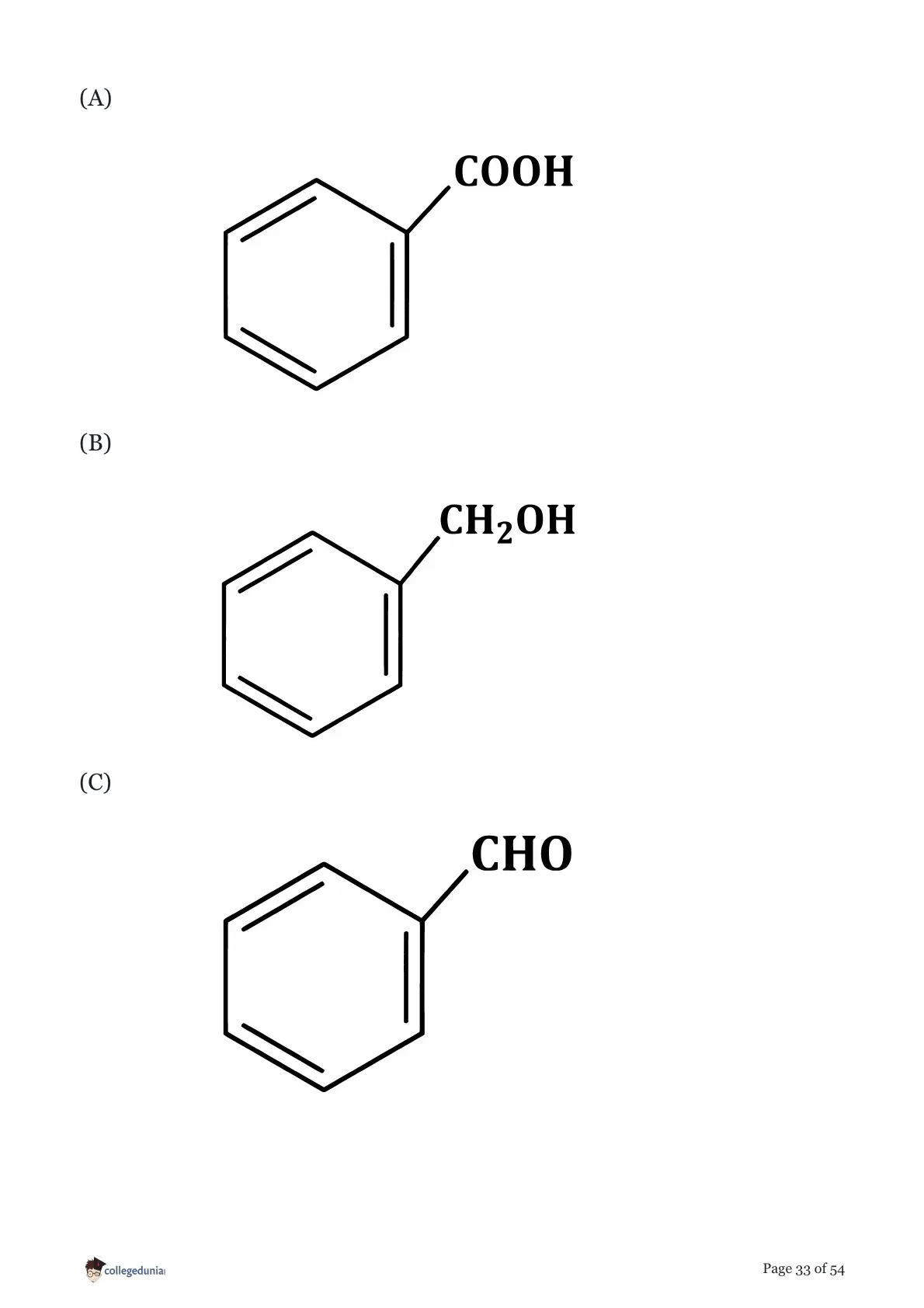
Identify the product P obtained in following reaction

- (A)
![]()
- (B)
![]()
- (C)
![]()
- (D)
![]()


Which among the following has lowest boiling point?
Which from following is obtained by hydroboration - oxidation of propene?
Identify the reagent 'R' used in the following reaction
\(\text{C}_6\text{H}_5\text{COCl}\overset{\text{R}\,}{\rightarrow }\text{C}_6\text{H}_5\text{CHO}+\text{HCl}\)
Identify the product 'B' in the following reaction
\(\text{Isopropyl cyanide}\overset{\text{SnCl}_2,\text{HCl}\,}{\rightarrow }\text{A}\overset{\text{H}_3\text{O}^+\,}{\rightarrow }\text{B}+\text{NH}_4\text{Cl}\)
Benzonitrile on reaction with a reagent in dry ether followed by hydrolysis forms benzophenone along with ammonia and hydroxymagnesium bromide. Identify the reagent used in above transformation.
Propyne on reaction with water in presence of \(40\%\) sulphuric acid and \(1\%\) mercuric sulphate forms
Identify final products in the following sequence of reactions
\(\text{RCOOH}+\text{R’OH}\overset{\text{H}^+\,}{\rightarrow }\text{intermediate}\overset{\text{Ni},\Delta \,}{\rightarrow }^{\text{H}_2}\text{Products}\)
Which from following amines does NOT form alkyl isocyanide when heated with alc. KOH and chloroform
Which from following statements is NOT correct regarding Hofmann's exhaustive alkylation?
Which from following is NOT a globular protein?
Which of the following has largest size?
What is the total mass of products obtained when one gram mole of sucrose is hydrolysed?
Which from following polymers is NOT obtained by addition polymerisation method?
Which medicinal property is exhibited by methylsalicylate?
Mathematics Section (Questions 101 to 150)
The value of \((\frac{-1+i\sqrt{3}}{2})^{18}+(\frac{-1-i\sqrt{3}}{2})^{18}\) is
11 players of the Indian cricket team are sitting at a circular table. The number of ways they can sit so that two players, the wicket keeper and the captain never sit together is ___
In \(△ABC\), if \(\angle C = \frac{π}{3}\), then the value of \(cos^2A+cos^2B+cosAcosB\) is...
The line \(L_1\) given by \(\frac{x}{p}+\frac{y}{2} = 1\) passes through the point \((5,0)\). The line \(L_2\) given by \(\frac{x}{10}+\frac{y}{q} = 1\) is parallel to \(L_1\). Then the distance between the lines \(L_1\) and \(L_2\) is...
Two lines are given by \(x^2-4xy+4y^2+kx-2ky = 0\), then the value of k so that the distance between them is 3 is
The area of the region (in sq. unit) bounded by x-axis, the tangent and normal to the circle \(x^2+y^2 = 4\), drawn at a point \((1,\sqrt{3})\) is
The tangent to the circle \(x^2+y^2 = 10\) at the point \((3,1)\) touches the circle \(x^2+y^2-2\sqrt{10}\,x-20y+k = 0\), then the value of \(k\) is...
If the eccentricity of the ellipse \(\frac{x^2}{a^2}+\frac{y^2}{b^2} = 1,(a > b)\) is \(\frac{2}{3}\) and its focal chord is \(3x+2y-6 = 0\), then the value of \(a^2+b^2\) is...
If \(\underset{x\rightarrow \infty }{lim}[\frac{x^2+x+1}{x+1}-ax-b] = 3\), then \(a-b =\)...
The correct logical equivalence from the following is /are ___
(I) \(p\rightarrow (q\rightarrow r)\equiv (p∧q)\rightarrow r\)
(II) \((p\rightarrow q)\rightarrow r\equiv p\rightarrow (q∨r)\)
(III) \((p\rightarrow q)\rightarrow r\equiv (p\rightarrow r)∧(\sim q\rightarrow r)\)
(IV) \(p\rightarrow (q\rightarrow r)\equiv q\rightarrow (p\rightarrow r)\)
The contrapositive of the statement pattern \([p∨(p\rightarrow q)]\rightarrow (p∧\sim q)\) is
The negation of the converse of \(p∨q\) is
In triangle ABC, with usual notations, if \((a+b+c)(a+b-c) = ab\), then the measure of angle C is...
In \(△ABC\), with usual notation, if \(a = 13,b = 14,c = 15\), then the sum of the values of \(sin(\frac{A}{2})\) and \(sinA\) is....
Let \(A = \left[ \begin{array}{ccc}cosα & -sinα & 0 \\ sinα & cosα & 0 \\ 0 & 0 & 1\end{array} \right]\). If \(B = \text{adj}\,A\), then the matrix \(B^{-1}\) is equal to...
Let \(A = [\begin{array}{cc}3 & -4 \\ 1 & -1\end{array}]\) and \(B = [\begin{array}{cc}6 & -13 \\ 5 & -10\end{array}]\) be two matrices. If the variables \(x\) and \(y\) satisfy the matrix equation \(((A^{-1})^2+B)[\begin{array}{c}x \\ y\end{array}] = [\begin{array}{c}0 \\ 0\end{array}]\), then the ordered pair \((x,y) =\)
If \(0\leq x\leq 1\), \(I_1 = \int sin^{-1}\sqrt{1-x^2}\,dx\) and \(I_2 = \int sin^{-1}x\,dx\), then which of the following is true?
Let \(t\in (0,1)\) and \(α\in (0,\frac{π}{4})\). If \(x = \text{cosec}^{-1}(\frac{1+t^2}{2t})\), \(y = cot^{-1}(\frac{\sqrt{1-t^2}}{t})\) and \(\frac{dy}{dx} = f(t)\), then the value of \(f(tanα)\) is
If \(y = tan^{-1}⎛⎝\frac{log(\frac{e}{x^3})}{logex^3}⎞⎠+tan^{-1}⎛⎝\frac{log(e^4x^3)}{log(\frac{e}{x^{12}})}⎞⎠\), \(x\in (e^{-\frac{1}{3}},e^{\frac{1}{12}})\) then \(\frac{dy}{dx}\) is equal to...
If \(0\leq x\leq 1\) and \((sin^{-1}x)^3+(cos^{-1}x)^3 = aπ^3\) then
If \(\sum _{n = 1}^{2026}tan^{-1}(\frac{1}{n^2+n+1}) = tan^{-1}(1-\frac{1}{x})\), where \(x\neq 0\), then \(x =\)
Let \(f(x) = ax+b\) and \(g(x) = cx+d\). The condition \(f(g(x)) = g(f(x))\) holds for all \(x\) if and only if ...
The number of point / points where the function \(f(x) = \frac{1}{x^2-5|x|+6}\) is discontinuous is......
If \(x\,e^{xy} = y+sin^2x\), then the value of \(\frac{dy}{dx}\) at \(x = 0\) is equal to
If \(g(x) = (x^2+2x+1)\cdot f(x)\) such that \(f(0) = 5\) and \(\underset{x\rightarrow 0}{lim}\frac{f(x)-5}{x} = 4\) then \(g^'(0) =\)
If the line \(x+By+C = 0\) is the normal to the curve given by \(x = asin^3t\), \(y = bcos^3t\), (where \(a,b\neq 0\)) at a point \(t = \frac{π}{2}\), then \(B-C =\)
If the tangent to the curve \(xy+ax+by = 0\) at \((1,1)\) makes an angle of \(tan^{-1}2\) with positive direction of the \(x\)-axis, then the value of \(\frac{ab}{a+b}\) is...
If the side of an equilateral triangle increases at the rate of \(\sqrt{3} \text{cm/sec}\), then the rate of change of increase of its area when the side is \(12 \text{cm}\) is ____
\(\int sin(logx)\,dx =\)
The value of \(\int \frac{n\sqrt{\text{cosec}^2x^n-1}}{x^{(1-n)}}\,dx\) is ...
\(\int \frac{(x+1)\,dx}{x(1+xe^x)} = \ldots \ldots\)
The value of the definite integral \(\int _0^{log_e5}\frac{e^x\sqrt{e^x-1}}{e^x+3}\,dx\) is equal to...
If \([\cdot ]\) denotes the greatest integer function, then \(\int _0^{π/3}[tanx]\,dx =\)
The area (in square units) bounded by the line \(y = x\), the X-axis and the lines \(x = -2\) and \(x = 4\) is...
The equation of the curve whose slope is \(\frac{y-1}{x^2+x}\) and which passes through the point \((1,0)\) is
A body cools from \(100^{\circ}\text{C}\) to \(60^{\circ}\text{C}\) in 20 minutes, the temperature of the surroundings being \(20^{\circ}\text{C}\). The total time taken (in minutes) for the body to cool down to \(40^{\circ}\text{C}\) is ...
The general solution of the differential equation \(xsinx\frac{dy}{dx}+(xcosx+sinx)y = sinx\) is
If \(\overset{̄}{a} = \hat{i}-\hat{k}\), \(\overset{̄}{b} = x\hat{i}+\hat{j}+(1-x)\hat{k}\) and \(\overset{̄}{c} = y\hat{i}+x\hat{j}+(1+x-y)\hat{k}\) then \([\overset{̄}{a} \overset{̄}{b} \overset{̄}{c}]\) depends on
Let \(\overset{̄}{u},\overset{̄}{v},\overset{̄}{w}\) be three vectors such that \(|\overset{̄}{u}| = 1,|\overset{̄}{v}| = 2,|\overset{̄}{w}| = 3\). If the projection of \(\overset{̄}{v}\) along \(\overset{̄}{u}\) is equal to the projection of \(\overset{̄}{w}\) along \(\overset{̄}{u}\) and \(\overset{̄}{v},\overset{̄}{w}\) are perpendicular to each other, then \(|\overset{̄}{u}-\overset{̄}{v}+\overset{̄}{w}| =\)...
Let \(\overset{̄}{a},\overset{̄}{b},\overset{̄}{c}\) be three vectors of equal magnitude such that the angle between \(\overset{̄}{a}\) and \(\overset{̄}{b}\) is \(α\), \(\overset{̄}{b}\) and \(\overset{̄}{c}\) is \(β\), \(\overset{̄}{c}\) and \(\overset{̄}{a}\) is \(γ\).
Then the minimum value of \(cosα+cosβ+cosγ\) is ...
A vector which is orthogonal to the vector \(\overset{̄}{a} = \hat{i}+2\hat{j}+3\hat{k}\) and coplanar with the vectors \(\overset{̄}{b} = 3\hat{i}+2\hat{j}\) and \(\overset{̄}{c} = 2\hat{i}+\hat{j}+3\hat{k}\) is
The line \(\ell\) passes through the point \((2,1,1)\) and is parallel to the plane \(x+y+2z = 18\). If line \(\ell\) intersects the line \(\frac{x+2}{3} = \frac{y+1}{-1} = \frac{z-2}{1}\), then equation of the line \(\ell\) is...
The acute angle \(θ\) between the \(xy\)-plane and the plane passing through the point \((1,2,4)\) and parallel to the vectors with direction ratios \(3,2,-1\) and \(1,-2,-2\) is...
If the plane \(\overset{̄}{r} = (λ+μ)\hat{i}+(2+μ)\hat{j}+(3λ+2μ)\hat{k}\), where \(λ\) and \(μ\) are parameters, intersects coordinate axes at points \((a,0,0)\), \((0,b,0)\) and \((0,0,c)\) then \(a+b+c =\)...
The coordinates of the point of intersection of the lines \(\frac{x-3}{1} = \frac{y-5}{2} = \frac{z-1}{-1}\) and \(\frac{x-4}{2} = \frac{y-2}{-1} = \frac{z-4}{2}\) are...
If the plane \(2x+3y+z = 6\) cuts coordinate axes at A, B and C, then the volume of tetrahedron OABC (where O is the origin) is ......cubic units.
The maximum value of \(Z = 4x+5y\), subject to the constraints \(3x+y\leq 15,3x+4y\leq 24,x\geq 0,y\geq 0\) is
A fair coin is tossed 9 times. On each toss, a man predicts that the outcome will be heads. The probability that the number of successful predictions is strictly greater than the number of unsuccessful predictions is...
Let \(F(x)\) be the cumulative distribution function (c.d.f.) of a continuous random variable \(X\). If \(F(b) = 0.7\) and \(P(X > a) = 0.4\), then the value of \(P(a < X < b)\) is ...
If the probabilities of a student succeeding in the entrance tests for institutes A, B and C are \(0.6\), \(0.5\) and \(0.4\) respectively, while the probability of succeeding in both A and B is \(0.3\), in both B and C is \(0.2\), in both A and C is \(0.2\), and in all three is \(0.1\), then the probability that the student succeeds in exactly one of these tests is......
MHT CET PCM Exam Pattern 2026
| Parameter | Details |
|---|---|
| Conducting Body | Maharashtra Common Entrance Test Cell (Maharashtra CET Cell) |
| Exam Mode | Online (Computer-Based Test) |
| Duration | 180 minutes (3 hours) |
| Groups / Subjects | PCM (Physics, Chemistry, Mathematics) for Engineering |
| Total Questions |
150 |
| Total Marks | 200 |
| Question Type | Multiple Choice Questions (MCQs) |
| Marks Distribution |
|
| Negative Marking | No |
| Syllabus Weightage |
|



Comments