




MHT CET 2026 April 19 Shift 2 PCM Question Paper is available for download here. Maharashtra State CET Cell conducted MHT CET 2026 PCM Exam on April 19 in Shift 2 from 2 AM to 5 PM in CBT mode.
- The MHT CET 2026 PCM Question Paper consists of 150 multiple-choice questions (MCQs) totalling 200 marks divided into 3 sections: Physics, Chemistry, and Mathematics, with 50 questions in each subject.
- Physics and Chemistry questions carry 1 mark each while Mathematics questions carry 2 marks each.
- There is no negative marking for incorrect answers.
Also Check: MHT CET 2026 April 19 Shift 1 PCM Question Paper
Download MHT CET 2026 April 19 Shift 2 PCM Question Paper with Solutions PDF from the links provided below.
MHT CET 2026 April 19 Shift 2 PCM Question Paper PDF Download
| MHT CET 2026 April 19 Shift 2 Question Paper | Download PDF | Check Solution |





















MHT CET 2026 April 19 Shift 2 PCM Questions with Solutions
Physics Section (Questions 1 to 50)
A cuboid has volume \(V = l\times l\times \sqrt{l}\), where \(l\) is the length of one side. When the length \(l\) is measured by a meter scale of least count \(1\,\text{mm}\), the relative percentage error in the measurement of its volume is \(6.25\%\). Then the relative percentage error in measurement of its length and the value of the length \(l\) is
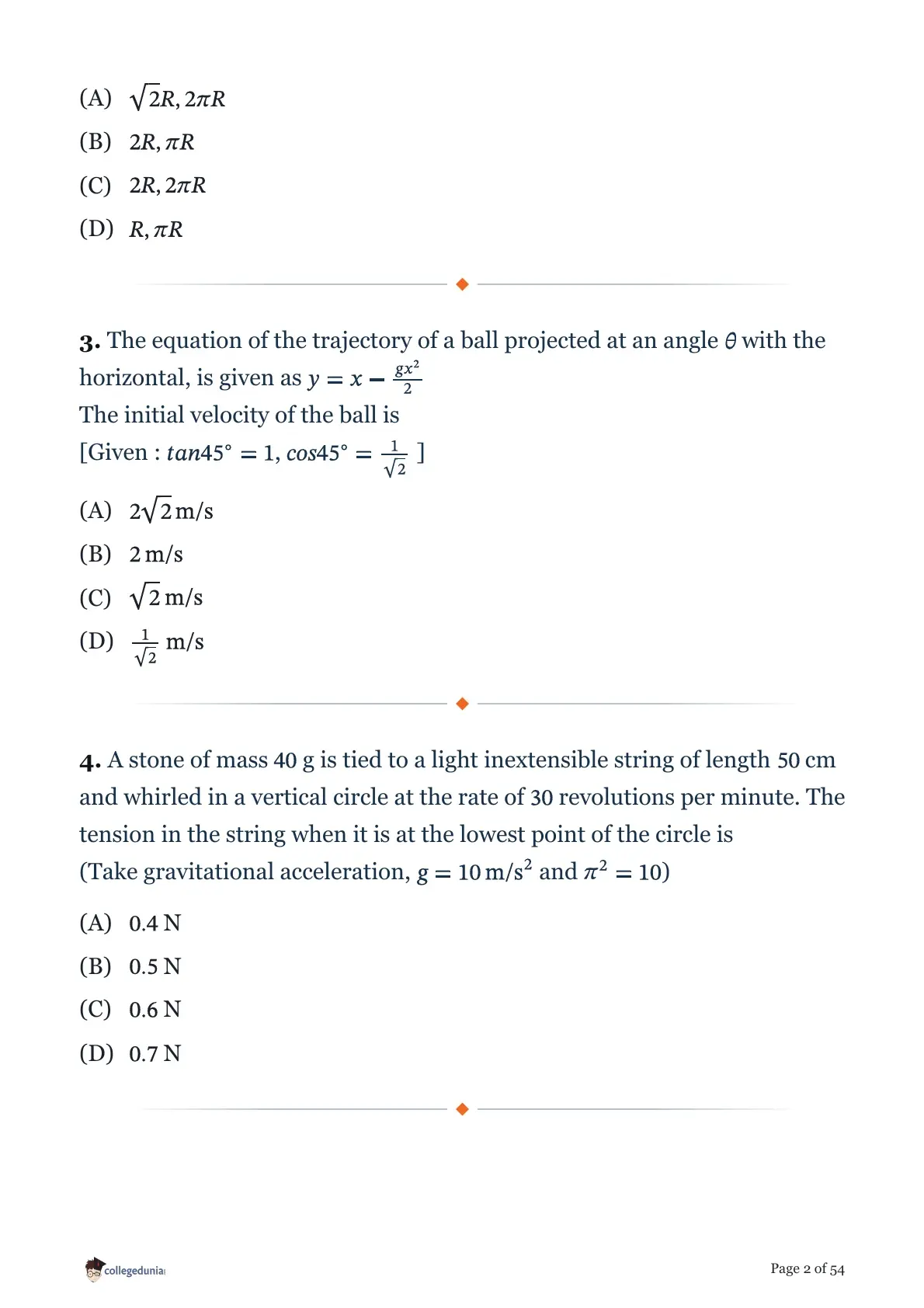
A particle is performing U.C.M. along a circle of radius \(R\). In half the period of revolution, its displacement and distance covered are respectively
The equation of the trajectory of a ball projected at an angle \(θ\) with the horizontal, is given as \(y = x-\frac{gx^2}{2}\)
The initial velocity of the ball is
[Given : \(tan45^{\circ} = 1\), \(cos45^{\circ} = \frac{1}{\sqrt{2}}\) ]
A stone of mass \(40\) g is tied to a light inextensible string of length \(50\) cm and whirled in a vertical circle at the rate of \(30\) revolutions per minute. The tension in the string when it is at the lowest point of the circle is
(Take gravitational acceleration, \(g = 10\,\text{m/s}^2\) and \(π^2 = 10\))
A body of mass 'm' attached at the end of a string is just completing the loop in a vertical circle. The apparent weight of the body at the lowest point in its path is
(\(g\) = gravitational acceleration)
Two particles of masses \(2\) g and \(4\) g are situated at the opposite ends, A and B of a wooden bar respectively. Let \(l(AB) = 9\) cm. The center of mass of the system will be
A force of \(3\hat{i}+2\hat{j}-\hat{k}\) N acts on a particle with position vector \(\hat{i}+\hat{j}-\hat{k}\) m. The magnitude of torque of given force is
A satellite is revolving around a planet in a circular orbit close to its surface. Let \(ρ\) be mean density and \(R\) be the radius of the planet; then the period of the satellite is
(\(G\) = Universal constant of gravitation).
A metal wire of length 'L' and density 'd' floats horizontally on the free surface of water. The maximum radius of the wire does not sink in water is
[ \(T\) = surface tension of water , \(g\) = gravitational acceleration]
The energy needed for breaking a liquid drop of radius 'R' into 'n' droplets each of radius 'r' is
[ \(T\) = surface tension of the liquid]
In most liquids, with rise in temperature surface tension of liquid
Out of the following, which statement is NOT true about black body radiation ?
\(15\) g of ice at \(0^{\circ}\text{C}\) is added to a vessel containing water at \(40^{\circ}\text{C}\). The mass of water and water equivalent of the vessel is \(60\) g. Assuming that negligible heat is taken from the surroundings, the final temperature of the mixture will be
[ \(L_{\text{ice}} = 80\,\text{cal/g}\) , \(S_{\text{water}} = 1\,\text{cal/g}\) ]
An ideal gas having pressure P, volume V and temperature T undergoes a thermodynamic process in which \(dW = 0\) and \(dQ < 0\). Then, for the gas
An ideal gas at pressure 'P' and temperature 'T' is enclosed in a vessel of volume 'V'. Some gas leaks through a hole from the vessel and the pressure of the enclosed gas falls to \(P^1\). Assuming that the temperature of the gas remains constant during the leakage, the number of moles of the gas that have leaked is
Assuming the expression for the pressure exerted by the gas, it can be shown that pressure is
An ideal gas (\(γ = 1.5\)) is expanded adiabatically. To reduce the root mean square velocity of molecules two times, the gas should be expanded
A spring force constant \(180\) N/m is loaded with a mass \(0.2\) kg. The amplitude of oscillations is \(4\) cm. When mass comes to equilibrium position, its velocity is
A particle executing linear S.H.M. has velocities \(V_1\) and \(V_2\) at distance \(x_1\) and \(x_2\) respectively, from the mean position, its angular velocity is
In a resonance tube open at one end, the end correction is \(1.1\) cm. If the shortest length of resonating air column with a tuning fork is \(18\) cm, the next resonating length will be
For stationary wave, \(y = 12cos(\frac{πx}{10})sin(36πt)\) cm, the distance between a node and the successive antinode is
Two waves of same frequency (\(n\)) approaching each other with same velocity of \(18\) m/s interfere. The distance between two consecutive antinodes is
The equation of a progressive wave is given by \(y = 6cos(100t-4x)\) where \(y\) is in \(μ\text{m}\), \(x\) in metre and \(t\) in second. The ratio of the maximum particle velocity to the velocity of wave is
A body sends a wave \(150\) mm long through medium P and \(0.30\) m long in medium Q. If velocity of the wave in medium P is \(80\,\text{cm s}^{-1}\), the velocity of wave in medium Q is
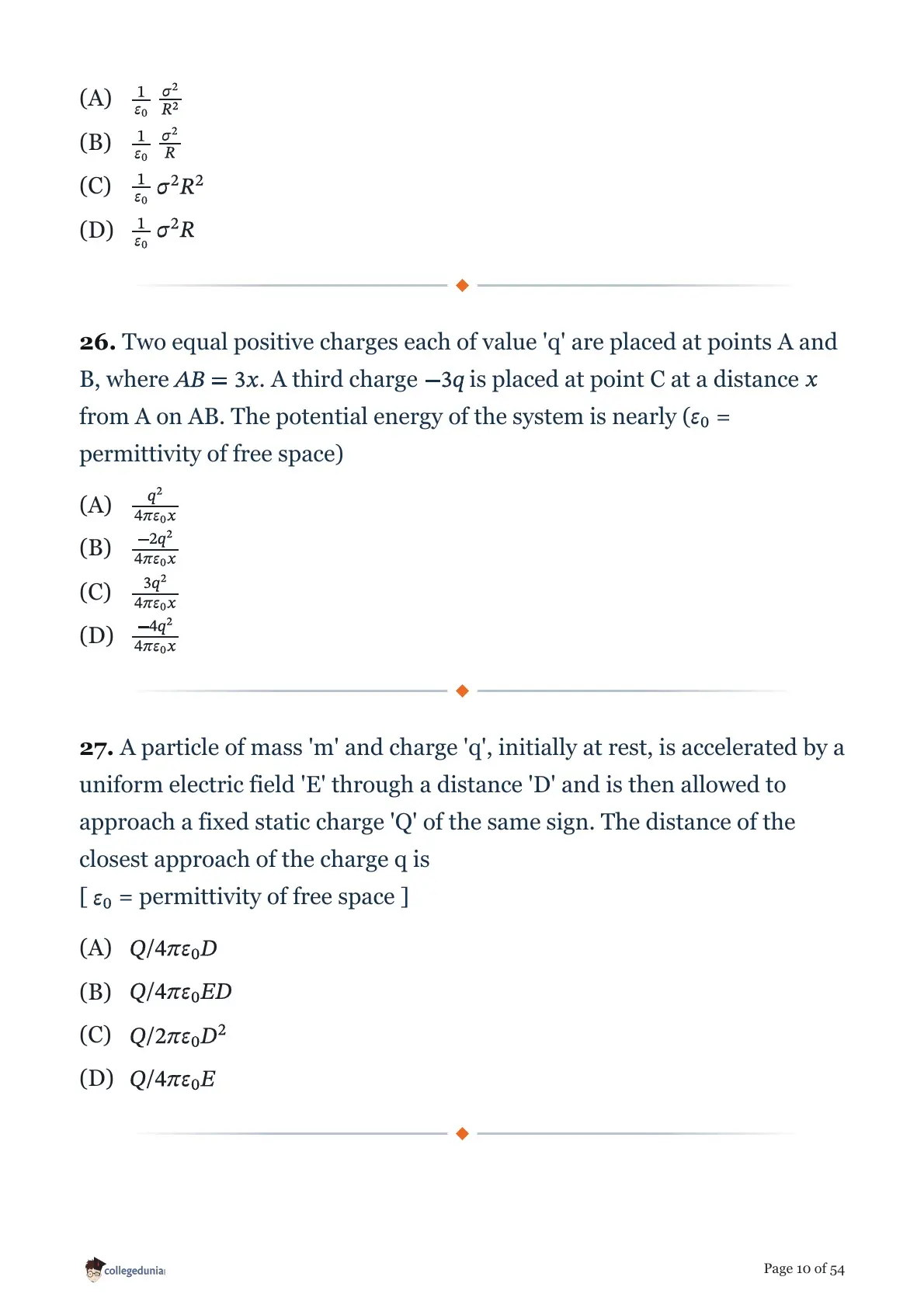
An uniformly charged thin spherical shell of radius 'R' has uniform surface charge density '\(σ\)'. It is made of two hemispherical identical shells held together by pressing them with force 'F' as shown. F is proportional to
[\(ε_0\) = permittivity of free space]

Two equal positive charges each of value 'q' are placed at points A and B, where \(AB = 3x\). A third charge \(-3q\) is placed at point C at a distance \(x\) from A on AB. The potential energy of the system is nearly (\(ε_0\) = permittivity of free space)
A particle of mass 'm' and charge 'q', initially at rest, is accelerated by a uniform electric field 'E' through a distance 'D' and is then allowed to approach a fixed static charge 'Q' of the same sign. The distance of the closest approach of the charge q is
[ \(ε_0\) = permittivity of free space ]
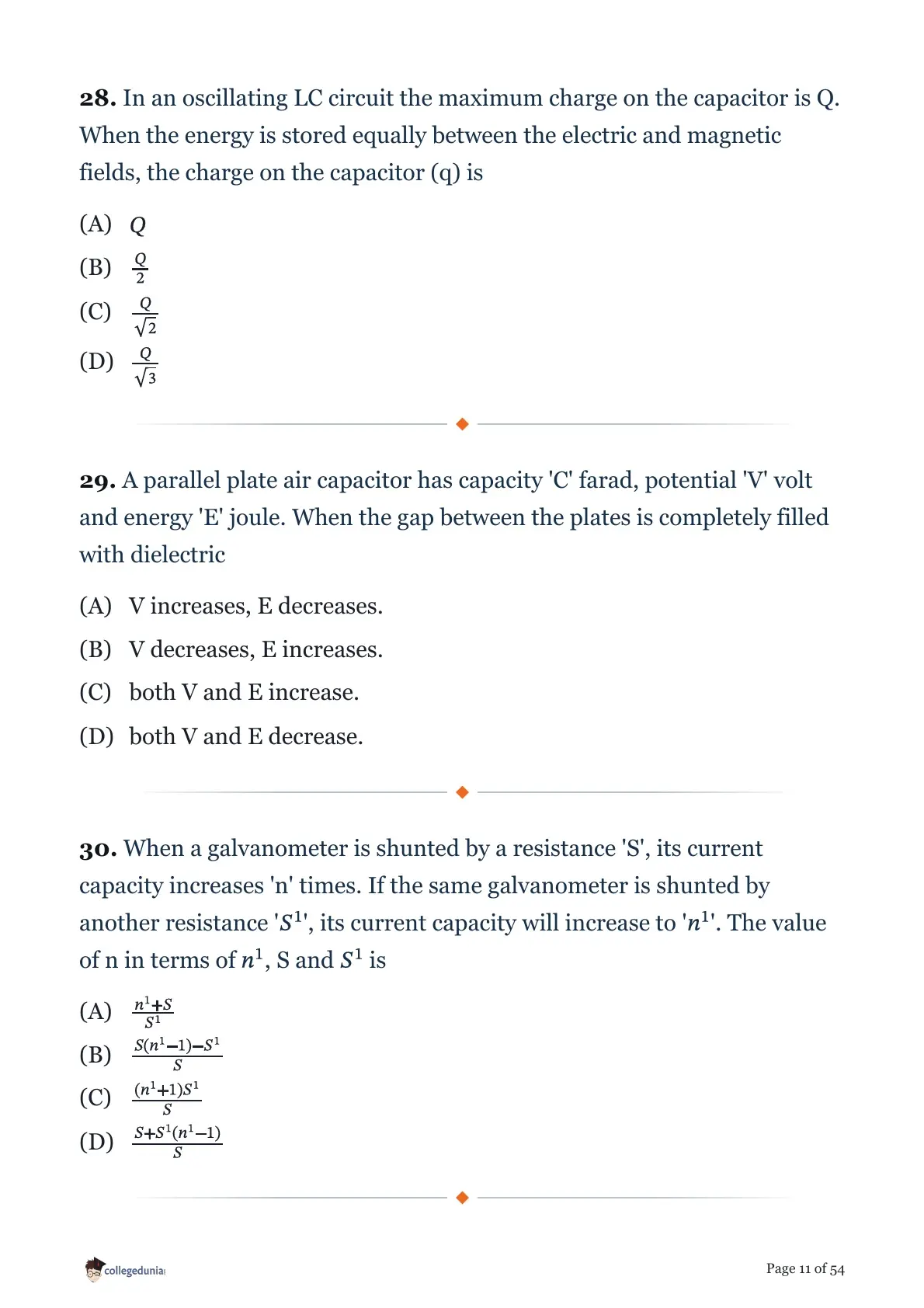
In an oscillating LC circuit the maximum charge on the capacitor is Q. When the energy is stored equally between the electric and magnetic fields, the charge on the capacitor (q) is
A parallel plate air capacitor has capacity 'C' farad, potential 'V' volt and energy 'E' joule. When the gap between the plates is completely filled with dielectric
When a galvanometer is shunted by a resistance 'S', its current capacity increases 'n' times. If the same galvanometer is shunted by another resistance '\(S^1\)', its current capacity will increase to '\(n^1\)'. The value of n in terms of \(n^1\), S and \(S^1\) is
The resistances in the two gaps of a balanced meter bridge are 'X' \(\Omega\) and '3X' \(\Omega\) respectively. If the resistances are interchanged the balance point shifts by
A current carrying circular coil of radius 'R' produces magnetic field \(B_1\) at an axial point P at a distance 'x' from its centre and \(B_2\) at point Q placed at its centre respectively . If \(B_2 = 8B_1\), the value of x is
The magnetic induction produced inside an ideal solenoid, depends on which of the following quantities ?
(a) number of turns per unit length.
(b) radius of the wire.
(c) current flowing throught it.
(d) permeability of the medium.
Two coils P and S have a mutual inductance of (\(π\)) mH. The secondary coil S has resistance \(4\,\Omega\) and self inductance \((60/π)\) mH. If the current in the primary is \(I_p = 12sin(50πt)\), then the maximum value of the current induced in coil S is [Take \(π^2 = 10\)]
A solenoid is connected to a battery so that a steady current flows through it. If an iron core is inserted into the solenoid, then the current in the coil
The magnetic energy stored in an inductor of inductance \(4\,\text{H}\) carrying a current of \(1.5\) A is
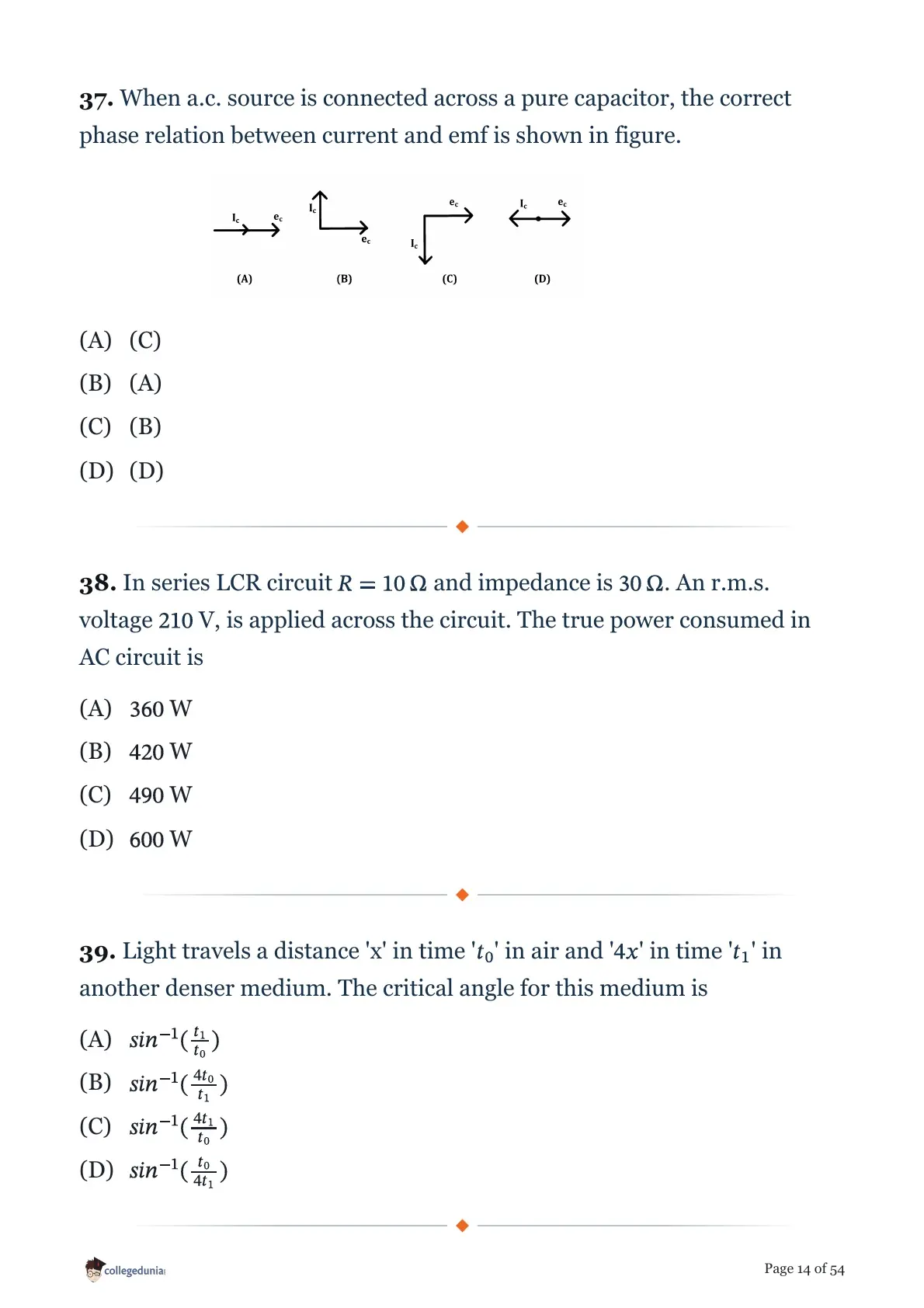
When a.c. source is connected across a pure capacitor, the correct phase relation between current and emf is shown in figure.

In series LCR circuit \(R = 10\,\Omega\) and impedance is \(30\,\Omega\). An r.m.s. voltage \(210\) V, is applied across the circuit. The true power consumed in AC circuit is
Light travels a distance 'x' in time '\(t_0\)' in air and '\(4x\)' in time '\(t_1\)' in another denser medium. The critical angle for this medium is
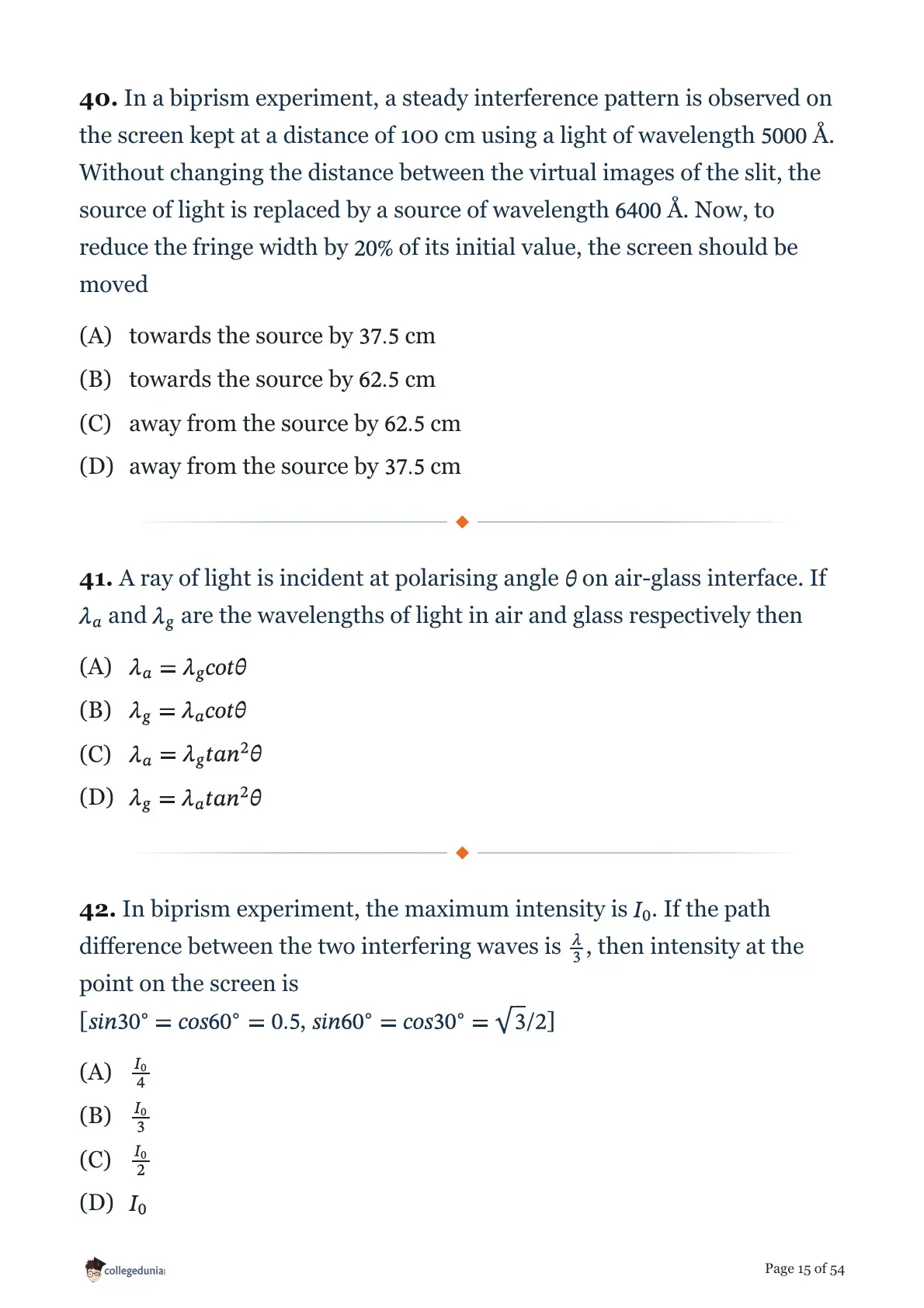
In a biprism experiment, a steady interference pattern is observed on the screen kept at a distance of 100 cm using a light of wavelength \(5000\) Å. Without changing the distance between the virtual images of the slit, the source of light is replaced by a source of wavelength \(6400\) Å. Now, to reduce the fringe width by \(20\%\) of its initial value, the screen should be moved
A ray of light is incident at polarising angle \(θ\) on air-glass interface. If \(λ_a\) and \(λ_g\) are the wavelengths of light in air and glass respectively then
In biprism experiment, the maximum intensity is \(I_0\). If the path difference between the two interfering waves is \(\frac{λ}{3}\), then intensity at the point on the screen is
[\(sin30^{\circ} = cos60^{\circ} = 0.5\), \(sin60^{\circ} = cos30^{\circ} = \sqrt{3}/2\)]
When light of wavelength '\(λ\)' is incident on a photosensitive surface, the stopping potential is 'V'. When a light of wavelength \(1.5λ\) is incident on the same surface, the stopping potential is '\(\frac{V}{4}\)'. Threshold wavelength for the surface is
If the ionisation energy for the hydrogen atom is \(13.6\) eV, then the energy required to excite it from the ground state to the next higher state is nearly
The de-Broglie wavelength of an electron moving in the \(n^{th}\) Bohr orbit of radius 'r' is
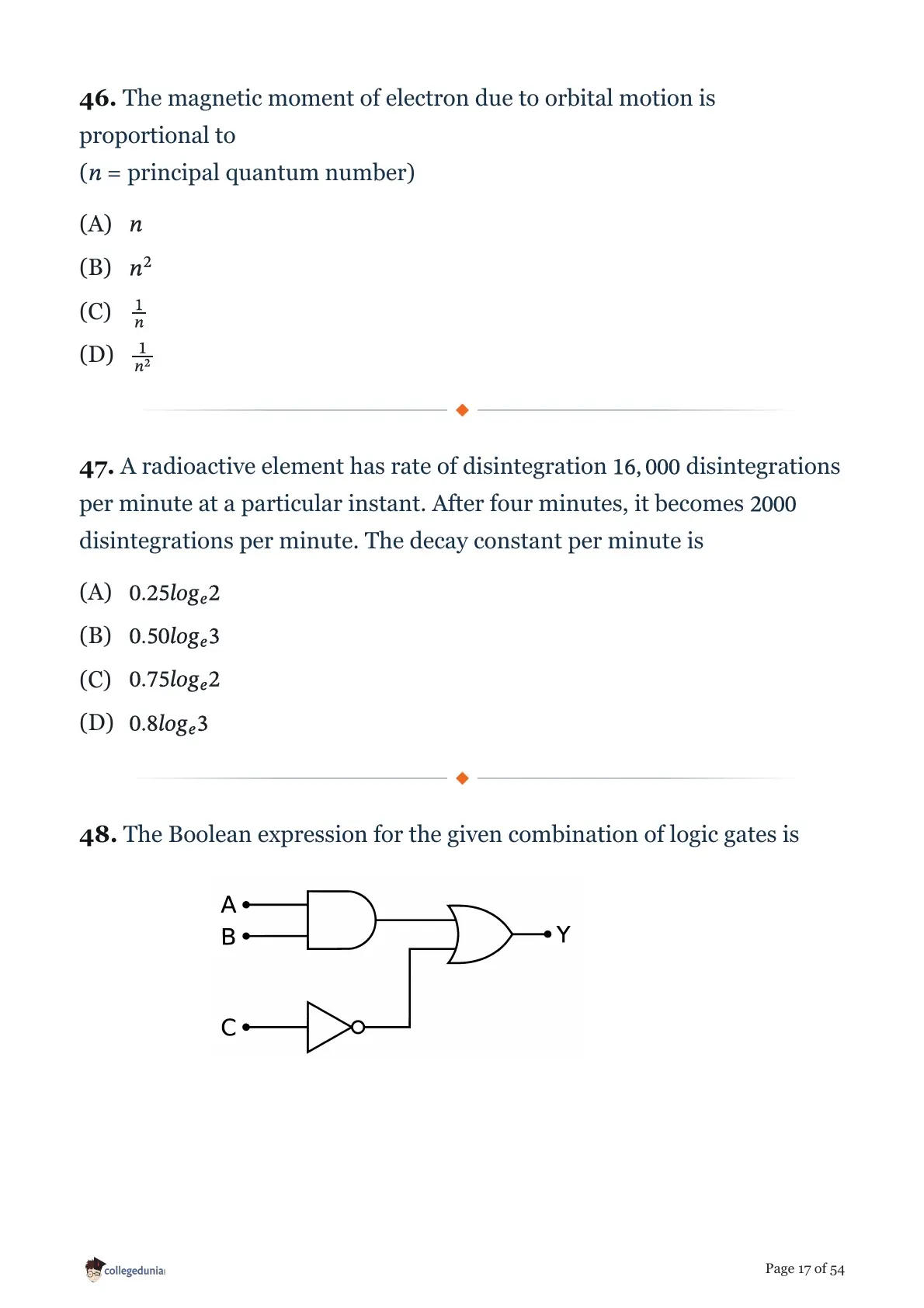
The magnetic moment of electron due to orbital motion is proportional to
(\(n\) = principal quantum number)
A radioactive element has rate of disintegration \(16,000\) disintegrations per minute at a particular instant. After four minutes, it becomes \(2000\) disintegrations per minute. The decay constant per minute is

In a transistor, comparing the doping of emitter, base and collector, the part which is heavily doped and that which is lightly doped are respectively
In the following electrical circuit, the reading in the milliammeter is
(Take knee voltage of silicon diode \(= 0.7\) V)

Chemistry Section (Questions 51 to 100)
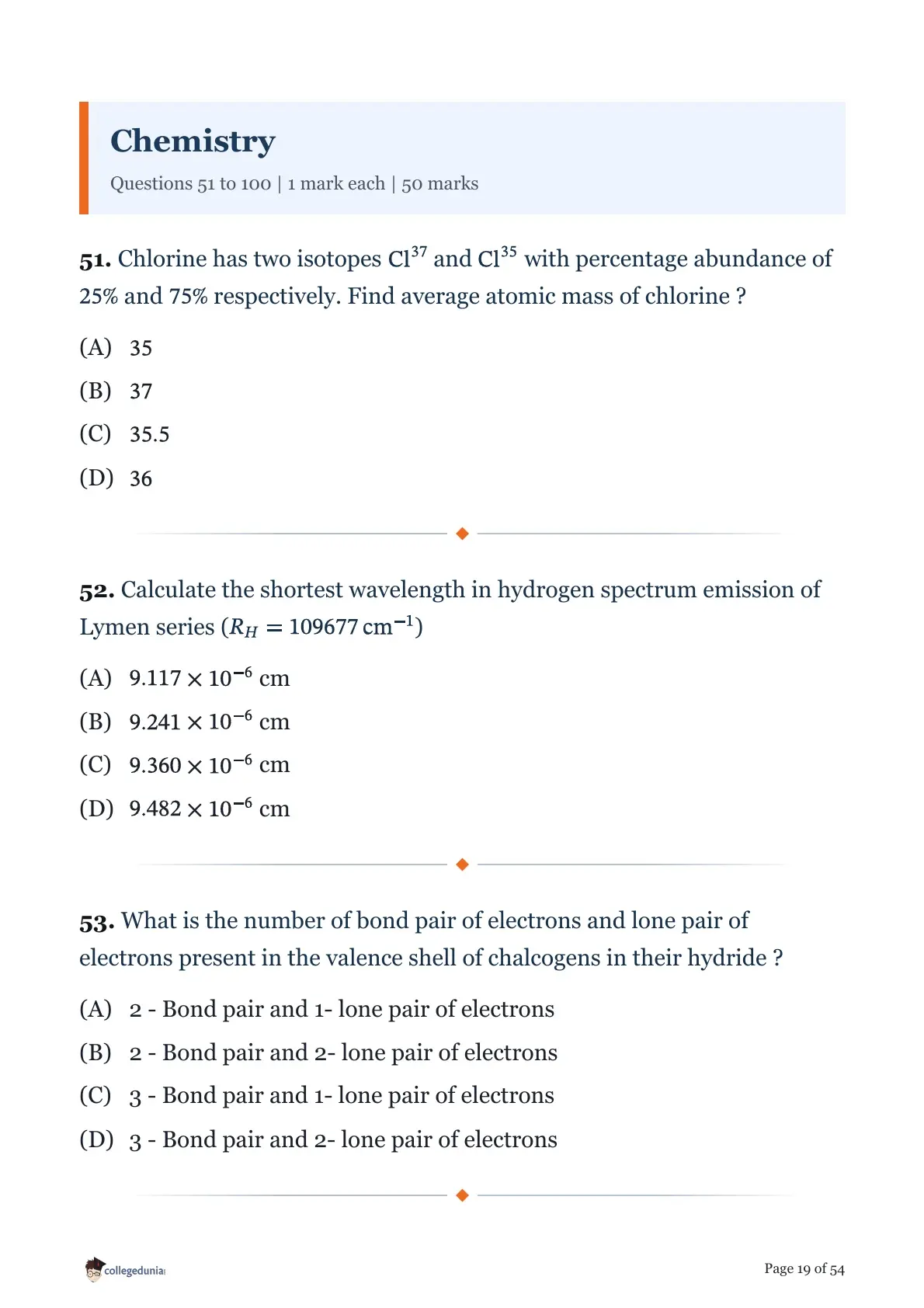
Chlorine has two isotopes \(\text{Cl}^{37}\) and \(\text{Cl}^{35}\) with percentage abundance of \(25\%\) and \(75\%\) respectively. Find average atomic mass of chlorine ?
Calculate the shortest wavelength in hydrogen spectrum emission of Lymen series (\(R_H = 109677\,\text{cm}^{-1}\))
What is the number of bond pair of electrons and lone pair of electrons present in the valence shell of chalcogens in their hydride ?
Which of the following is favourable condition for the formation of ionic bond ?
Which is the correct decreasing order of boiling points for different compounds from following ?
Which from following gases is least soluble in water under same conditions of temperature and pressure ?
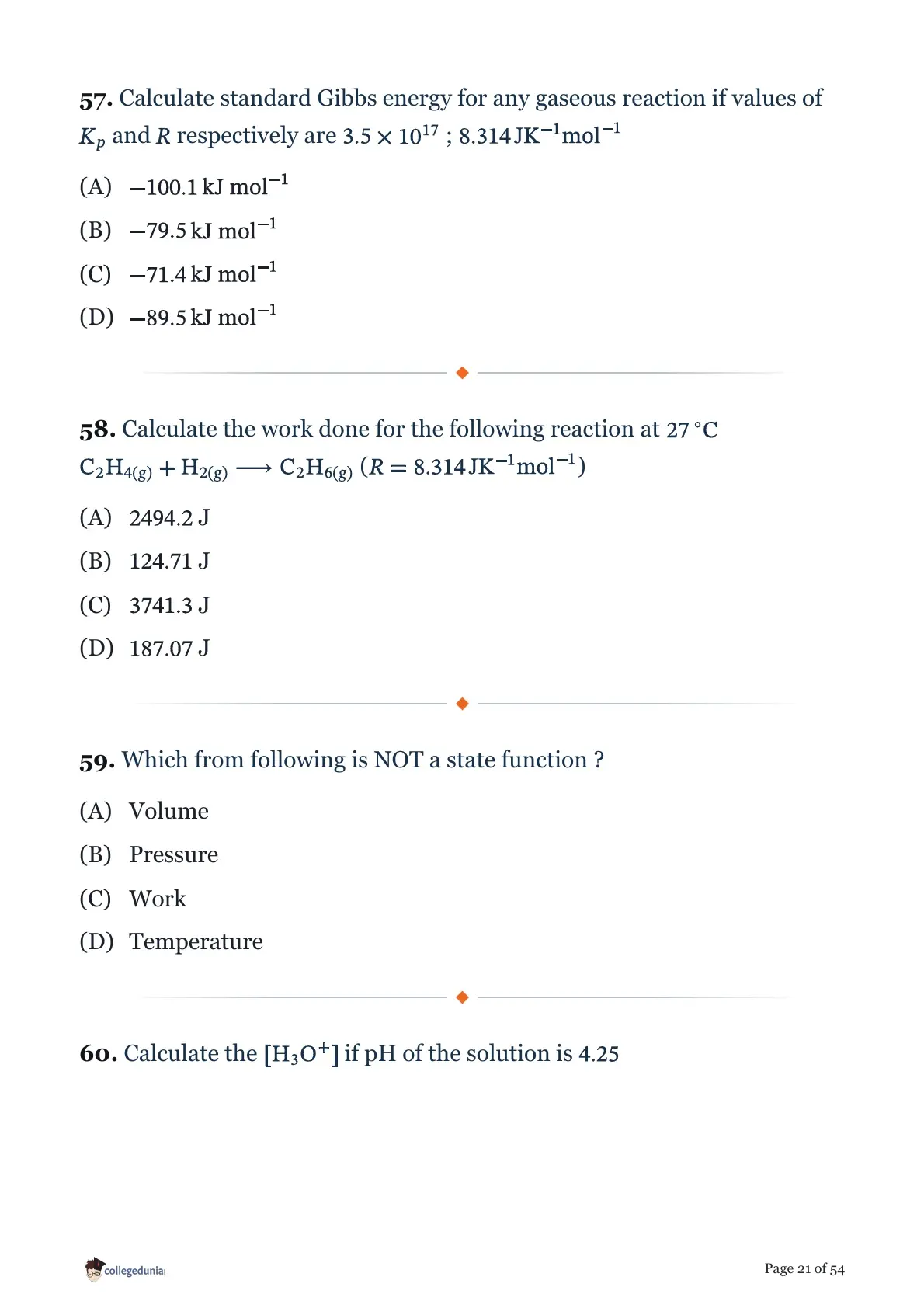
Calculate standard Gibbs energy for any gaseous reaction if values of \(K_p\) and \(R\) respectively are \(3.5\times 10^{17}\) ; \(8.314\,\text{JK}^{-1}\text{mol}^{-1}\)
Calculate the work done for the following reaction at \(27\,^{\circ}\text{C}\)
\(\text{C}_2\text{H}_{4(g)}+\text{H}_{2(g)}⟶\text{C}_2\text{H}_{6(g)}\) (\(R = 8.314\,\text{JK}^{-1}\text{mol}^{-1}\))
Which from following is NOT a state function ?
Calculate the \([\text{H}_3\text{O}^+]\) if pH of the solution is \(4.25\)
If \([\text{H}_3\text{O}^+]\) of a solution is \(1\times 10^{-4}\). What is the value of pOH at \(298\,\text{K}\) ?
Calculate the molar concentration of weak monobasic acid if \(K_a = 1.8\times 10^{-5}\) and degree of dissociation is \(0.01\) ?
Which of the following equimolar solutions is the best conductor of electricity at same temperature ?
Which of the following statements is false regarding hydrogen ?


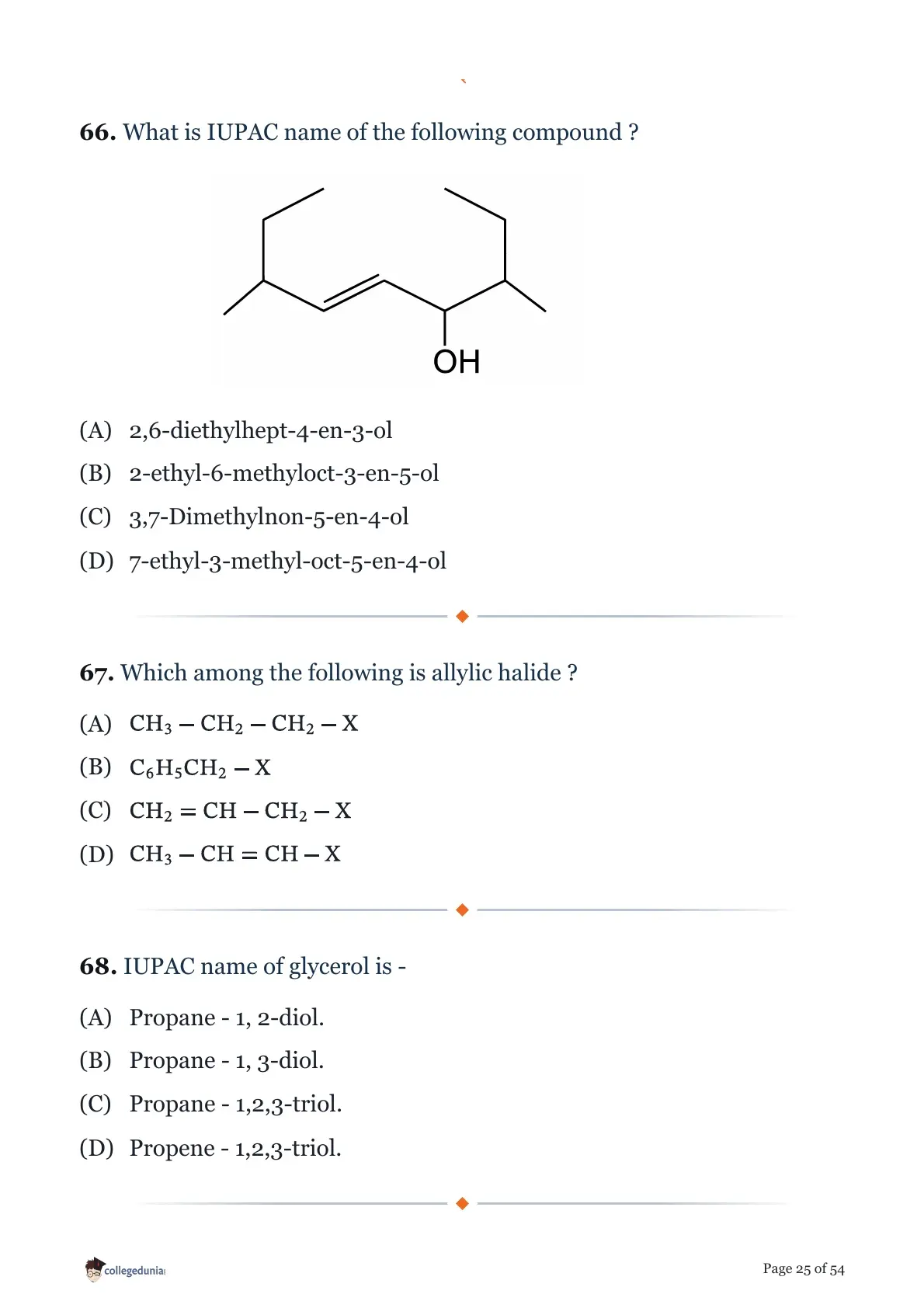
Which among the following is allylic halide ?
IUPAC name of glycerol is -
Which from following structures represents 1,3 butadiene ?
- (A)
![]()
- (B)
![]()
- (C)
![]()
- (D)
![]()


Find the number of structural isomers possible for hexane ?
Which of the following hydrocarbons has stronger London dispersion forces ?
Identify the major product of following reaction.
\(\text{Propene}\rightarrow _{\text{Peroxide}\,}^{\text{HBr}\,}\,?\)
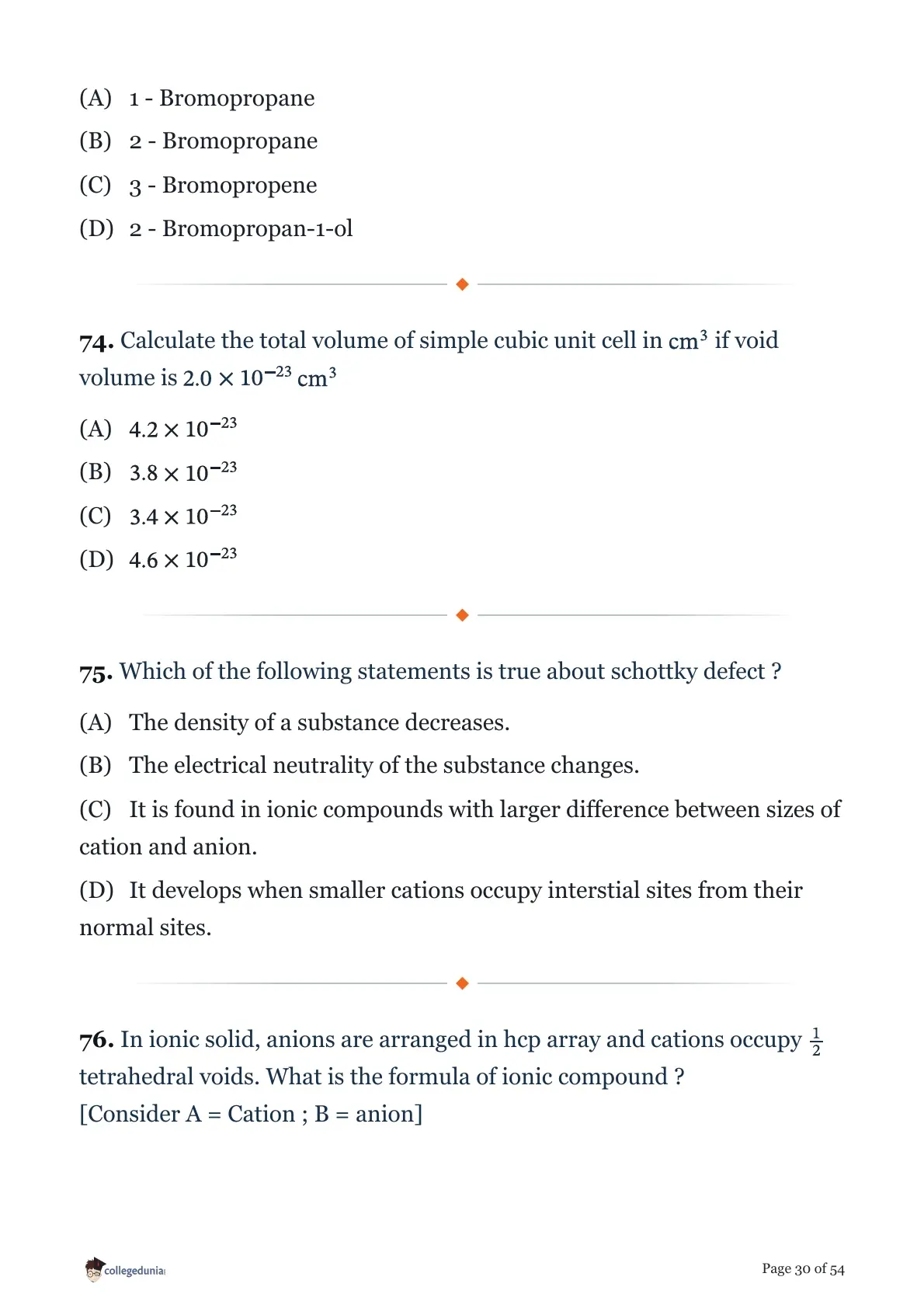
Calculate the total volume of simple cubic unit cell in \(\text{cm}^3\) if void volume is \(2.0\times 10^{-23}\,\text{cm}^3\)
Which of the following statements is true about schottky defect ?
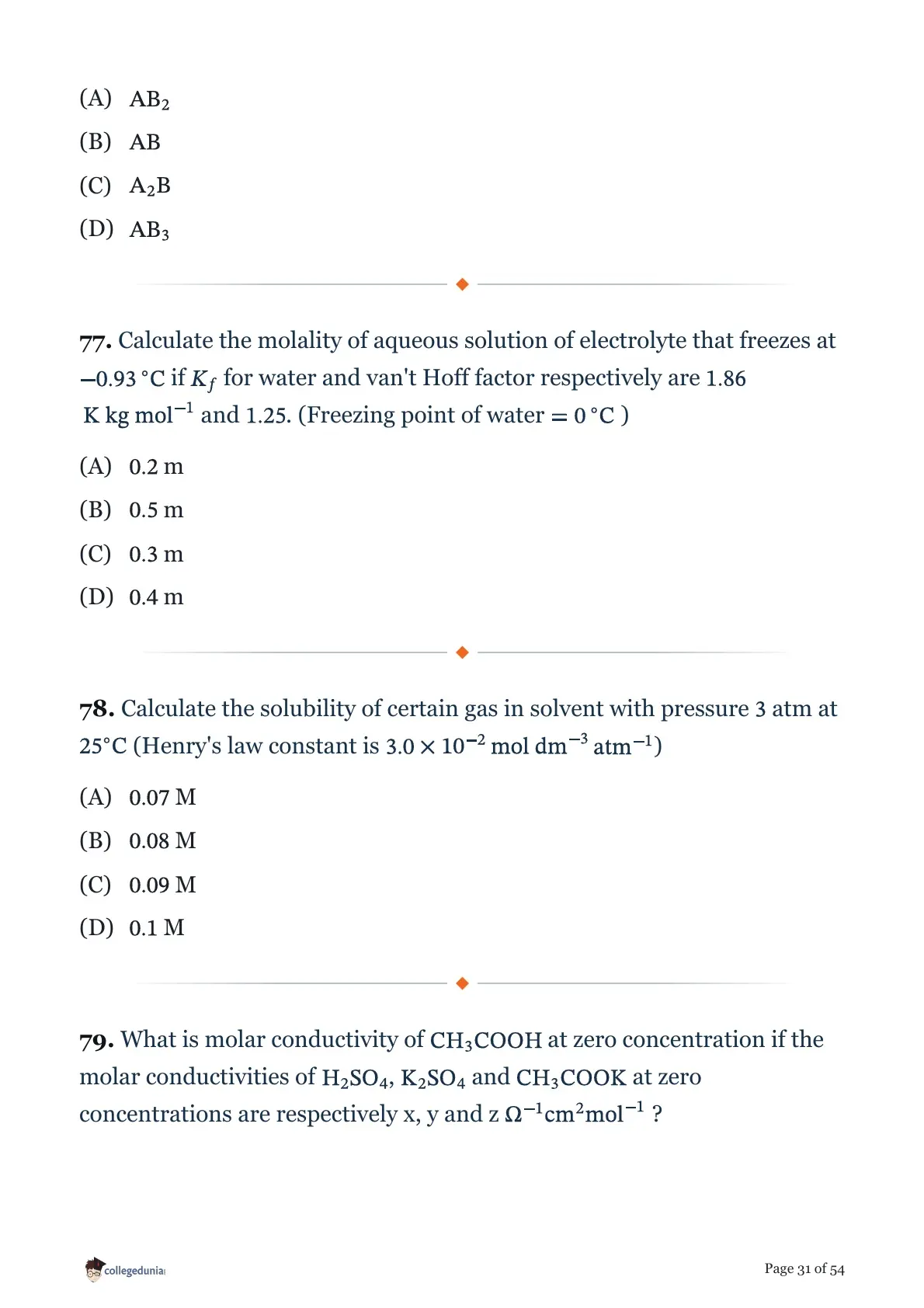
In ionic solid, anions are arranged in hcp array and cations occupy \(\frac{1}{2}\) tetrahedral voids. What is the formula of ionic compound ?
[Consider A = Cation ; B = anion]
Calculate the molality of aqueous solution of electrolyte that freezes at \(-0.93\,^{\circ}\text{C}\) if \(K_f\) for water and van't Hoff factor respectively are \(1.86\,\text{K kg mol}^{-1}\) and \(1.25\). (Freezing point of water \(= 0\,^{\circ}\text{C}\) )
Calculate the solubility of certain gas in solvent with pressure \(3\) atm at \(25^{\circ}\text{C}\) (Henry's law constant is \(3.0\times 10^{-2}\,\text{mol dm}^{-3}\,\text{atm}^{-1}\))
What is molar conductivity of \(\text{CH}_3\text{COOH}\) at zero concentration if the molar conductivities of \(\text{H}_2\text{SO}_4\), \(\text{K}_2\text{SO}_4\) and \(\text{CH}_3\text{COOK}\) at zero concentrations are respectively x, y and z \(\Omega ^{-1}\text{cm}^2\text{mol}^{-1}\) ?
What must be the molarity of \(\text{BaCl}_2\) solution to have molar conductivity \(240\,\Omega ^{-1}\text{cm}^2\text{mol}^{-1}\) and conductivity \(0.012\,\Omega ^{-1}\text{cm}^{-1}\) at \(25^{\circ}\text{C}\) ?
Half life of a first order reaction is \(900\) second. If initial concentration of reactant is \(0.08\,\text{mol dm}^{-3}\) find concentration that remains after \(35\) minute ?
Consider the reaction,
\(3\text{I}_{(aq)}^-+\text{S}_2\text{O}_8^{2-}_{(aq)}⟶\text{I}_3^-_{(aq)}+2\text{SO}_4^{2-}_{(aq)}\)
If the rate of formation of \(\text{SO}_4^{2-}\) at a particular time is \(2.2\times 10^{-2}\,\text{mol dm}^{-3}\,\text{s}^{-1}\). Calculate the rate of consumption of \(\text{I}^-\).
For a first order reaction, half life is \(5\) hour. What time is required to reduce \(10\) g of reactant to \(2.5\) g ?
Which of following forces is responsible for physisorption ?
Which of the following ranges of particle size defines nano scale ?
Which of the following is the correct decreasing order of bond dissociation enthalpy of halogens ?
Which from following is NOT an inner transition element ?
Identify species having metal atom in \(+6\) oxidation state from following
Which element from following is NOT regarded as transition element ?
Which from following coordinate complexes contains neutral ligand ?
Which from following complexes is an example of \(\text{MA}_4\text{BC}\) type distereoisomers ?
Identify the product B in following reaction.
\(\text{CH}_3\text{Br}\overset{\text{KCN}\,}{\rightarrow }\text{A}\rightarrow _{\text{C}_2\text{H}_5\text{OH}\,}^{\text{Na}\,}\text{B}\)
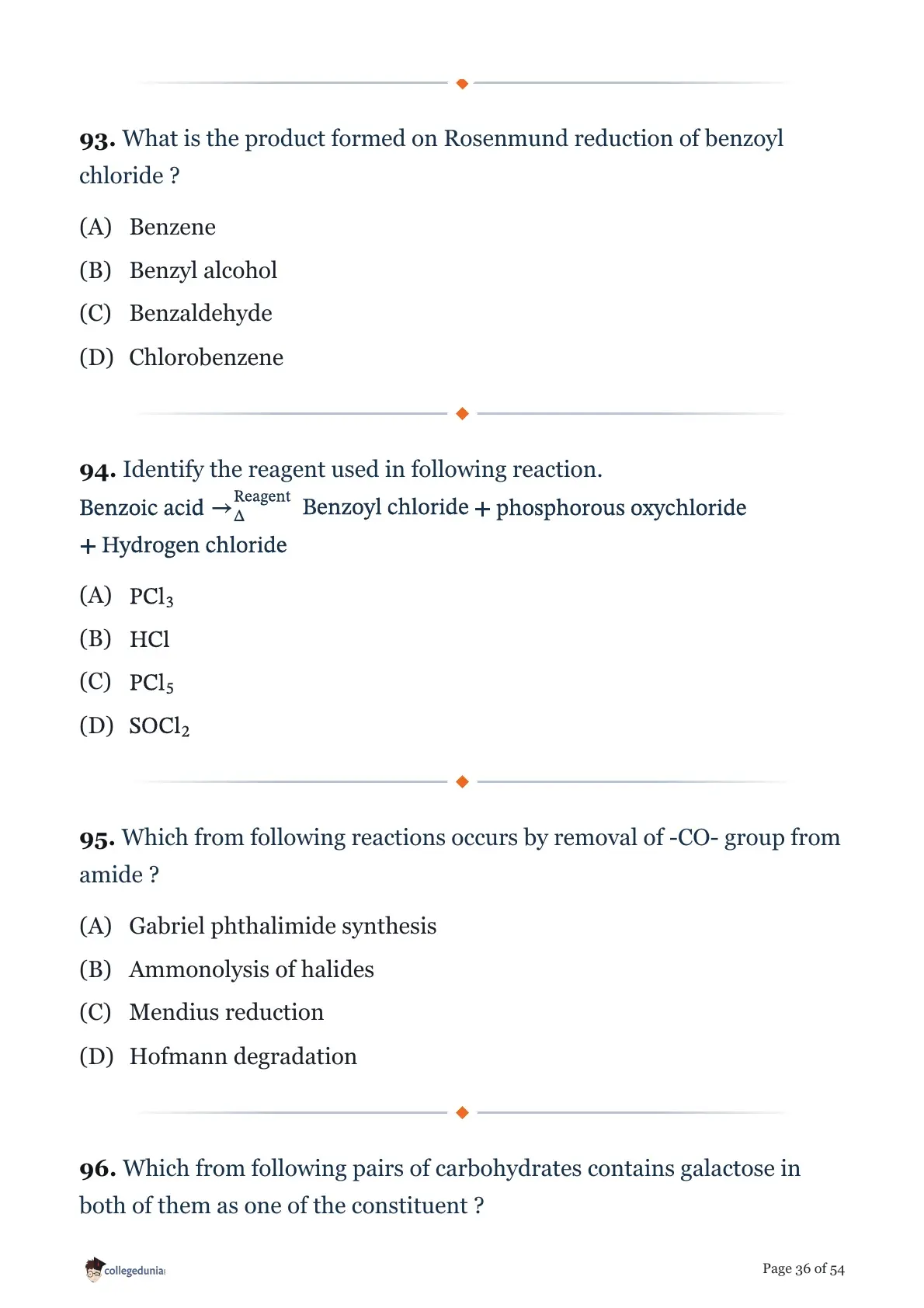
What is the product formed on Rosenmund reduction of benzoyl chloride ?
Identify the reagent used in following reaction.
\(\text{Benzoic acid}\rightarrow _{\Delta \,}^{\text{Reagent}\,}\text{Benzoyl chloride}+\text{phosphorous oxychloride}+\text{Hydrogen chloride}\)
Which from following reactions occurs by removal of -CO- group from amide ?
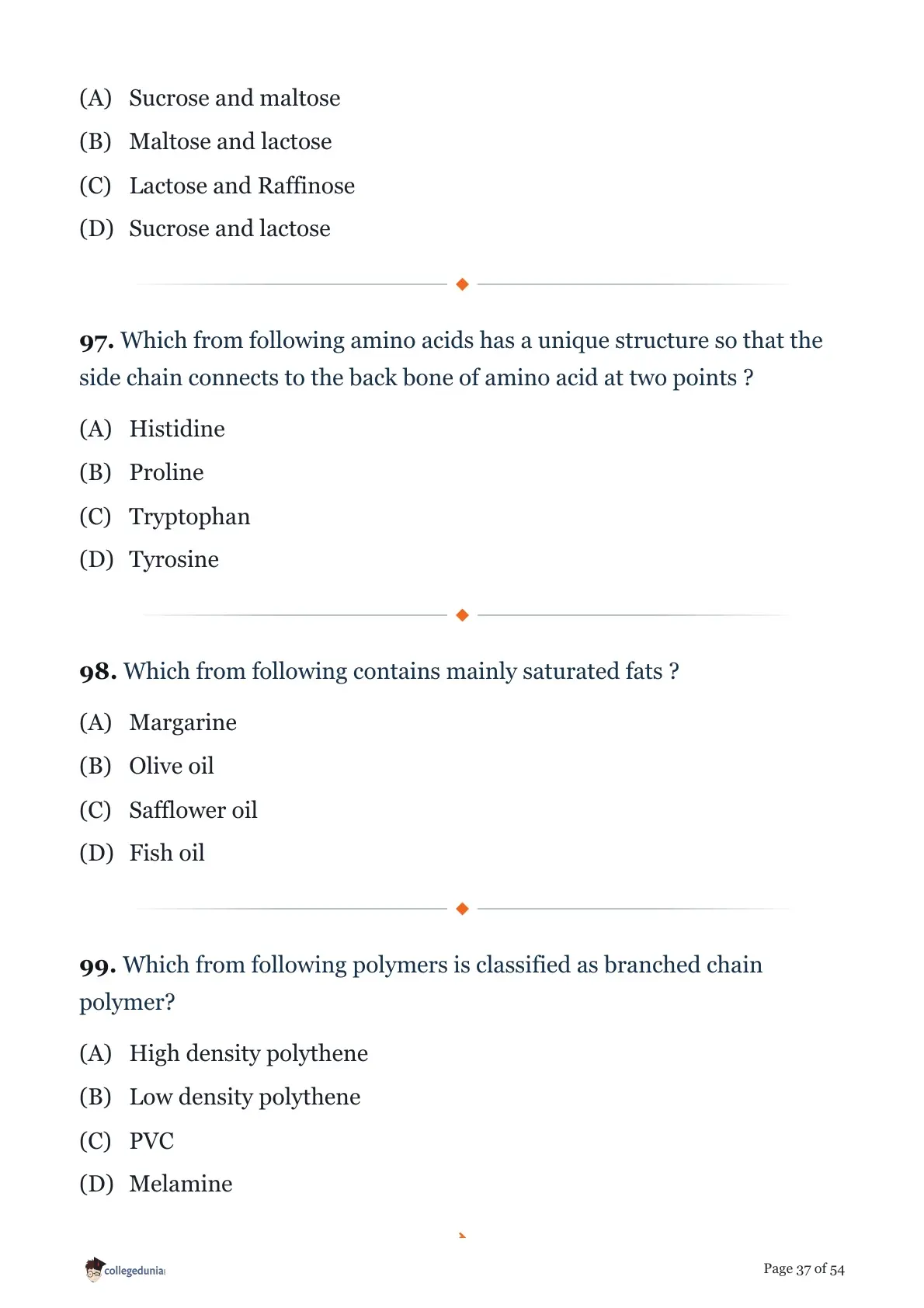
Which from following pairs of carbohydrates contains galactose in both of them as one of the constituent ?
Which from following amino acids has a unique structure so that the side chain connects to the back bone of amino acid at two points ?
Which from following contains mainly saturated fats ?
Which from following polymers is classified as branched chain polymer?
Which from following polymers is obtained by condensation polymerisation method ?
- (A) \([\,\text{CF}_2-\text{CF}_2\,]_n\)
- (B) \([\,\text{CH}_2-\text{CH}_2\,]_n\)
- (C) \([\,\text{NH}-(\text{CH}_2)_5-\text{CO}\,]_n\)
- (D)
![]()

Mathematics Section (Questions 101 to 150)
If \(z = \sum _{n = 0}^{2026}i^n\), where \(i = \sqrt{-1}\), then one of the values of \(\sqrt{z}\) is...
Point A\((5,12)\) rotated about the origin O in the XY-plane through an angle of \(30^{\circ}\) in the anticlockwise direction to a new position B. The ordinate of point B is...
If \(^nC_4,^nC_5\) and \(^nC_6\) are in arithmetic progression (A.P.), then the value of n is...
The family of straight lines \(4ax+3by+c = 0\) such that \(a+b+c = 0\) (where a, b, c are real constants) are concurrent at the point...
If two lines represented by \(x^2-(1+\sqrt{3})xy+\sqrt{3}y^2 = 0\) make angles \(α\) and \(β\) with the X-axis, then \(tan(α+β)\) is...
Let PA and PB be the tangent segments drawn from point P\((6,8)\) to the circle with the centre at origin O. The radius of circle for which the area of quadrilateral PAOB is maximum, is...
A circle passes through the point \((0,1)\) and touches the parabola \(y = x^2\) at the point \((1,1)\). The centre of the circle is...
The eccentricity of the ellipse represented by the equation \(7x^2+16y^2-14x+64y-377 = 0\) is...
If \(\underset{x\rightarrow 1}{lim}\frac{x^3+ax^2+bx+c}{x^2-2x+1} = 2026\) then the value of \(a-c\) is...
If the truth value of \([(p∨q)∧(q\rightarrow r)∧(\sim r)]\rightarrow (p∧q)\) is false, then which of the following is NOT true?
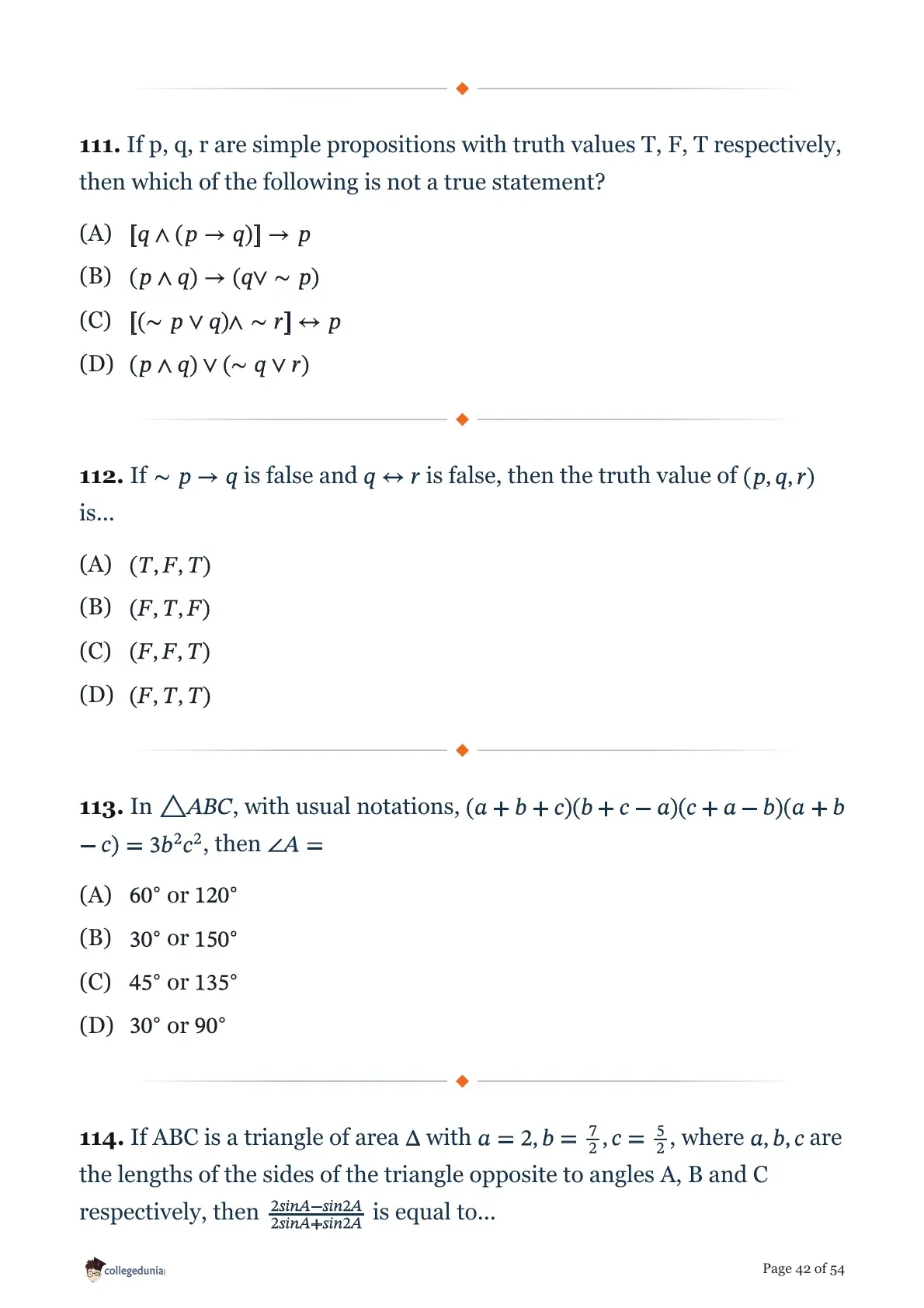
If p, q, r are simple propositions with truth values T, F, T respectively, then which of the following is not a true statement?
If \(\sim p\rightarrow q\) is false and \(q\leftrightarrow r\) is false, then the truth value of \((p,q,r)\) is...
In \(△ABC\), with usual notations, \((a+b+c)(b+c-a)(c+a-b)(a+b-c) = 3b^2c^2\), then \(\angle A =\)
If ABC is a triangle of area \(\Delta\) with \(a = 2,b = \frac{7}{2},c = \frac{5}{2}\), where \(a,b,c\) are the lengths of the sides of the triangle opposite to angles A, B and C respectively, then \(\frac{2sinA-sin2A}{2sinA+sin2A}\) is equal to...
If matrix \(A = \left[ \begin{array}{ccc}-1 & 2025 & 2026 \\ 0 & 2 & 2027 \\ 0 & 0 & -1\end{array} \right]\), then the sum of all elements in \(\text{adj}(A^{-1})\) is equal to...
The inverse of the matrix \(A = \left[ \begin{array}{ccc}2 & -1 & 4 \\ 4 & -3 & 1 \\ 1 & 2 & 1\end{array} \right]\) is \(B = \frac{1}{37}\left[ \begin{array}{ccc}-5 & 9 & 11 \\ -3 & -2 & 14 \\ 11 & -5 & k\end{array} \right]\), then the value of \(k\) is...
The value of \(sin^{-1}(sin\frac{5π}{6})+cos^{-1}(cos\frac{7π}{6})+tan^{-1}(tan\frac{2π}{3})\) is equal to...
Let \(f(x) = 1-\frac{1}{x},g_2(x) = f(f(x)),g_3(x) = f(f(f(x)))\) and so on. If \(\int x\cdot g_{2026}(x)\,dx = \int g_{2025}(x)\,dx+h(x)+c\), then \(h(x) =\)...
If \(g(x) = 1-\sqrt{x}\) and \(f(g(x)) = 5+4\sqrt{x}+x\), then the value of \(f(6)\) is...
If the function \(f(x) = (\frac{5x-8}{8-3x})^{\frac{3}{2x-4}}\), for \(x\neq 2\) is continuous at \(x = 2\), then the value of \(f(2)\) is...
If \(x^m+y^m = k,(m\neq 1)\) and \(y^{''} = \frac{ax^b}{y^c}\) such that \(a+b+c = 0\), then the value of k is...
If \(y = sin^{-1}(\frac{25-x^2}{25+x^2})\), then \(y^'(1)\) is...
If \(f(x)\) and \(g(x)\) are inverse functions of each other and \(f(x) = x+e^x\), then \(g^'(x) =\)...
If \(3y^2-2xy-x = 0\), then the value of \(\frac{dy}{dx}\) at \(y = 2\) is...
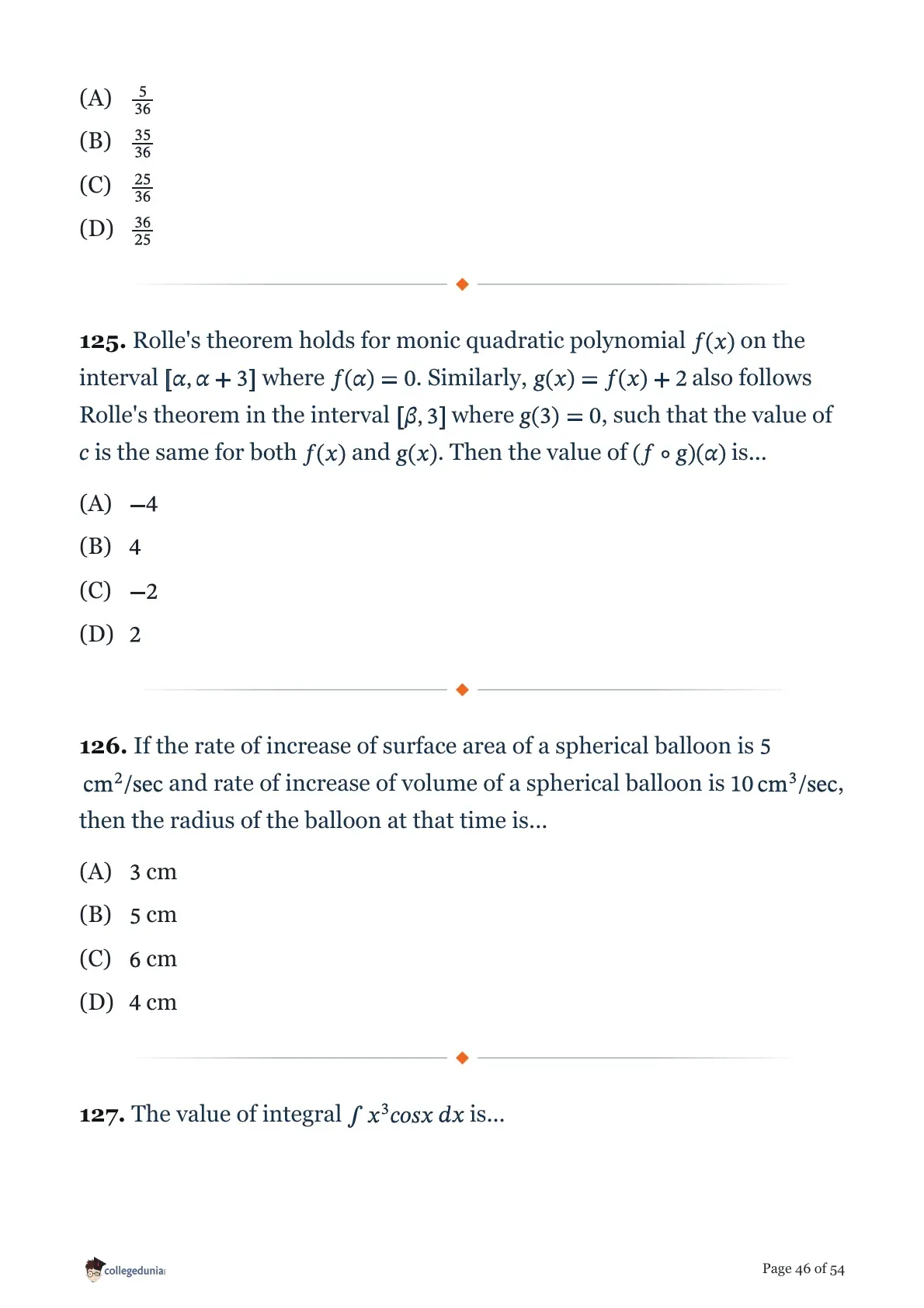
Rolle's theorem holds for monic quadratic polynomial \(f(x)\) on the interval \([α,α+3]\) where \(f(α) = 0\). Similarly, \(g(x) = f(x)+2\) also follows Rolle's theorem in the interval \([β,3]\) where \(g(3) = 0\), such that the value of \(c\) is the same for both \(f(x)\) and \(g(x)\). Then the value of \((f\circ g)(α)\) is...
If the rate of increase of surface area of a spherical balloon is \(5\,\text{cm}^2/\text{sec}\) and rate of increase of volume of a spherical balloon is \(10\,\text{cm}^3/\text{sec}\), then the radius of the balloon at that time is...
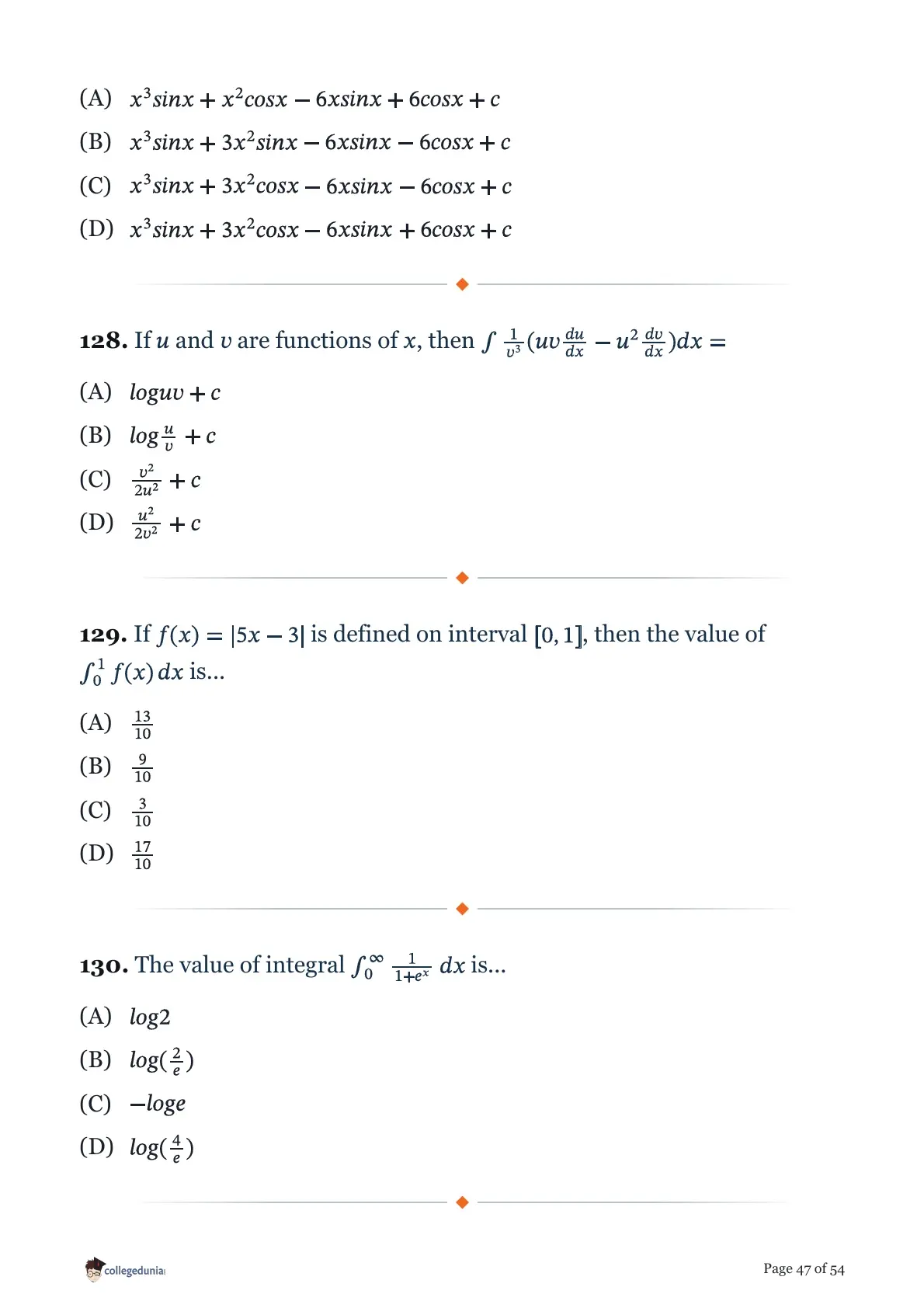
The value of integral \(\int x^3cosx\,dx\) is...
If \(u\) and \(v\) are functions of \(x\), then \(\int \frac{1}{v^3}(uv\frac{du}{dx}-u^2\frac{dv}{dx})dx =\)
If \(f(x) = |5x-3|\) is defined on interval \([0,1]\), then the value of \(\int _0^1f(x)\,dx\) is...
The value of integral \(\int _0^{\infty}\frac{1}{1+e^x}\,dx\) is...
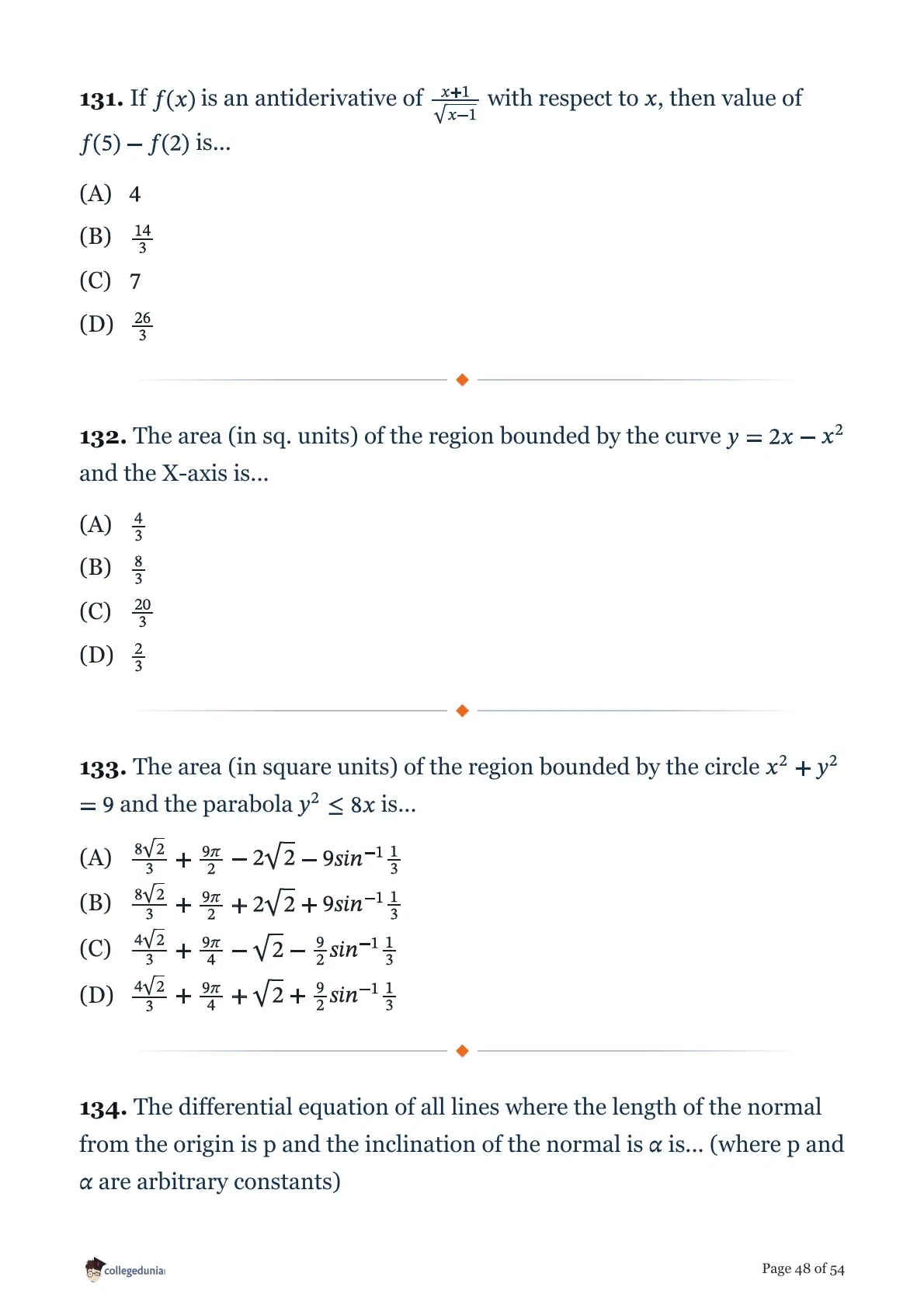
If \(f(x)\) is an antiderivative of \(\frac{x+1}{\sqrt{x-1}}\) with respect to \(x\), then value of \(f(5)-f(2)\) is...
The area (in sq. units) of the region bounded by the curve \(y = 2x-x^2\) and the X-axis is...
The area (in square units) of the region bounded by the circle \(x^2+y^2 = 9\) and the parabola \(y^2\leq 8x\) is...
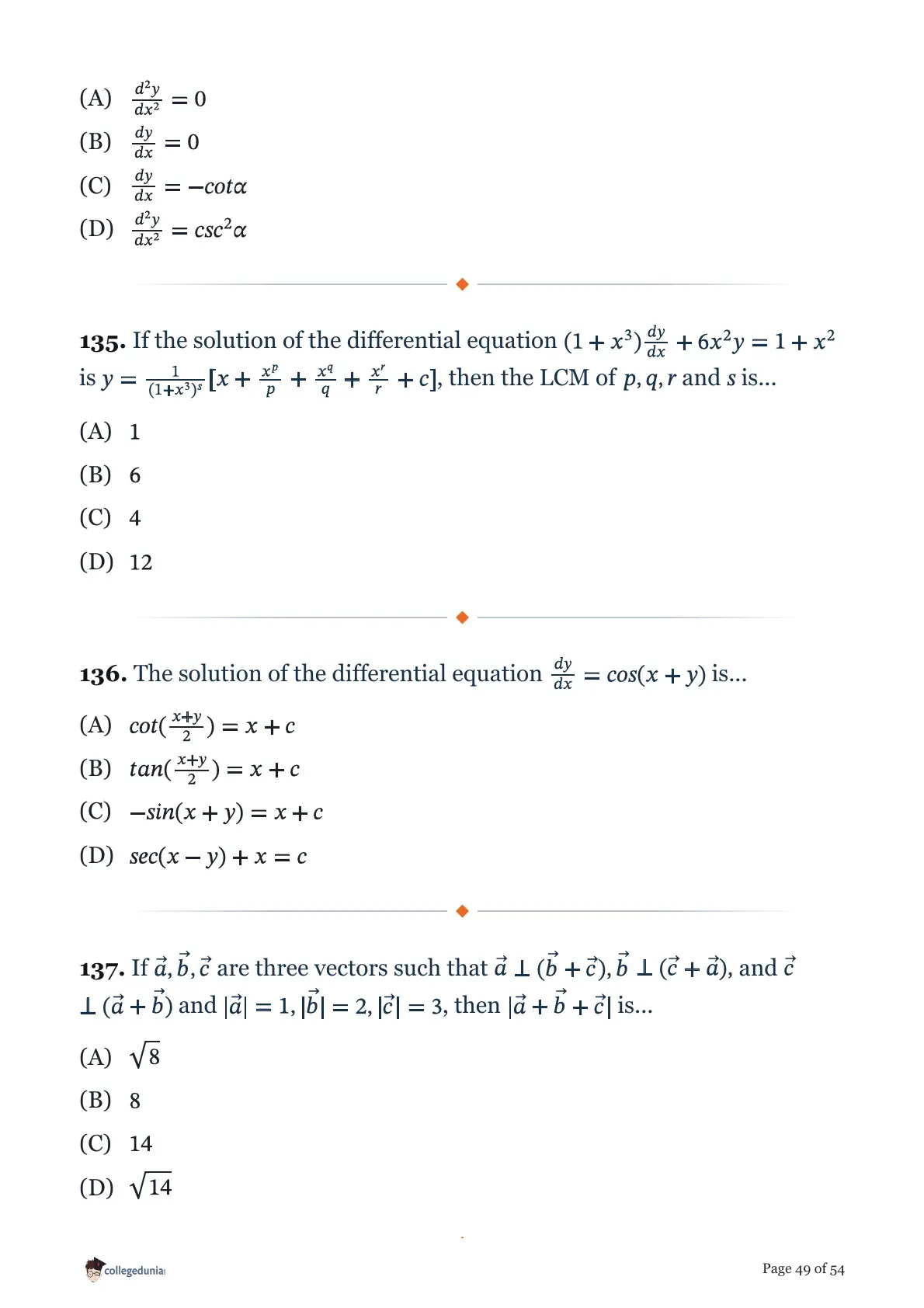
The differential equation of all lines where the length of the normal from the origin is p and the inclination of the normal is \(α\) is... (where p and \(α\) are arbitrary constants)
If the solution of the differential equation \((1+x^3)\frac{dy}{dx}+6x^2y = 1+x^2\) is \(y = \frac{1}{(1+x^3)^s}[x+\frac{x^p}{p}+\frac{x^q}{q}+\frac{x^r}{r}+c]\), then the LCM of \(p,q,r\) and \(s\) is...
The solution of the differential equation \(\frac{dy}{dx} = cos(x+y)\) is...
If \(\overset{⃗}{a},\overset{⃗}{b},\overset{⃗}{c}\) are three vectors such that \(\overset{⃗}{a}⟂(\overset{⃗}{b}+\overset{⃗}{c}),\overset{⃗}{b}⟂(\overset{⃗}{c}+\overset{⃗}{a}),\) and \(\overset{⃗}{c}⟂(\overset{⃗}{a}+\overset{⃗}{b})\) and \(|\overset{⃗}{a}| = 1,|\overset{⃗}{b}| = 2,|\overset{⃗}{c}| = 3\), then \(|\overset{⃗}{a}+\overset{⃗}{b}+\overset{⃗}{c}|\) is...
Two adjacent sides of a parallelogram ABCD are given by \(\overline{AB} = 2\hat{i}+10\hat{j}+11\hat{k}\) and \(\overline{AD} = -\hat{i}+2\hat{j}+2\hat{k}\). The side \(AD\) is rotated by an acute angle \(α\) in the plane of the parallelogram so that \(AD\) becomes \(AD^'\). If \(AD^'\) makes a right angle with the side \(AB\), then the cosine of the angle \(α\) is...
The maximum volume of a parallelopiped (in cubic units) with vectors \((2a\hat{i}+\hat{k}),(a\hat{j}-a\hat{k})\), and \((3\hat{i}+a\hat{j})\), where \(a\in [0,1]\), as its coterminous edges is...
Let O\((0,0)\), A\((-1,2)\) and B\((1,3)\) be the vertices of \(△\)OAB. The bisector of angle O intersects side AB at point D. The value of \(\overset{⃗}{OD}\cdot \overset{⃗}{AB}\) is equal to...
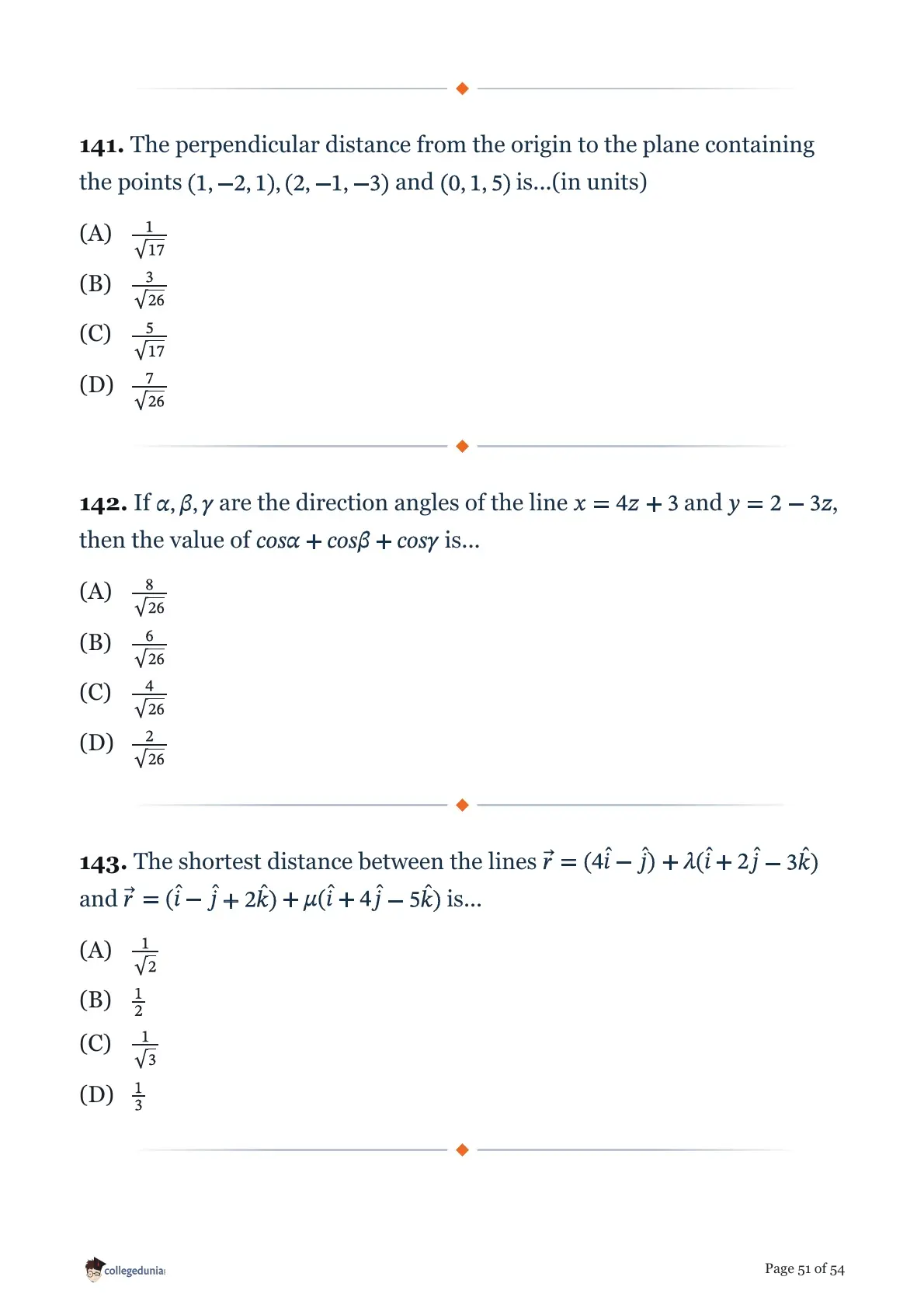
The perpendicular distance from the origin to the plane containing the points \((1,-2,1),(2,-1,-3)\) and \((0,1,5)\) is...(in units)
If \(α,β,γ\) are the direction angles of the line \(x = 4z+3\) and \(y = 2-3z\), then the value of \(cosα+cosβ+cosγ\) is...
The shortest distance between the lines \(\overset{⃗}{r} = (4\hat{i}-\hat{j})+λ(\hat{i}+2\hat{j}-3\hat{k})\) and \(\overset{⃗}{r} = (\hat{i}-\hat{j}+2\hat{k})+μ(\hat{i}+4\hat{j}-5\hat{k})\) is...
Let \(\overset{⃗}{r}\cdot (3\hat{i}-2\hat{j}+7\hat{k}) = 32\) is the equation of a plane and the line having direction ratios \((5,b,3)\) is parallel to the plane, then the value of b is...
A line passing through the points \((1,-1,2)\) and \((2,0,1)\) meets the XY plane and the YZ plane at points A and B respectively. The distance AB is equal to...
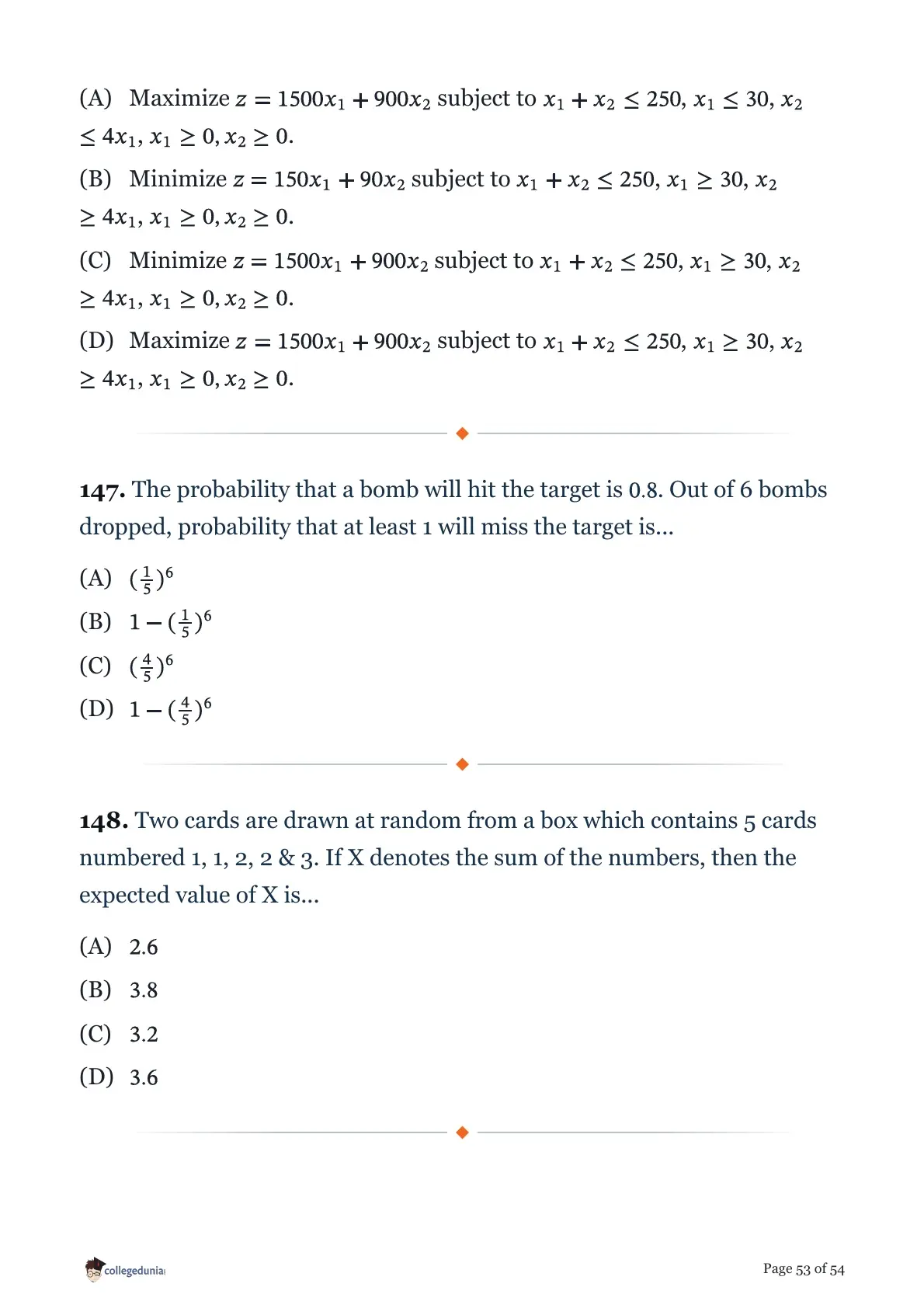
An airplane can carry a maximum of \(250\) passengers. A profit of Rs \(1500\) is made on each executive class ticket and a profit of Rs \(900\) is made on each economy class ticket. The airline reserves at least \(30\) seats for executive class. However at least \(4\) times as many passengers prefer to travel by economy class than by executive class. Let \(x_1\) be the number of passengers of executive class and \(x_2\) be the number of passengers of economy class. Formulate the LPP in order to maximize the profit for the airline...
The probability that a bomb will hit the target is \(0.8\). Out of 6 bombs dropped, probability that at least 1 will miss the target is...
Two cards are drawn at random from a box which contains 5 cards numbered 1, 1, 2, 2 & 3. If X denotes the sum of the numbers, then the expected value of X is...
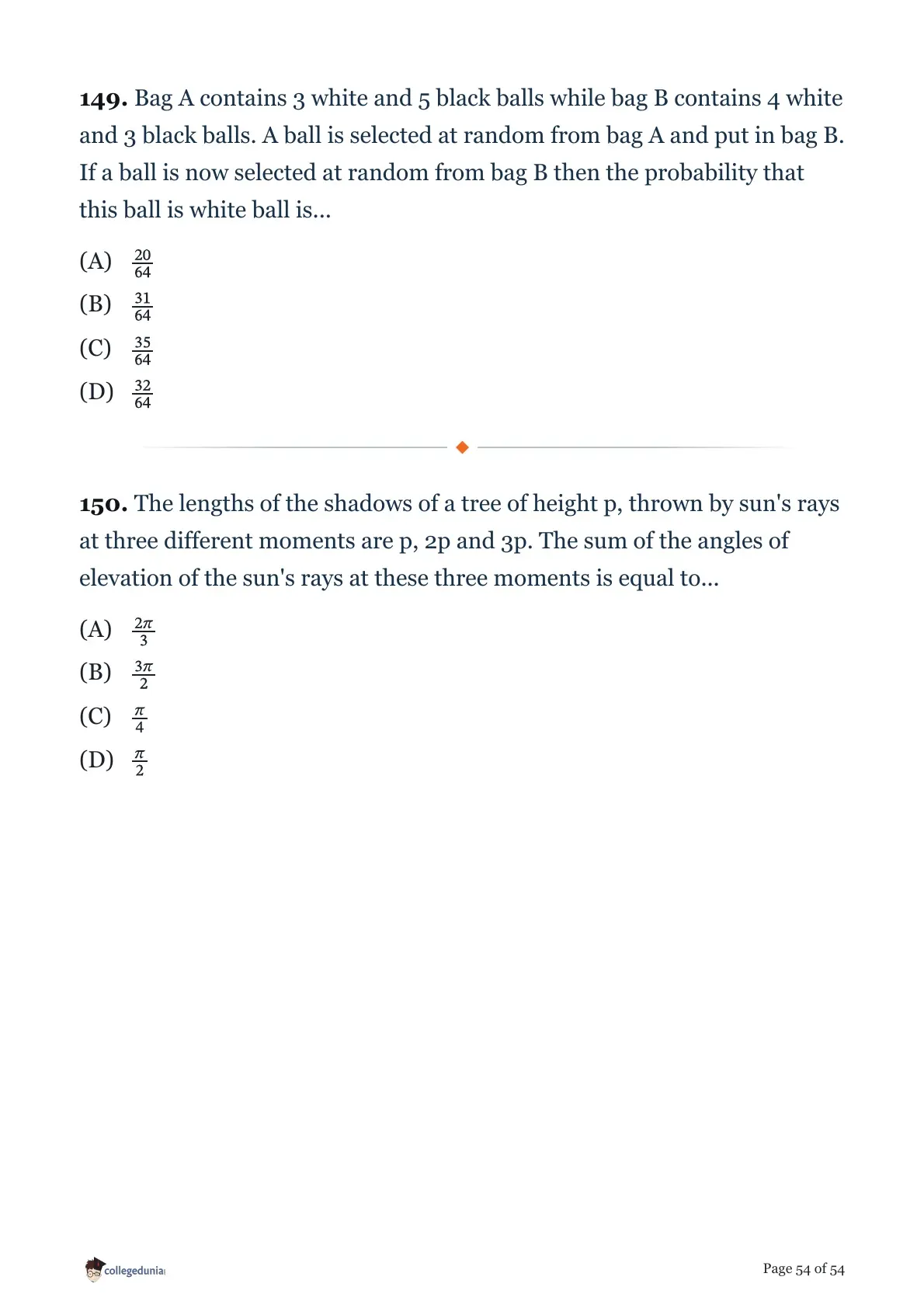
Bag A contains 3 white and 5 black balls while bag B contains 4 white and 3 black balls. A ball is selected at random from bag A and put in bag B. If a ball is now selected at random from bag B then the probability that this ball is white ball is...
The lengths of the shadows of a tree of height p, thrown by sun's rays at three different moments are p, 2p and 3p. The sum of the angles of elevation of the sun's rays at these three moments is equal to...
MHT CET PCM Exam Pattern 2026
| Parameter | Details |
|---|---|
| Conducting Body | Maharashtra Common Entrance Test Cell (Maharashtra CET Cell) |
| Exam Mode | Online (Computer-Based Test) |
| Duration | 180 minutes (3 hours) |
| Groups / Subjects | PCM (Physics, Chemistry, Mathematics) for Engineering |
| Total Questions |
150 |
| Total Marks | 200 |
| Question Type | Multiple Choice Questions (MCQs) |
| Marks Distribution |
|
| Negative Marking | No |
| Syllabus Weightage |
|



Comments