



Exams Prep Master
An abiotic factor refers to a non-living part of the environment that also equally shapes its environment just as biotic factors. In the terrestrial ecosystem, abiotic factors like temperature, light, and water might include. Again, in the marine ecosystem, abiotic factors might include salinity and ocean currents. Let’s have a closer look at the topic along with some important questions.
The world we live in is composed of rivers, lakes, forests, valleys, as well as the animals and plants inhabiting the environments. Ecologically, these environmental components can be categorized into biotic factors and abiotic factors. The living parts of an ecosystem are called biotic factors, while the non-living parts are called abiotic factors. In this article, we will be discussing the abiotic factors in an ecosystem and the effect of human activities on the ecosystem.
| Table of Content |
KeyTerms: Factor, Ecosystem, Marine ecosystem, Environment, Biotic factors, Currents, Components, Atmosphere, Hydrosphere, Lithosphere, Temperature, Light, Water
Read More: Tundra Ecosystem
What are Abiotic Factors?
[Click Here for Sample Questions]
The term “abiotic” is derived from “a” meaning ‘without’ and “bio” meaning ‘life’. The non-living part of an environment is called the abiotic factor. All physical and chemical aspects of an ecosystem are included within it. The abiotic factors support survival and reproduction, thus contributing to the continuity of life on earth. The factors may be present in the atmosphere, hydrosphere, and lithosphere.
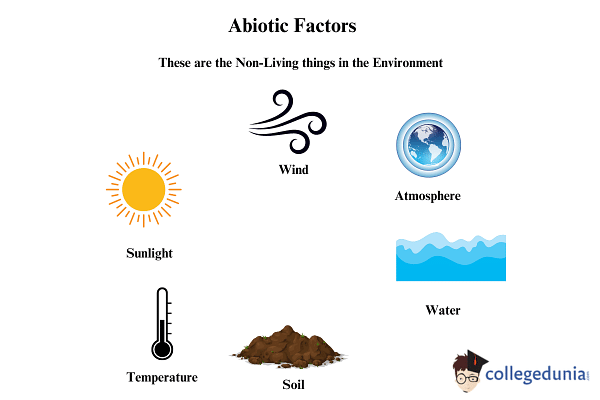
Abiotic Factors Examples
Examples of abiotic factors are:
- Water
- Sunlight
- Temperature
- Soil
- Atmosphere
- Air Humidity
- Wind
Read More:
Major Abiotic Factors of the Ecosystem
[Click Here for Previous Year Questions]
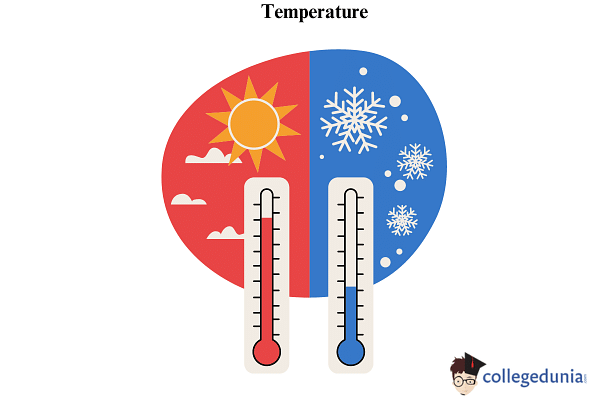
Temperature
The average temperature on land changes every season. It decreases towards the poles from the equator, and towards the mountain peaks from the plains. The kinetics of enzymes are affected by temperature, and in turn, the basal metabolism, activity, and other physiological functions of the organism are affected.
Water
Water forms the basis of the origin of life on earth, and thus life is unsustainable without water. The salt concentration in water varies with the aquatic environment. Measured as salinity in parts per thousand, the salt concentration in inland waters is below 5 percent, in the sea is 30-35 percent, while in hypersaline lagoons, it is above 100 percent.

Water
Light
Light is responsible for the production of food by photosynthesis by plants. Moreover, sunlight also fulfills the photoperiodic requirement for flowering for many plants. Besides plants, animals time their foraging, reproductive and migratory activities using the diurnal and seasonal variations in light intensity and duration, also called photoperiod.
Soil
The percolation and water holding capacity of the soil is determined by the soil composition, grain size, and aggregation, which in turn determines the vegetation of an area along with other factors such as pH, mineral composition, and topography.
Types of Ecosystem Based on Abiotic Factors
- Desert Abiotic Factors: Deserts develop ecosystems that are very distinguishable from other environments due to low rainfall. It covers 20% of the earth’s surface that includes Antarctica. Extreme temperature swings are often observed in deserts because open-air and water vapor stabilizes the temperature.
- Tropical Rainforest Abiotic Factors: Tropical rainforests experience the most rainfall on earth. Most of the rainforests have more than 100 inches of rain every year. It possesses warm and wet climates and the rainforests create a dense, lush, and complex ecosystem.
- Tundra Abiotic Factors: The tundra regions see less light and heat from the sun. A deep layer of soil called the subsoil is observed and it can remain frozen for many years. Only grasses and small plants grow in this region.
- Ocean Abiotic Factors: The abiotic factors which play an integral part in the ocean’s environment are salinity, heat, pollution, and many more. It is a truly unique environment. Due to its depth, the different zones receive a different amount of sunlight and heat.
Human Activity Affecting the Ecosystem
[Click Here for Sample Questions]
Case study: Pollution and the Peppered Moth
At the beginning of the 19th century, there were two types of moths in the United Kingdom. At that time, the white-bodied peppered moth was common, whose black-speckled white body allowed it to blend in with the tree bark to avoid being eaten by birds. However, during the Industrial Revolution, coal-burning factories produced lots of ash, which settled on the tree barks. Thus, the white-bodied moths were now distinguishable from the dark tree trunks. On the other hand, the black-bodied moths, which were uncommon back then, could now hide more effectively.

Later, it was discovered that black-bodied moths were dominant near the industrial areas, whereas the white-bodied moths were restricted to the soot-free forests and the rural areas.
Also Read:
| Important Chapter Topics | ||
|---|---|---|
| Pelagic Zone | Benthic Zone | Productivity in Ecosystem |
| Biome Vs Ecosystem | Food Chains and Webs | Decomposers |
| Microbes in Human Welfare | Diversity in Living Organisms | Biomes |
Abiotic Factors Versus Biotic Factors
[Click Here for Previous Year Questions]
- Biotic factors refer to the living components of the ecosystem, whereas abiotic factors refer to the non-living factors.
- Biotic factors include the organisms and any decaying matter present in the environment, while abiotic factors include the elements which are essential for survival and influence the ecosystem.
There are various differences between biotic and abiotic factors, but both have profound effects on the balance of an ecosystem.
Things to Remember
- The abiotic factors may change depending on the environment. For example, sound waves and pressure are abiotic factors in sub-terrestrial or marine environments.
- Abiotic factors may also include added challenges to life forms, such as temperature extremes, high winds, or even pollution.
- Human activity has now become an important factor in determining the life forms which can survive in an ecosystem.
- In cases of the abiotic factors in an environment being unfavorable, a living organism uses different strategies to cope with the stressful condition.
Previous Year Questions
- the rate of production of organic matter by consumers….[NEET 2012]
- About 70% of total global carbon is found in...[NEET 2008]
- An ecosystem which can be easily damaged but can….[NEET 2004]
- The biomass available for consumption by the herbivores...[NEET 2010]
- Both hydrarch and xerarch successions lead to...[NEET 2011]
- During ecological succession...[NEET 2015]
- In a biotic community, the primary consumers are...[NEET 1995]
- In an ecosystem, which one shows one-way passage...[NEET 1988]
- Upper part of sea/aquatic ecosystem contains...[NEET 1988]
- Vertical distribution of different species occupying different...[NEET 2015]
- What is true of ecosystem?...[NEET 1988]
- Which ecosystem has the maximum biomass ?...[NEET 2017]
- Which of the following aquatic plant does not show pollination by water? … (KCET 2021)
- Aquatic reptiles are … (NEET 1999)
- Upper part of sea/aquatic ecosystem contains … (NEET 1988)
- An ecosystem which can be easily damaged but can recover … (NEET 2004)
- Energy transfer from one trophic level to other...[NEET 1999]
Sample Questions
Ques: Which abiotic factor is edaphic? (2 marks)
Ans. The edaphic abiotic factor is soil. Edaphic itself means related to soil. Soil is an important abiotic factor affecting the growth of plants. Soil provides support, minerals, and water to plants.
Ques: Which abiotic factor is topographic? (2 marks)
Ans. The topographic abiotic factor is the Earth’s surface. It tells about the physical features of a surface or region. It contains geographic positions and elevations for both natural and man-made features.
Ques: What is the temperature at hydrothermal sea vents? (2 marks)
Ans. The hydrothermal sea vents are present on the sea floor. It includes geysers or hot springs present on the ocean floor which contains geothermally heated water. It has a temperature above 100°C which may rise up to 400°C.
Ques: What are plants growing at high temperatures alternatively called? (2 marks)
Ans. The plants growing at high temperatures are termed as megatherms. These plants usually grow near the equator in tropical rainforests. They need abundant moisture along with high temperatures.
Ques: What are plants growing in high- low temperatures called? (2 marks)
Ans. Mesotherms are plants that survive at a high temperature of summer along with a low temperature of winter. They are found in deciduous forests of tropical and subtropical regions.
Ques: What are plants growing at low temperatures called? (2 marks)
Ans. Plants growing at low temperatures are called microtherms. They are found in temperate regions with high altitudes. They mostly consist of coniferous plants.
Ques: What are plants growing at very low temperatures called? (2 marks)
Ans. Hekistotherms are plants growing at very low temperatures. They are found in tropic regions (Arctic and Alpine). Alpine plants grow maximally at low temperatures.
Ques: What are warm-blooded animals called? (3 marks)
Ans. The warm-blooded animals are called homeotherms. They have the ability to maintain their body temperature at a constant level despite the change in temperature of the surrounding environment. Examples are mammals, birds.
Ques: What are cold-blooded animals called? (3 marks)
Ans. Poikilotherms are cold-blooded animals. They cannot regulate their body temperature and take on the temperature of their surrounding environment. An example is reptiles.
Ques: What is the problem faced by aquatic animals? (3 marks)
Ans. Endosmosis is a problem for aquatic animals. It leads to an increase in body fluid concentration which may lead to cell lysis. Exosmosis may also harm these animals as this leads to water loss from the body leading to shrinkage and dehydration.
Previous Year’s Questions
Ques: (i) What are the four abiotic components that lead to variations in the physical and chemical conditions of habitats.
(ii) Explain the effect of these components on the distribution of organisms in different habitats. (All India 2009 C)
Ans. (i)The four abiotic components are, temperature, water, light, and soil.
(ii) The impact of these components on the distribution of organisms in different habitats are:
(a) Temperature influences the kinetics of enzymes and therefore the metabolism and other physiological functions of the organisms. Organisms may be eurythermal and can tolerate a vast range of temperatures while stenothermal can tolerate only a narrow range of temperatures.
(b) In order to sustain life, water is important and productivity and the distribution of plants is dependent on water. Freshwater forms cannot thrive in seawater and vice versa.
(c) Light influences the photosynthesis of plants and also influences the flowering in plants and the timing of foraging, reproduction, and migratory activities of animals.
Aquatic plants occupy different depths based on their pigments and the light available.
(d) Soil influences vegetation by the water holding capacity, topography, and composition.
For Latest Updates on Upcoming Board Exams, Click Here:https://t.me/class_10_12_board_updates
Do Check Out:



Comments