



Education Journalist | Study Abroad Lead
Aldehydes and ketones are organic molecules that contain the C=O carbonyl functional group. This group's carbon atom has two remaining bonds that hydrogen, alkyl, or aryl substituents can occupy. An aldehyde is a chemical in which at least one of the substituents is hydrogen. The compound is a ketone if neither hydrogen exists. General Formula of both Ketone and Aldehyde is CnH2nO.
| Table of Content |
Key Terms: Aldehyde, Ketones, Nomenclature, Propanone, Phenylethanone, Organic molecules, Hydrogen, Carbon, Atom, Alkyl, Aryl
Aldehyde
[Click Here for Sample Questions]
An aldehyde is an organic chemical with the structure C(H)=O that contains a functional group. An aldehyde or formal group is a functional group that does not have the "R" side chain attached. Aldehydes are widely used and play an essential role in technology and biology.

Aldehyde
Also Read:
Ketone
[Click Here for Sample Questions]
Ketone is a functional group in chemistry having the formula R2C=O, where R can be any carbon-containing substituent. Carbonyl groups are found in ketone molecules (a carbon-oxygen double bond). Acetone (R = R' = methyl) is the most basic ketone, with the formula CH3C(O)CH3. Ketones play an important role in biology and industry. Many sugars (ketoses), many steroids (e.g., testosterone), and the solvent acetone are all examples.

Ketone
Nomenclature
[Click Here for Sample Questions]
The IUPAC nomenclature system gives these classes a distinctive suffix, such as al for aldehydes and one for ketones. Methanal, also known as formaldehyde, is an example of H2C=O. Due to the fact that an aldehyde carbonyl group must always be found at the end of a carbon chain, it is assigned to position number one and so determines the numbering direction.

Aldehydes Nomenclature
A location number specifies where a ketone carbonyl function can be found inside a chain or ring. The end of the chain closest to the carbonyl group is usually numbered first. Unless there are more than one carbonyl group present, the carbonyl group is assigned position number one in cyclic ketones, and this number is not referenced in the name.

Aldehydes Nomenclature
There is only one potential site for a ketone carbonyl function, very simple ketones like propanone and phenylethanone do not require a locator number. Similarly, because aldehyde functions must occupy the endpoints of carbon chains, locator numbers are deleted for the simple dialdehyde. The hydroxy butanal and propanal examples, as well as the oxopropanal example, demonstrate the IUPAC suffixes' nomenclature primacy. The aldehyde function has a greater rank than an alcohol, alkene, or ketone in all circumstances, and serves as the nomenclature suffix. Substitutes are used for the other functional groups.
Occurrence
[Click Here for Sample Questions]
Aldehydes and ketones are found in abundance in nature, and they are frequently coupled with other functional groups. The following diagram shows an example. The compounds in the top row are mostly found in plants or microbes, whereas the ones in the bottom row are derived from animals. These chemical structures are all chiral, with the exception of the first three compounds (top row). Although different sources may yield different enantiomers, chiral substances found in nature are usually enantiomerically pure. Carvone is present in spearmint oil as the levorotatory (R)-enantiomer, whereas caraway seeds contain the dextrorotatory (S)-enantiomer.
In condensed or complex formulations, the aldehyde function is frequently expressed as –CHO.
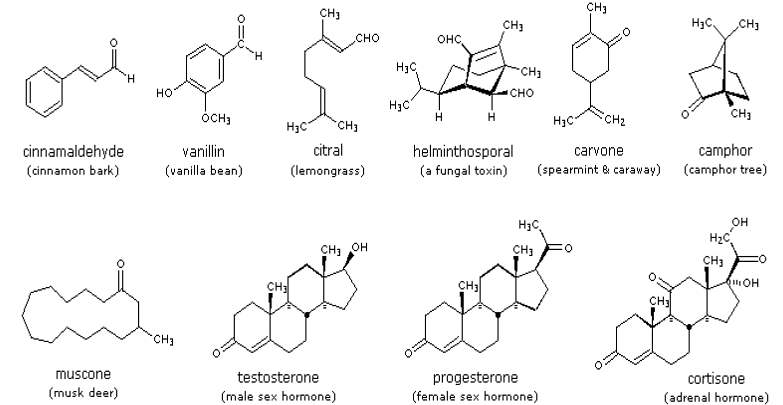
Natural Form of Aldehydes and Ketones
Synthetic Preparation
[Click Here for Sample Questions]
Many of the reactions produce aldehydes and ketones as byproducts. The most essential of these are summarised in the diagram below.


Essential Reactions of Aldehydes and Ketones
These procedures do not enhance the size or complexity of molecules, other than Friedel-Crafts acylation. One of the most useful qualities of aldehydes and ketones is their reactivity with carbon nucleophiles and the resultant development of molecular structure, as we will see in the coming sections of this chapter. Aldehydes and ketones, in short, are crucial intermediates in the assembly or synthesis of complex organic compounds.
Properties
[Click Here for Sample Questions]
Because both feature a double bond functional group, a comparison of the characteristics and reactivity of aldehydes and ketones with those of alkenes is necessary. The carbonyl group is polar due to the stronger electronegativity of oxygen, hence aldehydes and ketones have bigger molecular dipole moments (D) than alkenes.
The relative dipole moments of formaldehyde, various aldehydes, and ketones demonstrate the stabilising effect of alkyl substituents on carbocations, as seen in the resonance structures on the right (the larger the dipole moment the greater the polar character of the carbonyl group).
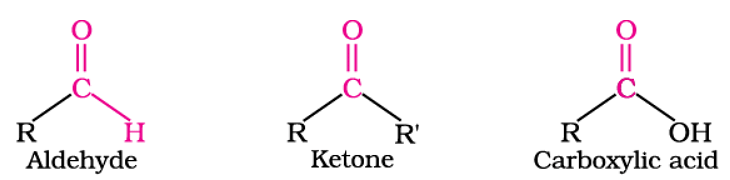
Functional Groups of Aldehydes and Ketones
When compared to the non-polar double bonds of alkenes, the polarity of the carbonyl group has a significant impact on its chemical reactivity. In the absence of a strong acid catalyst, reversible water addition to the carbonyl function is fast, whereas water addition to alkenes is infinitely slow. Surprisingly, relative bond energies have the opposite effect on the thermodynamics of such addition processes.
The average bond energy of C=C alkenes is 146 kcal/mole. Because the bond energy of a C–C -bond is 83 kcal/mole, the -bond energy can be approximated to be 63 kcal/mole (i.e. less than the energy of the sigma bond).
Things to Remember
- Aldehydes and ketones are organic molecules that contain the C=O carbonyl functional group. This group's carbon atom has two remaining bonds that hydrogen, alkyl, or aryl substituents can occupy. An aldehyde is a chemical in which at least one of the substituents is hydrogen. The compound is a ketone if neither hydrogen exists.
- An aldehyde is an organic chemical with the structure C(H)=O that contains a functional group. An aldehyde or formal group is a functional group that does not have the "R" side chain attached. Aldehydes are widely used and play an essential role in technology and biology.
- A ketone is a functional group in chemistry having the formula R2C=O, where R can be any carbon-containing substituent. Carbonyl groups are found in ketone molecules (a carbon-oxygen double bond). Acetone (R = R' = methyl) is the most basic ketone, with the formula CH3C(O)CH3.
- Because both feature a double bond functional group, a comparison of the characteristics and reactivity of aldehydes and ketones with those of alkenes is necessary. The carbonyl group is polar due to the stronger electronegativity of oxygen, hence aldehydes and ketones have bigger molecular dipole moments (D) than alkenes.
Also Read:
Sample Questions
Ques. What is Keto-enol tautomerization? (2 marks)
Ans: Ketones with at least one alpha-hydrogen go through keto-enol tautomerization, which results in an enol as the tautomer. Acids and bases are both catalysts for tautomerization. The keto form is usually more stable than the enol version. Ketones can be made by hydrating alkynes, thanks to this equilibrium.

Keto-enol tautomerization
Ques. Define Brønsted–Lowry acid–base theory (2 marks)
Ans: The Bronsted–Lowry hypothesis (also known as the proton theory of acids and bases) is an acid–base reaction theory proposed by Johannes Nicolaus Brnsted and Thomas Martin Lowry separately in 1923. The basic idea behind this theory is whenever an acid and a base react, the acid forms its conjugate base and the base produces its conjugate acid through a proton exchange (the hydrogen cation, or H+). The Arrhenius theory is an extension of this idea.
Ques. What is resonance? (2 marks)
Ans: In valence bond theory, resonance, also referred as mesomerism, is a way of describing bonding in specific molecules or ions by merging many contributing structures (or forms, also called as resonance structures aka canonical structures) into a resonance hybrid (or hybrid structure). It's especially suitable for representing delocalized electrons within specific compounds or polyatomic ions in which the bonding can't be described by a single Lewis structure.
Ques. What is propionaldehyde? (2 marks)
Ans: The chemical molecule propionaldehyde, commonly known as propanal, has the formula CH3CH2CHO. It is just the aldehyde with three carbons. It's a clear, flammable substance with a faintly fruity aroma. It is prepared on a massive scale in an industrial setting.

Propionaldehyde
Ques. What is cyclohexanone? (3 marks)
Ans: The chemical compound cyclohexanone has the formula (CH2)5CO. A six-carbon cyclic compound containing a ketone functional group makes up the molecule. The odour of this colourless oil is similar to that of acetone. Cyclohexanone samples develop a yellow tint with time. Cyclohexanone is water-insoluble and miscible with most organic solvents. Every year, billions of kilograms are produced, mostly as a precursor to nylon.

Cyclohexanone
Ques. What is Oppenauer oxidation? (3 marks)
Ans: Oppenauer oxidation is a mild process for selectively oxidising secondary alcohols to ketones, named after Rupert Viktor Oppenauer [de].

Oppenauer oxidation
The reaction is the Meerwein–Ponndorf–Verley reduction in reverse. In excess acetone, the alcohol is oxidised with aluminium isopropoxide. This changes the balance of power to the product side.
Ques. What is Clemmensen Reduction? (3 marks)
Ans: Heating a carbonyl compound with finely split, amalgamated zinc in a hydroxylic solvent (typically an aqueous combination) containing a mineral acid such as HCl is an alternate reduction method. The mercury in the zinc alloy does not participate in the reaction; it just assists to keep the active metal surface clean. Substituents like hydroxyl, alkoxy, and halogens are reduced first, followed by the reduction of the unsubstituted aldehyde or ketone to the parent hydrocarbon.
Ques. How are enamines formed? (3 marks)
Ans: Enamines are produced when most aldehydes and ketones react with 2o-amines. It's worth noting that, like acetal production, those are acid-catalysed reversible water-losing processes. As a result, acid-catalysed hydrolysis quickly converts enamines return to their carbonyl precursors.

Enamines
Ques. What is spectroscopy? (3 marks)
Ans: The study of the interaction of matter with electromagnetic radiation as a function of the wavelength or frequency of the radiation is known as spectroscopy. In simpler terms, spectroscopy is the precise study of colour as it applies to all bands of the electromagnetic spectrum, including visible light. Indeed, spectroscopy was born out of the study of the wavelength dependence of visible light dispersed by a prism absorption by gas phase materials. Radiative energy includes matter waves and acoustic waves, and gravitational waves have recently been linked to a spectral signature as part of the Laser Interferometer Gravitational-Wave Observatory (LIGO).

Spectroscopy
Ques. What is Wolff-Kishner Reduction? (4 marks)
Ans: When an aldehyde or ketone reacts with excess hydrazine, a hydrazone derivative is formed, which when heated with base yields the corresponding hydrocarbon. To obtain the required temperatures, a high-boiling hydroxylic solvent, such as diethylene glycol, is frequently utilised. This reduction can be used to convert cyclopentanone to cyclopentane, as seen in the picture below. A second example, in which an aldehyde is converted to a methyl group in the same way, demonstrates the usage of an acetal protecting group once more. Because of the highly basic conditions utilised in this reaction, it cannot be used with base sensitive molecules.

Wolff-Kishner Reduction
For Latest Updates on Upcoming Board Exams, Click Here: https://t.me/class_10_12_board_updates
Check-Out:



Comments