



Education Journalist | Study Abroad Lead
A Friedel-Crafts reaction is a type of organic coupling reaction that uses an electrophilic aromatic substitution for the purpose of attaching various substituents to aromatic rings. In the year 1877, French scientist Charles Friedel and American chemist James Crafts developed these reactions. The Friedel-Craft reactions can be classified into two types: Friedel-Craft alkylation reaction and Friedel-Craft acylation reaction. Both of these reactions include electrophilic aromatic substitution. In this article, we will have a look at the Friedel-Craft acylation reaction, its mechanism, limitations, and related sample questions.
| Table of Content |
Key Terms: Friedel-Crafts acylation, Acyl halide, Catalyst, Carbon, Compounds, Electrophilic aromatic substitution, Benzene, Acyl chloride, Lewis acid
What is Friedel-Crafts Acylation reaction?
[Click Here for Sample Questions]
An acyl group is added to an aromatic ring in the Friedel-Crafts acylation reaction. Typically, an acid chloride (R-(C=O)-Cl) and a Lewis acid catalyst, such as AlCl3, are used. The aromatic ring is converted to a ketone via the acylation process. Under these circumstances, the reaction between benzene and an acyl chloride like acetyl chloride is as shown below.

In Friedel-Crafts acylation, an acid anhydride can be employed instead of acyl halide. The acyl halide's halogen forms a complex with the Lewis acid, yielding a highly electrophilic acylium ion with the general formula RCO+ and resonance stabilization.
Also Read:
| Related Articles | ||
|---|---|---|
| Clemmesen Reduction Reaction | Lanthanide Contraction | Hofmann Elimination |
| IUPAC Nomenclature of Organic Compounds | Nomenclature of Haloalkanes and Haloarenes | Fehling Test |
Mechanism of Friedel-Crafts Acylation reaction
[Click Here for Sample Questions]
Friedel-Crafts acylation reactions are carried out in a four-step process.
Step 1: The Lewis acid catalyst (AlCl3) and the acyl halide undergo a reaction. The acyl halide loses one of its halide ions, creating an acylium ion that is stabilized by resonance.

Step 2: After that, the acylium ion (RCO+) attacks the aromatic ring electrophilically. As a complex is formed, the ring's aromaticity is temporarily lost.
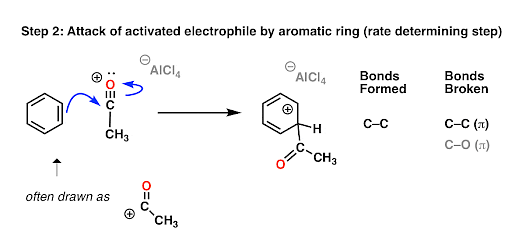
Step 3: Deprotonation of the intermediate complex restores the ring's aromaticity. HCl is formed when this proton joins a chloride ion (from the complexed Lewis acid). The AlCl3 catalyst is replaced.

Now that the catalyst has been regenerated, it may attack the carbonyl oxygen. As a result, by adding water to the products generated in step 3, the ketone product must be released. The Friedel-Crafts acylation process is used to generate the necessary acyl benzene product.
Limitation of Friedel-Crafts Acylation Reaction
[Click Here for Sample Questions]
The Friedel-Crafts acylation reaction has a few flaws while resolving some of the constraints of the related alkylation reaction (such as carbocation rearrangement and polyalkylation).
- Ketones are the only products of the acylation process. When exposed to these circumstances, formyl chloride (H(C=O)Cl) decomposes into CO and HCl.
- Compared to a mono-halobenzene, if the aromatic compound is less reactive, it can’t participate in this reaction.
- Because aryl amines produce very unreactive complexes with the Lewis acid catalyst, they can't be utilized in this process.
When amines or alcohols are employed, acylations can occur on the nitrogen or oxygen atoms.
Things to Remember
- Friedel and Crafts discovered Friedel-Crafts acylation, a method related to Friedel-Crafts alkylation wherein an electrophilic aromatic substitution reaction can occur when a Lewis acid is added to an acyl halide in the presence of an aromatic ring, in which the acyl group is added to the aromatic ring (with -HX loss).
- The aromatic ring is converted to a ketone via the acylation process.
- The particular Lewis acid in the Friedel-Crafts acylation can vary, just like it can in the Friedel-Crafts alkylation. Although aluminium chloride (AlCl3) is commonly utilized, FeCl3 and other Lewis acids can also be used.
- The reaction between acetyl chloride and benzene catalyzed by aluminium chloride is an example of Friedel-Crafts acylation.
Also Read:
Sample Questions
Ques. State with the help of an example, what is Friedel-Craft's reaction? (2 marks)
Ans. The Friedel-Crafts alkylation process is an electrophile aromatic substitution reaction that adds an alkyl group to a benzene molecule. One example is the insertion of a methyl group into a benzene ring. The electrophile assaults the electron system of the benzene ring in order to create a nonaromatic carbocation.
Ques. What are the benefits of acylation by Friedel-Crafts? (2 marks)
Ans. Friedel-Crafts acylation employs a Lewis acid catalyst and an acyl chloride to add benzene to an acyl ring and offers a few benefits over alkylation. The ketones can be converted to alkyl groups via Clemmensen reduction.
Ques. Is acylation by Friedel-Crafts reversible? (2 marks)
Ans. Friedel-Crafts alkylation was thought to be reversible, according to the theory. In a retro-Friedel-Crafts reaction or Friedel-Crafts dealkylation, alkyl groups in the presence of protons or other Lewis acids are removed. The real result of the reaction is 1,3,5-triethyl benzene with all the alkyl groups present as a meta substituent.
Ques. In Friedel-Crafts acylation, how is a Lewis acid used? (2 marks)
Ans. The Friedel-Crafts acylation process is one of the most popular aromatic chemistry procedures utilized in the production of aryl ketones. When stoichiometric quantities of Lewis acid are used, a complex form at the conclusion of the reaction between the aryl ketone produced and the Lewis acid.
Ques. What is benzene's alkylation? (2 marks)
Ans. The process of replacing an alkyl group is known as alkylation. The benzene ring is the alkyl group in this example. A group, such as a methyl or an ethyl, is replaced for a hydrogen ring. After that, benzene is treated with chloroalkane in the presence of a catalyst, Aluminum Chloride.
Ques. Give an example of the Friedel-Crafts Reaction. (3 marks)
Ans. The Friedel-Crafts Process is an electrophilic substitution reaction for joining substituents to aromatic rings. Friedel-Crafts processes are divided into two categories: alkylation and acylation.

Example: In the reaction below, the catalyst is aluminium chloride, and the aromatic ring is benzene.
Ques. What are an electrophile and a nucleophile? (2 marks)
Ans. An electrophile is a reagent that grasps an electron pair, whereas a nucleophile is a reagent that brings an electron pair.
Ques. What are the limitations of Friedel-Crafts Acylation reaction? (3 marks)
Ans. The limitations are as follows:
- Ketones are the only products of the acylation process. When exposed to these circumstances, formyl chloride (H(C=O)Cl) decomposes into CO and HCl.
- Compared to a mono-halobenzene, if the aromatic compound is less reactive, it can’t participate in this reaction.
- Because aryl amines produce very unreactive complexes with the Lewis acid catalyst, they can't be utilized in this process.
For Latest Updates on Upcoming Board Exams, Click Here: https://t.me/class_10_12_board_updates
Check-Out:



Comments