



Content Writer
Tollens' Test is the chemical test used to distinguish reducing sugar and non-reducing sugar. Based on the end product resulted, the test is also called the Silver Mirror Test. The test is more reactive when identifying the presence of the carbonyl group as a given unknown substance. The test is also useful in distinguishing it as an aldehyde or a ketone.
| Table of Content |
Keyterms: Tollens' Test, Sugar, Reducing sugar, Non-reducing sugar, Silver Mirror Test, Carbonyl group, Aldehyde, Ketone, Ammonia, Silver nitrate
What is Tollens’ Test?
[Click Here for Sample Questions]
Bernhard Tollens, a German chemist discovered Tolens’ Test and its benefits. This test is called the Silver Mirror Test. Tollen test will help in identifying the Aldehydes and Ketones groups.
To conduct the tollens’ test, ammonia and silver nitrate are required. Tollens Reagent has a short shelf life, and the reagent is not available across the market to sell. Thus, tollens’ reagent is prepared directly in the laboratory.

Also Read:
| Related Articles | ||
|---|---|---|
| Friedel-Crafts acylation reaction | Rosenmund reduction reaction | Decarboxylation Reaction |
| Aldehydes and Ketones | Carboxylic Acid | Fehling Test |
Principle of Tollens' Test
[Click Here for Sample Questions]
- Silver nitrate is mixed with liquid ammonia to form a complex.
- The complex formed contains water as a ligand.
- Again the aqua complexes are converted to silver oxides, in turn, form a brown precipitate.
- The brown precipitate is dissolved in ammonia to form a silver nitrate complex.
- So formed silver nitrate complex is the primary compound of Tollens' reagentthat is strongly oxidizing in nature.
- This oxidizing complex oxidizes the aldehyde in the unknown substance to form carboxylic acid, in turn.
- Simultaneously, the silver ions are reduced to metallic silver.
- This metallic silver results in the formation of a silver mirror on the bottom and sides of the test tube.
- Tollens' Testis positive if the unknown substance is – hydroxyl ketone. As the Tollens' reagent oxidizes - hydroxyl ketone from aldehyde.
Tollens’ Reagent
[Click Here for Sample Questions]
Tollens' Reagent is the alkaline solution of silver nitrate and ammonia. The reagent is freshly prepared in the laboratory and used for qualitative analysis. It is not recommended to store the reagent due to poor shelf life. Hence, the reagent is not sold commercially.

Tollens’ Reagent Preparation
[Click Here for Sample Questions]
Step: 1. Dilute NaOH is added to an aqueous solution of silver nitrate to form a brown precipitate of silver oxide (Ag2O). The reaction is:
2AgNo3+2NaOH → Ag2O+2NaNO3+H2O
Step: 2. Silver oxide is the brown-colored precipitate that is added to aqueous ammonia. ⌈Ag(NH3)2⌋+ is formed as the result of dissolution which is the primary complex of Tollens' reagent.
Ag2O+4NH3+ 2NaNO3+H2O → 2 Ag⌈(NH3)2⌋NO3+2NaOH
Applications of Tollens’ Test
[Click Here for Sample Questions]
- Tollens' Test is one of the naming reactions that are performed in the laboratory as qualitative analysis.
- The test is used to differentiate between reducing sugars and non-reducing sugars.
- Tollens' Test is a mild oxidizing agent that is used to oxidize aldehydes and - hydroxyl ketone.
Things to Remember
- Tollens' reagent is ammoniacal silver nitrate or ammoniacal silver hydroxide that oxidizes the aldehyde meanwhile the reagent gets reduced to metallic silver and ammonia.
- Tollens' Test is also given by alkynes where the c-c triple bond between C1 and C2 are easily identified.
- Only the aldehydes and not the ketones are oxidized by Tollens' Reagent.
- Excepting aldehydes terminal alkynes, formic acid is giving Tollens' Test. But neither aliphatic nor aromatic ketones give Tollens' Test.
- Exceptionally the alpha hydroxyl ketones give positive Tollens' Test and tautomerize to give alpha hydroxyl aldehydes.
Also Read:
Sample Questions
Ques. Is it possible to perform Tollens' Test in a beaker or conical flask? (1 Mark)
Ans. No. Tollens' Test is carried out in the test tube alone because the brown precipitate of metallic silver is better identified in a test tube and not in a conical flask or beaker.
Ques. Do alcohols give positive Tollens' Test? (1 Mark)
Ans. Alcohol does not have –CHO group in its structure. It is said that –CHO alone oxidizes to –COOH so only the chemical compounds possessing –CHO group give positive Tollens' Test.
Ques. Is Tollens' Test is an important naming reaction to distinguish between carbonyl compounds? (2 Marks)
Ans. Yes. To differentiate the functional group either aldehyde or ketone, Tollens' Test is a fine choice. Perhaps, Tollens' Test is an important chemical test to characterize the Carbonyl compounds.
Ques. Does Tollens' Test have limitations? (2 Marks)
Ans. Yes. Tollens' Test has limitations because some carbohydrates do not have an aldehyde group but give a positive result on Tollens' Test.This is because of the isomerization of such carbohydrates in alkaline solutions.
Ques What is the role of Tollens' reagent in the case of aromatic aldehyde? (2 Marks)
Ans. The Tollens' Test indicates a positive reaction with aromatic aldehyde just like aliphatic aldehyde. For example Benzaldehyde is oxidized to Benzoic acid when Tollens' reagent is added few drops. The reaction is as follows:
C6H5CHO + 2 Ag⌈(NH3)2⌋NO3 + H2O → C6H5COOH + 2Ag + 4NH3 + 2H+
Ques. Do ketones oxidized by Tollens' reagent just like aldehydes? (3 Marks)
Ans. No, ketones are not oxidized by Tollens' reagent like aldehydes. Ketones require a strong oxidizing agent to oxidize but Tollens' reagent is mild in action.
Ketones do not have Hydrogen (H) atoms bonded with the carbonyl group (c=o).
This Hydrogen (H) atom gets reduced to give the corresponding acid that is present in aldehyde. However, Ketone fails Hydrogen atom bond with carbonyl group that prevents ketones to give positive Tollens' Test.
Ques. How does Tollens' reagent react with formaldehyde? (3 Marks)
Ans. Tollens' reagent when added to formaldehyde gets oxidized to corresponding carboxylic acids (Formic acid). However, formic aid is unique so it further oxidizes to metallic silver, CO2, and H2O.
H-CHO + Ag 2O → H – COOH + 2Ag (Silver mirror)
H- COOH → CO2 + H2O + 2Ag (silver mirror)
Ques. What are the functional groups that give tollen's test and fehling's test respectively? (5 Marks)
Ans. Tests to distinguish between aldehydes and ketones:
Tollens’ test: When an aldehyde is heated with Tollens’ reagent, it forms a silver mirror. Tollens’ reagent is an ammoniacal solution of AgNO3.
RCHO + 2[Ag(NH3)2]+ + 3OH- → RCOO- + 2Ag + 2H2O + 4NH3
Ketones do not form a silver mirror.
Fehling’s test: When an aldehyde is heated with Fehling’s reagent, it forms a reddish-brown precipitate of cuprous oxide. Fehling’s reagent: Fehling solution A (aqueous solution of CuSO4) + Fehling solution B (alkaline solution of sodium potassium tartrate) 2 Red brown ppt.
RCHO + 2Cu2+ + 5HO- → RCOO- + Cu2O + 3H2O
Ketones do not form a reddish-brown precipitate of cuprous oxide.
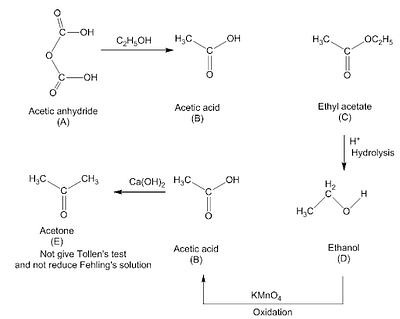
Ques. American organic compound A on treatment with ethyl alcohol gives a carboxylic acid B and compound C. Hydrolysis of C under acidic condition gives B and D. Oxidation of B with KMnO4 also gives D. Compound N on heating with Ca (OH)2 gives E . Compound E does not give Tollen's test and doesn't reduce Fehling's solution but forms yellow ppt with Brady's reagent. Identify A to E. (5 Marks)
Ans. Compound A = Acetic anhydride
a carboxylic acid B = Acetic acid
Compound C = Ethyl acetate
Compound D = Ethanol
Compound E = Acetone or propanone.
Ques. An organic compound A gives positive test with Tollen's reagent on treatment with ammonia forms B which is an eye medicine. A on treatment with concentrated KOH forms C and D . C on oxidation forms A again. D on acidification responds to Tollen's test. A combines with CH3MgI followed by hydrolysis forms E which on oxidation followed by decarboxylation forms methane. Identify A to E. With proper equations involved. (6 Marks)
Ans. An organic compound Formaldehyde (A) gives a positive test with Tollen's reagent on treatment with ammonia forms Hexamethylenetetramine (B) which is an eye medicine.

In cannizarro's condensation, Formaldehyde (A) on treatment with concentrated KOH forms Methanol (C) and Methanoic acid (D). (C) on oxidation forms (A) Formaldehyde again. Methanoic acid (D) on acidification responds to Tollen's test.
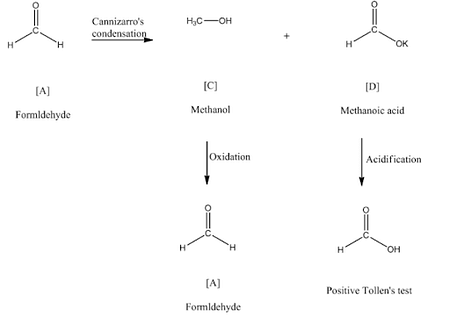
Formaldehyde (A) combines with CH3MgI followed by hydrolysis forms Ethanol (E) which on oxidation followed by decarboxylation forms methane.

For Latest Updates on Upcoming Board Exams, Click Here: https://t.me/class_10_12_board_updates
Also check:



Comments