



Education Journalist | Study Abroad Lead
Algebra of Matrices is a kind of Mathematics that is used in vector spaces between a variety of dimensions. Matrix algebra came was made because coordinate space contains n-dimensional planes. A matrix is a combination of numbers, symbols or expressions in a rectangular array. This combination appears as vertical columns and horizontal rows, which have the order of the number of rows multiplied by the number of columns. In a three dimensional space, each pair of points represents a unique equation that can have one or more than one solutions. The algebra of the matrix contains the different operations of matrices, such as subtraction, addition, multiplication etc. The matrix algebra can also be used in statistics to visualise a collection of data.
Read More: Applications of Determinants and Matrices
| Table of Content |
Key Terms: Matrix, Matrices, Row Matrix, Column Matrix, Matrix Algebra, Vector, Elements, Addition, Subtraction, Scalar Multiplication, Transpose, Algebra, Multiplication, Division, Statistics
Types of Matrices
[Click Here for Sample Questions]
A Matrix can be of several different types, some of them are as follows:
- Row Matrix
A Matrix that contains a single row is known as a Row vector or row matrix.
For Example: [a1 a2 a3……..an], or [1, 3, 9, 12], etc.
The video below explains this:
Matrices Detailed Video Explanation:
- Column Matrix
A matrix that consists of a single column is known as a column matrix or a column vector.
For Example:

- Null Matrix or Zero Matrix
A matrix that is in the form of m x n and has zero elements, then it is known as a null matrix or a zero matrix. It has an order of (m,n), and can be represented as Omxn.
For Example:
- Rectangular and Square Matrix
A matrix with an equal number of rows and columns is known as Square Matrix whereas a matrix with an unequal number of rows and matrix is known as Rectangular Matrix.
For Example: is an example of a Square matrix.
- Diagonal Matrix
A diagonal matrix consists of all elements as zero except the diagonal ones.
For Example,

is an example of a diagonal matrix.
Read More: Types of Matrices
- Scalar Matrix
A Diagnol matrix where all the diagonal elements are equal to a value such as ‘k’ ‘is known as a Scalar Matrix.
For Example: ,
, 
- Unit Matrix
A scalar matrix with the diagonal elements only equal to 1 is known as a unit matrix.
For example, 
- Upper Triangle Matrix
A matrix where all the elements below the diagonal are zero is known as an upper triangle matrix.
For Example, 
- Lower Triangle Matrix
A matrix where all the elements above the diagonal are zero is known as a Lower Triangle Matrix.
For Example, 
- Sub Matrix
A matrix that is obtained upon deleting one or more rows or columns is called a submatrix.
For Example,  here is a normal matrix, but
 is a Sub matrix.
- Equal Matrices
Two matrices having X = [xij] and Y = [yij] will be equal if the order of their X and Y is the same and corresponding elements in both of them are safe.

Read More: Determinant of a Matrix
Algebra of Matrices
[Click Here for Sample Questions]
There are several types of Algebra on Matrices, these are as follows.
- Addition or Subtraction of Matrices
Two Matrices having the X and Y in the same order can be added as X + Y, or subtracted from each other by subtracting the corresponding elements. So if X = (xij)mxn and Y= (yij)mxn then
X + Y = (xij + yij)mxn
Properties of Addition or Subtraction of Matrices
If the matrices X, Y and Z are of the same order, then,
- Commutative Law is X + Y = Y + Z
- Associative Law is (X + Y) + Z = X + (Y + Z)
- K (X + Y) = k.A + k.B, where k is constant.
Read More: Matrix Addition
- Negative of a Matrix
If the signs of all the elements in a matrix are interchanged, then we can get the negative of a matrix.
Example:
Given Matrix is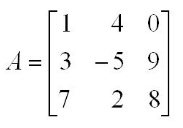 but its negative will be
- Scalar Multiplication
A matrix is multiplied by a constant such as ‘k’, then this process is known as Scalar Multiplication.
Example:
 is the given matrix, upon its multiplication, it will be
Read More: Properties Of Scalar Product Of Two Vectors
- Multiplication
If the number of elements in the column of the X matrix is equal to the rows of the Y matrix then the two matrices can be multiplied.
Properties of Matrix Multiplication
- The Multiplication of two matrices is never commutative i.e. XY ≠ YZ
- The Multiplication of two matrices is associative i.e. (XY)Z = X(YZ)
- X(Y + Z) = XY + XZ. In the same manner, (X + Y)Z = XZ + YZ
- If we have X as an invertible matrix and X, Y, and Z in such a way that XY = XZ then, Y = Z.
- The product of two non-zero matrices is also non-zero.
Read More: Matrix Multiplication
- Transpose of a Matrix
A Matrix is transposed when its rows and columns are interchanged. A transpose is represented as A’ or AT. So, if X = [xij] and X’ = [yij], hence, xij = yji

Transpose of a Matrix
Read More: Transpose of a Matrix
Properties of Transpose of a Matrix
- A matrix can be called a transpose of its own transpose matrix generally, i.e., X = (X’)’
- The Matrix’s transpose works on the equation (X + Y)’ = X’ + Y’
- (XY)’ = Y’X’
- Symmetric Matrix
When A matrix “X” is found to be symmetric then X’ = X
Example: 
- Skew Symmetric Matrix
A matrix will be known as a skew-symmetric if X’ = -X
X = [xij] then, xij = -xji
Example: 
Read More: Operations on Matrices
Things to Remember
- A matrix is a combination of numbers, symbols or expressions in a rectangular array.
- This combination appears as vertical columns and horizontal rows, which have the order of the number of rows multiplied by the number of columns.
- In a three dimensional space, each pair of points represents a unique equation that can have one or more than one solutions.
- Two Matrices having the X and Y in the same order can be added as X + Y, or subtracted from each other by subtracting the corresponding elements.
- Two matrices can be multiplied if the number of elements in the column of the X matrix is equal to the rows of the Y matrix.
- When the rows and columns of a particular matrix are exchanged then we call it a transpose. It is represented as A’ or AT.
Also Read:
Sample Questions
Ques. Given  and
and  . Find P + Q. (3 Marks)
Ans. Given, and
and 
Addition of P and Q is as follows:

Ques. If  and
and  , then find A - B. (3 Marks)
Ans. Subtraction of the matrices P and Q is given as follows:

Ques. If  and
and  , then find the product of A and B. (3 Marks)
Ans. Product of A and B is

Ques. Find A2 , if  (3 Marks)
Ans. A2 = A.A = 
Ques. Find the multiplication of Matrices given below . (3 Marks)
Ans.

Ques. What will be the element of the second row and third column of the matrix A + B if a23 = -17 is an element of A and b23 = 20 is an element in B. (3 Marks)
Ans. First, we have to evaluate a23 + b23 to determine the element of the second row and the third column of the matrix A + B.
a23 + b23 = -17 + 20 = 3
Therefore, the element in the second row and third column of A + B is given as 3.
Ques. Give the essential condition for the addition of two matrices? Give example. (3 Marks)
Ans. Two matrices can be only added if they have the same dimensions which means that they have the same number of rows and columns.
For example- 
Since they have an equal number of rows and columns, they can be added.

For Latest Updates on Upcoming Board Exams, Click Here: https://t.me/class_10_12_board_updates
Check-Out:



Comments