



Education Content Expert
Appendicular Skeleton is one of two major bone groups in the human body along with the Axial Skeleton.
- It is made up of the upper and lower extremities that include the shoulder girdle and pelvis.
- Appendicular skeleton and axial skeleton are connected through the shoulder girdle and pelvis.
- Out of the total 206 bones in the adult human body, 126 bones form the appendicular skeleton.
- Appendicular skeleton includes the bones of the hands, feet, upper and lower extremities, shoulder girdle, and pelvic bones.
Read More: NCERT Solutions For Class 11 Biology Locomotion and Movement
Key Terms: Appendicular Skeleton, Vertebrates, Bones, Pelvic Girdle, Pectoral Girdle, Axial Skeleton, Pelvic Bones
What is Appendicular Skeleton?
[Click Here for Sample Questions]
Appendicular Skeleton in vertebrates mainly comprises bones that help in supporting and composing the appendages. It mainly helps in locomotion and movement as the arms and legs of the human body are part of the appendicular skeleton.
Appendicular Skeleton can be further bifurcated into six major areas, which are as follows:
- Shoulder Girdle: Appendicular skeleton consists of 4 bones, which are the left and right clavicle and the scapula.
- Arms and Forearms: It consists of 6 bones, which are the left and right humerus, ulna, and radius.
- Hands: It consists of 54 bones, which are the left and right carpals, metacarpals, proximal phalanges, intermediate phalanges, and distal phalanges.
- Pelvis: It consists of 2 bones, which are the left hip bone and right hip bone.
- Thighs and Legs: It consists of 8 bones, which are the left and right femur, patella, tibia, and fibula.
- Feet and Ankles: It consists of 52 bones, which are the left and right tarsals, metatarsals, proximal phalanges, intermediate phalanges, and distal phalanges.
Thus, the bones of the limbs, alongside the girdles, form the appendicular skeleton. Every limb is constituted of 30 bones.
Read More:
| Relevant Concepts | ||
|---|---|---|
| Skeletal System | Bones of the Ankle | Difference between Compact and Spongy Bone |
| Bones of the Wrist | Difference between Bone and Cartilage | Bones of Legs |
Appendicular Skeleton Anatomy
[Click Here for Previous Year Questions]
The important components of the Appendicular Skeleton are as follows:
- Girdle: Girdle mainly consists of a group of bones that helps to connect the appendages to the axial skeleton.
- Phalanges: Phalanges in appendicular skeleton are the bones of the fingers and the toes (singular, phalanx).
- Appendages: An appendage is mainly an external body part that protrudes from the human body alongside other organisms.
Appendicular Skeleton Diagram
The diagrammatic representation of the Appendicular Skeleton is as follows:
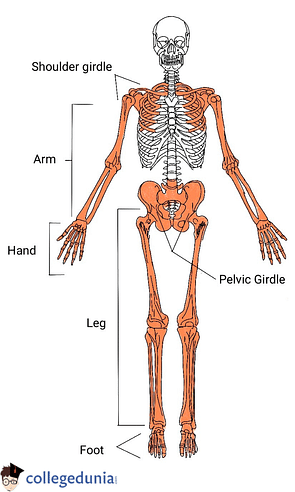
Appendicular Skeleton
Read More: Locomotion and Movement Important Questions
Pectoral Girdle and Pelvic Girdle
[Click Here for Sample Questions]
The two types of Girdles in the appendicular skeleton are described as follows:
Pectoral Girdle
- Pectoral Girdle is the supporting complex between the upper limbs and axial skeleton.
- It can be dissected into two halves, the right and left.
- It mainly incorporates two bones namely the clavicle and the scapula.
- The clavicle is an f-shaped structure attached to the acromion of the scapula.
- The other end is connected with the manubrium of the sternum in the appendicular skeleton.
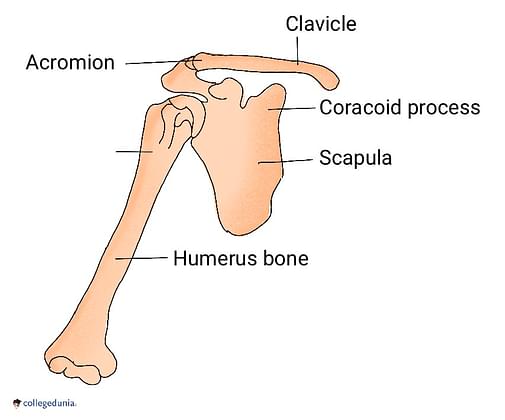
Pelvic Girdle
- Pelvic girdle, also known as the bony pelvis, is basically a ring-shaped framework of bones.
- It helps connect the trunk and the legs, which support the trunk.
- Pelvic girdle bones include the ilium, ischium, and pubis.

Check More:
| Related Topics | ||
|---|---|---|
| Osteoporosis | Deltoid Muscle | Pectoralis Muscle |
| Bones of the Foot | Types of Joints | Hyoid Bone |
Things to Remember
- Appendicular Skeleton and Axial Skeleton are the two major bone groups in the human body.
- Axial skeleton contains the bones of the head and torso while the appendicular skeleton contains the bones of the limbs.
- Appendicular Skeleton consists of 126 bones out of 206 bones and helps in the locomotion of organisms.
- It consists of the bones of the limbs and limb girdles.
- It is divided into six major regions namely Shoulder Girdles, Arms and Forearms, Hands, Pelvic Girdle, Thighs and Legs, and Feet and Ankles.
Previous Years’ Questions
- Appendicular skeleton includes…
- Three of the following pairs of the human skeletal parts are… (NEET - 2011)
- Which of the following is not a function of vertebral column…
- Coxal bones of pelvic girdle is not formed by… (JIPMER - 2016)
- Acetabulum is present in…
- Complete the following paragraph by selecting the correct…
- Scapula is a large triangular flat bone situated in the dorsal part… (KEAM 2011)
- The clavicle articulates with ...... of scapula… (DUET 2011)
- Glenoid cavity articulates… (NEET 2015)
- In the human body which one of the following is an atomically… (NEET 2007)
Sample Questions
Ques. What are the major regions of the Appendicular Skeleton? (2 Marks)
Ans. Appendicular Skeleton is divided mainly into six regions, namely:
- Shoulder Girdles
- Arms and Forearms
- Hands
- Pelvic Girdle
- Thighs and Legs
- Feet and Ankles
Ques. What is Appendicular Skeleton? (1 Mark)
Ans. Appendicular Skeleton is the part of the skeletal system that mainly incorporates bones to support the appendages in the human body. It consists of 126 bones which include the elements within the limbs.
Ques. What is Pectoral Girdle? (2 Marks)
Ans. Pectoral girdle comprises two bone joints that connect the upper limbs and the axial skeletal system. It is also known as the shoulder girdle. It consists of two bones namely
- Clavicle
- Scapula
Ques. What are the functions of the appendicular skeleton? (3 Marks)
Ans. Some of the functions of the Appendicular Skeleton are:
- Anchors and support the limbs.
- Acts as an important attachment site to muscles.
- Supports and protects the soft vital organs.
- Helps in hand movement
- Helps the shoulder to perform a wide range of functions.
- Acts as weight-bearing bones.
- Supports the entire structure of the body.
Ques. Define Sarcomere of Skeletal Muscle. (1 Mark)
Ans. Sarcomere is known to be the tiniest unit of muscle fiber in the skeletal system of an organism. This is the arranged collection of regulatory, contractile, and structural proteins. The shortening of these structures leads to the contraction of the skeletal fibers.
Ques. State whether a sarcomere is a muscle cell or not. (2 Marks)
Ans. Sarcomeres are basically repeated throughout the muscle cells. The proteins formed inside them can alter, leading to a change in the overall muscle length. A singular sarcomere mainly comprises many actin and myosin filaments. The sarcomere is known to be the tiniest unit of muscle fiber in the skeletal system of an organism.
Ques. What is the type of joint that lies between the pubic bones in the pelvic girdle? (2 Marks)
Ans. The pelvic girdle, also known as the bony pelvis, is basically a ring-shaped framework of bones. This help connects the trunk and the legs, which support the trunk. The type of joint that lies between the pubic bones in the pelvic girdle is called a fibrocartilaginous joint.
Ques. What are the vital steps in muscle contraction? (2 Marks)
Ans. Here are the steps during muscle contraction:
- There is a release of calcium ions alongside emerging depolarisation.
- The formation of actin and myosin cross-bridge.
- Occurrence of the sliding mechanism of both actin and myosin filaments.
Ques. Write a short note on the Pelvic Girdle. (3 Marks)
Ans. The pelvic girdle, also known as the bony pelvis, generally resembles a ring-shaped framework of bones that helps connect the trunk and the legs in the human body.
- It supports the trunk.
- It is situated between the hind limbs and axial skeleton.
- Generally, the pelvic girdle can be dissected into two halves, innominate and co-axes.
- In addition, each innominate is seen to comprise fused bones called the ilium, ischium, and pubis.
Ques. What are Appendicular and Axial Skeleton? (2 Marks)
Ans. Appendicular and Axial Skeleton are the two types of bone structure in human body. The head, neck, back, and chest bones comprise the axial skeleton. Apart from these, every other structure in the body comprise the appendicular skeleton. These are the bones that are attached to the axial skeleton. The bones included in this appendicular skeleton system are the shoulder, pelvis, limbs, arms, hands, legs, and feet.
Check-Out:



Comments