



Content Writer
Asparagine is a type of α-amino acid used in protein synthesis.
- This amino acid is polar and aliphatic, with an α-amino group, α-carboxylic acid group, and a side chain carboxamide.
- It was originally isolated in a crystalline form from asparagus juice and was the very first amino acid discovered.
- The chemical formula of Asparagine is C4H8N2O3.
- Asparagine residues are commonly found around the beginning of alpha-helices as ASX turns and ASX motifs, and in similar turn motifs, or amide rings, in beta sheets.
- This is because the asparagine side chain may establish hydrogen bond interactions with the peptide backbone.
- Its function may be regarded as "capping" the hydrogen bond interactions that the polypeptide backbone would otherwise satisfy.
| Table of Content |
Key Terms: Amino Acid, Protein, Amide Ring, Polypeptide, Hydrogen Bond, Double Bond, ZwitterIon, Carboxylic group, Chemical formula, Structure of Asparagine
What is Asparagine?
[Click Here for Sample Questions]
Asparagine is an alpha-amino acid that is found in animal proteins and is one of the 20 amino acids contained in them.
- It helps in the production of proteins.
- It is made of an alpha-amino group, an alpha carboxylic group, and a side chain called a carboxamide, which distributes the amino acid in the form of polar aliphatic amino acids.
- When cooked to the proper temperature, the reaction between asparagine and reducing sugars or any other source of carbonyls tends to create acrylamide in the meal.
- Baked foods like potato chips, french fries, and toasted bread include these ingredients.
- Aliphatic amino acids are nonpolar and hydrophobic.
- Valine, alanine, leucine, proline, and isoleucine are among the examples.
- Aliphatic chemicals have structures that are unsaturated with double bonds, saturated with a single bond, or even triple bonds.
- Chlorine, sulfur, nitrogen, and oxygen are some of the elements that bind to the carbon chain.
- They are often combustible and are utilized as fuel in the form of liquefied natural gas and hydrocarbons.
Also check:
| Related Concepts | ||
|---|---|---|
| Difference Between Electrophile and Nucleophile | Unsaturated Hydrocarbons | Properties of bases |
| Atoms and Molecules | Interhalogen compounds | Glutamic Acid |
Structure of Asparagine
[Click Here for Sample Questions]
An alpha-amino group, an alpha-carboxylic group, and a carboxamide side-chain make up the asparagine amino acid.
- Asparagine functional groups are classified as polar aliphatic amino acids in all of these ways.
- Asparagine, on the other hand, is a non-essential amino acid in the human body since it may be synthesized by the body on its own.
The structure of Asparagine is shown below.
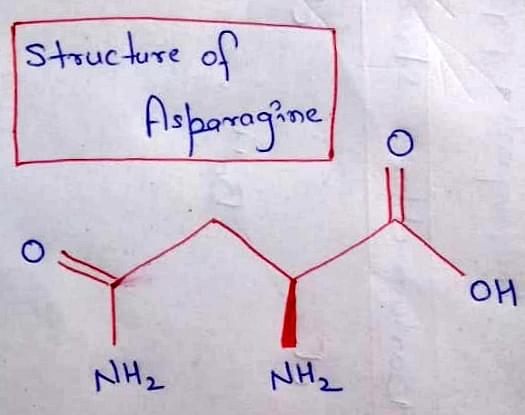
Structure of Asparagine
Physical and Chemical Properties of Asparagine
[Click Here for Sample Questions]
The following are the physical and chemical properties of Asparagine
- The chemical formula of asparagine is C4H8N2O3.
- This compound has a molar mass of 132.119 grams per mole.
- Asparagine is white and crystalline in appearance under normal conditions.
- The density of this compound corresponds to 1.543 grams per cubic centimeter.
- Asparagine has a melting point of 507 K and a boiling temperature of 711 K.
- Asparagine is somewhat soluble in water – it has a solubility of 2.94 g/100 mL.
- The crystal structure of this compound is orthorhombic.
Asparagine Functions
[Click Here for Sample Questions]
The following are the functions of Asparagine
- Asparagine residues are frequently found as ASX motifs and ASX turns, which are identical to turn motifs, near the top of alpha-helices in beta-sheets.
- This amino acid assists in the preservation of balance, which is necessary for the human central nervous system to function properly.
- It aids in the regulation of the brain's metabolic functions.
- It's also in charge of keeping our body cells and neurological system running smoothly.
- It keeps you from being unusually calm or worried.
- An amino acid, or L, is a kind of amino acid that is found in proteins.
- The liver produces asparagine amino acids, which are non-essential amino acids.
- It is required for the production of a wide number of proteins.
Sources of Asparagine
[Click Here for Sample Questions]
It may be found in a variety of foods. It is not required for human beings since they are integrated from a transnational metabolic route. The following are a few of them.
- Plant proteins include a large quantity of them.
- Whole grains, soy, almonds, legumes, asparagus, seeds, and potatoes are all good plant sources.
- Various shellfish, whey, chicken, beef, eggs, fish, lactalbumin, and dairy products are all good sources of asparagine.
- They are present in roasted coffee and french fries.
Asparagine Deficiency
[Click Here for Sample Questions]
The symptoms of an asparagine deficit in the human body are as follows.
- Headaches
- Irritability
- Confusion
- Depression
- Psychosis
Things To Remember
- When asparagine is cooked to a high enough temperature, it reacts with reducing sugars or other carbonyl sources to form acrylamide in food.
- It is non-essential in humans, which means that the body can make it.
- Antoine François Boutron Charlard and Théophile-Jules Pelouze, two French chemists, originally derived the empirical formula for asparagine in 1833.
- Asparagine also serves as a critical position for N-linked glycosylation, which involves the attachment of carbohydrate chains to the protein chain.
- The HIF1 hypoxia-inducible transcription factor may hydroxylate asparagine. HIF1-mediated gene activation is inhibited by this alteration.
- Oxaloacetate is the precursor to asparagine.
Also check:
Sample Questions
Ques. Where is asparagine found? (2 Marks)
Ans. Asparagine is present in many plant-based foods, including whole grains, nuts and seeds, soy, and several vegetables (including asparagus). Dairy products, eggs, fish, seafood, meat, and poultry all have high quantities of it.
Ques. What is asparagine? (2 Marks)
Ans. Asparagine, an α-amino acid, is essential for the synthesis of proteins. This amino acid is classified as polar and aliphatic due to its α-amino group, α-carboxylic acid group, and side chain carboxamide.
Ques. What are the different bonds that Asparagine can form? (2 Marks)
Ans. With the aid of its alpha-amino and carboxyl groups, asparagine is a kind of amino acid that likes to participate in peptide bonding. It also contains an amido group, which may be found on the radical chain of beta-carbonyl. This is the place at which the chain or sugar moiety usually starts. N-acetylglucosamine, sometimes known as GlcNAc, is a glycan that is connected to the asparagine amino acid.
Ques. What are the different functions of Asparagine? (5 Marks)
Ans. Asparagine is essential for the production of glycoproteins. Aside from that, it's essential for the production of a variety of other proteins. The asparagine amino acid is also required by the human neurological system to maintain its balance. Asparagine is an amino acid that helps to improve the smooth functioning of the human liver and increases resistance to tiredness. As a result, asparagine is essential for the proper functioning of the human liver and neurological system.
Asparagine is an amino acid that is created when aspartic acid undergoes a transamination process. It is a necessary component of many different types of proteins and plays an important function in protein synthesis. These proteins are known to be enzymes or to have a structural role. These enzymes, in turn, play a critical role in nitrogen metabolism as well as in the speeding up of anabolic events.
Ques. What is asparagine used for? (3 Marks)
Ans. Treatment of nutritional deficiency or imbalance, as well as supplemental nutrition. An amino acid that isn't necessary for survival. Asparagine is necessary for the body's production of proteins, enzymes, and muscle tissue. This amino acid supplement is supposed to aid in the proper functioning of the neurological system. Asparagine is required for the production of many proteins, but it also has additional functions. Asparagine aids in the breakdown of harmful ammonia within cells is necessary for protein modification and is required for the production of a specific molecule that sends brain signals.
Ques. Why is asparagine so important? (5 Marks)
Ans. The following are the importance of Asparagine:
- Asparagine is required for protein synthesis and cell development in all cells.
- The bulk of asparagine required by normal cells is produced by the cells themselves.
- Cancer cells, like normal cells, require asparagine to grow and proliferate, but most cancer cells cannot create enough of it.
- The maintenance of intracellular asparagine levels is required for cancer cell growth, according to findings.
- Asparagine is an important regulator of cancer cell amino acid balance, anabolic metabolism, and proliferation.
Ques. Where are the sources of asparagine? (2 Marks)
Ans. The majority of fruits and vegetables, except asparagus, are low in asparagine. Asparagine can be found in whole grains, nuts and seeds, soy, and certain vegetables, among other plant-based meals (yes, including asparagus). It's found in great amounts in dairy products, eggs, fish, shellfish, meat, and poultry.
Ques. What is the R group of asparagine? (2 Marks)
Ans. Amino acids are chemical molecules that have both an amino and a carboxyl group in them. The linked functional group R distinguishes them. Six amino acids have acid or basic R-groups, out of the twenty that make up proteins. The amide R groups are found in both asparagine and glutamine, which were initially isolated from asparagus. The amino group (NH2) may donate hydrogen bonds, whereas the carbonyl group can accept them.
Ques. Why do tumor cells need asparagine? (2 Marks)
Ans. All cells require asparagine for protein synthesis and cell growth. The bulk of the asparagine that normal cells require is created by the cells themselves. Similar to normal cells, asparagine is a component required by cancer cells to grow and proliferate, but most cancer cells cannot produce enough of it. Asparagine appears to be in high demand among cancer cells, and this desire might be exploited therapeutically.
Ques. What causes asparagine deficiency? (2 Marks)
Ans. Mutations in the ASNS gene lead to asparagine synthetase deficiency. This gene directs the production of an enzyme known as asparagine synthetase. This enzyme transforms the protein building block (amino acid) aspartic acid to the amino acid asparagine in cells throughout the body. Higher asparagine levels may indicate a functional demand for magnesium in the conversion of aspartic acid.
For Latest Updates on Upcoming Board Exams, Click Here: https://t.me/class_10_12_board_updates
Also Read:



Comments