



Education Journalist | Study Abroad Lead
Critical Angle Formula = the inverse function of the sine (refraction index / incident index). Critical Angle is the angle of incidence corresponding to the angle of refraction of 90°. Here, the light ray gets completely reflected inside the medium itself. Light must travel from an optically denser medium to a rarer medium. Due to this, at the interface of the two mediums, light is partly reflected back into the same medium and partly refracted into the second medium. This reflection is called as Total Internal Reflection.
| Table of Content |
Key Terms: Critical angle formula, Equation for critical angle, Reflection, Refraction, Total internal reflection, Angle, Angle of incidence, Light ray, Refractive index
Critical Angle Formula
[Click Here for Sample Questions]
Critical Angle is the angle of incidence which provides a 90 degree angle of refraction. Critical angle is an angle of incidence value and for the water-to-air limit, critical angle is 48.6 degrees. For boundary between the glass and crown water, critical angle is 61.0 degrees. The actual value of the critical angle depends upon the combination of materials present on each side of the boundary.
If µd is the refractive index of the denser medium, from Snell’s Law, the refractive index of air with respect to the denser medium is given by,
\(\frac{\mu_a}{\mu_d}=\frac{sin i}{sin r}\)
1/ µd = sin i/sin r (Since, µa= 1 for air)
If,
r = 90o, i = c
sin c /sin 90o= 1/µd
Or,
sin c = 1/µd
Or,
c = sin-1(1/µd)
If the denser medium is glass,
c = sin-1(1/µg)
In general terms, we can write Critical Angle Formula as:
The video below explains this:
Critical Angle & Total Reflection Detailed Video Explanation:
\(\theta_{cric} = \sin^{-1}\frac{n_r}{n_i}\)
| Example: A ray of light strikes from a medium with n = 1.67 on a surface of separation with the air with n = 1. Find the value of critical angle. Solution: \(\theta_{cric} = \sin^{-1}\frac{n_r}{n_i}\) \(\theta_{cric} = \sin^{-1}\frac{1}{1.67}\) Therefore, \(\theta_{cric} = 0.064 rad\)
|
Also check:
What is Total Internal Reflection?
[Click Here for Previous Year Questions]
When light travels from a denser medium towards a rarer medium, then at the interface of the two mediums it is partly reflected back into the same medium and partly refracted into the second medium. This reflection is called internal reflection.

Internal Reflection in a Glass Medium
When a ray of light enters from a denser medium to a rarer medium it tends to bend away from the normal, for example, the ray AO1B in the figure given below. The incident ray AO1 is partly reflected (O1C) and partly refracted (O1B), the angle of refraction(r) is greater than the angle of incidence(i).

Total Internal Reflection
With the increase in the angle of incidence, the angle of refraction also increases till ray AO3 for which the angle of refraction is 90°. AO3D represents the refracted ray. Beyond this point, if the angle of incidence is further increased (ray AO4), there is no refraction. At that point, the total internal reflection will take place. This is called total internal reflection.
We must note here that the angle of incidence ic corresponding to the angle of refraction 90° is called the critical angle. Mirages in a desert, the internal structure of diamond, and optical fibres are some examples where we can see the effect of total internal reflection.
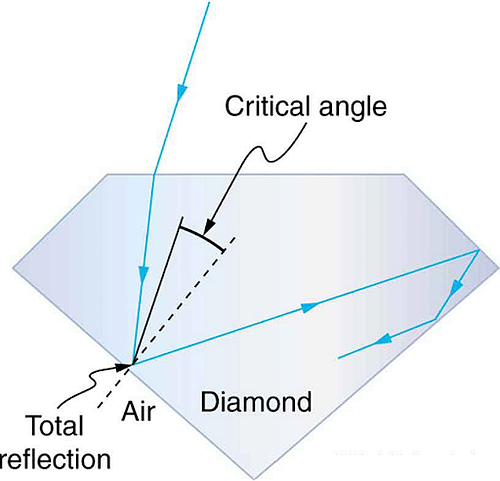
Total Internal Reflection in Diamond
| Conditions For Total Internal Reflection
|
Examples of Total Internal Reflection
[Click Here for Sample Questions]
Some of the real-life examples of total internal reflection are as follows.
Sparkling of Diamonds
The refractive index of diamond with respect to air is 2.42. Its critical angle is 24.41o. When light from any source makes an incidence with an angle of more than 24.41o, total internal reflection takes place. This causes multiple internal reflections to occur. And thus the diamond illuminates.

Sparkling of Diamonds
Mirages in a Desert
During summer the air near the ground becomes hotter than the air at higher levels. The refractive index value of air increases with its density. Hotter air being less dense has a smaller refractive index than cooler air. If the air is still, the optical density at different layers of air increases with height.

Mirages in Desert
As a result, light from a high object passes through a medium whose refractive index decreases towards the ground. Thus, a ray of light from such an object successively bends away from the normal and undergoes total internal reflection, if the angle of incidence for the air near the ground exceeds the critical angle.

Highway Mirages
The observer thinks that light is being reflected from the ground, for example, a pool of water/ an oasis near the tall object. This phenomenon is called mirage. This type of mirage is common in hot deserts. Some of you might have noticed that while moving in a bus or a car during a hot summer day, a distant part of the road, especially on a highway, appears to be wet. But, in reality, it is not the case. This is the effect of total internal reflection.
Optical fibres
Optical fibres are extensively used for the transmission of audio and video signals through long distances. Optical fibres make use of total internal reflection. They are fabricated with high-quality composite glass or quartz fibres. Each fibre consists of a core and cladding. The refractive index of the core is higher than the refractive index of outer cladding.

Optical Fibres
When a signal in the form of light is directed at one end of the fibre at a certain angle, it undergoes repeated internal reflections along the length of the fibre and finally comes out at the other end. Since light undergoes total internal reflection at each stage, there is a negligible loss in the intensity of the light signal. Optical fibres are designed in a way that reflection at one side of the inner surface strikes the other at an angle larger than the critical angle.
The critical angles of some transparent media with respect to air has been given in the table below.
| Substance medium | Refractive index | Critical angle |
|---|---|---|
| Water | 1.33 | 48.75o |
| Crown Glass | 1.52 | 41.14o |
| Flint Glass | 1.62 | 37.31o |
| Diamond | 2.42 | 24.41o |
Also Read:
Things To Remember
- The angle of incidence corresponding to an angle of refraction of 90o is called critical angle ic for the given pair of media.
- Light rays move from denser to rarer medium for total internal reflection to take place.
- Major applications of total internal reflection include optical fibres. Naturally occurring examples are mirages.
- For total internal reflection to occur, Light rays should move from denser to rarer medium and the angle of incidence should be greater than the critical angle.
- the refractive index of air with respect to the denser medium is given by µa/ µd = sin i /sin r
Sample Questions
Ques. Calculate the angle of incidence for total internal reflection of a ray going from water with nW= 1.3 to glass with nG= 1.52? (2 marks)
Ans. Given the refraction indices for the mediums by which the ray passes,
we use the formula
θcritical =sin-1(nr/ni)
θcritical =sin-1(1.3/1.52)
So,
Θcritical = 1.064 rad
The critical angle is 1.064 rad.
Ques. A ray of light strikes the surface (assumed flat) separating water from air making an angle of incidence of 10 ° with the normal to the surface. (Take the refractive index of air as 1 and the refractive index of water as 1.3). (2 marks)
1. What is the angle of refraction?
2. What is the critical angle?
Ans. 1. Applying Snell's law
n1 sin(i) = n2 sin(t)
1.3 × sin(i) = 1 × sin(t)
sin (t) = 1.3 × sin(10°)
t = arcsin(1.3 × sin(10°) ≈ 13.0 °
- sin-1(10/13) = 59o.
Ques. State the conditions for the phenomenon of the total internal reflection to take place. (CBSE 2010) (2 marks)
Ans. The two important conditions for the total internal reflection to take place are as follows,
- Light should travel from an optically denser medium to an optically rarer medium.
- The angle of incidence in the denser medium should be greater than the critical angle for the two media.
Ques. Figures (a) and (b) show the refraction of a ray in air incident at 60° with the normal to a glass- air and water-air interface, respectively. Predict the angle of refraction in a glass when the angle of incidence in water is 45° with the normal to a water-glass interface (figure c). (3 marks)

Ans.
- Applying Snell’s law for the refraction from air to glass. Refractive index of glass with respect to air,
α μ g = \(\frac {sin 60^o} {sin 35^o}\) = \(\frac {0.8660} {0.5736}\) = 1.51
- Now Snell’s law for the refraction from air to water
α μ g = \(\frac {sin 60^o} {sin 47^o}\) = \(\frac {0.8660} {0.6560}\)= 1.32
- Now the light beam is incident at an angle of 45° from water to a glass

Ques. The figure shows a cross-section of light pipe made of glass fiber with a refractive index of 1.68. The outer covering of the pipe is made of a material of refractive index 1.44. What is the range of the angles of the incident rays with the axis of the pipe for which total reflections inside the pipe take place, as shown in the figure? (3 marks)

Ans. Let us first derive the condition for total internal reflection. The critical angle for the interface of medium 1 and medium 2.

Condition for total internal reflection from core to cladding
i2 > 59 o or r ≤ \(\frac {\pi} {2}\) – 59 o or r ≤ 31 o
Now, for refraction at first surface air to the core.

Thus all incident rays which make an angle of incidence between 0° and 60° will suffer total internal reflection in the optical fiber.
Ques. What is the critical angle for a light ray traveling in water with a refractive index of 1.33 that is incident on the surface of the water above which air is with a refractive index of 1.00? Answer to the nearest degree. (4 marks)
Ans. Let us recall the equation to determine the critical angle:
\(sin \theta _c = \frac{n_2}{n_1}\)
Here, we know that a ray of light travels through water, approaching the boundary of the above air. Water is the incident material, so we will use n1=1.33 and n2=1.00.
First, we will rewrite the equation to solve and since we have values for two of the three variables in the equation, we can substitute them to solve for the critical angle:
\(si \theta _c = \frac{n_2}{n_1}\)
\(\theta _c = arcsin \frac{n_2}{n_1}\)
\(= arcsin \frac{1.00}{1.33}\)
= 48.8o
Rounding to the nearest degree, we have determined that the critical angle between water and air exists in water and occurs at 49∘.
Ques. A ray of light traveling through glass with an index of refraction n=1.5n=1.5 strikes the interface of the glass-water. Let the index of refraction of water be n=1.33. At what angle, the ray does not enter the water? (4 marks)
Ans. When a ray of light strikes a boundary of two different media, part of it is reflected back into the same medium and part of the ray enters the second medium (or refracted).
In this question, we are asked to find an angle at which the refracted ray is removed. This occurs when the refracted angle in the second medium (here, water) becomes greater than or equal to 90∘. Applying Snell's law of refraction, we have:
\(n_1 sin \theta _1 =n_2 sin\theta_2 \)
\((1.5) sin \theta_1 = (1.33) sin 90^\circ\)
\(\Rightarrow sin \theta_2 =\frac{1.33}{1.5}\sin 90^\circ\)
= 0.887
Next, take the inverse of the sine to find the angle whose sine is 1.128
\(\theta_2 =\sin^{-1}(0.887)=62.5^\circ\)
This incident angle at which the refracted angle becomes \(90^\circ\) is called the critical angle. Any ray, in the glass, striking the boundary with an angle that exceeds 40 degrees, totally returns back into the same original medium. This phenomenon is also called total internal reflection.
Ques. Find the critical angle for a ray of light traveling from Ethyl alcohol to Benzene? Ethyl alcohol has an index of refraction of n=1.361 and Benzene has n=1.501. (2 marks)
Ans. There occurs no totally internal reflection because there is no critical angle for this configuration. In this scenario, light is traveling from a rare medium (low n) to a dense medium (with high n) and this is contrary to the criteria for the formation of a total internal reflection.
Thus, total internal reflection occurs when light traveling in a medium strikes the boundary of a medium whose index of refraction is higher than the original medium.
Ques. A light bulb is placed 5 meters below a swimming pool. What is the diameter of the circle of light formed on the surface seen directly from above? (3 marks)
Ans. Rays emit in all directions from that point source and strike the interface of water-air. Some rays are incident on the boundary at less than the critical angle, refracted, and enter the air. The rays have an incident angle greater than the critical angle, do not enter the air, and 100% reflect back into the water.
These completely reflected rays are responsible for the formation of a circle of light on the surface of the water. The diameter of the circle of light is the distance between the two points at which the rays reach the surface at the critical angle. First, using the critical angle formula, we find:
θc=sin−1(1.00/1.33)=48.7∘
As you can see from the geometry, and using the definition of the sine function, the radius of the circle of light is found as:
\(\sin\theta_c=\frac{r}{H} \Rightarrow r=H\sin\theta_c\)
where HH is the pool's depth. So, the radius or diameter of the circle D=2r is computed as:
\(D=2Hsinθc=2(5)(sin48.7 ^{\circ})=7.5m\)
Ques. Which of the following is a possible path followed by a ray of light incident from n1 into n2? (3 marks)

A) I only
B) II only
C) I and II only
D) I, II and IV only
E) IV only
Ans. Light rays are incident in a medium with a refractive index 1.7 higher than the refractive index of the medium where the ray will be refracted. If the angle of incidence is equal to 0 case I, the ray is transmitted into the second medium without any change of direction. So case I is possible.
If the angle of incidence is greater than 0, with n 1 > n2, the angle of incidence is smaller than the angle of refraction and so II is also possible.
Ques. What is meant by the statement ‘the critical angle for diamond is 24°? (2 marks)
Ans. The critical angle for a diamond is 24°. This implies that at an incident angle of 24° within the diamond the angle of refraction in the air will be 90°. And if the incident angle will be more than this angle then the ray will suffer total internal reflection without any refraction.
Previous Year Questions
- When light passes form one medium to another, there is a change in… [KCET 1996]
- Optical fiber works on the principle of… [KCET 1996]
- A red flower seen through a green glass looks… [KCET 1996]
- The aperture of objective lens of a telescope is made large so as to… [KCET 2003]
- A lamp hanging 4 m above the table is lowered… [KCET 2003]
- The light reflected by a plane mirror may form a real image… [KCET 2002]
- Light appears to travel in straight line because… [KCET 2002]
- An object is placed 12 cm to the left of a converging lens of focal length… [KCET 2002]
- A microscope is having objective of focal length… [KCET 2014]
- Radii of curvature of a converging lens are in the ratio… [KCET 2013]
- A mirror forms a real image of unit magnification… [KCET 1999]
- In fog, photographs of the objects taken with infra-red radiations… [KCET 2009]
- A ray of light is incident normally on one face of a right angled isosceles… [KCET 2007]
- A prism of a certain angle deviates the red and blue rays… [KCET 2007]
- A convex lens is made up of three different materials… [KCET 2002]
- A convex lens of refractive index n behaves as a convex lens… [KCET 1999]
- The focal length of a plano convex lens is equal to its radius of curvature… [KCET 1997]
- The normal magnifying power of a simple microscope… [KCET 1997]
- A point source of light produces an illumination… [KCET 1997]
- A fish in water (refractive index n) looks at a bird vertically… [KCET 2008]
For Latest Updates on Upcoming Board Exams, Click Here: https://t.me/class_10_12_board_updates
Check-Out:



Comments