



Content Writer
Decarboxylation reaction is a chemical reaction that removes a carboxyl group and releases carbon dioxide (CO2).
- Decarboxylation mostly refers to a carboxylic acid reaction that removes a carbon atom from a carbon chain.
- For example, when sodium salt of carboxylic acid is heated with soda-lime, carbon dioxide is released.
- In this process, hydrocarbons are produced.
- Carboxylation is a totally reversible reaction that occurs as the first chemical step in photosynthesis and involves the addition of CO2 to the molecule.
- Decarboxylases, on the other hand, are enzymes that catalyze decarboxylation.
| Table of Content |
Key Terms: Decarboxylation reaction, Carboxyl group, Carbon dioxide, Carboxylation, Decarboxylases, Carboxylic acid, Organic compounds, Chemical reactions, Amino acids
What is a Decarboxylation Reaction?
[Click Here for Sample Questions]
Decarboxylation is among the oldest known organic reactions. The removal of a carboxyl group (-COOH) from any reactant molecule is referred to as decarboxylation.
- It is the chemical reaction in which a carboxyl group (-COOH) is removed and carbon dioxide (CO2 ) is liberated at the product end.
- It is one of the processes that is considered to occur along with destructive distillation and pyrolysis.
- Metal salts, particularly copper compounds, facilitate the process by acting as intermediaries for metal carboxylate complexes.
- Aryl carboxylates can be decarboxylated to produce the corresponding aryl anion, which can later undergo cross-coupling processes.
- In many circumstances, the release of CO2 renders the reaction nearly irreversible in decarboxylation reactions.
- However, the reverse process is the addition of CO2, known as Carboxylation.
- Carboxylic acid is formed as a result of carboxylation.
- Carboxylation is a totally reversible reaction that occurs as the first chemical step in photosynthesis and involves the addition of CO2 to the molecule.
Also check:
| Related Concepts | ||
|---|---|---|
| Preparation of Benzene | Acetylation | Aldehydes, Ketones and Carboxylic Acid |
| Preparation Of Alkanes | Aldol Condensation | Isomerism |
Decarboxylation of Carboxylic Acid
[Click Here for Sample Questions]
Carboxylic acids are organic decarboxylation acids denoted by the symbol RCOOH, where R represents an alkyl group hydrogen.
- The -COOH group or a carboxylate salt of the supplied acid is removed during the reaction step.
- The reaction produces RH as well as CO2.
\(RCOOH \:\: \longrightarrow \:\:RH\:+\:CO_2\)
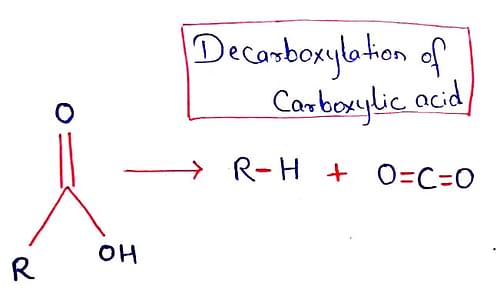
Many substances show decarboxylation reactions in a slightly classified manner. Some of them are listed below:
Krapcho Decarboxylation
Krapcho decarboxylation involves activated esters with an electron drawing group and halide anions. Later, the ester is replaced by a proton or an electrophile.
Hunsdiecker Reaction
The Hunsdiecker Reaction occurs when silver salts of carboxylic acid are decarboxylated, producing an organic halide by-product. For the addition of halogen, it is also known as the Halogenation reaction.
Mechanism of Decarboxylation
[Click Here for Sample Questions]
The decarboxylation mechanism substitutes hydrogen for the carboxyl group in a carboxylic acid.
- A set of enzymes known as decarboxylases or carboxy lyases helps in the process.
- Soda lime is the reagent that helps in the reaction. It is a mixture of caustic soda and quick lime.
- The reaction mechanism consists of three phases.
First Phase
The first phase starts with the removal of the H+ ion from the carboxylic acid and the addition of Na. This procedure resulted in the formation of a Na salt of carboxylic acid and a water molecule.
Second Phase
In the second step, an oxygen-negative charge is introduced between the carbon-oxygen link. As a result, the bond between the alkyl group (-R) and carbon is broken. In this stage, CO2 is released.
Third Phase
The third phase is carried out with the assistance of the H2O produced in the first stage. It decomposes to form a proton ion, which interacts with an alkyl group to form an alkane.
Decarboxylation Enzyme
[Click Here for Sample Questions]
Decarboxylases or carboxy-lyases are enzymes that aid in the decarboxylation of certain organic acids.
- They perform both the addition and removal of a carboxyl group from an organic molecule.
- They are usually named after the substrate that they catalyze.
- Ornithine decarboxylase and more enzymes are examples of this type.
Decarboxylation of Amino Acids
[Click Here for Sample Questions]
By removing the carboxyl group (-COOH) from the amino acid, decarboxylation results in the creation of an amine.
- Because the organic acid group is removed, the byproduct has a higher pH and is more alkaline.
- The decarboxylase enzymes aid in the decarboxylation pathway, which involves the elimination of acidic groups.
- Deaminases, on the other hand, remove amino groups to produce compounds that are acidic in nature.

Decarboxylation Tests
[Click Here for Sample Questions]
These are the biochemical tests involving the enzyme decarboxylase synthesis. As a result, they are often referred to as decarboxylase tests.
- The test is used to distinguish certain Enterobacteriaceae members that manufacture decarboxylase from other gram-negative bacteria.
- Organisms that can decarboxylate amino acids are identified by the presence of decarboxylase enzymes such as arginine decarboxylase, ornithine decarboxylase, and lysine decarboxylase.
- The members are then differentiated further based on their ability to manufacture these enzymes.
- Moeller’s recipe is used as the basal medium in the test.
- The presence of meat peptones and beef extract in the medium provides nitrogenous nourishment for bacterial growth.
- The pH indicators in the media are cresol red and Bromocresol purple.
- To detect decarboxylation, substrates such as arginine, ornithine, and lysine are introduced to the media.
Things to Remember
- The removal of a carboxyl group (-COOH) from any reactant molecule is referred to as decarboxylation.
- The majority of decarboxylation reactions involve carboxylic acids, in which a carbon atom is removed from the carbon chain.
- CO2 is formed as a result of the emission of this carbon atom.
- Carboxylic acids are organic decarboxylation acids denoted by the symbol RCOOH, where R represents an alkyl group hydrogen.
- Decarboxylases or carboxy-lyases are enzymes that aid in the decarboxylation of certain organic acids.
- By removing the carboxyl group (-COOH) from the amino acid, decarboxylation results in the creation of an amine.
Also check:
Sample Questions
Ques. What is decarboxylation? (2 Marks)
Ans. Decarboxylation is a chemical process that eliminates a carboxyl group and produces CO2. Typically, decarboxylation refers to the process of carboxylic acids that remove a carbon atom from a carbon chain.
Ques. Which compounds undergo decarboxylation easily? (1 Mark)
Ans. β-Keto acids undergo decarboxylation easily.
Ques. Is decarboxylation endothermic or exothermic? (1 Mark)
Ans. Decarboxylation reactions are exothermic, whereas decarbonylation has a relatively small endothermic effect.
Ques. What is Hydro Decarboxylation? (3 Marks)
Ans. Hydro decarboxylation is the process of converting a carboxylic acid to its corresponding hydrocarbon. This is identical to the more general word “decarboxylation”, except the carboxyl group must be replaced by hydrogen, as expected. When malonic ester synthesis and Knoevenagel condensation are involved, the reaction becomes very prevalent. A carboxylate ion, a carboxylate base, and an unsaturated electron density receptor, such as a protonated carbonyl group, are all involved in the reaction. Because protonated carbon dioxide is created when a carboxylic acid is cooked with strong hydrochloric acid, a straight path is impossible. In these cases, the addition of water plus a proton is most likely to initiate the reaction.
Ques. What are the benefits of the decarboxylation test? (3 Marks)
Ans. The decarboxylation test can be used for the following purposes.
- The test is effective at distinguishing Enterobacteriaceae members with comparable physiological activity.
- The decarboxylase test for lysine decarboxylase distinguishes between Salmonella (+) and Shigella (-).
- The arginine decarboxylase test identifies Enterococcus species based on their Arginine metabolizing activity.
Ques. What are the drawbacks of the decarboxylation test? (3 Marks)
Ans. The decarboxylation test does have certain restrictions. They are as follows:
- The exam takes a long time. Before 18-24 hours of incubation, the results cannot be evaluated. Microorganisms that do not ferment glucose can have low levels of decarboxylase activity.
- The test does not evaluate the enzyme’s intracellular concentration. The presence of enzymes is only detectable by a change in pH.
Ques. What are the mechanisms of decarboxylation in the biological system? (2 Marks)
Ans. Decarboxylation, or the removal of carbon dioxide from organic acids, is a critical occurrence in life. Decarboxylase enzymes are crucial in both aerobic and anaerobic conditions for glucose metabolism and amino acid conversion. Over the last decade, our misunderstanding of the systems that permit these crucial decarboxylase activities has grown and inspired us.
Ques. Explain Histidine decarboxylation. (3 Marks)
Ans. Histidine is an amino acid that is decarboxylated in the body to create alkaline amine molecules.
Histidine decarboxylation: Histidine is decarboxylation in the presence of the enzyme histidine decarboxylase, which is catalyzed by coenzyme B6-PO4. Histamine and CO2 are produced as a result of the reaction. Decarboxylation occurs in Basophils, the stomach, gastric mucosa cells, and CNS histaminergic neurons. Histamine is released in excess at the site of a wound and in wounded tissues.
Ques. Explain Glutamate decarboxylation. (3 Marks)
Ans. Glutamate is also an amino acid that is decarboxylated in the body to create alkaline amine molecules.
Glutamate Decarboxylation: Glutamate decarboxylation is catalyzed by the glutamate decarboxylase enzyme and coenzyme B6-PO4. Along with the release of CO2, the process produces- aminobutyric acid (GABA). The reaction occurs in the gray matter of the CNS. When GABA is released from neuron axon terminals, it works as an inhibitory transmitter.
Ques. What are Krapcho decarboxylation and Hunsdiecker Reaction? (2 Marks)
Ans. Krapcho decarboxylation involves activated esters with an electron drawing group and halide anions. Later, the ester is replaced by a proton or an electrophile.
The Hunsdiecker Reaction occurs when silver salts of carboxylic acid are decarboxylated, producing an organic halide by-product. For the addition of halogen, it is also known as the Halogenation reaction.
For Latest Updates on Upcoming Board Exams, Click Here: https://t.me/class_10_12_board_updates
Also Read:



Comments