


Draw an electric circuit with a cell, key, ammeter, a resistor (series) of 2 ohm with combination of two resistors (4 ohm each) in parallel and a voltmeter across parallel combination.

As per the question, Will the potential difference across the 2 Ω resistor be similar to the one across the parallel combination with 4Ω resistors? The following reasons can be illustrated:

Step 1: Circuit Diagram

The circuit diagram with a cell, key, ammeter, resistors in series (2 \(\Omega\)) with a combination of two resistors can be represented as:
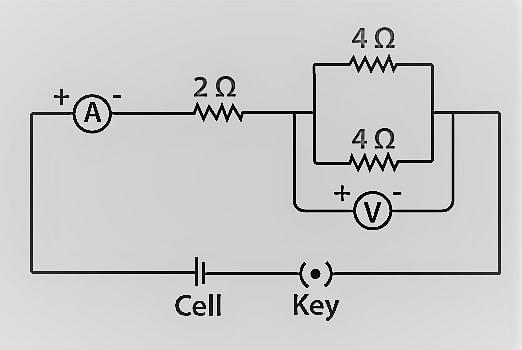
Electric Circuit Diagram

Electric Circuit Diagram

Step 2: Solution

Effective resistance of the parallel connected combination of two resistors is:

Reff = \({4\ \times\ 4} \over {4\ +\ 4}\)

⇒ Reff = \({{16} \over 8}\)

⇒ Reff = 2Ω

Hence, because of the 2 Ω resistor and the parallel combination of two 4 Ω resistors are connected in series, the flow of current will be in the same direction. Due to this reason, the potential difference that occurs between the two-ohm resistors is similar to the potential difference between two resistors jointly.


Related Questions

  1. In An Arrangement Of Resistances, Find Effective Resistance Between Points A and B.
  2. What Is Effective Resistance?
  3. X and Y, which are two resistors, with resistances of 2 Ω and 3 Ω respectively are first connected in parallel and then in series. In both cases, the voltage that is supplied is 5 V. (i) Illustrate a circuit diagram to show the combination of resistors. (ii) Calculate the amount of voltage across 3 Ω resistor in the series combination of resistors.
  4. Two Identical Resistors With Resistances 15 Ohm Are Connected In Series And Parallel To A Battery Of 6 V. Calculate Ratio Of Power Consumed.
  5. A Circuit Consists Of A Battery Of 3 Cells (2 V Each), A Combination Of Three Resistors, 10 Ohm, 20 Ohm And 30 Ohm, Attached Parallelly, With Plug Key And Ammeter (In Series).

Also Check:

CBSE CLASS XII Related Questions

  • 1.
    Consider a cylindrical conductor of length \( l \) and area of cross-section \( A \). Current \( I \) is maintained in the conductor and electrons drift with velocity \( \vec{v}_d \, (|\vec{v}_d| = \frac{eE}{m} \tau) \), where symbols have their usual meanings. Show that the conductivity of the material of the conductor is given by \[ \sigma = \frac{n e^2 \tau}{m}. \]


      • 2.
        The resistance of a metal wire at \( 20^\circ \text{C} \) is \( 1.05 \, \Omega \) and at \( 100^\circ \text{C} \) is \( 1.38 \, \Omega \). Determine the temperature coefficient of resistivity of this metal.


          • 3.
            An electric field $\vec{E}$ is established across the ends of a cylindrical conductor of length L and area of cross-section A. Discuss how electrons attain an average velocity, independent of time. Hence, obtain a relation between current in the conductor and this ‘average velocity’ of electrons.


              • 4.
                Derive an expression for the capacitance of a parallel plate capacitor of plate area A and plate separation d with air present between the plates.


                  • 5.
                    Write two advantages of reflecting telescope over refracting telescope.


                      • 6.
                        Read the following paragraph and answer the questions that follow.
                        A p-type or n-type semiconductor can be converted into a p-n junction by doping it with suitable impurity. The motion of majority charge carriers causes diffusion current across the junction while the barrier electric field causes motion of minority carriers for drift current. In case of unbiased diode, the diffusion and drift currents are equal. This equilibrium is disturbed by the biasing batteries. Diodes, therefore, allow currents in one direction. This property of diode is used in making rectifiers.

                          CBSE CLASS XII Previous Year Papers

                          Comments


                          No Comments To Show
