


A meter bridge has a straight and uniform wire of materials such as Manganin.
- The wire is of one-meter length and is stretched along the side of a meter scale AC.
- The ends of the wire are attached to thick copper strips of L shape with negligible resistance at A and C.
- The L-shaped copper stripes and the wire are mounted on a wooden base horizontally.
- Between the two L-shaped copper strips, another thick copper strip D having negligible resistance is fixed in a way that two gaps are formed.
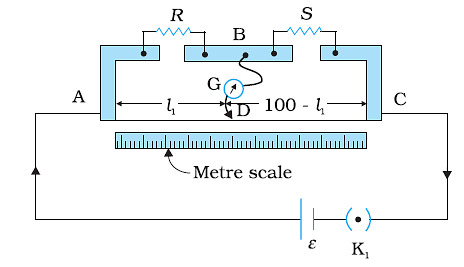
In the AD gap, a resistance R is connected whose value is to be measured. In the CD gap, a resistance box S is connected. To complete the Wheatstone bridge, resistances P and Q are formed by dividing the meter bridge wire into parts using a jockey which changes P and Q continuously.
Related Questions
- Can you find very high resistance accurately with the help of a Metre bridge?
- Why Carey Foster Bridge Is So Sensitive?
- Meter Bridge or Slide Wire Bridge is a practical form of?
- Meter bridge works on the principle of?
- Why should we get the null point in the middle of the Metre bridge wire?
- How does a bridge circuit work?
- How do you solve an unbalanced bridge?
- Why is Wheatstone's bridge more accurate?
- What Is Null Voltage?
Read More:



Comments