



Education Journalist | Study Abroad Lead
The Krebs cycle, also known as the citric acid cycle or the tricarboxylic acid (TCA) cycle, is a series of biochemical reactions occurring in the mitochondrial matrix. In the cycle, acetyl-CoA is oxidised to form carbon dioxide and coenzymes are reduced. This generates ATP in the electron transport chain. Cellular Respiration is the process by which cells convert glucose and other organic molecules into energy in the form of ATP.
- Krebs cycle is the second stage of cellular respiration.
- The cycle is named after its discoverer, Sir Hans Krebs, who first described it in 1937.
- During the Krebs cycle, the acetyl-CoA molecule is completely oxidized to produce carbon dioxide, water, and ATP.
- The NADH and FADH2 produced during the Krebs cycle go on to donate their electrons to the electron transport chain.
- The citrate is then converted into a series of intermediate compounds before it regenerates into oxaloacetate, a four-carbon molecule.
- The cycle starts with the conversion of acetyl-CoA, derived from the breakdown of glucose, fatty acids, or amino acids, into citrate, a six-carbon molecule.
| Table of Content |
Key Terms: Krebs cycle, Citric acid cycle, TCA cycle, Glycolysis, Pyruvate, Acetyl-CoA, NADH, ATP, Cellular respiration
Krebs cycle
[Click Here for Sample Questions]
Krebs cycle or tricarboxylic acid cycle is a series of chemical reactions of central importance in all living cells that utilises oxygen as part of cellular respiration. Krebs cycle takes place in mitochondria in eukaryotes, whereas in prokaryotes it takes place in the protoplasm. Each turn of the cycle forms one GTP or ATP, three NADH molecules and one FADH2 molecule, which will be used in further steps of cellular respiration to produce ATP for the cell.
Krebs Cycle - A Part of Cellular Respiration
Cellular respiration is a 4 stage catabolic reaction taking place in the cells. It is a biochemical process that oxidises glucose to carbon dioxide and reduces oxygen to water. Each glucose molecule releases energy that is stored in the form of 36 to 38 ATPs. The 4 stages of cellular respiration are as follows –
Step 1 – Glycolysis
- In glycolysis, glucose (six-carbon sugar) undergoes partial oxidation in the cytosol and gets converted into two molecules of pyruvate (3-carbon molecule).
- Here, ATP is produced, and NAD is converted to NADH.
Step 2 – Pyruvate oxidation
- Each pyruvate from glycolysis enters the mitochondrial matrix (the innermost compartment of mitochondria).
- Pyruvate undergoes oxidative decarboxylation and is converted into acetyl CoA. Carbon dioxide is released and NADH is generated.
- Pyruvate dehydrogenase enzyme acts as a catalyst for this reaction.
Step 3 – Krebs cycle
- The acetyl CoA made in the previous step reacts with a four-carbon molecule and goes through a cycle of reactions (Krebs cycle).
- It completely oxidizes glucose.
- Acetyl CoA combines with oxaloacetate to create citrate, a 6-carbon molecule.
- This forms two molecules of carbon dioxide with the regeneration of oxaloacetate.
- The process generates energy in the form of ATP and other high-energy compounds such as NADH and FADH2.
Step 4 – Oxidative phosphorylation
The NADH and FADH2 made in the above steps deposit their electrons in the electron transport chain, turning back into their nascent forms NAD and FAD. O2 is reduced to H2O.
Also Read:
Where does the Krebs cycle Take Place?
[Click Here for Sample Questions]
The Krebs cycle in eukaryotes happens only within the mitochondrial matrix.
- Pyruvate is produced in the cytosol of the cell and transported into the mitochondria.
- In the intermembrane space, pyruvate is converted to acetyl CoA and transported to the mitochondrial matrix.
- The matrix, bound by the inner membrane, is the innermost part of the mitochondria.

Krebs cycle Steps
[Click Here for Sample Questions]
The Krebs cycle is a central pathway in the complex metabolism of bio-organism that provides a unifying point for many metabolites, which feed into it at various points. Krebs cycle or Citric acid cycle is an eight-step process that takes place in the matrix of mitochondria under aerobic conditions:
- Step 1: Acetyl CoA (a 2-carbon molecule), formed from pyruvate, combines with oxaloacetate (4-carbon molecule) to form citrate (a 6-carbon molecule). Citrate synthase acts as a catalyst here.
- Step 2: Citrate is converted to isocitrate (an isomer of citrate). The enzyme aconitase is used as a catalyst in this reaction.
- Step 3: Isocitrate undergoes dehydrogenation and decarboxylation to form 5C – alpha-ketoglutarate. One NADH molecule is formed and one CO2 is released
- Step 4: Alpha-ketoglutarate is oxidised to form a 4-carbon molecule, forming succinyl CoA. Another (2nd) molecule of NADH and a 2nd molecule of carbon dioxide is produced. The reaction is catalyzed by the alpha-ketoglutarate dehydrogenase enzyme complex.
- Step 5: Succinyl CoA is converted to succinate (a 4-carbon molecule). One GTP molecule is produced.
- Step 6: Succinate thus produced is converted into fumarate (another 4-carbon molecule). A molecule of FAD is converted to FADH2 in this step.
- Step 7: Fumarate is converted to malate (another 4-carbon molecule).
- Step 8: Malate is then converted into oxaloacetate (4 carbon molecules) thus, completing the cycle. The 3rd molecule of NADH is produced in this step.
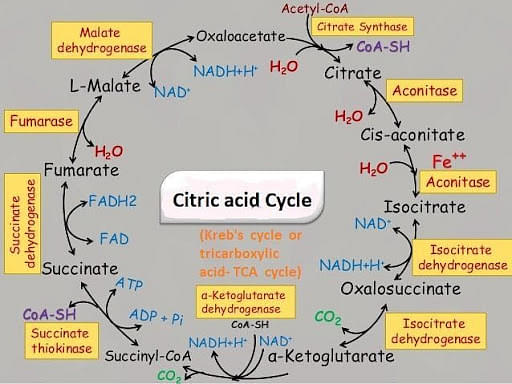
Krebs cycle Equation
[Click Here for Sample Questions]
The overall reaction/ equation of the Krebs cycle is:
2Acetyl CoA + 6NAD+ + 2FAD + 2ADP + 2Pi + 2H2O → 4CO2 + 6NADH + 2FADH2 + 2ATP + 2CoA
Frequently Asked Questions on Krebs CycleWhy Is Krebs Cycle Called As Amphibolic Pathway? The Krebs cycle is called an amphibolic pathway as it has both catabolic (breaking down) and anabolic (building up) functions. It catabolizes acetyl-CoA to produce energy in the form of ATP while also providing intermediates for the biosynthesis of amino acids, nucleotides, and other important molecules in the anabolic pathways. Why Krebs Cycle Is Called the Citric Acid Cycle? |
Products formed by the Krebs cycle
[Click Here for Sample Questions]
The following are the products of the Krebs Cycle:
Intermediate Products of Krebs cycle
The following products are formed in various steps of the Krebs cycle:
- Citrate (Citric acid)
- Isocitrate
- Oxoglutarate
- Succinyl-CoA
- Succinate
- Fumarate
- Malate
- Oxaloacetate (oxaloacetic acid)
Final Products of Krebs cycle
In a single turn of the cycle, one molecule of acetyl CoA produces
- Two molecules of carbon dioxide: Steps 3 and 4
- Three molecules of NADH: Steps 3, 4 and 8
- One molecule of FADH: Step 6
- One molecule of ATP or GTP: Step 5
Each glucose produces two acetyl CoA molecules, so we need to multiply the above numbers by 2 if we want the per-glucose yield.

Significance of Krebs cycle
[Click Here for Sample Questions]
The significance of the Krebs cycle is as follows:
- Krebs cycle is the final pathway of oxidation of fats, glucose, and amino acids.
- Protein's metabolic byproduct, amino acids, undergo deamination and convert to intermediates of the Krebs cycle, such as pyruvate.
- These intermediates then enter the cycle and undergo metabolism.
- A large amount of energy is produced in the form of ATP after the complete oxidation of nutrients
- It enables many organisms to use nutrients other than glucose as an energy source.
- Fatty acids or lipids enter the Krebs cycle after beta-oxidation in the form of acetyl CoA.
- Krebs cycle is a significant process of cellular respiration as it is associated with the formation of electron carriers.
- Krebs cycle plays a significant role in gluconeogenesis, lipogenesis and interconversion of amino acids.
- Succinyl-CoA of the Krebs cycle is used in the synthesis of haemoglobin and myoglobin.
- Synthesization of amino acids, nucleotides, cytochrome, chlorophyll, and many more are done by intermediate compounds of the Krebs Cycle.
- The genetic defects in Krebs's cycle enzymes may lead to neural damage.
- Regulation of the Krebs cycle is dependent on the supply of NAD+ and the use of ATP in physical and chemical work
- As most of the biological processes occur in the liver, damage to liver cells can have a lot of repercussions.
MCQs on Krebs Cycle for NEET 2023Ques. Which of the following is a product of the Krebs cycle required for oxidative phosphorylation? (a) NADPH and ATP Explanation: The correct answer is (d) NADH and FADH2.
Ques. What powers ATP synthesis? (a) Coenzyme motive force Explanation: The answer is (c) proton gradient. ATP synthesis is powered by the energy released from the flow of protons across a membrane down a gradient.
Ques. Why the Krebs cycle occurs in aerobic respiration? (a) The electron transport chain requires aerobic conditions to operate. Explanation: The correct answer is (a) The electron transport chain requires aerobic conditions to operate.
|
Read More:
| Related Articles | ||
|---|---|---|
| Lipids | Plasma Membrane | Test for Protein |
| Discovery of Cells | Vitamin B | Test for Fats |
Things to Remember
- The Krebs cycle is a metabolic pathway that breaks down acetyl-CoA into carbon dioxide, generating energy in the form of ATP and electron carriers.
- The Krebs cycle is essential for the production of energy (ATP) from carbohydrates, fats, and proteins in aerobic organisms.
- Krebs cycle takes place in the mitochondrial matrix.
- The reactants of the Krebs cycle are acetyl-CoA, NAD+, FAD, GDP, and Pi.
- For each complete oxidation of a glucose molecule, the Krebs cycle results in 4 CO2, 6NADH, 2 FADH2 and 2 ATPs. So one Krebs Cycle produce 2 ATPs.
- Each molecule of NADH forms 2-3 ATPs.
- Each FADH2 results in 2 ATPs on oxidation in the electron transport chain.
Sample Questions
Ques: What is pyruvate? (2 Marks)
Ans: Pyruvate is a biological molecule and product of glucose metabolism that reacts with NAD and CoA, converting it into acetyl-CoA, CO2 and NADH at the beginning of the TCA cycle. Pyruvate plays an important role in multiple biotransformations.

Ques: What is Krebs Cycle’s function? (3 Marks)
Ans: The Krebs cycle is likely the most important part of the process of aerobic respiration because it drives the formation of electron carriers. These carriers are important. They carry the energy required to create a large number of ATP molecules during the final steps of aerobic respiration. The electron carriers produced (NADH and FADH2) cannot provide energy to the cellular process directly. So, the processes of the electron transport chain and oxidative phosphorylation will use the energy from these molecules to activate the enzyme complex ATP synthase, which produces ATP.
Ques: What is Acetyl-CoA? (3 Marks)
Ans: Acetyl-CoA also known as acetyl coenzyme A is a component of cellular respiration that adds acetyl groups to biochemical reactions. These reactions metabolise proteins, carbohydrates, and lipids that will provide energy sources in the forms of adenosine triphosphate (ATP), lactic acid, and ketone bodies. Acetyl-CoA formation takes place in the mitochondria. As a metabolite acetyl-CoA needs to be freely available. It is produced via the catabolism of carbohydrates and lipids. Acetyl CoA essentially transfers the carbon atoms in acetyl to other molecules.

Ques: What are the Krebs cycle Enzymes? (4 Marks)
Ans: In eukaryotic cells, the enzymes that catalyse the reactions of the citric acid cycle are present in the matrix of the mitochondria except for succinate dehydrogenase and aconitase, which are present in the inner mitochondrial membrane. All the enzymes involved in the Krebs cycle require Mg2+ to function.
Enzymes that catalyse different steps in the Krebs cycle:
- Citrate synthase
- Aconitase
- Isocitrate dehydrogenase
- α-ketoglutarate
- Succinyl-CoA synthetase
- Succinate dehydrogenase
- Fumarase
- Malate dehydrogenase
Ques: Write about the regulation of the Krebs Cycle. (2 Marks)
Ans: The Krebs Cycle is regulated in multiple ways. Products of the Krebs cycle provide negative feedback on the enzymes that catalyse it. For example, NADH inhibits the majority of the upstream enzymes found in the Krebs cycle. Citrate inhibits phosphofructokinase, which reduces the rate of production of pyruvate and therefore of acetyl-CoA. Calcium also stimulates a key reaction in the Krebs cycle.
Ques: Write the differences between glycolysis and the Krebs cycle. (5 Marks)
Ans: Following are the differences:
| Basis of Comparison | Glycolysis | Krebs cycle |
|---|---|---|
| Location | In the cytoplasm | In the matrix of mitochondria |
| Presence of oxygen | occurs both in aerobic and anaerobic respiration | occurs in aerobic respiration only |
| Type of pathway | linear pathway | cyclic pathway |
| Metabolite product | Two molecules of pyruvic acid | Carbon dioxide and water |
| Energy product | NADH2 and ATP are formed. | NADH2, ATP and FADH2 are formed |
Ques: What is the Difference Between Krebs and Calvin Cycle? (3 Marks)
Ans: Krebs cycle is part of the aerobic respiration process whereas the Calvin cycle is part of photosynthesis. Krebs cycle is a catabolic process while the Calvin cycle is an anabolic process. Additionally, the Krebs cycle occurs in the matrix of mitochondria while the Calvin cycle occurs in the stroma of chloroplasts. Krebs cycle occurs in aerobic organisms, it produces ATP and CO2 and it occurs in the presence of oxygen. But the Calvin cycle occurs only in plants. It takes up ATP and CO2 and produces glucose. Furthermore, the Calvin cycle does not require oxygen.
Check Out:



Comments