



Education Content Expert
Lattice Energy is the energy required to separate a mole of an ionic solid or compound into individual gaseous ions. It is a concept associated with both the disintegration and formation of ionic compounds.
- It is the degree of the strength of ionic bonds in an ionic compound.
- The experimental determination of lattice energy is quite difficult and it cannot be measured directly.
- It is calculated with the help of the Born-Haber Cycle.
- It is expressed in the units of kilojoules per mole (kJ/mol).
Lattice Energy helps to determine several properties of an ionic solid such as solubility, hardness, and volatility.
Read More: NCERT Solutions for Class 11 Chemistry Chemical Bonding and Molecular Structure
| Table of Content |
Key Terms: Lattice Energy, Lattice Energy Formula, Ionic Compounds, Born-Haber Cycle, Energy, Sodium Chloride, Lattice Enthalpy
What is Lattice Energy?
[Click Here for Sample Questions]
Lattice Energy is the energy required to convert one mole of a crystalline ionic solid into its gaseous ionic constituents. Lattice Energy can be defined in two different ways as follows:
- Lattice Energy is the energy required to disintegrate an ionic solid and transform its constituent atoms into gaseous ions. The value of lattice energy in this case will be positive because the reaction will be an endothermic reaction.
- Lattice Energy is the energy released when gaseous ions come together to create an ionic solid. This process will be an exothermic reaction, hence the value of lattice energy will be negative.
Example of Lattice Energy
Here is the crystal lattice of a Sodium Chloride molecule:
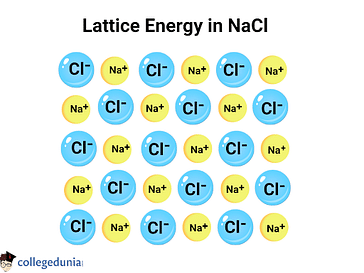
In the given molecule, the lattice energy is the energy required for the given reaction:
NaCl(s) → Na+ (g) + Cl– (g)
Thus, the energy that is required for 1 mole of sodium chloride to separate into gaseous Na+ and Cl– ions is 786 kilojoules.
Read More:
Lattice Energy Formula
The exact value of the lattice energy of an ionic compound cannot be determined easily. Lattice Energy of ionic compounds is calculated using the simplified form of Coulomb’s Law.
Lattice Energy Formula is as follows:
U = -kQ1Q2 /r
Where
- U is the Lattice Energy of an Ionic Compound.
- K is the Proportionality Constant.
- Q1 and Q2 are the positive and negative ions of the compound.
- r0 is the internuclear distance of the ions.
Factors Affecting Lattice Energy
[Click Here for Sample Questions]
There are two major factors that affect the lattice energy of an ionic compound which are as follows:
- Charges on Ions
- Radius of Ions (Distance Between the Ions)
Charge on Ions
- The individual ions in an ionic lattice are attracted to each other due to the electrostatic forces between them.
- The strength of the electrostatic force of attraction is in direct proportion to the magnitude of the charge held by the ions.
- The greater the charge, the stronger the force of attraction, and thus the stronger will be the lattice.
- For instance, the lattice energy of calcium chloride is greater than that of potassium chloride despite the similarity in the crystal arrangements.
- The reason for the same is that the magnitude of the positive charge held by the calcium cation (+2) is greater than that held by the potassium cation (+1).
- Thus, the electrostatic forces of attraction are stronger in calcium chloride than in potassium chloride.
- Hence, it is considered that the lattice energy of CaCl2 is greater than that of KCl.
Radius of Ions
- Lattice Energy is inversely proportional to the distance between the ions.
- The more the distance between the ions in a lattice, the weaker the electrostatic forces, and the lower will be the lattice energy.
- Small atoms have smaller interatomic distances in the ionic lattice and stronger binding forces.
- The smaller the size of the constituent ions, the greater will be the lattice energy.
Read More: Chemical Bonding and Molecular Structure Important Questions
Lattice Energy and Lattice Enthalpy
[Click Here for Previous Year Questions]
The molar lattice energy of an ionic crystal in terms of molar lattice enthalpy, pressure, and volume change can be expressed as follows:
| ΔLatticeU = ΔLatticeH – pΔVm |
Here
- ΔLatticeU denotes the molar lattice energy.
- ΔLattice H denotes the molar lattice enthalpy.
- ΔVm is the change in volume (per mole).
- p is the pressure.
Therefore, the external pressure is also taken into account while calculating the lattice energies of ionic solids.
Calculating Lattice Energy Using Born-Haber Cycle
[Click Here for Sample Questions]
Born-Haber Cycle is based on Hess’ law of Constant Heat of Summation. Hess' Laws state that irrespective of the fact that a chemical reaction occurs in a single step or multiple steps, the reaction's overall heat stays constant.
Consider the chemical reaction given as follows:
A → B
The heat of the reaction (ΔH) will be +Q.
If the reaction takes place over several steps, then
A → C ΔH1 = q1
C → D ΔH2 = q2
D → B ΔH3 = q3
Then, according to Hess’ law, +Q = q1 + q2 + q3. This law is also applicable to cyclic processes.
Read More: Important MCQs on Chemical Bonding and Molecular Structure
Calculating the Change in Energy for the Formation of NaCl
[Click Here for Previous Year Questions]
Sodium chloride can be created in two ways as mentioned below:
- Sodium chloride is created when metallic sodium combines with chlorine gas.
- The second process for creating sodium chloride involves several steps which are mentioned as follows:
- Sodium Sublimation: Sublimation is the conversion of solid sodium to gaseous sodium. This process needs energy, specifically sublimation energy (+S).
- Sodium Ionization: The sodium atom loses an electron to become a sodium ion during the ionization process. The ionization potential (+IP) is what's needed for energy.
- Chlorine Dissociation: The energy needed to cause the chlorine molecule to split into two chlorine atoms is called the dissociation energy (+D/2).
- Chloride Ion Formation: Chloride ions are created when the Cl atom receives an electron to create an ion. The electron affinity is the energy released (-Ea).
- Sodium Chloride Ion Formation: Sodium chloride is created when sodium ions interact with chloride ions. The lattice energy is the total amount of energy released.
As a result, the value of ΔHf equals the total of all the energies mentioned above.
Check More:
Things to Remember
- Lattice Energy is the energy required to separate one mole of an ionic solid into gaseous ions.
- It is a type of potential energy measured in kJ/mol.
- When the energy is required to disintegrate an ionic solid into gaseous ions, the lattice energy will be positive.
- When energy is required to create an ionic solid from gaseous ions, the lattice energy will be negative.
- It affects the properties of an ionic solid such as volatility, solubility, and hardness.
- Atomic Charge and Ionic Distance are the two factors affecting the lattice energy of an ionic solid.
Previous Years’ Questions
- Lattice energy is calculated by… (Rajasthan PMT - 2004)
- Lattice energy of an ionic compound depends upon… (AIEEE - 2005)
- The highest lattice energy corresponds to… (AMUEEE - 2010)
- The lattice energy of NaCl is 788 kJ mol… (KEAM)
- Lattice energy of alkali metal chlorides follows… (DUET - 2004)
- Among the following which compound will show the… (NEET - 1993)
- CaO and NaCl have the same crystal structure and approximately… (AIIMS - 2010)
- If Na+ ion is larger than Mg2+ ion and S2− ion is larger… (Manipal - 2008)
- Which one of the following has maximum lattice energy… (AMUEEE - 2011)
- Hess's law states…
Sample Questions
Ques. What is Lattice Energy? (3 Marks)
Ans. Lattice energy is the amount of energy required to break up an ionic solid and convert its atoms into gaseous ions. The reaction is an endothermic reaction, thus the value of the lattice energy will be positive.
On the other hand, lattice energy is also defined as the energy generated when gaseous ions combine to form an ionic solid. This will be an exothermic reaction, and thus, the value of the lattice energy will be negative.
Ques. State the Hess's Law of Constant Heat Summation. (3 Marks)
Ans. Hess's Law states that the enthalpy change during a chemical reaction will be the same irrespective of the fact whether the reaction takes place in one step or multiple steps. The only condition for the same is that the initial and final states of the reactants and products are the same as the main reaction.
It states that the heat absorbed or evolved during a chemical reaction is the sum of the heat evolved or absorbed in the individual steps of the given reaction. The summation of individual steps will give the heat of the overall reaction.
Ques. Which factors affect the lattice energy of an ionic compound? (3 Marks)
Ans. Lattice energy is used to find how strong the ionic bonds are in an ionic molecule. It provides details about the volatility, solubility, and hardness of ionic materials.
- The lattice energy of an ionic compound is inversely correlated with the separation between the ions.
- It decreases with the strength of the electrostatic forces holding ions together in a lattice.
- The interatomic distances and binding forces are shorter and greater in the ionic lattice of smaller atoms.
- As a result, the lattice energy of an ionic solid increases with the size of its constituent ions.
Ques. What is the importance of Lattice Energy? (3 Marks)
Ans. The strength of ionic solids is measured using lattice energy, which is also used to assess the relationship between electrons and fluorides. Lattice energy helps in calculating the amount of energy produced when a collection of ions joins to form a molecule. It is generally employed to assess the strength of ionic compounds or solids. The high lattice energy of ionic solids or compounds often enables them to acquire better stability and makes it challenging to break their relationship.
Ques. What is Dissociation Energy? (2 Marks)
Ans. Dissociation Energy is the amount of energy needed to separate a compound. The dissociation of a compound is always an endothermic process, which means energy must constantly be supplied. The electronegativity of the atoms involved determines the size of the dissociation energy.
Ques. Describe the fundamental properties of ionic compounds. (3 Marks)
Ans. The following are the fundamental properties of ionic compounds:
- They are crystalline solids with a crystal lattice structure.
- Ionic compounds do not consist of a single molecule, in contrast to other gaseous molecules like H2, N2, O2, and Cl2.
- Because of the strong interionic force, ionic compounds have high melting and boiling points.
- They are soluble in polar solvents such as water but not in organic ones such as benzene, CCl4, and others.
- Although they don't conduct electricity well when they're solid, they do so when melted or dissolved in water.
- Ionic substances create ions in the solution, which react fast with ions that have charges that are in opposition to one another.
Ques. How is Lattice Energy used to explain the stability of ionic solids? (3 Marks)
Ans. Lattice energy is used to explain why ionic solids are stable. It may be predicted that such an organized structure would be less stable because the system's entropy would be low. However, due to the crystalline structure, each ion can interact with a number of other ions that have opposite charges, changing the system's enthalpy in a very favorable way.
Ques. How is electron affinity useful in finding Lattice Energy? (3 Marks)
Ans. Electron affinity is the amount of energy produced when an electron is introduced to a neutral atom or ion. Despite the fact that the principle of electron affinity dictates that energy released should have a negative value, most tables display it as a positive amount. As a result, we must remember to consider this while calculating the lattice energy.
Ques. What is meant by lattice enthalpy? (2 Marks)
Ans. Ions are created and then come together to form an ionic compound. Lattice energy, sometimes referred to as lattice enthalpy, is the energy released during this reaction. In other words, lattice energy or lattice enthalpy is the name for the energy released when a cation and an anion unite to form one mole of an ionic molecule.
Ques. What is Sublimation Energy? (2 Marks)
Ans. Sublimation Energy is the energy needed to change a solid to a gas without passing through a liquid state is called sublimation energy. It has a positive value because it is an energy input. It can also be referred to as atomization energy.
Check-Out:



Comments