



Content Writer
The law of the independent assortment is based on Mendel’s experimental study that describes the inheritance of genes from paternal and maternal sources. Mendel proposed three laws of inheritance. Collectively all three laws are known as Mendel’s Law of Inheritance.
- The three laws of inheritance are - Law of Independent Assortment, the Law of segregation, and the law of dominance.
- Mendel conducted a dihybrid cross for the law of independent assortment.
- The law of independent assortment showed that the genes do not influence each other for sorting alleles into gametes.
- The law of independent assortment explains why the offsprings of a species are not identical to their parents.
Read more: Mendelian Inheritance
| Table of Content |
KeyTerms: Independent assortment, Genetics, Chromosomes, Gametes, Inheritance, DNA, Meiosis, Alleles
What is the Law of Independent Assortment?
[Click Here for Sample Questions]
According to the Law of Inheritance Assortment, different genes and their alleles are inherited independently within sexually reproducing organisms. During the process of meiosis, chromosomes are separated into multiple gametes. By the process of crossing – over, genes linked on a chromosome can rearrange themselves. This is how each gene is inherited independently.
Gregor Mendel’s Experiment on the Law of Independent Assortment
[Click Here for Sample Questions]
Gregor Mendel conducted a hybridization experiment on garden peas from 1856 to 1863 (for 7 years). He proposed the law of inheritance in organisms. Mendel’s experiment had a large sampling size, which rewarded greater credibility to the data he collected. Mendel investigated characters of pea plants that were manifested as two opposite traits. This led to the set up of a basic framework of rules governing inheritance.
- The experiment was conducted by artificial pollination using several true – breeding pea lines. He selected a variety of 14 true – breeding pea plants, as pairs with one character of contrasting traits. Some of the contrasting seeds were wrinkled seeds or smooth seeds, inflated or constricted green or yellow pods, tall or dwarf plants, and yellow seed or green seeds.
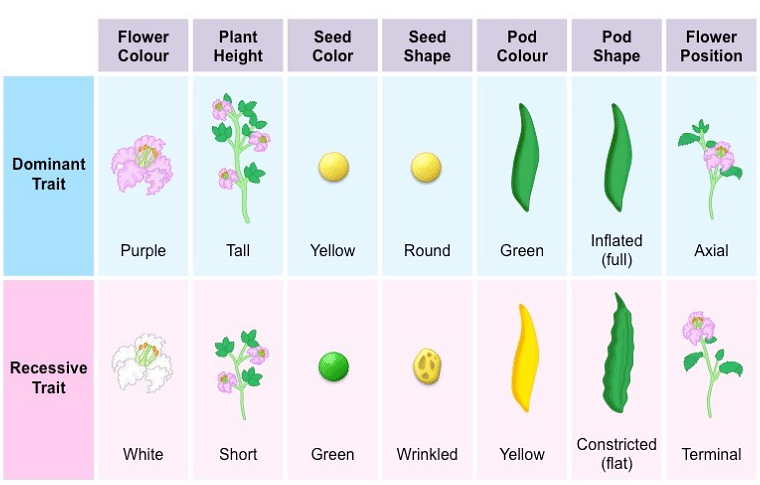
Pea plant traits
- In a dihybrid cross, he selected wrinkled seeds and round – yellow seeds and crossed them. Only round yellow seeds in the F1 generation were obtained. Self – pollination of F1 progeny provided four different combinations of seeds in the F2 generation. Wrinkled- yellow, round – yellow, wrinkled - green, and round – green seeds in phenotypic ratio 9 : 3 : 3 : 1.
- The phenotypic ratio 3 : 1 of the round : wrinkled seeds shape and the ratio 3 : 1 of the yellow : green color during the monohybrid cross was retained in the dihybrid cross. Based on the observations Mendel developed his third law of independent assortment.
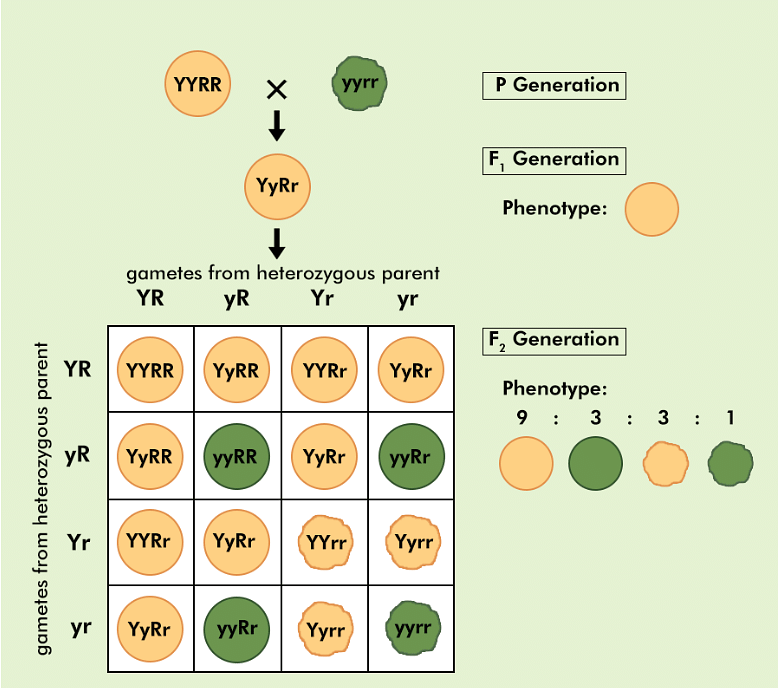
Dihybrid Cross
- The law is explained by the dihybrid cross between the parental genotypes rryy (green - wrinkled seeds) and RRYY (round - yellow seeds). Gametes formation chances with gene R and the gene r are 50 : 50.
- According to the law of independent assortment, the segregation of r and R is separate from the segregation of y and Y.
When does Independent Assortment occur?
[Click Here for Sample Questions]
The independent assortment occurs during the process of meiosis. The law of independent assortment takes place when sources of DNA (like maternal and paternal sources) are randomly divided. Sometimes, the paternal version of the gene is inherited by the gamete, and sometimes maternal performance is inherited. Which version is inherited is entirely random, based on the order that these chromosomes are lined up during the first stage of meiosis.
Example Of the Law of Independent Assortment
[Click Here for Sample Questions]
Consider an example of cats with two visible traits –
- Fur color – black or white
- Eye color – green or grey
Two – hybrid cats are crossed. The two cats have a genotype B b G g. Each cat produced gametes before breeding. During this process, the separation of the alleles occurs and a copy of each chromosome is assigned to a different gamete. This shows, regardless of the parental phenotype, the kittens inherit different combinations of the traits.
Read more:
| Relevant Concepts | ||
|---|---|---|
| Controlled Pollination | Tissue Culture | Gibberellins |
| Plant Breeding | Genotype | Dominant Traits |
Things to remember
Given below are the things to remember about the law of independent assortment –
- The law of inheritance is of three types namely - the Law of Independent Assortment, the Law of Segregation, and the law of Dominance.
- Gregor Mendel conducted a hybridization experiment on garden peas for 7 years (from 1856 to 1863). He proposed the law of inheritance in organisms.
- Mendel’s experiment had a large sampling size, which rewarded greater credibility to the data he collected.
- The law of inheritance assortment states that different genes and their alleles are inherited independently within sexually reproducing organisms.
- The independent assortment occurs during the process of meiosis.
Sample Questions
Ques. What is a true – breeding line? (2 marks)
Ans. Having undergone continuous self – pollination shows that stable trait inheritance and expression for several generations is known as a true – breeding line. Mendel conducted cross pollination / artificial pollination experiments using true – breeding pea lines.
Ques. Give an example of the law of independent assortment. (3 marks)
Ans. Consider an example of dogs with two visible traits –
- The fur color of the dogs – black or white
- The eye color of the dogs – green or blue
Two – hybrid dogs are crossed for this experiment. The two dogs have a genotype W w G g. both the dogs produced gametes before breeding. The alleles are then separated and a copy of each chromosome is assigned to a different gamete. This indicates that the puppies inherit traits of different combinations regardless of the parental phenotype.
Ques. What is the law of independent assortment? (2 marks)
Ans. The law of independent assortment states the inheritance of genes from paternal and maternal sources. The law of independent assortment occurs when the maternal and paternal sources of DNA are randomly divided. Sometimes, the paternal version of the gene is inherited by the gamete, and sometimes maternal performance is inherited.
Ques. On what observations did Mendel develop the law of independent assortment? (2 marks)
Ans. Mendel developed the law of independent assortment by observing the phenotypic ratio 3 : 1 of the round : wrinkled seeds shape and the ratio 3 : 1 of the yellow : green color during the monohybrid cross was retained in the dihybrid cross.
Ques. How many laws of inheritance are there? (2 marks)
Ans. There are three laws of inheritance. They are-
- The Law of Independent Assortment,
- The Law of Segregation,
- The law of Dominance.
Ques. How many pea plant varieties were selected by Mendel? (2 marks)
Ans. Mendel selected 14 true – breeding pea plant varieties for his experiments, as similar pairs except for one character with contrasting traits. Some of the contrasting seeds were wrinkled seeds or smooth seeds, inflated or constricted green or yellow pods, tall or dwarf plants, and yellow seed or green seeds.
Ques. How long did Mendel’s experiment last? (1 mark)
Ans. Mendel’s experiment lasted for 7 years (from 1856 to 1863).
Ques. When does independent assortment occur? (2 marks)
Ans. During the process of meiosis, Independent assortment occurs. When maternal and paternal sources of the D N A are randomly divided then the law of independent assortment takes place.
Ques. How is the law of independent assortment explained? (3 marks)
Ans. The law of independent assortment is explained through the dihybrid cross between the parental genotype and RRYY (round - yellow seeds) and rryy (green - wrinkled seeds).
- There are 50: 50 chances of gametes formation with gene R and the gene r.
- The law of Independent assortment states that the segregation of y and Y is independent of the segregation of r and R.
Ques. What led to the set up of a basic framework of rules governing inheritance? (3 marks)
Ans. The experiment of hybridization of pea plants conducted by Gregor Mendel led to the set up of a basic framework of rules governing inheritance.
- He conducted the experiment through artificial pollination or cross – pollination of 14 pea plant varieties.
- Mendel used a large sampling size which resulted in greater credibility for the data collected by him.
Ques. What is an exception to the law of independent assortment? (3 marks)
Ans. Gene linkage is an exception to the law of independent assortment.
- According to the law of independent assortment, the alleles of different genes get sorted into gametes independently of each other.
- The gene linkage is an exception to this law as this law applies to the genes which are located on the separate chromosome.
Ques. Who proposed the law of inheritance? (2 marks)
Ans. Gregor Mendel proposed the law of inheritance. Mendel conducted a hybridization experiment on the garden of peas for 7 years. Mendel investigated the characteristics of pea plants that had two opposite traits. This led to the set up of a basic framework of rules governing inheritance.
For Latest Updates on Upcoming Board Exams, Click Here: https://t.me/class_10_12_board_updates
Check out:



Comments