



Education Journalist | Study Abroad Lead
Genotype is an organism's genetic makeup. A gene can be defined as a segment of DNA that encodes a certain characteristic or feature. The genotype defines an individual's inherited potentials and limitations from embryonic development to adulthood. A person's genotype is made up of the entire set of genes received from both parents in sexually reproducing organisms. Because each nucleotide consists of a phosphate group, such as sugar, and a base, the nucleotide order of a gene can change between copies of the same gene. Sexual reproduction makes sure that each individual possesses a unique genotype, as can be proven quantitatively. As a result, a gene in different organisms may take on distinct forms. Alleles are a common term for these various sorts.
| Table of Content |
Key Terms: Genotype, Phenotype, Genes, DNA, Alleles, Chromosomes, Sexual Reproduction, Progeny, Nucleus, Cells
Read More: MCQ on Chromosomes
Definition of Genotype
[Click Here for Sample Questions]
An organism's genotype can be defined as its genetic makeup. Humans are diploid organisms, which means they have two alleles for each genetic location, one from each parent. The physical qualities of an organism that can be seen with our eyes are referred to as phenotypes. These characteristics include the organism's appearance, development, behaviour, height, eye colour, hair colour, and so on.
Genotype in Biology
[Click Here for Sample Questions]
Genotype is defined in biology as the variance in Genes that determines specific features. A gene is a piece of DNA that encodes a set of characteristics; these characteristics are referred to as genotypes. The nucleotide order in a Gene can vary between copies of the same Gene. Each nucleotide is made up of several phosphate groups, such as sugar and a base.
As a result, genes can exist in a variety of forms between species or even amongst individuals of the same species. From the Embryonic stage to Adulthood, genotype serves to identify an individual's inherited potentials and limitations. A Genotype is a collection of genes inherited from both parents in sexually reproducing organisms.
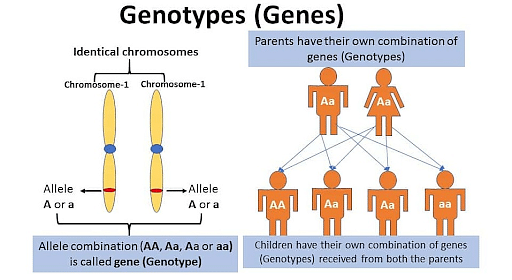
Genotypes
Read More: Difference Between Nucleotide and Nucleoside
Examples of Genotypes
[Click Here for Sample Questions]
Some examples of Genotypes are as follows:
- Example 1
The flower-colour Gene in the pea plant had three potential Genotypes: red-red, red-white, and white-white.
- Example 2
When it comes to pea plant height genotypes, T stands for tall variety and s for small variation. Alleles are variations of the same character called "height of a pea plant," and they are known as T and s. Ts, ss, TT, and sT are four potential combinations if T is dominant. If a plant's pure breed is TT and ss, the chances of the progeny being short are 1 in 4.
Read More: Mendelian Genetics
Types of Genotype
[Click Here for Sample Questions]
A person's unique characteristics are determined by a combination of Alleles on corresponding chromosomes. A Genotype is made up of genes that are responsible for features like skin colour. Genotypes are divided into three categories. They can be differentiated by a person's Alleles.
- Homozygous dominant, PP
- Heterozygous, Pp
- Homozygous recessive pp
Adapting a Genotype's system to diverse settings is necessary for it to survive intensive breeding. Because various species have varying genotype adaptability, natural selection is continual.
The Strongest Genotype
[Click Here for Sample Questions]
The strongest genotype is one with the most dominant genes. Dark hair, right-handedness, brown eyes, broad brows, crossed left thumbs, long eyelashes, left arm over right, broad lips, and so on. Certain races have large lips as their dominant gene in hot temperature zones.
Read More: Difference between Dominant and Recessive Traits
Where are Genotypes Found?
[Click Here for Sample Questions]
Chromosomes, the closely packed DNA structures in the cell nucleus, contain genes. Chromosomes come in pairs in sexually reproducing organisms, one from the mother and one from the father. Each person, for example, will have two 'Chromosome 1s' and two 'Chromosome 2s.' Because they carry the same genes, chromosomes in a pair (excluding sex chromosomes) are called homologous chromosomes.
Each gene always has two copies, one from each parent. A gene, on the other hand, can have several alleles. Alleles are different variants of the same gene. Genotypes are formed by the combination of alleles inherited from both parents.
Difference Between Genotype and Phenotype
[Click Here for Sample Questions]
The major points of differences between genotype and phenotype are as follows:
| Genotype | Phenotype |
|---|---|
| The genetic information of an organism is stored in its DNA as a gene and does not change over time. | Phenotypes are an organism's observable characteristics. |
| Individuals with the same genotype show no differences in phenotype. | There may or may not be a link between genotype and phenotype. |
| It exists in the body as genetic material. | Genetic expression manifests itself externally. |
| Parents and children are genetically identical. | The phenotype does not pass down the generations. |
| This can be determined using scientific processes such as the polymerase chain reaction. | The behaviour of an organism is sufficient to identify it. |
| This is where genes come into play. | Environmental and genetic variables are both important. |
| Blood type, eye colour, height, and hereditary illnesses are examples. | The weight, physique, and beak of birds are some examples. |
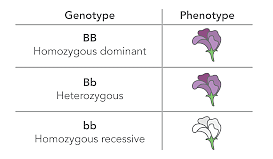
Genotype VS Phenotype
Read More: Acquired and Inherited Traits
Things to Remember
- In the alphabetical representation of genotypes, Bb stands for the dominant allele and b for the recessive allele. However, the genotype is not the only element that influences the phenotype.
- Various variables, including mutations that change the frequency of base pairs or the structure of DNA sequences, affect the genotypes of organisms. There are no changes in genotypes as a result of these mutations.
- The expression of genotypes in organisms is determined by the genotype's composition. When a dominant allele is present, independent of the other allele, the children will almost surely inherit the dominant traits.
- Genotypes, like phenotypes, are invisible to the naked eye. The process of genotyping will be used instead.
Also Read:
Sample Questions
Ques. What is the definition of genotype in biology? (2 Marks)
Ans. The term "genotype" basically indicates an organism's genetic makeup in a broad sense. In simpler terms, it describes an organism's entire set of genes. It can also refer to the alleles, or alternative forms of a gene, that an organism carries. Humans are referred to as diploid organisms, i.e, each genetic location, or locus, has two alleles, one inherited from each parent. Thus, the genotype of a gene is characterized by each pair of alleles.
Ques. What is AA and AS genotype? (2 Marks)
Ans. Three genotypes are available if the dominant allele is labelled "A" and the recessive allele is labelled "a": "AA", "aa", and "Aa". The terms "homozygous" and "aa" are used to characterise the pairs "AA" and "aa" since the alleles in both are dominant or recessive. The allelic pair "Aa," on the other hand, is referred to as "heterozygous." Individuals with genotypes AA or Aa will show the dominant characteristic, while those with genotype aa will show the recessive trait.
Ques. What genotype is SC? (2 Marks)
Ans. People with the haemoglobin (Hb) SC genotype have inherited the haemoglobin S gene from one parent and the haemoglobin C gene from the other. Hb SC disease, a sickle cell disease variant, affects certain people with this genotype. Hb SC disease, a compound heterozygous disorder, is the most common and least severe of the hemoglobinopathies, however, it is nonetheless dangerous. Sensorineural hearing loss is one of the known side effects of having the Hb SC genotype (SNHL).
Ques. Can AA genotype marry AA? (2 Marks)
Ans. The following genotypes are compatible for marriage: AA marries an AA. That is the most compatible option. That way, your future children will not have to be concerned about genetic compatibility. AA gets married to an AS. You'll have kids with AA and AS, which is a good thing. However, if you're unlucky, all of the children will be AS, limiting their partner options. A good possibility can be seen here that AS and AS will have a child with SS if they marry. AS and SS should not think or consider getting married. Furthermore, SS and SS should not marry because there is no way to avoid producing a child with sickle cell disease.
Ques. What is BB genotype? (2 Marks)
Ans. When discussing genotype, biologists refer to dominant alleles as uppercase letters and recessive alleles as lowercase letters. For instance, "B" refers to a brown allele and "b" refers to a blue allele for eye colour. A homozygous dominant genotype, thus, can be defined as an organism that has two dominant alleles for a characteristic. This genotype will be BB in the case of eye colour. A heterozygous genotype can be explained as an organism with one dominant allele and one recessive allele.
Ques. Which genotype can marry? (3 Marks)
Ans. Human genotypes are AA, AS, AC, and SS. They refer to the components of the haemoglobin gene on red blood cells. AC is uncommon, although AS and AC are both abnormal. According to a Genotype Compatibility Chart:
- AA + AA = AA, AA, AA, AA (Excellent)
- AA + AS = AA, AS, AA, AS, (Good)
- AA + SS = AS, AS, AS, AS, (Fair)
- AA + AC = AA, AA, AA, AC. (Good)
- AS + AS = AA, AS, AS, SS, (Very Bad)
- AS + SS = AS, SS, SS, SS, (Very Bad)
- AS + AC = AA, AC, AS,SS. (Bad; Advice needed)
- SS + SS = SS, SS, SS, SS, (Very Bad)
- AC + SS = AS, AS, SS, SS, (Very Bad)
- AC + AC = AA, AC, AC, SS. ( Bad; Advice needed)
Ques. How do you write a genotype? (2 Marks)
Ans. Homozygous for a gene, diploid organisms have two identical alleles, one on each of their homologous chromosomes. The genotype is frequently written as YY or yy, with each letter representing one of the genotype's two alleles. The dominant allele is written in capital letters, whereas the recessive allele is written in lower case letters. The dominant trait (in this case, yellow allele, or "Y") is frequently tied to the letter used for the gene (seed colour in this case).
For Latest Updates on Upcoming Board Exams, Click Here: https://t.me/class_10_12_board_updates
Check-Out:



Comments