



Content Curator
Types of Pollination are self-pollination, cross-pollination and geitonogamy. Pollination is a part of the reproduction occurring in flowering plants. Sexual reproduction is incomplete without fertilization. Further development occurs only when the male and female gametes meet for fertilization. Plants can reproduce sexually, or by the generation of seeds, to create progeny. The genetic material for creating a new plant is found in seeds. Pollen exchange between blooms of the same species is necessary for the production of seeds.
Read More: Cross-Pollination Vs Self-Pollination
| Table of Content |
Key Terms: Pollinating Agents, Angiosperms, Stigma, Style, Stamen, Anther, Pistil, Fertilization, Pollination, Self-pollination, Cross-pollination, Geitonogamy
What is Pollination?
[Click Here for Sample Questions]
Pollination refers to the act of transferring pollen grains from the male part of a plant (anther) to the female part of a plant (stigma) enabling fertilization and later the production of seeds Plants cannot move and need the help of a vector for this. Pollination is thus the means by which the male and female gametes meet for fertilization. Pollination vectors or agents help in successful fertilization to occur between the same species.
The process of pollination occurs as follows:
- Pollen grains contain the male reproductive cell of the plant.
- They are called sperm cells or male gametes.
- During pollination, the pollen grains from the male part of the plant are transferred to the female part called the stigma.
- After the pollen grains have landed on the stigma, the pollen tube gets formed.
- The sperm cells then move down to the ovary through the pollen tube.
- The sperm cells fertilize the egg cells and form seeds.
- These later get detached from the plant and grow into a new plant.
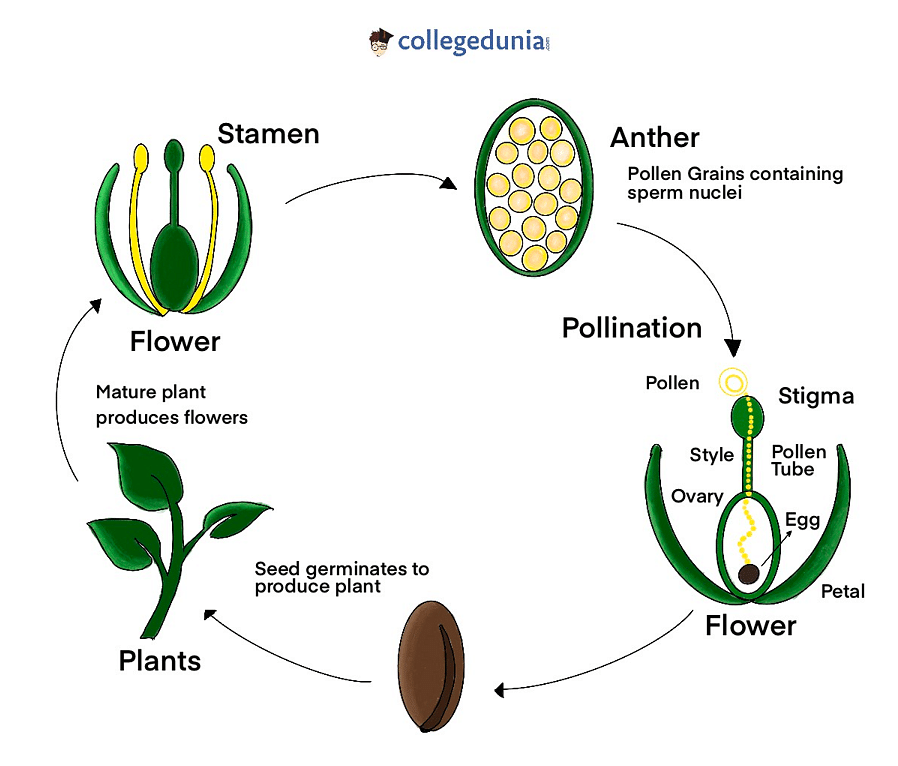
Pollination Schematic
Read More: Pollination & Fertilization
Types of Pollination
[Click Here for Previous Year Questions]
Crop plants often undergo one of the three types of pollination, which are as follows:
- Autogamy or self-pollination
- Allogamy or cross-pollination
- Geitonogamy
Read More:
Self-Pollination (Autogamy)
[Click Here for Sample Questions]
Self-pollination is when a flower is pollinated by pollen from either that blossom or another flower on the same plant.
- Since annual plants have a short lifespan and few opportunities for genetic recombination, self-pollination is essential to ensuring reproductive success.
- Only bisexual plants can undergo this sort of pollination.
- Common crop plants that self-pollinate include barley (Hordeum vulgare), common beans, eggplant, lettuce (Lactuca sativa), oat (Avena sativa), pea (Pisum sativum), peaches (Prunus persica), peanut, pepper, rice (Oryza sativa), soybean (Glycine max), tomato (Lycopersicon esculentum), wheat, and pepper (Triticum aestivum).
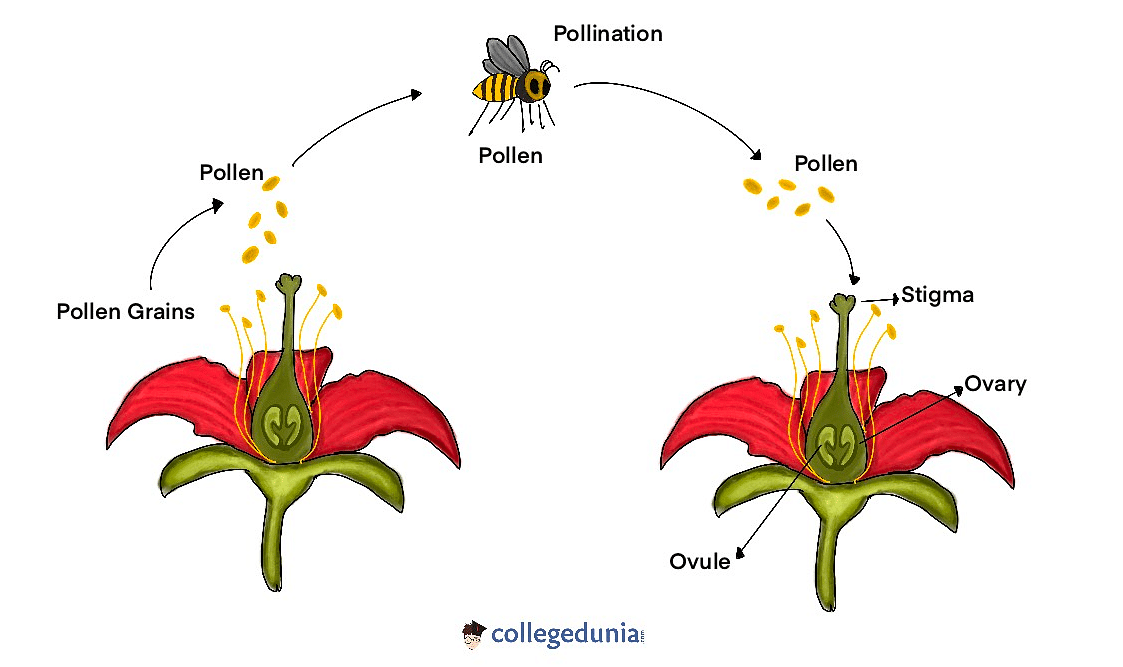
Self-Pollination
Read More: Reproduction in plants
Cross-Pollination
[Click Here for Previous Year Questions]
Cross-pollination refers to the pollination of a flower by pollen from a blossom of a different species.
- Perennial plants are more likely to experience cross-pollination than annual plants due to their longer lifespans and higher potential for genetic recombination.
- Both unisexual and bisexual flowers can experience this sort of pollination, but unisexual blooms are more likely to experience it.
- Alfalfa (Medicago sativa), bananas (Musa sapientum), carrots (Daucus carota), cassava, cucumbers (Cucumis sativus), maize (Zea mays), onions (Allium cepa), rye (Secale cereale), sugar beet, sunflowers (Helianthus annus), sweet potatoes, and watermelons are some popular cross-pollinating crop species (Citrullus vulgaris) are some of the examples.
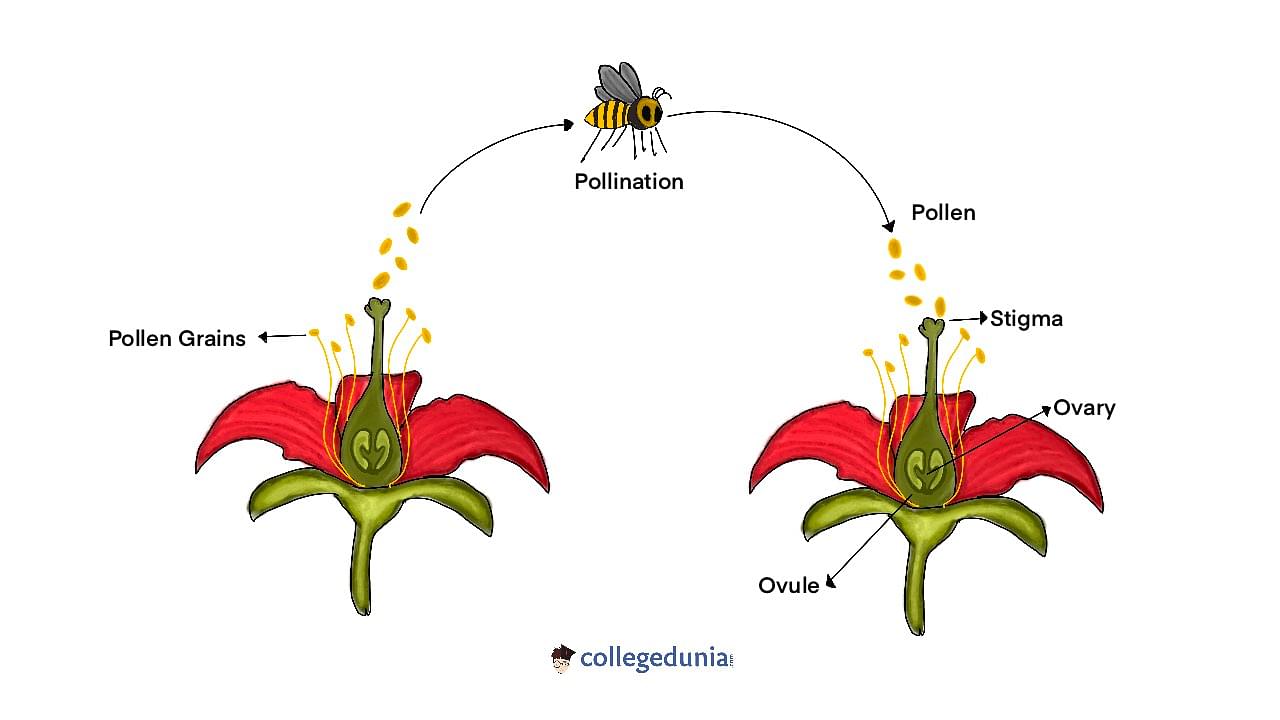
Cross-Pollination
Read More: Pistil of Flower
Geitonogamy
[Click Here for Sample Questions]
When the pollen of one flower contacts the stigma of another flower on the same plant, it is called Geitonogamy. Genetically, this is equivalent to self-pollination. e.g. corn. It may seem similar to cross-pollination and it occurs with the help of pollinating agents, both the gametes have the same plant as their origin.
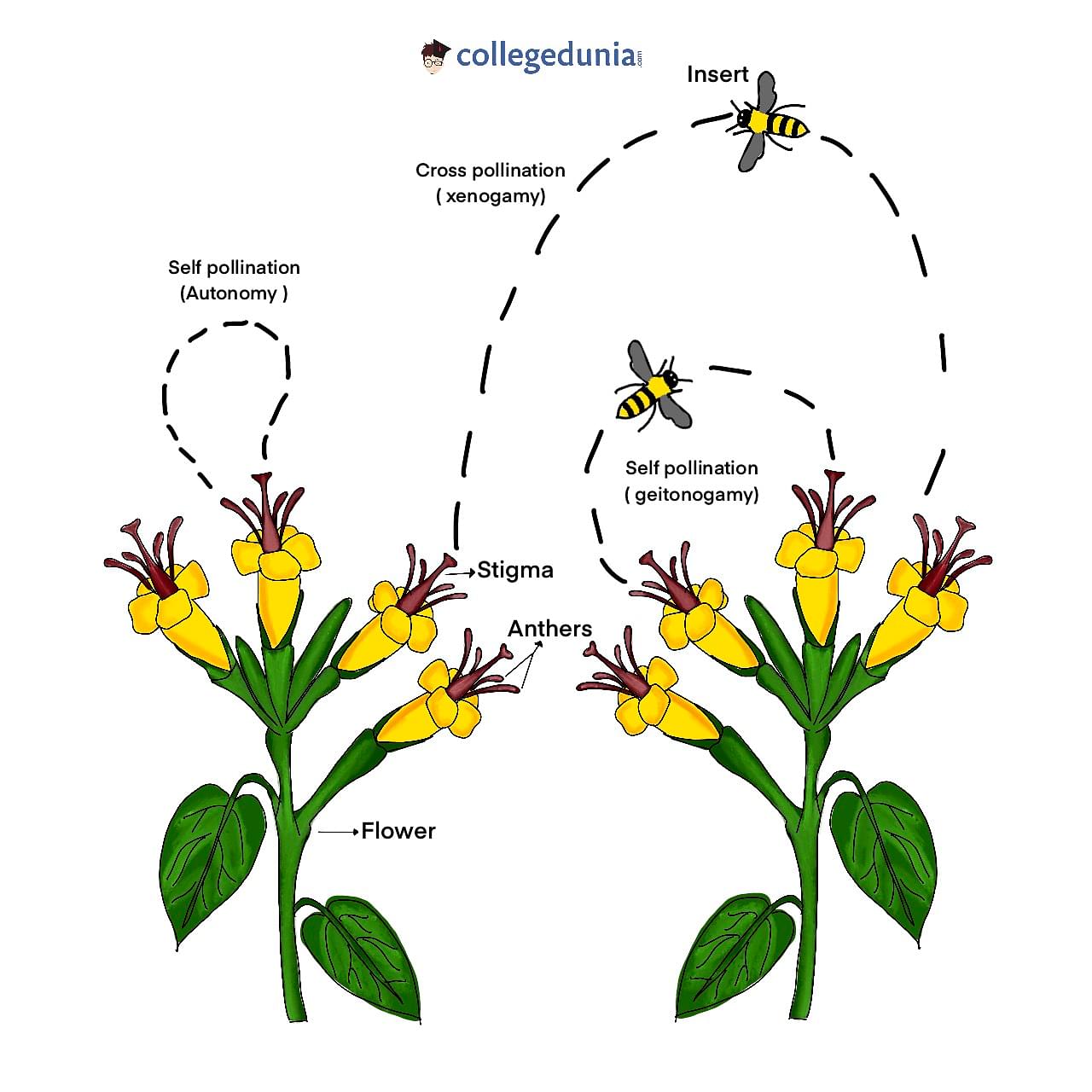
Geitonogamy
Read More: Oogenesis
Conditions for Self-Pollination
[Click Here for Previous Year Questions]
The following are some important parameters for self-pollination.
Monocliny or Bisexuality
The presence of both male and female reproductive organs in a single flower or on a single plant is referred to as monocliny or bisexuality. This is the most essential and necessary criterion for self-pollination.
Homogamy
A bisexual flower has a trait known as homogamy in which both the male (anther) and female (stigma) parts develop simultaneously. Additionally, it is a key necessity for self-pollination.
Chasmogamy
Chasmogamy occurs in several species where the flowers primarily open after pollination.
- This type of pollination, also known as bud pollination, takes place when the flower is still closed.
- Examples: Many cereals, including wheat, barley, rice, and oats, contain this. Some cross-pollination may take place now that the flowers have finally opened.
Cleistogamy
Cleistogamy is total self-pollination because the bisexual flowers hardly unfold. e.g. California oat grass.
Sometimes the flower's morphology is such that the anthers are tightly surrounding the stigmas (e.g. tomato, brinjal).
- Pollination usually takes place after the flowers have opened on such flowers. However, self-pollination is achieved by the anthers' position in comparison to stigmas.
- In certain species, flowers open, but other floral organs cover the stamens and stigmas.
- The stamens and stigmas are contained by the two petals of many legumes, such as the pea (Pisum sativum), mung (Vigna radiata), soybean (Glycine max), and gramme (Cicer arietinum).
- A few species have stigmas that lengthen through the stamina columns and become receptive.
Read More: Reproduction in Organisms
Conditions for Cross-Pollination
[Click Here for Sample Questions]
The following are some significant aspects that facilitate cross-pollination.
Dicliny or Unisexuality
A flower that exhibits dicliny, also known as unisexuality, has only one type of reproductive organ.
- In all of this, a plant may be monoecious, – which means that the male and female reproductive organs are in different blooms.
- However, male and female components may be found in separate flowers on different plants or may be present on the same plant if the plant is dioecious.
- Thus, cross-pollination is the only method available to unisexual plants.
Dichogamy
Bisexual flowers have distinct maturation periods for the male and female components.
- Protandry refers to when the male and female parts of an organism mature first.
- Protogyny, on the other hand, occurs when the female portion develops first.
Heterostyly
Heterstyly is cross-pollination that occurs as a result of the length differences in flower styles and filaments.
Herkogamy
Kerkogamy is the spatial separation between the anthers and the stigmas, for example, it may exist in some flowers and act as a physical barrier, making it difficult or even impossible for the anthers and the stigmas to pollinate with one another.
Male-sterility
In mostly bisexual flowers, male sterility is defined as the absence of functioning pollen grains.It is the failure of the same flower's pollen to fertilize an embryo. This is Male-sterility. Cross-pollination consequently occurs.
Self-incompatibility
A genetically controlled mechanism to avoid self-fertilization is self-incompatibility.
Cross-pollination occurs because the pollen in this situation is productive but unable to fertilize the same flower.
Read More: Sexual Reproduction in Flowering Plants
Things to Remember
- Some plants require the assistance of animals referred to as pollinators.
- Honeybees play a crucial role in pollination.
- Pollinators are animals that carry pollen from one plant to another.
- Eggs in a plant are fertilized by pollen. The anther, a section of the stamen, is where the pollen of a flower is found.
- Pollen is spread to a pollinator's body or legs when it lands on a bloom to ingest nectar.
- When the pollinator lands on another flower, the pollen rubs off on a part of the flower called the stigma.
- The plant's pistil, which also stores its style and ovaries, includes the stigma.
- The pollen enters the ovary through the style.
- Pollen nourishes the flower's eggs in the ovary (ovules). These fertilized eggs will ultimately produce seeds.
Read More:
Previous Year Questions
- If the pollen tube enters the ovule through the funiculus, the phenomenon is known as [JIPMER 2004]
- Which of the following is the most resistant material in pollen grain? [JIPMER 2004]
- The term used for the transfer of pollen grains that brings genetically different types of pollen grains to stigma, is? [NEET 2021]
- Anemophily type of pollination is found in[ NEET 2001]
- In water hyacinth and water lily, pollination takes place by?[ NEET 2020]
- Wind pollination is common in
- Devices for self-pollination are : [JKCET 2004]
- Pollination caused by wind is called? [JKCET 2010]
- The type of pollination when different pollen grains are brought to stigma is [AMUEEE 2012]
- For self-pollination, flower must be? [WBJEE 2007]
Sample Questions
Ques. Which two flower components are used in pollination? (2 Marks)
Ans. An anther and a stigma are the first two components of a flower that are pollinated. An anther is a pollen-coated component of the male reproductive system of the plant. The stigma is a component of the female reproductive system of the plant.
Ques. What vital plant function couldn't occur without pollination? (2 Marks)
Ans. Both the male and female gametes must be present for fertilization to occur in living things. Pollination won't occur if the pollen grains aren't delivered to the female counterpart via the pollen tube.
Ques. The transfer of pollen grains to a pistil's stigma is known as ___? (1 mark)
Ans. It is the movement of a single pollen grain to the floral stigma. The result of this process is fertilization. The seeds are created as a result of this procedure.
Ques. Which flowers are always autogamous since there is no potential for cross-pollination to reach the stigma? (1 mark)
Ans. Cleistogamous plants are an automatic sort of self-pollinating plants that can pollinate through non-opening self-pollinating blooms, particularly in peanuts and peas.
Ques. Which process entails the movement of pollen grains from one flower's stigma to another? (2 Marks)
Ans. Xenogamy is the process that entails the movement of pollen grains from one flower's stigma to another. It is defined as the transfer of pollen grains from an anther of one plant to the stigma of another is known as xenogamy. This method of pollination aids in the genetic diversity of the pollen that is produced.
Ques. Complete autogamy is relatively rare in typical flowers that open to reveal the ___ and the stigma. (1 mark)
Ans. Anthers. The pollen-producing and pollen-storage anthers are the knob-like fertile component of the stamen. The pollen grains disintegrate at dehiscence, which is the opening of anther sacs.
Ques. In which type of flowers does the pollination achieved within the same flower? (2 Marks)
Ans. Autogamy. The sort of pollination known as autogamy is when flowers self-pollinate.
Cleistogamy and autogamy differ in that pollination take place inside the buds of cleistogamy plants, whereas pollination takes place in open flowers in autogamy.
Ques. Which type of flowers produces mandatory seeds even in the absence of a pollinator? (1 mark)
Ans. Cleistogamous. Self-pollinating cleistogamous plants produce closed, bud-fertilized blooms that do not open. Peas and peanuts are a couple of examples of flowers that reproduce through cleistogamy.
Ques. Give the advantages and disadvantages of cleistogamy. (2 Marks)
Ans. Followings are the advantages and disadvantages -
| Advantage | Disadvantage |
|---|---|
| Even in the absence of pollinators, cleistogamous flowers produce seeds that will germinate. | Autogamy exists only in cleistogamous flowers. |
| It is a self-pollination | Cross-pollination is impossible. |
| Produce seeds in all conditions. | The absence of variation is the biggest disadvantage in terms of genetics. |
Ques. What’s the difference between pollination and fertilization? (2 Marks)
Ans.
| Pollination | Fertilization |
|---|---|
| Pollination occurs from anthers of stamens to the stigma of the ovary. | It is the fusion of female and male gametes |
| Pollination occurs only in flowering plants. | Fertilization is followed by almost every living being present on the planet earth, including plants, animals, birds, insects, humans, etc. |
For Latest Updates on Upcoming Board Exams, Click Here:https://t.me/class_10_12_board_updates
Read More:



Comments