



Content Curator
Magnetic moment refers to the strength and orientation of a magnet or any other object that produces magnetic field. It can also be defined as the magnetic dipole moment of an object. The ability of a magnetic dipole to align itself with the external magnetic field can be measured by the magnetic dipole moment. Permanent magnets, electromagnets, some molecules, electrons, astronomical objects like planets, stars etc. are some of the examples of the objects having magnetic moment. In case of electrons, magnetic moment is caused by its inherent spin and electric charge properties.
Magnetic moment is a vector quantity. The direction of the magnetic moment is from the south pole to the north pole of a magnet. The magnetic field produced by a magnet is directly proportional to the magnetic moment.
Check Also: NCERT Solutions for Class 12 Physics Chapter 5 Magnetism and Matter
| Table of Content |
Key Terms: Magnetic Moment, Magnetic Dipole, Magnetic Fields, Electron, Torque, Bohr Magneton, Magnetometer, Electric Field
What is Magnetic Moment?
[Click Here for Sample Questions]
A substance that may repel or attract other substances is referred to as a "magnetic material." The arrangement of electrons, also known as the magnetic moment of the material, determines whether these materials are attracted to or repel one another. The magnetic dipole moment of an object is a measure of the torque experienced by it in the presence of a magnetic field.
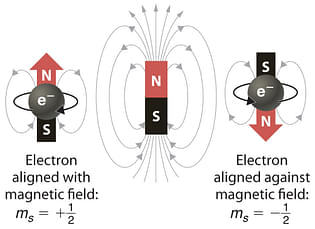
Magnetic Moment Electron
The magnetic moment can be generated by two ways:
- Motion of electric charge
- Spin angular momentum
Measuring Magnetic MomentMagnetic moments are measured with the help of a device called Magnetometer. It is a navigation device which measures the magnetic dipole moment or strength of the magnetic field.
Magnetometer Magnetometers are equipped with a sensor that measures the magnetic flux density. They are used to determine the strength, direction, and variation in the magnetic field at a specific location. Magnetometers are of two types:
|

Read More:
Magnetic Properties of Solids
[Click Here for Previous Year Questions]
The magnetic characteristics of the ions or atoms that make up a solid determine the magnetic properties of that solid. The magnetism and magnetization of a material can be impacted by the mobility of electrons within an atom. Because each electron in an atom behaves like a magnet, as a result the entire solid has magnetic properties. An atom's magnetic activity is influenced by the ways in which electrons flow within it. They move in one of the two different ways:
- Electrons revolving around its nucleus.
- Spinning of electrons along their own axis; the + and - signs denote the direction of the spin.
Because of these constant movements, the electrons are surrounded by an electric field that resembles a current loop and thus generates magnetic moment. Based on their magnetic properties, solids are divided into five classes:
Paramagnetic
These compounds exhibit weak magnetization in the presence of an external magnetic field. Such substances are weakly attracted by magnetic fields. If a paramagnetic substance is taken out of the magnetic field, it loses its magnetic properties. Paramagnetism is created when the magnetic field magnetizes at least one pair of mismatched electrons in their orbit shell. Cu2+, O2 are some of the examples.
Diamagnetic
Diamagnetic substances are the substances that are weakly repelled by the magnetic fields. They do so because the magnetic property that has settled inside of them runs counter to the magnetic fields. In diamagnetic substances, all of the electrons in the orbital are completely filled and are paired. This is why their atoms have zero magnetic moments. Diamagnetic substances behave like an insulator. Examples include NaCl, Benzene etc.
Ferromagnetic
Ferromagnetic substances are strongly attracted by the magnetic fields. These solids become permanently magnetized when they are subjected to an external magnetic field. It means they can maintain their magnetic properties even in the absence of external magnetic fields. Ferromagnetic substances have distinct groups of metal ions known as "domains." Every domain is comparable to a little magnet. In an electromagnetic environment, these domains organize and align themselves with the magnetic field. All the electrons in these substances are unpaired and aligned in the same direction. Examples of ferromagnetic solids include cobalt, nickel etc.
Antiferromagnetic
These substances have a net zero magnetic moment. This is because their dipole moments are arranged in a compensatory manner. The examples of such substances include MnO, V2O3 etc.
Ferrimagnetic
These substances emerge when magnetic moments are aligned in both directions (parallel and antiparallel), but in unequal proportions. They have a small net magnetic moment. Some materials might entirely lose their ferromagnetism upon heating. Examples include ferrites made of magnesium, zinc, and iron.
Magnetic Moment Formula
[Click Here for Sample Questions]
The magnetic moment measures the torque acting on an object when it is placed in a magnetic field. This relation can be expressed by the following equation;
\(\tau = m \times B\)
where,
- \(\tau\) is the torque experienced by the object
- m is the magnetic moment
- B is the magnetic field
Derivation of the Magnetic Moment Formula
Let us consider an object placed in a magnetic field B,
force on the N-pole = mB (in the direction of the magnetic field)
force on the S-pole = mB (opposite to the direction of the magnetic field)
The forces acting on the north and the south poles are equal in magnitude but opposite in direction. They create a parallel couple rotating the magnet clockwise and producing a net torque on the magnet. Thus, the torque can be written as,
\(\tau\) = moment of the couple
\(\tau\) = mB × 2l sin \(\theta\) (\(\theta\) is the angle between the magnetic axis of the magnet and the magnetic field)
Now, we know that
M = m × 2l
Thus, \(\tau\) = MB sin\(\theta\)
Or, \(\tau\) = M × B
Bohr Magneton
[Click Here for Previous Year Questions]
Natural magnetic dipoles make up the majority of elementary particles. For instance, the electron functions as a magnetic dipole and has a spin magnetic dipole moment. Since the electron is a point entity and lacks both an area A and the ability to revolve about itself, its existence depends on this magnetic moment.
According to Neil Bohr's atom model, the negatively charged electron orbits a positively charged nucleus in a circle with radius r. A revolving electron in a small channel makes up an electric current. An ordinary current flows clockwise as a result of the electron's anticlockwise motion.
Current is given as,
i = e ⁄ T
where, e is the charge of an electron and T is the period of the electron’s revolution.
If v is the electron’s orbital velocity, then
T = 2πr ⁄ v
where, r is the radius of the orbit
Therefore, i = ev ⁄ 2πr
There will be an orbital magnetic moment μl due to the electron’s orbital motion,
μl = i A
Here, A is the area of the orbit
A = πr2
μl = (ev ⁄ 2πr) (πr2)
μl = evr ⁄ 2
Consider the mass of the electron be m,
μl = (e ⁄ 2m) (mvr)
The electron’s angular momentum (l) around the central nucleus is (mvr),
μl = (e ⁄ 2m)l
(μl ⁄ l = e ⁄ 2 m is called gyromagnetic ratio and is a constant)
Its value is 8.8 × 10¹⁰ C kg-1. The angular momentum, according to Bohr, has only a discrete set of values given by the equation,
l = nh ⁄ 2π
Here, n is a natural number and h is Planck’s constant.
Substitute the formula of l into the formula of μl,
μl = (e ⁄ 2m) (nh ⁄ 2π)
= neh ⁄ 4πm
The minimum value of the magnetic moment is obtained at n = 1.
μl = eh ⁄ 4πm
It is called Bohr Magneton.
By entering the values of e, h, and m, it is discovered that the Bohr magneton's value is 9.27 × 10⁻²⁷ J/T.
In addition to the magnetic moment caused by orbital motion, the electron also has a magnetic moment due to its spin. The vector sum of an electron's magnetic orbital and spin moment is the resultant magnetic moment.
Read More:
Things to Remember
- Magnetic moment is a measure of the orientation and the strength of the magnet producing magnetic field.
- The formula for magnetic moment is given by \(\tau\) = M × B.
- The magnetic moment of an electron, or electron magnetic dipole moment, is caused by its inherent spin and electric charge properties.
- The magnetic moment is generated by the motion of electrons – revolution around the nucleus and spinning on its own axis.
- The magnetic characteristics of the ions or atoms that make up a solid determine the magnetic properties of the solid.
Sample Questions
Ques. Define magnetic moment. (1 Mark)
Ans. The magnetic moment, also known as the magnetic dipole moment, is a measurement of an object's inclination to align with a magnetic field. It is defined as the magnetic strength and orientation of a magnet or other item that produces a magnetic field.
Ques. How do electrons form a magnetic dipole? (2 Marks)
Ans. The orbit of the electrons around the nucleus is constrained in an atom. Because they are charged particles, electrons have an orbit that resembles a current loop. While the current spins in a clockwise direction, electrons spin in an anticlockwise way. The development of a south pole and a north pole by the movement of electrons makes the atom act like a magnetic dipole.
Ques. What is a current loop’s magnetic dipole moment? (2 Marks)
Ans. The magnetic dipole moment of a current loop carrying current I with area A determines the magnitude of m.
m = I A
The orientation of the magnetic dipole moment is perpendicular to the current loop's plane.
Ques. Why do electrons have a magnetic field? (2 Marks)
Ans. Magnetism is a result of the movement of electric charges. Charged particles called electrons are found inside every atom. The nucleus, or centre, of an atom, is surrounded by electrons that spin like tops. Due to their mobility, each electron acts as a small magnet, resulting in an electric current.
Ques. What is the value of current flowing in the electron for a time period of 2s? (3 Marks)
Ans. Charge of the electron, e = 1.60217662 × 10⁻¹⁹ C
Given: Time period, T = 2s
Current, i = e ⁄ T
i = 1.60217662 × 10⁻¹⁹ ⁄ 2 A
i = 0.80108831 A
Hence, the current flowing in the electron is 0.80108831 A.
Ques. Why do electric field lines cross at a location on a conductor's equipotential surface? (3 Marks)
Ans. If the electric field lines were parallel to the equipotential surface, there would be a non-zero component along the surface. This surface cannot be an equipotential surface since it would take effort to move a unit test charge against the direction of the field. As a result, at a particular location on a conductor's equipotential surface, electric field lines are perpendicular.
Ques. Which direction is the stable or unstable equilibrium for a dipole in a uniform electric field? (3 Marks)
Ans. For stable equilibrium, a dipole is positioned parallel to the electric field; for unstable equilibrium, a dipole is positioned antiparallel to the electric field. net force will surely be greater than zero if the field is not uniform. In addition, the system will experience torque as before. Consider the simpler circumstances where p is either parallel to or antiparallel to E because the general case is complex. In all scenarios, the net torque is zero, but if E is not uniform, there is a net force on the dipole.
Ques. Can a charged particle be accelerated by a magnetic field? Is there a way to increase its speed? (3 Marks)
Ans. The charged particle is accelerated by the magnetic field by changing the direction of its motion. The magnetic field has no impact on the charged particle's speed. Since the magnetic field exerts a force that is perpendicular to the motion, it has no impact on speed. Therefore, the force is unable to function on the particle. The particle's kinetic energy cannot be altered as a result. Because of this, it is unable to change the speed.
Ques. What is the orbital magnetic moment of an electron moving with an orbital velocity of 0.5 m ⁄ s? (5 Marks)
Ans. Charge of the electron, e = 1.60217662 × 10⁻¹⁹ C
The radius of the electron, r = 2.8179403262 × 10⁻¹⁵ m
Given that, velocity of electron = 0.5 m ⁄ s
Orbital magnetic moment, μl = evr ⁄ 2
= 1.60217662 × 10-19 × 0.5 × 2.8179403262 × 10-15 ⁄ 2 Am2
= 1.1287095268 × 10⁻³⁴ Am2
Hence, the orbital magnetic moment of an electron is 1.1287095268 × 10⁻³⁴ Am2.
Ques. A charged particle (charge q) moves at a constant speed v in a circle of radius R. What is the accompanying magnetic moment? (5 Marks)
Ans. Because of the movement in a circle, the current in a circular path is provided by,
i = q/T
∴ i = qv/2πR
As a result, the magnetic moment of the particle is,
μ = iA
∴ μ = qv/2πR × πR2
∴ μ = qvR/2
For Latest Updates on Upcoming Board Exams, Click Here:https://t.me/class_10_12_board_updates
Check Also:



Comments