



Content Curator
Microwave is a part of the electromagnetic spectrum having wavelengths between one meter and one millimeter, which correspond to frequencies between 300 MHz and 300 GHz, respectively.
- The term "microwaves" refers to a variety of frequency bands; the wide definition given above covers both the UHF and EHF (millimeter wave) bands.
- The range between 1 and 100 GHz is a more typical description in radio-frequency engineering (wavelengths between 0.3 m and 3 mm).
- Every time, microwaves at the very least cover the full SHF range (3 to 30 GHz, or 10 to 1 cm).
- Microwave frequencies are frequently identified by their IEEE radar band names, such as S, C, X, Ku, K, or Ka band, or by comparable NATO or EU designations.
| Table of Content |
Key Terms: Microwave, Electromagnetic waves, Radiations, Frequency, Wavelength, Radio waves, Infrared rays.
Electromagnetic Spectrum
[Click Here for Sample Questions]
The electromagnetic spectrum is the range of frequencies of electromagnetic waves and their respective wavelengths and photon energies.
- The electromagnetic waves in the electromagnetic spectrum range from a low 1 hertz to above 1025 Hz.
- The corresponding wavelengths range from some kilometres to a tiny portion of the size of an atomic nucleus.
- Electromagnetic waves typically move at speeds close to those of light in a vacuum.
- But they do so at different wavelengths, frequencies, and photon intensities.
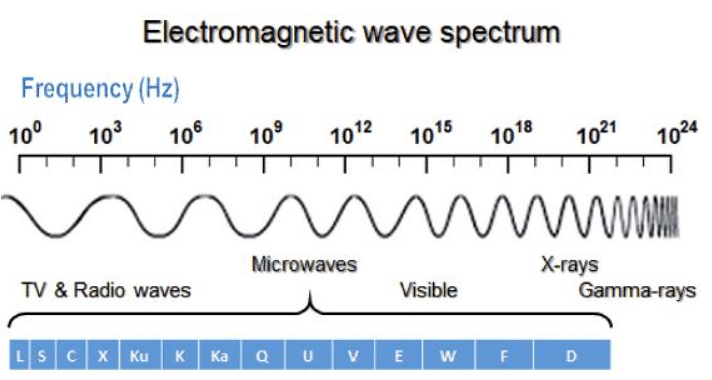
Electromagnetic Spectrum
All electromagnetic radiation is included in the electromagnetic spectrum, which also contains a large number of subranges or sections. Different types of electromagnetic radiation are:
- Radio waves
- Microwaves
- Infrared rays
- Visible Light
- Ultraviolet rays
- X- rays
- Gamma rays
What are Microwaves?
[Click Here for Sample Questions]
Microwaves are electromagnetic radiations with frequencies between 300 MHz and 300 GHz and wavelengths between 1 mm and roughly 30 cm. Microwave radiation is commonly referred to as microwaves.
- On the electromagnetic spectrum, they can be located between infrared and radio waves.
- The microwaves are produced by vacuum tubes such as klystrons, magnetrons, and Gunn diodes.
- Metal surfaces reflect electromagnetic waves.
- A certain wavelength of microwaves may transmit and receive data from satellites in orbit because they can pass through the atmosphere.
- Metal satellite dishes are utilized as a result because they effectively reflect microwaves. Microwaves at a particular frequency are absorbed by water.
Properties of Microwaves
[Click Here for Sample Questions]
The following are a few of the properties of microwaves:
- Microwaves are capable of radiating electromagnetic energy with shorter wavelengths.
- Surfaces made of metal reflect microwaves.
- Glass and plastic can both be penetrated by microwaves.
- People use a plastic or glass container in a microwave oven instead of a metal one because the metal reflects microwaves away from food.
- When delivering data to and from satellites in orbit, microwaves with a particular wavelength can travel through the Earth's atmosphere. Metals reflect microwaves well, thus satellite dishes are fashioned with them.
- The transmission of microwaves from one place to another is affected by phenomena like dispersion, refraction, reflection, and interference.
- Microwaves are not reflected by the ionosphere.
- Water absorbs specific microwave frequencies. Cooking can benefit from this microwave feature. Microwaves absorb the food's water, heating it up and cooking the food as a result.
Applications of Microwaves
[Click Here for Sample Questions]
Microwaves have a wide range of practical uses, such as radar systems, microwave ovens, and monitoring the speed of moving things like tennis balls and cars. Following are the uses of microwaves:
Telecommunication, Space communication is the exchange of information between the Earth and outer space.
- Microwaves are used in the food processing sector of the economy.
- Other industries that use microwaves include those that are based on chemicals, plastics, rubber, wood products, and so forth.
- With a power of 600 W and a frequency of 2.45 GHz, microwave ovens are used to heat food.
- Microwaves are used in man-made public works projects to among other things, break rocks, dry or break concrete, and cure cement.
- A wide range of diagnostic and therapeutic techniques employ microwave technology.
- Microwaves are used to check for lung water conditions, monitor heartbeat, and determine how much water is in the lungs.
- Diathermy uses microwaves to heat a particular area of the skin.
- In addition to monitoring missiles, microwaves are also employed to spot aircraft and other soaring objects.
- The distance between objects and their speed of flight is calculated using microwaves.
A useful use of microwaves is in microwave ovens. The cooking top of the oven is constructed of ceramic glass. Inside the oven, there are waveguides, stirring fans, and metallic magnetron tubes.
Microwaves and Cellphones
[Click Here for Sample Questions]
Microwaves are used to transmit cell phone signals through the atmosphere. By altering the frequency of the waves, the caller's voice can be encoded in microwaves. This process is known as frequency modulation.
- The cell tower receives the encoded microwaves through the air.
- The waves proceed to a switching center from the cell tower.
- From there, they travel to a different cell tower and then, from the tower to the caller.
- The receiver converts the microwaves that were encoded back to sound.
- Buildings and other obstacles can interfere with microwave transmissions, thus cell towers must be erected well above the ground to shield mobile phone signals from this.
Interesting Facts about Microwaves
[Click Here for Sample Questions]
Some interesting facts about microwaves are:
- The employment of microwaves to discover the early signs of the Big Bang is something that is not widely recognized.
- Two scientists who just so happened to be using specialized low-noise antennae in the 1960s saw something extraordinary.
- They could hear sounds coming from all sides and then they observed something weird. There was constant noise coming from every direction.
- The two scientists, Arno Penzias, and Robert Wilson, assumed that the direction would be rather specific if it originated from anywhere on Earth, but it wasn't!
- They realized they had unintentionally found the cosmic microwave background radiation.
- This microwave radiation permeates the whole electromagnetic spectrum and served as our initial indicator of the Big Bang's occurrence.
- There is a widespread perception that because microwaves generate radiation, they are unhealthy.
- Yet, microwaves belong to the electromagnetic spectrum's low frequencies. They are also weakly energetic.
- As a result, they lack the energy necessary to ionize things and modify their chemical composition.
- Here, the word "radiation" refers to energy rather than radioactivity.
- Moreover, certain research has cancer-causing effects (these are not the same as previously mentioned high energy emitting exposure).
Also Read:
| Related Articles | ||
|---|---|---|
| Electromagnetic spectrum | Unit of the wavelength | Electromagnetic wave |
| Magnetic field | Types of radiation | Radio waves |
Things to Remember
- Microwave radiation penetrates the whole electromagnetic spectrum and was our first sign that the Big Bang had happened.
- Microwaves are electromagnetic radiations with frequencies in the range from 300 MHz to 300 GHz and wavelengths ranging from 1 mm to nearly 30 cm.
- Several processes are used to create electromagnetic waves. Based on their methods of production, interactions with matter, and practical uses, the bands differ, reflecting various features.
- The ability to categorize electromagnetic waves and organize them according to their various frequencies or wavelengths is the main significance of the electromagnetic spectrum.
- Low-frequency components of the electromagnetic spectrum include microwaves. They have low energy levels as well. They lack the energy needed to ionize objects and change their chemical makeup as a result.
Sample Questions
Ques. What does the microwave electromagnetic spectrum look like? (4 marks)
Ans. Microwave is electromagnetic radiation having a frequency between 300 MHz and 300 GHz. The wavelength, on the other hand, varies from 1 mm to about 30 cm. Microwaves are a frequent name for electromagnetic radiation. On the electromagnetic spectrum, they are located halfway between radio waves and infrared radiation.
Ques. Explain the justifications behind the name of the electromagnetic spectrum. (3 Marks)
Ans. The name given to the collection of all electromagnetic radiation present in the cosmos is the electromagnetic spectrum. The transport of energy and information is made possible by energy that permeates the cosmos in the form of electric and magnetic waves.
Ques. What fundamental components make up the electromagnetic spectrum? (2 Marks)
Ans. Elements of the electromagnetic spectrum are termed as follows, by the highest to the lowest energy: gamma rays, X-rays, UV radiation, visible light, infrared radiation, and radio waves.
>Ques. What use do microwaves serve? (3 Marks)
Ans. The main usage of microwave radiation is for cooking in a microwave. By directly transferring energy to the water molecules contained in food items, the microwave employs radiation. These radiations are also used by astronomers to analyze the structure of surrounding galaxies and stars.
Ques. How does the microwave spectrum originate? (3 Marks)
Ans. Since they are essentially radio waves with an incredibly high frequency, transmitters of all kinds can produce microwaves. They are created by a transmitter chip and an antenna in a mobile phone, whereas a "magnetron" is used in a microwave oven to create them. They typically have a few centimeters as their wavelength. Even stars emit microwaves.
Ques. Write the characteristics of electromagnetic waves. (4 Marks)
Ans. The following are characteristics of electromagnetic waves:
- By oscillating magnetic fields and electric fields at right angles to one another, electromagnetic waves are propagated.
- In a vacuum, these waves move at the speed of 3 × 10⁸ meters per second.
- Magnetic or electric fields have no effect on them.
- Diffraction or interference can be seen in them.
- The relationship between wavelength and frequency is c = vλ.
Ques. What causes electromagnetic radiation? (2 Marks)
Ans. When an electron or any atomic particle like it is propelled by an electric field, electromagnetic radiation results.
Ques. Describe the incidence of the first clue to the big bang theory. (4 Marks)
Ans. Not many people are aware that microwaves can be used to find the first traces of the Big Bang. In the 1960s, something extraordinary was observed by two scientists who just so happened to be utilizing specialized low-noise antennae. They could hear noises coming from all directions, and then they noticed an odd sight. Every direction was filled with a continual din. The direction wasn't as specific as the two scientists, Arno Penzias and Robert Wilson, thought it would be if it came from anywhere on Earth. They came to the conclusion that they had accidentally discovered the cosmic microwave background radiation. This microwave radiation, which permeates the entire electromagnetic spectrum, was our first sign that the Big Bang had happened.
Ques. What is the relationship between microwaves and RADAR? (4 marks)
Ans. Radio Detection and Ranging is known as RADAR. Authorities employ radar guns to find automobiles traveling too fast. An instantaneous microwave burst is sent by a radar gun. The radar gun's receiver picks up microwave reflections from the approaching car. The vehicle's speed is used to calculate its own speed. Radar is used, among other things, to monitor air traffic and track storms.
Ques. What is the relationship between microwaves and cell phones? (4 marks)
Ans. Cell phone signals are transmitted through the environment using microwaves. The caller's voice can be encoded in microwaves by changing the frequency of the waves. Frequency modulation is the technical word for this. The airborne microwaves with encryption are picked up by the cell tower. The waves leave the cell tower and travel to a switching center. They then proceed to a different cell tower before arriving at the caller via the tower. The encoded microwaves are converted back to sound by the receiver. To protect mobile phone signals from this interference caused by structures and other impediments, cell towers must be placed far above the ground.
For Latest Updates on Upcoming Board Exams, Click Here: https://t.me/class_10_12_board_updates
Also Read:



Comments