



Education Content Expert
Monomeric Proteins are molecules that combine to form complex protein structures. Monomers are molecules that are combined to form polymers. Various monomers of protein bonds bind to other monomers in repeating chain molecules through the process of polymerization.
- Monomers of Proteins may be either of natural origin or synthetically made.
- The building block monomers of proteins are called amino acids.
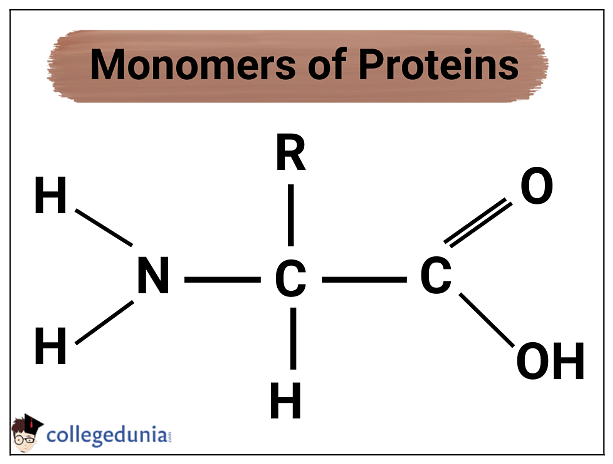
- Amino acids are small organic molecules that consist of an alpha carbon atom linked to an amino or a carboxyl group and hydrogen atom, and a variable component called a side chain.
- There are twenty different types of amino acids, of which 11 are essential, and 9 are non-essential in the natural form.
- Monomers are essential for the existence of life on Earth.
Key Terms: Monomeric Proteins, Monomers, Polymer, Molecules, Starch, Amino Acids, Glucose, Nucleotides
What are Monomers?
[Click Here for Sample Questions]
Monomers are the small number of molecules joining a chain to form more complex compounds called polymers.
- Some common examples of monomers are Vinyl Chloride, Glucose, and amino acids.
- Glucose is the most abundant polymer, which naturally occurs in the environment.
- Monomers can be synthesized abiotically, and each of them is a vital component for the existence and development of life.
- They are generally found in nebulae or interstellar medium.
Read More:
| Relevant Concepts | ||
|---|---|---|
| Difference between Essential and Non-essential Amino Acids | Test for Protein | Copolymers |
| Proteolytic Enzymes | Lysine | Biopolymers |
What are Monomeric Proteins?
[Click Here for Previous Year Questions]
Monomeric Proteins are the protein molecules that usually come together and combine to form multi-protein complex structures.
- They represents a huge class of molecules that are further generalized in subgroups, including sugars, amino acids, fatty acids, and nucleotides.
- All of these monomer plays very important roles in the existence and development of life.
- These proteins can also be synthesized abiotically.
- Some of the hydrophobic monomers are Valine, Leucine, and Cysteine.
Monomers of Proteins
Monomers of Protein Bonds
[Click Here for Sample Questions]
Amino Acids are the monomers that combine to build a polymer known as protein. There are 20 monomers of amino acids that possess a general structure.
Sugar Monomers
- Glucose is a most common natural monomer that combines to form polymers of starch, cellulose, and glycogen.
- Carbohydrate made up of a single sugar monomer is called a monosaccharide.
- They are also known as a simple sugar.
- The three monomers of sugar are glucose, fructose, and galactose.
- All three monosaccharides have the same formula, that is, C6H12O6.
- Glucose is also known as dextrose.
Nucleotides
- They are monomeric proteins that join together to form the structural units of RNA and DNA.
- They provide an energy source for metabolism activity.
- Nucleotides are the building blocks of nucleic acid.
- A sugar molecule and a nitrogen base are attached to a phosphate group.
- There are four types of nucleotides namely Adenine Base, Thymine Base, Cytosine Base, and Uracil Base.
Composition of Protein
[Click Here for Previous Year Questions]
Proteins is the covalent bonds that include carbon, hydrogen, oxygen, nitrogen, and Sulphur.
- The basic building blocks of monomeric protein include the 20 amino acids with different lengths and backbone atoms.
- Amino acids form a covalent bond to make a protein molecule.
- These are often referred to as the peptide bond.
- Our body consists of different types of proteins, and the quantity in which they are present are vital for the normal functioning of the human body.
- Protein structures present inside our body are structural proteins.
Protein Structures
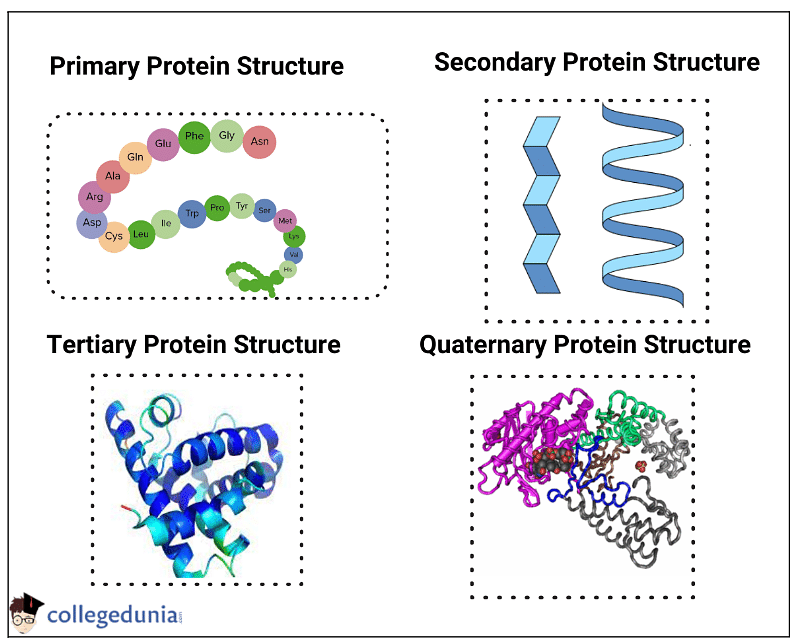
There are four main structures of proteins.
- Primary Protein Structure: The long and defined polypeptide chains are called proteins, in which one end of the chain contains the free amino group (-NH2), and the other end consists of the free carboxyl group. Amino acids of the chain are linked with peptide bonds. The protein is composed of two or more polypeptide chains called multimeric proteins. It can also show in the form of a quaternary structure.
- Secondary Protein Structure: The formation of the non-covalent bond between the –NH and –CO groups of the amino acids, which are very close to one another, is defined as the secondary structure of the protein. It has an alpha-helix structure, and the helix forms a spiral. The hydrogen bonds are the reason why the protein is functional. They can be broken only by taking the temperature to very high levels or if the acidic property of the surrounding is increased.
- Tertiary Protein Structure: The tertiary protein structure is the polypeptide chain that bends and turns at different places to give a spherical formation. The side chain reaction of amino acids then stabilizes the structure.
- Quaternary Protein Structure: These proteins exist as two or more polypeptide chains. Differed polypeptide chains are bound together by non-covalent and generally by covalent bonds.
Types of Proteins
[Click Here for Sample Questions]
The proteins can be classified into two types
Fibrous Proteins
- According to the basic definition of Fibrous Proteins, a polypeptide chain runs parallel and is held together by hydrogen and disulfide bonds, then a fiber-like structure is formed.
- These types of proteins are insoluble in water.
- Examples of this type of protein are keratin (present in hair, nails) and myosin (present in muscles), and many more.
Globular Proteins
- The chains of polypeptide coil around to give this protein a spherical shape.
- These types of protein are soluble in water examples of Insulin and albumin (present in egg).
- The shape and structure of proteins can be divided into further types like primary, secondary, tertiary, and quaternary.
Building Blocks of Monomeric Proteins
[Click Here for Previous Year Questions]
Amino acids are the building blocks of monomeric proteins, and all the other types of proteins and polymers are made from them. Amino acids are classified into two groups:
- Essential Amino Acids: They can be synthesized or produced in the body. There are nine amino acids: Leucine, Valine, Phenylalanine, Tryptophan, Lysine, Threonine, Methionine, Histidine, and Isoleucine.
- Non-essential Amino Acids: These are synthesized by our body and are not necessarily taken as food supplements thus are called non-amino acids. There are 11 non-essential amino acids namely Arginine, Alanine, Aspartic Acid, Cysteine, Glutamine, Glutamic Acid, Proline, Glycerine, Glycine, Serine, and Tyrosine.
Without these amino acids, it will be difficult for our body to synthesize the monomeric proteins required to repair, grow, and maintain cells.
20 Monomers of Proteins
[Click Here for Sample Questions]
The 20 monomers of proteins are mentioned below.
| 20 Monomers of Proteins | |||
|---|---|---|---|
| Leucine | Threonine | Alanine | Proline |
| Valine | Methionine | Aspartic Acid | Glycerine |
| Phenylalanine | Histidine | Cysteine | Serine |
| Tryptophan | Isoleucine | Glutamine | Glycine |
| Lysine | Arginine | Glutamic Acid | Tyrosine |
Things to Remember
- Proteins are vital for the normal functioning of the human body.
- Monomeric Proteins are organic compounds made up of amino acids.
- Amino acids are the building block of proteins and are used by the human body to break down food, grow, and repair body tissues.
- There are four levels of structural organization in Proteins- Primary, Secondary, Tertiary, and Quaternary Protein Structure.
- The basic building blocks of protein include the 20 amino acids with different lengths and backbone atoms.
Check More:
| Related Topics | ||
|---|---|---|
| Translation | L Methionine | Histidine |
| Peptide Bond or Peptide Linkage | Translation Protein Synthesis | Denaturation of Proteins |
Previous Years’ Questions
|
Sample Questions
Ques. What are the different types of monomers? (3 Marks)
Ans. The different types of monomers are:
- Carbohydrates: Made up of monosaccharides.
- Lipids: Made up of fatty acids and glycerol.
- Nucleic Acids: Made up of nucleotides.
- Proteins: Made up of Amino acids.
Ques. What are examples of protein monomers? (3 Marks)
Ans. Some examples of protein monomers are:
- Hydrophilic Monomer (Water-loving): Glutamine, Lysine, etc.
- Hydrophobic Monomer (Water-repelling): Valine, Isoleucine, etc.
- Neither Hydrophilic nor Hydrophobic: Glycine, Serine, etc.
Ques. What are Monomers and Polymers of Protein? (3 Marks)
Ans. Monomers are defined as single molecules that are joined together with other molecules of the same type to form a polymer. The building block units of proteins are amino acids which are together called as the monomers of proteins. Monomeric will simply be the amino acids, and the polymers are referred to as proteins.
Ques. Explain the functionality of a monomer. (3 Marks)
Ans. The functionality of a monomer implies the number of binding sites present in it. Examples of monomers like propene, styrene, and many others that have functionality have one bonding site. Monomers such as ethylene glycol, hexamethylenediamine, and fatty acid have two bonding sites.
Ques. List some monomers and the macromolecule of their structure. (3 Marks)
Ans. Some monomers along with the macromolecule of their structure are as follows:
| Monomer | Macromolecule |
|---|---|
| Amino Acids | Proteins |
| Fatty Acid and Glycerol | Lipids |
| Nucleotides | Nucleic Acids |
| Monosaccharide | Carbohydrates |
Ques. What are the essential amino acids and non-essential amino acids? (3 Marks)
Ans. Amino acids are classified into two groups essential amino acids and non–essential amino acids.
- Essential Amino Acids: There are nine amino acids namely leucine, valine, phenylalanine, tryptophan, lysine, threonine, methionine, histidine, and isoleucine.
- Non–essential Amino Acids: There are 11 non-essential amino acids namely arginine, alanine, aspartic acid, cysteine, glutamine, glutamic acid, proline, glycerine, glycine, serine, and tyrosine.
Ques. Explain the different types of Proteins and their types. (3 Marks)
Ans. Proteins are considered the fundamental building block unit of the body. They also strengthen our body for producing hormones, enzymes, and all the other metabolic activities.
- Fibrous: These types of protein are found in animals and insoluble in water. Fibrous proteins are enzymes resistant and exist as thread-like structures and form fibers, for example, collagen and keratin in hair, claws, and feather of birds.
- Globular: These types of proteins are water-soluble and are made up of polypeptides that form spherical molecules like albumin and insulin and hormones like oxytocin.
Ques. How many Monomers of Proteins are there? (2 Marks)
Ans. Monomeric Proteins are made up of Amino acids. They form a covalent bond to make a protein molecule. These are often referred to as the peptide bond. The human body consists of 20 different types of amino acids. All of them possess a general structure. A few of them are glutamine, glutamic acid, proline, valine, phenylalanine, and tryptophan.
Ques. How do you know if a Protein is monomeric? (2 Marks)
Ans. The simplest way to determine whether a protein is a monomeric protein is to check its band structure. If there is one band in both gels, it is monomeric. If there are two different bands in both gels, it is polymeric. The protein structure generally consists of 4 monomers.
Ques. What are the three parts of the monomer for protein? (2 Marks)
Ans. Amino acids are the basic structure that makes up proteins. The structure of all the types of amino acids is the same. The three parts of the monomeric proteins are-
- Central carbon atom bonded to an amino group
- A carboxyl group
- A hydrogen atom
Ques. What is a Monomer? (1 Mark)
Ans. Monomer means a single molecule that can combine with other molecules of monomer and form a polymer.
Ques. What is polymerization? (1 Mark)
Ans. The process by which a number of monomers combine and form a large chain is known as polymerization.
Ques. What are Monosaccharides? (1 Mark)
Ans. Monosaccharides are the most basic form of carbohydrates. Most organisms produce and store energy by breaking down the monosaccharide glucose and harvesting the energy released.
Ques. What types of proteins are present in albumin and insulin? (1 Mark)
Ans. The globular type of protein is present in albumin and insulin.
Ques. What is Glycogen? (1 Mark)
Ans. Glycogen is the stored form of glucose that is made up of many connected glucose molecules and it is the main source of energy. It comes from carbohydrates in certain fluids and food you consume.
For Latest Updates on Upcoming Board Exams, Click Here: https://t.me/class_10_12_board_updates
Check-Out:



Comments