



Education Journalist | Study Abroad Lead
Ohm's Law formula is V = IR where V=voltage, I=current, and R=resistance. Ohm’s Law links voltage (V) and current (I) to the properties of the conductor, that is its resistance (r) in a circuit. Ohm’s law states that voltage across a conductor is proportional to the current flowing through it, considering all physical conditions and temperatures remain constant. The most basic and important law of electric circuits is the Ohm's Law.
| Table of Content |
Key Terms: Ohm's Law, Ohm's law formula, Ohm's Law, Resistance, Ohm's Law Example, Law of Resistance, Ohm's Law Calculation, Voltage, Current
Ohm’s Law
[Click Here for Sample Questions]
Ohms law essentially describes a mathematical relationship between the voltage (V), current (I), and circuit resistance ( R ).

Ohm's Law
Mathematically, Ohm's Law is written as:
V = I * R
Where,
- V is the Voltage (Potential Difference) measured in Volts.
To find voltage (V),
[V = I x R] V(volts) = (amps) x R(Ω)
- It is the current flowing through the conductor.
To Find the current (I),
[I = V / R] I(amps) = V(volts) + R(Ω)
- R is the resistance of the circuit measured in Ohms (Ω).
To find the resistance (R),
[R = V / I] R= V volts) / I(amps)
Ohms Law Explained
Ohms law video
Also Check:
Application of Ohm's Law
[Click Here for Previous Year Questions]
The applications of ohm’s law are:
- Ohm’s law helps in determining resistance, current, voltage of a circuit when two of the three quantities are known to us.
- Ohms law makes power calculation simple.
- Maintains the desired voltage in the electric component.
- Ohm's law is used in DC shunts and DC ammeter to divert the current.
Relationship Between Voltage, Resistance and current
[Click Here for Sample Questions]
The relationship of current, resistance and voltage is expressed by Ohm’s Law. It states that the current flowing in a circuit is proportional to the applied voltage and inversely proportional to the circuit, provided the temperature remains constant.
Current (I) = Voltage (V) / Resistance (R)
To increase the current flowing in a circuit, the voltage must be increased, or the resistance decreased.
Calculating Resistance Equation using Ohm’s Law
[Click Here for Previous Year Questions]
Ohm's Law equation is used to calculate the voltage, current and resistance of a circuit. The ohm's law formula triangle is-

Ohms Law Triangle
Now, To calculate the current in a circuit, rearrange the Ohm's Law equation as-
I = V / R

Similarly, you can calculate the electrical resistance of a circuit through-
R = V / I

For a circuit to obey Ohm's Law, Constant Resistance (R) is required.The Electrical resistance in a circuit is affected by various physical factors, including temperature. The resistance increases as the temperature increases (such as copper wire), so Ohm's Law does not hold true in that case.
Also Check:
Limitations of Ohm’s Law
[Click Here for Sample Questions]
Given below are the few examples where the Ohm’s law fails to apply:
- A diode demonstrates the limitations of Ohm’s law. When the V vs I graph for a diode is plotted, it is observed that the relation between V and I is not linear. This happens when V is marked in a reverse direction so that the magnitude is fixed. The I is therefore produced in the opposite direction with a different magnitude.
- Due to the unilateral network, Ohm’s law is not applicable to a water volt-ammeter.
- It is also not necessary that all the conductors obey Ohm’s law. Also, semiconductors like Germanium and Silicon do not obey Ohm’s law. Therefore, they are regarded as Non-Ohmic conductors.
Ohm's Law Pie Chart and Matrix Table
[Click Here for Previous Year Questions]
All the equations used to find the current, voltage , resistance and power, and combine them into a simple Ohm’s pie chart and matrix table as shown below.

Ohm's law Pie Chart
We can also combine the individual Ohm’s Law equations into a simple matrix table as shown below for calculating an unknown value.
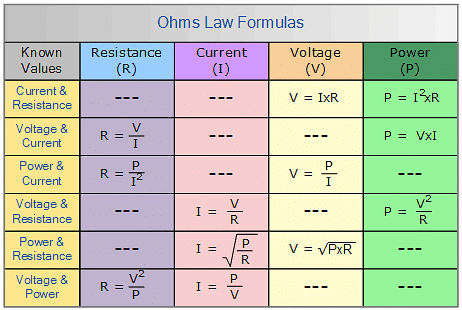
Ohm’s Law Matrix Table
Discover about the Chapter video:
Current Electricity Detailed Video Explanation:
Things To Remember
- The Ohm's law helps in determining resistance, current, voltage of a circuit when two of the three quantities are known to us.
- One of the most important laws in electrical theory as It links voltage (V) and current (I) to the properties of the conductor, that is its resistance (r) in a circuit.
- The SI unit of electric resistance is the ohm (Ω). 1 Ω = 1 V/A.
- Ohm’s law is not applicable to a water volt-ammeter due to the Unilateral Network.
Previous Year Questions
- A square loop ABCD, carrying a current I, is placed near and coplanar with a long straight conductor XY carrying a current I, as shown in figure. The net force on the loop will be
- Which of the following graph represents the variation of resistivity $(\rho)$ with temperature (T) for copper ?
- In a good conductor of electricity, the type of bonding that exists is:
- A wire of length ll and resistance RR is stretched to get the radius of cross-section r2r2 . Then the new value of RR is
- A galvanometer of resistance 20Ω20Ω is to be converted into an ammeter of range 1A1A. If a current of 1mA1mA produces full scale deflection, the shunt required for the purpose is
- A current of 5A5A is passing through a metallic wire of cross-sectional area 4×10⁻⁶m24×10−6m2 . If the density of charge carriers of the wire is 5×10265×1026 m−3,m−3, the drift velocity of the electrons will be
- In the Wheatstone's network given, P=10Ω,Q=20Ω,R=15Ω,S=30Ω,P=10Ω,Q=20Ω,R=15Ω,S=30Ω, the current passing through the battery (of negligible internal resistance) is
- An electric motor runs on DC source of emf 200V200V and draws a current of 10A10A. If the efficiency be 40%40%, then the resistance of armature is
- An electron moves in a circle of radius 1.0cm1.0cm with a constant speed of 4.0×10⁶m/s4.0×106m/s , the electric current at a point on the circle will be (e=1.6×10⁻¹⁹C)
- A cell of constant emf first connected to a resistance $ {{R}_{1}} $ and then connected to a resistance $ {{R}_{2}} $ . If power delivered in both cases is same, then the internal resistance of the cell is
- A galvanometer of 50Ω50Ω resistance has 2525 divisions. A current of 4×10−44×10−4 A gives a deflection of one division. To convert this galvanometer into a voltmeter having a range of 25V25V, it should be connected with a resistance of
- Five equal resistances each of resistance RR are connected as shown in the figure. A battery of VV volts is connected between AA and BB. The current flowing in AFCEBAFCEB will be
- A 6V6V battery is connected to the terminals of a three metre long wire of uniform thickness and resistance of 100Ω100Ω . The difference of potential between two points on the wire separated by a distance of 50cm50cm will be
- Which of the following II- VV graph represents ohmic conductors ?
- Which of the following is correct for VV-II graph of a good conductor ?
- Which of the following is NOT the name of a secondary cell ?
- Which of the following is secondary cell?
- Wire bound resistors are made by
- With increase in temperature the conductivity of
Sample Questions
Ques 1. What does Ohm’s law state? (2 marks)
Ans. The ohm's law states that the voltage through a conductor between two points is directly proportional to the current across the two points. Considering all physical conditions and temperatures remain constant.
Ques 2. What can Ohm’s law be used for? (2 marks)
Ans. Ohm’s law is used for validating the static values of all the circuit components such as current levels, voltage supplies and drops. Ohms law makes power calculation simple. The ohm's law Maintains the desired voltage in the electric component. It is used in DC shunts and DC ammeter to divert the current.
Ques 3. Is Ohm’s law Universal? (2 marks)
Ans. Ohm's law is not a universal law because it is only applicable to ohmic conductors such as iron and copper but is not applicable to semiconductors or non ohmic conductors.
Ques 4. Why is Ohm’s law not applicable to semiconductors? (2 marks)
Ans. The law does not apply to them as they are nonlinear devices. Which means that the ratio of voltage to current doesn’t remain constant for variations in voltage.
Ques 5. When does Ohm’s law fail? (2 marks)
Ans. It fails to explain the behavior of unilateral devices and semiconductors such as diodes. Ohm’s law does not give the apt results if the physical conditions such as pressure or temperature are not kept constant.
Ques 6. Find the resistance of an electrical circuit that has voltage supply of 10 Volts and current of 5mA. (3 marks)
Ans. V = 10 V, I = 5 mA = 0.005 A
R = V / I
= 10 V / 0.005 A
= 2000 Ω = 2 kΩ
Ques 7. What is the Si unit of ohm's law? (2 marks)
Ans. The SI unit of electric resistance is ohm (Ω). 1 Ω = 1 V/A.
Ques 8. Why is ohm's law important? (3 marks)
Ans. Ohm's regulation is vitally crucial to describing electric circuits as it relates the voltage to the modern-day, with the resistance value moderating the relationship among the two.
Because of this, you may use Ohm’s law to control the amount of modern-day in a circuit, including resistors to reduce the modern-day drift and taking them away to increase the amount of current.
- It can also be extended to explain electric strength (the rate of electricity float in step with 2d), due to the fact electricity P = IV, and so you can use it to make sure your circuit presents sufficient power to, say, a 60-watt equipment.
- For physics students, the most crucial thing about Ohm’s law is that it permits you to investigate circuit diagrams, particularly when you integrate it with Kirchhoff’s laws, which comply with it.
- Kirchhoff’s voltage law states that the voltage drop round any closed loop in a circuit is always identical to zero, and the modern regulation states that the amount of cutting-edge flowing into a junction or node in a circuit is the same to the amount flowing out of it.
- Ohm’s regulation with the voltage regulation in particular to calculate the voltage drop across any factor of a circuit, that's a commonplace problem posed in electronics classes.
Ques 9. For the circuit shown below find the Voltage (V), the Current (I), the Resistance (R) and the Power (P). (3 marks)

Ans. Voltage [ V = I x R ] = 2 x 12Ω = 24V
Current [ I = V ÷ R ] = 24 ÷ 12Ω = 2A
Resistance [ R = V ÷ I ] = 24 ÷ 2 = 12 Ω
Power [ P = V x I ] = 24 x 2 = 48W
Ques 10. An EMF source of 8.0 V is connected to a resistive electrical appliance (a light bulb). An electric current of 2.0 A flows through it. Consider the conducting wires to be resistance-free. Calculate the resistance. (2 marks)
Ans. When we are asked to determine the value of resistance when the values of voltage and current are given, we cover R in the triangle. This leaves us with V ÷ I.
R = V ÷ I
R = 8 V ÷ 2 A = 4 Ω
R = 4
Ques 11. If a voltage of 10 volts is placed across a 500 ohm resistor, determine the amount of current that will flow. (2 marks)

Ans. Looking at the Ohms Law triangle the current is the unknown leaving the voltage and resistance as the known values.

In this way the current is found by dividing the voltage by the resistance.
I = \(\frac{V}{R}\) = \(\frac{10}{500}\)= 0.02A = 20mA
For Latest Updates on Upcoming Board Exams, Click Here:https://t.me/class_10_12_board_updates
Also Check:



Comments