



Education Journalist | Study Abroad Lead
Difference between Electric and Magnetic fields can be understood by the nature of the moving charges in any material. Electric and magnetic fields are represented in two dimensions using field lines. The densities of these field lines are indicative of the strength of the field at a particular point. The denser the field lines, the stronger the field. To model the unique aspects of each force, the conventions show how electric, and magnetic field lines are all slightly different.
Read More: Current Electricity
| Table of Content |
Key Terms: Electric Field, Magnetic Field, Electric Charge, Coulomb, Vector, Field Lines, Work, Current Electricity, Dimension, Electricity
Difference between Electric Field & Magnetic Field
[Click Here for Sample Questions]
Electric and magnetic fields are interrelated but not dependent on one another. The following table summarises the key differences between the electric and magnetic fields.
| Characteristic | Electric Field | Magnetic Field |
|---|---|---|
| Symbol | Denoted with the letter, E. | Denoted with the letter, B. |
| Units | Newton per coulomb, or volt per metre | Gauss or Tesla, Newton Second/ Coulomb meter (after Nikola Tesla) |
| Quantity | Vector | Vector |
| Dimension | Exists in Two-dimension | Exists in Three-dimension |
| Electronic charge | Creates an electric charge in the surrounding (positron and electron) | Creates an electric charge around the moving magnets |
| Formula | Newton / coulomb (N/C) | Tesla, wb/m2 |
| Proportionality | Proportional to the electric charge | Dependent on the speed of moving the electric charge |
| Perpendicularity | Perpendicular to the magnetic field | Perpendicular to the electric field |
| Measuring Instrument | Electrometer | Magnetometer |
| Poles | Monopoles or single charges (positive or negative) exist. | Only dipoles exist |
| Field Lines | Straight lines which move away( positive charges) and move inwards (electrons)- no loop formation | Start at the north pole and end at the south pole- form a loop |
| Work Done | Work is done by changing velocity and direction. | Work Done is zero |
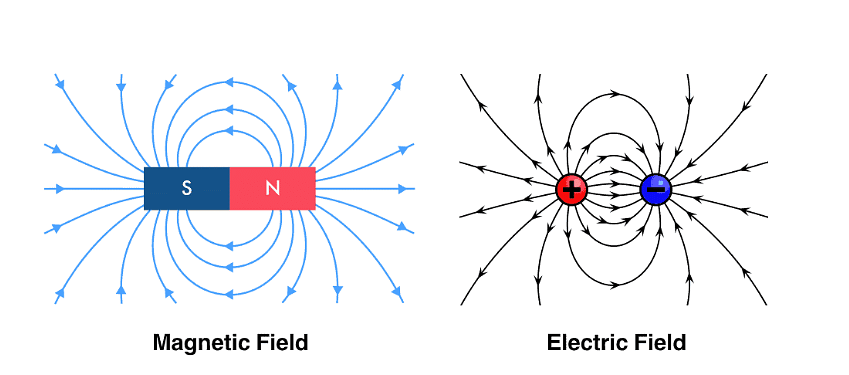
Magnetic Field vs Electric Field
Discover about the Chapter video:
Current Electricity Detailed Video Explanation:
Read More: NCERT Solutions of Current Electricity
What is Electric Field?
[Click Here for Previous Year Questions]
Electric field or electric field intensity refers to the force that surrounds an electrically charged particle. It can also be referred to as an area where the lines of force exist. These lines of force surround the electric field and are imaginary lines used to define the area of influence around the electric charge.
- It is a vector quantity since it has both direction and magnitude.
- The symbol for electric field is E and the unit of measuring it is Newton/Coulomb.
- The electric field E is produced by the charge Q which is the source of the field where,
E = \(\frac{Q {r^*}}{(4\pi \in 0 )r2}\)
where r* is the unit vector along the direction r, and the field E is a vector field. A charge q interacts with this field and experiences a force F given by F = q E = q Q r* / (4πε0 ) r2
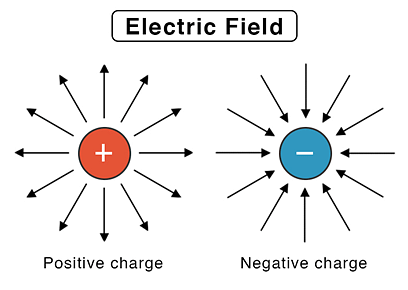
Electric Field
Also Read: Difference between Electric & Magnetic Field -Important Questions
Properties of Electric Field
Electric fields arise from electric charges and changing magnetic fields. An electric charge, or a collection of charges, will have an associated electric field. Any charged object that is placed in this field will experience an electrostatic force as the field interacts with the charge of the object.
- Field lines represent the force a positively charged particle would experience if it were in the field at that point.
- A changing magnetic field can also cause electric charges to move.
- This phenomenon is generally used in electric generators to induce electric currents in wires.
- The induced current can be enhanced by causing larger changes in the magnetic field or by coiling the wire.
- This is done so that more wire is affected by the changing magnetic field.

The direction of Electric Field
Also Read:
| Important Concepts Related to Electric & Magnetic Field | ||
|---|---|---|
| Momentum | Velocity | Ohm’s Law And its Limitations |
| Kirchhoff’s Rules | Wheatstone Bridge | Meter Bridge |
| Circuit Diagram | Potentiometer | Ampere |
| Electromotive Force | Combination of Resistors-Series and Parallel | Unit of Current |
What is a Magnetic Field?
[Click Here for Sample Questions]
Magnetic field refers to the area around the magnet where the attractive and repulsive forces are exhibited by the poles of the magnet. When electric charges move across an electrical conductor or space, due to the motion, a magnetic field is induced. It arises from permanent magnets and electric charges in motion.
It is denoted by B (r). It is also a vector field and has several basic properties that are identical to the electric field. It is defined at each point in space and in addition, can also depend on time.

Magnetic Field
Read More: Resistance and Length Relation
Things to Remember
- Work is done by the field when a particle enters its field of force or influence.
- The force between the charges is the same.
- A positive electron repels another positive electron but attracts a negative electron.
- There are two types of charges present in an electric field.
- The positive charge is known as the positron and the negative charge is called the electron.
Read More:
Also Read: Difference between Electric & Magnetic Field MCQs
Previous Year Questions
- A direct current of 5A is superposed on an alternating…(NEET 2015)
- A resistance wire of 72 Ω has connected across… (COMEDK UGET)
- A 220-volt input is supplied to a transformer… (NEET 2010)
- A circuit when connected to an AC source of… (NEET 2019)
- A coil has a resistance of 30 ohms…(NEET 2011)
- A coil is self-inductance L is connected in series with…(NEEt 2013)
- A condenser of capacity C is charged… (NEET 2010)
- A series LCR circuit is connected to an ac voltage source…(NEET 2020)
- A transformer that has an efficiency of 90% is working on… (NEET 2014)
- An AC voltage is applied to a resistance R and an inductor…(NEET 2011)
- In the given circuit the reading of the voltmeter… (NEET 2010)
- Which of the following combinations should be selected for…(NEET 2016)
- In an A.C. circuit, V and I are… (KCET 2011)
- The core of a transformer is laminated to reduce… (KCET 2001)
- The output of a step-down transformer is measured to be…(KCET 2017)
- In the circuit shown, the symbols have their usual meanings…(BITSAT 2018)
- An electrical cable having a resistance of…(WBJEE 2009)
- A coil of inductance 8.4 mH and resistance… (JEE Advanced 1999)
- A coil of resistance 10Ω and inductance… (VITEEE 2011)
- For a coil having L = 2 mH, current flow through it is… (NEET 2001)
Also Read:
Sample Questions
Ques: Is it possible that electric fields exist without magnetic fields? (2 Marks)
Ans: Electric fields can exist without a magnetic field, for example, a stationary point charge. A stationary electric charge is able to create an electric field while a changing electric field is able to create a magnetic field.
Ques: What are the similarities between electric and magnetic fields? (3 Marks)
Ans: Similarities between electric and magnetic fields are as follows:
- Unlike poles attract just like, like poles repel.
- Both electric and magnetic fields are produced by two kinds of charges/magnetic poles; positive and negative in the case of electric fields and north and south poles in the case of magnetic poles although the latter is produced by moving charges.
Ques: What are the differences between electric and magnetic field lines in terms of their loops? (1 Mark)
Ans: Magnetic field lines move in continuous endless loops, unlike electric field lines that have a definite starting and ending point.
Ques: Can the charges exist separately in an electric field line? (1 Mark)
Ans: Yes, positive and negative charges in an electric field line can exist separately.
Ques: In which direction do the magnetic and electric field lines point? (2 Marks)
Ans: Magnetic field lines point in the direction of the force that is experienced by a north pole whereas the electric field lines point in the direction of the force that is experienced by a positive charge.
Ques: What is the relationship between electric and magnetic field lines? (2 Marks)
Ans: Both kinds of fields are a result of the repulsion and attraction of the electrical charges. In the case of a magnetic field, the charges are moving while in the electric field they are stationary.
Ques: What does the electric field depend on? (2 Marks)
Ans: The strength of an electric field depends on the source charge, and not on the test charge. Since an electric field has both direction and magnitude, the direction of the force on a positive charge is arbitrarily chosen as the direction of the electric field.
Ques: Mention the sources of electric and magnetic fields. (2 Marks)
Ans: The sources are the electrical appliances used in our homes, the electrical wiring in the household, the power lines and substations outside of our homes. They are also sourced from electric transport and the electricity used in the workplace.
Ques: What are the differences between an Electric field and Magnetic Field? (5 Marks)
Ans: Electric field or electric field intensity refers to the force that surrounds an electrically charged particle, whereas, Magnetic field refers to the area around the magnet where the attractive and repulsive forces are exhibited by the poles of the magnet.
Here are the differences between these two-
| Electric Field | Magnetic Field |
|---|---|
| It creates an electric charge in surrounding | It creates an electric charge around the moving magnets |
| It is measured as Newton per coulomb, volt per meter | It is measured as gauss or tesla (after Nikola Tesla) |
| It is proportional to the electric charge | It refers to how fast an electric charge is moving. |
| It is perpendicular to the magnetic field | It is perpendicular to the electric field |
| The instrument used is an electrometer | The instrument used is a magnetometer |
Ques: Mention the basic properties of Electric Field. (3 Marks)
Ans: Here are the basic properties of electric fields-
- At any point in a plane, the magnetic field's direction is perpendicular to the field line. The field line would be indicated by a little compass.
- The closer the lines are together, the stronger the field is. The ratio of the number of lines to the area perpendicular to the lines is precise (called the areal density).
- Since magnetic field lines can never intersect, the field exists exclusively at each location in space.
- Continuous magnetic field lines produce closed loops with no beginning or end.
For Latest Updates on Upcoming Board Exams, Click Here: https://t.me/class_10_12_board_updates
Also Read:



Comments