



Content Writer
Phylum Hemichordata, widely known as a sub-phylum, is generally considered the sister group of the echinoderms. This phylum is small and contains a few hundred species, and it is one of the most important groups of species.
- Phylum Hemichordata consists of animals with distinct structures and forms.
- This species of phylum includes two main classes, namely Pterobranchia and Enteropneusta.
- It also includes a third class of species, namely Planctosphaeroidea.
- These animals possess definite shapes and sizes with organs internally linked.
Phylum Hemichordata includes sense organs, nervous system, and excretory organs. These species live in burrows and are deposit feeders.
- Echinodermata, Chordata and hemichordate are all considered ancestor groups.
- The common name of the Phylum Hemichordata is acorn worm.
- The habitat of this species is the entire ocean.
- These animals produce both sexually and asexually.
Key Terms: Phylum Hemichordata, Hemichordata, Echinodermata, Chordata, Species, Animals, Nervous Systems, Excretory Organ, Budding, Marine animals, Phylum chordata, Acorn worms
What is Hemichordata?
[Click Here for Sample Questions]
The term Hemichordata was derived from the Greek word "hemi", meaning "half", and chorde", meaning "string", thus, "half-chordate". It shows that this phylum has some characteristics of the Chordata imbibed in it while others do not.
- Hemichordata is a phylum that contains a small group of marine animals which are worm-like.
- These animals are equipped with organ system level of organisation.
- This category of animals is also called Acorn Worms and was previously grouped under the phylum Chordata.
- Bateson considered that this group is a subphylum of the phylum Chordata.
- Balanoglossus is the scientific name of this phylum.
Later, a separate phylum, Hemichordata, was formed since those organisms did not have a post-anal tail or the notochord, which is one of the significant features of the animals belonging to phylum Chordata.
- Some renowned scientists, such as Van der Horst, Dawydoff, Marcus, and Hyman, give it an independent status.
- The body plan of the phylum consists of the anterior prosome, the intermediate mesosome, and the posterior metasome.
- Animals found in this species is triploblastic, enterocoelomate, and bilaterally symmetrical.
Examples of HemichordataThe following are some widely known examples of phylum Hemichordata-
|
The tabulated details about Phylum Hemichordata are as follows:
| Category | Data |
|---|---|
| Kingdom | Animalia |
| Subkingdom | Eumetazoa |
| Phylum | Hemichordata |
| Superphylum | Deuterostomia |
| Scientific Name | Balanoglossus |
| Common Name | Acorn worm or Tongue worm |
| Examples | Balanoglossus, Rhabdopleura, Atubaria, Dendrograptus and Saccoglossus |
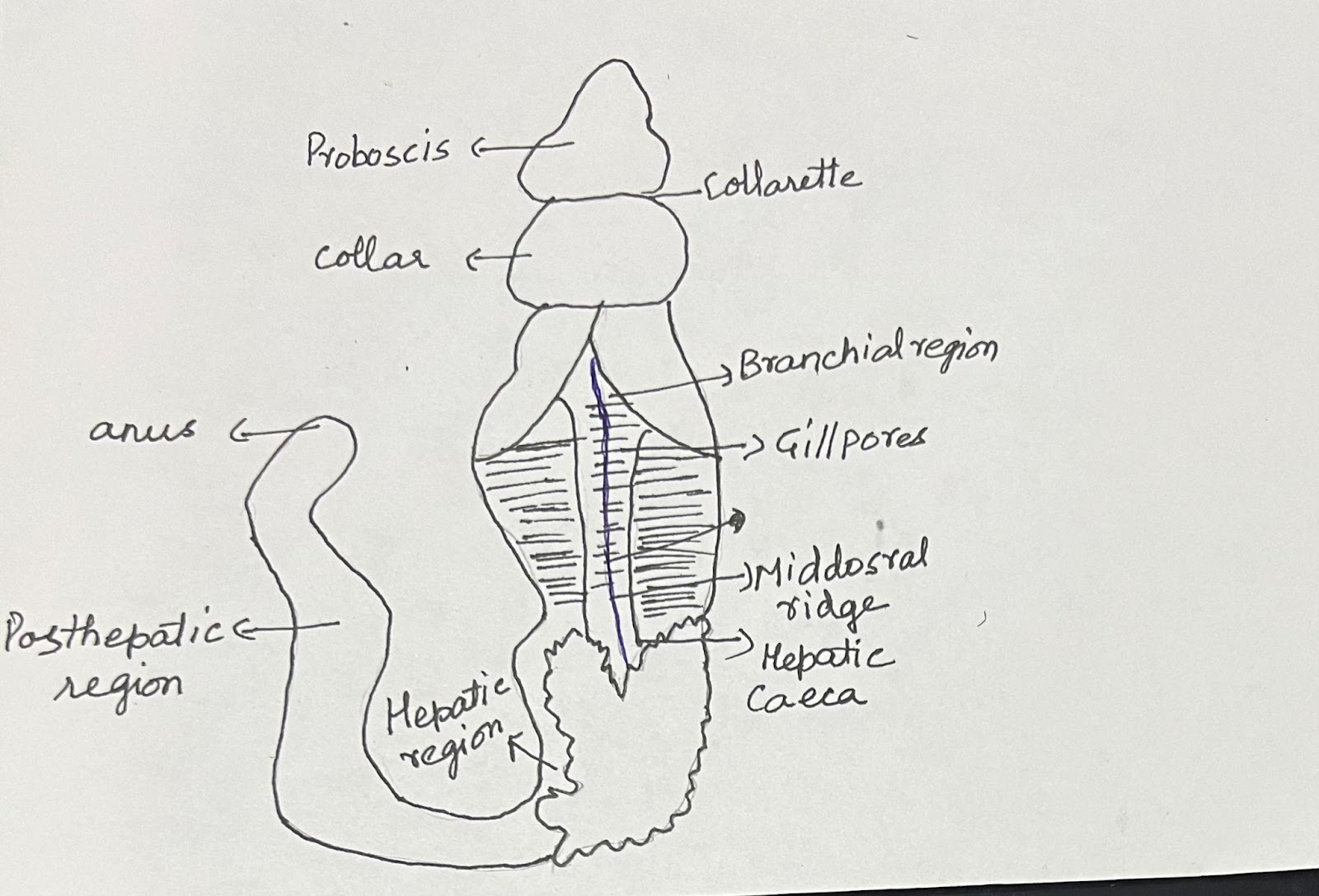
Phylum Hemichordata
Also Read:
| Related Articles | ||
|---|---|---|
| Animal Kingdom | Five kingdom classification | Open type circulatory system |
| Human heart | Differences between Open Circulatory Systems and Closed Circulatory Systems | Zoology |
Classification of Phylum Hemichordata
[Click Here for Sample Questions]
The phylum hemichordate includes almost a few hundred species and is divided into four classes, namely the following-
Enteropneusta
The characteristics of Enteropneusta are as follows:
- Enteropneusta are usually solitary, free-swimming animals.
- They have an elongated, vermiform body with no stalk.
- These animals have a straight alimentary canal.
- They lack asexual reproduction and contain numerous pairs of U-shaped gill slits.
Example of EnteropneustaExample: Examples include Balanoglossus, Ptychodera, Saccoglossus, Palatoglossus. |
Pterobranchia
The characteristics of Pterobranchia are as follows:
- Pterobranchia are sedentary, may be solitary or colonial, and tubicolous animals.
- Their bodies are compact, with stalks for attachment, and live in secreted chitinous tubes.
- They contain a U-shaped alimentary canal and contain either one or no gill slits.
- Anus dorsal lies near the mouth.
- They undergo asexual reproduction by budding.
- These are further divided into two orders - Rhabdopleura and Cephalodiscida.
Example of PterobranchiaExample: Examples include Rhabdopleura, Cephalodiscus. |
Graptolite
The characteristics of Graptolite are as follows:
- Graptolites have a tubular chitinous skeleton.
- They live in colonies.
- These are extinct hemichordates.
- They show a close similarity with Rhabdopleura.
Example of GraptoliteExample: One example is Dendrograptus. |
Planctosphaeroidea
The characteristics of Planctosphaeroidea are as follows:
- The planctosphaeroidea alimentary canal is L-shaped.
- Their larval body is covered by ciliary bands.
- They contain some specialized tornaria larvae.
Example of PlanctosphaeroideaExample: One example includes Planctosphaera. |
Classification chart of Phylum Hemichordata is as follows:
Kingdom Animalia
↓
Subkingdom Eumetazoa
↓
Superphylum Deuterostomia
↓
Phylum Hemichordata
↓
Class Enteropneusta
↓
Class Graptolithina
↓
Class Pterobranchia
↓
Class Planctosphaeroidea
Characteristics of Hemichordata
[Click Here for Sample Questions]
Important characteristics of Hemichordata are as follows:
- The organisms in the phylum Hemichordata are bilaterally symmetric and triploblastic.
- The animals can live alone or in colonies and are mostly tubicolous.
- They are exclusively marine animals that perform respiration with the help of gills.
- Their circulatory system is open-type, quite simple, and well-developed.
- Hemichordata uses a glomerulus situated in the proboscis gland as the excretory organ.
- Their bodies are cylindrical, soft, fragile, vermiform, and divided into anterior proboscis, collar, and trunk.
- These animals have a single-layered epidermis, which is their body wall.
These animals under the phylum Hemichordata have a primitive type of nervous system, which mainly consists of a subepidermal nerve plexus. Moreover, they have a hollow dorsal nerve cord.
- Reproduction is mainly sexual, and the sexes are separate; gonads are one to several pairs.
- Development is mostly indirect through free swimming tornaria larva.
- Direct development is also seen in some cases.
- They are coelomate animals whose fertilization is external.
Balanoglossus
[Click Here for Sample Questions]
Balanoglossus is an acorn or tongue worm that is considered significant in the field of zoology as it is an “evolutionary link” between invertebrates and vertebrates.
- It is a deuterostome that looks like Ascidians or sea squirts.
- Balanoglossus consists of branchial openings or gill slits.
- These species do have a stomochord, which means their gut chord is enclosed by the collar.
- The superior part of the body consists of a notochord.
Things to Remember
- Phylum Hemichordata is a species that contains an organ-system level of organisation, also known as the sister group of Echinodermata.
- These animals can be solitary or live in colonies, exclusively marine animals.
- They perform respiration with the help of gills, whose bodies are divided into anterior proboscis, collar, and trunk.
- Hemichordata are considered Ambulacraria, which are chordates that live close to other invertebrates.
- There are 130 known species, and many more are being discovered in the deep water.
Also Read:
Sample Questions
Ques: (A) Balanoglossus belongs to which phylum?
(B) In hemichordates, the body is divided into how many regions. Name them? (2 marks)
Ans: (A) It belongs to Phylum Hemichordata.
(B) There are three regions of the body in hemichordates. These are Proboscis, Collar, and Trunk.
Ques: What are the characteristics of Hemichordata? (5 marks)
Ans: The various characteristics of phylum Hemichordata include :
- Hemichordata are marine animals and can live in colonies or solitary, mostly tubicolous.
- Their respiratory system includes gills.
- These species reproduce sexually and even have separate sexes.
- They have an excretory system and excrete with the help of a single glomerulus gland, in the proboscis.
- They have a single and well-developed, circulatory system which is open type.
- It also have a stomachache.
Ques: Why are Hemichordata an independent phylum and not considered as true Chordata? (3 marks)
Ans: The animals belonging to the phylum Hemichordata do not possess the notochord. The notochord is a skeletal rod made of cartilages that supports the body in all the embryonic animals and also in some of the adult chordate animals.
- It is one of the distinguishing features of the chordates.
- Therefore, they are not true chordates.
- Moreover, zoologists are not sure whether the notochord, gill slits, and the nerve chord of the animals are homologous to that of the chordates.
- Hence, they are placed in a separate phylum and given the name Hemichordata meaning "half-chordates".
Ques: Provide a technical term for the following:
(A) The lood filled cavity in arthropods
(B) A stinging organ of jellyfish
(C) A free-floating form of Cnidaria
(D) The lateral appendages in aquatic annelids? (2 marks)
Ans: (A) Haemocoel
(B) Nematocysts
(C) Medusa
(D) Parapodia
Ques: What is the difference between direct and indirect development? (5 marks)
Ans: The difference between direct and indirect development are as follows:
| Direct development | Indirect development |
|---|---|
| The newborn is a child form of the adult of the animal. | The newborn is different from the adult form of the article. |
| No intermediate form of the larva of the animal present. | In this type, the embryo of the egg hatches from the larva of the animal. |
| Their eggs have a large amount of yolk to feed the young ones, or can be fed directly by the mother. | Their eggs have very little yolk and therefore, the larvae develops and hatches rapidly. |
| The young ones develop into a mature individual without undergoing metamorphosis. | The larva hatches from the egg metamorphosed into an adult. |
| The animals that experience direct development are fishes, reptiles, birds and mammals. | Amphibians, echinoderms, and arthropods such as insects undergo indirect development. |
Ques: Differentiate between open and closed circulatory systems? (5 marks)
Ans: The difference between open and closed circulatory systems are as follows:
| Open Circulatory System | Closed Circulatory System |
|---|---|
| Blood flow cannot be regulated. | Blood flow can be regulated. |
| Blood flows freely through open spaces called lacunae. | Blood flows through closed vessels. |
| Dorsal blood vessels are present. | Dorsal and ventral blood vessels are present. |
| The blood flows slowly. | The blood flows at a higher pace. |
| Nutrients are exchanged between the blood and tissues. | Nutrients are exchanged via the tissue fluid. |
| There is no transport of gases. | Gases are transported. |
| The capillary system is absent. | The capillary system is present. |
| Blood is pumped directly into the body cavity. | Blood is pumped through vessels by the heart. |
Ques: What are triploblastic animals?Give examples of cold-blooded animals? (2 marks)
Ans: All multicellular animals such as molluscs, worms, arthropods and vertebrates are triploblastic animals. The animals that have three layers - ectoderm, mesoderm, and endoderm are called triploblastic animals. All amphibians like frogs, toads, and alligators, snakes, fish, lizards, and insects like dragonflies and bees.
Ques: (A) What is the importance of pneumatic bones and air sacs in Aves? (3 marks)
(B) Give examples for the animal having a canal system and spicules.
(C) Mention the role of the radula in Molluscs.
Ans: (A) The pneumatic bones, hollow bones and air sacs in Aves, help them to fly.
(B) Scypha and Euspongilla and other animals of Porifera have spicules and a canal system in their body.
(C) The role of the radula in molluscs is significant as their natural habitat is rocks. The radula helps in scratching the food and creates a depression in rocks.
Ques: What are the characteristics of Saccoglossus? (3 marks)
Ans: The characteristics of Saccoglossus are as follows:
- Saccoglossus is a acorn worms that has 18 species.
- It is considered largest genus of phlyum hemichordata.
- The species is marked by the concentric rings of muscle fibers in the proboscis.
- They are found in coastal mud and sand habitat, specially near bays.
Ques: What is the difference between phylum chordata and phylum non-chordata? (5 marks)
Ans: The difference between phylum chordata and phylum non-chordata are as follows:
| Chordates | Non-chordates |
|---|---|
| Notochord is present. | Notochord is absent. |
| Pharynx is perforated by gill slits. | Gill slits are absent. |
| The post-anal tail is present. | The post-anal tail is absent. |
| The central nervous system is dorsal, hollow, and single. | The central nervous system is ventral, solid, and double. |
| The heart is ventral. | If present, the heart is dorsal. |
Ques: What is Acorn worms? (3 marks)
Ans: Acorn worm also known as Enteropneusta, is an invertebrates Hemichordate that are closely linked to chordates. Acorn worms are found in about 70 species worldwide, the most well studied of which is Saccoglossus kowalevskii.
- Since every species is benthic, it feeds either on the ground or in the air.
- While most acorn worms were much smaller, some of these worms can get rather enormous; one species has been recorded to exceed 2.5 meters (almost eight feet) in length.
- For instance, Balanoglossus is occasionally called the tongue worm.
For Latest Updates on Upcoming Board Exams, Click Here: https://t.me/class_10_12_board_updates
Check-Out:



Comments