



Education Journalist | Study Abroad Lead
Propan 2 ol is a colorless, flammable, with a pleasant smell chemical compound. The simplest example of a secondary alcohol is an isopropyl group linked to a hydroxyl group, in which the alcohol carbon atom is attached to two other carbon atoms. Propan 2 ol is a colorless liquid solution at room temperature that looks similar to the propan 1 ol but has a bitter taste. Its chemical composition is C3H8O.
| Table of Content |
Key Takeaways: Isopropyl alcohol, Secondary alcohol, Propan 2 ol, 2 Methyl propan 2 ol, Propan 2 ol, Alcohol, Isopropyl group, Chemical compound, Hydroxyl group
Propan 2 ol Formula
[Click Here for Sample Questions]
Propan 2 ol is a colorless flammable liquid with disinfectant properties that is widely used as an antiseptic. Propan 2 ol is a 1-propanol isomer. Propan 2 ol is widely used in the production of pharmaceutical drugs, dye solutions, cosmetics, window cleaners, lacquer formulations, anti-freezes, and soaps. Furthermore, approximately 70% of propan 2 ol is sold in aqueous form as rubbing alcohol. Propan 2 Ol becomes viscous as temperature decreases and freezes at -89 °C. Propan 2 ol is of molecular biology grade and is suitable for nucleic acid precipitation.
Also Read:
| Related Articles | ||
|---|---|---|
| Polymerase | Ketones | Hydrocarbon |
| Ortho nitrophenol | Esters | Aldehydes |
Structure of Propan 2 ol
[Click Here for Sample Questions]
Propan 2 ol's structure is formed by combining an isopropyl group with a hydroxyl group. The best example of secondary alcohol is isopropyl alcohol. Since the carbon atom containing alcohol is linked to two other carbon atoms. Propan 2 ol's structure is an isomer of 1 propanol and ethyl methyl ether.
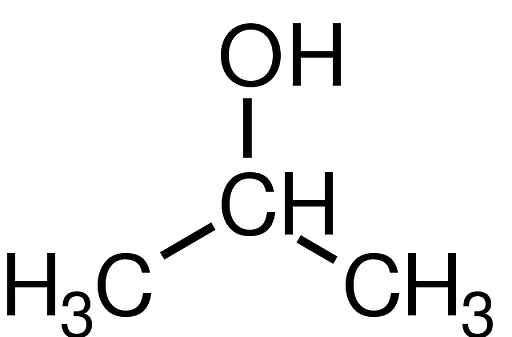
Propan 2 ol
Properties of Propan 2 ol
[Click Here for Sample Questions]
- The chemical formula of Propan 2 ol is .
- Chemical names for Propan 2 ol are s-Propanol, 2-Propanol, Isopropanol[1], Rubbing alcohol, iPrOH, sec-Propyl alcohol, i-PrOH and Dimethyl carbinol.
- The Melting and Boiling point of Propan 2 ol is -89 °C and 82.6 °C.
- Isopropyl alcohol has a molecular weight of approximately 60.096 g/mol-1. This aqueous solution has a density of about 0.786 g/cm3.
Application of Propan 2 ol
[Click Here for Sample Questions]
Propan 2 ol has been used in DNA and RNA extraction, hydroxyproline determination, cell viability testing by the MTT assay, and in microarray hybridization. It is also suitable for use in standard DNA precipitation protocols and as a solvent in the preparation of solutions for molecular biology applications.
Things to Remember
- Propan 2 ol is a colorless flammable liquid with disinfectant properties.
- It is commonly used as an antiseptic.
- The Melting and Boiling point of Propan 2 ol is -89 °C and 82.6 °C.
- Isopropyl alcohol has a molecular weight of approximately 60.096 g/mol-1 and a density of approx. 0.786 g/cm3.
- Propan2 ol has been used in DNA and RNA extraction and also as a solvent in the preparation of solutions for molecular biology applications.
- The 2 Methyl Propan 2 ol is a primary alcohol and the IUPAC name of tetra- butyl alcohol is 2 Methyl Propan 2 ol.
Also Read:
Sample Questions
Ques: What are the uses of 2 Propanol and why is Propan-2-ol classified as a secondary alcohol? (3 marks)
Ans: Isopropyl alcohol, also known as 2 methyl propan 2 ol, is a chemical that is widely used in the production of paints, paint removers, thinners, fuels, inks, coatings, cement, dyes, disinfectants, and deicers. They are used to make acetones, waxes, vegetable and animal oils, and flavoring agents.
The –OH group is attached to the middle carbon atom in the propan 2 ol structure. As a result, propan-2-ol is classified as a secondary alcohol. Since propan 2 ol is the secondary alcohol, it is typically more reactive, stable, and less acidic than propan 1 ol. Ketones are formed instead of aldehydes during the oxidation reaction of propan 2 ol.
Ques: Propan-2-ol is What type of Alcohol? Why does propanol have a higher boiling point than the hydrocarbon, butane? (3 marks)
Ans: Isopropyl alcohol is another name for propan 2 ol. Propan 2 ol is a flammable, colorless, clear liquid with a mildly alcoholic odor. Propan 2 ol's physical and chemical properties are similar to those of ethyl alcohol. Furthermore, propan 2 ol is completely soluble in water, making it one of the most organic solvents.
Butane molecules are held together by weak van der Waal forces of attraction, whereas propanol molecules are held together by stronger intermolecular hydrogen bonding.
Ques: What exactly is the hydroboration-oxidation reaction? Give an example to demonstrate. Explain how you can distinguish propan-2-ol and 2-methylpropan-2-ol? (5 marks)
Ans: The process of adding diborane to alkenes to form trialkyl boranes and then oxidizing them with alkaline hydrogen peroxide to form alcohols is known as hydroboration-oxidation.
FOR EXAMPLE:

Different products are formed when propan-2-ol and 2-methyl-propan-2-ol are treated with copper at 573k. Hence, we can tell them apart based on their nature. When propan-2-ol and 2-methyl-propan-2-ol are treated with lucas reagent at room temperature, the Luca’s test helps in differentiating the turbidity formation.
Ques: Alcohols are more soluble in water than comparable molecular mass hydrocarbons. Describe this fact. Also explain, In phenol, the C-O bond is much shorter than in ethanol. (3 marks)
Ans: Alcohols can form hydrogen bonds with water as well as break existing hydrogen bonds between water molecules. As a result, they are water soluble. Hydrocarbons, on the other hand, cannot form hydrogen bonds with water and therefore are insoluble in water.

The carbon of the C-O bond in phenol is Sp2 hybridized, giving it a partial double bond character, whereas in ethanol it is Sp3 hybridized, giving it a single bond character. Hence, a double bond is shorter than a single bond.
Ques: Describe why ortho nitrophenol is more acidic than ortho methoxyphenol. (3 marks)
Ans: In nature, the nitro (NO) group is an electron withdrawing group, whereas the methoxy (OCH3) group is an electron releasing group. The release of H+ ion is thus easier with o-nitrophenol but difficult with o-methoxyphenol. Aside from that, the ion o-nitrophenoxide is stabilized due to resonance, and o-nitrophenol is steam volatile whereas p-nitrophenol is not. This is due to intramolecular hydrogen bonding in o-nitrophenol molecules. As a result, its boiling point is lower than that of p-nitrophenol, which is linked by intermolecular hydrogen bonding.
It is worth noting that the nature and position of the substituent influences the boiling point of phenol in substituted phenols.
Ques: Explain how the – OH group attached to a carbon of a benzene ring causes it to undergo electrophilic substitution. (2 marks)
Ans: Phenol could be assumed as a resonance hybrid of structures I-V. The electron density in the benzene ring increases as a result of the +R effect of the -OH group, facilitating the attack of an electrophile. In other words, the presence of a -OH group activates the benzene ring, causing it to undergo electrophilic substitution reactions. Furthermore, because the electron density is higher at the two o- and one p-positions, electrophilic substitution occurs primarily at the o- and p-positions.
Ques: Explain the limitations of Willamson synthesis in the preparation of specific types of ethers. (2 marks)
Ans: Williamson's synthesis is a versatile method for producing symmetrical and unsymmetrical ethers. However, proper reactant selection is required for the synthesis of unsymmetrical ethers. Because Williamson's synthesis is based on the SN2 mechanism and primary alkyl halides are the most reactive in the Sn2 reaction, the best yields of unsymmetrical ethers are obtained when the alkyl halides are primary and the alkoxide is primary, secondary, or tertiary.
For Latest Updates on Upcoming Board Exams, Click Here: https://t.me/class_10_12_board_updates
Check-Out:



Comments