



Education Journalist | Study Abroad Lead
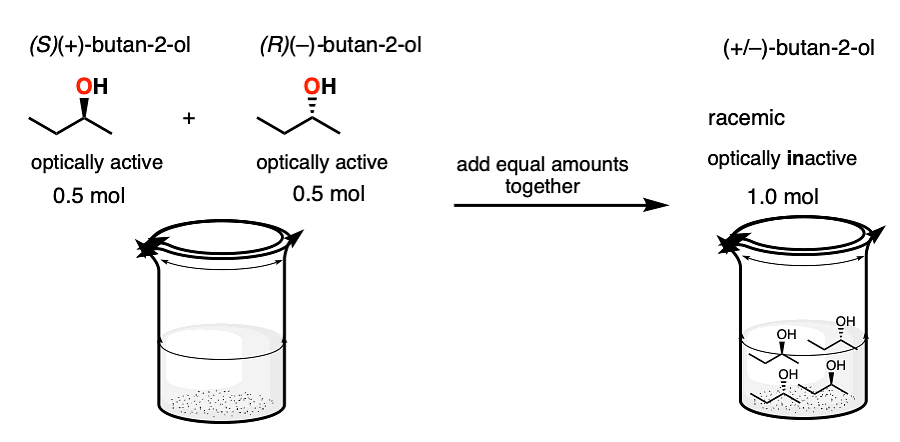
Racemic mixture, also known as a racemate, is a mixture of two enantiomers, or compounds with dissymmetric molecular structures that are mirror copies of one another, in equal amounts. Each enantiomer spins the plane of polarization of plane-polarized light via a specific angle, but the racemic combination is optically inactive since each component's rotatory impact completely cancels the other's. The term comes from racemic acid, which was the first chemical of this type to be examined thoroughly. Racemic acid, or racemic tartaric acid, is a combination of equal proportions of dextrorotatory and levorotatory tartaric acids; it is commonly referred to as D- or L- tartaric acid, or (+)- or (–)- tartaric acid, respectively.
| Table of Content |
Key Terms: Enantiomers, Polarisation, Chirality, Dextrorotatory, Levorotatory, Polarization, Racemization, Resolurtion, Racemic acid, Racemic tartaric acid
Racemization
[Click Here for Sample Questions]
The racemization is described as "the direct conversion of an optically active chemical, either dextro or levorotatory, into a racemate." When a racemic alteration is split into its constituent enantiomers, it is called resolution. Racemization is a thermodynamically advantageous process that occurs spontaneously if a sufficient channel for enantiomer interconversion is available.

Racemization
Racemic refers to a sample of a chiral chemical that has a 1:1 mixture of enantiomers. Racemization will eventually become racemic. A stereocenter whose configurational purity declines in the course of a reaction (S), or a sample whose enantiomeric excess reduces in the course of a reaction (A).
The racemization is the process of converting half of a substance's dextro form into its levo form, resulting in a combination that is optically inactive due to the existence of equal proportions of the two enantiomers. Racemization can be caused by a variety of factors.
- Heat action - Heat action frequently converts optically active enantiomers into racemic mixtures.
- The presence of foreign substances can also bring about the activation of chemical reagents.
- Autoracemisation - This can also be completed by just leaving the substance at room temperature for some time.
Also Read:
Racemic Mixture
[Click Here for Sample Questions]
The functional groups of a compound's molecule can be in either the right or left position at the same time. In a molecular structure, their orientation may differ in the same carbon position. Both molecules have nearly identical chemical characteristics. A racemate or racemic mixture is a combination of these two substances.

Racemic Mixture
The quantity of two enantiomers in the combination is equal in racemate chemistry. The term derives from Louis Pasteur, who was the first to recognize the combination. He discovered that racemic acid has two forms of isomers. Tartaric acid is another name for it. The word 'racemic' derives from the Latin word 'racemus,' which means grape cluster. Tartaric acid is the name for the right-oriented molecule.
Nomenclature of Racemate Compounds
[Click Here for Sample Questions]
As we have seen, the sole difference between two racemic compounds is their ability to rotate polarized light, and this is employed as the method of naming to differentiate them. When a racemic combination does not display any impact or change in polarised light travelling through it, the amounts of both chemicals are equal, according to racemate chemistry. When these compounds are separated and then exposed to polarised light, a distinct alteration is observed. The light rotates either clockwise or anticlockwise. Dextrorotation refers to the rotation of plane-polarized light in an anticlockwise direction. Levorotation is the opposite of levorotation. As a result, the chemical name of every compound that exhibits one of the two rotatory effects is prefixed by a particular prefix.
A dextrorotatory compound has a '+', 'd', or 'D' prefix, according to racemic meaning and nomenclature. All of the meanings are the same. A levorotatory compound, on the other hand, has the prefix '-', 'l', or 'L'. Let's have a look at an example. Dextro-fructose is also known as D-fructose, +-fructose, and d-fructose. L-fructose, -fructose, or l-fructose are all examples of enantiomers having levorotation.
Properties of Racemate Mixtures
[Click Here for Sample Questions]
- The definition of racemate mixes explains how plane-polarized light may be rotated by them.
- The light will be rotated in opposing directions by a pair of racemic chemicals, making the combination optically inactive. When these substances are present in equal amounts in a combination, this occurs.
- Because all of these chemicals' physical properties are identical, it's difficult to tell them differently.
- Unless these substances are optically active, we won't be able to identify them.
- The melting and boiling points are where the differences are most visible. They can also exhibit a variety of solubilities.
- Many pharmacological drugs are available in either racemate or pure enantiomer form. This is done to increase the bioavailability of therapeutic compounds since the human body's biological system contains several chiral and racemic asymmetries.
Resolution of Racemic Mixture
[Click Here for Sample Questions]
A racemic mixture, also known as a racemate, is an equimolar mixture of a molecule's enantiomers that may be recognized by their differences in how they interact with chiral substances or media. Racemic mixtures are denoted by the ()- prefix. This 'optical rotation descriptor' refers to the complete solution of a racemic mixture, rather than a single stereoisomer. Enantiomers generally have the same physical and chemical properties. As a result, it's tough to tell them apart.

Resolution of Racemic Mixtures
Enantiomers, on the other hand, can have unique features when they interact with chiral media. Enantiomers of a molecule, for example, might interact differently with the chiral olfactory receptors in our bodies, giving each enantiomer a unique aroma.
As a result, racemic mixtures can be separated using an enantiomeric resolution technique. In this reaction, enantiomers react with a chiral resolving agent to generate diastereomers. These diastereomers may be easily isolated and reconverted to make enantiomerically pure molecules.
Optical Activity
[Click Here for Sample Questions]
The property of an organic compound that rotates plane polarised light (made by passing ordinary light through a Nicol prism) when it is passed through their solutions is known as optical activity, and the compounds are known as optically active compounds.
Optical Activity of Racemic Mixtures
When a substance's solution is placed in the path of plane-polarized light, its optical activity is a measure of the substance's capacity to rotate the polarisation plane. The number of degrees of rotation of the plane-polarized light at room temperature was calculated by 8.3 percent concentration of each L-, D-, and DL-alanine solution using a Perkin-Elmer Model 141 polarimeter with a Sodium lamp of 584 nm wavelength (D-line) and fitted with a digital counter.
Things To Remember
- The three-dimensional or spatial arrangements of molecules create chirality.
- Although racemization of an optically active paraffin hydrocarbon is difficult, racemization of lactic acid is simple.
- A eutectic mixture is made up of enantiomerically pure R and S crystals.
- Around 10% of racemic chiral substances crystallize as a conglomerate.
- A little amount of one enantiomer is added to a racemic material to reduce its melting point. The melting point of the pure enantiomer, on the other hand, maybe higher or lower than that of the complex.
Also Read:
Sample Questions
Ques. How can you identify the compounds of a racemate mixture? (5 Marks)
Ans. A racemic mixture, also known as a racemate, is a solution that contains equal amounts of both enantiomers of a substance. Racemic mixtures can be represented by adding a (d/l)- or ()- prefix to the substance's name. Because enantiomers have equal and opposing specific rotations, a racemic mixture has no optical activity. As a result, polarimetry alone cannot tell the difference between a racemic and an achiral substance. It's vital to understand that the terms chiral and optically active are not synonymous. It is incorrect to claim that a racemic combination is achiral. Chirality is a feature of individual molecules. Optical activity is a property of solutions. A racemic mixture of chiral molecules has no net optical activity, even though it is made up of chiral molecules.
Ques. Where do enantiomers get their name ‘racemate’ from? (4 Marks)
Ans. The word 'racemate' is derived from the Latin word 'racemes,' which means grape cluster. Racemate substances were named after the first enantiomers, tartaric acid, and racemic acid, which were discovered in grapes by Louis Pasteur. They use a separate system of classification. To identify the optical characteristics of these compounds, prefixes such as signs and letters are utilized. Enantiomers are the absolute opposites of one another.
Ques. How is racemate synthesized? (5 Marks)
Ans. If there is no chiral influence, a chemical process that produces a chiral product will always produce a racemate (for example, a chiral catalyst, solvent, or starting material). Synthesis of a racemate can be cheaper and easier than a synthesis of the pure enantiomer since it does not require special conditions. This begs the issue of how biological homochirality emerged on the racemic primordial planet. Because they are uncertain in a certain stereoisomerism, racemic mixture reagents and reactions are deemed "not stereospecific" or "not stereoselective."
Ques. How do you separate a racemic mixture? (3 Marks)
Ans. You can separate the ingredients of a racemic mixture by treating them with an optically active reagent. The finished result is a diastereomer mixture. Diastereomers have a wide range of physical features. You can isolate them using common isolation procedures such as fractional crystallization.
Ques. What is the difference between optically active and inactive? (2 Marks)
Ans. If the light goes to the right, it is said to have dextrorotatory optical activity, and if it moves to the left, it is said to have laevorotatory optical activity. And if the light bandpasses undetected by Nicol's lens. It is thought to be inactive from an optical standpoint.
Ques. What is optical isomerism with example? (3 Marks)
Ans. In a vacuum, isomers are molecules with the same chemical makeup but a distinct atom arrangement. We call two isomers optical isomers or enantiomers unless the structure in space prevents them from being superimposable mirror images of one other. The amino acid alanine is one example of this.
Ques. What molecules have optical activity? (3 Marks)
Ans. Once procedures for determining a molecule's three-dimensional structure have been developed, the source of the substance's optical activity has been identified: optically active substances include chiral molecules. Chirality is a characteristic of a molecule resulting from its structure.
Ques. What is the difference between optically active and inactive? (2 Marks)
Ans. When the light goes to the right, it is said to exhibit dextrorotatory optical activity, and when it moves to the left, it is said to exhibit laevorotatory optical activity. And the band of light remains unaltered as it passes through Nicol's lens. Optical inertia is claimed for it.
Ques. How does optical activity depend on the state of substance? (3 Marks)
Ans. Every aggregation state has a large number of compounds, which implies that their optical behavior is dictated by the characteristics of the individual molecules. The particular rotation is influenced by a variety of parameters, including the degree of aggregation, temperature, pressure, and solvent type.
For Latest Updates on Upcoming Board Exams, Click Here: https://t.me/class_10_12_board_updates
Check-Out:



Comments