



Content Curator
Rheumatoid Arthritis is a long-term autoimmune disease that causes chronic inflation, swelling and pain of the joints. The common signs and symptoms of the disease include joint pain, swelling, redness, inflammation, morning stiffness and fever. Although the cause of the disease is yet to be completely understood, a patient develops rheumatoid arthritis when his immune system starts attacking his joints mistakenly. Several genetic and environmental factors have been found to be associated with it. It is more predominant in women than men. The treatment options for this disease are symptom-dependent and include use of the drugs, physiotherapies and surgery in severe cases. Change in lifestyle, proper diet and exercise can have a positive influence while coping with such disorders.
| Table of Content |
Key Takeaways- Rheumatoid Arthritis, Joints, Immune System, Autoimmune Diseases, chronic inflammation, swelling, morning stiffness, fever
What is Rheumatoid Arthritis?
[Click Here for Sample Questions]
Rheumatoid Arthritis is a common, long term autoimmune disorder of humans that causes chronic inflammation, swelling and pain of the joints. Small joints such as the hands and feet are mostly involved in Rheumatoid Arthritis but the larger joints get affected later in the disease. The joints are typically affected in a symmetrical pattern.

Rheumatoid Arthritis
Although the cause of the disease is largely unclear, the underlying mechanism of the disease involves an attack of the body’s immune system on the joints. The disease may affect other parts of the body such as the lungs, heart, eyes and blood vessels etc. The signs and symptoms of the disease generally appear in mid-to-late adulthood.
Also Read:
| Related Articles | ||
|---|---|---|
| Acquired Immunodeficiency Syndrome | Arthritis | insulin |
| Symptoms of Heart Attack | Heart Diseases | Cancer |
| Typhoid | Thyroid | Leprosy |
Symptoms of Rheumatoid Arthritis
[Click Here for Sample Questions]
Rheumatoid Arthritis primarily affects joints; however, it also affects other organs in 15-25% of cases. The signs and symptoms of the disease appear in mid or later adulthood. Many of the patients face episodes of symptoms (flares) followed by episodes with no symptoms for the rest of their lives whereas severely affected individuals face continuous health issues related to the disease. Here are the main symptoms of the disease are-
- Joint pain
- Swelling of the joints, warmth and redness
- Morning stiffness or stiffness after still for a long time; limitation of movement in severe cases.
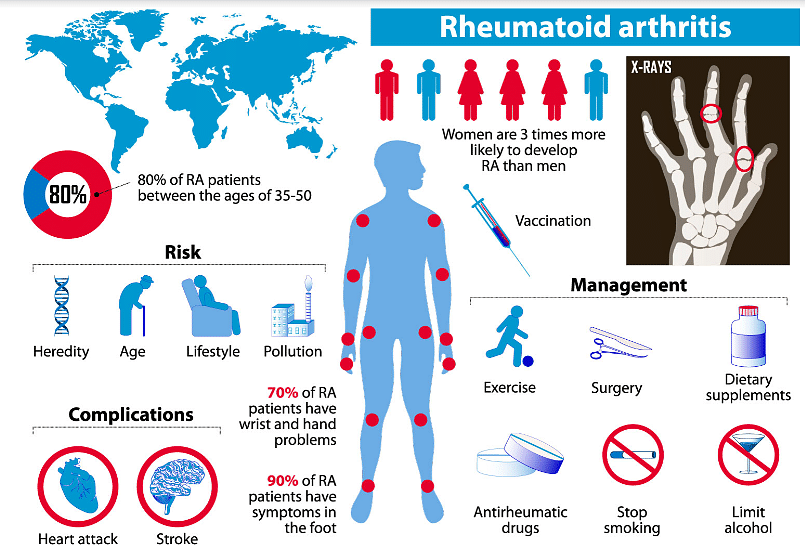
Risk of Rheumatoid Arthritis
The other symptoms include
- High temperature or a fever
- Sweating
- A poor appetite
- Fatigue, lack of energy
- Dry eyes as a result of inflammation
- Chest pain as a result of inflammation
- Weight loss
- In acute cases, symptoms of lung fibrosis, atherosclerosis, myocardial infarction, anaemia, renal amyloidosis, rheumatoid nodules etc have been found to be developed.
Read More: Parathyroid Hormone
Causes of Rheumatoid Arthritis
[Click Here for Sample Questions]
The human immune system is chiefly responsible for protecting the body from foreign agents such as bacteria, fungi. They release antibodies to thwart those microorganisms; however, in some cases, the immune system mistakenly sends the antibodies to attack the lining of the joints leading to Rheumatoid Arthritis. Besides chronic inflammation of the synovial joints by infiltration of blood-derived cells such as memory T-cells, macrophages, plasma cells take place. This may lead to the progressive destruction of bones and cartilages. It occurs mainly after the invasion of these tissues by cellular synovial tissue mediated by cytokine induction of destructive enzymes (matrix metalloproteinases). Apart from these developments of new vessels and acute phase proteins are also observed in severe cases. There are several factors that influence the development of the disease. Here are some of those factors-
Age: Rheumatoid Arthritis generally affects adults of any age however, most people are diagnosed between the ages of 40 and 60.
Sex: The disease has been found to be more frequent in women than men suggesting a key role of sex hormones.

Causes of Rheumatoid Arthritis
Genetics: The development of Rheumatoid Arthritis as a disorder depends on the combination of genetic and environmental factors. Although it is largely unclear the genetic mechanisms underlying the disease it is thought to have a major connection with Rheumatoid Arthritis.
Weight: Overweight and obesity have a significant correlation with developing rheumatoid arthritis. Most adults with a higher-than-normal BMI are connected with the condition.
Smoking: Smoking cigarettes or tobacco significantly increases the risk of developing Rheumatoid Arthritis.
Diet: There is some evidence that consumption of red meat and a dearth of vitamin C increases the risk of developing rheumatoid arthritis.
Diagnosis of Rheumatoid Arthritis
[Click Here for Sample Questions]
Diagnosis of Rheumatoid Arthritis is mainly based on the symptoms, the physical examinations and the results of x-rays, scans and several blood tests. It can be difficult to diagnose patients in early adulthood when the symptoms have not appeared. Several parameters such as erythrocyte sedimentation rate (ESR), a full blood count, level of C-reactive proteins, presence and levels of rheumatoid factors and anti-CCP antibodies can be checked for the diagnosis. Scans including x-rays, ultrasound scans and MRI scans are also done for the diagnosis process.

Rheumatoid Arthritis affects the joints
Also Read:
| Related Articles | ||
|---|---|---|
| Tuberculosis | Dengue Fever | Hepatitis |
| Infectious Diseases | Human Health and Diseases | Human Diseases |
| Thalassemia | Hemophilia | Jaundice |
Treatment of Rheumatoid Arthritis
[Click Here for Sample Questions]
There are multiple treatments available for rheumatoid arthritis and the earlier the treatment is started the more it is likely to work. There are three main ways of treating the disorder
- Surgery
- Physical therapies
Drugs
Four groups of drugs are used for the treatment of Rheumatoid Arthritis. They are-
- Painkillers
- Steroids
- Non-steroidal anti-inflammatory drugs (NSAIDs)
- Disease-modifying ant-rheumatic drugs (DMARDs).

Drugs for Rheumatoid Arthritis
Many patients with this disease are required to take more than one drug and the treatment may change from time to time as well. Everything depends on the severity of the symptoms and the test results. Physical therapies are also employed which have been found significant in alleviating pain and body mobility. The extreme severe cases need surgeries.
Read More: An Overview and Types of Pathogens
Diet & Exercise in Rheumatoid Arthritis
[Click Here for Sample Questions]
Diet and exercise are an important part of our lifestyle. They have significant effects when it comes to coping with disorders like rheumatoid arthritis. Getting plenty of exercise helps in reducing the pain, inflammation, stiffness and provides better flexibility and mobility.
On the other hand, certain foods help to reduce inflammation, joint pain and may prove to help deal with Rheumatoid Arthritis. Here is a small list of such food items-
- Turmeric
- Ginger
- Fish
- Coriander
- Green tea
- Pineapples
Things To Remember
[Click Here for Sample Questions]
- Rheumatoid Arthritis is a common autoimmune disease that causes chronic inflammation, swelling and pain of the joints.
- The major symptoms of the disorder are Joint pain, swelling of the joints, warmth and redness, morning stiffness or stiffness after still for a long time, fever, limitation of movement in severe cases.
- Rheumatoid Arthritis happens when the body’s immune system attacks the joints. Both genetic and environmental factors influence the development and spread of the disease.
- The diagnosis of Rheumatoid Arthritis is mainly based on the symptoms, the physical examinations and the test results of x-rays, scans and several blood tests.
- The therapies of the disease include use of drugs such as painkillers, steroids, NSAIDs, DMARDs, different physical therapies and surgery if needed.
Also Read:
Sample Questions
Ques: What is Rheumatoid Arthritis? (2 marks)
Ans: Rheumatoid Arthritis is a long-term autoimmune disorder of humans that causes chronic inflammation, swelling and pain of the joints.
Ques: What are some causes of Rheumatoid Arthritis? (2 marks)
Ans: Rheumatoid Arthritis occurs when the body’s immune system attacks the joints. Both genetic and environmental factors such as age, sex, diet, lifestyle, weight have influenced the development and spread of the disease.
Ques: State the symptoms of rheumatoid arthritis. (3 marks)
Ans: The symptoms of Rheumatoid Arthritis are as follows-
- Joint pain
- Swelling of the joints, warmth and redness
- Morning stiffness or stiffness after still for a long time; limitation of movement in severe cases.
- High temperature or a fever
- Sweating
- Fatigue, lack of energy
- Dry eyes as a result of inflammation
- Chest pain as a result of inflammation
- Weight loss
- In acute cases, symptoms of lung fibrosis, atherosclerosis, myocardial infarction, anaemia, renal amyloidosis, rheumatoid nodules etc are developed.
Ques: What are the treatments available to treat Rheumatoid Arthritis? (2 marks)
Ans: There are multiple treatment options available to the person having rheumatoid arthritis. These options include the use of drugs such as painkillers, steroids, NSAIDs, DMARDs, different physical therapies and surgery if needed.
Ques: What is an autoimmune disease? (2 marks)
Ans: An autoimmune disease is a health condition when the body’s immune system attacks the healthy cells mistakenly. Rheumatoid arthritis, lupus, inflammatory bowel disease are some of the examples of autoimmune diseases.
Ques: What is Inflammation? (2 marks)
Ans: Inflammation is a part of the body’s defence mechanism that helps in the healing of the body. Whenever the body is attacked by pathogens, the inflammatory cells travel to the place of injury to deal with it. Inflammation is generally characterized by swelling, redness and pain or irritation.
Ques: What are the early signs of rheumatoid arthritis? (2 marks)
Ans: The early signs of rheumatoid arthritis include morning joint stiffness that lasts more than 30 minutes. Some patients may experience flare-ups which may include fever and fatigue and loss of appetite.
Ques: What is the frequency of the occurrence of rheumatoid arthritis? (2 marks)
Ans: It is estimated that Rheumatoid Arthritis occurs in up to 1% of the total population. The disorder is two to three times more frequent in women than men which may be linked with hormonal factors.
Ques: What is the role of diet and exercise in alleviating Rheumatoid Arthritis? (2 marks)
Ans: Diet and exercise may have significant effects when it comes to coping with rheumatoid arthritis. Getting plenty of exercise helps in reducing the pain, inflammation, stiffness and provides better flexibility and mobility.
On the other hand, there are certain foods like turmeric, ginger, fish, coriander, green tea, pineapples that help to reduce inflammation and joint pain.
For Latest Updates on Upcoming Board Exams, Click Here: https://t.me/class_10_12_board_updates
Check-Out:



Comments