



Education Journalist | Study Abroad Lead
Rhombus is a quadrilateral with four edges and four corners that are all the same length in Euclidean geometry. All rhombuses are a parallelogram, which means that their adjacent edges are parallel. The interesting thing to note here is that a square is a rhombus whose corners are at right angles.A rhombus is also known as a diamond because of its shape, which is similar to that of a diamond. One of the best illustrations of a rhombus is the diamond-shaped figure found in playing cards. Furthermore, all rhombuses are likely to be kites and parallelograms, but if all angles of a rhombus measure 90 degrees, it is a square.
| Table of Content |
Key Terms: Area, Perimeter, Quadrilateral, Square, Parallelogram, Angle, Geometry, Diagonals, Right angles, Euclidean geometry, Kites, Rhombus
Quadrilaterals
[Click Here for Sample Questions]
Let's first define a quadrilateral before moving on to the rhombus. A quadrilateral is a closed, two-dimensional form with four straight sides, as defined by geometry. The total of a quadrilateral's internal angles equals 360°. Quadrilaterals are divided into six categories, namely,
- Parallelogram
- Trapezium
- Square
- Rectangle
- Kite
- Rhombus
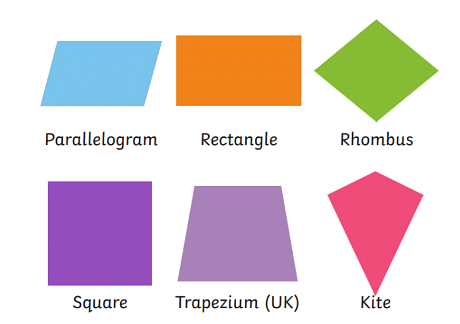
Types of Quadrilaterals
What is a Rhombus?
[Click Here for Sample Questions]
A rhombus is a specific sort of parallelogram with equal sides on all four sides. As a result, it's also known as an equilateral parallelogram. A rhombus has four equal-length sides as well as diagonals that bisect each other at 90 degrees, or right angles. The diagonals are not equal in length; one is shorter than the other. Angles perpendicular to the longer diagonal are larger than angles perpendicular to the shorter diagonal.

Rhombus
The sides of the rhombus are AB, BC, CD, and AD, whereas the diagonals are AC and BD in the rhombus ABCD above. AC and BD have lengths of d1 and d2, respectively. As shown in the diagram, the rhombus's two diagonals connect at right angles.
Read More: Area of Rhombus
Area of Rhombus Formula
[Click Here for Sample Questions]
Area of rhombus has different formulas in different cases, and the most commonly used are discussed here:
- Based on Side of the Rhombus: Consider a Rhombus ABCD with length of side ‘a’ and height of rhombus ‘h’. The area ‘A’ can then be determined by the formula
| A = a * h |
- Based on Diagonal of the Rhombus: Consider a Rhombus ABCD with AC and BD as diagonals. Let the length of diagonals AC and BD be d1 and d2 respectively. The area ‘A’ can then be determined by the formula
| A = ½ x d1 x d2 |
- Based on Perimeter of the Rhombus: Consider a Rhombus ABCD with length of side as ‘a’ and ‘r’ be the radius of the circle inscribed inside the rhombus. Hence, the area ‘A’ can then be determined by the formula
| A = 2ar |
- Based on Height and Vertex Angle: Consider a Rhombus ABCD with height ‘h’ and vertex angle ‘α’. The area ‘A’ can then be determined by the formula
| A = h2 / sin α |
Area of Rhombus Formula Derivation
[Click Here for Sample Questions]
Let ABCD be a rhombus with:
- Base AB = b
- Diagonal (DB) = d1 and Diagonal AC = d2
- DB ⊥ AC
- ‘h’ is the altitude from C on AB is CE
1) Area of rhombus ABCD = 2 x Area of \(\Delta\) ABC
= 2 × ½ AB × CD sq. units.
= 2 × ½ b × h sq. units
= base × height sq. units
2) Area of rhombus ABCD = 4 × area of \(\Delta\) AOB
= 4 × ½ × AO × OB sq. units
= 4 × ½ × ½ d2 × 12 d1 sq. units
= 4 × 1/8 d1 × d2 square units
= ½ × d1 × d2 square units
Read More: Area of Parallelogram
Perimeter of Rhombus
[Click Here for Sample Questions]
The perimeter of a rhombus is simply the sum of all sides. Consider a rhombus ABCD with length of all sides equal to ‘a’. Hence,
| Perimeter of Rhombus = 4 x a = 4a |
Also, semi-perimeter of a rhombus is equal to the perimeter of rhombus divided by 2, i.e,
| Semi-Perimeter of Rhombus = 4a / 2 = 2a |
Characteristics of Rhombus
[Click Here for Sample Questions]
Mentioned below are the important characteristics of a rhombus:
- The opposite sides of a rhombus are parallel, and the opposite angles are equal.
- A rhombus' sides are all the same length.
- A rhombus's diagonals cut each other at right angles.
- Rhombi or rhombuses are the plural form of rhombus.
Properties of Rhombus
[Click Here for Sample Questions]
Mentioned below are the important properties of a rhombus:
- Diagonals in a rhombus bisect each other at right angles.
- A rhombus' angles are bisected by diagonals. This is one of the most important characteristics of rhombus diagonals.
- 180° is equal to the sum of two neighbouring angles.
- A rhombus's two diagonals generate four right-angled triangles that are congruent to one another.
- In a rhombus, there are only two lines of symmetry.
- A rhombus has 180° rotational symmetry.
- A rectangle is formed by joining the midpoints of all four sides of a rhombus. The rectangle's length and breadth will be half the value of the major diagonal, and its area will be half that of the rhombus.
- When you combine the midpoints of half the diagonal, you'll get another rhombus.
- A rhombus does not have a circumscribing circle.
- Within a rhombus, there can't be an inscribing circle.
- Two congruent equilateral triangles are generated when the shorter diagonal is equal to one of the rhombus's sides.
Also Read: Difference between Square and Rhombus
Things to Remember
- A rhombus is a 2-dimensional shape that has four equal sides. Rhombus consists of all sides equal and its opposite angles are equal in measure.
- The adjacent angles in a rhombus are supplementary and sum up to 180°. The diagonals bisect each other at right angles.
- The opposite sides of a quadrilateral are always parallel, and opposite angles will be the same (congruent). Hence, every rhombus is a quadrilateral.
- A rhombus is a subset of a parallelogram, and in some cases, it might be square.
- The diagonals also bisect the rhombus's opposite angles, dividing the rhombus into two triangles that are congruent to each other.
- For any rhombus, formulas are defined in terms of the two main properties of area and perimeter.
- The perimeter of a rhombus is the overall length of its boundary, which is computed by adding all of its sides together. A rhombus' perimeter is measured in linear measures such as inches, yards, millimetres, and others.
- The length of the two diagonals of a rhombus with length d1 and d2 can be determined by the formula:
\(Diagonal d1 = \sqrt{4a^2 -d2^2}\)
Also Read:
Sample Questions
Ques. Define parallelogram (2 marks)
Ans. In geometry, you will encounter a variety of forms and sizes that you must study in order to develop a better understanding of how to calculate the area and perimeter of various objects. The triangle, circle, and quadrilateral are the most important shapes in Euclidean geometry. There are obtuse angle triangles, right-angle triangles, and acute angle triangles, and others. In quadrilaterals, a parallelogram is formed when the two opposite sides are parallel to one other.
Ques. Describe the importance of the rhombus. (2 marks)
Ans. The rhombus is a particularly important object in Euclidean geometry because it represents one of the varieties of parallelograms with equal sides. The shape of a body with all sides equal is by default a parallelogram, although many people confuse that shape with a square. Because a square is a specific condition of a rhombus, whereas all rhombuses are squares, not all rhombuses are squares.
Ques. Define area and perimeter. (2 marks)
Ans. The terms area and perimeter are significant measurements that indicate the features of the space that an object occupies. The perimeter is essentially the measurement of an object's outer edge, which extends throughout the contour of the body and gives it a specific shape. The area, on the other hand, is not affected by boundary conditions and is defined as the space occupied by a body's contained bounds.
Ques. What is the perimeter of a rhombus whose sides are all equal to 8 cm? (3 marks)
Ans. Side of rhombus = 8 cm
As all the sides of a rhombus are equal, so,
Perimeter = 4 x side
P = 4 x 8 cm
= 32 cm
Ques. Calculate the diagonal of a rhombus if its area is 121 cm2 and the length of the longer diagonal is 22 cm. (3 marks)
Ans. Area of rhombus = 121 cm2
d1 = 22 cm.
Area of the rhombus, A = (d1 x d2)/2
121 = (22 x d2) / 2
121 = 11 x d2
or, 11 = d2
Therefore, the length of the other diagonal is 11 cm.
Ques. Find the perimeter of the following rhombus:  (4 marks)
Ans. A rhombus's sides are all congruent, hence HO = (x + 2). Triangle HBO is a right triangle since the diagonals of a rhombus are perpendicular. We can get, using the Pythagorean Theorem,
(HB) 2 + (BO)2 = (HO)2
x2 + (x+1)2 = (x+2)2
x2 + x2 + 2x + 1 = x2 + 4x + 4
x2 – 2x – 3 = 0
We can solve x using the quadratic formula,
x = 3 or x = –1. We can reject x = –1 since the side of a rhombus cannot be negative.
∴ Side of the rhombus = x + 2 = 5
So, the perimeter of the rhombus HRMO is 5 x 4 units = 20 units.
Ques. The two diagonal lengths d1 and d2 of a rhombus are 5cm and 14 cm. Calculate its area. (2 marks)
Ans. Diagonal d1 = 5cm
Diagonal d2 = 14 cm
Area of the rhombus, A = (d1 x d2) / 2 square units
A = (5 x 14) / 2
A = 70 / 2
A = 35 cm2
Ques. Find the rhombus area where each side is equal to 17 cm and one of its diagonals equal to 16 cm. (4 marks)
Ans. In rhombus ABCD, AB = BC = CD = DA = 17 cm
AC = 16 cm, AO = 8 cm
In Δ AOD,
AD2 = AO2 + OD2
172 = 82 + OD2
289 = 64 + OD2
225 = OD2
OD = 15 cm
So, BD = 2 OD
= 2 × 15
= 30 cm
Now, area of rhombus = 12 × d1 × d2
= 12× 16 × 30
= 240 cm2
Ques. Arun has drawn a rhombus where the lengths of the diagonals d1 and d2 are 5 units and 10 units. He asks his sister Kiran to help him find the area. Please help Kiran to find the area. (2 marks)
Ans. Given,
Diagonal, d1 = 5 units, and d2 = 10 units
A = (d1 × d2) / 2
A = (5×10) / 2
A = 25 sq. units
Ques. Veer and his brother were playing a game of hopscotch and found a rhombus-shaped tile at the playground. The length of each side of the tile was 15 units. Help them to find the perimeter of the tile. (2 marks)
Ans. Length of the tile = 15 units.
As all sides of a rhombus are equal, all four sides are equal to 15 units.
So, perimeter = 4 × side = 4 × 15 = 60 units
For Latest Updates on Upcoming Board Exams, Click Here: https://t.me/class_10_12_board_updates
Check-Out:



Comments