



Education Content Expert
Scapula is a triangular, flat bone, that serves as a site for attachment for many muscles.
- Scapula is also known as the “Shoulder Blade”.
- It is situated between the second and seventh ribs.
- Scapula is made up of the spine, coracoid, acromion process, and glenoid cavity.
- It is one of the two bones that make up the pectoral girdle along with the collarbone or clavicle.
Scapula plays an important role in assisting the other bones involved in the pattern of shoulder motion. It controls the shoulder joint's flexibility and stability. Each scapula provides a point of attachment for a number of muscles that make up the arm and shoulder.
Read More: NCERT Solutions For Class 11 Biology Locomotion and Movement
| Table of Content |
Key Terms: Scapula, Shoulder Blade, Bones, Shoulder Girdle, Joints, Muscles, Articulation, Posterior Surface, Ribcage
What is Scapula?
[Click Here for Sample Questions]
Scapula is a triangular-shaped flat bone positioned at the back of the trunk.
- Scapula is the bone that connects the humerus to the clavicle, providing support to the back of the shoulder girdle.
- A collection of muscles that aid in retraction and internal and external joint rotation is supported by this triangular bone.
- At the tip of the acromion, the clavicle connects with the scapula.
- The acromion, a portion of the scapula, and the clavicle meet at the acromioclavicular joint.
- Typically, neurological diseases including strokes and other brain hemorrhages restrict the blood supply to the scapula.
Scapula Diagram
[Click Here for Previous Year Questions]
Scapula, also known as the shoulder blade, is the bone that connects the clavicle to the humerus. It forms the posterior of the shoulder girdle. Scapula is a sturdy, flat, and triangular bone in appearance.
A well-labeled Scapula Diagram is given as follows:
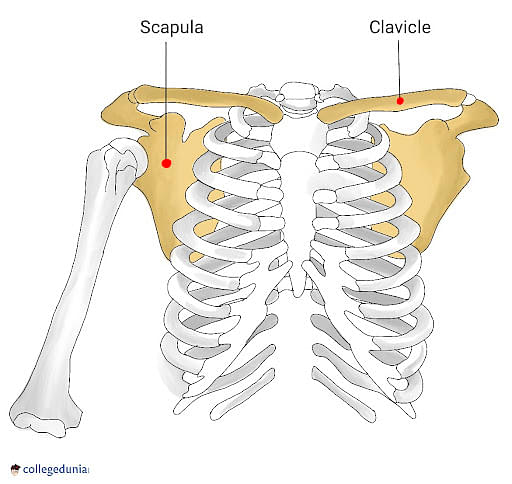
Scapula Diagram
Read More:
| Relevant Concepts | ||
|---|---|---|
| Skeletal System | Deltoid Muscle | Pectoralis Muscle |
| Types of Joints | Pelvic Bones | Bones of Legs |
Features of Scapula
[Click Here for Sample Questions]
Scapula is the origin of the biceps, triceps, deltoid, teres minor and major, supra and infraspinatus, and other muscles. There are two scapula bones in the pectoral girdle. Here are some primary features of the scapula:
- It is located over the ribs posteriorly, encompassing the 2nd to 7th ribs, and makes up the posterior portion of the shoulder girdle.
- The spine of the scapula is a raised ridge that extends from the convex dorsal surface of the scapula.
- The infraspinous fossa and supraspinous fossa separate the bone into an upper, smaller section and a lower, larger component.
- The subscapular fossa is a concave area on the ventral side.
- The glenoid cavity is a depression laterally in the scapula bone.
- The glenohumeral joint allows the humerus' head to articulate with the glenoid cavity.
- The coracoid process is the hook-shaped extension seen above and below the glenoid cavity.
- By ligaments, it is connected to the clavicle.
- The diverse shoulder movements are made possible by a variety of muscles that are linked to the scapula.
- The muscles that stabilize and rotate the scapula include the trapezius, levator scapulae, serratus anterior, and rhomboid.
Read More: Locomotion and Movement Important Questions
Functions of Scapula
[Click Here for Previous Year Questions]
Scapula control the shoulder joint's flexibility and stability. Numerous muscles, notably the rotator cuff muscles, are attached to the scapula. The movement of the shoulder joint is controlled by these muscles. The muscles that attach to the scapula surround the area of the scapula, which is on the higher posterior surface of the trunk (shoulder blade).
There are three categories into which these scapula muscles can be separated:
- Extrinsic Scapular Muscles: They connect the axial to the appendicular skeleton (levator scapulae, latissimus dorsi, trapezius, rhomboid minor, and rhomboid major)
- Intrinsic Scapula Muscles: These muscles attach the scapula to the humerus (deltoid, supraspinatus, infraspinatus, teres minor, teres major, and subscapularis).
- Stabilization and Rotation of the Scapula: The serratus anterior, trapezius, levator scapulae, and rhomboid are located on the superior, medial, and inferior borders of the scapula.
In addition, scapula is connected to a multitude of ligaments and tendons that support the shoulder joint.
Read More: Difference between Locomotion and Movement
Anatomy of Scapula
[Click Here for Sample Questions]
Scapula is a triangular-shaped bone in the upper back that makes up the shoulder blade. The body, the neck, and the spine make up the scapula. Given below are the parts of Scapula:
Borders
- Superior Border: Thinnest and the shortest border.
- Medial Border: Tiny border moving parallel to the vertebral column. It is usually known as the vertebral border.
- Lateral Border: Strongest and the thickest border. It sustains the glenoid cavity, which connects with the rounded head of the humerus, thus, creating the shoulder joint or glenohumeral joint.
Angles
- The superior border meets with the lateral border to create the lateral angle.
- The superior border coincides with the medial border which creates the superior angle.
- The lateral and medial borders meet to create the inferior angle.
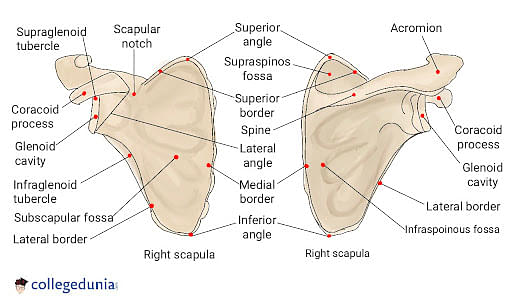
Anatomy of Scapula
Scapula Surface
The surface of the scapula has been categorized into three parts which are as follows:
Costal Surface
The Costal Surface, often known as the thoracic cage or ribcage, is the anterior surface of the Scapula.
- The subscapularis muscle protrudes from a sizable depression in this structure that faces the back and is known as the subscapular fossa.
- The coracoid procedure involves starting from the superior edge of the scapula's head, pushing forward, and bending laterally until it lies beneath the clavicle.
Lateral Surface
The scapula's lateral surface, which faces the humerus, is exposed. The main bone features of it are:
- Glenoid Fossa: At the lateral angle of the scapula is a shallow pyriform depression called the glenoid fossa. The glenohumeral (shoulder) joint is formed when it abuts the humerus' rounded head.
- Supraglenoid Tubercle: At the base of the coracoid process, on the glenoid fossa of the scapula, is a little projection known as the supraglenoid tubercle.
- Infraglenoid Tubercle: On the side of the scapula, right behind the glenoid fossa, is a rough imprint called an infraglenoid tubercle.
Posterior Surface
Scapula's posterior surface faces outward. Here is where the majority of the shoulder's rotator cuff tissues originate. The key anatomical features are
- Spine: On the back of the scapula, there is a long, thin bone segment known as the spine. It separates the supraspinous and infraspinous fossa, which are located on the back of the scapula. The two fossae are connected by the spinoglenoid notch. The spinoglenoid ligament spans this notch that is close to the spine.
- Supraspinous Fossa: The supraspinous fossa is the region above the scapula's spine. It has a concave shape, is smooth, and is wider at the vertebral point than the humeral point. The heart of this region is where the supraspinatus muscle starts. It is positioned on the side of the spinoglenoid fossa and is smaller than the infraspinous fossa.
- Infraspinous Fossa: The area beneath the scapula spine is known as the infraspinous fossa. Convex and much larger than the previous one, it is. It has a shallow concavity at the top portion of its body, near the vertebral edge. It has a concave core and a deep groove that runs from the upper to lower portion towards the lateral border.
- Acromion: The acromion is a large bony protrusion on the top of the scapula. At the acromioclavicular (AC) joint, it articulates with the clavicle and extends over the shoulder joint.
Check More:
| Related Topics | ||
|---|---|---|
| Difference between Bone and Cartilage | Bones of the Ankle | Difference between Compact and Spongy Bone |
| Bones of the Wrist | Pelvic Girdle Bones | Osteoporosis |
Articulations of Scapula
[Click Here for Previous Year Questions]
Articulation refers to the joint formed by two bones or cartilages.
- The movable joint that connects the glenoid cavity to the scapula and houses the tip of the humerus is referred to as the articulation in the scapula.
- With various body bones, the scapula creates significant articulations.
- The humerus, which links to the elbow and forearm, and the clavicle, or collarbone, which links to the shoulder, are the two points of connection at the top of the arm.
Things to Remember
- Scapula is a bone situated between the second and seventh ribs.
- Scapula plays a key role in assisting the other bones involved in the pattern of shoulder motion.
- The muscles that stabilize and rotate the scapula include the trapezius, levator scapulae, serratus anterior, and rhomboid.
- Scapula connects the humerus to the clavicle, providing support to the back of the shoulder girdle.
- It supports the collection of muscles that aid in retraction and internal and external joint rotation.
- The superior border, medial border, and inferior border are the three borders of the scapula.
- There are three surfaces of the Scapula namely the Costal Surface, Lateral Surface, and Posterior Surface.
Previous Years’ Questions
- Scapula is a large triangular flat bone situated in the dorsal part… (KEAM 2011)
- The clavicle articulates with ...... of scapula… (DUET 2011)
- Glenoid cavity articulates… (NEET 2015)
- Three of the following pairs of the human skeletal parts are… (NEET 2011)
- Which of the following components is a part of the pectoral girdle… (NEET 1994)
- Striated muscle fibers are found in…
- Ribs are attached to…
- Haversian canals occur in… (NEET 1989)
- Formation of cartilage bones involves… (AIPMT 1993)
- In the human body which one of the following is an atomically… (NEET 2007)
Sample Questions
Ques. Describe the scapula. Mention the different Scapular Parts. (3 Marks)
Ans. Scapula is a triangular-shaped, flat bone. It can be found at the rear of the trunk and is frequently referred to as the shoulder blade.
The major elements of the Scapula are
- Borders: Medial, Axillary, and Superior Borders.
- Angles: Inferior angle, Glenoid angle, and Superior angle or Medial angle.
- Surfaces: Lateral, Posterior, and Coastal surfaces.
- Coracobrachialis, biceps, triceps, pectoralis minor, serratus anterior, and subscapularis are some of the muscles.
Ques. What joints does the scapula connect to? (2 Marks)
Ans. The scapular region is a term used to describe the upper thoracic area on the dorsal side of the rib cage. The shoulder joint is created as a result of this connection between the clavicle and humerus at the glenohumeral joint and the acromioclavicular joint.
Ques. What is the anatomy and ossification of the Scapula? (5 Marks)
Ans. The glenoid cavity and the acromion process make up the two components that make up the scapula. Between the second and third months of fetal development, ossification takes place, with development starting at the inferior angle of the scapula and fusing to other sections during infancy.
A newborn baby's shoulder joint contains a lot of cartilage. Cartilage makes up the glenoid cavity, coracoid process, acromion, vertebral border, and inferior angle. However, the majority of these less crucial components of the shoulder tend to fuse with the rest of the bone by the time a person is fifteen. Throughout adolescence, the shoulder's bones continue to fuse in the following order:
- Near the acromion, at the base of the coracoid process.
- The inferior angle, as well as the surrounding vertebral boundary.
- Near the acromion's extremity
- At the edge of the vertebrae.
Ques. What is the movement of the Scapula? (3 Marks)
Ans. The scapula or shoulder blade moves along with the humerus. The scapula moves whenever our arm does. It can move in six different directions: up and down, forward and back, and toward the vertebral column (movement away from the vertebral column). It may also rotate both upward and downward.
17 of the 34 muscles that comprise the shoulder girdle attaches from the chest wall to the scapula. Four of these muscles namely the subscapularis, infraspinatus, teres minor, and supraspinatus, make up the rotator cuff, which protects the shoulder capsule and allows your shoulder blade to rotate and pivot.
Ques. How many borders can be seen on the scapular spine? (2 Marks)
Ans. The inferior is concave, while the superior has three boundaries and two surfaces where it is a component of the infraspinatous fossa. The front border is connected to the dorsal surface of the bone, while the posterior border is large, broader, and features two lips and an interval.
Ques. Describe the anatomical position of the scapula. (2 Marks)
Ans. The scapula, often known as the shoulder bone, is a flat, triangular bone. It is located on the posterior surface of ribs 2 to 7 and is visible at the back of the trunk. In other words, it is located on the dorsal surface of the rib cage in the upper thoracic region.
Ques. What purpose does the scapula bone serve? (3 Marks)
Ans. The functions of the scapula bone are
- The main support for the structure comes from the scapula bone.
- The scapula bone is where muscles including the deltoid, trapezius, and pectoralis minor are attached.
- Additionally, the scapula uses six separate muscle groups. It allows for fully functional upper extremity movement including rotation in both the upward and downward direction as well as elevation, retraction, and protraction.
- It assists in bringing up the upper trapezius while bringing down the lower trapezius. The scapula makes it feasible for the pectoralis minor to rotate downward and the trapezius to rotate upward.
Ques. Indicate where the scapular spine is located. (2 Marks)
Ans. An obvious bone plate that runs obliquely across the medial of the scapula and up toward its upper part is known as the scapular spine. It separates the supraspinous fossa from the infraspinatous fossa in this way.
Ques. What are the disorders of the scapula? (3 Marks)
Ans. The disorders of the scapula are:
- Shoulder impingement can be brought on by abnormal scapular function. During the motion of serving or throwing, the scapula lifts the acromion process. An impingement results when the scapula is unable to carry out this duty.
- A scapular bone malformation is called winging. It results from the medial scapular border's extreme prominence. Pushing and punching activities are reduced as a result. The scapula will wing during attempts to press, preventing the arm from being elevated over a 90-degree angle.
Ques. What is the scapular spine? (2 Marks)
Ans. The scapula's spine is a raised ridge that runs down its backside. It separates the larger infraspinatous fossa from the smaller supraspinous fossa in the convex posterior region of the scapula.
Check-Out:



Comments