


State Ohm's law. How can it be verified experimentally?

Ohm’s law states that voltage across a conductor is directly proportional to the current flowing through it, provided the temperature and physical conditions remain constant.

Experimental Verification of Ohm’s Law

The experiment that can easily verify Ohm’s Law is given below – 
Apparatus Required:

Circuit Diagram:
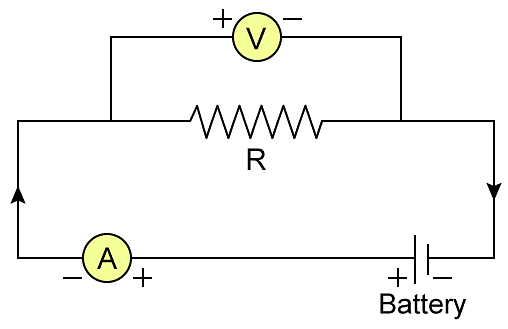
Ohm's Law Circuit Diagram

Procedure:

  • The key K is initially closed, and the rheostat is adjusted to get the minimum reading in Ammeter A and voltmeter V.
  • The current is gradually increased in the circuit by moving the sliding terminal of the rheostat.
  • During the process, current flows in the circuit, and a corresponding value of potential difference across the resistance wire R is recorded.
  • Therefore, different sets of values of current and voltage are obtained.
  • For each set of values of V and I, the V/I ratio is calculated.
  • When you calculate V/I for each recording, you will observe that it is almost the same. So V/I = R is a constant.
  • Plot a graph of current against potential difference which will be a straight line.
  • This shows that the current is proportional to the potential difference.

Related Questions:

  1. What is the necessary condition for a conductor to obey Ohm's Law?
  2. Why is the curve representing Ohm's law linear?
  3. What are the limitations of Ohm's Law?
  4. How do you find the resistance to Ohm's law?
  5. What are the 3 forms of Ohm's law
  6. Is resistance constant in Ohm's law?

Read More:

CBSE CLASS XII Related Questions

  • 1.
    Two small identical metallic balls having charges \( q \) and \( -2q \) are kept far at a separation \( r \). They are brought in contact and then separated at distance \( \frac{r}{2} \). Compared to the initial force \( F \), they will now:

      • attract with a force \( \frac{F}{2} \)
      • repel with a force \( \frac{F}{2} \)
      • repel with a force \( F \)
      • attract with a force \( F \)

    • 2.
      Two parallel plate capacitors X and Y are connected in series to a 6 V battery. They have the same plate area and same plate separation but capacitor X has air between its plates, whereas capacitor Y contains a material of dielectric constant 4. Calculate the capacitances of X and Y, if the equivalent capacitance of the combination of X and Y is \( 4 \, \mu\text{F} \). Calculate the potential difference across the plates of X and Y.


        • 3.
          If Bohr’s quantization postulate (angular momentum \( = \frac{nh}{2\pi} \)) is a basic law of nature, it should be equally valid for the case of planetary motion also. Why, then, do we never speak of quantization of orbits of planets around the Sun? Explain.


            • 4.
              Photoemission of electrons occurs from a metal (\( \phi_0 = 1.96 \, \text{eV} \)) when light of frequency \( 6.4 \times 10^{14} \, \text{Hz} \) is incident on it. Calculate: Energy of a photon in the incident light, The maximum kinetic energy of the emitted electrons, and The stopping potential.


                • 5.
                  Draw the number of scattered particles versus the scattering angle graph for scattering of alpha particles by a thin foil. Write two important conclusions that can be drawn from this plot.


                    • 6.
                      What is displacement current (\( i_d \))? Considering the case of charging of a capacitor, show that \( i_d = \varepsilon_0 \frac{d\Phi_E}{dt} \). What is the value of \( i_d \) for a conductor across which a constant voltage is applied?

                        CBSE CLASS XII Previous Year Papers

                        Comments


                        No Comments To Show
