



Education Journalist | Study Abroad Lead
Systematic Analysis of anions is an integral part of Salt Analysis. Ions are charged atoms or molecules. An Anion is an ion that is negatively charged and a Cation is positively charged. Inorganic salts are usually formed by the neutralization of an acid by a base either partially or completely. The acidic contribution part is called an anion and the contribution by the base is called a cation.
The mixture of salt undergoes various tests to identify anionic radicals. An Analysis is done to identify and detect acidic and basic radicals in salts.
During salt analysis, two principles are followed namely -
- Solubility Product
- Common Ion Defect
To detect the anions present in the salt, various tests are performed. Different anions show different results when specific tests are performed on them.
| Table of Content |
Key Terms: Anions, Cations, Solubility Product, Common Ion Effect, Tests, Salt Analysis
Aim
[Click Here for Sample Questions]
Aim To identify various anions present in inorganic salts by performing various tests
Salt Analysis
[Click Here for Sample Questions]
Salt analysis or qualitative analysis of anions is considered one of the best ways to detect and identify acidic and basic radicals in salts. Salts are formed by the neutralization reaction between acids and bases or between acidic oxides and base or basic oxides. The examples of neutralization reactions are as follows -
KOH + HCL → KCL + H2O
NaOH + HNO3 → NaNO3 + H2O
2KOH + H2SO4 → K2SO4 + 2H2O
Usually, organic compounds contain crystalline solids and have geometrical shapes. They consist of oppositely charged ions called radicals.
Solubility Product
Solubility Product is defined as the multiplication of ion concentrations along with the number of occurrences of ions in an equation, representing electrolytic dissociation of saturated solution as their raised powers.
- A Solubility product is an ionic product if the solution is saturated.
- It can also be defined as the equilibrium constant when the solid substance is dissociated in an aqueous solution.
- It is denoted by Ksp.
An Example of a solubility product is as
AgCl(s)↔Ag⁺(aq)+Cl⁻(aq)
Ksp=[Ag⁺][Cl⁻]
Common Ion Effect
The common ion effect refers to the phenomenon where the addition of an ion that is already present in a solution reduces the solubility or precipitation of a sparingly soluble salt. This effect arises because the presence of a common ion in a solution reduces the solubility product of the salt.
It is a consequence of Le Chatelier's principle(Equilibrium Law).
- It can also be defined as the suppression of dissociation of a weak electrolyte by adding a small amount of a strong electrolyte that contains a common ion.
- An example of a Common ion Effect is the suppression of ionization of weak electrolyte acetic acid with the addition of strong electrolyte sodium acetate containing a common ion acetate.
Also Read: High Density Polythene
Salt Tests
[Click Here for Sample Questions]
Identification of Anions from Volatile Products:
| Experiment | Observation | Inference |
|---|---|---|
| The Action of dilute H2SO4 Here dilute H2SO4 is added to salt in a test tube and warmed, | Brisk effervescence | Anion is CO32- |
| Rotten egg smell | May be Sulphide Ion | |
| Burning Sulphur smell | May be Sulphate anion | |
| Colorless vinegar-flavored gas released | May be acetate anion | |
| Fishy odor reddish brown gas | May be Nitrate anion | |
| The Action of Conc.H2SO4 Here Conc.H2SO4 is added to salt and heated | Reddish brown vapors turning red paper fluorescent | Bromide ion |
| Violet Colored vapors turning blue starch paper | Iodide anion | |
| Reddish brown vapors turning brown ferrous sulfate paper into acidified | Nitrate anion | |
| No characteristic observation | The above-mentioned anions are absent | |
| Action of NaOH If NaOH solution is added to salt and heated | Colorless gas with a pungent smell that produces dense white fumes with a glass rod dipped in HCL | Ammonium Ion |
| No gas released from ammonium | Ammonium is not present |
Sodium Carbonate Extract:
Confirmatory Tests for CO32-, S2-, SO32-, NO2- and CH3COO- anions:
Anion testing is confirmed using water extract if salt is soluble in water but if salt is insoluble in water then we use sodium carbonate extract. Water extract is formed by dissolving salt in water
- Sodium carbonate extract is formed by taking 1 g of salt in a boiling tube and then mixing 3 g of sodium carbonate extract in 15 mL of distilled water.
- After removing the contents and cooking for about 10 minutes, then cool it down.
- Collect the filtrate in a test tube and mark it a label as sodium carbonate extract
| Experiment | Observation | Inference |
|---|---|---|
| Silver Nitrate Test In this test, we add dilute HNO3 to sodium carbonate extract till effervescence stops. Then we add AgNO3 solution in excess. | Curdy white NH4OH soluble precipitate | Chloride anion |
| Insoluble yellow precipitate in NH4OH | Iodide anion | |
| Pale yellow precipitate in NH4OH, sparingly soluble | Bromide anion | |
| No precipitate | Absence of the above ions | |
| Barium Chloride Test In this test we add BaCl2 solution, then we add dilute HCL. | Insoluble white precipitate in HCL— | SO42- anion |
| HCL soluble white precipitate— | SO32- anion | |
| No precipitate | SO42- anion and SO32- absent | |
| Lead Acetate Test Here we add lead acetate solution to extract(acidification with acetic acid,co2 boiling off and cooled) | White ppt soluble in excess ammonium acetate solution | Maybe SO42- anion |
| Ethyl Acetate Test Here we add ethanol to salt in a test tube and then add. Heat it slowly and then cool it down | Pleasant fruity odor | Acetate anion is present |
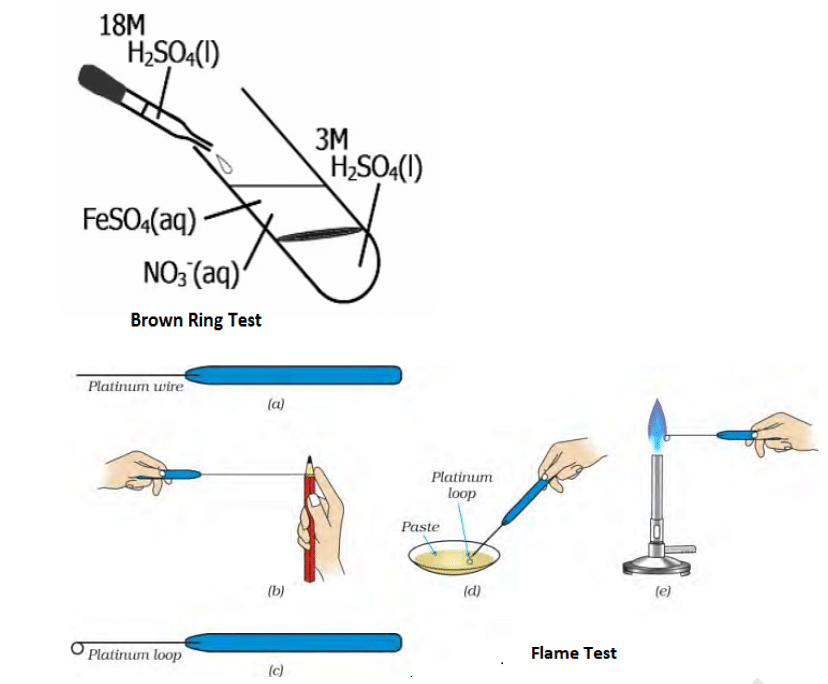
| Ferrous Sulphate Test: (Brown Ring Test) Add H2SO4 to extract till effervescence stops and then add 2 to 3 drops of freshly prepared FeSO4 solution. Then place it in a slanting position in a test tube and add H2SO4 without inference to the solution | The Brown ring is seen at the liquid junction If no brown ring is found | Maybe NO3- anion. Maybe NO3- is not present |
Material Required
[Click Here for Sample Questions]
- Test tubes
- Boiling tubes
- Test tube holder
- Test tube stands
- Corks
- Filter paper
- Delivery tube
- Reagents
Apparatus Setup
[Click Here for Sample Questions]
Apparatus Setup
Procedure
[Click Here for Sample Questions]
| Experiment | Observation | Inference |
|---|---|---|
| Preliminary reactions | Salt is colorless | Absence of Fe2+, Fe3+, Ni2+ and Co2+ ions |
| Appearance | Salt is green | May contain Fe2+, Ni2+, Cu2+ |
| Salt is green | May contain Fe2+ | |
| Salt is pink | May contain Co2+. Mn2+ | |
| Salt is blue | May contain Cu2+ | |
| Action of Heat A Small amount of salt is added to a dry test tube and then heated gently | a colorless gas with a pungent odor is released and turns moist red litmus blue | May contain NH4+ |
| reddish-brown vapors are released turning acidic ferrous sulfate brown paper | May contain NO3- | |
| A substance is white in cold and yellow in hot | May contain (Zn)2+ | |
| Flame Test When we drop Conc.HCL in a watch glass containing salt and then place the paste formed with the help of a glass rod into the base of a non-luminous bunsen burner, | a)Apple green Color b)Crimson red color c)Brick red color d)Bluish green flame | Maybe Ba2+ Maybe Sr2+ Maybe Ca2+ Maybe Cu2+ |
Results
[Click Here for Sample Questions]
Salt contains—(CO32-, S3‒2-, SO32-, SO32-, NO2-, NO3⁻, Cl‒, Br‒, I⁻, PO43‒, C2O42‒, CH3COO⁻) anion.
Also Read: Polytetrafluoroethene (Teflon)
Precautions
[Click Here for Sample Questions]
- The Labeling of bottles should be read carefully before using any reagent or chemicals. Unlabeled reagents should never be used.
- Remember in the chemical laboratory, we should use an apron, an eye protector, and hand gloves
- Be careful during the smell of vapors. Always gently fan the vapors to your nose. The Chemical should not be tasted also.
- Don't throw sodium metal into the sink.
- When heating or adding a reagent in the test tube, be careful that it should never point to yourself or your neighbors.
- The Working environment should be kept clean.
- Be careful with explosive compounds, flammable substances, toxic gasses, electrical appliances, glass products, flames, and hot substances.
- There should be a minimum use of the number of reagents, otherwise, the chemicals are not only wasted but also environmental damage too.
- When laboratory work has been completed, we should wash our hands.
Things To Remember
- Acid contributes Anion part and base contributes Cation part to salt
- Solubility product means the product of ion concentrations raised to power the number of occurrences in the electrolytic dissociation of a saturated solution
- Common Ion Effect is the suppression of dissociation of weak electrolytes with the addition of a strong electrolyte containing a common ion as the former electrolyte.
- Different tests we deal with here for salts–Flame test, dilute H2SO4 addition to salt, Conc. H2SO4 added to salt etc.
- Systematic analysis of anions involves a series of tests to identify and separate anions in a given sample.
- The first step in the systematic analysis of anions is the preliminary test, which involves the addition of dilute HCl to the sample solution to detect the presence of sulfide, sulfite, and carbonate ions.
- The next step is the group reagent test, which involves adding a specific reagent to the sample solution to precipitate an entire group of anions. The common group reagents are HCl, H2SO4, NH4OH, and Hg2(NO3)2.
Also Read:
Sample Questions
Ques. What is Neutralisation Reaction? (1 Mark)
Ans. It is the reaction between an acid with a base resulting in the formation of a salt.
Ques. How salts are formed? (1 Mark)
Ans. Salts are formed by the reaction of an acid with base or acid oxides with base or basic oxides
Ques. What is a Solubility Product? (2 Marks)
Ans. It can be defined as the product of concentrations of ions with the raised power as the number of times that ion is occurring in an equation. It is denoted by Ksp.
Ques. What is the Common Ion Effect? (2 Marks)
Ans. It is defined as the suppression of dissociation of a weak electrolyte by the addition of a strong electrolyte containing a common ion with the prior electrolyte.
Ques. What is the other name of the Ferrous Sulphate Test? Why is it called that? (2 Marks)
Ans. the other name of the Ferrous Sulphate Test is the Brown Ring Test. It is called that because the test produces a brown ring in the middle of the solution being tested. The brown ring is formed due to the formation of a complex between Fe2+ and NO2- ions present in the solution, which results in the formation of a nitrosyl-ferrous complex, Fe(NO)(H2O)52+.
The Brown Ring Test is commonly used to detect the presence of nitrates (NO3-) in a solution. It involves adding a few drops of freshly prepared FeSO4 solution to the sample solution, followed by adding concentrated sulfuric acid (H2SO4) down the side of the test tube so that it forms a layer at the bottom of the tube. The mixture is then gently shaken, and a brown ring will appear at the junction of the two layers if nitrates are present in the solution. The test is based on the fact that nitrates are reduced to nitrites (NO2-) in the presence of FeSO4 under acidic conditions, and the nitrites then react with the Fe2+ ions to form the brown complex.
The Brown Ring Test is qualitative, and it is not quantitative, meaning it does not measure the concentration of nitrates present in the sample. It is a sensitive and specific test for detecting nitrates and is commonly used in the analysis of water and soil samples.
Ques. How is Ferrous Sulphate or Brown Ring Test Done? (3 Marks)
Ans. Firstly we add H2SO4 to salt till effervescence stops and then after that, drops of freshly prepared FeSO4 solution are added. After this, we place it in a slanting position in a test tube. If the result shows a brown ring at the liquid junction, then we can say that salt contains NO3- anions otherwise these NO3- anions are absent
Ques. How is the Flame Test Done? What are the results? (5 Marks)
Ans. The flame test is a simple chemical test used to identify the presence of certain metal ions in a sample based on the characteristic colors emitted by their respective atomic emissions in a flame.
Here are the general steps for conducting a flame test:
Clean a platinum or nichrome wire by dipping it in concentrated hydrochloric acid and heating it in a flame until the wire turns red hot.
Dip the cleaned wire into the sample solution, and then hold the wire in the flame of a Bunsen burner.
Observe the color of the flame.
The color of the flame will vary depending on the metal ion present in the sample:
- Sodium ions produce a yellow flame.
- Potassium ions produce a lilac or pink flame.
- Calcium ions produce an orange-red flame.
- Copper ions produce a blue-green flame.
- Barium ions produce a green flame.
Other metal ions can also produce characteristic colors in a flame, but these are the most common examples. The flame test is qualitative and is not quantitative, meaning it does not measure the concentration of the metal ion present in the sample.
It is important to note that the flame test must be done with caution, as the sample may contain toxic or flammable substances. Protective clothing and goggles should be worn when performing this test, and all waste should be disposed of properly. Additionally, the wire used in the test should be cleaned thoroughly between each sample to avoid contamination.
Ques. What is the Silver Nitrate Test? (5 Marks)
Ans. The silver nitrate test is a commonly used chemical test to detect the presence of halide ions (chloride, bromide, or iodide) in a solution. The test is based on the ability of silver ions to react with halide ions to form a precipitate of the corresponding silver halide.
The test involves adding a few drops of silver nitrate solution (AgNO3) to the solution being tested. If halide ions are present in the solution, a white or colored precipitate of the corresponding silver halide will form. The reactions are as follows:
AgNO3(aq) + NaCl(aq) → AgCl(s) + NaNO3(aq)
AgNO3(aq) + NaBr(aq) → AgBr(s) + NaNO3(aq)
AgNO3(aq) + NaI(aq) → AgI(s) + NaNO3(aq)
The color of the precipitate depends on the halide ion present: silver chloride is white, silver bromide is cream-colored, and silver iodide is yellow.
The silver nitrate test is commonly used in qualitative salt analysis to identify the presence of halide ions in a given salt. It is also used in medical and biological laboratories to test for the presence of halide ions in various samples, such as urine and blood.
Ques. What is Barium Chloride Test? (3 Marks)
Ans. The barium chloride test is a common chemical test used to detect the presence of sulfate ions in a solution. The test is based on the ability of barium ions to react with sulfate ions to form a white precipitate of barium sulfate.
The test involves adding a small amount of barium chloride solution to the solution being tested. If sulfate ions are present in the solution, a white precipitate of barium sulfate will form. The reaction is as follows:
BaCl2(aq) + Na2SO4(aq) → BaSO4(s) + 2NaCl(aq)
The white precipitate of barium sulfate is insoluble in water and is easily visible. The test can be confirmed by filtering the precipitate and washing it with distilled water to remove any soluble impurities. The barium sulfate can then be identified using various methods, such as flame testing or spectroscopy.
The barium chloride test is commonly used in qualitative salt analysis to identify the presence of sulfate ions in a given salt. It is also used in the analysis of water and soil samples to test for the presence of sulfate ions, which can be harmful to plants and animals in high concentrations.
Ques. What are the results of adding dilute H2SO4 to salt? (5 Marks)
Ans. If dilute H2SO4 is added to salt in a test tube, and then slightly heated, the results we may get can be inferred as
- Brisk effervescence— Anion is CO32-
- Rotten egg smell — Sulphide Ion
- Burning Sulphur smell — Sulphate anion
- Colorless vinegar flavored gas released — Acetate anion
- Fishy odor reddish brown gas — May be Nitrate anion
Ques. What are the results of adding Conc H2SO4 to salt? (3 Marks)
Ans. The addition of concentrated H2SO4 to salt is a commonly used test in qualitative salt analysis. The results and inferences obtained from this test depend on the type of salt being tested.
Chloride salts: When concentrated H2SO4 is added to chloride salts, hydrogen chloride gas (HCl) is evolved. This is due to the reaction of H2SO4 with chloride ions in the salt, which produces HCl gas. The evolution of HCl gas can be confirmed by holding a piece of moistened blue litmus paper over the test tube. The litmus paper will turn red in the presence of HCl gas, indicating a positive chloride test.
Nitrate salts: When concentrated H2SO4 is added to nitrate salts, brown fumes of nitrogen dioxide (NO2) are evolved. This is due to the reaction of H2SO4 with nitrate ions in the salt, which produces NO2 gas. The evolution of brown fumes can be confirmed by holding a piece of paper or glass rod moistened with potassium iodide-starch solution near the mouth of the test tube. The starch-iodide paper or glass rod will turn blue in the presence of NO2 gas, indicating a positive test for nitrate.
Sulfate salts: When concentrated H2SO4 is added to sulfate salts, no visible reaction occurs. This is because sulfate ions do not react with H2SO4 to produce a gas or any other visible change. However, if a small amount of barium chloride solution is added to the mixture after adding H2SO4, a white precipitate of barium sulfate will be formed. The formation of the white precipitate confirms the presence of sulfate ions in the salt.
In conclusion, adding concentrated H2SO4 to salt is a useful test for identifying the presence of chloride, nitrate, and sulfate ions in the salt. The test results can be used to infer the identity of the salt being tested.
Ques. What are the results of adding NaOH to salt? (3 Marks)
Ans. If NaOH solution is added to salt and heated, different results that can be inferred are -
- A Colorless gas may be seen with a pungent smell that produces dense white fumes with a glass rod dipped in HCL - Presence of ammonium Ion
- No gas released from ammonium - Ammonium is absent
For Latest Updates on Upcoming Board Exams, Click Here: https://t.me/class_10_12_board_updates
Check-Out:



Comments