



Education Content Expert
Ethyl Acetate is an organic compound which is also known as Ethyl Ethanoate. Ethyl acetate is used as a solvent in various reactions. It is obtained from a process that involves direct esterification of ethyl alcohol along with acetic acid.
- Ethyl Acetate Formula is CH3COOCH2CH3.
- The reaction between acetic acid and ethanol gives out ethyl acetate which is considered a carboxylate ester.
- The reaction between carboxylic acid and alcohol categorizes ethyl acetate as a carboxylate ester.
- As the compound does not contain any hydrogen atom and directly reacts with the electronegative atoms, it is known as a polar aprotic solvent.
Key Terms: Ethyl Acetate, Ethyl Acetate Formula, Esterification, Distillation, Ester, Organic Compound, Solvent
What is Ethyl Acetate?
[Click Here for Sample Questions]
Ethyl Acetate is an organic compound with the chemical formula CH3COOCH2CH3. It is a clear, colorless liquid with a fruity, sweet aroma. It is a volatile solvent and is widely used in the production of various products such as paints, inks, adhesives, and some types of glues.
- Ethyl acetate is an ester, which is a compound formed by the reaction of an alcohol and an organic acid. In this case, the alcohol is ethanol and the acid is acetic acid.
- It is produced by the esterification of ethanol and acetic acid in the presence of an acid catalyst.
- It is also a byproduct of fermentation and is present in many foods, such as fruits and wine.
- Ethyl acetate is considered to be a flammable liquid and should be handled with care.
- Ethyl acetate is also used as a solvent for removing nail polish and other coatings.
- In the food industry, it is used as a flavoring agent, as well as to extract coffee and tea flavors.
- It is also used in perfumes, and as an extraction solvent in the essential oil and herbal medicine industry.
- Long-term exposure to high concentrations of ethyl acetate can cause eye, nose and throat irritation, headaches, and dizziness.
Read More:
Ethyl Acetate Formula and Structure
[Click Here for Sample Questions]
Ethyl Acetate, also known as ethyl ethanoate, is a colorless liquid with a fruity aroma. Ethyl Acetate Formula is CH3COOCH2CH3.
- It is composed of a carbonyl group (C=O) and an ester group (COO).
- The molecule consists of a carbon atom attached to an oxygen atom (carbonyl group) and another carbon atom (ester group) attached to an oxygen atom and an ethyl group (-C2H5).
- It is produced through the esterification of acetic acid and ethanol, which is typically done through the use of an acid catalyst.
- Ethyl acetate is a polar solvent, which means it can dissolve polar compounds such as water and alcohols, but not nonpolar compounds such as oils and fats.
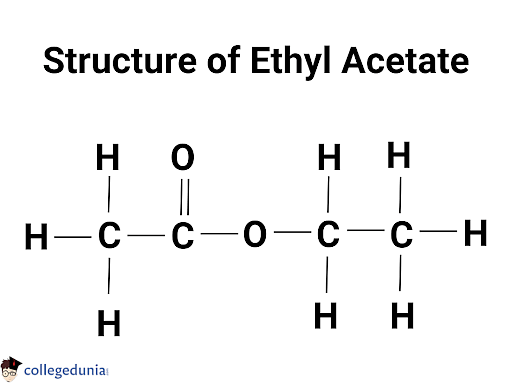
Ethyl Acetate Structure
Ball and Stick Model for Ethyl Acetate
A ball and stick model is a representation of a molecule where the atoms are represented as spheres, or balls, and the bonds between atoms are represented as sticks.
- The ball and stick model of ethyl acetate shows the molecular structure and the spatial arrangement of the atoms in the molecule.
- The model clearly illustrates the location of the polar carbonyl and ester groups, which are responsible for the polar nature of the molecule.
- The model also shows the location of the carbon-hydrogen bonds, which are responsible for the characteristic fruity aroma of ethyl acetate.
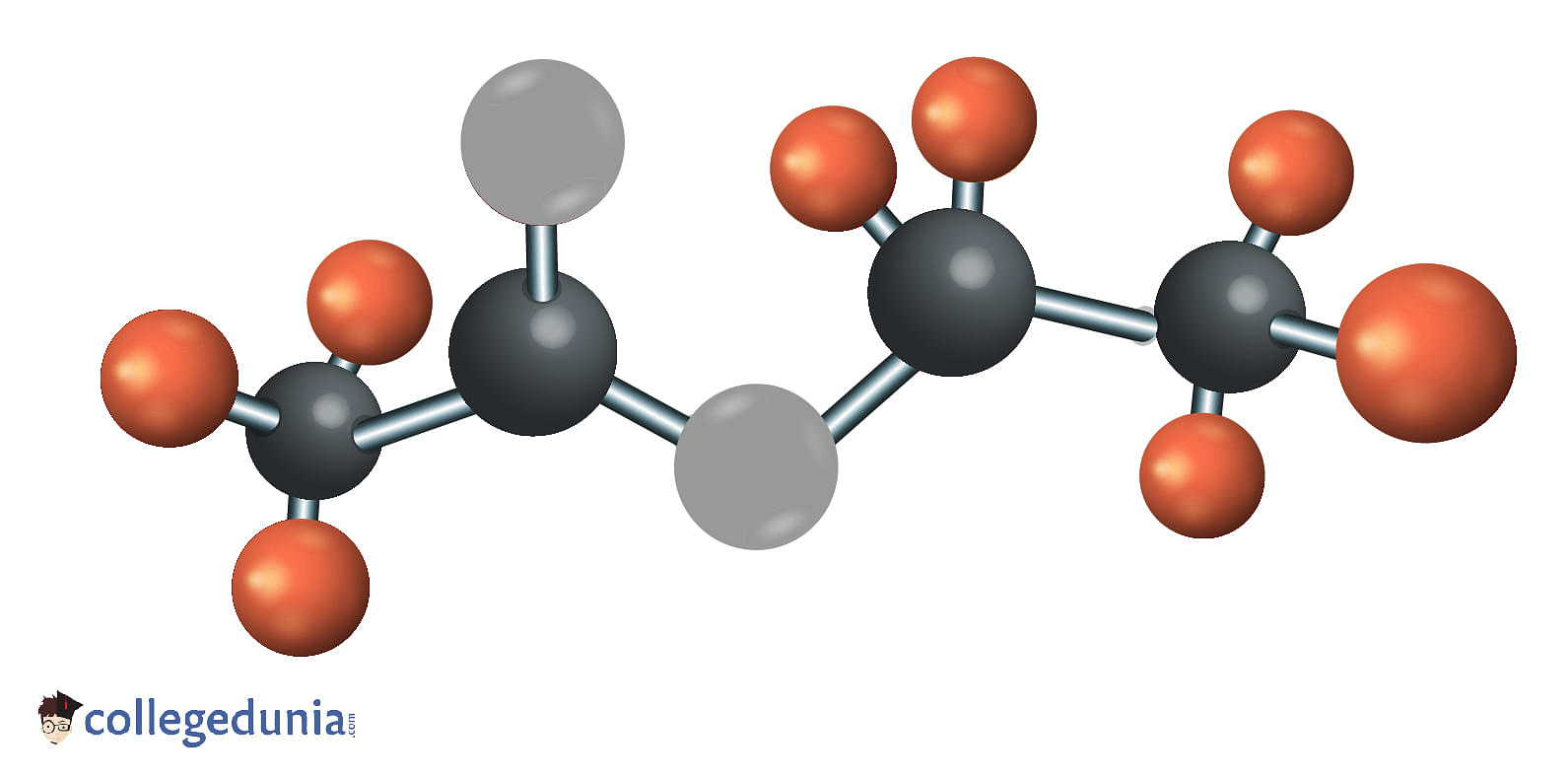
Ethyl Acetate Ball and Stick Model
Ethyl Acetate Properties
[Click Here for Sample Questions]
The well-known properties of the Ethyl Acetate are as follows:
- It is colorless and produces a sweet odor.
- It has a molecular weight of 88.11.
- It is highly flammable in the liquid state and toxic when inhaled.
- The boiling point of the compound is 77.1оC and the freezing point is -83.6 оC.
- It is almost insoluble in water with the insolubility of 8.3g/100 ml at 20 оC but it is soluble in organic solvents such as chloroform, toluene, acetone, and benzene.
- The specific gravity is 0.902 at 20 оC.
- The molar mass of the compound is 30.070 g.mol-1.
- The compound is not hygroscopic.
Ethyl Acetate Uses
[Click Here for Sample Questions]
Roughly 1.3 million tonnes of Ethyl Acetate is produced every year with a production value of $3.3 billion.
- It is used in the production of the taste of wine. The small quantity of acetic acid reacts with ethanol which forms ethyl acetate.
- It is used as a decaffeinating agent in tea and coffee.
- It is used in extraction and column chromatography.
- In the textile industry, it is used as a cleaning agent.
- In the food industry, it is used as preservatives and flavoring agents.
- It is a good solvent for varnishes, fats, nitrocellulose, airplane dopes, and lacquer ink because of its favorable odor, low toxicity, and inexpensiveness.
- It is used in the production of paints uses ethyl acetate as a hardener or activator.
- It is used in perfumes, fruits, and confectionery.
- As the compound has the properties of a solvent, it can evaporate on the skin which retains the fragrance of the perfume to stay.
Ethyl Acetate Health Hazards
[Click Here for Sample Questions]
Ethyl Acetate induces bad effects on health when exposed to accidental exposure.
- It may react adversely when inhaled, brought in contact with eyes and skin, and consumed.
- The use of this chemical indirectly can cause problems in the central nervous system.
- It also causes symptoms of depression and hemorrhages.
- It can cause serious damages to the internal organs if he/she is subjected to prolonged exposure to the substance continuously.
Check More:
Things to Remember
- Ethyl Acetate is an organic compound mainly used as a solvent in different reactions.
- Ethyl Acetate Formula is given as CH3COOCH2CH3.
- It is obtained by the classic Fischer esterification mechanism of acetic acid and ethanol.
- It is also prepared by the process of catalytic condensation of alkoxide and acetaldehyde.
- Ethyl acetate is incapable of holding itself to water which diminishes its property of being a reaction solvent.
- It is found in beers, wine, fruit juices, lacquers, spirits, cereal crops, and alcoholic drinks.
Sample Questions
Ques. What are the various physical properties of Ethyl Acetate? (5 Marks)
Ans. The Physical properties of Ethyl Acetate are as follows:
- Ethyl Acetate is a colorless liquid with a fruity smell.
- It has a relatively low boiling point (77 °C) and a relatively low melting point (-83 °C)
- It has a relatively low viscosity, meaning it flows easily.
- It has a relatively low density (about 0.9 g/cm3)
- It is flammable and has a relatively low flash point (7 °C)
- It is completely miscible with water and most organic solvents, meaning it can mix homogeneously with water and other organic solvents.
- It is a relatively low surface tension liquid, meaning it can easily spread over a surface.
- It has a relatively low refractive index, meaning light does not bend much as it passes through the liquid.
- It has a relatively low index of refraction and a relatively low polarizability, meaning it does not interact strongly with electric and magnetic fields.
- It is considered to be relatively safe to handle, but contact with the skin and eyes should be avoided as it can cause irritation.
Ques. What is the ideal way to store Ethyl Acetate? (3 Marks)
Ans. Ethyl Acetate is highly reactive when exposed to moisture which is why it should be stored in a cool, dry, and well-ventilated container. Therefore, the storage of ethyl acetate should be checked so that it does not trigger its explosive nature. It is always advisable to maintain safety while handling ethyl acetates such as wearing gloves, masks, and safety glasses.
Ques. Why is Ethyl Acetate considered a good solvent? (2 Marks)
Ans. Hydrogen bonds are accepted by the molecules of ketones, ethyl ether, ethyl acetate, and other ethers which makes them devoid of electrons which solves the problem of donors more readily than chloroform. Thus, ethyl acetate is a solvent that is used as an electron donor more frequently.
Ques. Calculate the molar weight of Ethyl Acetate. (3 Marks)
Ans. Ethyl acetate has a total of 14 molecules. The formula is C4H802 and consists of 8 hydrogen atoms, 4 carbon atoms, and 2 oxygen atoms. The molecular weight of the ethyl acetate is calculated by adding the atomic weight of each element multiplied by the number of atoms.
By calculating the atomic mass of each element:
C = 12 x 4 = 48
H = 1 x 8 = 8
O = 16 x 2 = 32
Molecular Weight of Ethyl Acetate = 48 + 8+ 32 = 88 g/mol
Ques. What are the various chemical properties of Ethyl Acetate? (5 Marks)
Ans. The chemical properties of the Ethyl Acetate are as follows:
- Ethyl Acetate, also known as Ethyl ethanoate, is a colorless liquid with a fruity smell.
- It is a polar solvent, meaning it can dissolve polar compounds such as water-soluble salts and sugars, but is not very effective at dissolving non-polar compounds such as oils and waxes.
- It is miscible with water and most organic solvents, meaning it can mix homogeneously with water and other organic solvents.
- It is a relatively weak organic acid, meaning it can donate protons to acceptors and can act as a proton acceptor.
- It is also a relatively weak organic base, meaning it can accept protons and can act as a proton donor.
- It is considered to be relatively safe to handle, but contact with the skin and eyes should be avoided as it can cause irritation.
- It is considered to be relatively safe for use in food and pharmaceuticals as a flavoring agent and a solvent, but exposure to high concentrations should be avoided.
Ques. What is one of the most common uses of Ethyl Acetate? (2 Marks)
Ans. Etymology is the study of insects that uses the vapor of ethyl acetate in the jars to capture insects without killing them. The solubility of the substance makes it suitable to be used in the food industry. Food products such as gums, baked foods, cakes, ice creams, candy, etc use ethyl acetate as an artificial flavoring.
Ques. What are the main methods of manufacturing Ethyl Acetate? (2 Marks)
Ans. Ethyl acetate is mainly produced by the esterification of acetic acid and ethanol. Another method of manufacturing ethyl acetate is by the process of catalytic condensation of alkoxide and acetaldehyde.
Ques. What are the various uses of Ethyl Acetate? (5 Marks)
Ans. The various uses of the Ethyl Acetate are as follows:
- Ethyl Acetate is commonly used as a solvent in the production of coatings, adhesives, inks, and cleaning agents.
- It is also used as a solvent in the production of cellulose acetate for films and fibers.
- It is used as a flavoring agent and a solvent in the food and pharmaceutical industries.
- It is used in the production of perfumes, as a solvent for fragrances and as a fixative to help the fragrance last longer.
- It is used in the production of some types of plastics, such as polyvinyl acetate.
- It is used as an extraction solvent in the decaffeination process of coffee and tea.
- It is also used as a chemical intermediate in the production of other chemicals such as acetic anhydride and esters.
- It is used in the production of some types of adhesives, such as contact adhesives and as a coating for some types of paper and cardboard.
- It is also used as a solvent for the production of some pesticides and herbicides.
Ques. How to remove water during the production of Ethyl Acetate? (3 Marks)
Ans. Through the process of Fischer esterification, ethanol is reacted with acetic acid in the presence of an acid catalyst such as hydrochloric and sulphuric acid to give out ethyl acetate as the product. The equation is:
CH3CH2OH + CH3COOH \(\to\) CH3COOC2H5 + H2O
Ques. What is saponification of Ethyl Acetate? (2 Marks)
Ans. Saponification of ethyl acetate is also known as a second-order reaction because both the reactants are directly proportional to the rate of reaction. The formula used for the same is:
K = 1/t [(v0 - vt)/v0vt ]
Ques. Explain the process of the hydrolysis of Ethyl Acetate? (5 Marks)
Ans. Hydrolysis of ethyl acetate is a chemical process in which ethyl acetate is broken down into ethanol and acetic acid by reacting with water. The process can occur under both acidic and basic conditions.
Acidic Hydrolysis
- It occurs in the presence of an acid catalyst, such as sulfuric acid.
- The acid catalyst acts as a proton donor, donating a proton to the oxygen atom of the ester group in the ethyl acetate molecule, breaking the ester bond.
- The result of this reaction is the formation of ethanol and acetic acid.
The chemical equation for this reaction is:
C4H8O2 + H2O \(\to\) C2H5OH + C2H4O2
Basic Hydrolysis
- It occurs in the presence of a base catalyst, such as sodium hydroxide.
- The base catalyst acts as a proton acceptor, accepting a proton from the oxygen atom of the ester group in the ethyl acetate molecule, breaking the ester bond.
- The result of this reaction is the formation of ethanol and acetic acid.
The chemical equation for this reaction is:
C4H8O2 + H2O \(\to\) C2H5OH + C2H4O2
Check-Out:



Comments