




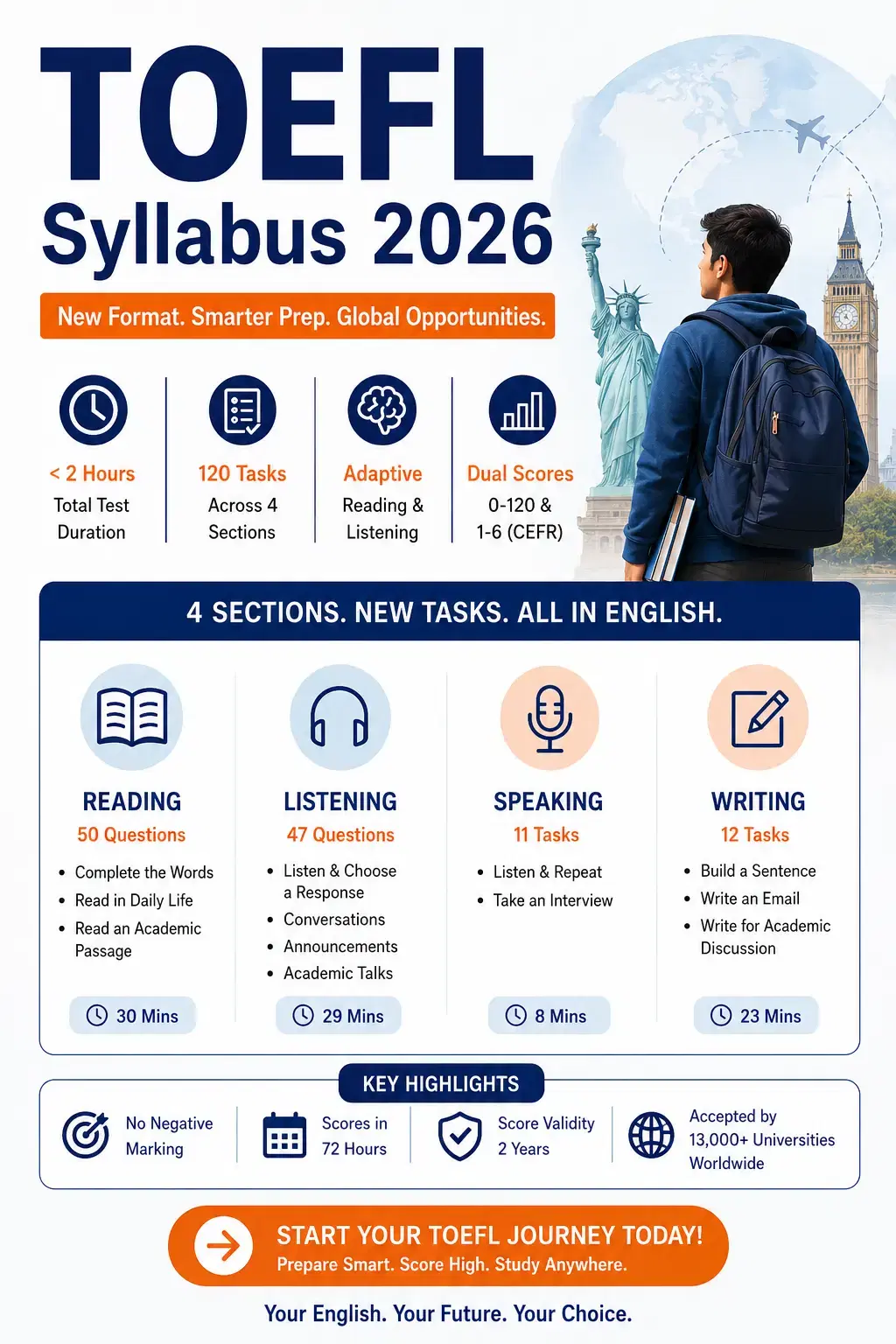
The TOEFL syllabus 2026 was completely revised by ETS on January 21, 2026. The TOEFL iBT now has 4 sections, 120 items, and a pure testing time of 1 hour 23 minutes to 1 hour 29 minutes. The Reading and Listening sections follow a multistage adaptive format, while Speaking and Writing remain linear.
- Brand-new task types such as Complete the Words, Listen and Repeat, Take an Interview, and Build a Sentence have replaced parts of the older syllabus.
- Scores are now primarily reported on a 1–6 scale (aligned with CEFR), with a comparable 0–120 overall score provided during the two-year transition period.
- Scores are valid for 2 years.
- TOEFL syllabus 2026 sections: Reading, Listening, Speaking, and Writing – all in English, computer-based, with no negative marking.
- TOEFL total items: Reading 50, Listening 47, Writing 12, Speaking 11.
- TOEFL scoring 2026: Primary scale is 1–6 (section scores and overall). A comparable 0–120 overall score is also reported during the transition. Official scores are available 3 days after the test.
Also read:
- TOEFL Exam Syllabus 2026
- TOEFL Section-Wise Syllabus 2026
2.1 TOEFL Reading Syllabus 2026
2.2 TOEFL Listening Syllabus 2026
2.3 TOEFL Writing Syllabus 2026
2.4 TOEFL Speaking Syllabus 2026
- TOEFL Syllabus 2026: Vocabulary and Grammar Topics
3.1 Recommended TOEFL Vocabulary Focus
- TOEFL Marking Scheme and Scoring 2026
4.1 How is the new 1-6 band score linked to the TOEFL syllabus?
- TOEFL Computer-Adaptive Format and Syllabus Delivery
- TOEFL On-Screen Tools and Test-Day Mechanics
- TOEFL Syllabus Compared to IELTS, PTE and Duolingo
- How to Prepare for the TOEFL Syllabus 2026
- FAQs
TOEFL Exam Syllabus 2026
The TOEFL iBT syllabus covers four English skills: Reading, Listening, Writing, and Speaking. It focuses on academic and campus-based situations, including lectures, conversations, announcements, and online discussions.
Below is the complete TOEFL syllabus 2026 structure with section-wise task types and time:
| Section | Task Types in Syllabus | No. of Questions / Tasks | Duration |
|---|---|---|---|
| Reading | Complete the Words, Read in Daily Life, Read an Academic Passage | 50 | 30 min |
| Listening | Listen and Choose a Response, Listen to a Conversation, Listen to an Announcement, Listen to an Academic Talk | 47 | 29 min |
| Writing | Build a Sentence, Write an Email, Write for an Academic Discussion | 12 | 23 min |
| Speaking | Listen and Repeat, Take an Interview | 11 | 8 min |

TOEFL Section-Wise Syllabus 2026
The 2026 TOEFL iBT now blends pure academic content with everyday campus English. Each section has its own task list, topic focus, and time block. Indian students should pay extra attention to Listen and Repeat and Take an Interview tasks because both are new in 2026 and have no preparation time.
TOEFL Reading Syllabus 2026
The TOEFL Reading section in 2026 tests how well you understand short academic and real-world English texts. The section is multistage adaptive, with about 50 questions in 30 minutes across three task types.
- Complete the Words: Fill in missing letters inside an academic paragraph. Tests vocabulary, spelling, and contextual understanding.
- Read in Daily Life: Short real-world texts such as emails, hostel notices, library announcements, course advisor mailers, restaurant menus, syllabi, or campus event flyers. Question types include detail, purpose, and tone identification.
- Read an Academic Passage: Shorter than the old TOEFL — approximately 200 words per passage instead of 700. Topics include biology, environmental science, history, sociology, art history, and psychology. Question types: main idea, vocabulary in context, inference, factual detail, sentence insertion.
TOEFL Reading topics in the syllabus: climate change, urbanisation, marine biology, ancient civilisations, modern psychology, US/UK history, business ethics, anthropology, geology, behavioural economics, art movements, public health.
| TOEFL Reading Practice Tests 2026 | |
|---|---|
| TOEFL Reading Practice Test 1 | TOEFL Reading Practice Test 2 |
| TOEFL Reading Practice Test 3 | TOEFL Reading Practice Test 4 |
Also Read:
TOEFL Listening Syllabus 2026
The TOEFL Listening section contains approximately 47 items and lasts about 25–29 minutes. It is multistage adaptive and includes four task types. Candidates may hear native-speaker accents from North America, the United Kingdom, New Zealand, or Australia.
- Listen and Choose a Response: Candidates hear a short spoken prompt (a statement or question) and select the most appropriate reply. This task measures understanding of meaning, intent, and common spoken patterns.
- Listen to a Conversation: Short conversations related to campus life. Questions test understanding of main ideas, key details, speaker intent, and implied meaning.
- Listen to an Announcement: Short announcements in academic or campus settings. Questions focus on the speaker’s purpose, key information, and implied meaning.
- Listen to an Academic Talk: Short academic talks given by a professor or expert. Questions measure understanding of main ideas, supporting details, organisation, and inferences.
TOEFL Listening topics in syllabus: Official ETS materials do not publish fixed topic lists or exact audio lengths. Topics come from a range of academic fields, and no prior subject knowledge is required. Note-taking is allowed throughout the section.
| TOEFL Listening Practice Tests 2026 | |
|---|---|
| TOEFL Listening Practice Test 1 | TOEFL Listening Practice Test 2 |
| TOEFL Listening Practice Test 3 | TOEFL Listening Practice Test 4 |
Also Check:
TOEFL Writing Syllabus 2026
The TOEFL Writing section contains 12 items and lasts 23 minutes. The old integrated essay has been removed and replaced with three shorter task types.
- Build a Sentence (10 items): Candidates rearrange scrambled words or phrases to form grammatically correct sentences. This task measures understanding of English sentence structure, grammar, and word order.
- Write an Email (1 item): Candidates write an email in response to a realistic academic or social situation (for example, making a request or giving information). This task measures the ability to write clearly, stay on topic, and follow appropriate writing conventions.
- Write for an Academic Discussion (1 item): Candidates contribute to an online classroom discussion by stating and supporting an opinion. A good response is usually at least 100 words. This task measures the ability to develop ideas and write in an academic tone.
Note: Official ETS materials do not publish fixed word counts or exact time splits for individual tasks, nor a fixed list of topics. Topics are designed so that no specialised background knowledge is required.
| TOEFL Writing Practice Tests 2026 | |
|---|---|
| TOEFL Writing Test 1 | TOEFL Writing Test 2 |
| TOEFL Writing Test 3 | TOEFL Writing Test 4 |
Also check: TOEFL Writing Topics
TOEFL Speaking Syllabus 2026
The TOEFL Speaking section was completely redesigned in 2026. The old four-task format has been replaced. The new section contains 11 spoken responses across two task types and lasts 8 minutes. All responses are recorded through a microphone, and there is no preparation time.
- Listen and Repeat (7 items): Candidates hear short English sentences one at a time and must repeat each sentence exactly. This task measures pronunciation accuracy, stress, intonation, and intelligibility.
- Take an Interview (4 items): Candidates participate in a simulated interview and answer questions related to academic or campus situations. This task measures the ability to communicate clearly, maintain a natural speaking pace, and use appropriate vocabulary and grammar.
Scoring: Speaking responses are scored by a combination of AI scoring (SpeechRater) and ETS-certified human raters. The section score is reported on the 1–6 scale.
Note: Official ETS materials do not publish a fixed list of topics. Questions are based on academic and campus-related situations.
| TOEFL Speaking Practice Tests 2026 | |
|---|---|
| TOEFL Speaking Practice Test 1 | TOEFL Speaking Practice Test 2 |
| TOEFL Speaking Practice Test 3 | TOEFL Speaking Practice Test 4 |
Also check: TOEFL Speaking Topics
TOEFL Syllabus 2026: Vocabulary and Grammar Topics
The TOEFL does not have an official vocabulary or grammar syllabus. Unlike school exams, ETS does not publish a fixed list of words or grammar rules that will be tested. However, strong performance in all four sections requires solid command of academic vocabulary and accurate grammar.
Recommended TOEFL Vocabulary Focus
- Academic vocabulary commonly found in university texts (many students use the Coxhead Academic Word List as a reference)
- Understanding words in context (especially useful for the Complete the Words task)
- Collocations and natural phrasing
- Topic-related vocabulary from common academic areas (science, social science, arts, business, etc.)
Recommended Grammar Focus
- Sentence structure and word order (important for the Build a Sentence task)
- Subject-verb agreement
- Verb tenses
- Articles and prepositions
- Active and passive voice
- Relative clauses
- Conditionals
- Clear punctuation
Important Note: These are general areas that help candidates perform well. They are not an official ETS syllabus. The best preparation is regular practice with authentic TOEFL-style materials and extensive reading and listening in academic English.
TOEFL Marking Scheme and Scoring 2026
TOEFL iBT 2026 introduces a dual-scale scoring system. ETS continues to issue the familiar 0-120 score during the 2026-2028 transition period and adds a new 1-6 band score aligned with the Common European Framework of Reference (CEFR).
| Section | Score Range (Old Format) | Score Range (New Format) | What is Tested |
|---|---|---|---|
| Reading | 0-30 | 1-6 | Comprehension of academic and real-world texts |
| Listening | 0-30 | 1-6 | Understanding of lectures, conversations, announcements |
| Writing | 0-30 | 1-6 | Grammar, sentence structure, task fulfilment, organisation |
| Speaking | 0-30 | 1-6 | Pronunciation, fluency, vocabulary, coherence |
| Total | 0-120 | 1-6 | Aligned with 1-6 CEFR bands |

Source: https://collegedunia.com/exams/toefl/practice-papers
Important syllabus-related scoring rules for 2026:
- No negative marking — guess if unsure.
- MyBest Scores combines your best section scores across multiple test attempts, but many universities (especially MIT, Caltech, ETH Zurich) do not accept them.
- Score validity: 2 years from test date. Read More
- Score release: Official scores are available in the ETS account 3 days after the test date.
Also Read
How is the new 1-6 band score linked to the TOEFL syllabus?
Each band on the 1–6 scale corresponds to a CEFR level:
- Band 1: A1 (beginner)
- Band 6: C2 (mastery)
The 1–6 scale was designed by ETS to provide a clearer and more consistent link to the Common European Framework of Reference (CEFR). A score of 4, for example, aligns with CEFR level B2 across all four sections (Reading, Listening, Speaking, and Writing).
TOEFL Computer-Adaptive Format and Syllabus Delivery
For the first time in TOEFL history, the Reading and Listening sections follow a multistage adaptive design starting in 2026. The Speaking and Writing sections remain linear because they are open-response tasks scored by a combination of AI and human raters.
How the adaptive format works:
- Stage 1 (Router): All test takers begin with the same set of items.
- Stage 2: Based on performance in the first stage, candidates are routed to either a Lower or Upper module.
The final section score takes into account performance on both stages as well as the difficulty of the items.
What this means for preparation: Because the test adapts to the candidate’s performance, it is important to prepare across the full range of task types and difficulty levels. Focusing only on easier items is not effective.
TOEFL On-Screen Tools and Test-Day Mechanics
- Scratch paper: Provided at test centres for notes; Home Edition test takers use a small whiteboard.
- No calculator — TOEFL is a language test, not a quantitative one.
- Review and skip: You can move back and forth within the Reading and Listening sections within their time limits. Speaking and Writing tasks cannot be revisited once submitted.
- Volume control: Adjustable during the unscored audio check at the start.
- Timer: Always visible on screen. You can hide it during Reading if it feels distracting.
- No spell check or dictionary in Writing — practise manual proofreading.
- No breaks in the 2026 format because the test is shorter than 2 hours.
Also Check:
How to Prepare for the TOEFL Syllabus 2026
- Phase 1 (Weeks 1-2): Diagnostic. Take the free ETS TOEFL diagnostic, identify weak sections, and review the official ETS TOEFL iBT Free Practice Test for the 2026 format.
- Phase 2 (Weeks 3-6): Section-by-section coverage. Dedicate one week each to Reading, Listening, Speaking, and Writing. Practise the new task types — Listen and Repeat, Take an Interview, Build a Sentence, Write an Email.
- Phase 3 (Weeks 7-8): Full-length mocks. Take 4-6 full mocks under timed conditions. Indian students should focus extra mock time on Listen and Repeat because it has zero preparation time.
- Phase 4 (Final week): Refinement. Review test-day logistics, ID requirements, and equipment setup if taking the Home Edition.
- Daily habit: 20 minutes of US podcast listening (NPR, This American Life, BBC News), 10 minutes of reading from The New York Times or The Atlantic, and 10 minutes of recorded speaking practice.
The TOEFL syllabus 2026 rewards consistent multi-skill practice. It is no longer enough to memorise one essay template or one Speaking introduction line because the new task types are short, sharp, and demand instant English production. Indian students who treat TOEFL as a real-language proficiency check, not just a structured exam, will score consistently above 100 on the 0-120 scale.
FAQs
Ques. Is the TOEFL syllabus the same for the home edition and the test centre?
Ans. Yes. According to ETS, both formats have the same content, structure, and scoring across Reading, Listening, Speaking, and Writing. The main difference is the testing environment: the Home Edition is monitored online, while the test-centre version is taken at an authorised test centre.
Ques. What is the TOEFL syllabus 2026?
Ans. The TOEFL syllabus 2026 covers four sections — Reading, Listening, Speaking, and Writing — with new task types like Complete the Words, Read in Daily Life, Listen and Repeat, Take an Interview, Build a Sentence, and Write an Email. The total test takes under 2 hours.
Ques. How many sections does the TOEFL exam have in 2026?
Ans. The TOEFL iBT 2026 has 4 sections — Reading, Listening, Speaking, and Writing. Each section is scored on a 0-30 scale, totalling 0-120 plus a 1-6 CEFR band.
Ques. Is the TOEFL syllabus the same as the exam pattern?
Ans. The syllabus refers to the topical content and task types you must master, while the exam pattern refers to the structure, timing, and marking scheme. On Collegedunia, both are addressed together because they overlap heavily in TOEFL preparation.
Ques. Has the TOEFL syllabus changed in 2026?
Ans. Yes. ETS rolled out a complete syllabus overhaul on January 21, 2026. Reading and Listening are now multistage adaptive, the Speaking section was rebuilt with 2 new task types, and the Writing section dropped the Independent Essay in favour of Build a Sentence and Write an Email tasks.
*The article might have information for the previous academic years, which will be updated soon subject to the notification issued by the University/College.



Comments