



Content Curator
Drugs are chemical substances that can change a person’s ability to think and feel. It interrupts the biological function of the human body. These are used by doctors widely as medicines to cure many diseases or remove pain and inflammation in the body. Since they can change how a person performs, they should not be taken without a doctor’s guidance. There are both legal and illegal uses of drugs. Illegal use can even result in the death of a person.
| Table of Content |
Key Takeaways: Drugs, Stress, Antidepressants, Analgesics, Antihistamines
What are Drugs?
[Click Here for Sample Questions]
Drugs are chemical substances with low molecular masses (~100 – 500u). They can affect the physiological or biological state of the body. Hence, some can work as a therapy and help in removing stress, physical pain or reducing inflammation. These drugs are known as medicines and are used in the diagnosis, prevention and treatment of diseases. They should only be consumed after the doctor’s prescription because if not taken cautiously these drugs can become poisonous.
Classification Of Drugs
[Click Here for Sample Questions]
The criteria for the classification of drugs are as follows:
Based on Pharmacological Effect
The science of how drugs act on biological systems and how the body responds to the drugs is known as pharmacology. Different drugs have different pharmacological effects on human bodies. These are helpful for doctors in providing a range of drugs for a particular type of disease or problem. For example, antiseptics can kill or arrest the growth of microorganisms, analgesics can help in reducing pain.
Based on Drug Action
This happens when a classification of a drug is based on how a drug in its way generates a response called drug action. For example, there are many drugs available in reducing inflammation. But each drug will reduce inflammation through a different pathway.
Based on Chemical Structure
Drugs are classified into groups as having a similar chemical structure. The drugs in the same group also have the same pharmacological effect. For example, sulphonamides have a similar chemical structure.

Sulphonamide Structure
Based on Molecular Targets
Drugs usually interact with target molecules to generate a biological response such as biomolecules, carbohydrates, lipids, proteins and nucleic acids. This classification is very useful for doctors and medicinal chemists. Biomolecules perform various functions in the body. The proteins that perform the role of biological catalysts in the body are called enzymes, those which perform communication systems in the body are called receptors.
Types of Drugs
[Click Here for Sample Questions]
Various types of drugs are used by healthcare professionals to cure specific ailments in the body.
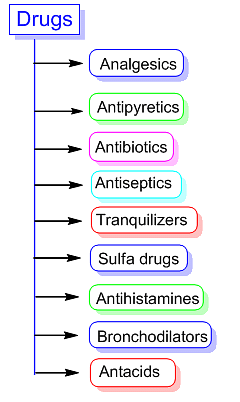
Types of Drugs
Antacids
Antacids act like bases and neutralise the acid present in the stomach and make its Ph value more neutral. These are used to treat the symptoms of Gastroesophageal Reflux Disease or acid reflux, heartburn and indigestion. Antacids contain key ingredients such as aluminium, calcium, magnesium, or sodium and sometimes a combination of two salts, such as magnesium carbonate and aluminium hydroxide.
Some antacids are also used to treat, for example:
- Aluminium antacids: lower elevated blood phosphate levels and prevent the formation of kidney stones.
- Calcium carbonate antacids: These treat calcium deficiency.
- Magnesium oxide antacids: These treat magnesium deficiency.
Alka-Seltzer(Aspirin), Gaviscon, and Eno are the popular antacids readily available in the market.
Antihistamines
Antihistamines are used to treat acute diseases like allergic rhinitis, common cold, influenza, nasal congestion or sneezing. The drugs are taken to treat the symptoms such as coughing, sneezing and watery eyes caused by too much histamine in the body. These drugs can be taken without a doctor’s prescription. However, it is advisable that one should consult a doctor before consuming them in the long run.
Antihistamines have two major subtypes.
- H-1 receptor antagonists or H-1 blockers: They are used to treat allergy symptoms.
- H-2 receptor antagonists or H-2 blockers: They are used to treat gastrointestinal conditions, including gastroesophageal reflux disease (GERD), peptic ulcers, gastritis and nausea.
Examples of antihistamines are Levocetirizine, Fexofenadine (Allegra) and Loratadine.
Neurologically Active Drugs
There are two types of neurologically active drugs:
- Tranquilisers: These are drugs that are used to treat stress, fatigue, mild and severe mental diseases.
- Analgesics: These drugs are responsible for providing relief from pain in the body. Analgesics are further classified into:
(i) Non-narcotic drugs: Aspirin and paracetamol are highly popular non-narcotic drugs. Aspirin inhibits the synthesis of chemicals known as prostaglandins which stimulate inflammation in the tissue. These chemicals are responsible for causing pain in the body. These drugs are effective in relieving skeletal pain such as that due to arthritis, reducing fever (antipyretic) and preventing platelet coagulation and preventing heart attacks.
(ii) Narcotic drugs: These drugs become poisonous if consumed more than the prescribed amount. One such example is Morphine and many of its homologues, when taken with guidance relieve pain and produce sleep. If not taken cautiously then they can cause stupor, coma, convulsions and ultimately death. These analgesics are also used for the relief of different types of pain such as cardiac pain and pains of terminal cancer and childbirth.
Antimicrobials
Antimicrobial drugs are chemical substances that suppress the growth of or kill microorganisms including bacteria, fungi, protozoa and viruses. They can be natural or artificial in origin. The types of antimicrobial drugs are:
- Antibiotics: These are used to treat bacterial infections such as strep throat, urinary infections in the body. They either kill the bacteria or stop them from multiplying. For example, Penicillin
- Antiseptics: Chemicals used for cleaning wounds to kill or prevent the growth of organisms are known as antiseptics. Some of the popular antiseptics are chlorhexidine, povidone-iodine, isopropyl alcohol, benzalkonium chloride and hydrogen peroxide.
- Disinfectants: Disinfectants are chemical substances used to inactivate or kill microorganisms on inert surfaces. Chlorine bleach is a popular example of a disinfectant.
Antifertility Drugs
The drugs used to avoid population growth and help in family planning are called antifertility drugs. These are made from the combination of derivatives of oestrogen and progesterone. For example, Ethynylestradiol, mestranol, and norethynodrel are antifertility drugs.
Things to Remember
- Drugs are an important part of the healthcare industry which doctors use in the prevention and treatment of various diseases.
- Drugs interfere with the biological or physiological functions of the body.
- Drugs should be taken cautiously and do not be taken more than prescribed doses.
- Many adolescents indulge in taking drugs which can prove lethal to them.
- Hence, proper counselling should be done so that they refrain from their consumption in any form.
Sample Questions
Ques: What is chemotherapy? (2 Marks)
Ans: The drug treatment that uses powerful chemicals to kill certain cells in the body is known as chemotherapy. These cells multiply really fast and their production can only be reduced through chemotherapy. It is used in the treatment of cancer. They can either reduce symptoms or prolong the life of the patient.
Ques: What is the tincture of iodine? Write its use. (2 Marks)
Ans: Tincture of iodine is a weak iodine solution that contains 2% to 7% element iodine along with potassium iodide or sodium iodide, dissolved in a mixture of ethanol and water. It is used as a disinfectant to treat minor bacterial skin infections and to disinfect wounds.
Ques: Name a substance that can be used as an antiseptic as well as a disinfectant. (2 Marks)
Ans: Phenol can be used as both antiseptic as well as disinfectant. 0.2% solution of phenol is used as an antiseptic while its 1% solution can be used as a disinfectant. It is used for the disinfection of the skin and it also helps to relieve itching.
Ques: What are food preservatives? (2 Marks)
Ans: Food preservatives are substances or chemicals that are added to food and beverages to prevent the decay of food that happens due to microbes.
Food preservatives are of two types:
- Natural preservatives: Raspberry extract, vinegar, alcohol, garlic and clove with honey, ginger cinnamon are natural food preservatives.
- Artificial preservatives: Benzoates, sulphates, Propionates, Nitrates, and Sorbates.
Ques: Define the term ‘broad-spectrum’ antibiotics. (2 Marks)
Ans: ‘Broad-spectrum’ antibiotics can change the body's normal microbial content by attacking indiscriminately both the pathological and naturally occurring, beneficial or harmless bacteria found in the many organs as their side-effect. This leads to disruption of immunity, nutrition, and leads to a relative overgrowth in some bacteria or fungi. Examples of broad-spectrum antibiotics are Doxycycline, Minocycline, Ampicillin, Amoxicillin/clavulanic acid (Augmentin) etc.
Ques: Why are cimetidine and ranitidine better antacids than sodium hydrogen carbonate, magnesium or aluminium hydroxide?(2 Marks)
Ans: Acidity is caused due to the release of excess acid in the stomach. More production of acid is caused by the interaction of histamine with receptors in the stomach walls. Sodium hydrogen carbonate, magnesium or aluminium hydroxide neutralise the excess HCL present in the stomach but they do not treat the root cause for the release of excess acid. Cimetidine and ranitidine control the root cause of acidity and decrease the amount of acid released in the stomach.
Ques: Mention some misuses of Drugs? (2 Marks)
Ans: When drugs are taken without an expert’s guidance the drugs can prove lethal to the body and can even cause death. Hence, one should not consume more than a specified amount. Many adolescents also get addicted to drugs and this hampers their whole lives. It is advisable to stay away from drugs as much as possible and only medicinal drugs should only be consumed at the time of illness with a doctor’s prescription. Tea and coffee contain a drug called caffeine, which changes the way the brain functions as they result in increased alertness in the body. Therefore one should avoid them.
Ques: What are artificial sweetening agents? Give two examples. (2 Marks)
Ans: Chemicals used to sweeten the food are called artificial sweetening agents. They are helpful for patients suffering from diabetes as they do not add calories to our bodies. They do not cause any harm to our bodies. Examples include aspartame, saccharin, sucralose and alitame approved by FDA.
Ques: Low level of noradrenaline is the major cause of depression. Name the two drugs that are needed to cure this problem. (2 Marks)
Ans: Noradrenaline is a neurotransmitter and plays an important role in defining our mood. Its low level leads to depression, so tranquilisers or antidepressants are used to counteract the effect of depression. These drugs release enzymes catalysing the degradation of the neurotransmitters, noradrenaline. As a result, the neurotransmitters are slowly metabolised and then the receptor gets activated for longer periods of time. Two antidepressant drugs are Iproniazid and Phenelzine.
Check-Out:



Comments