



Education Journalist | Study Abroad Lead
Chemistry is basically the study of materials and the development of new materials for the betterment of mankind. In our daily life, we use so many substances like toothpaste, soaps and detergents, sugar, etc, which are made up of chemical compounds. From the way our body exchanges oxygen to how the universe was created, all these things are associated with chemistry. There are three important areas where we use chemistry in our life namely Medicines, Food Materials and Detergents.
| Table of Content |
Key Terms: Chemistry, Cleansing Agents, Soaps, Detergents, Medicines, Drugs, Antioxidants, Preservatives, Cosmetics
Chemistry in Medicine
[Click Here for Sample Questions]
A drug is a chemical substance that affects human metabolism and provides a cure for a disease. Drugs are chemicals that interact with macromolecular targets to elicit a biological response.
- Drugs will interact with macromolecular targets (where these targets are chemical compounds such as proteins, lipids, etc.) to maintain balance in the body.
- When the biological response is therapeutic and useful, these chemicals are called drugs and are used in the diagnosis, prevention, and treatment of disease.
- Medicines are a subclass of drugs. They produce a good response and are useful for the diagnosis, prevention and treatment of diseases.
- Most drugs used as medicines are potential poisons if taken in higher doses than recommended.
- The use of chemicals to treat and cure disease is called chemotherapy.
- Treatment of a disease with a chemical compound that destroys microorganisms without attacking the tissue of the human body is known as chemotherapy.
- The compounds used are called chemotherapeutics.
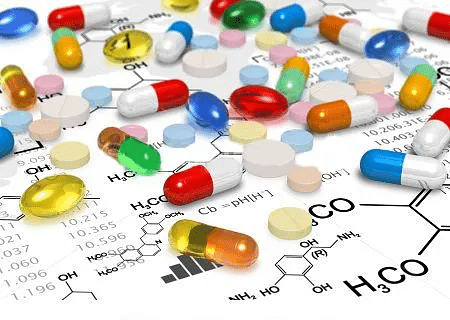
Chemistry in Medicine
Read More: Types of Drugs
Chemistry in Food in Everyday Life
[Click Here for Previous Year's Questions]
Chemicals are widely used in the following food items:
- Coloring agents
- Artificial sweeteners
- Antioxidants
- Minerals
- Vitamins
- Artificial preservatives
- Flow stabilizers
- Binding substance
Artificial Preservatives: These substances help in preventing the spoilage of food by preventing or stopping the growth of microorganisms. For instance, Sodium benzoate, and sodium metabisulphite.
Artificial Sweeteners: Artificial Sweeteners do not add any calories to the body as these substances are excreted through urine. For instance,
- Aspartame: This substance is used in cold drinks and ice-creams.
- Alitame: It is around 2000 times sweeter than sucrose.

Artificial Sweeteners
Antioxidants: Antioxidants are those substances that prevent the spoilage of food by preventing the oxidation of food. Here are a few examples:
- Butylated hydroxyl tolerance (BHT)
- Butylated hydroxyl anisole (BHA)
Read More: Difference Between Oxidation and Reduction
Chemistry in Cleansing Agents in Everyday Life
[Click Here for Sample Questions]
Here is how Chemistry plays an important role in cleansing agents in our everyday life.
What are Soaps and Detergents?
We need to understand what actually a soap or a detergent means in chemistry.
Detergents
- The word detergent means "cleaning agent". Detergent is derived from the Latin word "detergere" meaning "to wipe".
- Detergents are substances that remove dirt and have a cleaning effect in the water.
- Detergents can be divided into 2 types- Soapy detergents or soaps and Synthetic detergents.
Soaps
- Soaps are sodium or potassium salts of long-chain fatty acids (containing 15-18 carbon atoms), such as stearic, oleic and palmitic acids.
- Sodium salts of fatty acids are known as hard soaps and potassium salts of any fatty acids are known as soft soaps.

Soaps and Detergents
Read More: Difference Between Soap and Detergent
Preparation of Soaps
- Soaps containing sodium salts are created by heating a fat (ie glyceryl ester of a fatty acid) with an aqueous solution of sodium hydroxide. This reaction is known as saponification.
- During saponification, fatty acid esters are hydrolyzed and the obtained soap remains in colloidal form.
- Then, it is precipitated from the solution by adding sodium chloride.
- The solution left after removing the soap contains glycerol, which can be obtained by fractional distillation.
- Note that only sodium and potassium soaps are water soluble and are used for cleaning purposes.
- Compared to sodium, potassium soaps are gentle on the skin. These can be prepared by using potassium hydroxide solution instead of sodium hydroxide.
Read More:
How do Soaps Work?
Generally, soaps are sodium or potassium salts of long-chain fatty acids. Soap molecules have both a hydrophobic and a hydrophilic part. While the hydrophilic part sticks to water during washing, the hydrophobic end to dirt particles. So when we pour the water out, the dirt particles are washed away with the soap molecules.
Read More: Cleaning Capacity of Soap in Soft & Hard Water
Types of Soaps
Different types of soaps are made by using different types of raw materials.
- Toilet Soaps: They are prepared using better grades of fats and oils and attention is paid to removing excess alkali. Colours and perfumes are added to make them more attractive.
- Floating Soaps: Soaps that float in water are made by beating out tiny air bubbles before they solidify.
- Clear Soaps: They are prepared by dissolving soap in ethanol and then evaporating the excess solvent.
- Medicinal Soaps: Substances with medicinal value are added in this type of soap.
- Shaving Soaps: These kinds of soap contain glycerol to prevent rapid drying. During their production, a gum called rosin is added. It produces sodium rosinate which foams well.
- Laundry Soaps: These soaps have fillers such as sodium rosinate, sodium silicate, borax and sodium carbonate.
- Soap Bars: Soap shards are made by applying a thin sheet of molten soap to a cold roller and scraping the soap into small pieces.
- Soap Granules: They are dried miniature soap bubbles.
- Soap Powders and Cleaning Products: Soaps contain a certain amount of soap, an abrasive (abrasive agent) such as powdered pumice or finely ground sand, and fillers such as sodium carbonate and sodium phosphate.
Synthetic Detergents
Synthetic detergents are cleaning products that have all the properties of soaps but do not actually contain any soap. They can be used in both soft and hard water as they foam even in hard water. Since calcium and magnesium salts are also detergents, like their sodium salts, they are also soluble in water.
Types of Detergents
- Anionic Detergent: In this anion acts as detergents. For example, sodium lauryl sulfate
- Cationic Detergents: In this type, the cation acts as a detergent. For example, cetyltrimethylammonium bromide.
- Non-Ionic Detergents: They are neutral. The entire molecule acts as a detergent. For example, polyethylene glycol stearate.
Read More: Organic Solvent
Chemistry of Cosmetics in Everyday life
[Click Here for Previous Year's Questions]
Cosmetics contain the following categories of chemicals.
- Emulsifier: They increase the stability of the emulsion. For example, potassium cetyl sulfate.
- Preservatives: The preservatives are added to cosmetics to increase their shelf life. For example, benzyl alcohol, and salicylic acid.
- Thickeners: Add an appealing consistency. For example, cetyl alcohol, and stearic acid.
- Emollients: Softens the skin by preventing water loss. For example, glycerin, and zinc oxide.
- Glimmer and Shiners: For example mica, bismuth oxychloride.

Chemistry in Cosmetics
Other Examples of Chemistry in Everyday Life
[Click Here for Sample Questions]
Let us now discuss some common examples of chemistry in everyday life that most of us never knew about.
-
Expiry Date of Bottled Drinking Water
Have you ever wondered why there is an expiration date on a bottle of drinking water, after all, it's just water, right? Most of us don't even notice that there is actually an expiration date on that bottle. The idea behind introducing expiration into bottled drinking water is to standardize the quality of its packaging.
The actual use-by date means that if the use-by date has passed, the taste of the water will be different because there is a possibility that the chemicals in the packaging material will destroy the quality of the water.
-
Elements in Human Body
We all know that our body is about 60% water, but what makes up the rest? Carbon, hydrogen, nitrogen and oxygen. These elements make up 96% of the human body. While the remaining 4% is made up of about 60 elements. Some of these elements include calcium, phosphorus, potassium, and sulfur.
-
Sunblock and Sunscreen
There are two types of sunlight that are particularly harmful to us, UV-A and UV-B. The effect of sunscreen is, as the name suggests, that it acts as a screen and offers protection against burning caused by UV-B radiation. Whereas sunscreen is more reflective in nature and blocks both UV-A and UV-B radiation.
Read More: Ultraviolet Light
Things to Remember
- Chemistry is primarily concerned with the study of materials and the creation of new materials for the benefit of mankind.
- Drug chemistry deals with stopping or killing bacteria, preventing the body from contracting numerous infectious diseases, and alleviating psychological stress.
- Chemicals in everyday life are examples of medicines, food additives, cleaning products, etc.
- Chemicals are widely used in food items in various forms such as colouring agents, artificial preservatives, binding substances, artificial sweeteners, antioxidants, etc.
- Chemistry is widely applicable in the production of cleansing agents such as soaps and detergents.
- These chemicals present in our everyday life show the importance of Chemistry in our day-to-day life.
Important PYQs Based On Everyday Life
- Which Of The Following Is A Natural Dye
- Which One Of The Following Is Not Used As A Filler
- Insulin A Hormone Chemically Is
- Chloropicrin Is Obtained By The Reaction Of
- Which Of The Following Is A Natural Dye
- Which Of The Following Is An Antihistamine Drug
- Which Of The Following Is Incorrectly Matched
- Which Of The Following Is Not An Antibiotic
- Which One Is A Broad Spectrum Antibiotic
- Which One Of The Following Types Of Drugs Reduces
- Which Of The Following Drugs Is An Analgesic
- Which Of The Following Compounds Is Aspirin
- What Is The Problem Faced While Using Alitame As A
- To Which Class Of Dyes Does Malachite Green Belong
- Examples Of Three Detergents Are Given Below Mark
- Equanil Is An Example Of
- Chloramphenicol Is An
- Barbituric Acid And Its Derivatives Are Well Known
- Azo Dye Is Prepared By The Coupling Of Phenol And
Sample Questions
Ques. Explain the cleaning effect of soap. Why do soaps not effective in hard water? (3 Marks)
Ans. The cleansing effect of soap is due to the fact that the soap molecules form micelles around the oil droplets in such a way that the hydrophobic part of the stearate ions is in the oil droplets and the hydrophilic part protrudes from the drop of fat like bristles. Because polar groups can interact with water, the oil droplet surrounded by stearate ions is now drawn into the water and removed from the dirty surface. The soap thus helps emulsify and wash away oils and fats.
Ques. Explain Cationic detergents. (3 Marks)
Ans: Cationic detergents are quaternary ammonium salts of amines with acetates, chlorides or bromides as anions, and the cationic part has a long hydrocarbon chain and a positive charge on the nitrogen atom. That is why they are called cationic detergents.
Ques. Describe Food preservatives and Synthetic detergents. (3 Marks)
Ans. Food Preservatives are used to prevent the spoilage of food due to microbial growth.
Examples of food preservatives are Table salt, vegetable oils, sodium benzoate, etc.
Synthetic Detergents are cleansing agents which have all the properties of soap but which actually do not contain any soap. For instance, Sodium lauryl sulfate.
Ques. (i) Name the sweetener used in the preparation of diabetic sweets. (3 Marks)
(ii) What are antibiotics? Give an example.
Ans. (i) Saccharin is used for diabetic patients to prepare sweets.
(ii) Those chemical substances which are wholly or partly produced by chemical synthesis in low concentration and either kill or inhibit the growth of microorganisms by interfering with their metabolic processes are known as antibiotics.
Examples: Tetracycline â Bacteriostatic antibiotics, Penicillin Bactericidal antibiotics
Ques. How are detergents classified? (3 Marks)
Ans. Synthetic detergents are classified as:
- Anionic Detergents: These are sodium salts of long chain sulfonated alcohols or hydrocarbons. Here, the anionic part of the molecule participates in the cleaning action. eg sodium lauryl sulfate.
- Cationic Detergents: These are quaternary ammonium salts of amines with acetate, chloride or bromide anions. eg cetyltrimethyl - ammonium bromide.
- Non-ionic Detergents: These detergents do not contain any ions in their composition.
Ques. How is the problem of non-biodegradable detergents solved? (3 Marks)
Ans. Detergents with a highly branched hydrocarbon component are not biodegradable and cause water pollution. This problem can be overcome if the branching of the hydrocarbon chain is controlled and kept to a minimum - unbranched detergents are biodegradable and cause less pollution.
Ques. Explain the types of analgesics with an example. (3 Marks)
Ans. Analgesics are classified as
- Non-Narcotic Analgesics: These drugs are effective in relieving skeletal pain and are non-addictive. They can have many other effects, such as reducing fever and preventing platelet coagulation. eg aspirin and paracetamol.
- Narcotic Analgesics: These are addictive or addictive drugs, eg morphine and its homologues. When given in medicinal doses, they relieve pain and induce sleep, but in poisonous doses, they can cause coma, convulsions, and even death.
Do Check Out:



Comments