



Education Journalist | Study Abroad Lead
Voids can be defined as gaps or empty spaces between constituent atomic particles. When atoms are arranged in close packing with each other, it leads to the formation of vacant space between the atoms. This phenomenon of vacant spaces created between atoms is known as voids in solid states. Close packing of solid is done in three ways: 1D close packing, 2D close packing and 3D close packing. In 1-D packing, the atoms can be arranged only in one manner i.e, next to each other. Whereas, in 2-D and 3-D close packing, different methods of packing are used like close square packing and hexagonal close packing.
| Table of Content |
Key Terms: Voids, Solid-State, Close Packing, Tetrahedral, Octahedral, Atom, Close square packing, Hexagonal close packing, Solid, Sphere
Close Packing in Solids
[Click Here for Sample Questions]
In solids, the constituent particles are close-packed in three ways i.e., 1-D, 2-D, and 3-D, leaving the minimum vacant space.
Close Packing in One Dimension
There is only one way of arranging spheres in a one dimensional close packed structure. The spheres are arranged in rows, touching each other.
In this arrangement, each sphere is in contact with two of its neighbors. The number of nearest neighbors of a particle is called its coordination number. Thus, in a one-dimensional close packed arrangement, the coordination number is 2.
Close Packing in Two Dimensions
Two-dimensional close packing can be done in two different ways.
2-D Square Close Packing
In this arrangement, spheres are placed in rows such that the spheres of the second row are exactly above those of the first row. These spheres are aligned horizontally as well as vertically. This arrangement is of AAA type.
Each sphere is in contact with four of its neighbors. Thus, the two-dimensional coordination number is 4. It is called square packing as if the centers of these 4 immediate neighboring spheres are joined, a square is formed.

Square close packing in two dimensions
2-D Hexagonal Close Packing
In this arrangement, spheres of the second row are placed above the first one in a staggered manner such that its spheres fit in the depressions of the first row. It is done so that there is less free space and this packing is more efficient than the square close packing. This arrangement is of ABAB type.
Each sphere is in contact with six of its neighbours. Thus, the two-dimensional coordination number is 6. It is called two-dimensional hexagonal close packing as the centres of these six spheres are at the corners of a regular hexagon. In hexagonal packing, the voids are in triangular shapes and are thus known as triangular voids.

Hexagonal close packing of spheres in two dimensions
Close Packing in Three Dimensions
All real structures are three-dimensional structures. 3-D structures are obtained by placing 2-D layers on top of each other. About 26% of the total space is vacant in a three-dimensional structure. These empty spaces are known as interstitial voids, interstices or holes. In a three-dimensional close packing structure, there are two types of interstitial voids.

Close Packing in Three Dimensions
A stack of two layers of close-packed spheres and voids is generated in them.
T=Tetrahedral void; O=Octahedral void
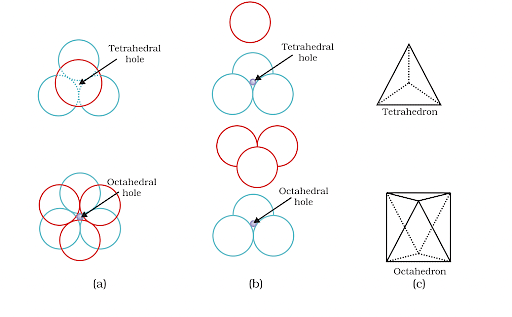
Tetrahedral and octahedral voids
(a) top view (b) exploded side view and (c) geometrical shape of the void.
Read More:
| Related Articles | ||
|---|---|---|
| Three States of Matter | Amorphous and Crystalline Solids | Crystal Lattices and Unit Cells |
| Packing Efficiency | Imperfections in Solids | Magnetic Properties |
Tetrahedral Voids
[Click Here for Sample Questions]
In a cubic close-packed structure, when a sphere of the second layer is placed above the void of the first layer, a tetrahedral void is formed. These voids are called tetrahedral voids because a tetrahedron is formed when the centres of these four spheres are joined.
In a close packed structure, the number of tetrahedral voids is two times the number of spheres. i.e., if the number of spheres is n, then the number of tetrahedral voids will be 2n.
Octahedral voids
[Click Here for Sample Questions]
When the triangular voids of the first layer coincide with the triangular voids of the layer above or below it, an octahedral void is formed. These voids are surrounded by six spheres. Octahedral voids are adjacent to tetrahedral voids. They are created by the combination of the triangular voids of the first and second layers. This arrangement is of ABCABC type.
In a close-packed structure, the number of octahedral voids is the same as the number of spheres i.e., if the number of spheres is n, then the number of tetrahedral voids will also be n.
Things to Remember
- The number of tetrahedral and octahedral voids depends on the number of closed-packed spheres.
- If the number of closed packed spheres is N, then the octahedral void is N the tetrahedral void be 2N.
- In 2-D hexagonal packing, the voids are in triangular shapes and are known as the triangular voids.
- About 26% of the total space is vacant in a three-dimensional structure.
- The packing efficiency in the body-centered cubic is 68%.
Read More:
Sample Questions
Ques: If the number of spheres is n, then the number of tetrahedral voids will be ______ (1 mark)
(A) 1n
(B) 2n
(C) 3n
(D) 4n
Ans: B) 2n
Explanation: The number of the two types of voids depends upon the number of close-packed spheres. If the number of close-packed spheres is N, then the number of tetrahedral voids generated is 2N
Ques: A void surrounded by 6 spheres is called _______ (1 mark)
(A) Cubic close packing
(B) Tetrahedral void
(C) Trigonal Void
(D) Octahedral void
Ans: D) Octahedral Void
Explanation: When the triangular voids of the first layer coincide with the triangular voids of the layer above or below it, an octahedral void is formed. These octahedral voids are adjacent to tetrahedral voids and are surrounded by six spheres.
Ques: The vacant space between the constituent particles in a closed packed structure is called _______(1 mark)
(A) Blocks
(B) Cubes
(C) Voids
(D) Squares
Ans: C) Voids
Explanation: Voids can be defined as gaps or empty spaces between constituent particles. When atoms are arranged in close packing with each other, it leads to the formation of vacant space between the atoms. This phenomenon of vacant spaces created between atoms is known as voids in solid states.
Ques. How many lattice points are there in one unit cell of each of the following lattices? (3 marks)
(1) Face-Centred Cubic
(2) Face-Centred Tetragonal
(3) Body-Centred Cubic
Ans:
- Face-Centred Cubic
There are 14 lattice points in face-centred cubic(8 from the corners+6 from the faces).
- Face-Centered Tetragonal
There are 14 lattice points in face-centred tetragonal(8 from the corners+6 from the faces).
- Body-Centered Cubic
There are 9 lattice points in body-centred cubic(1 from the centre +8 from the corners).
Ques: Calculate for the following: Gold (Atomic Radius=0.144 nm) crystallises in a Face-Centred unit cell. What is the length of a side of the cell? (3 marks)
Ans: (i) For a face-centred unit cell:
a=2√2r
It is given that the atomic radius, r=0.144 nm
So, a=2√2r ×0.144nm
i.e., a=0.407nm
Hence, length of a side of the cell=0.407 nm
Ques: Aluminium crystallises in a cubic close-packed structure. Its metallic radius is 125 PM. (3 marks)
(a) What is the length of the side of the unit cell?
(b) How many unit cells are there in 1.00 cm3 of Aluminium?
Ans: (a) For cubic close-packed structure:
a=2√2r
⇒ 2√2=125pm
= 353.55 pm
Hence, the length of the side of the unit cell is 354 pm (approximately).
(b) Volume of one unit cell=
= 4.4107 cm3
= 4.4107 10-30cm3
=4.4 10-23cm3
Therefore, number of unit cells in 1.00 cm3=\(\frac{1.00 cm^3}{4.4 10^{-23}cm^3}\)=2.27*1022
Ques: What is the primary difference between Tetrahedral and Octahedral voids? (3 marks)
Ans: i) Tetrahedral voids are unoccupied empty spaces present in substances having a tetrahedral crystal system. Octahedral voids are unoccupied empty spaces present in substances having an octahedral crystal system.
ii) A tetrahedral void is a simple triangular void in a crystal and is surrounded by four spheres arranged tetrahedrally around it. On the other hand, an octahedral void is a double triangular void with one triangle vertex upwards and the other triangle vertex downwards and is surrounded by six spheres.
iii) If the number of the closed packed spheres is N, then the tetrahedral void is 2N. Similarly, if the number of the closed packed spheres is N, then the octahedral void is N.
Ques. Silver crystallises in the FCC Lattice. If the edge length of the cell is 4.07*10-8cm and density is 10.5 g cm-3, calculate the atomic mass of Silver. (3 marks)
Ans: It is given that the edge length, a=4.07*10-8cm
density d=10.5 g cm3
As the lattice is fcc type, the number of atoms per unit cell, z=4
We also know that,
NA = 6.022×10²³mol-1

Therefore, the atomic mass of silver=107.13u
Ques. Niobium crystallises in Body-Centered Cubic Structure. If the density is 8.55 g cm3 Calculate the Atomic Radius of Niobium using its Atomic Mass 93 U. (4 marks)
Ans: It is given that the density of niobium, d=8.55g cm3
Atomic mass, M=93gmol-1
As the lattice is bcc type, the number of atoms per unit cell, z=2
We also know that, NA=6.022×10²³mol-1
Using the relation:

= 3.612* 10-23cm3
So, a=3.612 *10-23cm3
For body-centred cubic unit cell:

Therefore, r=14.32 nm
Ques: Calculate the packing efficiency in case of metal crystal for body-centred Cubic  (4 marks)
Ans: From the figure, it is clear that the atom at the centre will be in touch with the other two atoms diagonally arranged.
In Δ EFD,
b2=a2+a2=2a2
b=2a
Now in Δ AFD,
c2=a2+b2=a2+2a2= 3a2
c= √3a
The length of the body diagonal c is equal to 4r, where r is the radius of the sphere (atom), as all the three spheres along with the diagonal touch each other.
Therefore,
√3a=4r

Therefore,
Packing efficiency= 
= 68%
Therefore, packing efficiency in the body-centred cubic is 68%.
Ques. A cubic solid Is made of two elements A and B. Atoms of B are at the corners of the cube and A at the Body-Centre. What is the formula of the compound? What are the coordination numbers of A and B? (3 marks)
Ans: It is given that the atoms of B are present at the corners of the cube.
Therefore, the number of atoms of B in one unit cell=8 × (1/8)=1
It is also given that the atoms of A are present at the body centre.
Therefore, the number of atoms of A in one unit cell=1
This means that the ratio of the number of A atoms to the number of B atoms, A:B=1:1
Hence, the formula of the compound is AB
The coordination number of both A and B is 8.
Ques. Copper crystallises into an FCC lattice with an edge length 3.61* 10-8cm. Show that the Calculated density is in agreement with its measured value of 8.92g cm3. (3 marks)
Ans: Edge length, a= 3.61× 10⁻⁸cm
As the lattice is fcc type, the number of atoms per unit cell, z=4
Atomic mass, M=63.5 g mol-1
We also know that, NA=6.022×10²³ mol-1
Using the relation:

d=8.97gcm-3
The measured value of density is given as 8.97gcm-3. Hence, the calculated value is in agreement with its measured value.
Ques: Ferric oxide crystallises in a hexagonal close-packed array of oxide ions with two out of every three octahedral holes occupied by ferric ions. Derive the formula of the ferric oxide. (3 marks)
Ans: Let the number of oxides (O2-) ions be x.
So, the number of octahedral voids =x
It is given that two out of every three octahedral holes are occupied by ferric ions.

Hence, the formula of the ferric oxide is Fe2O3
For Latest Updates on Upcoming Board Exams, Click Here: https://t.me/class_10_12_board_updates
Check-Out:



Comments