


When Wheatstone bridge is in a balanced condition, current via the galvanometer will be

Assuming that the bridge is in a balanced condition, there will be no current flow via the galvanometer due to the fact that the potential difference between the two ends of the galvanometer becomes the same.
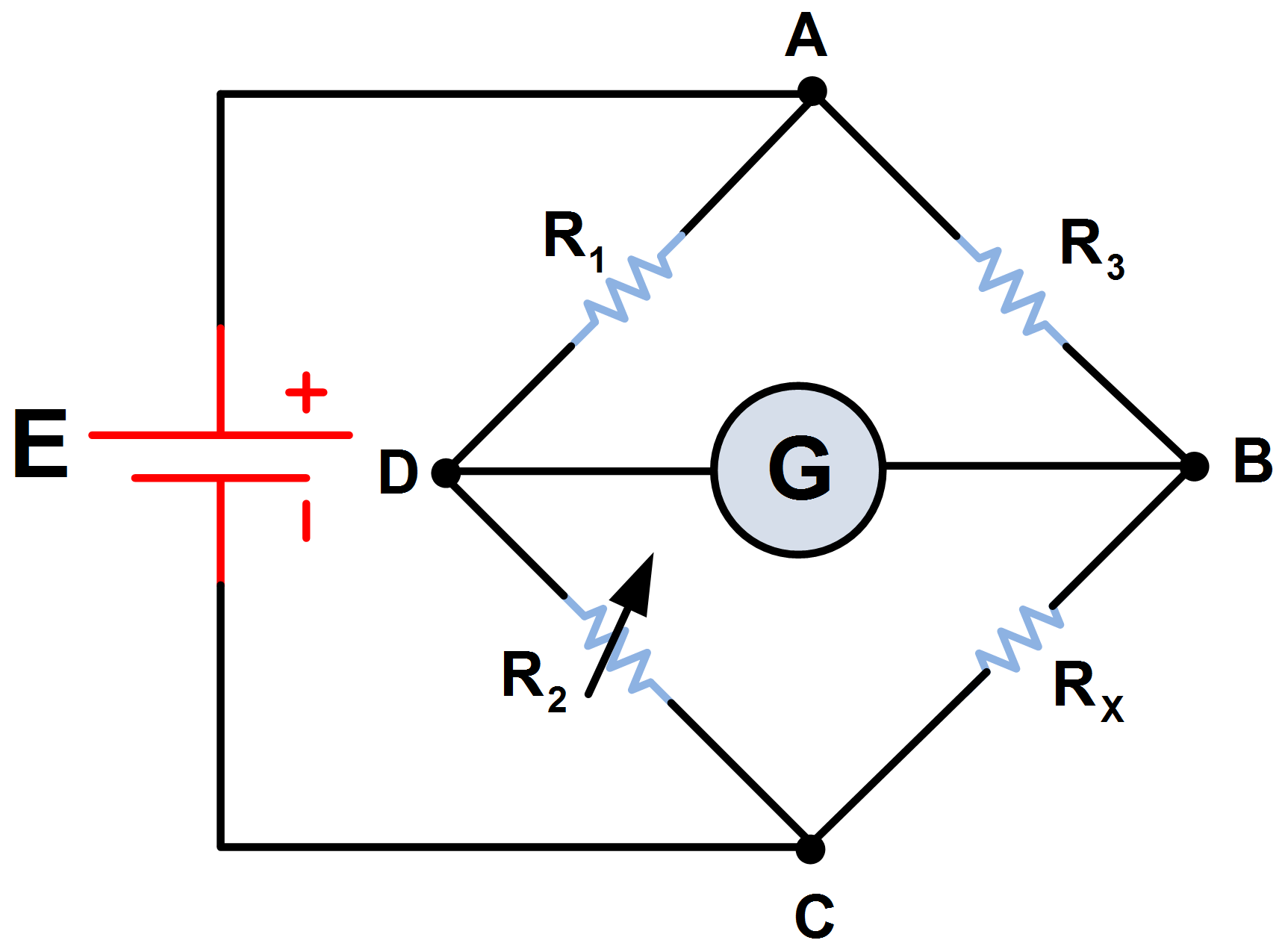
Wheatstone Bridge

Wheatstone Bridge


Related Questions

  1. Can you find very high resistance accurately with the help of a Metre bridge?
  2. Why Carey Foster Bridge Is So Sensitive?
  3. Meter Bridge or Slide Wire Bridge is a practical form of?
  4. Meter bridge works on the principle of?
  5. Why should we get the null point in the middle of the Metre bridge wire?
  6. How does a bridge circuit work?
  7. How do you solve an unbalanced bridge?
  8. Why is Wheatstone's bridge more accurate?
  9. What Is Null Voltage?

Do Check out:

CBSE CLASS XII Related Questions

  • 1.
    Assertion (A) : The mass of a nucleus is less than the sum of the masses of the constituent nucleons. Reason (R) : Energy is absorbed when the nucleons are bound together to form a nucleus.

      • Both Assertion (A) and Reason (R) are true and Reason (R) is the correct explanation of the Assertion (A).
      • Both Assertion (A) and Reason (R) are true, but Reason (R) is not the correct explanation of the Assertion (A).
      • Assertion (A) is true, but Reason (R) is false.
      • Both Assertion (A) and Reason (R) are false.

    • 2.
      Photoemission of electrons occurs from a metal (\( \phi_0 = 1.96 \, \text{eV} \)) when light of frequency \( 6.4 \times 10^{14} \, \text{Hz} \) is incident on it. Calculate: Energy of a photon in the incident light, The maximum kinetic energy of the emitted electrons, and The stopping potential.


        • 3.
          Assertion (A) : All atoms have a net magnetic moment. Reason (R) : A current loop does not always behave as a magnetic dipole.

            • Both Assertion (A) and Reason (R) are true and Reason (R) is the correct explanation of the Assertion (A).
            • Both Assertion (A) and Reason (R) are true, but Reason (R) is not the correct explanation of the Assertion (A).
            • Assertion (A) is true, but Reason (R) is false.
            • Both Assertion (A) and Reason (R) are false.

          • 4.
            If Bohr’s quantization postulate (angular momentum \( = \frac{nh}{2\pi} \)) is a basic law of nature, it should be equally valid for the case of planetary motion also. Why, then, do we never speak of quantization of orbits of planets around the Sun? Explain.


              • 5.
                Draw the number of scattered particles versus the scattering angle graph for scattering of alpha particles by a thin foil. Write two important conclusions that can be drawn from this plot.


                  • 6.
                    Write any two features of nuclear forces.

                      CBSE CLASS XII Previous Year Papers

                      Comments


                      No Comments To Show