



Content Curator
Xylene is a colourless liquid-vapour that is part of the aromatic Hydrocarbon group. It is produced by the thermal reforming of certain cycloalkane petroleum distillates. The Isomers of Xylene are meta-xylene, ortho-xylene, and para-xylene. The chemical formula for Xylene is C8H10 or (C6H4) (CH3)2. Xylene is commonly used as a high powered motor and aviation fuel mixture, solvent, and chemical intermediate.
| Table of Contents |
Key Terms: Xylene, Isomers, Dimethyl benzene, organic compound, Hydrocarbon, Cycloalkane, Petroleum Distillate
What is Xylene?
[Click Here for Previous Year Questions]
Xylene is a colourless aromatic hydrocarbon. It has three isomers namely meta-xylene, ortho-xylene, and para-xylene. The fourth Isomer is Ethyl Benzene. The chemical Xylene was named after Xylong, the Greek word for wood as it was found in the crude wood spirit. The formula for Xylene is C8H10 or (C6H4) (CH3)2.
Xylene is not a solvent in water but it can float on top if combined with dense water, however, it is miscible with several other organic liquids. Other names for Xylene are Methyl Toluene, Xylol, Dimethyl Benzene, and Mixed Xylenes.
Also Read:
Structure of Xylene
[Click Here for Sample Questions]
- The structure of Xylene is a mix of two methyl groups attached to a six-carbon ring.
- Xylene is not one but three Isomeric Dimethyl benzene which has the same chemical formula but different molecular structures.
- The three of the Isomers that are officially chosen, ortho (o), meta (m), and para (p) differ structurally only in the location of the methyl groups.
- The obtained Xylol contains 40-60% of m-xylene, 20% of o-xylene (approx.), 20% of p-xylene, and 6-20% of ethyl benzene
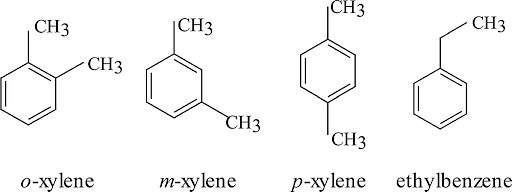
Structure of Xylene
- Fractional distillation removes meta and para isomers, which have the same boiling point, from less explosive ortho Isomer.
- Upon cooling of the mixture of both the Isomers (meta and para), they crystallize in a pure form.
- The meta isomer (principal component of the remaining liquid) is then purified by taking advantage of its solubility in a mixture of hydrofluoric acid and boron trifluoride.
Read More: Alkanes
Properties of Xylene
[Click Here for Previous Year Questions]
The chemical properties of different isomers of Xylene are given below.
Dimethylbenzene (o- Xylene)
- Density and Phase: 0.88g/mL, liquid
- Boiling Point: 144oC
- Viscosity: 0.812 cP at 20oC
- Flashpoint: 17oC
Dimythylbenzene (m-Xylene)
- Density and Phase: 0.86g/Ml, liquid
- Boiling Point: 139oC
- Viscosity: 0.62 cP at 30oC
- Flashpoint: 25oC
Dimythylbenzene (p-Xylene)
- Density and Phase: 0.86g/Ml, liquid
- Boiling Point: 138oC
- Viscosity: 0.34 cP at 30oC
- Flashpoint: 25oC
Xylene’s melting point can differ from -47.87oC for m-Xylene to 13.26oC for p-Xylene.
Read More: Alkenes
Uses of Xylene
[Click Here for Sample Questions]
- One of the most important uses of Xylene is in Medicine, particularly in microscopic examination of tissues. It is used in the process of staining the tissues.
- Xylene is very commonly used as a paint solvent because it is excellent at removing old paint on a variety of surfaces.
- Xylene is also effective in removing greasy stains, resins, enamels, and glue.
- Xylene is also used in the form of raw material in the manufacturing of fibres, films, and dyes.
- Xylene is used as a lubricant in the form of motor oil or brake fluid.
- Xylene is used as a cleaning agent in various fields, such as dentistry and electronics to the petroleum industry (p-Xylene).
- Xylene is also used in cosmetic products for removing excessive ear wax.
- Xylene can be used as a pesticide and disinfectant.
Exposure Risks of Xylene
[Click Here for Previous Year Questions]
Xylene serves as a useful source to multiple industries, but it comes with several risks too.
Health Risks of Xylene Exposure
More than adults the health risk of Xylene exposure is greatly seen among children.
- Exposure to Xylene can occur via inhalation, ingestion, and eye or skin contact.
- It is metabolized to Methylhypric acid mainly in the liver by oxidation of methyl groups and combination with glycerin, which is excreted through the urinal gland.
- A small amount is excreted unchanged with exhalation.
- The measure of severity can be both acute and also chronic. Individuals react differently to different exposures.
- The primary risk of Xylene is through Inhalation which directly affects the nervous system.
- Xylene is known to be a slow depressant which means it slows the central nervous system, leading to headaches, irritability, nausea, dizziness even fainting, short-term memory loss, and vomiting.
- The level of intake may also cause visual impairment.
- Xylene, if came in contact with the skin, can dissolve its natural protective oils.
- Damaged skin may result in a greater risk of absorption of chemicals causing the skin to be dry or feel irritation because of the exposure. The Xylene in liquid form can also cause a painful burning sensation on the skin
- Xylene in contact with the eye can damage the cornea.
Corrosive Effects of Xylene
- Corrosion is a chemical reaction that breaks down new compounds through the process of oxidation.
- Being great solvents, Xylene dissolves non-polar organic compounds and generally don’t react chemically with other substances in normal conditions. Therefore, it is not considered Harmful.
- Xylene can be destructive if converted to acids like monocarboxylic acids (toluic acids), and dicarboxylic acids (phthalic acids) when oxidized.
Also Read:
Things to Remember
- Xylene is an aromatic organic chemical compound also known as dimethyl benzene or Xylol.
- Xylene is a colorless, sweet-smelling flammable, nonviscous, toxic liquid.
- They are derived from the substitution of two hydrogen atoms with the methyl groups in a benzene ring
- Each molecule has a benzene ring and two of the methyl group linked to it.
- IUPAC Name: o-Isomer: 1,2 dimethylbenzene, m-Isomer: 1,3 dimethylbenzene, p-Isomer: 1,4 dimethylbenzene
Previous Year Questions
- Which of the following compounds undergoes nitration more readily? [AMUEE 2012]
- The effective electrophile in aromatic sulphonation is?[NEET 2003]
- Identity Z in the sequence of reactions… [KCET 2016]
- Some meta-directing substituents in aromatic substitution are given… [AMUEE 2007]
- Correct order of stability is? [NEET 2001]
- Which one of these is not compatible with arenes? [NEET 2011]
Sample Questions
Ques. Write the formula of Xylene. (2 marks)
Ans: In Organic Chemistry, Xylene is formed from three organic compounds with the formula (C6H4) (CH3)2 or C8H10.
Ques. When was Xylene first used? (2 marks)
Ans: Xylene was first isolated and named in the year 1850 by a French chemist named Auguste Cahours (1813-1891). It was derived from the Greek word ‘Xylong’ which means wood as it was found in the crude wood spirit.
Ques. Para-Xylene is similar to: (2 marks)
a) 1,2 dimethylbenzene
b) 1,4 dimethylbenzene
c) 1,1 dimethylbenzene
d) 1,3 dimethylbenzene
Ans: b) the diagram shown has two methyl groups that are substituted on the first and fourth positions of benzene. Hence, the name 1,4 dimethylbenzene.
Ques. What is the density of Xylene? (2 marks)
Ans: 0.86g/Ml
Ques. How is xylene formed? (2 marks)
Ans: Xylene is formed by toluene and benzene methylation. Xylene that is produced contains 40-65% of m-Xylene, 20% of o-Xylene, 20% of p-Xylene, and 6-20% of ethyl xylene.
Ques. Is Xylene more toxic than Acetone? (2 marks)
Ans: Xylene and Acetone both are organic compounds with the formula (C6H4) (CH3)2 and Acetone with the formula (CH3)2CO respectively. While Xylene is a less toxic and cheap solvent, Acetone is an expensive and more toxic solvent.
Ques. What can dissolve in Xylene? (2 marks)
Ans: Xylene is an excellent solvent for hydrocarbons and many hydrophobic or water-insoluble compounds, and is very good at dissolving oily compounds that are poorly soluble in water. Compounds such as greases and various pesticides and herbicides.
Ques. What type of chemical is Xylene? (2 marks)
Ans: Xylene is a synthetic chemical, however, it can also occur naturally during forest fires, in coal tar, petroleum, etc.
Ques. What is the difference between Toluene and Xylene? (2 marks)
Ans: Toluene and Xylene both are aromatic organic compounds. The key difference is that toluene consists of one methyl group attached to the benzene ring while xylene contains two methyl groups attached to the benzene ring.
Ques. Is Xylene non polar? (2 marks)
Ans: Xylenes are usually considered non-polar due to their lack of heteroatom (an atom other than carbon in the ring of a heterocyclic compound).
For Latest Updates on Upcoming Board Exams, Click Here: https://t.me/class_10_12_board_updates
Check-Out:



Comments