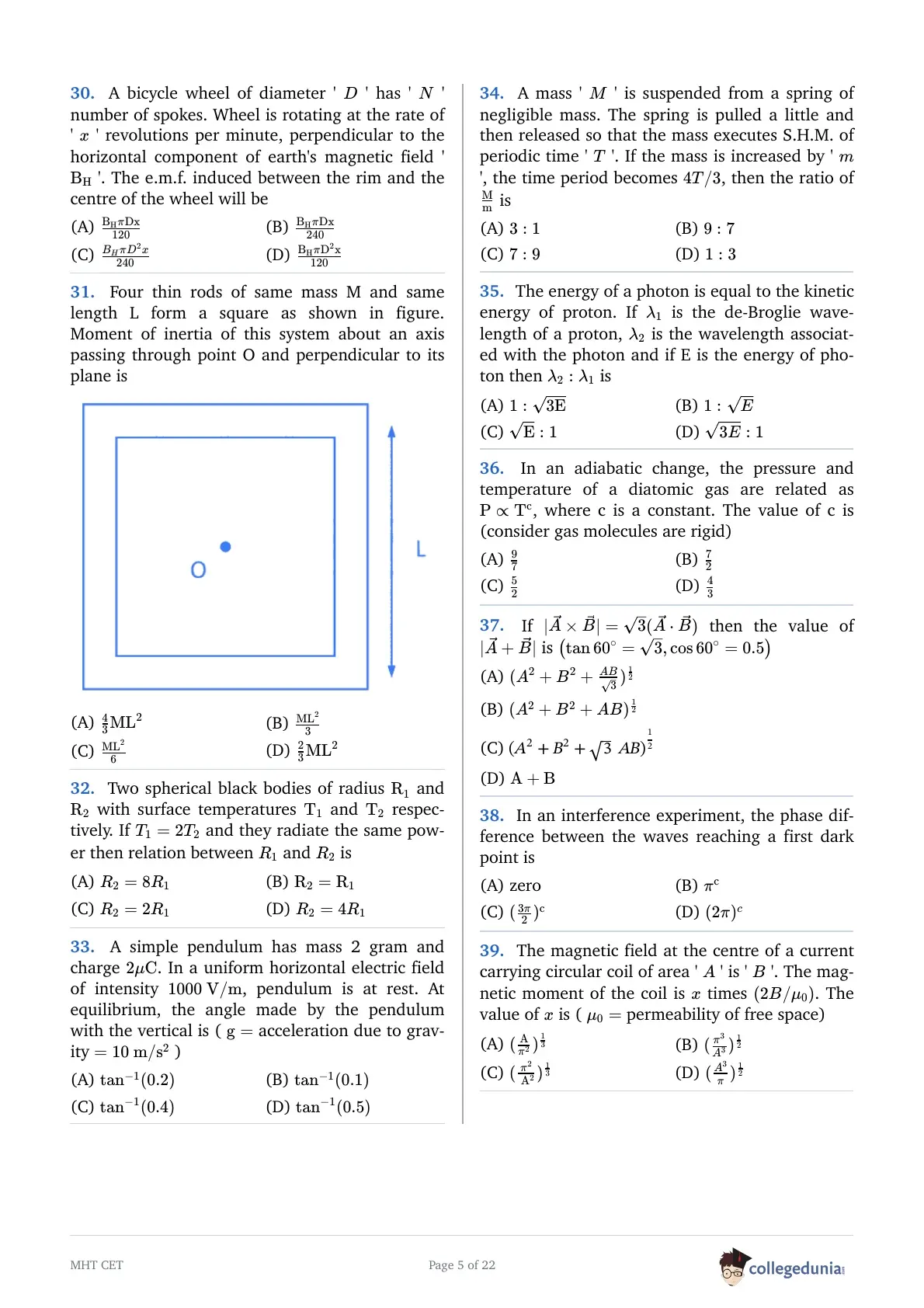
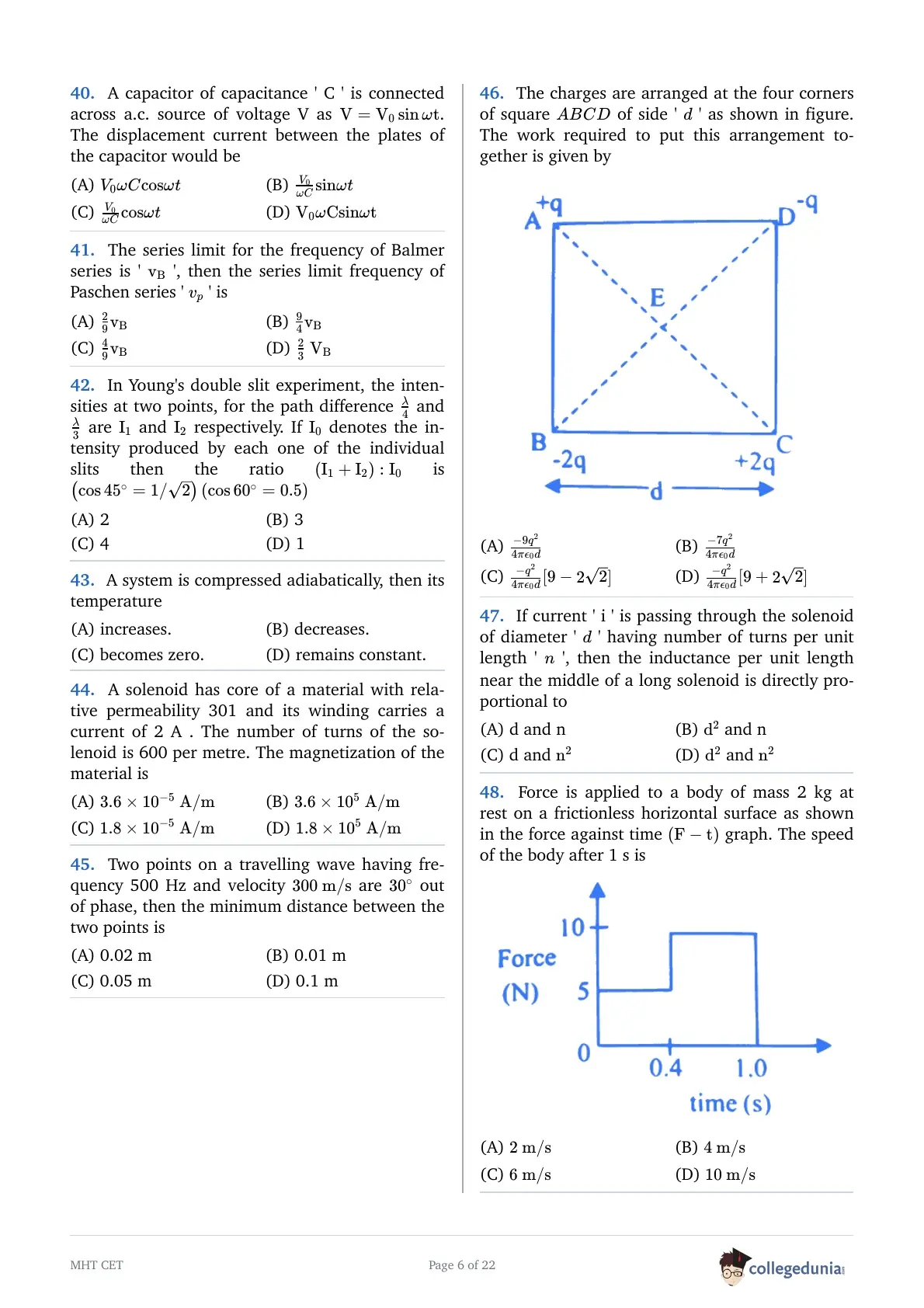
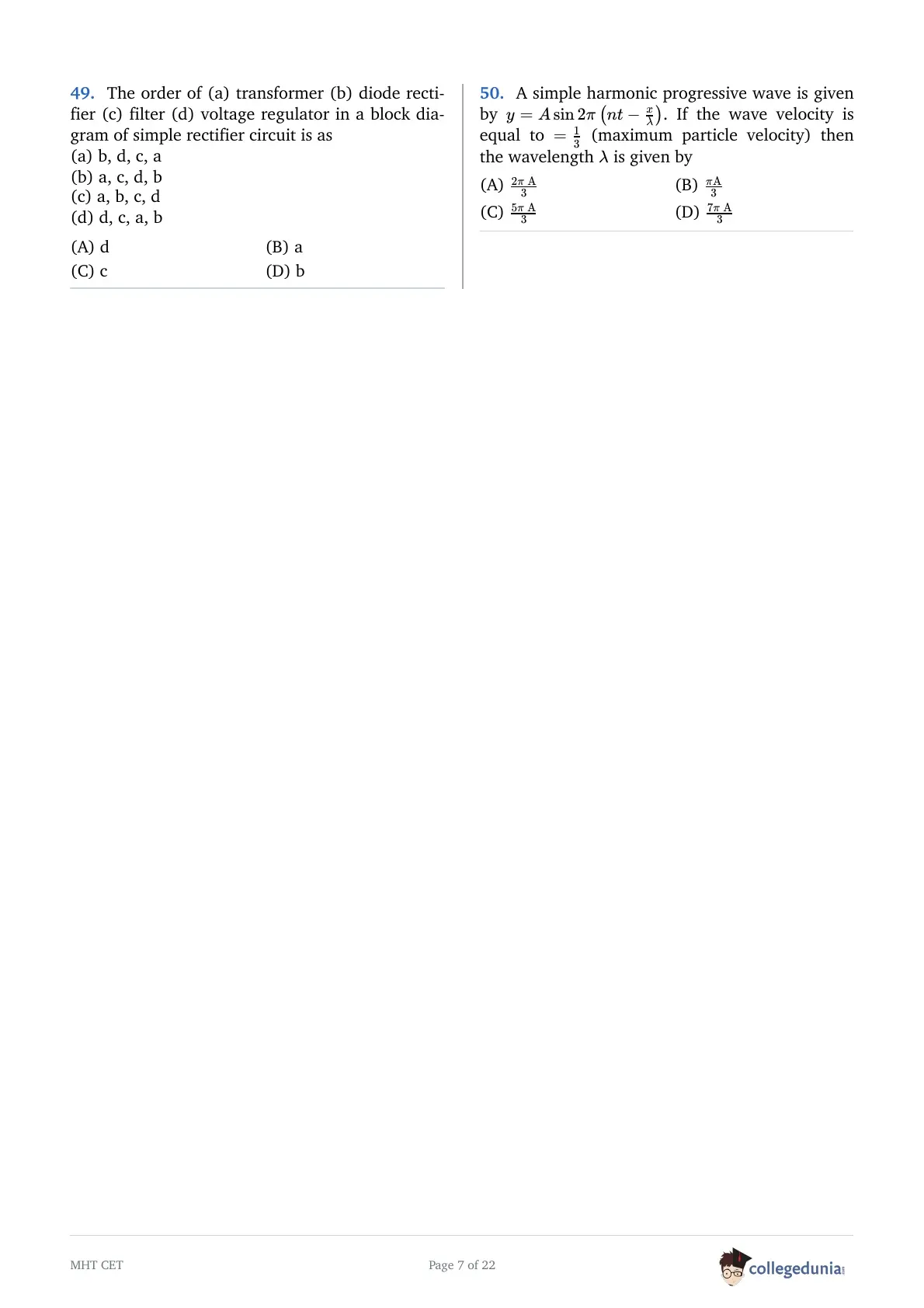
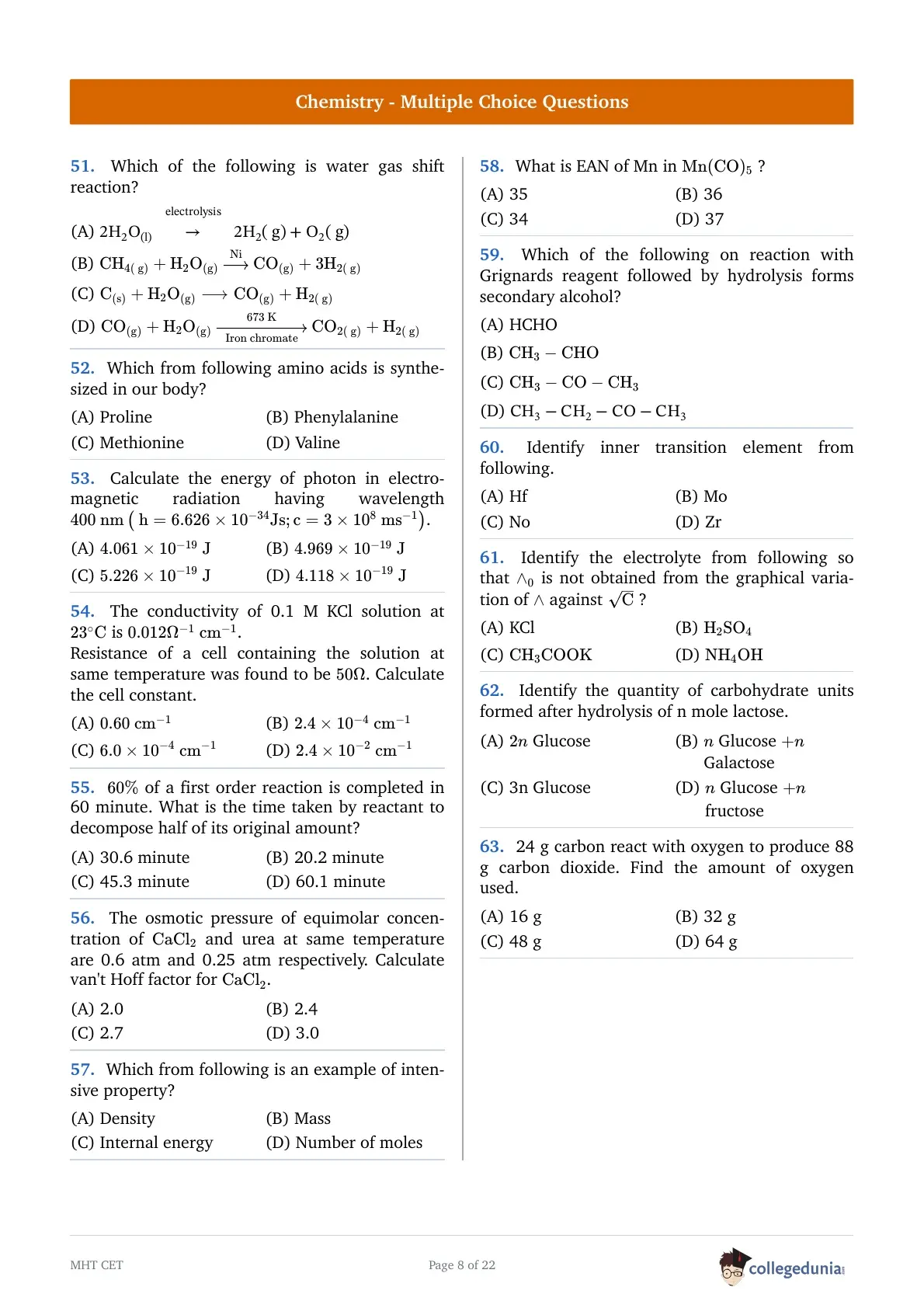
MHT CET 2025 April 9 Shift 1 PCB Question Paper is available for download here. Maharashtra State CET Cell conducted MHT CET 2025 PCB Exam on April 9 in Shift 1 from 9 AM to 12 PM in CBT mode.

The MHT CET 2025 PCB question paper includes the following:

  • The MHT CET 2025 PCB Question Paper consists of 200 multiple-choice questions (MCQs) totalling 200 marks divided into 3 sections: Physics (50 questions), Chemistry (50 questions), and Biology (100 questions).
  • All questions carry 1 mark each. There is no negative marking for incorrect answers.

MHT CET 2025 April 9 Shift 1 PCB Question Paper with Solution PDF

CD PDF CD PDF with Solutions
Download Collegedunia PDF 1.17 MB -

Also Check:

MHT CET 2025 April 9 Shift 1 PCB Questions with Solutions


Physics (Q1 - Q50)

Question 1:

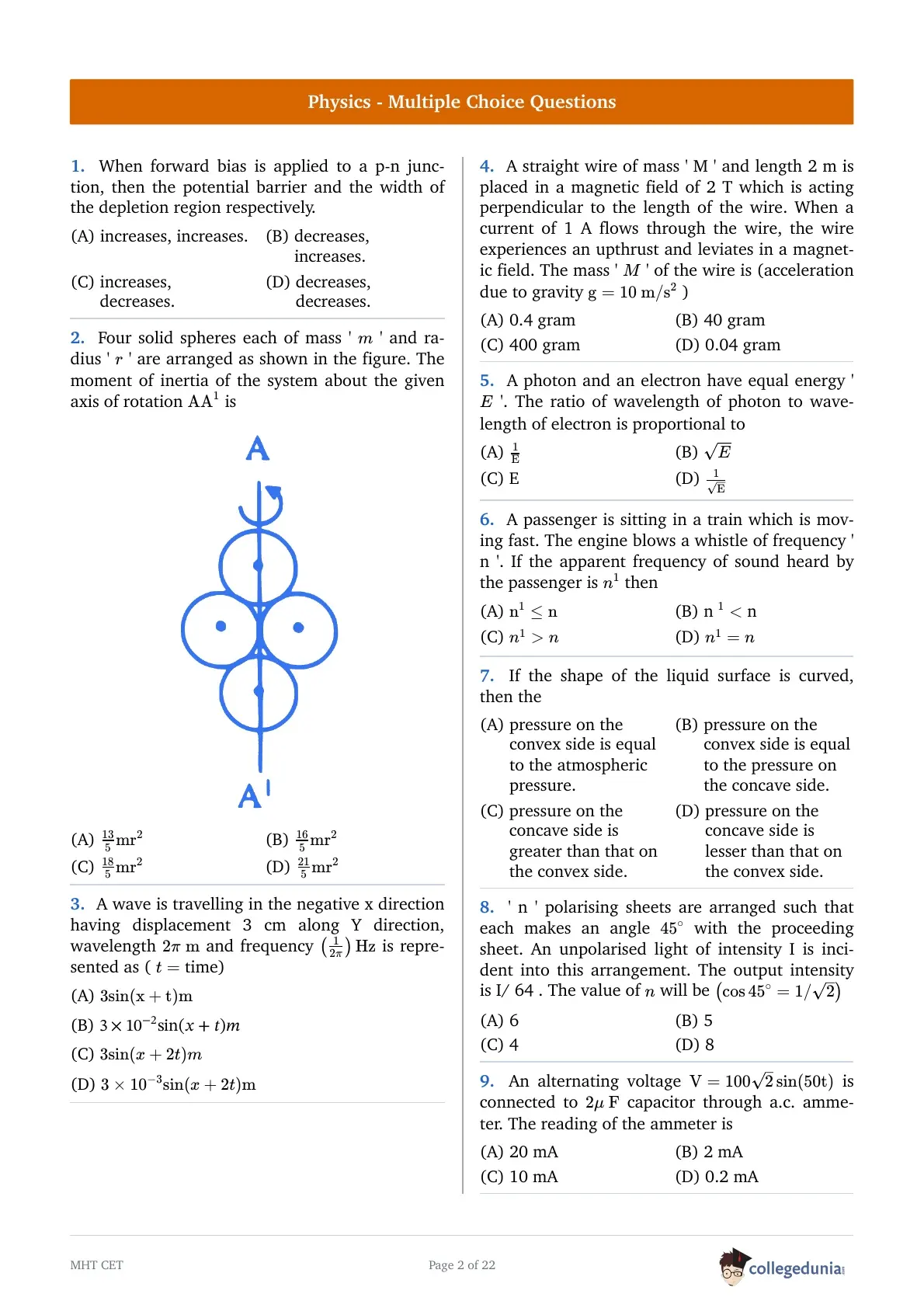
When forward bias is applied to a p-n junction, then the potential barrier and the width of the depletion region respectively.

  • (A)

    increases, increases.

  • (B)

    decreases, increases.

  • (C)

    increases, decreases.

  • (D)

    decreases, decreases.


Question 2:

Four solid spheres each of mass ' \(m\) ' and radius ' \(r\) ' are arranged as shown in the figure. The moment of inertia of the system about the given axis of rotation \(\mathrm{AA}^1\) is

  • (A)

    \(\frac{13}{5}\mathrm{mr}^{2}\)

  • (B)

    \(\frac{16}{5}\mathrm{mr}^{2}\)

  • (C)

    \(\frac{18}{5}\mathrm{mr}^{2}\)

  • (D)

    \(\frac{21}{5}\mathrm{mr}^{2}\)


Question 3:

A wave is travelling in the negative x direction having displacement 3 cm along Y direction, wavelength \(2 \pi \mathrm{~m}\) and frequency \(\left(\frac{1}{2 \pi}\right) \mathrm{Hz}\) is represented as ( \(t=\) time)

  • (A)

    \(3\mathrm{sin}(\mathrm{x}+\mathrm{t})\mathrm{m}\)

  • (B)

    \(3\times 10^{-2}\mathrm{sin}(x+t)m\)

  • (C)

    \(3\mathrm{sin}(x+2t)m\)

  • (D)

    \(3\times 10^{-3}\mathrm{sin}(x+2t)\mathrm{m}\)


Question 4:

A straight wire of mass ' M ' and length 2 m is placed in a magnetic field of 2 T which is acting perpendicular to the length of the wire. When a current of 1 A flows through the wire, the wire experiences an upthrust and leviates in a magnetic field. The mass ' \(M\) ' of the wire is (acceleration due to gravity \(\mathrm{g}=10 \mathrm{~m} / \mathrm{s}^2\) )

  • (A)

    0.4 gram

  • (B)

    40 gram

  • (C)

    400 gram

  • (D)

    0.04 gram


Question 5:

A photon and an electron have equal energy ' \(E\) '. The ratio of wavelength of photon to wavelength of electron is proportional to

  • (A)

    \(\frac{1}{\mathrm{E}}\)

  • (B)

    \(\sqrt{E}\)

  • (C)

    E

  • (D)

    \(\frac{1}{\sqrt{\mathrm{E}}}\)


Question 7:

If the shape of the liquid surface is curved, then the

  • (A)

    pressure on the convex side is equal to the atmospheric pressure.

  • (B)

    pressure on the convex side is equal to the pressure on the concave side.

  • (C)

    pressure on the concave side is greater than that on the convex side.

  • (D)

    pressure on the concave side is lesser than that on the convex side.


Question 8:

' n ' polarising sheets are arranged such that each makes an angle \(45^{\circ}\) with the proceeding sheet. An unpolarised light of intensity I is incident into this arrangement. The output intensity is I/ 64 . The value of \(n\) will be \(\left(\cos 45^{\circ}=1 / \sqrt{2}\right)\)

  • (A)

    6

  • (B)

    5

  • (C)

    4

  • (D)

    8


Question 9:

An alternating voltage \(\mathrm{V}=100 \sqrt{2} \sin (50 \mathrm{t})\) is connected to \(2 \mu \mathrm{~F}\) capacitor through a.c. ammeter. The reading of the ammeter is

  • (A)

    20 mA

  • (B)

    2 mA

  • (C)

    10 mA

  • (D)

    0.2 mA


Question 10:

A gas at \(800^{\circ} \mathrm{C}\) is cooled until both its pressure and volume are halved. The final temperature of the gas will be

  • (A)

    473 K

  • (B)

    373.25 K

  • (C)

    293.29 K

  • (D)

    268.25 K


Question 11:

When the r.m.s. velocity of a gas is denoted by ' V ' and temperature of the gas by T , which of the following relations is TRUE?

  • (A)

    \(\mathrm{VT}^{2}=\) constant

  • (B)

    \(\frac{\mathrm{V}}{\mathrm{T}^{2}}=\) constant

  • (C)

    \(\frac{\mathrm{V}^{2}}{\text{ }\mathrm{T}}=\) constant

  • (D)

    \(\mathrm{V}^{2}\cdot \text{ }\mathrm{T}=\) constant


Question 12:

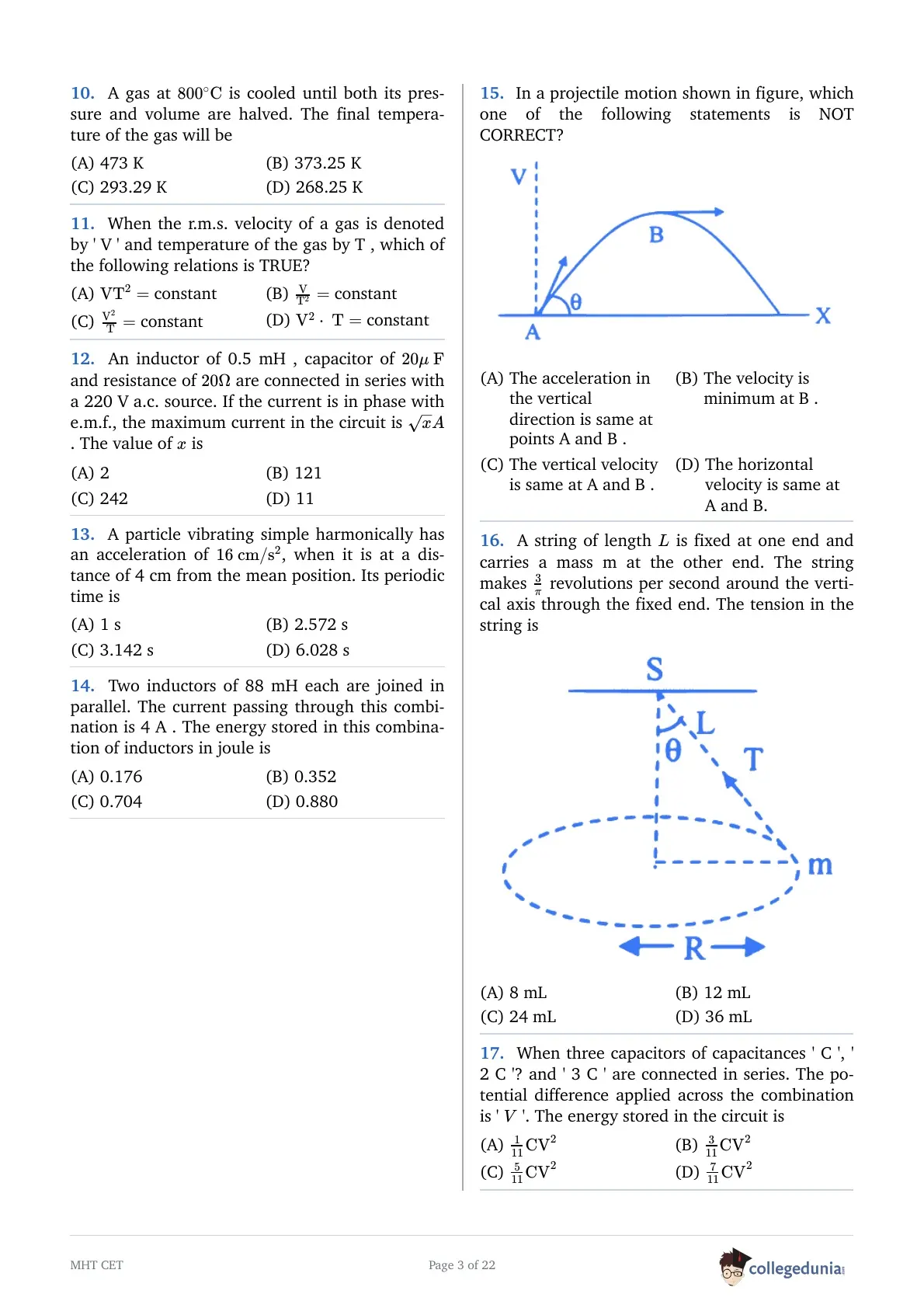
An inductor of 0.5 mH , capacitor of \(20 \mu \mathrm{~F}\) and resistance of \(20 \Omega\) are connected in series with a 220 V a.c. source. If the current is in phase with e.m.f., the maximum current in the circuit is \(\sqrt{x} A\). The value of \(x\) is

  • (A)

    2

  • (B)

    121

  • (C)

    242

  • (D)

    11


Question 13:

A particle vibrating simple harmonically has an acceleration of \(16 \mathrm{~cm} / \mathrm{s}^2\), when it is at a distance of 4 cm from the mean position. Its periodic time is

  • (A)

    1 s

  • (B)

    2.572 s

  • (C)

    3.142 s

  • (D)

    6.028 s


Question 14:

Two inductors of 88 mH each are joined in parallel. The current passing through this combination is 4 A . The energy stored in this combination of inductors in joule is

  • (A)

    0.176

  • (B)

    0.352

  • (C)

    0.704

  • (D)

    0.880


Question 15:

In a projectile motion shown in figure, which one of the following statements is NOT CORRECT?

  • (A)

    The acceleration in the vertical direction is same at points A and B .

  • (B)

    The velocity is minimum at B .

  • (C)

    The vertical velocity is same at A and B .

  • (D)

    The horizontal velocity is same at A and B.


Question 16:

A string of length \(L\) is fixed at one end and carries a mass m at the other end. The string makes \(\frac{3}{\pi}\) revolutions per second around the vertical axis through the fixed end. The tension in the string is

  • (A)

    8 mL

  • (B)

    12 mL

  • (C)

    24 mL

  • (D)

    36 mL


Question 17:

When three capacitors of capacitances ' C ', ' 2 C '? and ' 3 C ' are connected in series. The potential difference applied across the combination is ' \(V\) '. The energy stored in the circuit is

  • (A)

    \(\frac{1}{11}\mathrm{CV}^{2}\)

  • (B)

    \(\frac{3}{11}\mathrm{CV}^{2}\)

  • (C)

    \(\frac{5}{11}\mathrm{CV}^{2}\)

  • (D)

    \(\frac{7}{11}\mathrm{CV}^{2}\)


Question 18:

In the spectrum of hydrogen atom the ratio of the longest wavelength in the Balmer series to the longest wavelength in the Lyman series is

  • (A)

    \(\frac{9}{4}\)

  • (B)

    \(\frac{4}{9}\)

  • (C)

    \(\frac{27}{5}\)

  • (D)

    \(\frac{5}{27}\)


Question 19:

A spherical liquid drop of radius R is divided into 64 equal droplets. If surface tension is \(T\) then the work done in this process will be

  • (A)

    \(8\pi R^{2}T\)

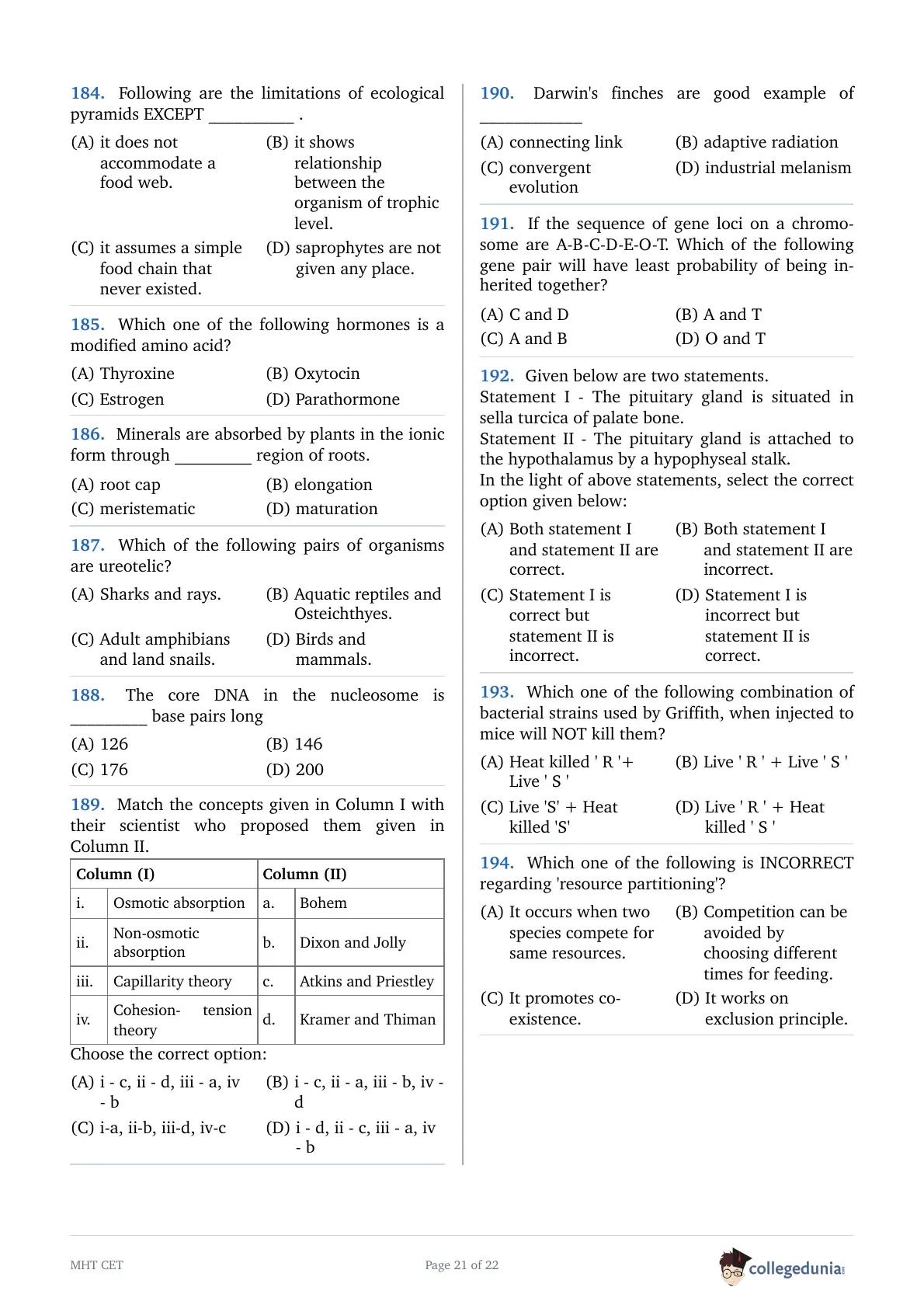
  • (B)

    \(12\pi R^{2}T\)

  • (C)

    \(4\pi R^{2}T\)

  • (D)

    \(16\pi R^{2}T\)


Question 20:

A lens of power +5 D is put in contact with a lens of power -3 D . The combination will behave like a

  • (A)

    convergent lens of focal length 75 cm .

  • (B)

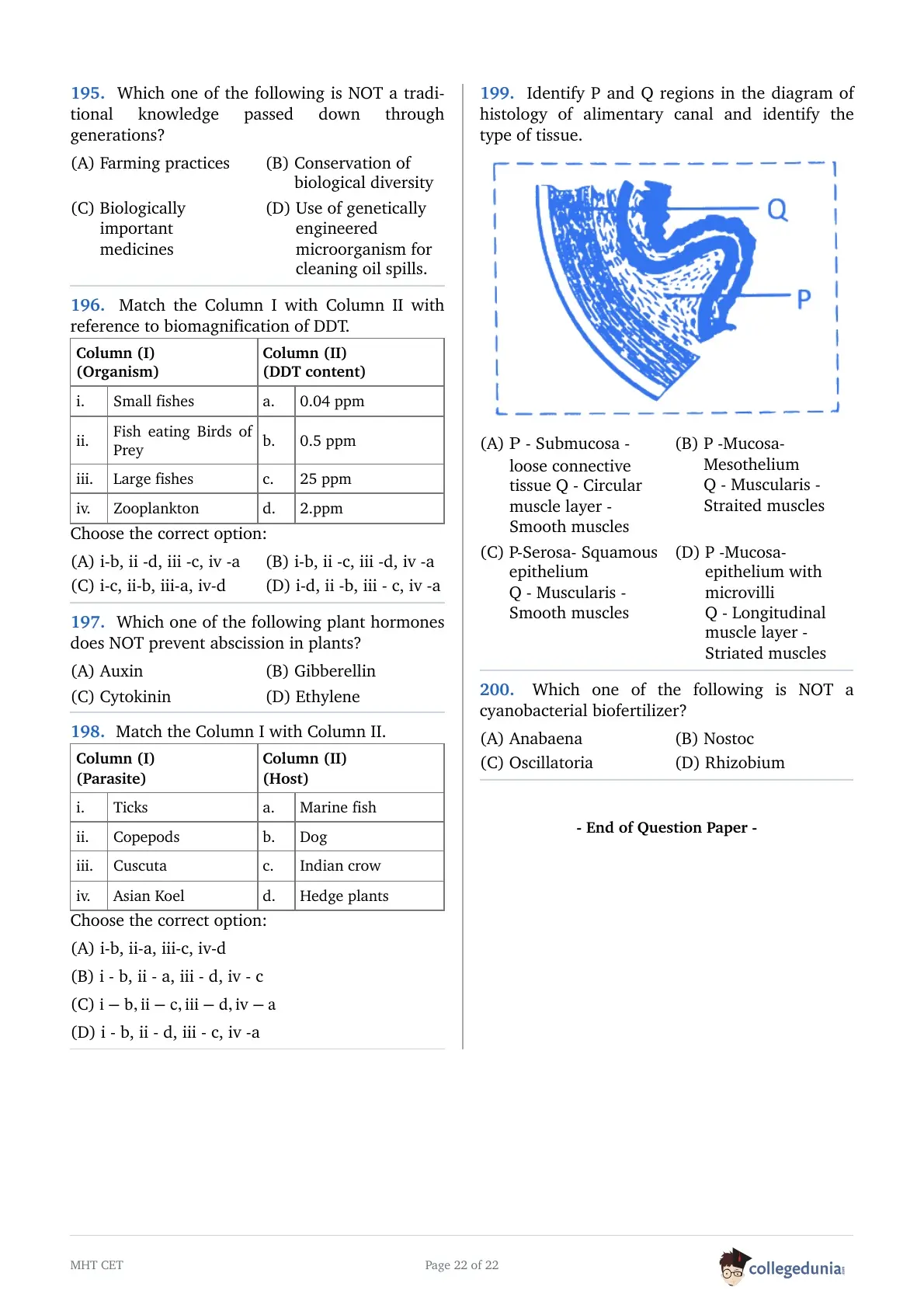
    divergent lens of focal length 16 cm .

  • (C)

    convergent lens of focal length 50 cm .

  • (D)

    divergent lens of focal length 40 cm .


Question 21:

A glass capillary of radius 0.35 mm is inclined at \(60^{\circ}\) with the vertical in water. The length of water column in the capillary tube is (surface tension of water \(=7 \times 10^{-2} \mathrm{Nm}^{-1}\), acceleration due to gravity \(=10 \mathrm{~m} / \mathrm{s}^2, \cos 0^{\circ}=1\), \(\cos 60^{\circ}=0.5\), density of water \(=1 \mathrm{gram} / \mathrm{cm}^3\) )

  • (A)

    16 cm

  • (B)

    4 cm

  • (C)

    8 cm

  • (D)

    0.8 cm


Question 22:

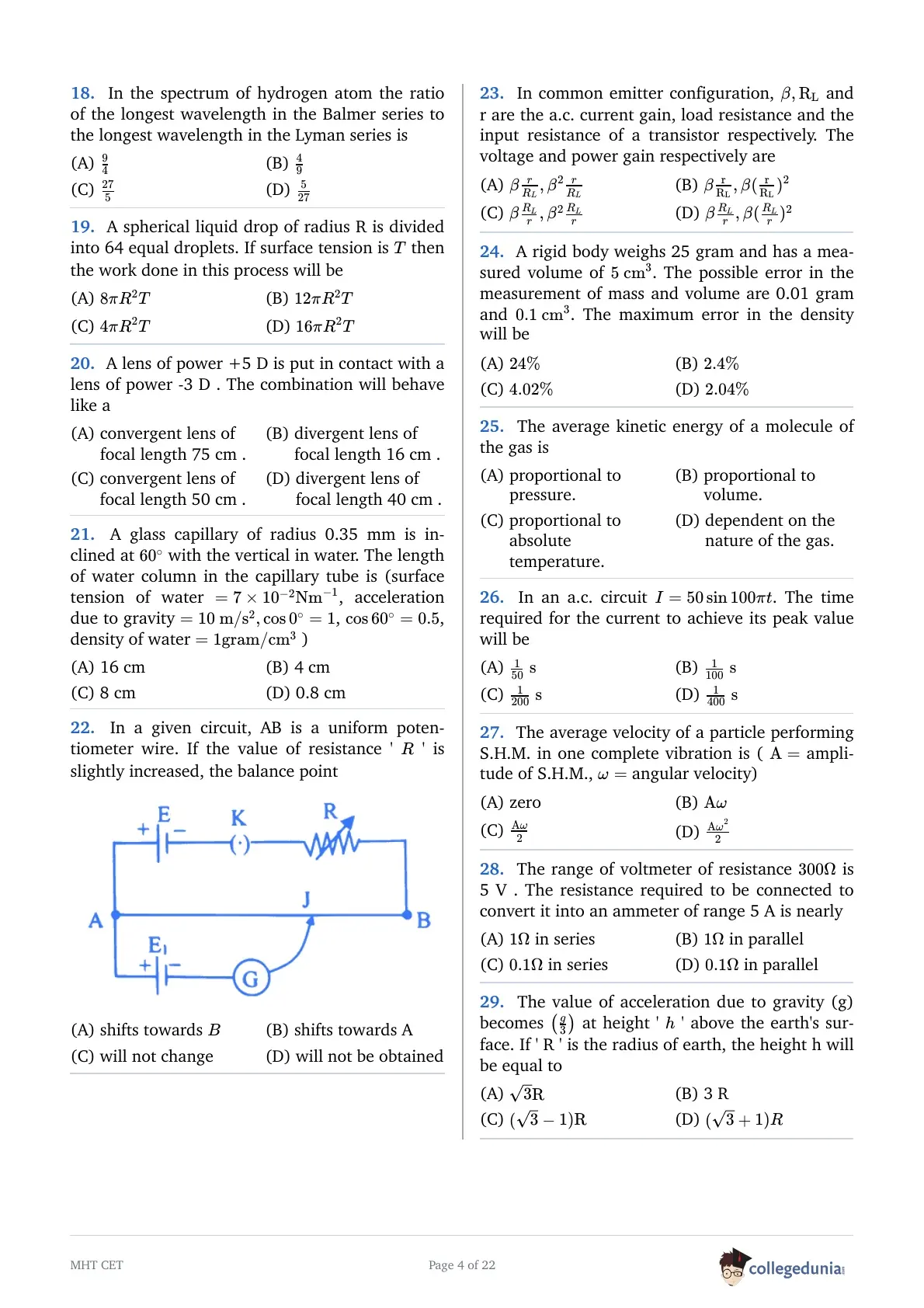
In a given circuit, AB is a uniform potentiometer wire. If the value of resistance ' \(R\) ' is slightly increased, the balance point

  • (A)

    shifts towards \(B\)

  • (B)

    shifts towards A

  • (C)

    will not change

  • (D)

    will not be obtained


Question 23:

In common emitter configuration, \(\beta, \mathrm{R}_{\mathrm{L}}\) and r are the a.c. current gain, load resistance and the input resistance of a transistor respectively. The voltage and power gain respectively are

  • (A)

    \(\beta \frac{r}{R_{L}},\beta ^{2}\frac{r}{R_{L}}\)

  • (B)

    \(\beta \frac{\mathrm{r}}{\mathrm{R}_{\mathrm{L}}},\beta (\frac{\mathrm{r}}{\mathrm{R}_{\mathrm{L}}})^{2}\)

  • (C)

    \(\beta \frac{R_{L}}{r},\beta ^{2}\frac{R_{L}}{r}\)

  • (D)

    \(\beta \frac{R_{L}}{r},\beta (\frac{R_{L}}{r})^{2}\)


Question 24:

A rigid body weighs 25 gram and has a measured volume of \(5 \mathrm{~cm}^3\). The possible error in the measurement of mass and volume are 0.01 gram and \(0.1 \mathrm{~cm}^3\). The maximum error in the density will be

  • (A)

    \(24\%\)

  • (B)

    \(2.4\%\)

  • (C)

    \(4.02\%\)

  • (D)

    \(2.04\%\)


Question 25:

The average kinetic energy of a molecule of the gas is

  • (A)

    proportional to pressure.

  • (B)

    proportional to volume.

  • (C)

    proportional to absolute temperature.

  • (D)

    dependent on the nature of the gas.


Question 26:

In an a.c. circuit \(I=50 \sin 100 \pi t\). The time required for the current to achieve its peak value will be

  • (A)

    \(\frac{1}{50}\text{ }\mathrm{s}\)

  • (B)

    \(\frac{1}{100}\text{ }\mathrm{s}\)

  • (C)

    \(\frac{1}{200}\text{ }\mathrm{s}\)

  • (D)

    \(\frac{1}{400}\text{ }\mathrm{s}\)


Question 27:

The average velocity of a particle performing S.H.M. in one complete vibration is ( \(\mathrm{A}=\) amplitude of S.H.M., \(\omega=\) angular velocity)

  • (A)

    zero

  • (B)

    \(\mathrm{A}\omega\)

  • (C)

    \(\frac{\mathrm{A}\omega}{2}\)

  • (D)

    \(\frac{\mathrm{A}\omega ^{2}}{2}\)


Question 28:

The range of voltmeter of resistance \(300 \Omega\) is 5 V . The resistance required to be connected to convert it into an ammeter of range 5 A is nearly

  • (A)

    \(1\Omega\) in series

  • (B)

    \(1\Omega\) in parallel

  • (C)

    \(0.1\Omega\) in series

  • (D)

    \(0.1\Omega\) in parallel


Question 29:

The value of acceleration due to gravity (g) becomes \(\left(\frac{g}{3}\right)\) at height ' \(h\) ' above the earth's surface. If ' R ' is the radius of earth, the height h will be equal to

  • (A)

    \(\sqrt{3}\mathrm{R}\)

  • (B)

    3 R

  • (C)

    \((\sqrt{3}-1)\mathrm{R}\)

  • (D)

    \((\sqrt{3}+1)R\)


Question 30:

A bicycle wheel of diameter ' \(D\) ' has ' \(N\) ' number of spokes. Wheel is rotating at the rate of ' \(x\) ' revolutions per minute, perpendicular to the horizontal component of earth's magnetic field ' \(\mathrm{B}_{\mathrm{H}}\) '. The e.m.f. induced between the rim and the centre of the wheel will be

  • (A)

    \(\frac{\mathrm{B}_{\mathrm{H}}\pi \mathrm{Dx}}{120}\)

  • (B)

    \(\frac{\mathrm{B}_{\mathrm{H}}\pi \mathrm{Dx}}{240}\)

  • (C)

    \(\frac{B_{H}\pi D^{2}x}{240}\)

  • (D)

    \(\frac{\mathrm{B}_{\mathrm{H}}\pi \mathrm{D}^{2}\mathrm{x}}{120}\)


Question 31:

Four thin rods of same mass M and same length L form a square as shown in figure. Moment of inertia of this system about an axis passing through point O and perpendicular to its plane is

  • (A)

    \(\frac{4}{3}\mathrm{ML}^{2}\)

  • (B)

    \(\frac{\mathrm{ML}^{2}}{3}\)

  • (C)

    \(\frac{\mathrm{ML}^{2}}{6}\)

  • (D)

    \(\frac{2}{3}\mathrm{ML}^{2}\)


Question 32:

Two spherical black bodies of radius \(\mathrm{R}_1\) and \(\mathrm{R}_2\) with surface temperatures \(\mathrm{T}_1\) and \(\mathrm{T}_2\) respectively. If \(T_1=2 T_2\) and they radiate the same power then relation between \(R_1\) and \(R_2\) is

  • (A)

    \(R_{2}=8R_{1}\)

  • (B)

    \(\mathrm{R}_{2}=\mathrm{R}_{1}\)

  • (C)

    \(R_{2}=2R_{1}\)

  • (D)

    \(R_{2}=4R_{1}\)


Question 33:

A simple pendulum has mass 2 gram and charge \(2 \mu \mathrm{C}\). In a uniform horizontal electric field of intensity \(1000 \mathrm{~V} / \mathrm{m}\), pendulum is at rest. At equilibrium, the angle made by the pendulum with the vertical is ( \(\mathrm{g}=\) acceleration due to gravity \(=10 \mathrm{~m} / \mathrm{s}^2\) )

  • (A)

    \(\mathrm{tan}^{-1}(0.2)\)

  • (B)

    \(\mathrm{tan}^{-1}(0.1)\)

  • (C)

    \(\mathrm{tan}^{-1}(0.4)\)

  • (D)

    \(\mathrm{tan}^{-1}(0.5)\)


Question 34:

A mass ' \(M\) ' is suspended from a spring of negligible mass. The spring is pulled a little and then released so that the mass executes S.H.M. of periodic time ' \(T\) '. If the mass is increased by ' \(m\) ', the time period becomes \(4 T / 3\), then the ratio of \(\frac{\mathrm{M}}{\mathrm{m}}\) is

  • (A)

    \(3:1\)

  • (B)

    \(9:7\)

  • (C)

    \(7:9\)

  • (D)

    \(1:3\)


Question 35:

The energy of a photon is equal to the kinetic energy of proton. If \(\lambda_1\) is the de-Broglie wavelength of a proton, \(\lambda_2\) is the wavelength associated with the photon and if E is the energy of photon then \(\lambda_2: \lambda_1\) is

  • (A)

    \(1:\sqrt{3\mathrm{E}}\)

  • (B)

    \(1:\sqrt{E}\)

  • (C)

    \(\sqrt{\mathrm{E}}:1\)

  • (D)

    \(\sqrt{3E}:1\)


Question 36:

In an adiabatic change, the pressure and temperature of a diatomic gas are related as \(\mathrm{P} \propto \mathrm{T}^{\mathrm{c}}\), where c is a constant. The value of c is (consider gas molecules are rigid)

  • (A)

    \(\frac{9}{7}\)

  • (B)

    \(\frac{7}{2}\)

  • (C)

    \(\frac{5}{2}\)

  • (D)

    \(\frac{4}{3}\)


Question 37:

If \(|\vec{A} \times \vec{B}|=\sqrt{3}(\vec{A} \cdot \vec{B})\) then the value of \(|\vec{A}+\vec{B}|\) is \(\left(\tan 60^{\circ}=\sqrt{3}, \cos 60^{\circ}=0.5\right)\)

  • (A)

    \((A^{2}+B^{2}+\frac{AB}{\sqrt{3}})^{\frac{1}{2}}\)

  • (B)

    \((A^{2}+B^{2}+AB)^{\frac{1}{2}}\)

  • (C)

    \((A^{2}+B^{2}+\sqrt{3}AB)^{\frac{1}{2}}\)

  • (D)

    \(\mathrm{A}+\mathrm{B}\)


Question 38:

In an interference experiment, the phase difference between the waves reaching a first dark point is

  • (A)

    zero

  • (B)

    \(\pi ^{\mathrm{c}}\)

  • (C)

    \((\frac{3\pi}{2})^{\mathrm{c}}\)

  • (D)

    \((2\pi )^{c}\)


Question 39:

The magnetic field at the centre of a current carrying circular coil of area ' \(A\) ' is ' \(B\) '. The magnetic moment of the coil is \(x\) times \(\left(2 B / \mu_0\right)\). The value of \(x\) is ( \(\mu_0=\) permeability of free space)

  • (A)

    \((\frac{\mathrm{A}}{\pi ^{2}})^{\frac{1}{3}}\)

  • (B)

    \((\frac{\pi ^{3}}{A^{3}})^{\frac{1}{2}}\)

  • (C)

    \((\frac{\pi ^{2}}{\text{ }\mathrm{A}^{2}})^{\frac{1}{3}}\)

  • (D)

    \((\frac{A^{3}}{\pi})^{\frac{1}{2}}\)


Question 40:

A capacitor of capacitance ' C ' is connected across a.c. source of voltage V as \(\mathrm{V}=\mathrm{V}_0 \sin \omega \mathrm{t}\). The displacement current between the plates of the capacitor would be

  • (A)

    \(V_{0}\omega C\mathrm{cos}\omega t\)

  • (B)

    \(\frac{V_{0}}{\omega C}\mathrm{sin}\omega t\)

  • (C)

    \(\frac{V_{0}}{\omega C}\mathrm{cos}\omega t\)

  • (D)

    \(\mathrm{V}_{0}\omega \mathrm{Csin}\omega \mathrm{t}\)


Question 41:

The series limit for the frequency of Balmer series is ' \(\mathrm{v}_{\mathrm{B}}\) ', then the series limit frequency of Paschen series ' \(v_p\) ' is

  • (A)

    \(\frac{2}{9}\mathrm{v}_{\mathrm{B}}\)

  • (B)

    \(\frac{9}{4}\mathrm{v}_{\mathrm{B}}\)

  • (C)

    \(\frac{4}{9}\mathrm{v}_{\mathrm{B}}\)

  • (D)

    \(\frac{2}{3}\text{ }\mathrm{V}_{\mathrm{B}}\)


Question 42:

In Young's double slit experiment, the intensities at two points, for the path difference \(\frac{\lambda}{4}\) and \(\frac{\lambda}{3}\) are \(\mathrm{I}_1\) and \(\mathrm{I}_2\) respectively. If \(\mathrm{I}_0\) denotes the intensity produced by each one of the individual slits then the ratio \(\left(\mathrm{I}_1+\mathrm{I}_2\right): \mathrm{I}_0\) is \(\left(\cos 45^{\circ}=1 / \sqrt{2}\right)\left(\cos 60^{\circ}=0.5\right)\)

  • (A)

    2

  • (B)

    3

  • (C)

    4

  • (D)

    1


Question 43:

A system is compressed adiabatically, then its temperature

  • (A)

    increases.

  • (B)

    decreases.

  • (C)

    becomes zero.

  • (D)

    remains constant.


Question 44:

A solenoid has core of a material with relative permeability 301 and its winding carries a current of 2 A . The number of turns of the solenoid is 600 per metre. The magnetization of the material is

  • (A)

    \(3.6\times 10^{-5}\text{ }\mathrm{A}/\mathrm{m}\)

  • (B)

    \(3.6\times 10^{5}\text{ }\mathrm{A}/\mathrm{m}\)

  • (C)

    \(1.8\times 10^{-5}\text{ }\mathrm{A}/\mathrm{m}\)

  • (D)

    \(1.8\times 10^{5}\text{ }\mathrm{A}/\mathrm{m}\)


Question 45:

Two points on a travelling wave having frequency 500 Hz and velocity \(300 \mathrm{~m} / \mathrm{s}\) are \(30^{\circ}\) out of phase, then the minimum distance between the two points is

  • (A)

    0.02 m

  • (B)

    0.01 m

  • (C)

    0.05 m

  • (D)

    0.1 m


Question 46:

The charges are arranged at the four corners of square \(A B C D\) of side ' \(d\) ' as shown in figure. The work required to put this arrangement together is given by

  • (A)

    \(\frac{-9q^{2}}{4\pi \epsilon _{0}d}\)

  • (B)

    \(\frac{-7q^{2}}{4\pi \epsilon _{0}d}\)

  • (C)

    \(\frac{-q^{2}}{4\pi \epsilon _{0}d}[9-2\sqrt{2}]\)

  • (D)

    \(\frac{-q^{2}}{4\pi \epsilon _{0}d}[9+2\sqrt{2}]\)


Question 47:

If current ' i ' is passing through the solenoid of diameter ' \(d\) ' having number of turns per unit length ' \(n\) ', then the inductance per unit length near the middle of a long solenoid is directly proportional to

  • (A)

    d and n

  • (B)

    \(\mathrm{d}^{2}\) and n

  • (C)

    d and \(\mathrm{n}^{2}\)

  • (D)

    \(\mathrm{d}^{2}\) and \(\mathrm{n}^{2}\)


Question 48:

Force is applied to a body of mass 2 kg at rest on a frictionless horizontal surface as shown in the force against time \((\mathrm{F}-\mathrm{t})\) graph. The speed of the body after 1 s is

  • (A)

    \(2\text{ }\mathrm{m}/\mathrm{s}\)

  • (B)

    \(4\text{ }\mathrm{m}/\mathrm{s}\)

  • (C)

    \(6\text{ }\mathrm{m}/\mathrm{s}\)

  • (D)

    \(10\text{ }\mathrm{m}/\mathrm{s}\)


Question 49:

The order of (a) transformer (b) diode rectifier (c) filter (d) voltage regulator in a block diagram of simple rectifier circuit is as

(a) b, d, c, a

(b) a, c, d, b

(c) a, b, c, d

(d) d, c, a, b

  • (A)

    d

  • (B)

    a

  • (C)

    c

  • (D)

    b


Question 50:

A simple harmonic progressive wave is given by \(y=A \sin 2 \pi\left(n t-\frac{x}{\lambda}\right)\). If the wave velocity is equal to \(=\frac{1}{3}\) (maximum particle velocity) then the wavelength \(\lambda\) is given by

  • (A)

    \(\frac{2\pi \text{ }\mathrm{A}}{3}\)

  • (B)

    \(\frac{\pi \mathrm{A}}{3}\)

  • (C)

    \(\frac{5\pi \text{ }\mathrm{A}}{3}\)

  • (D)

    \(\frac{7\pi \text{ }\mathrm{A}}{3}\)


Chemistry (Q51 - Q100)

Question 51:

Which of the following is water gas shift reaction?

  • (A)

    \(2\mathrm{H}_{2}\mathrm{O}_{(\mathrm{l})}\xrightarrow{\text{ electrolysis }}2\mathrm{H}_{2}(\text{ }\mathrm{g})+\mathrm{O}_{2}(\text{ }\mathrm{g})\)

  • (B)

    \(\mathrm{CH}_{4(\text{ }\mathrm{g})}+\mathrm{H}_{2}\mathrm{O}_{(\mathrm{g})}\xrightarrow{\mathrm{Ni}}\mathrm{CO}_{(\mathrm{g})}+3\mathrm{H}_{2(\text{ }\mathrm{g})}\)

  • (C)

    \(\mathrm{C}_{(\mathrm{s})}+\mathrm{H}_{2}\mathrm{O}_{(\mathrm{g})}\longrightarrow \mathrm{CO}_{(\mathrm{g})}+\mathrm{H}_{2(\text{ }\mathrm{g})}\)

  • (D)

    \(\mathrm{CO}_{(\mathrm{g})}+\mathrm{H}_{2}\mathrm{O}_{(\mathrm{g})}\xrightarrow[\text{ Iron chromate }]{673\text{ }\mathrm{K}}\mathrm{CO}_{2(\text{ }\mathrm{g})}+\mathrm{H}_{2(\text{ }\mathrm{g})}\)


Question 52:

Which from following amino acids is synthesized in our body?

  • (A)

    Proline

  • (B)

    Phenylalanine

  • (C)

    Methionine

  • (D)

    Valine


Question 53:

Calculate the energy of photon in electromagnetic radiation having wavelength \(400 \mathrm{~nm}\left(\mathrm{~h}=6.626 \times 10^{-34} \mathrm{Js} ; \mathrm{c}=3 \times 10^8 \mathrm{~ms}^{-1}\right)\).

  • (A)

    \(4.061\times 10^{-19}\text{ }\mathrm{J}\)

  • (B)

    \(4.969\times 10^{-19}\text{ }\mathrm{J}\)

  • (C)

    \(5.226\times 10^{-19}\text{ }\mathrm{J}\)

  • (D)

    \(4.118\times 10^{-19}\text{ }\mathrm{J}\)


Question 54:

The conductivity of 0.1 M KCl solution at \(23^{\circ} \mathrm{C}\) is \(0.012 \Omega^{-1} \mathrm{~cm}^{-1}\).

Resistance of a cell containing the solution at same temperature was found to be \(50 \Omega\). Calculate the cell constant.

  • (A)

    \(0.60\text{ }\mathrm{cm}^{-1}\)

  • (B)

    \(2.4\times 10^{-4}\text{ }\mathrm{cm}^{-1}\)

  • (C)

    \(6.0\times 10^{-4}\text{ }\mathrm{cm}^{-1}\)

  • (D)

    \(2.4\times 10^{-2}\text{ }\mathrm{cm}^{-1}\)


Question 55:

\(60 \%\) of a first order reaction is completed in 60 minute. What is the time taken by reactant to decompose half of its original amount?

  • (A)

    30.6 minute

  • (B)

    20.2 minute

  • (C)

    45.3 minute

  • (D)

    60.1 minute


Question 56:

The osmotic pressure of equimolar concentration of \(\mathrm{CaCl}_2\) and urea at same temperature are 0.6 atm and 0.25 atm respectively. Calculate van't Hoff factor for \(\mathrm{CaCl}_2\).

  • (A)

    2.0

  • (B)

    2.4

  • (C)

    2.7

  • (D)

    3.0


Question 57:

Which from following is an example of intensive property?

  • (A)

    Density

  • (B)

    Mass

  • (C)

    Internal energy

  • (D)

    Number of moles


Question 58:

What is EAN of Mn in \(\mathrm{Mn}(\mathrm{CO})_5\) ?

  • (A)

    35

  • (B)

    36

  • (C)

    34

  • (D)

    37


Question 59:

Which of the following on reaction with Grignards reagent followed by hydrolysis forms secondary alcohol?

  • (A)

    HCHO

  • (B)

    \(\mathrm{CH}_{3}-\mathrm{CHO}\)

  • (C)

    \(\mathrm{CH}_{3}-\mathrm{CO}-\mathrm{CH}_{3}\)

  • (D)

    \(\mathrm{CH}_{3}-\mathrm{CH}_{2}-\mathrm{CO}-\mathrm{CH}_{3}\)


Question 60:

Identify inner transition element from following.

  • (A)

    Hf

  • (B)

    Mo

  • (C)

    No

  • (D)

    Zr


Question 61:

Identify the electrolyte from following so that \(\wedge_0\) is not obtained from the graphical variation of \(\wedge\) against \(\sqrt{\mathrm{C}}\) ?

  • (A)

    KCl

  • (B)

    \(\mathrm{H}_{2}\mathrm{SO}_{4}\)

  • (C)

    \(\mathrm{CH}_{3}\mathrm{COOK}\)

  • (D)

    \(\mathrm{NH}_{4}\mathrm{OH}\)


Question 62:

Identify the quantity of carbohydrate units formed after hydrolysis of n mole lactose.

  • (A)

    \(2n\) Glucose

  • (B)

    \(n\) Glucose \(+n\) Galactose

  • (C)

    3n Glucose

  • (D)

    \(n\) Glucose \(+n\) fructose


Question 63:

24 g carbon react with oxygen to produce 88 g carbon dioxide. Find the amount of oxygen used.

  • (A)

    16 g

  • (B)

    32 g

  • (C)

    48 g

  • (D)

    64 g


Question 64:

Which of the following statements is NOT true about vacancy defect?

  • (A)

    It arises when a particle is missing from its regular site in the crystal lattice during crystallisation.

  • (B)

    The vacancy defect can also be developed when the substance is heated.

  • (C)

    In this the mass of substance decreases.

  • (D)

    The density of crystal remains same when vacancy defect is created.


Question 65:

Which of the following is the most abundant chalcogens?

  • (A)

    Oxygen

  • (B)

    Sulphur

  • (C)

    Selenium

  • (D)

    Tellurium


Question 66:

What is the number of moles of ' C ' atoms and ' H ' atoms respectively present in n mole molecule represented as follows?

  • (A)

    \(n\) and n

  • (B)

    \(2n\) and \(2n\)

  • (C)

    \(2n\) and \(n\)

  • (D)

    \(3n\) and n


Question 67:

For a certain reaction, \(\Delta \mathrm{H}^{\circ}=219 \mathrm{~kJ}\) and \(\Delta \mathrm{S}^{\circ}=-21 \mathrm{JK}^{-1}\). Find the value of \(\Delta \mathrm{G}^{\circ}\).

  • (A)

    202.74 kJ

  • (B)

    -312.74 kJ

  • (C)

    225.26 kJ

  • (D)

    -325.06 kJ


Question 68:

Identify product P in following reaction. Acetamide \(+4[\mathrm{H}] \xrightarrow{\mathrm{Na}_2-\mathrm{C}_2 \mathrm{H}_5 \mathrm{OH}} \mathrm{P}\)

  • (A)

    Methanamine

  • (B)

    Acetonitrile

  • (C)

    Ethanamine

  • (D)

    Ethanoic acid


Question 69:

What is IUPAC name of glyoxal?

  • (A)

    Ethanedial

  • (B)

    Propanedial

  • (C)

    Prop-2-enal

  • (D)

    2-Methylpropanal


Question 70:

Which from following is a biodegradable polymer?

  • (A)
  • (B)
  • (C)
  • (D)

Question 71:

Identify an aldehyde used in margarine and food for its buttery odour.

  • (A)

    Benzaldehyde

  • (B)

    Butyraldehyde

  • (C)

    Cinnamaldehyde

  • (D)

    Oxaldehyde


Question 72:

Consider the reaction

\[ 3 \mathrm{I}_{(\mathrm{aq})}^{-}+\mathrm{S}_2 \mathrm{O}_{8(\mathrm{aq})}^{--} \longrightarrow \mathrm{I}_{3(\mathrm{aq})}^{-}+2 \mathrm{SO}_{4(\mathrm{aq})}^{2-} \]

rate of formation of \(\mathrm{SO}_4^{2-}\) at a particular time is

\[ 2.2 \times 10^{-2} \mathrm{~mol} \mathrm{dm}^{-3} \mathrm{~s}^{-1} \]

What is the value of \(\frac{d}{d t}\left[I_3^{-}\right]\)?

  • (A)

    \(1.1\times 10^{-2}\text{ }\mathrm{moldm}^{-3}\text{ }\mathrm{s}^{-1}\)

  • (B)

    \(2.2\times 10^{-2}\text{ }\mathrm{moldm}^{-3}\text{ }\mathrm{s}^{-1}\)

  • (C)

    \(3.3\times 10^{-2}\text{ }\mathrm{moldm}^{-3}\text{ }\mathrm{s}^{-1}\)

  • (D)

    \(4.4\times 10^{-2}\text{ }\mathrm{moldm}^{-3}\text{ }\mathrm{s}^{-1}\)


Question 73:

Calculate the number of electrons required to reduce completely \(0.1 \mathrm{~mol} \mathrm{Al}^{+3}\) ions from aqueous \(\mathrm{Al}_2\left(\mathrm{SO}_4\right)_3\) solution.

  • (A)

    \(1.806\times 10^{23}\)

  • (B)

    \(3.011\times 10^{22}\)

  • (C)

    \(6.022\times 10^{22}\)

  • (D)

    \(3.011\times 10^{23}\)


Question 74:

Which of the following compounds has highest lattice energy?

  • (A)

    CsF

  • (B)

    KF

  • (C)

    NaF

  • (D)

    RbF


Question 75:

Identify linear polymer from following.

  • (A)

    High density polymer

  • (B)

    Low density polymer

  • (C)

    Bakelite

  • (D)

    Melamine


Question 76:

What is the maximum number of ester linkages in a triglyceride?

  • (A)

    4

  • (B)

    3

  • (C)

    2

  • (D)

    1


Question 77:

Identify the compound from following so that Ostwald's dilution law is NOT applicable to it.

  • (A)

    NaOH

  • (B)

    \(\mathrm{NH}_{4}\mathrm{OH}\)

  • (C)

    \(\mathrm{H}_{2}\mathrm{CO}_{3}\)

  • (D)

    \(\mathrm{H}_{2}\text{ }\mathrm{S}\)


Question 78:

What is the number of alkyl groups attached with N -atom of amines formed when 4 n moles of alkyl halide treated with n mole alc. \(\mathrm{NH}_3\) at 373 K ?

  • (A)

    4

  • (B)

    3

  • (C)

    2

  • (D)

    1


Question 79:

Which among the following is vinylic halide?

  • (A)

    \(\mathrm{CH}_{2}=\mathrm{CH}-\mathrm{CH}_{2}-\mathrm{X}\)

  • (B)

    \(\mathrm{CH}_{3}-\mathrm{CH}=\mathrm{CH}-\mathrm{X}\)

  • (C)

    \(\mathrm{CH}_{3}-\mathrm{C}\equiv \mathrm{C}-\mathrm{X}\)

  • (D)

    \(\mathrm{C}_{6}\mathrm{H}_{5}-\mathrm{CH}_{2}-\mathrm{X}\)


Question 80:

Which from following is a transition element and also included as post actinoid element?

  • (A)

    Rf

  • (B)

    Lu

  • (C)

    Cd

  • (D)

    Hf


Question 81:

What is the number of electrons released in conversion of \(\mathrm{C}_2 \mathrm{O}_4^{2-}\) to \(\mathrm{CO}_2\) ?

  • (A)

    2

  • (B)

    4

  • (C)

    6

  • (D)

    5


Question 82:

Which from following is the strongest haloacetic acid?

  • (A)

    Fluoroacetic acid

  • (B)

    Bromoacetic acid

  • (C)

    Chloroacetic acid

  • (D)

    Iodoacetic acid


Question 83:

Which of the following alkanes does NOT exhibit structural isomerism?

  • (A)

    Propane

  • (B)

    Butane

  • (C)

    Pentane

  • (D)

    Hexane


Question 84:

Calculate the volume occupied by a particle in simple cubic unit cell if the total volume of unit cell is \(4.0 \times 10^{-23} \mathrm{~cm}^3\).

  • (A)

    \(1.5\times 10^{-23}\text{ }\mathrm{cm}^{3}\)

  • (B)

    \(2.9\times 10^{-23}\text{ }\mathrm{cm}^{3}\)

  • (C)

    \(2.1\times 10^{-23}\text{ }\mathrm{cm}^{3}\)

  • (D)

    \(3.7\times 10^{-23}\text{ }\mathrm{cm}^{3}\)


Question 85:

Which of the following gas has high percentage by volume in air?

  • (A)

    \(\mathrm{O}_{2}\)

  • (B)

    \(\mathrm{N}_{2}\)

  • (C)

    \(\mathrm{CO}_{2}\)

  • (D)

    Ar


Question 86:

The rate law for the reaction, \(x \mathrm{~A}+y \mathrm{~B} \longrightarrow \mathrm{mP}+\mathrm{nQ}\), is \(\mathrm{r}=\mathrm{k}[\mathrm{A}]^{\mathrm{c}} \times[\mathrm{B}]^{\mathrm{d}}\) What is the overall order of reaction?

  • (A)

    \((x+y)\)

  • (B)

    \((m+n)\)

  • (C)

    \((\mathrm{c}+\mathrm{d})\)

  • (D)

    \(\frac{x}{y}\)


Question 87:

Calculate the molal elevation constant of water if boiling point of 0.7 m solution of non volatile solute is 373.5 K .

[Boiling point of water \(=373.15 \mathrm{~K}\) ]

  • (A)

    \(0.4\text{ }\mathrm{K}\text{ }\mathrm{kg}\text{ }\mathrm{mol}^{-1}\)

  • (B)

    \(0.25\text{ }\mathrm{K}\text{ }\mathrm{kg}\text{ }\mathrm{mol}^{-1}\)

  • (C)

    \(0.5\text{ }\mathrm{K}\text{ }\mathrm{kg}\text{ }\mathrm{mol}^{-1}\)

  • (D)

    \(0.60\text{ }\mathrm{K}\text{ }\mathrm{kg}\text{ }\mathrm{mol}^{-1}\)


Question 88:

Calculate the work done in following reaction.

\[ \begin{aligned} & \mathrm{C}_2 \mathrm{H}_{4(\mathrm{~g})}+\mathrm{HCl}_{(\mathrm{g})} \longrightarrow \mathrm{C}_2 \mathrm{H}_5 \mathrm{Cl}_{(\mathrm{g})} \text { at } 27^{\circ} \mathrm{C} . \\ & \left(\mathrm{R}=8.314 \mathrm{~J} \mathrm{~K}^{-1} \mathrm{~mol}^{-1}\right) \end{aligned} \]

  • (A)

    \(4988.4\text{ }\mathrm{J}\)

  • (B)

    \(-1247.1\text{ }\mathrm{J}\)

  • (C)

    2494.2 J

  • (D)

    3741.3 J


Question 89:

At 298 K pH of a solution is 13 . What is the number of \(\mathrm{H}_3 \mathrm{O}^{+}\)ions present in one mL of this solution?

  • (A)

    \(6.022\times 10^{7}\)

  • (B)

    \(5.020\times 10^{8}\)

  • (C)

    \(7.022\times 10^{13}\)

  • (D)

    \(1\times 10^{13}\)


Question 90:

Which of the following compounds has highest boiling point?

  • (A)

    1-Bromobutane

  • (B)

    1-Bromo-2-methylpropane

  • (C)

    2-Bromobutane

  • (D)

    2-Bromo-2-methylpropane


Question 91:

Identify the ligands present Pentaamminecarbonatocobalt(III)chloride.

  • (A)

    \(\mathrm{NH}_{3}\) and \(\mathrm{Cl}^{-}\)

  • (B)

    \(\mathrm{Cl}^{-}\)and \(\mathrm{CO}_{3}^{--}\)

  • (C)

    \(\mathrm{CO}_{3}^{--}\)and \(\mathrm{NH}_{3}\)

  • (D)

    \(\mathrm{NH}_{3},\mathrm{CO}_{3}^{--}\)and \(\mathrm{Cl}^{-}\)


Question 92:

Identify zero-dimensional nanostructure from examples given below.

  • (A)

    Nanotubes

  • (B)

    Fibres

  • (C)

    Nanowires

  • (D)

    Quantum dot


Question 93:

Which of the following is false regarding adsorption?

  • (A)

    Concentration of adsorbate is high only at the surface of adsorbent.

  • (B)

    It is dependent on temperature and pressure.

  • (C)

    It is accompanied by evolution of heat.

  • (D)

    It is independent of surface area.


Question 94:

What is the molecular formula of following compound?

  • (A)

    \(\mathrm{C}_{6}\mathrm{H}_{6}\mathrm{Cl}_{6}\)

  • (B)

    \(\mathrm{C}_{6}\mathrm{Cl}_{6}\)

  • (C)

    \(\mathrm{C}_{6}\mathrm{H}_{12}\mathrm{Cl}_{6}\)

  • (D)

    \(\mathrm{C}_{6}\mathrm{H}_{3}\mathrm{Cl}_{6}\)


Question 95:

What is the name of t-butyl alcohol according to carbinol system?

  • (A)

    Methyl carbinol

  • (B)

    Ethyl carbinol

  • (C)

    Propyl carbinol

  • (D)

    Trimethyl carbinol


Question 96:

In ionic solid, anions are arranged in ccp array and cations occupy all the octahedral voids. What is the formula of ionic compound? [consider \(\mathrm{A}=\) cation; \(\mathrm{B}=\) anion]

  • (A)

    \(\mathrm{AB}_{3}\)

  • (B)

    \(\mathrm{A}_{2}\text{ }\mathrm{B}_{3}\)

  • (C)

    \(\mathrm{AB}_{4}\)

  • (D)

    AB


Question 97:

Which of the following is secondary benzylic alcohol?

  • (A)

    \(\mathrm{C}_{6}\mathrm{H}_{5}\mathrm{CH}_{2}-\mathrm{OH}\)

  • (B)

    \(\mathrm{C}_{6}\mathrm{H}_{5}\mathrm{CH}_{2}-\mathrm{CH}_{2}-\mathrm{OH}\)

  • (C)
  • (D)

    \(\text{ }\mathrm{C}_{6}\mathrm{H}_{5}-\mathrm{C}-(\mathrm{CH}_{3})_{2}-\mathrm{OH}\)


Question 98:

Which of the following hydride of chalcogens has lowest bond angle and highest bond length?

  • (A)

    \(\mathrm{H}_{2}\text{ }\mathrm{S}\)

  • (B)

    \(\mathrm{H}_{2}\mathrm{Se}\)

  • (C)

    \(\mathrm{H}_{2}\mathrm{Te}\)

  • (D)

    \(\mathrm{H}_{2}\mathrm{O}\)


Question 99:

What type of solution is the benzoic acid in benzene?

  • (A)

    Solid as solvent and solid as solute.

  • (B)

    Liquid as solvent and solid as solute.

  • (C)

    Solid as solvent and liquid as solute.

  • (D)

    Liquid as solute and liquid as solvent.


Question 100:

The solubility product of \(\mathrm{PbI}_2\) is \(2.8 \times 10^{-8}\). Calculate its solubility in \(\mathrm{mol} \mathrm{dm}^{-3}\).

  • (A)

    \(1.323\times 10^{-3}\)

  • (B)

    \(1.912\times 10^{-3}\)

  • (C)

    \(7.912\times 10^{-3}\)

  • (D)

    \(7.323\times 10^{-23}\)


Biology (Q101 - Q200)

Question 101:

Any foreign substance invading body and capable of stimulating an immune response is _________ .

  • (A)

    antibody

  • (B)

    antibiotic

  • (C)

    antigen

  • (D)

    anticoagulant


Question 102:

Identify the labels ' X ', \({ }^{\prime} \mathrm{Y}^{\prime}\) and ' Z ' in following figure.

  • (A)

    X - Styles, Y - Prop roots, Z - Tassel

  • (B)

    X - Prop roots, Y - Styles, Z - Tassel

  • (C)

    X - Prop roots, Y - Tassel, Z - Styles

  • (D)

    X - Tassel, Y - Prop roots, Z - Styles


Question 103:

Which of the following statements are correct regarding chromosomal basis of sex determination?

i. The mechanism of sex determination in insect is XX - XO type.

ii. In honey-bee, haplo-diploid type of sex determination is observed.

iii. Human males have homomorphic sex chromosomes.

iv. Human females have heteromorphic sex chromosomes.

v. Chromosomal mechanism of sex determination in birds is ZW-ZZ type.

  • (A)

    i, ii and v only

  • (B)

    iii and iv only

  • (C)

    i, ii and iv only

  • (D)

    ii, iv and v only


Question 104:

Which of the following is INCORRECT in case of severe haemorrhage?

  • (A)

    Osmoreceptors in hypothalamus stimulate ADH secretion.

  • (B)

    ADH stimulates reabsorption of water from last part of DCT and entire collecting duct.

  • (C)

    Urine volume increases.

  • (D)

    Osmolarity of blood decreases.


Question 105:

Select the INCORRECT statements.

i. The rate of formation of \(\mathrm{H}_2 \mathrm{CO}_3\) is slower in RBCs and faster in plasma.

ii. Dissociation of \(\mathrm{H}_2 \mathrm{CO}_3\) into \(\mathrm{H}^{+}\)and \(\mathrm{HCO}_3^{-}\) takes place due to carbonic anhydrase.

iii. The carbonic anhydrase is present in leucocytes,

iv. The prosthetic group of carbonic anhydrase is Mn .

Select the correct option.

  • (A) i and iv only
  • (B) ii and iii only
  • (C) i, iii and iv only
  • (D) i, ii and iv only

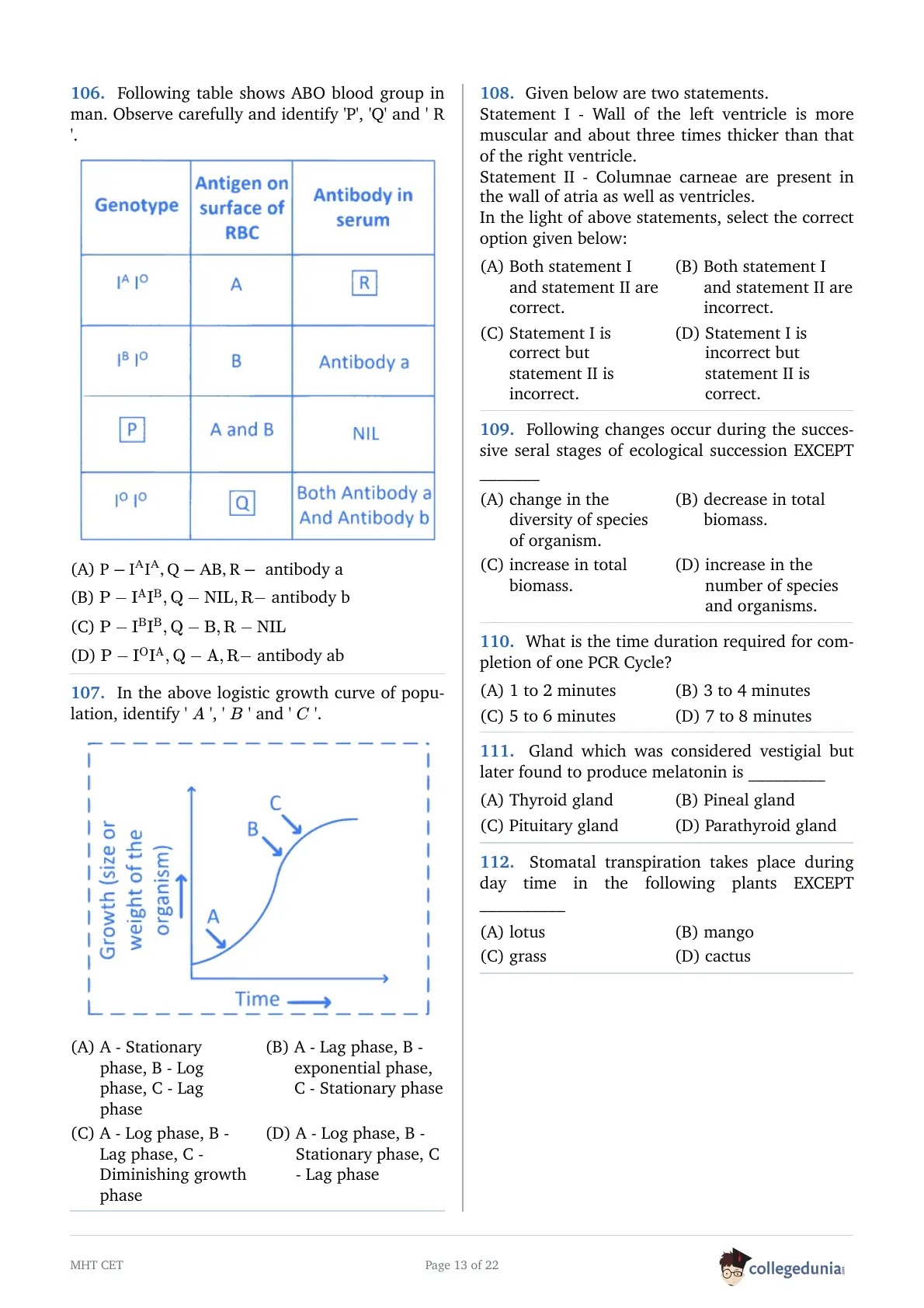
Question 106:

Following table shows ABO blood group in man. Observe carefully and identify 'P', 'Q' and ' R '.

  • (A)

    \(\mathrm{P}-\mathrm{I}^{\mathrm{A}}\mathrm{I}^{\mathrm{A}}, \mathrm{Q}-\mathrm{AB}, \mathrm{R}-\) antibody a

  • (B)

    \(\mathrm{P}-\mathrm{I}^{\mathrm{A}}\mathrm{I}^{\mathrm{B}}, \mathrm{Q}-\mathrm{NIL}, \mathrm{R}-\) antibody b

  • (C)

    \(\mathrm{P}-\mathrm{I}^{\mathrm{B}}\mathrm{I}^{\mathrm{B}}, \mathrm{Q}-\mathrm{B}, \mathrm{R}-\mathrm{NIL}\)

  • (D)

    \(\mathrm{P}-\mathrm{I}^{\mathrm{O}}\mathrm{I}^{\mathrm{A}}, \mathrm{Q}-\mathrm{A}, \mathrm{R}-\) antibody ab


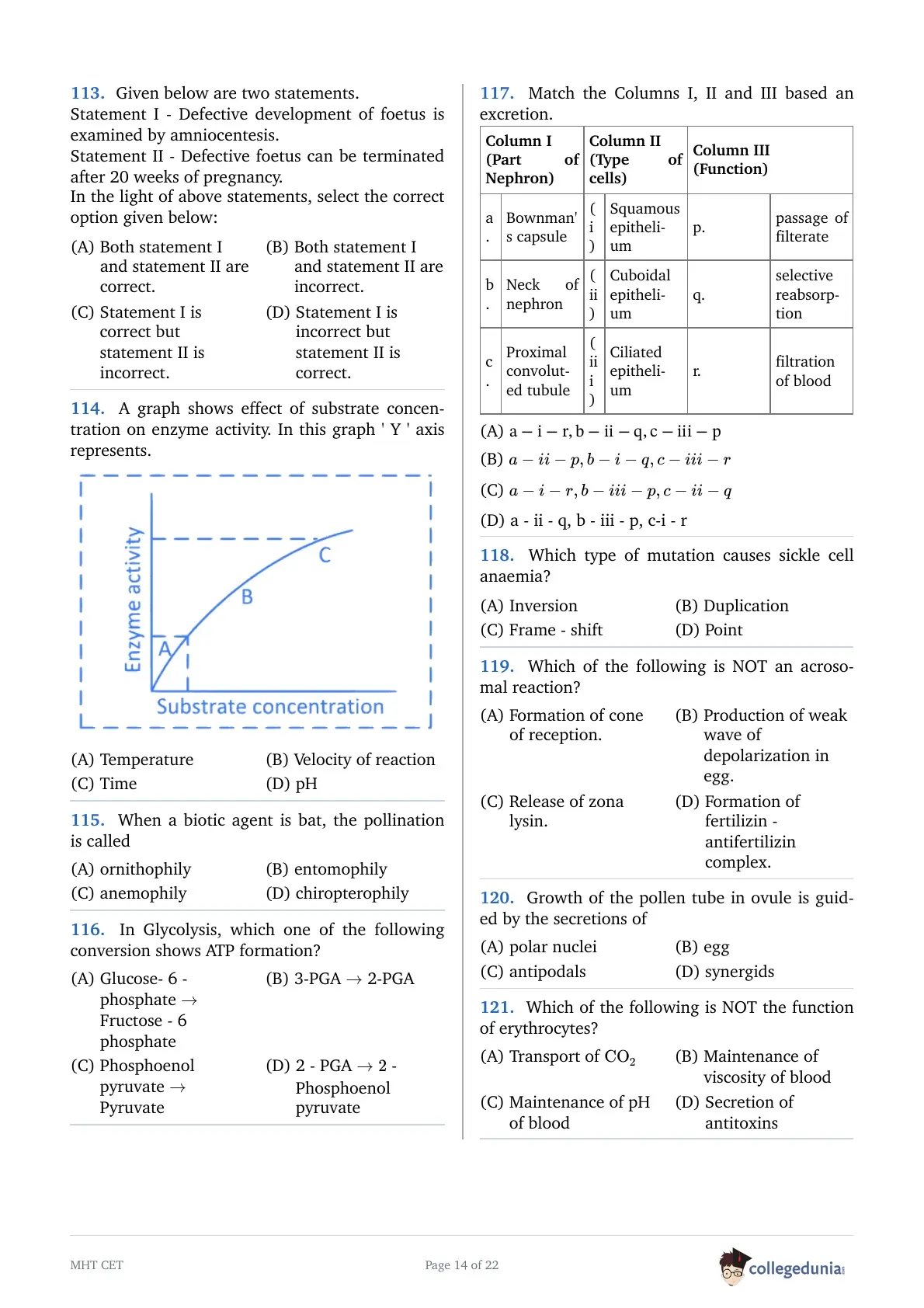
Question 107:

In the above logistic growth curve of population, identify ' \(A\) ', ' \(B\) ' and ' \(C\) '.

  • (A)

    A - Stationary phase, B - Log phase, C - Lag phase

  • (B)

    A - Lag phase, B - exponential phase, C - Stationary phase

  • (C)

    A - Log phase, B - Lag phase, C - Diminishing growth phase

  • (D)

    A - Log phase, B - Stationary phase, C - Lag phase


Question 108:

Given below are two statements.

Statement I - Wall of the left ventricle is more muscular and about three times thicker than that of the right ventricle.

Statement II - Columnae carneae are present in the wall of atria as well as ventricles.

In the light of above statements, select the correct option given below:

  • (A)

    Both statement I and statement II are correct.

  • (B)

    Both statement I and statement II are incorrect.

  • (C)

    Statement I is correct but statement II is incorrect.

  • (D)

    Statement I is incorrect but statement II is correct.


Question 109:

Following changes occur during the successive seral stages of ecological succession EXCEPT _______

  • (A)

    change in the diversity of species of organism.

  • (B)

    decrease in total biomass.

  • (C)

    increase in total biomass.

  • (D)

    increase in the number of species and organisms.


Question 110:

What is the time duration required for completion of one PCR Cycle?

  • (A)

    1 to 2 minutes

  • (B)

    3 to 4 minutes

  • (C)

    5 to 6 minutes

  • (D)

    7 to 8 minutes


Question 111:

Gland which was considered vestigial but later found to produce melatonin is _________

  • (A)

    Thyroid gland

  • (B)

    Pineal gland

  • (C)

    Pituitary gland

  • (D)

    Parathyroid gland


Question 112:

Stomatal transpiration takes place during day time in the following plants EXCEPT __________

  • (A)

    lotus

  • (B)

    mango

  • (C)

    grass

  • (D)

    cactus


Question 113:

Given below are two statements.

Statement I - Defective development of foetus is examined by amniocentesis.

Statement II - Defective foetus can be terminated after 20 weeks of pregnancy.

In the light of above statements, select the correct option given below:

  • (A)

    Both statement I and statement II are correct.

  • (B)

    Both statement I and statement II are incorrect.

  • (C)

    Statement I is correct but statement II is incorrect.

  • (D)

    Statement I is incorrect but statement II is correct.


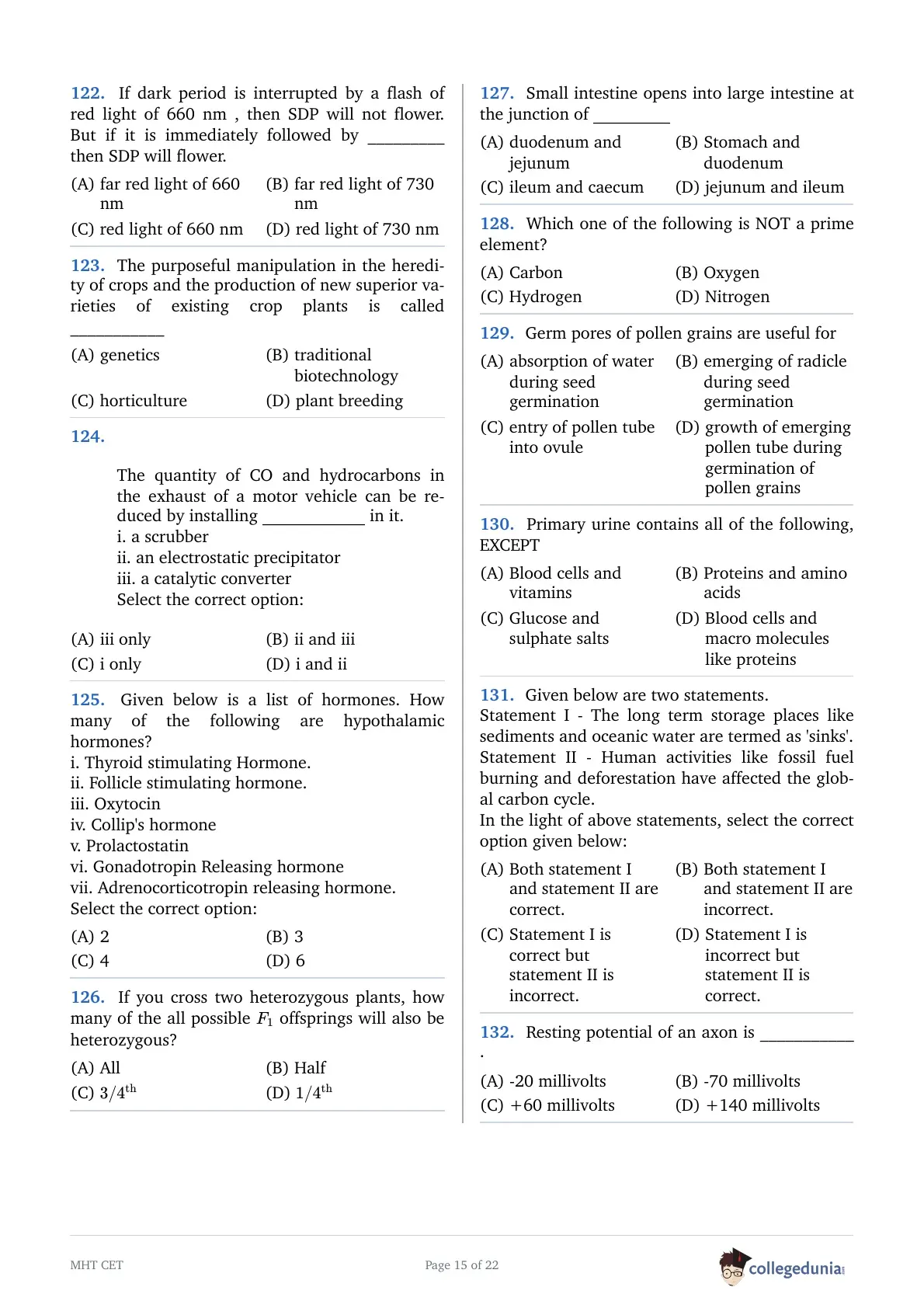
Question 114:

A graph shows effect of substrate concentration on enzyme activity. In this graph ' Y ' axis represents.

  • (A)

    Temperature

  • (B)

    Velocity of reaction

  • (C)

    Time

  • (D)

    pH


Question 115:

When a biotic agent is bat, the pollination is called

  • (A)

    ornithophily

  • (B)

    entomophily

  • (C)

    anemophily

  • (D)

    chiropterophily


Question 116:

In Glycolysis, which one of the following conversion shows ATP formation?

  • (A) Glucose- 6 - phosphate \(\rightarrow\) Fructose - 6 phosphate
  • (B) 3-PGA \(\rightarrow\) 2-PGA
  • (C) Phosphoenol pyruvate \(\rightarrow\) Pyruvate
  • (D) 2 - PGA \(\rightarrow 2\) - Phosphoenol pyruvate

Question 117:

Match the Columns I, II and III based an excretion.

Column I
(Part of Nephron)
Column II
(Type of cells)
Column III
(Function)
a.Bownman's capsule(i)Squamous epitheliump.passage of filterate
b.Neck of nephron(ii)Cuboidal epitheliumq.selective reabsorption
c.Proximal convoluted tubule(iii)Ciliated epitheliumr.filtration of blood
  • (A)

    \(\mathrm{a}-\mathrm{i}-\mathrm{r},\mathrm{b}-\mathrm{ii}-\mathrm{q},\mathrm{c}-\mathrm{iii}-\mathrm{p}\)

  • (B)

    \(a-ii-p,b-i-q,c-iii-r\)

  • (C)

    \(a-i-r,b-iii-p,c-ii-q\)

  • (D)

    a - ii - q, b - iii - p, c-i - r


Question 118:

Which type of mutation causes sickle cell anaemia?

  • (A)

    Inversion

  • (B)

    Duplication

  • (C)

    Frame - shift

  • (D)

    Point


Question 119:

Which of the following is NOT an acrosomal reaction?

  • (A)

    Formation of cone of reception.

  • (B)

    Production of weak wave of depolarization in egg.

  • (C)

    Release of zona lysin.

  • (D)

    Formation of fertilizin - antifertilizin complex.


Question 120:

Growth of the pollen tube in ovule is guided by the secretions of

  • (A)

    polar nuclei

  • (B)

    egg

  • (C)

    antipodals

  • (D)

    synergids


Question 121:

Which of the following is NOT the function of erythrocytes?

  • (A)

    Transport of \(\mathrm{CO}_{2}\)

  • (B)

    Maintenance of viscosity of blood

  • (C)

    Maintenance of pH of blood

  • (D)

    Secretion of antitoxins


Question 122:

If dark period is interrupted by a flash of red light of 660 nm , then SDP will not flower. But if it is immediately followed by _________ then SDP will flower.

  • (A)

    far red light of 660 nm

  • (B)

    far red light of 730 nm

  • (C)

    red light of 660 nm

  • (D)

    red light of 730 nm


Question 123:

The purposeful manipulation in the heredity of crops and the production of new superior varieties of existing crop plants is called ___________

  • (A)

    genetics

  • (B)

    traditional biotechnology

  • (C)

    horticulture

  • (D)

    plant breeding


Question 124:

The quantity of CO and hydrocarbons in the exhaust of a motor vehicle can be reduced by installing ____________ in it.

i. a scrubber

ii. an electrostatic precipitator

iii. a catalytic converter

Select the correct option:

  • (A)

    iii only

  • (B)

    ii and iii

  • (C)

    i only

  • (D)

    i and ii


Question 125:

Given below is a list of hormones. How many of the following are hypothalamic hormones?

i. Thyroid stimulating Hormone.

ii. Follicle stimulating hormone.

iii. Oxytocin

iv. Collip's hormone

v. Prolactostatin

vi. Gonadotropin Releasing hormone

vii. Adrenocorticotropin releasing hormone.

Select the correct option:

  • (A)

    2

  • (B)

    3

  • (C)

    4

  • (D)

    6


Question 126:

If you cross two heterozygous plants, how many of the all possible \(F_1\) offsprings will also be heterozygous?

  • (A)

    All

  • (B)

    Half

  • (C)

    \(3/4^{\text{th }}\)

  • (D)

    \(1/4^{\text{th }}\)


Question 127:

Small intestine opens into large intestine at the junction of _________

  • (A)

    duodenum and jejunum

  • (B)

    Stomach and duodenum

  • (C)

    ileum and caecum

  • (D)

    jejunum and ileum


Question 128:

Which one of the following is NOT a prime element?

  • (A)

    Carbon

  • (B)

    Oxygen

  • (C)

    Hydrogen

  • (D)

    Nitrogen


Question 129:

Germ pores of pollen grains are useful for

  • (A)

    absorption of water during seed germination

  • (B)

    emerging of radicle during seed germination

  • (C)

    entry of pollen tube into ovule

  • (D)

    growth of emerging pollen tube during germination of pollen grains


Question 130:

Primary urine contains all of the following, EXCEPT

  • (A)

    Blood cells and vitamins

  • (B)

    Proteins and amino acids

  • (C)

    Glucose and sulphate salts

  • (D)

    Blood cells and macro molecules like proteins


Question 131:

Given below are two statements.

Statement I - The long term storage places like sediments and oceanic water are termed as 'sinks'.

Statement II - Human activities like fossil fuel burning and deforestation have affected the global carbon cycle.

In the light of above statements, select the correct option given below:

  • (A)

    Both statement I and statement II are correct.

  • (B)

    Both statement I and statement II are incorrect.

  • (C)

    Statement I is correct but statement II is incorrect.

  • (D)

    Statement I is incorrect but statement II is correct.


Question 132:

Resting potential of an axon is ___________ .

  • (A)

    -20 millivolts

  • (B)

    -70 millivolts

  • (C)

    +60 millivolts

  • (D)

    +140 millivolts


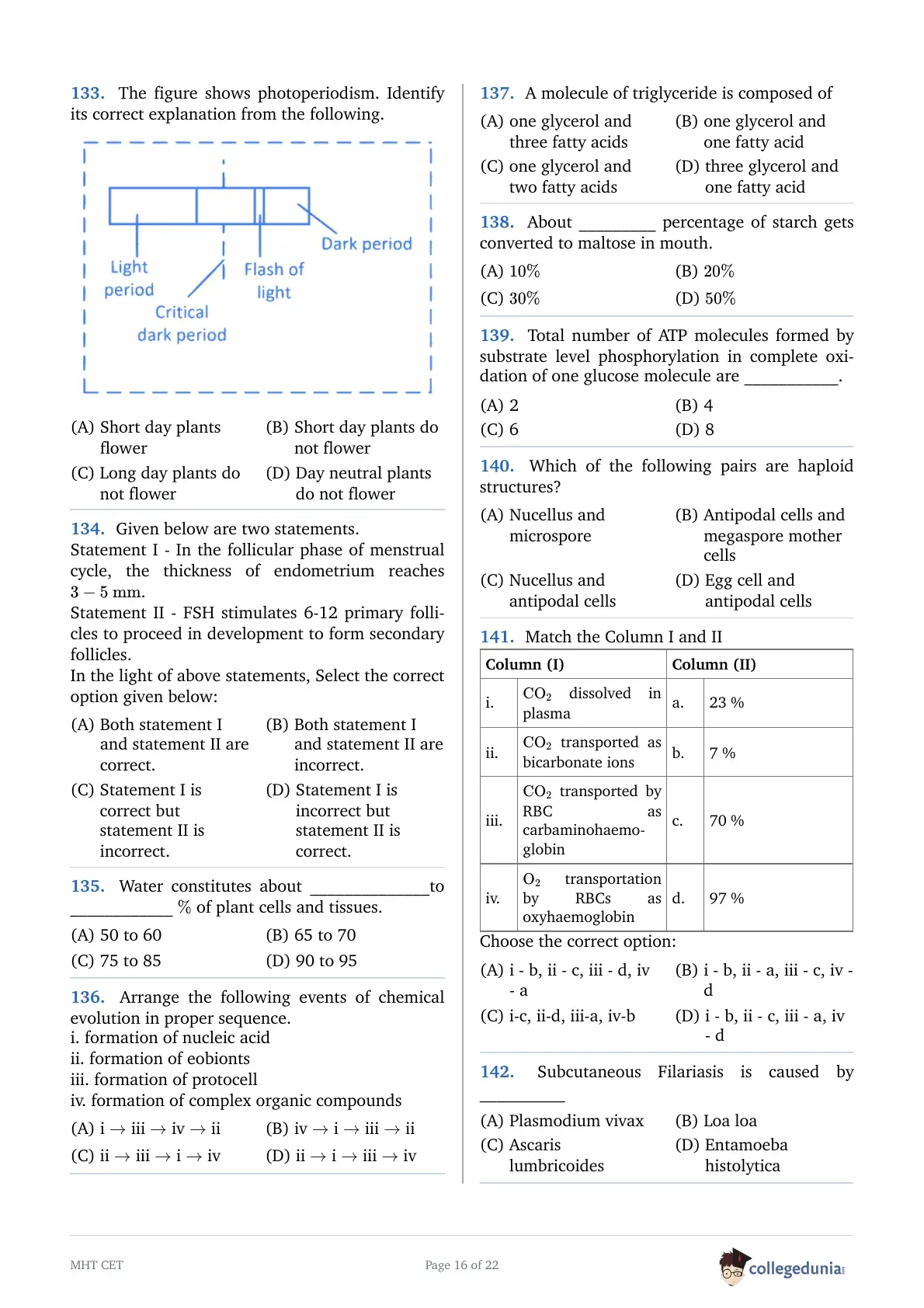
Question 133:

The figure shows photoperiodism. Identify its correct explanation from the following.

  • (A)

    Short day plants flower

  • (B)

    Short day plants do not flower

  • (C)

    Long day plants do not flower

  • (D)

    Day neutral plants do not flower


Question 135:

Water constitutes about ______________to ____________ \(\%\) of plant cells and tissues.

  • (A)

    50 to 60

  • (B)

    65 to 70

  • (C)

    75 to 85

  • (D)

    90 to 95


Question 136:

Arrange the following events of chemical evolution in proper sequence.

i. formation of nucleic acid

ii. formation of eobionts

iii. formation of protocell

iv. formation of complex organic compounds

  • (A)

    i \(\rightarrow\) iii \(\rightarrow\) iv \(\rightarrow\) ii

  • (B)

    iv \(\rightarrow\) i \(\rightarrow\) iii \(\rightarrow\) ii

  • (C)

    ii \(\rightarrow\) iii \(\rightarrow\) i \(\rightarrow\) iv

  • (D)

    ii \(\rightarrow\) i \(\rightarrow\) iii \(\rightarrow\) iv


Question 137:

A molecule of triglyceride is composed of

  • (A)

    one glycerol and three fatty acids

  • (B)

    one glycerol and one fatty acid

  • (C)

    one glycerol and two fatty acids

  • (D)

    three glycerol and one fatty acid


Question 138:

About _________ percentage of starch gets converted to maltose in mouth.

  • (A)

    \(10\%\)

  • (B)

    \(20\%\)

  • (C)

    \(30\%\)

  • (D)

    \(50\%\)


Question 139:

Total number of ATP molecules formed by substrate level phosphorylation in complete oxidation of one glucose molecule are ___________.

  • (A)

    2

  • (B)

    4

  • (C)

    6

  • (D)

    8


Question 140:

Which of the following pairs are haploid structures?

  • (A)

    Nucellus and microspore

  • (B)

    Antipodal cells and megaspore mother cells

  • (C)

    Nucellus and antipodal cells

  • (D)

    Egg cell and antipodal cells


Question 141:

Match the Column I and II

Column (I)Column (II)
i.\(\mathrm{CO}_2\) dissolved in plasmaa.23 %
ii.\(\mathrm{CO}_2\) transported as bicarbonate ionsb.7 %
iii.\(\mathrm{CO}_2\) transported by RBC as carbaminohaemoglobinc.70 %
iv.\(\mathrm{O}_2\) transportation by RBCs as oxyhaemoglobind.97 %
  • (A)

    i - b, ii - c, iii - d, iv - a

  • (B)

    i - b, ii - a, iii - c, iv - d

  • (C)

    i-c, ii-d, iii-a, iv-b

  • (D)

    i - b, ii - c, iii - a, iv - d


Question 142:

Subcutaneous Filariasis is caused by __________

  • (A)

    Plasmodium vivax

  • (B)

    Loa loa

  • (C)

    Ascaris lumbricoides

  • (D)

    Entamoeba histolytica


Question 143:

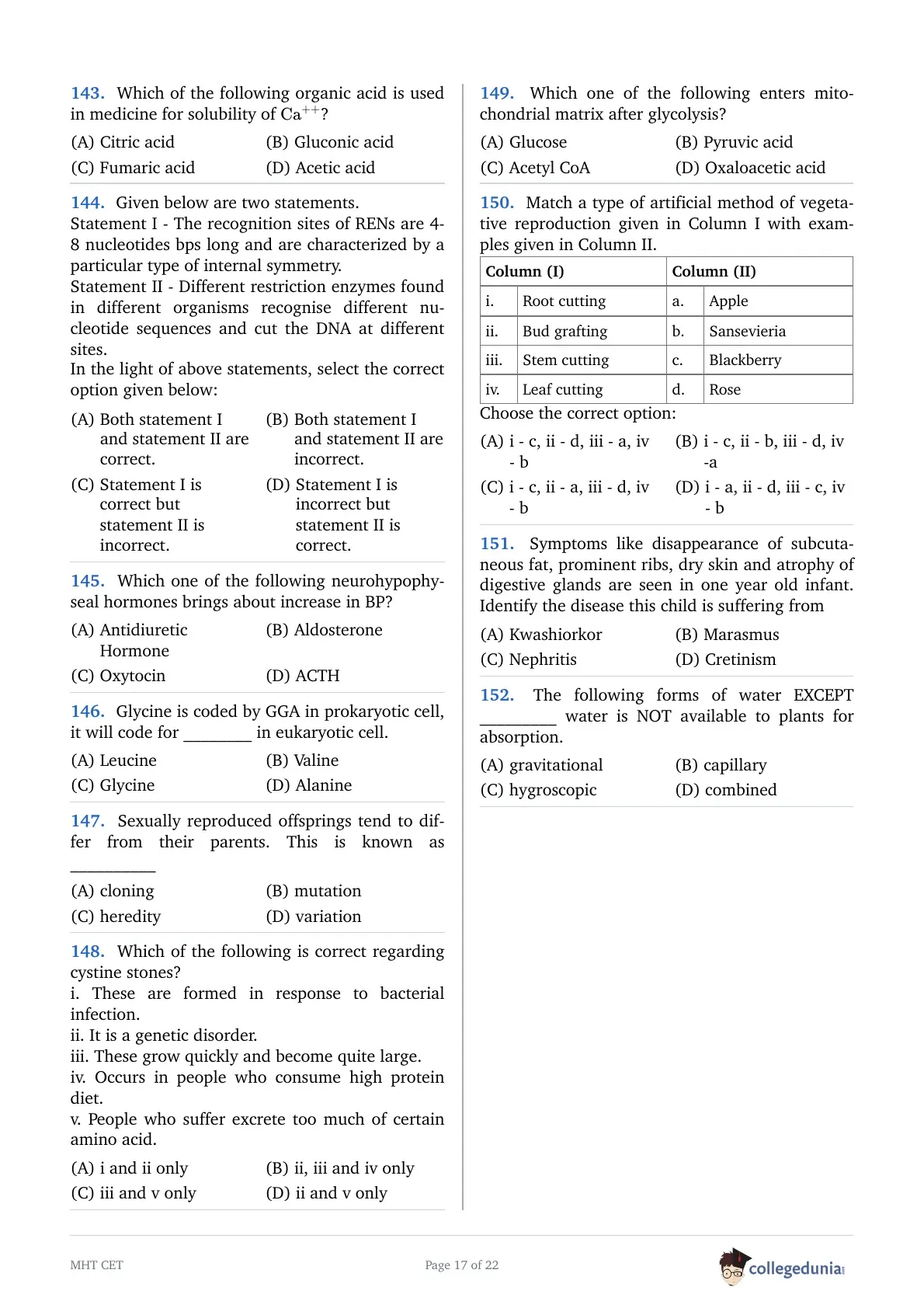
Which of the following organic acid is used in medicine for solubility of \(\mathrm{Ca}^{++}\)?

  • (A)

    Citric acid

  • (B)

    Gluconic acid

  • (C)

    Fumaric acid

  • (D)

    Acetic acid


Question 144:

Given below are two statements.

Statement I - The recognition sites of RENs are 4-8 nucleotides bps long and are characterized by a particular type of internal symmetry.

Statement II - Different restriction enzymes found in different organisms recognise different nucleotide sequences and cut the DNA at different sites.

In the light of above statements, select the correct option given below:

  • (A)

    Both statement I and statement II are correct.

  • (B)

    Both statement I and statement II are incorrect.

  • (C)

    Statement I is correct but statement II is incorrect.

  • (D)

    Statement I is incorrect but statement II is correct.


Question 145:

Which one of the following neurohypophyseal hormones brings about increase in BP?

  • (A)

    Antidiuretic Hormone

  • (B)

    Aldosterone

  • (C)

    Oxytocin

  • (D)

    ACTH


Question 146:

Glycine is coded by GGA in prokaryotic cell, it will code for ________ in eukaryotic cell.

  • (A)

    Leucine

  • (B)

    Valine

  • (C)

    Glycine

  • (D)

    Alanine


Question 147:

Sexually reproduced offsprings tend to differ from their parents. This is known as __________

  • (A)

    cloning

  • (B)

    mutation

  • (C)

    heredity

  • (D)

    variation


Question 148:

Which of the following is correct regarding cystine stones?

i. These are formed in response to bacterial infection.

ii. It is a genetic disorder.

iii. These grow quickly and become quite large.

iv. Occurs in people who consume high protein diet.

v. People who suffer excrete too much of certain amino acid.

  • (A)

    i and ii only

  • (B)

    ii, iii and iv only

  • (C)

    iii and v only

  • (D)

    ii and v only


Question 149:

Which one of the following enters mitochondrial matrix after glycolysis?

  • (A)

    Glucose

  • (B)

    Pyruvic acid

  • (C)

    Acetyl CoA

  • (D)

    Oxaloacetic acid


Question 150:

Match a type of artificial method of vegetative reproduction given in Column I with examples given in Column II.

Column (I)Column (II)
i.Root cuttinga.Apple
ii.Bud graftingb.Sansevieria
iii.Stem cuttingc.Blackberry
iv.Leaf cuttingd.Rose
  • (A)

    i - c, ii - d, iii - a, iv - b

  • (B)

    i - c, ii - b, iii - d, iv -a

  • (C)

    i - c, ii - a, iii - d, iv - b

  • (D)

    i - a, ii - d, iii - c, iv - b


Question 151:

Symptoms like disappearance of subcutaneous fat, prominent ribs, dry skin and atrophy of digestive glands are seen in one year old infant. Identify the disease this child is suffering from

  • (A)

    Kwashiorkor

  • (B)

    Marasmus

  • (C)

    Nephritis

  • (D)

    Cretinism


Question 152:

The following forms of water EXCEPT _________ water is NOT available to plants for absorption.

  • (A)

    gravitational

  • (B)

    capillary

  • (C)

    hygroscopic

  • (D)

    combined


Question 153:

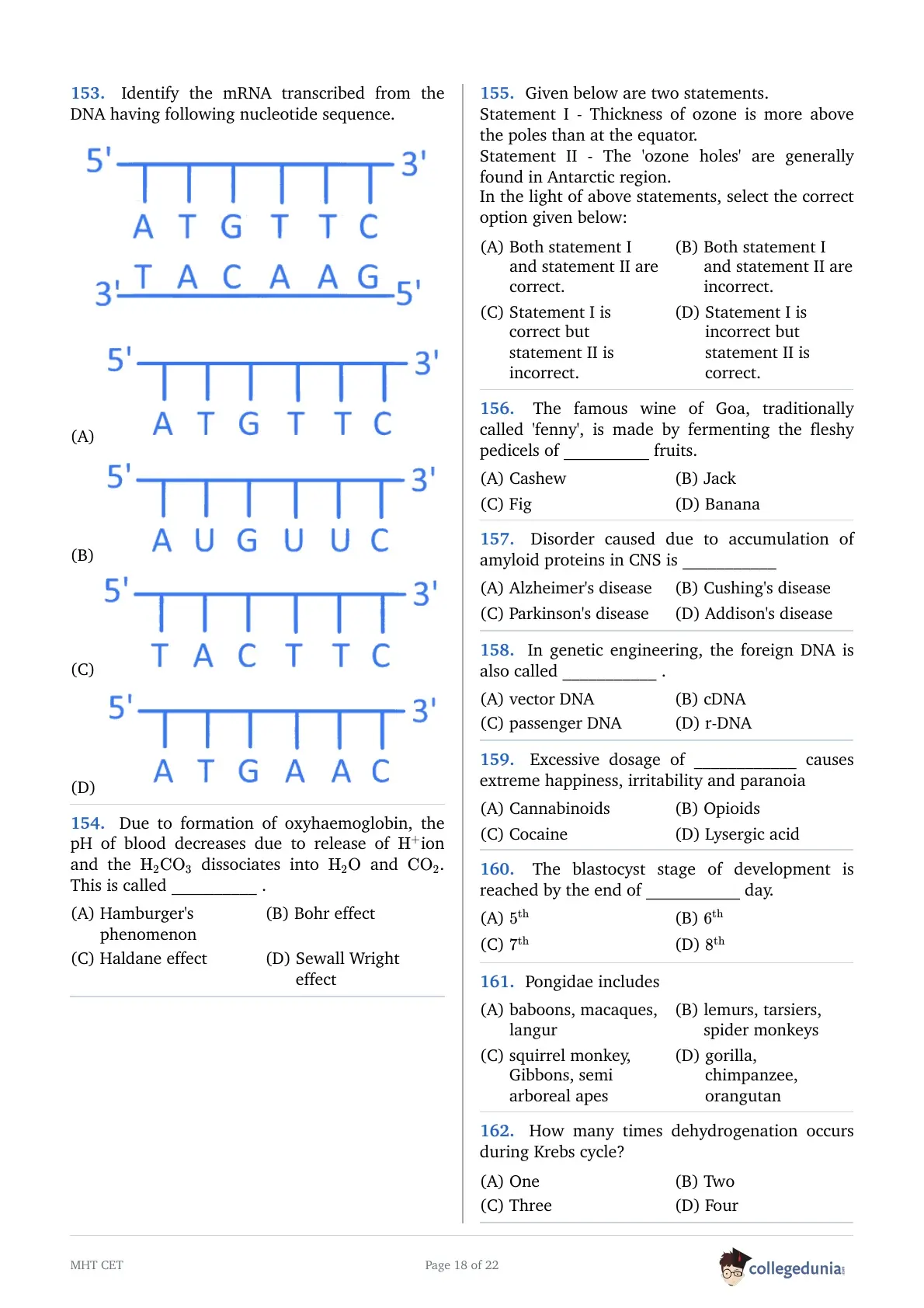
Identify the mRNA transcribed from the DNA having following nucleotide sequence.

  • (A)
  • (B)
  • (C)
  • (D)

Question 154:

Due to formation of oxyhaemoglobin, the pH of blood decreases due to release of \(\mathrm{H}^{+}\)ion and the \(\mathrm{H}_2 \mathrm{CO}_3\) dissociates into \(\mathrm{H}_2 \mathrm{O}\) and \(\mathrm{CO}_2\). This is called __________ .

  • (A)

    Hamburger's phenomenon

  • (B)

    Bohr effect

  • (C)

    Haldane effect

  • (D)

    Sewall Wright effect


Question 155:

Given below are two statements.

Statement I - Thickness of ozone is more above the poles than at the equator.

Statement II - The 'ozone holes' are generally found in Antarctic region.

In the light of above statements, select the correct option given below:

  • (A)

    Both statement I and statement II are correct.

  • (B)

    Both statement I and statement II are incorrect.

  • (C)

    Statement I is correct but statement II is incorrect.

  • (D)

    Statement I is incorrect but statement II is correct.


Question 156:

The famous wine of Goa, traditionally called 'fenny', is made by fermenting the fleshy pedicels of __________ fruits.

  • (A)

    Cashew

  • (B)

    Jack

  • (C)

    Fig

  • (D)

    Banana


Question 157:

Disorder caused due to accumulation of amyloid proteins in CNS is ___________

  • (A)

    Alzheimer's disease

  • (B)

    Cushing's disease

  • (C)

    Parkinson's disease

  • (D)

    Addison's disease


Question 158:

In genetic engineering, the foreign DNA is also called ___________ .

  • (A)

    vector DNA

  • (B)

    cDNA

  • (C)

    passenger DNA

  • (D)

    r-DNA


Question 159:

Excessive dosage of ____________ causes extreme happiness, irritability and paranoia

  • (A)

    Cannabinoids

  • (B)

    Opioids

  • (C)

    Cocaine

  • (D)

    Lysergic acid


Question 160:

The blastocyst stage of development is reached by the end of ___________ day.

  • (A)

    \(5^{\text{th }}\)

  • (B)

    \(6^{\text{th }}\)

  • (C)

    \(7^{\text{th }}\)

  • (D)

    \(8^{\text{th }}\)


Question 161:

Pongidae includes \(\qquad\)

  • (A)

    baboons, macaques, langur

  • (B)

    lemurs, tarsiers, spider monkeys

  • (C)

    squirrel monkey, Gibbons, semi arboreal apes

  • (D)

    gorilla, chimpanzee, orangutan


Question 162:

How many times dehydrogenation occurs during Krebs cycle?

  • (A)

    One

  • (B)

    Two

  • (C)

    Three

  • (D)

    Four


Question 163:

Which of the following covering of testis originates from peritoneum?

  • (A)

    Tunica adventitia

  • (B)

    Tunica albuginea

  • (C)

    Tunica vaginalis

  • (D)

    Tunica vasculosa


Question 164:

In a dihybrid cross, \(9: 3: 3: 1\) ratio, denotes that ___________.

  • (A)

    it is a polygenic inheritance

  • (B)

    alleles of two genes are linked to each other

  • (C)

    alleles of two genes are segregated independently

  • (D)

    it is a case of multiple alleles


Question 165:

How does the Hb act as buffer?

  • (A)

    By forming \(\mathrm{HbCO}_{2}\)

  • (B)

    By forming HHb

  • (C)

    By forming \(\mathrm{NaHCO}_{3}\)

  • (D)

    By forming \(\mathrm{HbO}_{2}\)


Question 166:

Which one of the following genetically engineered microorganisms, used for clearing oil spills in the sea, was given first biopatent?

  • (A)

    E. coli

  • (B)

    Pseudomonas

  • (C)

    Agrobacterium

  • (D)

    Bacillus


Question 167:

The current loss of biodiversity which is progressing at an alarming rate is estimated to be ________ to __________ times faster than prehuman times.

  • (A)

    10 to 100

  • (B)

    50 to 100

  • (C)

    100 to 1000

  • (D)

    1000 to 10000


Question 168:

Which of the following statements is INCORRECT regarding macula lutea?

  • (A)

    It has fovea centralis at its centre.

  • (B)

    It has maximum density of cone cells.

  • (C)

    It is the area of retina from where optic nerve leaves the eyeball.

  • (D)

    It is a place of formation of sharpest vision.


Question 169:

Spores of which one of the microbial biocontrol agents are used to get rid of butterfly?

  • (A)

    Beauveria bassiana

  • (B)

    Entomophthora pallidaroseum

  • (C)

    Zoopthora radicans

  • (D)

    Bacillus thuringiensis


Question 170:

In oliguria condition, urine output is less than ___________.

  • (A)

    400 ml /day

  • (B)

    800 ml /day

  • (C)

    \(1000\mathrm{ml}/\) day

  • (D)

    1200 ml /day


Question 172:

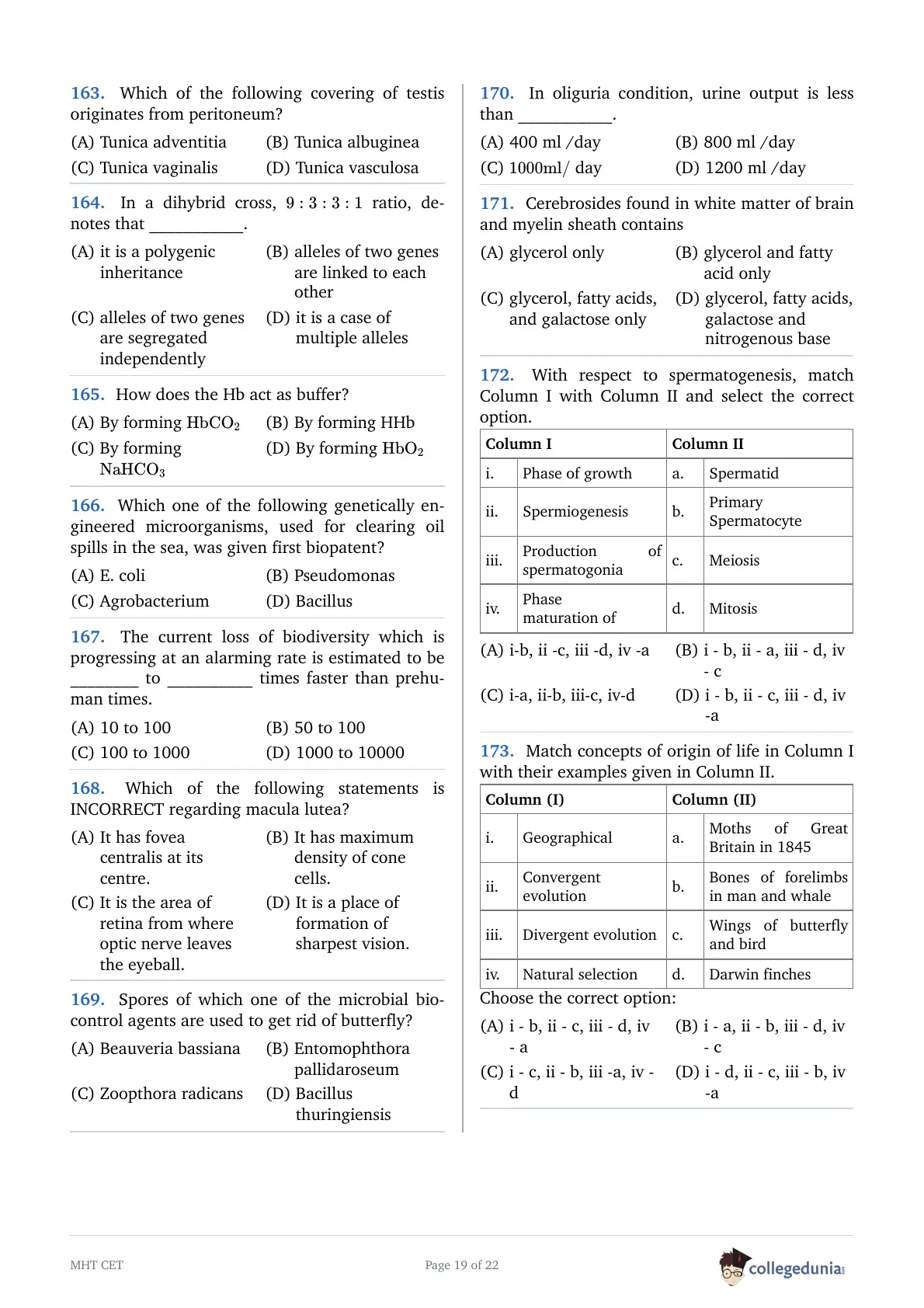
With respect to spermatogenesis, match Column I with Column II and select the correct option.

Column IColumn II
i.Phase of growtha.Spermatid
ii.Spermiogenesisb.Primary Spermatocyte
iii.Production of spermatogoniac.Meiosis
iv.Phase
maturation of
d.Mitosis
  • (A)

    i-b, ii -c, iii -d, iv -a

  • (B)

    i - b, ii - a, iii - d, iv - c

  • (C)

    i-a, ii-b, iii-c, iv-d

  • (D)

    i - b, ii - c, iii - d, iv -a


Question 173:

Match concepts of origin of life in Column I with their examples given in Column II.

Column (I)Column (II)
i.Geographicala.Moths of Great Britain in 1845
ii.Convergent evolutionb.Bones of forelimbs in man and whale
iii.Divergent evolutionc.Wings of butterfly and bird
iv.Natural selectiond.Darwin finches
  • (A)

    i - b, ii - c, iii - d, iv - a

  • (B)

    i - a, ii - b, iii - d, iv - c

  • (C)

    i - c, ii - b, iii -a, iv -d

  • (D)

    i - d, ii - c, iii - b, iv -a


Question 174:

Which one of the following represents qualitative growth in plants?

  • (A)

    Increase in dry weight

  • (B)

    Increase in number of cells

  • (C)

    Differentiation of cells

  • (D)

    Increase in volume


Question 175:

The smallest WBC is __________.

  • (A)

    neutrophil

  • (B)

    basophil

  • (C)

    monocyte

  • (D)

    lymphocyte


Question 176:

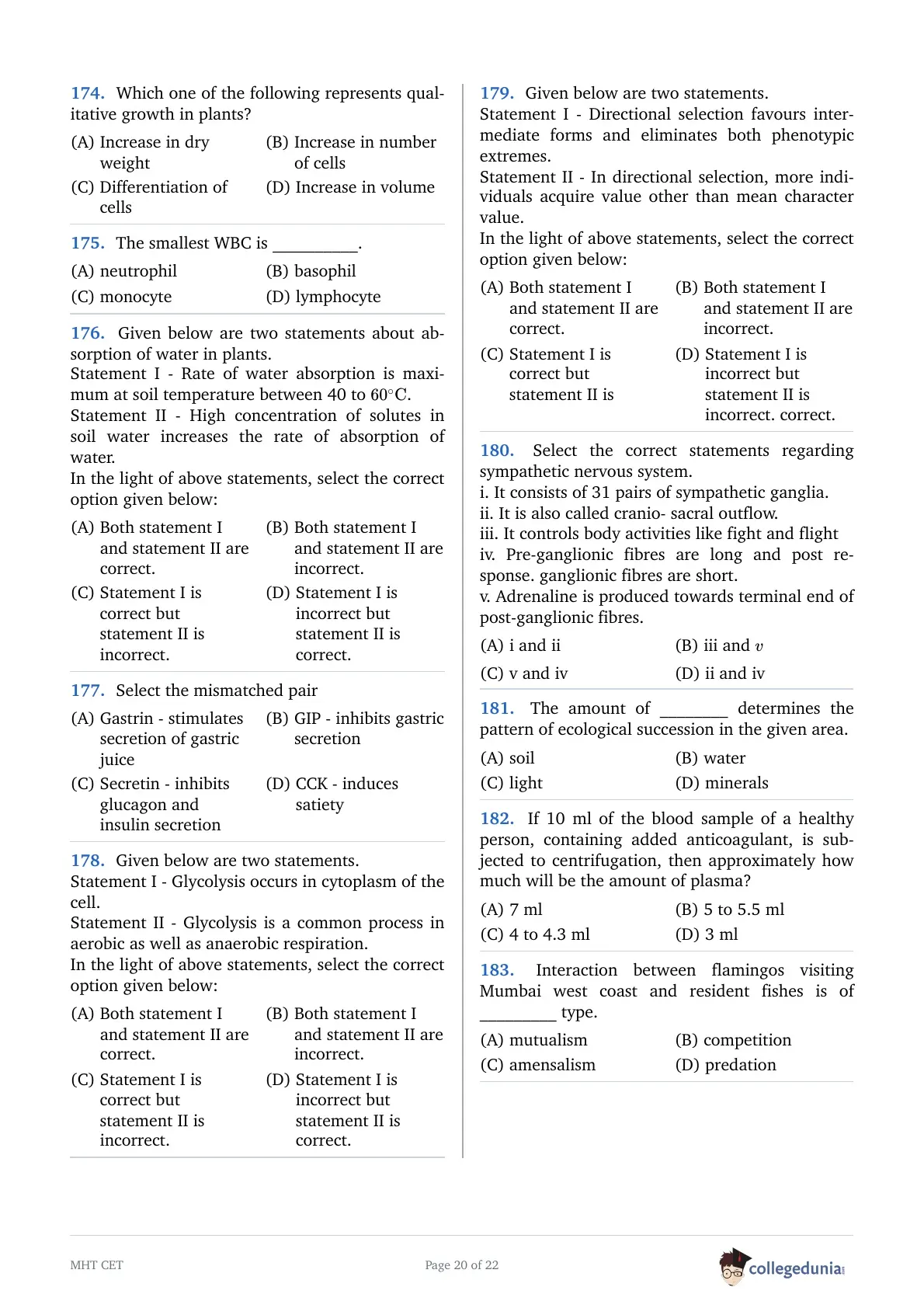
Given below are two statements about absorption of water in plants.

Statement I - Rate of water absorption is maximum at soil temperature between 40 to \(60^{\circ} \mathrm{C}\).

Statement II - High concentration of solutes in soil water increases the rate of absorption of water.

In the light of above statements, select the correct option given below:

  • (A)

    Both statement I and statement II are correct.

  • (B)

    Both statement I and statement II are incorrect.

  • (C)

    Statement I is correct but statement II is incorrect.

  • (D)

    Statement I is incorrect but statement II is correct.


Question 177:

Select the mismatched pair

  • (A)

    Gastrin - stimulates secretion of gastric juice

  • (B)

    GIP - inhibits gastric secretion

  • (C)

    Secretin - inhibits glucagon and insulin secretion

  • (D)

    CCK - induces satiety


Question 178:

Given below are two statements.

Statement I - Glycolysis occurs in cytoplasm of the cell.

Statement II - Glycolysis is a common process in aerobic as well as anaerobic respiration.

In the light of above statements, select the correct option given below:

  • (A)

    Both statement I and statement II are correct.

  • (B)

    Both statement I and statement II are incorrect.

  • (C)

    Statement I is correct but statement II is incorrect.

  • (D)

    Statement I is incorrect but statement II is correct.


Question 179:

Given below are two statements.

Statement I - Directional selection favours intermediate forms and eliminates both phenotypic extremes.

Statement II - In directional selection, more individuals acquire value other than mean character value.

In the light of above statements, select the correct option given below:

  • (A)

    Both statement I and statement II are correct.

  • (B)

    Both statement I and statement II are incorrect.

  • (C)

    Statement I is correct but statement II is

  • (D)

    Statement I is incorrect but statement II is incorrect. correct.


Question 180:

Select the correct statements regarding sympathetic nervous system.

i. It consists of 31 pairs of sympathetic ganglia.

ii. It is also called cranio- sacral outflow.

iii. It controls body activities like fight and flight

iv. Pre-ganglionic fibres are long and post response. ganglionic fibres are short.

v. Adrenaline is produced towards terminal end of post-ganglionic fibres.

  • (A)

    i and ii

  • (B)

    iii and \(v\)

  • (C)

    v and iv

  • (D)

    ii and iv


Question 181:

The amount of ________ determines the pattern of ecological succession in the given area.

  • (A)

    soil

  • (B)

    water

  • (C)

    light

  • (D)

    minerals


Question 182:

If 10 ml of the blood sample of a healthy person, containing added anticoagulant, is subjected to centrifugation, then approximately how much will be the amount of plasma?

  • (A)

    7 ml

  • (B)

    5 to 5.5 ml

  • (C)

    4 to 4.3 ml

  • (D)

    3 ml


Question 183:

Interaction between flamingos visiting Mumbai west coast and resident fishes is of _________ type.

  • (A)

    mutualism

  • (B)

    competition

  • (C)

    amensalism

  • (D)

    predation


Question 184:

Following are the limitations of ecological pyramids EXCEPT __________ .

  • (A)

    it does not accommodate a food web.

  • (B)

    it shows relationship between the organism of trophic level.

  • (C)

    it assumes a simple food chain that never existed.

  • (D)

    saprophytes are not given any place.


Question 185:

Which one of the following hormones is a modified amino acid?

  • (A)

    Thyroxine

  • (B)

    Oxytocin

  • (C)

    Estrogen

  • (D)

    Parathormone


Question 187:

Which of the following pairs of organisms are ureotelic?

  • (A)

    Sharks and rays.

  • (B)

    Aquatic reptiles and Osteichthyes.

  • (C)

    Adult amphibians and land snails.

  • (D)

    Birds and mammals.


Question 188:

The core DNA in the nucleosome is _________ base pairs long

  • (A)

    126

  • (B)

    146

  • (C)

    176

  • (D)

    200


Question 189:

Match the concepts given in Column I with their scientist who proposed them given in Column II.

Column (I)Column (II)
i.Osmotic absorptiona.Bohem
ii.Non-osmotic absorptionb.Dixon and Jolly
iii.Capillarity theoryc.Atkins and Priestley
iv.Cohesion- tension theoryd.Kramer and Thiman
  • (A)

    i - c, ii - d, iii - a, iv - b

  • (B)

    i - c, ii - a, iii - b, iv - d

  • (C)

    i-a, ii-b, iii-d, iv-c

  • (D)

    i - d, ii - c, iii - a, iv - b


Question 190:

Darwin's finches are good example of ____________

  • (A)

    connecting link

  • (B)

    adaptive radiation

  • (C)

    convergent evolution

  • (D)

    industrial melanism


Question 191:

If the sequence of gene loci on a chromosome are A-B-C-D-E-O-T. Which of the following gene pair will have least probability of being inherited together?

  • (A)

    C and D

  • (B)

    A and T

  • (C)

    A and B

  • (D)

    \(\mathrm{O}\) and T


Question 192:

Given below are two statements.

Statement I - The pituitary gland is situated in sella turcica of palate bone.

Statement II - The pituitary gland is attached to the hypothalamus by a hypophyseal stalk.

In the light of above statements, select the correct option given below:

  • (A)

    Both statement I and statement II are correct.

  • (B)

    Both statement I and statement II are incorrect.

  • (C)

    Statement I is correct but statement II is incorrect.

  • (D)

    Statement I is incorrect but statement II is correct.


Question 194:

Which one of the following is INCORRECT regarding 'resource partitioning'?

  • (A)

    It occurs when two species compete for same resources.

  • (B)

    Competition can be avoided by choosing different times for feeding.

  • (C)

    It promotes co-existence.

  • (D)

    It works on exclusion principle.


Question 195:

Which one of the following is NOT a traditional knowledge passed down through generations?

  • (A)

    Farming practices

  • (B)

    Conservation of biological diversity

  • (C)

    Biologically important medicines

  • (D)

    Use of genetically engineered microorganism for cleaning oil spills.


Question 196:

Match the Column I with Column II with reference to biomagnification of DDT.

Column (I)
(Organism)
Column (II)
(DDT content)
i.Small fishesa.0.04 ppm
ii.Fish eating Birds of Preyb.0.5 ppm
iii.Large fishesc.25 ppm
iv.Zooplanktond.2.ppm
  • (A)

    i-b, ii -d, iii -c, iv -a

  • (B)

    i-b, ii -c, iii -d, iv -a

  • (C)

    i-c, ii-b, iii-a, iv-d

  • (D)

    i-d, ii -b, iii - c, iv -a


Question 197:

Which one of the following plant hormones does NOT prevent abscission in plants?

  • (A)

    Auxin

  • (B)

    Gibberellin

  • (C)

    Cytokinin

  • (D)

    Ethylene


Question 198:

Match the Column I with Column II.

Column (I)
(Parasite)
Column (II)
(Host)
i.Ticksa.Marine fish
ii.Copepodsb.Dog
iii.Cuscutac.Indian crow
iv.Asian Koeld.Hedge plants
  • (A)

    i-b, ii-a, iii-c, iv-d

  • (B)

    i - b, ii - a, iii - d, iv - c

  • (C)

    \(\mathrm{i}-\mathrm{b},\mathrm{ii}-\mathrm{c},\mathrm{iii}-\mathrm{d},\mathrm{iv}-\mathrm{a}\)

  • (D)

    i - b, ii - d, iii - c, iv -a


Question 199:

Identify P and Q regions in the diagram of histology of alimentary canal and identify the type of tissue.

  • (A)

    \(\mathrm{P}\) - Submucosa - loose connective tissue Q - Circular muscle layer - Smooth muscles

  • (B)

    P -Mucosa-Mesothelium

    Q - Muscularis - Straited muscles

  • (C)

    P-Serosa- Squamous epithelium

    Q - Muscularis - Smooth muscles

  • (D)

    P -Mucosa-epithelium with microvilli

    Q - Longitudinal muscle layer - Striated muscles


Question 200:

Which one of the following is NOT a cyanobacterial biofertilizer?

  • (A)

    Anabaena

  • (B)

    Nostoc

  • (C)

    Oscillatoria

  • (D)

    Rhizobium

MHT CET 2025 PCB Exam Pattern and Marking Scheme

Parameter Details
Conducting Body Maharashtra Common Entrance Test Cell (Maharashtra CET Cell)
Exam Mode Online (Computer-Based Test)
Duration 180 minutes (3 hours)
Groups / Subjects PCB (Physics, Chemistry, Biology) for Pharmacy and Agriculture
Total Questions

200

Total Marks 200
Question Type Multiple Choice Questions (MCQs)
Marking Scheme 1 mark for each correct answer
Negative Marking No
Syllabus Weightage
  • Class 12 – 80%
  • Class 11 – 20%